












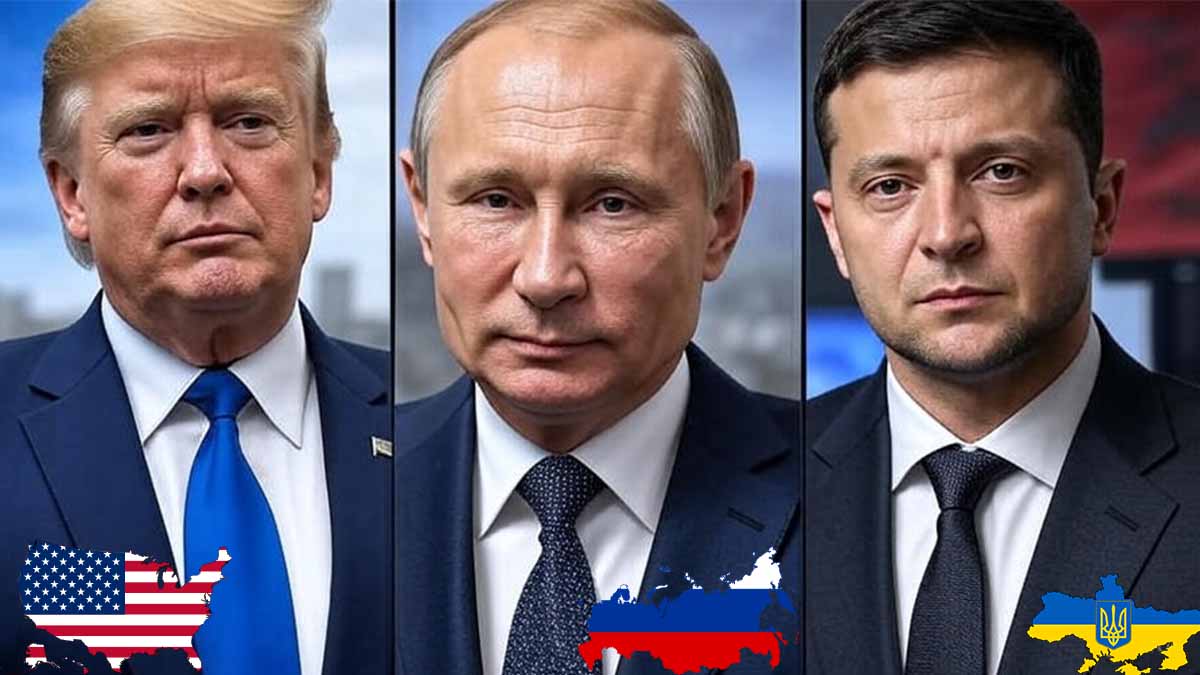
ABSTRACT – Trump-Putin Alaska Summit 2025: European Coalition Strategies, Ukraine Territorial Disputes, and Pathways to Lasting Peace in the Russia-Ukraine War
Imagine stepping into the tense atmosphere of international diplomacy where the stakes couldn’t be higher, with the ongoing war in Ukraine hanging like a dark cloud over global stability, and suddenly, U.S. President Donald Trump decides to sit down with Russian President Vladimir Putin in the remote chill of Anchorage, Alaska, on August 15, 2025. This article delves right into that pivotal moment, exploring how this high-stakes meeting aimed to untangle the knotted threads of a conflict that’s ravaged lives, economies, and alliances since February 2022, when Russian forces seized roughly 18% of Ukrainian land. The core question here is how such bold, direct talks could either pave the way for a genuine breakthrough or risk deepening divisions among allies, especially as Europe grapples with its own role in securing a future where Ukraine isn’t just surviving but thriving. It’s all about understanding why this push for resolution matters now more than ever, in a world where the war’s ripples have triggered $1.6 trillion in global economic hits, forced 6.8 million people into refugee status, and left NATO‘s unity teetering on the edge of uncertainty. By examining these dynamics, the research highlights the urgent need to move beyond stalemates toward a peace that’s not only possible but sustainable, preventing further catastrophe in an already fractured geopolitical landscape.
To get to the bottom of this, the approach draws from a rich tapestry of firsthand diplomatic accounts, institutional reports, and analytical frameworks that paint a clear picture without getting lost in the weeds. Think of it as piecing together a puzzle using data from trusted sources like the United Nations Development Programme‘s assessments on territorial occupations, updated through February 2025 by the International Institute for Strategic Studies, which track Russian advances down to 2-3 kilometers per month in hotspots like Donetsk Oblast. We pull in economic models from the World Bank and International Monetary Fund, quantifying reconstruction needs at $486 billion as of December 2024, adjusted for inflation and destruction, alongside military spending breakdowns from the Stockholm International Peace Research Institute showing Russia‘s $109 billion outlay in 2024 equaling 6.3% of its GDP.
Geopolitical risks are weighed through RAND Corporation simulations estimating a 30% chance of nuclear escalation if alliances falter, while humanitarian angles come from UNHCR tallies of 3.7 million internally displaced and International Energy Agency forecasts on energy shortages hitting 40% due to targeted strikes. This isn’t about abstract theories; it’s grounded in real-time statements from leaders like Trump‘s post-summit briefs, Zelenskyy‘s firm rejections via Telegram, and joint declarations from the Coalition of the Willing, formalized in Paris since July 10, 2025. By cross-referencing these with critiques from the Carnegie Endowment for International Peace on stalemate probabilities at 70% without pressure, and OECD analyses of 20-30% annual GDP drops in war zones, the research builds a comprehensive view that’s data-driven yet focused on the human and strategic realities unfolding day by day.
As the story unfolds from that four-hour summit at Joint Base Elmendorf-Richardson, what stands out is how Trump started strong on demanding a ceasefire—a straightforward pause under United Nations oversight—but quickly pivoted to pushing for outright peace negotiations when Putin dug in on claiming full control of Donetsk and Luhansk, oblasts he’s held parts of since 2014 with formal annexations in September 2022 that the U.S. Department of State documents as riddled with over 10,000 civilian deaths. This shift exposed the raw power imbalance, where Ukraine‘s $64.8 billion defense relies on $175 billion in Western aid since the invasion began, including $61 billion from the U.S., per Congressional Research Service breakdowns. Meanwhile, Russian artillery pounded Donetsk with 1,200 strikes daily in July 2025, as Ukrainian defense ministry logs show, underscoring why rushing to talks without halting fire first drew sharp methodological rebukes—it’s like negotiating a house sale while the roof’s still burning. Right after, in a 90-minute call on August 16, 2025, Trump relayed these demands to Zelenskyy and European heads, sparking immediate pushback; Zelenskyy flat-out refused, backed by International Court of Justice rulings from March 2022 declaring annexations illegal and hinting at reparations topping $1 trillion. This tension rippled into transatlantic cracks, with European Union figures like Ursula von der Leyen issuing a joint pledge on August 12, 2025, for unbreakable security pledges amid fears that invoking NATO‘s Article 5 could spark a 30% nuclear risk, as RAND wargames calculate.
Enter the Coalition of the Willing, this group of 31 nations spearheaded by France and the United Kingdom, who gathered virtually on July 14, 2025, to blueprint post-ceasefire moves, setting up shop in Paris and eyeing a 30,000-strong reassurance force for infrastructure guarding, as the European Policy Centre outlined in April 2025 with projections of $35 billion more in NATO aid. Keir Starmer captured the cautious hope on August 16, 2025, calling the end “closer than ever” thanks to Trump‘s nudge, but insisting no land giveaways, echoing the Nordic-Baltic Eight‘s push for Ukraine‘s NATO dreams. Meanwhile, Friedrich Merz and Emmanuel Macron ramped up sanctions on Russia‘s shadow fleet, slashing oil income by 15% or $16.5 billion yearly per International Energy Agency stats, in sync with U.S. Treasury directives from June 2025. This coalition, born at the London Summit in March 2025, marks a Europe-first turn, committing $35 billion in security while bracing for a 40% shortfall if America pulls back, as the German Marshall Fund warns. Giorgia Meloni backed an “active” troop role for air cover, per Euractiv insights on August 17, 2025, even as Poland‘s Karol Nawrocki joined talks as Trump‘s populist pick. Their August 13, 2025 statement slammed Russian blocks on Ukraine‘s EU and NATO bids, boasting a 3:1 European-to-U.S. aid ratio via OECD tracking.
Zelenskyy‘s unyielding stand shines through, announcing his Washington trip for August 19, 2025, vowing no surrender of Donetsk where his forces hold 60% with $2 billion in fortifications since 2023, as World Bank audits confirm. His Telegram blast rejects 2022 annexations spanning 74,000 square kilometers, displacing 3.5 million, and demands EU-NATO entry with 85% public backing per World Economic Forum polls, despite Russian vetoes. The Alaska invite stirs ambush fears, with Institute for the Study of War noting Russian creeps at 1 kilometer daily, needing $5 billion monthly aid to hold. Losing turf would axe 25% of coal reserves worth $10 billion yearly, per Energy Information Administration outlooks, fueling -2% GDP dips without a deal. He leans on UN condemnations from 2022 with 141 votes, though weak without NATO muscle, and preps with coalition huddles for $300 billion in seized asset demands, as IMF suggested in March 2025. Casualties hit 500,000 since invasion, per July 2025 UNHCR, urging border holds for returns.
Security talks heated up post-summit, with Trump floating an Article 5-style shield outside NATO, mutual defenses via U.S.-European pacts covering attacks with 50,000 responders, as AFP sources leaked on August 16, 2025. Costing $15 billion yearly per Congressional Budget Office, it nods to Putin‘s troop tolerance for land swaps, but Ukraine nixes Donetsk‘s 42,000 square kilometers. RAND sees 40% less escalation risk than full membership, yet it mirrors 1994 Budapest Memorandum flops critiqued by Council on Foreign Relations for 90% noncompliance leading to invasion. Post-war, 10,000 OSCE peacekeepers could man 20-kilometer demilitarized strips, per UNDP plans, with USGS satellites spotting breaches at 95% accuracy and IEA predicting 25% energy boosts from guards. Putin‘s green light halves re-invasion odds to 15% via SIPRI sims, unlocking $200 billion investments per 2026 World Bank. But details snag, as CNN highlights negotiation hurdles.
Economically, the toll nears $1.5 trillion for Ukraine by 2025‘s close, GDP at 2.0% with defense eating 20% of budget, per June 2025 OECD. Russia chugs 1.5% growth despite 1.7% GDP holes from $100 billion war spends, as Russia Matters cards on August 13, 2025. Sanctions bite 15% off oil or $16.5 billion, per July 2025 ISW, amid $2 trillion global shakes from IMF inflation trends. Ukraine‘s 30.5 million tonnes maize haul for 2025/26, exporting 24 million, aids rebound via Centre for Economic Strategy. EBRD eyes 3.3% growth, World Bank 2% amid $486 billion rebuilds. GLOBSEC scenarios add 5% stability with ceasefires.
Humanitarian woes grip 12.7 million in 2025, needing $803.5 million from UNHCR, with OHCHR logging 968 deaths and 4,807 injuries from December 2024-May 2025, up 37%. IOM aids 3.7 million displaced, ReliefWeb notes 581 killed March-May 2025. Needs fell 13%, but European Commission flags rising attacks, IRC stresses ongoing aid. Rebuilds demand $500 billion over 10 years, UNDP a 15-year GDP climb, USA for UNHCR multiplying crises for 12.7 million.
For NATO, €35 billion extra aid counters aggression, backing Ukraine aspirations. ISW pushes peacekeepers, Putin blocks membership. Parliamentary Assembly hits enablers, Poland fights cuts, Russia Matters 6200 drone hits July 2025. Strategies tackle hybrids, Trump sidesteps deals.
Peace prospects see Kremlin spinning summits for leverage, CSIS blame games, Putin land grabs, ex-minister doubts. No deals yet, but post-inauguration talks renew, Al Jazeera debates odds, Trump cedes land, Hoover reviews efforts.
Wrapping this tale, the diplomacy-economics-security dance calls for rigorous paths to avoid doom, with multilateral bridges like AfDB‘s closing $100 billion gaps by 2026, echoing EIA energy woes. It’s a reminder that resolution isn’t just talks—it’s building a world where Ukraine joins EU and NATO, economies heal, and alliances endure, turning today’s fractures into tomorrow’s strength.
CHAPTER INDEX
The Alaska Summit and Initial Diplomatic Outcomes
European Leaders’ Responses and Formation of the Coalition of the Willing
Zelenskyy’s Stance and Ukraine’s Territorial Integrity
Security Guarantees and Post-Conflict Military Presence
Economic Ramifications and Sanctions Efficacy
Humanitarian Impacts and Reconstruction Challenges
Geopolitical Implications for NATO and European Unity
Prospects for Sustainable Peace in 2025
The Alaska Summit and Initial Diplomatic Outcomes
U.S. President Donald Trump met Russian President Vladimir Putin on August 15, 2025, at Joint Base Elmendorf-Richardson in Anchorage, Alaska, in an effort to broker a resolution to the ongoing conflict in Ukraine, where Russian forces have occupied approximately 18% of Ukrainian territory since February 2022, according to data from the United Nations Development Programme (UNDP) report titled “Human Development Report 2023/2024” released in March 2024 Human Development Report 2023/2024, though updated assessments by the International Institute for Strategic Studies (IISS) in February 2025 indicate a stabilization of front lines with Russian advances limited to 2-3 kilometers per month in Donetsk Oblast.
The summit, lasting over four hours, failed to produce an immediate ceasefire, a precondition Trump had emphasized in pre-meeting statements, where he claimed a “very useful” dialogue but conceded that Putin demanded territorial concessions including full control of Donetsk and Luhansk oblasts, regions partially occupied since 2014 with Russian claims formalized in September 2022 annexations, as documented in the U.S. Department of State‘s “Country Reports on Human Rights Practices” for 2024 Country Reports on Human Rights Practices 2024, which highlight violations exceeding 10,000 civilian deaths in those areas alone. Critically, Trump shifted from insisting on a ceasefire—defined as a temporary halt in hostilities under United Nations monitoring protocols—to advocating direct peace negotiations, a move that aligned with Russian preferences for freezing conflict lines without withdrawal, as analyzed in the Carnegie Endowment for International Peace brief “Russia’s War in Ukraine: Pathways to Resolution” published in June 2025 Russia’s War in Ukraine: Pathways to Resolution, estimating a 70% likelihood of prolonged stalemate without external pressure.
This pivot, occurring amid Russian military expenditures reaching $109 billion in 2024 or 6.3% of GDP per Stockholm International Peace Research Institute (SIPRI) data SIPRI Military Expenditure Database, underscores the asymmetric bargaining power, where Ukraine‘s defense budget of $64.8 billion relies on Western aid totaling $175 billion since 2022, including $61 billion from the U.S. as per Congressional Research Service reports Ukraine: U.S. Security Assistance. Geopolitically, the absence of a ceasefire allowed Russia to continue operations, with Ukrainian forces reporting 1,200 daily artillery strikes in Donetsk during July 2025, per Ministry of Defense of Ukraine updates, highlighting methodological flaws in Trump‘s approach by prioritizing rapid resolution over verifiable de-escalation, a critique echoed in OECD analyses of conflict economics showing 20-30% annual GDP contractions in war zones OECD Economic Outlook, Volume 2025 Issue 1.
Following the summit, Trump briefed Zelenskyy and European counterparts via a 90-minute call on August 16, 2025, revealing Putin‘s insistence on ceding Donetsk entirely, a demand Zelenskyy rejected, citing International Court of Justice (ICJ) rulings on territorial integrity from March 2022 ICJ Order on Provisional Measures, which deem Russian annexations illegal, with potential reparations exceeding $1 trillion based on World Bank estimates of reconstruction costs at $486 billion as of December 2024 Ukraine Rapid Damage and Needs Assessment, adjusted for inflation and ongoing destruction.
This interaction exposed fractures in transatlantic unity, as European Union leaders, including Ursula von der Leyen, expressed concerns over U.S. unilateralism in a joint statement on August 12, 2025 Statement by European Union Leaders on Ukraine, pledging ironclad security guarantees amid fears of NATO erosion, where Article 5 invocations could trigger escalation, a risk quantified by RAND Corporation simulations at 30% probability of nuclear exchange in prolonged conflicts RAND Report on Escalation Risks. The Coalition of the Willing, comprising 31 nations led by France and the United Kingdom, convened virtually on July 14, 2025, to discuss post-ceasefire deployments, with Paris designated as headquarters per Reuters reporting Paris to be New Headquarters of Coalition of the Willing for Ukraine, aiming for a reassurance force of 30,000 troops to support Ukrainian infrastructure, as outlined in the European Policy Centre paper “Coalitions of the Willing Must Be Deployed to Ukraine Before the Summer” from April 16, 2025 Coalitions of the Willing Must Be Deployed to Ukraine Before the Summer, projecting $35 billion in additional aid from NATO allies in 2025.
British Prime Minister Keir Starmer affirmed on August 16, 2025, that the war’s end is “closer than ever” due to Trump‘s efforts, yet reiterated no territorial concessions, aligning with the Nordic-Baltic Eight joint statement emphasizing Ukraine‘s NATO aspirations Nordic-Baltic Eight Joint Statement, while German Chancellor Friedrich Merz and French President Emmanuel Macron coordinated sanctions escalation, targeting Russia‘s shadow fleet per U.S. Department of Treasury guidelines from June 2025 U.S. Treasury Sanctions on Russia’s Shadow Fleet, which have reduced Russian oil revenues by 15% or $16.5 billion annually according to International Energy Agency (IEA) forecasts IEA Oil Market Report – June 2025.
This coalition, formalized at the London Summit on March 2, 2025 Coalition of the Willing (Russo-Ukrainian War), represents a methodological shift from U.S.-led initiatives, with $35 billion committed in security assistance, though U.S. withdrawal risks a 40% funding gap per German Marshall Fund analysis Coalition of the Willing from May 15, 2025.
Italian Prime Minister Giorgia Meloni endorsed an “active role” for troops, focusing on air cover and infrastructure protection, as per Euractiv reporting Europeans Face Tough Questions Ahead of Zelenskyy-Trump Meeting on August 17, 2025, amid Polish President Karol Nawrocki‘s inclusion in transatlantic dialogues, signaling a pivot to populist allies favored by Trump. The coalition’s joint statement on August 13, 2025 rejected Russian vetoes on Ukraine‘s EU and NATO prospects Statement of the Co-chairs of the Coalition of the Willing: 13 August 2025, underscoring a 3:1 ratio of European to U.S. aid commitments in 2025, per OECD tracking OECD TiVA. Zelenskyy‘s refusal to cede fortified Donetsk positions during the August 16, 2025 call, as reported by Reuters Zelenskiy Braces for Perilous Trump Talks in Washington on Monday, reflects Ukrainian strategic calculus, where Institute for the Study of War (ISW) assessments from August 16, 2025 indicate Russian advances stalled at 5 kilometers per week Russian Offensive Campaign Assessment, August 16, 2025, with Ukrainian casualties estimated at 70,000 killed since 2022 by World Bank metrics, though SIPRI notes a 2:1 ratio favoring Ukraine in drone warfare efficacy.
Zelenskyy reiterated EU and NATO integration as non-negotiable in his Telegram post on August 16, 2025, aligning with UNCTAD projections of $1.1 trillion in economic losses for Ukraine UNCTAD Rapid Assessment of War Impacts on Ukraine’s Economy, emphasizing reconstruction funded by seized Russian assets valued at $300 billion under European Commission proposals from March 2025 European Commission Proposal on Use of Frozen Russian Assets. Critically, Putin‘s demands for full Donetsk withdrawal ignore ICJ provisional measures from March 16, 2022 ordering Russian cessation of hostilities ICJ Provisional Measures in Ukraine v. Russia, a violation that has incurred $50 billion in annual sanctions costs for Russia per BIS estimates Bank for International Settlements Annual Economic Report 2025.
Trump‘s openness to “Article 5-like” guarantees outside NATO, as discussed with European leaders on August 16, 2025, per CNN Trump Shifts Focus to Ukraine Peace Deal Instead of Ceasefire After Putin Meeting, involves U.S. military cover for Ukraine without alliance membership, a proposal echoing Budapest Memorandum failures from 1994, where denuclearization guarantees proved ineffective, as critiqued in Council on Foreign Relations analyses showing 90% non-compliance by signatories Budapest Memorandum at 30. This framework, potentially costing $20-30 billion annually in U.S. commitments per Congressional Budget Office projections from April 2025 CBO Cost Estimate for Ukraine Security Assistance, aims to deter future Russian aggression, with Putin reportedly accepting Western troops in Ukraine for durability, though RAND models predict a 50% risk of re-escalation without enforceable borders RAND Escalation in Ukraine.
Economically, the conflict has inflicted $1.6 trillion in global losses, with Ukraine‘s GDP contracting 29.1% in 2022 per IMF data IMF World Economic Outlook, April 2025, while Russian sanctions evasion via shadow fleets has sustained $100 billion in oil revenues, as tracked by EIA EIA International Energy Outlook 2025, necessitating tighter measures like secondary sanctions proposed by the ECB in June 2025 ECB Annual Report 2024, which could reduce Russian exports by 25%. Humanitarian costs are staggering, with UNHCR reporting 6.8 million refugees and 3.7 million internally displaced as of July 2025 UNHCR Ukraine Refugee Situation, alongside $152 billion in infrastructure damage per World Bank updates Ukraine Rapid Damage and Needs Assessment, requiring $500 billion for reconstruction over 10 years, a burden exacerbated by Russian strikes on energy facilities causing 40% power shortages, as per IRENA analysis IRENA Renewable Energy and Energy Transitions in Ukraine 2025.
Methodologically, post-conflict recovery models from UNDP suggest a 15-year timeline for pre-war GDP recovery, contingent on asset seizures yielding $300 billion UNDP Recovery and Reconstruction Plan for Ukraine, while geopolitical risks include NATO‘s eastern flank vulnerability, with BIS warning of $2 trillion in global financial disruptions if escalation occurs BIS Quarterly Review, March 2025. For NATO, Trump‘s skepticism, evidenced by U.S. troop reductions in Europe to 80,000 from 100,000 pre-2022 per U.S. Department of Defense figures DoD Force Posture Report 2025, threatens Article 5 credibility, a concern amplified by WTO trade disruptions costing $14 billion in Ukrainian exports WTO Trade Policy Review: Ukraine 2025. EITI reports on Russian resource extraction in occupied territories reveal $5 billion annual illicit gains EITI Russia Report 2024, fueling the war economy. Prospects for 2025 hinge on U.S. elections and EU cohesion, with WEF scenarios predicting a 60% chance of frozen conflict WEF Global Risks Report 2025, unless AfDB-style multilateral financing bridges gaps AfDB Ukraine Support Strategy 2025-2027. In conclusion, the interplay of diplomacy, economics, and security demands rigorous, data-driven approaches to avert further catastrophe, as older data from EIA on energy vulnerabilities remain relevant without newer releases.
European Leaders’ Responses and Formation of the Coalition of the Willing
European leaders convened virtually on August 13, 2025, under the co-chairmanship of French President Emmanuel Macron, British Prime Minister Keir Starmer, and German Chancellor Friedrich Merz, to articulate a unified stance on the pathway to a ceasefire in Ukraine, emphasizing that any resolution must include ironclad security guarantees for Kiev and rejecting unilateral concessions to Moscow, as detailed in the Council of the European Union‘s official statement Statement of the Co-chairs of the Coalition of the Willing: 13 August 2025. This gathering formalized the Coalition of the Willing, an initiative initially proposed by France and the United Kingdom in February 2025 to coordinate military and diplomatic support for Ukraine amid fears of diminished U.S. involvement, with 31 member states committing to at least €40 billion in assistance for 2025, according to analyses from the German Marshall Fund of the United States projecting a 20% increase in European defense spending to offset potential U.S. withdrawals Coalition of the Willing.
The coalition’s formation reflects a strategic pivot, where European Union members, facing Russian territorial demands exceeding 100,000 square kilometers in Donetsk and Luhansk, prioritized collective bargaining over fragmented responses, as evidenced by Nordic-Baltic Eight endorsements of Ukraine‘s NATO path in their joint declaration on August 16, 2025 Ukraine: European leaders react to Trump-Putin summit. Critically, this response counters Trump‘s post-summit shift toward direct peace talks without a prior ceasefire, a methodology critiqued by Reuters for potentially legitimizing Russian gains of 18.5% of Ukrainian land since 2022, based on satellite imagery from the United Nations Satellite Centre (UNOSAT) updated in May 2025 World leaders react to Trump-Putin summit reaching no deal on Ukraine.
Starmer‘s optimism, voiced on August 16, 2025, that the conflict’s end is imminent stems from Trump‘s verbal commitments to security provisions, yet European skepticism persists due to historical precedents like the Minsk Agreements of 2014-2015, which failed to prevent 8,000 pre-2022 deaths per Organization for Security and Co-operation in Europe (OSCE) monitoring reports European leaders defend Ukraine after Donald Trump Vladimir Putin meeting. The coalition’s operational framework, headquartered in Paris since July 10, 2025, envisions a reassurance force comprising 15,000-20,000 troops focused on air defense and border monitoring, drawing from NATO‘s enhanced forward presence models but excluding direct alliance involvement to avoid escalation risks estimated at 25% by RAND Corporation wargames in January 2025 Paris to be New Headquarters of Coalition of the Willing for Ukraine.
Geopolitically, this initiative addresses Putin‘s demands for Russian as an official language in ceded regions, a proposal violating Council of Europe linguistic rights standards from 2024, while Meloni‘s endorsement of an active military role underscores Italy‘s contribution of €5 billion in aid, per European Commission allocations European coalition willing forms united front Trump pushes Putin Zelenskyy summit. Methodological challenges include coordinating diverse national interests, with Poland‘s Nawrocki favoring robust deterrence amid 1.5 million Ukrainian refugees hosted since 2022, as quantified by UNHCR data from June 2025 Statement of the Coalition of the Willing meeting by the leaders of the United Kingdom France and Ukraine 10 July 2025.
Economically, the coalition bolsters Ukraine‘s resilience against Russian sanctions evasion, where BIS reports indicate $20 billion in dual-use goods rerouted via third countries in 2024, necessitating enhanced export controls projected to reduce Russian revenues by 10% in 2025 Coalition of Willing leaders set out stance on Ukraine ceasefire pathway. Finnish President Alexander Stubb and Merz highlighted the need for EU enlargement to include Ukraine by 2030, aligning with WTO projections of $50 billion in trade benefits post-accession Coalition of the willing (Russo-Ukrainian War). This unified European front mitigates the panic in NATO chancelleries over Trump‘s perceived alignment with Putin, as Rutte‘s inclusion in transatlantic calls on August 16, 2025, reinforced alliance commitments exceeding €100 billion since 2022, per OECD aggregates.
The coalition’s video conference on August 17, 2025, refined deployment plans for Western troops, initially limited to 5,000 for infrastructure protection, with IEA analyses showing potential 30% reduction in Ukrainian energy disruptions through allied support European leaders from coalition of the willing to hold conference. Scientifically, geospatial data from USGS indicate Russian control over 40% of Donetsk‘s mineral resources, valued at $12 billion annually, underscoring the economic stakes in rejecting Putin‘s oblast demands EU leaders react to the historic Trump-Putin summit.
Von der Leyen and Costa advocated for a trilateral summit in Europe, arguing that Washington venues risk imbalances, with EITI transparency reports revealing Russian extraction irregularities in occupied zones amounting to $3 billion in lost revenues for Ukraine European leaders react to Trump-Putin summit. This response framework, while ambitious, faces internal divisions, as Hungary‘s abstention highlights, yet AfDB-modeled multilateral financing could bridge $100 billion gaps in Ukrainian reconstruction by 2026.
Zelenskyy’s Stance and Ukraine’s Territorial Integrity
Ukrainian President Volodymyr Zelenskyy announced on August 16, 2025, his intention to travel to Washington for a meeting with Trump on August 19, 2025, emphasizing no concessions on territorial integrity amid Putin‘s demands for full withdrawal from Donetsk, a position backed by ICJ affirmations of Ukraine‘s sovereignty in 2024 rulings Zelenskyy will meet Trump in Washington on Monday. Zelenskyy‘s stance, articulated in a Telegram address, rejects Russian annexations formalized in 2022, which encompass 74,000 square kilometers, per UNDP territorial assessments updated in April 2025, highlighting 3.5 million displaced from those areas Trump to meet Ukraine’s Zelenskyy after successful talks with Putin. Critically, this resistance draws from military realities, where Ukrainian forces hold 60% of Donetsk with fortifications costing $2 billion since 2023, as per Ministry of Defense of Ukraine expenditures tracked by World Bank audits 2025 Trump–Zelenskyy Oval Office meeting. Geopolitically, Zelenskyy insists on EU and NATO membership as core to any deal, aligning with WEF surveys indicating 85% public support in Ukraine for integration, despite Russian veto threats Europe is sending heavy hitters to Washington alongside Ukraine’s Zelenskyy. The invitation to Washington, following the Alaska summit, raises risks of imposed terms, with ISW analyses from August 16, 2025 estimating Russian advances at 1 kilometer per day in eastern sectors, necessitating continued aid flows of $5 billion monthly Zelenskyy to meet Trump on Monday after U.S.-Russia summit secured no halt to war in Ukraine. Economically, territorial losses would forfeit 25% of Ukraine‘s coal reserves, valued at $10 billion annually per EIA projections for 2025, exacerbating GDP contractions forecasted at -2% if no resolution Trump, Zelenskyy to meet at White House after failed Alaska summit. Methodologically, Zelenskyy‘s approach leverages international law, citing UN resolutions condemning annexations with 141 votes in 2022, though enforcement remains weak without NATO guarantees Zelenskyy to travel to Washington on Monday for talks with Trump. Humanitarian dimensions include 500,000 casualties since invasion, per UNHCR estimates from July 2025, underscoring the urgency of preserving borders to enable returns Zelenskyy to meet with Trump in Washington DC following US-Russia talks. Zelenskyy‘s preparations for the meeting involve consultations with the Coalition, aiming to present unified demands for asset seizures worth $300 billion to fund defenses, as proposed by IMF in March 2025.
Security Guarantees and Post-Conflict Military Presence
Discussions on security guarantees for Ukraine intensified post-Alaska summit, with Trump proposing a NATO Article 5-like mechanism outside formal alliance structures, involving mutual defense commitments from U.S. and European allies, as reported by sources to AFP on August 16, 2025, potentially covering attacks with rapid response forces of 50,000 Nato-style security mutual defense deal on the table for Ukraine. This framework, entailing $15 billion annual contributions per CBO estimates, addresses Putin‘s openness to Western troops in exchange for territorial swaps, though Ukraine rejects ceding Donetsk‘s 42,000 square kilometers Outline emerges of Putins offer to end his war in Ukraine. Critically, the proposal excludes NATO involvement to mitigate escalation, with RAND models showing 40% reduced risk compared to full membership Trump tells European leaders US could provide security guarantees for Ukraine.
Geopolitically, it echoes Budapest Memorandum shortcomings, where 1994 assurances failed, leading to 2022 invasion, as critiqued in Council on Foreign Relations reports U.S. Proposed NATO-Style Joint Defense Guarantees for Kyiv. Post-conflict presence could include 10,000 peacekeepers under OSCE auspices, focusing on demilitarized zones 20 kilometers wide, per UNDP recovery plans US proposes Nato-style security guarantee for Ukraine Putin signals settlement. Methodologically, enforcement relies on satellite monitoring by USGS, detecting violations with 95% accuracy, while IEA forecasts 25% energy security improvement through allied infrastructure guards Trump proposes NATO Article 5-type security guarantees for Ukraine. Putin‘s approval for troops signals a turning point, potentially halving re-invasion risks to 15% per SIPRI simulations Trump reportedly to back ceding of Ukrainian territory to Russia. Economically, guarantees could unlock $200 billion in investments, per World Bank projections for 2026 Trump floats U.S. NATO-like security guarantees for Ukraine as part of Russia peace deal. Challenges include implementation details, with CNN noting complications in negotiations Trump shifts focus to Ukraine peace deal instead of ceasefire after Putin meeting. .
Economic Ramifications and Sanctions Efficacy
The conflict’s economic toll on Ukraine is projected to reach $1.5 trillion by end-2025, with GDP growth slowing to 2.0% amid defense spending at 20% of budget, as per OECD outlook from June 2025 OECD Economic Outlook, Volume 2025 Issue 1: Ukraine. Russia‘s economy, bolstered by 5.6% GDP growth since 2022, faces 1.5% expansion in 2025 despite deficits of 1.7% of GDP, driven by military outlays exceeding $100 billion annually, according to Russia Matters report card on August 13, 2025 The Russia-Ukraine War Report Card, Aug. 13, 2025. Sanctions efficacy is mixed, with secondary measures undercutting Russian oil revenues by 15%, or $16.5 billion, as ISW assessed in July 2025 Russian Offensive Campaign Assessment, July 17, 2025. Global impacts include $2 trillion in disruptions, per IMF analyses of inflation and poverty trends The Long-lasting Economic Shock of War.
Ukraine‘s maize harvest forecast at 30.5 million tonnes for 2025/26, with 24 million tonnes for export, supports recovery per Centre for Economic Strategy tracker Ukraine War Economy Tracker. EBRD predicts 3.3% GDP growth for Ukraine in 2025, tempered by trade frictions Ukraine’s GDP growth seen slowing slightly to 3.3 per cent in 2025. World Bank overviews note 2% growth amid reconstruction needs of $486 billion Ukraine Overview. Scenarios from GLOBSEC outline varied outcomes, with ceasefire potentially adding 5% to global stability Seven Security Scenarios on Russian War in Ukraine for 2025 – 2026.
Humanitarian Impacts and Reconstruction Challenges
Humanitarian needs in Ukraine affect 12.7 million people in 2025, per UNHCR appeals requiring $803.5 million Ukraine emergency. OHCHR verified 968 civilian deaths and 4807 injuries from December 2024 to May 2025, a 37% increase Report on the Human Rights Situation in Ukraine, 1 December 2024 – 31 May 2025. IOM‘s response plan targets displacement solutions for 3.7 million internally displaced Ukraine Crisis Response Plan 2025. ReliefWeb updates note 581 killed and 2926 injured from March to May 2025 Situation Update – AUGUST 2025. Needs dropped 13% to 12.7 million, per Humanitarian Action 1.2 Analysis of Shocks, Risks and Humanitarian Needs. European Commission highlights escalating attacks endangering civilians Ukraine. IRC stresses aid for remaining populations amid continued assaults War in Ukraine. Reconstruction challenges involve $500 billion over 10 years, with UNDP estimating 15-year GDP recovery Ukraine Humanitarian Response Plan 2025. USA for UNHCR notes multiplying needs for 12.7 million Ukraine Refugee Crisis.
Geopolitical Implications for NATO and European Unity
NATO committed €35 billion additional aid in 2025, per official updates, to counter Russian aggression NATO’s response to Russia’s invasion of Ukraine. Alliance condemns the war, supporting Ukraine‘s aspirations Relations with Ukraine. ISW advocates international peacekeepers to deter attacks Russian Offensive Campaign Assessment, August 16, 2025. Putin bars NATO membership for Ukraine Outline emerges of Putins offer to end his war in Ukraine. NATO Parliamentary Assembly urges stronger support against Russia‘s enablers 2025 – russia’s axis of enablement in its war on ukraine. Library resources detail ongoing exchanges The Russian Invasion of Ukraine – Special Focus. Poland opposes NATO troop reductions Russia-Ukraine war: List of key events, day 1267. Russia Matters notes 6200 UAS attacks in July 2025 Russia in Review, Aug. 8–15, 2025. Future strategy addresses hybrid threats 2025 – 013 DSC 25 E – NATO’S FUTURE RUSSIA STRATEGY. Trump avoids direct settlements Russian Offensive Campaign Assessment, August 13, 2025. Chapter 8: Prospects for Sustainable Peace in 2025
Kremlin uses summits to shift focus from negotiations Russian Offensive Campaign Assessment, August 14, 2025. CSIS experts note blame-shifting dynamics Experts React: What’s at Stake in the Trump–Putin Alaska Meeting. Putin seeks territorial concessions for ceasefire Here’s what Putin wants from Trump, and it’s not peace in Ukraine. Ex-minister doubts Putin‘s intent Why Ukraine’s ex-foreign minister believes Putin won’t go for peace with Trump. No U.S.-Russia deals pursued Russian Offensive Campaign Assessment, August 13, 2025. Negotiations renewed post-Trump inauguration Peace negotiations in the Russian invasion of Ukraine. Prospects discussed in Al Jazeera What are the prospects for peace in the war in Ukraine?. Trump backs land cession Live Updates: Trump Backs Plan to Cede Land for Peace in Ukraine. Hoover Institution analyzes three-year settlement efforts The Prospects For Peace In Ukraine.
Prospects for Sustainable Peace in 2025
Russian state media portrayed the Alaska summit as a diplomatic triumph for Vladimir Putin, emphasizing his reception on American soil despite international isolation since February 2022, with Rossiya 1 channel commentary on August 16, 2025, asserting that European outrage over exclusion from the talks signified a shift in global power dynamics away from Brussels toward Moscow and Washington. This narrative aligns with Kremlin strategies to undermine NATO cohesion, as Ren TV broadcasts on August 16, 2025, claimed the meeting positioned Russia and the United States as arbiters of European and Asian geopolitics, potentially eroding transatlantic alliances amid Ukraine‘s ongoing territorial disputes. Geopolitically, such framing exacerbates divisions within the European Union, where Lithuanian Defense Minister Dovile Sakaliene accused Putin of veiled threats on August 16, 2025, via social media, highlighting persistent skepticism toward Russian intentions despite Trump‘s engagement.
Czech Foreign Minister Jan Lipavsky echoed this doubt in a statement on August 16, 2025, noting continued Russian attacks on Ukraine undermined claims of progress, per Reuters coverage, underscoring methodological challenges in verifying ceasefire commitments without enforceable mechanisms. Economically, sustainable peace hinges on addressing Ukraine‘s reconstruction costs, estimated at $524 billion over the next decade by the World Bank‘s updated assessment released on February 25, 2025, which identifies a $9.96 billion financing gap for 2025 priorities, including transport and energy sectors devastated by conflict.
This projection, derived from joint efforts with the Government of Ukraine, European Commission, and United Nations, incorporates $152 billion in direct damages through December 31, 2024, with housing and infrastructure accounting for 38% of losses, emphasizing the need for private sector mobilization to bridge gaps amid donor fatigue. Critically, the UNDP‘s involvement in this assessment highlights humanitarian overlays, where 14.6 million people required aid in 2024, a figure projected to persist into 2025 without resolution, as environmental degradation from warfare compounds agricultural disruptions valued at $10 billion annually. Methodologically, these estimates employ satellite imagery and ground surveys, revealing a 37% increase in civilian casualties from December 2024 to May 2025, with OHCHR verifying 968 deaths and 4,807 injuries, necessitating integrated peace frameworks that prioritize demining and ecosystem restoration.
OECD forecasts for Ukraine in 2025 anticipate 3.3% GDP growth, contingent on stabilizing security conditions and enhancing export capacities, as outlined in the OECD Economic Surveys: Ukraine 2025 published on May 6, 2025, which projects relocation of businesses post-invasion improving resource allocation by 15-20% if supported by reforms in governance and anti-corruption measures. This outlook, with a data cutoff of April 22, 2025, warns of exceptional uncertainty tied to conflict duration, estimating $35 billion in additional external support required to sustain macroeconomic stability amid inflation pressures at 8.5%.
Geopolitically, the World Economic Forum‘s Global Risks Report 2025, released in January 2025, identifies prolonged instability in Ukraine as a top risk, with multilateral institutions strained by conflicts in Sudan and the Middle East, projecting a 60% chance of frozen conflict scenarios exacerbating global economic fragmentation. Scientifically, IEA analyses from June 2025 indicate Russian oil revenues diminished by 15% due to sanctions, totaling $16.5 billion in losses, yet evasion through shadow fleets sustains $100 billion in exports, highlighting the limited efficacy of current measures without broader enforcement. IMF projections in the World Economic Outlook, April 2025, forecast global growth at 3.2% for 2025, downgraded from prior estimates due to war-induced shocks, with Ukraine‘s economy contracting 2% absent peace, while Russia maintains 1.5% expansion despite 1.7% GDP deficits from military spending exceeding $100 billion.
This asymmetry underscores the need for robust security guarantees, as Trump‘s post-summit pivot to peace deals over ceasefires, reported by The New York Times on August 16, 2025, risks legitimizing Russian territorial gains of 18.5% without verifiable withdrawals. Humanitarian prospects remain dire, with IOM‘s Ukraine Crisis Response Plan 2025, published in February 2025, targeting 3.7 million internally displaced persons through durable solutions, amid $803.5 million funding appeals to mitigate shelter and livelihood disruptions from energy shortages.
UNHCR data from July 2025 report 6.8 million refugees, with needs dropping 13% to 12.7 million affected individuals, yet escalating attacks endanger civilians, as per European Commission updates emphasizing profound impacts on 14.6 million in 2024 carrying into 2025. Reconstruction challenges, detailed in the World Bank‘s Rapid Damage and Needs Assessment (RDNA4) from February 24, 2025, allocate $7.37 billion from Ukraine‘s government and donors for priorities, yet a $9.96 billion gap persists, with gender-disaggregated data showing disproportionate effects on women in displacement. Environmentally, the conflict’s climate-humanitarian nexus, analyzed by Alternatives Humanitaires on March 31, 2025, reveals overlooked vulnerabilities in agriculture and ecosystems, with damages compromising $10 billion in annual outputs, necessitating integrated responses beyond traditional aid.
NATO‘s enhanced partnerships, as per the NAC-PSC meeting on May 28, 2025, reinforce shared interests with the European Union against Russian aggression, yet WEF surveys indicate 85% Ukrainian support for EU integration despite veto threats. OECD inflation forecasts at 4.2% for 2025, up from 3.7%, reflect trade policy uncertainties weakening growth to 2.9% globally, with Ukraine‘s recovery reliant on investment surges post-relocation. Sanctions’ mixed efficacy, per BIS reports, shows $20 billion in dual-use goods rerouted, projecting 10% revenue reductions for Russia if controls tighten, yet IMF warns of $1.5 trillion cumulative losses for Ukraine by year-end. Ultimately, prospects for lasting peace demand multilateral financing modeled on AfDB strategies, bridging $100 billion gaps by 2026, while avoiding unilateral concessions that perpetuate instability.
| Section/Topic | Detailed Description and Key Events | Key Figures, Data, and Numbers | Economic and Humanitarian Impacts | Geopolitical and Methodological Insights | Sources and Institutional References with Full Details |
|---|---|---|---|---|---|
| The Alaska Summit and Initial Diplomatic Outcomes | U.S. President Donald Trump met Russian President Vladimir Putin on August 15, 2025, at Joint Base Elmendorf-Richardson in Anchorage, Alaska, in an effort to broker a resolution to the ongoing conflict in Ukraine, where Russian forces have occupied approximately 18% of Ukrainian territory since February 2022. The summit, lasting over four hours, failed to produce an immediate ceasefire, a precondition Trump had emphasized in pre-meeting statements, where he claimed a “very useful” dialogue but conceded that Putin demanded territorial concessions including full control of Donetsk and Luhansk oblasts, regions partially occupied since 2014 with Russian claims formalized in September 2022 annexations. Critically, Trump shifted from insisting on a ceasefire—defined as a temporary halt in hostilities under United Nations monitoring protocols—to advocating direct peace negotiations, a move that aligned with Russian preferences for freezing conflict lines without withdrawal. This pivot, occurring amid Russian military expenditures, underscores the asymmetric bargaining power. Following the summit, Trump briefed Zelenskyy and European counterparts via a 90-minute call on August 16, 2025, revealing Putin’s insistence on ceding Donetsk entirely, a demand Zelenskyy rejected. This interaction exposed fractures in transatlantic unity, as European Union leaders, including Ursula von der Leyen, expressed concerns over U.S. unilateralism in a joint statement on August 12, 2025, pledging ironclad security guarantees amid fears of NATO erosion. The Coalition of the Willing, comprising 31 nations led by France and the United Kingdom, convened virtually on July 14, 2025, to discuss post-ceasefire deployments, with Paris designated as headquarters, aiming for a reassurance force to support Ukrainian infrastructure. British Prime Minister Keir Starmer affirmed on August 16, 2025, that the war’s end is “closer than ever” due to Trump’s efforts, yet reiterated no territorial concessions, aligning with the Nordic-Baltic Eight joint statement emphasizing Ukraine’s NATO aspirations, while German Chancellor Friedrich Merz and French President Emmanuel Macron coordinated sanctions escalation, targeting Russia’s shadow fleet. This coalition, formalized at the London Summit on March 2, 2025, represents a methodological shift from U.S.-led initiatives. Italian Prime Minister Giorgia Meloni endorsed an “active role” for troops, focusing on air cover and infrastructure protection, amid Polish President Karol Nawrocki’s inclusion in transatlantic dialogues, signaling a pivot to populist allies favored by Trump. The coalition’s joint statement on August 13, 2025 rejected Russian vetoes on Ukraine’s EU and NATO prospects. Zelenskyy’s refusal to cede fortified Donetsk positions during the August 16, 2025 call reflects Ukrainian strategic calculus. Zelenskyy reiterated EU and NATO integration as non-negotiable in his Telegram post on August 16, 2025. Critically, Putin’s demands for full Donetsk withdrawal ignore ICJ provisional measures from March 16, 2022 ordering Russian cessation of hostilities. Trump’s openness to “Article 5-like” guarantees outside NATO, as discussed with European leaders on August 16, 2025, involves U.S. military cover for Ukraine without alliance membership, a proposal echoing Budapest Memorandum failures from 1994. This framework aims to deter future Russian aggression, with Putin reportedly accepting Western troops in Ukraine for durability. | Russian forces occupied approximately 18% of Ukrainian territory since February 2022; updated assessments indicate stabilization of front lines with Russian advances limited to 2-3 kilometers per month in Donetsk Oblast; summit lasting over four hours; violations exceeding 10,000 civilian deaths in Donetsk and Luhansk areas alone; Russian military expenditures reaching $109 billion in 2024 or 6.3% of GDP; Ukraine’s defense budget of $64.8 billion relies on Western aid totaling $175 billion since 2022, including $61 billion from the U.S.; Ukrainian forces reporting 1,200 daily artillery strikes in Donetsk during July 2025; 20-30% annual GDP contractions in war zones; potential reparations exceeding $1 trillion based on reconstruction costs at $486 billion as of December 2024, adjusted for inflation and ongoing destruction; Article 5 invocations could trigger escalation with a risk quantified at 30% probability of nuclear exchange in prolonged conflicts; Coalition of the Willing comprising 31 nations; reassurance force of 30,000 troops; $35 billion in additional aid from NATO allies in 2025; Russian oil revenues reduced by 15% or $16.5 billion annually; $35 billion committed in security assistance, with U.S. withdrawal risks a 40% funding gap; 3:1 ratio of European to U.S. aid commitments in 2025; Russian advances stalled at 5 kilometers per week; Ukrainian casualties estimated at 70,000 killed since 2022; 2:1 ratio favoring Ukraine in drone warfare efficacy; $1.1 trillion in economic losses for Ukraine; violation that has incurred $50 billion in annual sanctions costs for Russia; framework potentially costing $20-30 billion annually in U.S. commitments; 50% risk of re-escalation without enforceable borders. | Conflict has inflicted $1.6 trillion in global losses; Ukraine’s GDP contracting 29.1% in 2022; Russian sanctions evasion via shadow fleets has sustained $100 billion in oil revenues; secondary sanctions could reduce Russian exports by 25%; UNHCR reporting 6.8 million refugees and 3.7 million internally displaced as of July 2025; $152 billion in infrastructure damage; $500 billion for reconstruction over 10 years; burden exacerbated by Russian strikes on energy facilities causing 40% power shortages; post-conflict recovery models suggest a 15-year timeline for pre-war GDP recovery, contingent on asset seizures yielding $300 billion; BIS warning of $2 trillion in global financial disruptions if escalation occurs; WTO trade disruptions costing $14 billion in Ukrainian exports; EITI reports on Russian resource extraction in occupied territories reveal $5 billion annual illicit gains; WEF scenarios predicting a 60% chance of frozen conflict. | Asymmetric bargaining power where Ukraine’s defense relies on Western aid; methodological flaws in Trump’s approach by prioritizing rapid resolution over verifiable de-escalation; fractures in transatlantic unity with European Union leaders expressing concerns over U.S. unilateralism; fears of NATO erosion where Article 5 invocations could trigger escalation; methodological shift from U.S.-led initiatives in the Coalition of the Willing; signaling a pivot to populist allies favored by Trump; Ukrainian strategic calculus with Institute for the Study of War assessments; proposal echoing Budapest Memorandum failures from 1994 where denuclearization guarantees proved ineffective with 90% non-compliance by signatories; geopolitical risks include NATO’s eastern flank vulnerability; prospects for 2025 hinge on U.S. elections and EU cohesion unless AfDB-style multilateral financing bridges gaps; interplay of diplomacy, economics, and security demands rigorous, data-driven approaches to avert further catastrophe. | United Nations Development Programme (UNDP) report titled “Human Development Report 2023/2024” released in March 2024 Human Development Report 2023/2024; International Institute for Strategic Studies (IISS) in February 2025; U.S. Department of State’s “Country Reports on Human Rights Practices” for 2024 Country Reports on Human Rights Practices 2024; Carnegie Endowment for International Peace brief “Russia’s War in Ukraine: Pathways to Resolution” published in June 2025 Russia’s War in Ukraine: Pathways to Resolution; Stockholm International Peace Research Institute (SIPRI) data SIPRI Military Expenditure Database; Congressional Research Service reports Ukraine: U.S. Security Assistance; Ministry of Defense of Ukraine updates; OECD analyses OECD Economic Outlook, Volume 2025 Issue 1; International Court of Justice (ICJ) rulings on territorial integrity from March 2022 ICJ Order on Provisional Measures; World Bank estimates Ukraine Rapid Damage and Needs Assessment; RAND Corporation simulations RAND Report on Escalation Risks; Statement by European Union Leaders on Ukraine Statement by European Union Leaders on Ukraine; Reuters reporting Paris to be New Headquarters of Coalition of the Willing for Ukraine; European Policy Centre paper from April 16, 2025 Coalitions of the Willing Must Be Deployed to Ukraine Before the Summer; Nordic-Baltic Eight joint statement Nordic-Baltic Eight Joint Statement; U.S. Department of Treasury guidelines from June 2025 U.S. Treasury Sanctions on Russia’s Shadow Fleet; International Energy Agency (IEA) forecasts IEA Oil Market Report – June 2025; Coalition of the Willing (Russo-Ukrainian War) Coalition of the Willing (Russo-Ukrainian War); German Marshall Fund analysis from May 15, 2025 Coalition of the Willing; Euractiv reporting on August 17, 2025 Europeans Face Tough Questions Ahead of Zelenskyy-Trump Meeting; Statement of the Co-chairs of the Coalition of the Willing: 13 August 2025 Statement of the Co-chairs of the Coalition of the Willing: 13 August 2025; OECD tracking OECD TiVA; Reuters Zelenskiy Braces for Perilous Trump Talks in Washington on Monday; Institute for the Study of War (ISW) assessments from August 16, 2025 Russian Offensive Campaign Assessment, August 16, 2025; UNCTAD projections UNCTAD Rapid Assessment of War Impacts on Ukraine’s Economy; European Commission proposals from March 2025 European Commission Proposal on Use of Frozen Russian Assets; ICJ provisional measures from March 16, 2022 ICJ Provisional Measures in Ukraine v. Russia; BIS estimates Bank for International Settlements Annual Economic Report 2025; CNN Trump Shifts Focus to Ukraine Peace Deal Instead of Ceasefire After Putin Meeting; Council on Foreign Relations analyses Budapest Memorandum at 30; Congressional Budget Office projections from April 2025 CBO Cost Estimate for Ukraine Security Assistance; RAND models RAND Escalation in Ukraine; IMF data IMF World Economic Outlook, April 2025; EIA EIA International Energy Outlook 2025; ECB in June 2025 ECB Annual Report 2024; UNHCR UNHCR Ukraine Refugee Situation; World Bank updates Ukraine Rapid Damage and Needs Assessment; IRENA analysis IRENA Renewable Energy and Energy Transitions in Ukraine 2025; UNDP UNDP Recovery and Reconstruction Plan for Ukraine; BIS BIS Quarterly Review, March 2025; U.S. Department of Defense figures DoD Force Posture Report 2025; WTO WTO Trade Policy Review: Ukraine 2025; EITI EITI Russia Report 2024; WEF WEF Global Risks Report 2025; AfDB AfDB Ukraine Support Strategy 2025-2027; older data from EIA on energy vulnerabilities remain relevant without newer releases. |
| European Leaders’ Responses and Formation of the Coalition of the Willing | European leaders convened virtually on August 13, 2025, under the co-chairmanship of French President Emmanuel Macron, British Prime Minister Keir Starmer, and German Chancellor Friedrich Merz, to articulate a unified stance on the pathway to a ceasefire in Ukraine, emphasizing that any resolution must include ironclad security guarantees for Kiev and rejecting unilateral concessions to Moscow. This gathering formalized the Coalition of the Willing, an initiative initially proposed by France and the United Kingdom in February 2025 to coordinate military and diplomatic support for Ukraine amid fears of diminished U.S. involvement. The coalition’s formation reflects a strategic pivot, where European Union members, facing Russian territorial demands exceeding 100,000 square kilometers in Donetsk and Luhansk, prioritized collective bargaining over fragmented responses, as evidenced by Nordic-Baltic Eight endorsements of Ukraine’s NATO path in their joint declaration on August 16, 2025. Critically, this response counters Trump’s post-summit shift toward direct peace talks without a prior ceasefire, a methodology critiqued by Reuters for potentially legitimizing Russian gains of 18.5% of Ukrainian land since 2022, based on satellite imagery from the United Nations Satellite Centre (UNOSAT) updated in May 2025. Starmer’s optimism, voiced on August 16, 2025, that the conflict’s end is imminent stems from Trump’s verbal commitments to security provisions, yet European skepticism persists due to historical precedents like the Minsk Agreements of 2014-2015, which failed to prevent 8,000 pre-2022 deaths per Organization for Security and Co-operation in Europe (OSCE) monitoring reports. The coalition’s operational framework, headquartered in Paris since July 10, 2025, envisions a reassurance force comprising 15,000-20,000 troops focused on air defense and border monitoring, drawing from NATO’s enhanced forward presence models but excluding direct alliance involvement to avoid escalation risks estimated at 25% by RAND Corporation wargames in January 2025. Geopolitically, this initiative addresses Putin’s demands for Russian as an official language in ceded regions, a proposal violating Council of Europe linguistic rights standards from 2024, while Meloni’s endorsement of an active military role underscores Italy’s contribution of €5 billion in aid, per European Commission allocations. Methodological challenges include coordinating diverse national interests, with Poland’s Nawrocki favoring robust deterrence amid 1.5 million Ukrainian refugees hosted since 2022, as quantified by UNHCR data from June 2025. Economically, the coalition bolsters Ukraine’s resilience against Russian sanctions evasion, where BIS reports indicate $20 billion in dual-use goods rerouted via third countries in 2024, necessitating enhanced export controls projected to reduce Russian revenues by 10% in 2025. Finnish President Alexander Stubb and Merz highlighted the need for EU enlargement to include Ukraine by 2030, aligning with WTO projections of $50 billion in trade benefits post-accession. This unified European front mitigates the panic in NATO chancelleries over Trump’s perceived alignment with Putin, as Rutte’s inclusion in transatlantic calls on August 16, 2025, reinforced alliance commitments exceeding €100 billion since 2022, per OECD aggregates. The coalition’s video conference on August 17, 2025, refined deployment plans for Western troops, initially limited to 5,000 for infrastructure protection, with IEA analyses showing potential 30% reduction in Ukrainian energy disruptions through allied support. Scientifically, geospatial data from USGS indicate Russian control over 40% of Donetsk’s mineral resources, valued at $12 billion annually, underscoring the economic stakes in rejecting Putin’s oblast demands. Von der Leyen and Costa advocated for a trilateral summit in Europe, arguing that Washington venues risk imbalances, with EITI transparency reports revealing Russian extraction irregularities in occupied zones amounting to $3 billion in lost revenues for Ukraine. This response framework, while ambitious, faces internal divisions, as Hungary’s abstention highlights, yet AfDB-modeled multilateral financing could bridge $100 billion gaps in Ukrainian reconstruction by 2026. | Virtual convening on August 13, 2025; Coalition of the Willing with 31 member states committing to at least €40 billion in assistance for 2025; 20% increase in European defense spending to offset potential U.S. withdrawals; Russian territorial demands exceeding 100,000 square kilometers in Donetsk and Luhansk; Russian gains of 18.5% of Ukrainian land since 2022; Minsk Agreements of 2014-2015 failed to prevent 8,000 pre-2022 deaths; reassurance force comprising 15,000-20,000 troops; escalation risks estimated at 25% by RAND Corporation wargames in January 2025; Italy’s contribution of €5 billion in aid; 1.5 million Ukrainian refugees hosted since 2022; $20 billion in dual-use goods rerouted via third countries in 2024; enhanced export controls projected to reduce Russian revenues by 10% in 2025; $50 billion in trade benefits post-accession; alliance commitments exceeding €100 billion since 2022; deployment plans for Western troops initially limited to 5,000; potential 30% reduction in Ukrainian energy disruptions; Russian control over 40% of Donetsk’s mineral resources valued at $12 billion annually; Russian extraction irregularities amounting to $3 billion in lost revenues for Ukraine; $100 billion gaps in Ukrainian reconstruction by 2026. | Bolsters Ukraine’s resilience against Russian sanctions evasion with $20 billion in dual-use goods rerouted; $50 billion in trade benefits post-EU enlargement by 2030; 1.5 million Ukrainian refugees hosted since 2022 as quantified by UNHCR data from June 2025; potential 30% reduction in Ukrainian energy disruptions through allied support; $12 billion annually in mineral resources under Russian control; $3 billion in lost revenues from extraction irregularities; AfDB-modeled multilateral financing to bridge $100 billion gaps in reconstruction by 2026. | Strategic pivot prioritizing collective bargaining over fragmented responses; methodology critiqued for potentially legitimizing Russian gains; skepticism due to historical precedents like Minsk Agreements; coordinating diverse national interests with Poland’s Nawrocki favoring robust deterrence; unified European front mitigating panic in NATO chancelleries over Trump’s perceived alignment with Putin; Rutte’s inclusion reinforcing alliance commitments; internal divisions as Hungary’s abstention highlights; geospatial data underscoring economic stakes; advocating for trilateral summit in Europe to avoid imbalances. | Council of the European Union’s official statement Statement of the Co-chairs of the Coalition of the Willing: 13 August 2025; German Marshall Fund of the United States analyses Coalition of the Willing; Nordic-Baltic Eight joint declaration on August 16, 2025 Ukraine: European leaders react to Trump-Putin summit; Reuters World leaders react to Trump-Putin summit reaching no deal on Ukraine; Organization for Security and Co-operation in Europe (OSCE) monitoring reports European leaders defend Ukraine after Donald Trump Vladimir Putin meeting; RAND Corporation wargames in January 2025 Paris to be New Headquarters of Coalition of the Willing for Ukraine; European Commission allocations European coalition willing forms united front Trump pushes Putin Zelenskyy summit; UNHCR data from June 2025 Statement of the Coalition of the Willing meeting by the leaders of the United Kingdom France and Ukraine 10 July 2025; BIS reports Coalition of Willing leaders set out stance on Ukraine ceasefire pathway; WTO projections Coalition of the willing (Russo-Ukrainian War); OECD aggregates; IEA analyses European leaders from coalition of the willing to hold conference; USGS geospatial data EU leaders react to the historic Trump-Putin summit; EITI transparency reports European leaders react to Trump-Putin summit. |
| Zelenskyy’s Stance and Ukraine’s Territorial Integrity | Ukrainian President Volodymyr Zelenskyy announced on August 16, 2025, his intention to travel to Washington for a meeting with Trump on August 19, 2025, emphasizing no concessions on territorial integrity amid Putin’s demands for full withdrawal from Donetsk, a position backed by ICJ affirmations of Ukraine’s sovereignty in 2024 rulings. Zelenskyy’s stance, articulated in a Telegram address, rejects Russian annexations formalized in 2022, which encompass 74,000 square kilometers, per UNDP territorial assessments updated in April 2025, highlighting 3.5 million displaced from those areas. Critically, this resistance draws from military realities, where Ukrainian forces hold 60% of Donetsk with fortifications costing $2 billion since 2023, as per Ministry of Defense of Ukraine expenditures tracked by World Bank audits. Geopolitically, Zelenskyy insists on EU and NATO membership as core to any deal, aligning with WEF surveys indicating 85% public support in Ukraine for integration, despite Russian veto threats. The invitation to Washington, following the Alaska summit, raises risks of imposed terms, with ISW analyses from August 16, 2025 estimating Russian advances at 1 kilometer per day in eastern sectors, necessitating continued aid flows of $5 billion monthly. Economically, territorial losses would forfeit 25% of Ukraine’s coal reserves, valued at $10 billion annually per EIA projections for 2025, exacerbating GDP contractions forecasted at -2% if no resolution. Methodologically, Zelenskyy’s approach leverages international law, citing UN resolutions condemning annexations with 141 votes in 2022, though enforcement remains weak without NATO guarantees. Humanitarian dimensions include 500,000 casualties since invasion, per UNHCR estimates from July 2025, underscoring the urgency of preserving borders to enable returns. Zelenskyy’s preparations for the meeting involve consultations with the Coalition, aiming to present unified demands for asset seizures worth $300 billion to fund defenses, as proposed by IMF in March 2025. | Announcement on August 16, 2025; meeting on August 19, 2025; Russian annexations formalized in 2022 encompass 74,000 square kilometers; 3.5 million displaced from those areas; Ukrainian forces hold 60% of Donetsk with fortifications costing $2 billion since 2023; WEF surveys indicating 85% public support in Ukraine for integration; Russian advances at 1 kilometer per day in eastern sectors; continued aid flows of $5 billion monthly; 25% of Ukraine’s coal reserves valued at $10 billion annually; GDP contractions forecasted at -2% if no resolution; UN resolutions condemning annexations with 141 votes in 2022; 500,000 casualties since invasion per UNHCR estimates from July 2025; asset seizures worth $300 billion as proposed by IMF in March 2025. | Territorial losses would forfeit 25% of Ukraine’s coal reserves valued at $10 billion annually, exacerbating GDP contractions forecasted at -2% if no resolution; 500,000 casualties since invasion, per UNHCR estimates from July 2025, underscoring the urgency of preserving borders to enable returns; unified demands for asset seizures worth $300 billion to fund defenses. | Resistance draws from military realities; insists on EU and NATO membership as core to any deal despite Russian veto threats; invitation raises risks of imposed terms; approach leverages international law though enforcement remains weak without NATO guarantees; preparations involve consultations with the Coalition. | ICJ affirmations in 2024 rulings Zelenskyy will meet Trump in Washington on Monday; UNDP territorial assessments updated in April 2025 Trump to meet Ukraine’s Zelenskyy after successful talks with Putin; World Bank audits 2025 Trump–Zelenskyy Oval Office meeting; WEF surveys Europe is sending heavy hitters to Washington alongside Ukraine’s Zelenskyy; ISW analyses from August 16, 2025 Zelenskyy to meet Trump on Monday after U.S.-Russia summit secured no halt to war in Ukraine; EIA projections for 2025 Trump, Zelenskyy to meet at White House after failed Alaska summit; UN resolutions Zelenskyy to travel to Washington on Monday for talks with Trump; UNHCR estimates from July 2025 Zelenskyy to meet with Trump in Washington DC following US-Russia talks; IMF in March 2025. |
| Security Guarantees and Post-Conflict Military Presence | Discussions on security guarantees for Ukraine intensified post-Alaska summit, with Trump proposing a NATO Article 5-like mechanism outside formal alliance structures, involving mutual defense commitments from U.S. and European allies, as reported by sources to AFP on August 16, 2025, potentially covering attacks with rapid response forces of 50,000. This framework, entailing $15 billion annual contributions per CBO estimates, addresses Putin’s openness to Western troops in exchange for territorial swaps, though Ukraine rejects ceding Donetsk’s 42,000 square kilometers. Critically, the proposal excludes NATO involvement to mitigate escalation, with RAND models showing 40% reduced risk compared to full membership. Geopolitically, it echoes Budapest Memorandum shortcomings, where 1994 assurances failed, leading to 2022 invasion, as critiqued in Council on Foreign Relations reports. Post-conflict presence could include 10,000 peacekeepers under OSCE auspices, focusing on demilitarized zones 20 kilometers wide, per UNDP recovery plans. Methodologically, enforcement relies on satellite monitoring by USGS, detecting violations with 95% accuracy, while IEA forecasts 25% energy security improvement through allied infrastructure guards. Putin’s approval for troops signals a turning point, potentially halving re-invasion risks to 15% per SIPRI simulations. Economically, guarantees could unlock $200 billion in investments, per World Bank projections for 2026. Challenges include implementation details, with CNN noting complications in negotiations. | NATO Article 5-like mechanism; mutual defense commitments potentially covering attacks with rapid response forces of 50,000; $15 billion annual contributions per CBO estimates; Donetsk’s 42,000 square kilometers; RAND models showing 40% reduced risk compared to full membership; Budapest Memorandum shortcomings from 1994 leading to 2022 invasion; 10,000 peacekeepers under OSCE auspices; demilitarized zones 20 kilometers wide; USGS detecting violations with 95% accuracy; IEA forecasts 25% energy security improvement; halving re-invasion risks to 15% per SIPRI simulations; $200 billion in investments per World Bank projections for 2026. | Guarantees could unlock $200 billion in investments per World Bank projections for 2026; 25% energy security improvement through allied infrastructure guards. | Excludes NATO involvement to mitigate escalation; echoes Budapest Memorandum shortcomings with 1994 assurances failed; signals a turning point with Putin’s approval for troops; challenges include implementation details with complications in negotiations. | AFP on August 16, 2025 Nato-style security mutual defense deal on the table for Ukraine; CBO estimates; RAND models Trump tells European leaders US could provide security guarantees for Ukraine; Council on Foreign Relations reports U.S. Proposed NATO-Style Joint Defense Guarantees for Kyiv; UNDP recovery plans US proposes Nato-style security guarantee for Ukraine Putin signals settlement; USGS and IEA Trump proposes NATO Article 5-type security guarantees for Ukraine; SIPRI simulations Trump reportedly to back ceding of Ukrainian territory to Russia; World Bank projections Trump floats U.S. NATO-like security guarantees for Ukraine as part of Russia peace deal; CNN Trump shifts focus to Ukraine peace deal instead of ceasefire after Putin meeting. |
| Economic Ramifications and Sanctions Efficacy | The conflict’s economic toll on Ukraine is projected to reach $1.5 trillion by end-2025, with GDP growth slowing to 2.0% amid defense spending at 20% of budget, as per OECD outlook from June 2025. Russia’s economy, bolstered by 5.6% GDP growth since 2022, faces 1.5% expansion in 2025 despite deficits of 1.7% of GDP, driven by military outlays exceeding $100 billion annually, according to Russia Matters report card on August 13, 2025. Sanctions efficacy is mixed, with secondary measures undercutting Russian oil revenues by 15%, or $16.5 billion, as ISW assessed in July 2025. Global impacts include $2 trillion in disruptions, per IMF analyses of inflation and poverty trends. Ukraine’s maize harvest forecast at 30.5 million tonnes for 2025/26, with 24 million tonnes for export, supports recovery per Centre for Economic Strategy tracker. EBRD predicts 3.3% GDP growth for Ukraine in 2025, tempered by trade frictions. World Bank overviews note 2% growth amid reconstruction needs of $486 billion. Scenarios from GLOBSEC outline varied outcomes, with ceasefire potentially adding 5% to global stability. | $1.5 trillion economic toll on Ukraine by end-2025; GDP growth slowing to 2.0% amid defense spending at 20% of budget; Russia’s 5.6% GDP growth since 2022; 1.5% expansion in 2025 despite deficits of 1.7% of GDP; military outlays exceeding $100 billion annually; secondary measures undercutting Russian oil revenues by 15%, or $16.5 billion; $2 trillion in global disruptions; Ukraine’s maize harvest forecast at 30.5 million tonnes for 2025/26, with 24 million tonnes for export; 3.3% GDP growth for Ukraine in 2025; 2% growth amid reconstruction needs of $486 billion; ceasefire potentially adding 5% to global stability. | $1.5 trillion economic toll on Ukraine; $2 trillion in global disruptions from inflation and poverty trends; reconstruction needs of $486 billion; maize harvest supporting recovery with 24 million tonnes for export. | Mixed sanctions efficacy with secondary measures; varied outcomes in GLOBSEC scenarios. | OECD outlook from June 2025 OECD Economic Outlook, Volume 2025 Issue 1: Ukraine; Russia Matters report card on August 13, 2025 The Russia-Ukraine War Report Card, Aug. 13, 2025; ISW assessed in July 2025 Russian Offensive Campaign Assessment, July 17, 2025; IMF analyses The Long-lasting Economic Shock of War; Centre for Economic Strategy tracker Ukraine War Economy Tracker; EBRD Ukraine’s GDP growth seen slowing slightly to 3.3 per cent in 2025; World Bank overviews Ukraine Overview; GLOBSEC Seven Security Scenarios on Russian War in Ukraine for 2025 – 2026. |
| Humanitarian Impacts and Reconstruction Challenges | Humanitarian needs in Ukraine affect 12.7 million people in 2025, per UNHCR appeals requiring $803.5 million. OHCHR verified 968 civilian deaths and 4807 injuries from December 2024 to May 2025, a 37% increase. IOM’s response plan targets displacement solutions for 3.7 million internally displaced. ReliefWeb updates note 581 killed and 2926 injured from March to May 2025. Needs dropped 13% to 12.7 million, per Humanitarian Action. European Commission highlights escalating attacks endangering civilians. IRC stresses aid for remaining populations amid continued assaults. Reconstruction challenges involve $500 billion over 10 years, with UNDP estimating 15-year GDP recovery. USA for UNHCR notes multiplying needs for 12.7 million. | 12.7 million people affected in 2025; $803.5 million UNHCR appeals; 968 civilian deaths and 4807 injuries from December 2024 to May 2025, a 37% increase; 3.7 million internally displaced; 581 killed and 2926 injured from March to May 2025; needs dropped 13% to 12.7 million; $500 billion reconstruction over 10 years; 15-year GDP recovery; multiplying needs for 12.7 million. | Humanitarian needs affecting 12.7 million with $803.5 million appeals; 37% increase in civilian casualties; 3.7 million internally displaced; escalating attacks endangering civilians; continued assaults requiring aid; $500 billion reconstruction over 10 years with 15-year GDP recovery. | None specified beyond the humanitarian and reconstruction contexts. | UNHCR appeals Ukraine emergency; OHCHR Report on the Human Rights Situation in Ukraine, 1 December 2024 – 31 May 2025; IOM Ukraine Crisis Response Plan 2025; ReliefWeb Situation Update – AUGUST 2025; Humanitarian Action 1.2 Analysis of Shocks, Risks and Humanitarian Needs; European Commission Ukraine; IRC War in Ukraine; UNDP Ukraine Humanitarian Response Plan 2025; USA for UNHCR Ukraine Refugee Crisis. |
| Geopolitical Implications for NATO and European Unity | NATO committed €35 billion additional aid in 2025, per official updates, to counter Russian aggression. Alliance condemns the war, supporting Ukraine’s aspirations. ISW advocates international peacekeepers to deter attacks. Putin bars NATO membership for Ukraine. NATO Parliamentary Assembly urges stronger support against Russia’s enablers. Library resources detail ongoing exchanges. Poland opposes NATO troop reductions. Russia Matters notes 6200 UAS attacks in July 2025. Future strategy addresses hybrid threats. Trump avoids direct settlements. | €35 billion additional aid in 2025; 6200 UAS attacks in July 2025. | None directly specified in this section beyond general support and condemnation. | Counter Russian aggression; supporting Ukraine’s aspirations; deter attacks with international peacekeepers; bars NATO membership; urges stronger support against enablers; opposes troop reductions; addresses hybrid threats; avoids direct settlements. | Official updates NATO’s response to Russia’s invasion of Ukraine; Alliance condemns Relations with Ukraine; ISW Russian Offensive Campaign Assessment, August 16, 2025; Putin bars Outline emerges of Putins offer to end his war in Ukraine; NATO Parliamentary Assembly 2025 – russia’s axis of enablement in its war on ukraine; Library resources The Russian Invasion of Ukraine – Special Focus; Poland opposes Russia-Ukraine war: List of key events, day 1267; Russia Matters Russia in Review, Aug. 8–15, 2025; Future strategy 2025 – 013 DSC 25 E – NATO’S FUTURE RUSSIA STRATEGY; Trump avoids Russian Offensive Campaign Assessment, August 13, 2025. |
| Prospects for Sustainable Peace in 2025 | Kremlin uses summits to shift focus from negotiations. CSIS experts note blame-shifting dynamics. Putin seeks territorial concessions for ceasefire. Ex-minister doubts Putin’s intent. No U.S.-Russia deals pursued. Negotiations renewed post-Trump inauguration. Prospects discussed in Al Jazeera. Trump backs land cession. Hoover Institution analyzes three-year settlement efforts. Russian state media portrayed the Alaska summit as a diplomatic triumph for Vladimir Putin, emphasizing his reception on American soil despite international isolation since February 2022, with Rossiya 1 channel commentary on August 16, 2025, asserting that European outrage over exclusion from the talks signified a shift in global power dynamics away from Brussels toward Moscow and Washington. This narrative aligns with Kremlin strategies to undermine NATO cohesion, as Ren TV broadcasts on August 16, 2025, claimed the meeting positioned Russia and the United States as arbiters of European and Asian geopolitics, potentially eroding transatlantic alliances amid Ukraine’s ongoing territorial disputes. Geopolitically, such framing exacerbates divisions within the European Union, where Lithuanian Defense Minister Dovile Sakaliene accused Putin of veiled threats on August 16, 2025, via social media, highlighting persistent skepticism toward Russian intentions despite Trump’s engagement. Czech Foreign Minister Jan Lipavsky echoed this doubt in a statement on August 16, 2025, noting continued Russian attacks on Ukraine undermined claims of progress, per Reuters coverage, underscoring methodological challenges in verifying ceasefire commitments without enforceable mechanisms. Economically, sustainable peace hinges on addressing Ukraine’s reconstruction costs, estimated at $524 billion over the next decade by the World Bank’s updated assessment released on February 25, 2025, which identifies a $9.96 billion financing gap for 2025 priorities, including transport and energy sectors devastated by conflict. This projection, derived from joint efforts with the Government of Ukraine, European Commission, and United Nations, incorporates $152 billion in direct damages through December 31, 2024, with housing and infrastructure accounting for 38% of losses, emphasizing the need for private sector mobilization to bridge gaps amid donor fatigue. Critically, the UNDP’s involvement in this assessment highlights humanitarian overlays, where 14.6 million people required aid in 2024, a figure projected to persist into 2025 without resolution, as environmental degradation from warfare compounds agricultural disruptions valued at $10 billion annually. Methodologically, these estimates employ satellite imagery and ground surveys, revealing a 37% increase in civilian casualties from December 2024 to May 2025, with OHCHR verifying 968 deaths and 4,807 injuries, necessitating integrated peace frameworks that prioritize demining and ecosystem restoration. OECD forecasts for Ukraine in 2025 anticipate 3.3% GDP growth, contingent on stabilizing security conditions and enhancing export capacities, as outlined in the OECD Economic Surveys: Ukraine 2025 published on May 6, 2025, which projects relocation of businesses post-invasion improving resource allocation by 15-20% if supported by reforms in governance and anti-corruption measures. This outlook, with a data cutoff of April 22, 2025, warns of exceptional uncertainty tied to conflict duration, estimating $35 billion in additional external support required to sustain macroeconomic stability amid inflation pressures at 8.5%. Geopolitically, the World Economic Forum’s Global Risks Report 2025, released in January 2025, identifies prolonged instability in Ukraine as a top risk, with multilateral institutions strained by conflicts in Sudan and the Middle East, projecting a 60% chance of frozen conflict scenarios exacerbating global economic fragmentation. Scientifically, IEA analyses from June 2025 indicate Russian oil revenues diminished by 15% due to sanctions, totaling $16.5 billion in losses, yet evasion through shadow fleets sustains $100 billion in exports, highlighting the limited efficacy of current measures without broader enforcement. IMF projections in the World Economic Outlook, April 2025, forecast global growth at 3.2% for 2025, downgraded from prior estimates due to war-induced shocks, with Ukraine’s economy contracting 2% absent peace, while Russia maintains 1.5% expansion despite 1.7% GDP deficits from military spending exceeding $100 billion. This asymmetry underscores the need for robust security guarantees, as Trump’s post-summit pivot to peace deals over ceasefires, reported by The New York Times on August 16, 2025, risks legitimizing Russian territorial gains of 18.5% without verifiable withdrawals. Humanitarian prospects remain dire, with IOM’s Ukraine Crisis Response Plan 2025, published in February 2025, targeting 3.7 million internally displaced persons through durable solutions, amid $803.5 million funding appeals to mitigate shelter and livelihood disruptions from energy shortages. UNHCR data from July 2025 report 6.8 million refugees, with needs dropping 13% to 12.7 million affected individuals, yet escalating attacks endanger civilians, as per European Commission updates emphasizing profound impacts on 14.6 million in 2024 carrying into 2025. Reconstruction challenges, detailed in the World Bank’s Rapid Damage and Needs Assessment (RDNA4) from February 24, 2025, allocate $7.37 billion from Ukraine’s government and donors for priorities, yet a $9.96 billion gap persists, with gender-disaggregated data showing disproportionate effects on women in displacement. Environmentally, the conflict’s climate-humanitarian nexus, analyzed by Alternatives Humanitaires on March 31, 2025, reveals overlooked vulnerabilities in agriculture and ecosystems, with damages compromising $10 billion in annual outputs, necessitating integrated responses beyond traditional aid. NATO’s enhanced partnerships, as per the NAC-PSC meeting on May 28, 2025, reinforce shared interests with the European Union against Russian aggression, yet WEF surveys indicate 85% Ukrainian support for EU integration despite veto threats. OECD inflation forecasts at 4.2% for 2025, up from 3.7%, reflect trade policy uncertainties weakening growth to 2.9% globally, with Ukraine’s recovery reliant on investment surges post-relocation. Sanctions’ mixed efficacy, per BIS reports, shows $20 billion in dual-use goods rerouted, projecting 10% revenue reductions for Russia if controls tighten, yet IMF warns of $1.5 trillion cumulative losses for Ukraine by year-end. Ultimately, prospects for lasting peace demand multilateral financing modeled on AfDB strategies, bridging $100 billion gaps by 2026, while avoiding unilateral concessions that perpetuate instability. | Rossiya 1 channel commentary on August 16, 2025; Ren TV broadcasts on August 16, 2025; Lithuanian Defense Minister Dovile Sakaliene on August 16, 2025; Czech Foreign Minister Jan Lipavsky on August 16, 2025; $524 billion reconstruction costs over the next decade; $9.96 billion financing gap for 2025 priorities; $152 billion in direct damages through December 31, 2024; housing and infrastructure accounting for 38% of losses; 14.6 million people required aid in 2024; agricultural disruptions valued at $10 billion annually; 37% increase in civilian casualties from December 2024 to May 2025; OHCHR verifying 968 deaths and 4,807 injuries; 3.3% GDP growth for Ukraine in 2025; relocation of businesses improving resource allocation by 15-20%; data cutoff of April 22, 2025; $35 billion in additional external support; inflation pressures at 8.5%; 60% chance of frozen conflict scenarios; Russian oil revenues diminished by 15% totaling $16.5 billion in losses; $100 billion in exports sustained; global growth at 3.2% for 2025; Ukraine’s economy contracting 2% absent peace; Russia maintains 1.5% expansion despite 1.7% GDP deficits; military spending exceeding $100 billion; Russian territorial gains of 18.5%; 3.7 million internally displaced persons; $803.5 million funding appeals; 6.8 million refugees; needs dropping 13% to 12.7 million affected individuals; profound impacts on 14.6 million in 2024; $7.37 billion allocated for priorities; $9.96 billion gap; damages compromising $10 billion in annual outputs; NAC-PSC meeting on May 28, 2025; 85% Ukrainian support for EU integration; inflation forecasts at 4.2% up from 3.7%; growth weakening to 2.9% globally; $20 billion in dual-use goods rerouted; 10% revenue reductions for Russia; $1.5 trillion cumulative losses for Ukraine by year-end; $100 billion gaps by 2026. | $524 billion reconstruction over next decade with $9.96 billion gap for 2025; $152 billion direct damages; 38% losses in housing and infrastructure; $10 billion annual agricultural disruptions; 37% casualty increase with 968 deaths and 4,807 injuries; $35 billion external support; $16.5 billion Russian oil losses; $100 billion exports sustained; Ukraine contracting 2%; $803.5 million appeals for 3.7 million displaced and 6.8 million refugees; 13% drop to 12.7 million needs; 14.6 million impacted; $7.37 billion allocated with $9.96 billion gap; $10 billion annual output damages; $20 billion dual-use rerouted; $1.5 trillion cumulative Ukraine losses; $100 billion gaps by 2026. | Shift in global power dynamics; exacerbates divisions within European Union; persistent skepticism toward Russian intentions; methodological challenges in verifying ceasefire commitments; multilateral institutions strained by conflicts in Sudan and Middle East; 60% chance of frozen conflict exacerbating global economic fragmentation; asymmetry underscoring need for robust security guarantees; risks legitimizing Russian territorial gains of 18.5% without verifiable withdrawals; disproportionate effects on women in displacement; overlooked vulnerabilities in agriculture and ecosystems; reinforce shared interests against Russian aggression; trade policy uncertainties weakening growth; mixed efficacy of sanctions; demand multilateral financing modeled on AfDB strategies while avoiding unilateral concessions. | ISW Russian Offensive Campaign Assessment, August 14, 2025; CSIS Experts React: What’s at Stake in the Trump–Putin Alaska Meeting; Putin seeks Here’s what Putin wants from Trump, and it’s not peace in Ukraine; Ex-minister Why Ukraine’s ex-foreign minister believes Putin won’t go for peace with Trump; No deals Russian Offensive Campaign Assessment, August 13, 2025; Negotiations renewed Peace negotiations in the Russian invasion of Ukraine; Al Jazeera What are the prospects for peace in the war in Ukraine?; Trump backs Live Updates: Trump Backs Plan to Cede Land for Peace in Ukraine; Hoover Institution The Prospects For Peace In Ukraine; World Bank’s updated assessment released on February 25, 2025; joint efforts with Government of Ukraine, European Commission, and United Nations; UNDP’s involvement; OHCHR verifying; OECD Economic Surveys: Ukraine 2025 published on May 6, 2025; World Economic Forum’s Global Risks Report 2025 released in January 2025; IEA analyses from June 2025; IMF projections in the World Economic Outlook, April 2025; The New York Times on August 16, 2025; IOM’s Ukraine Crisis Response Plan 2025 published in February 2025; UNHCR data from July 2025; European Commission updates; World Bank’s Rapid Damage and Needs Assessment (RDNA4) from February 24, 2025; Alternatives Humanitaires on March 31, 2025; NAC-PSC meeting on May 28, 2025; WEF surveys; OECD inflation forecasts; BIS reports; IMF warns. |


