













ABSTRACT
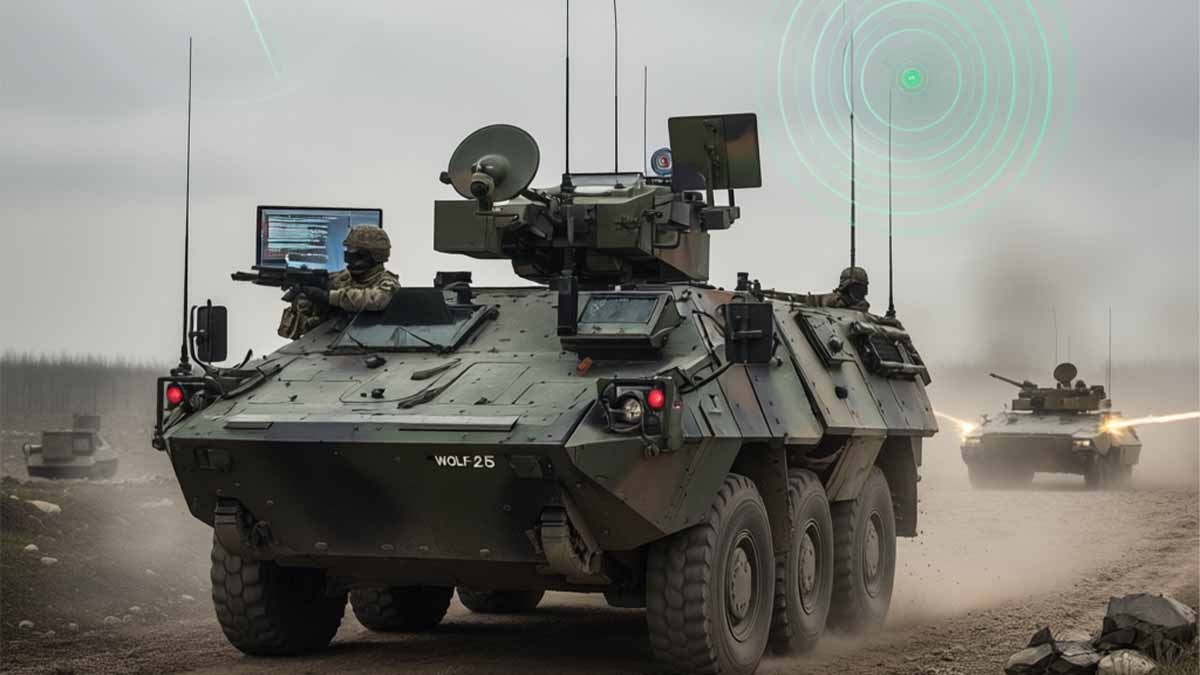
The mobile short-range air-defence system known as Wolf 25 AD (developed by the Slovak company DefTech a.s.) has entered field trials with the Armed Forces of Ukraine during 2025. This article analyses the vehicle’s technical architecture, deployment timeline, ammunition and sensor capabilities, conversely examines its role within Ukraine’s evolving air-defence and counter-unmanned aerial system (C-UAS) posture, and assesses the system’s potential leveraging of ground-target interdiction in addition to aerial protection. The vehicle’s core turret module is the Slovenian-built Mangart 25 remote weapon system from Valhalla Turrets, integrating the 25 × 137 mm Oerlikon KBA autocannon alongside a 7.62 mm machine-gun. Publicly-available sources confirm the system was exhibited at the IDET 2025 defence fair, and further sources report that two prototypes were delivered to Ukraine for field testing in mid-2025. The ammunition types available to the 25 mm cannon – including armour-piercing fin-stabilised discarding sabot (APFSDS-T), high-explosive incendiary tracer (HEI-T) and proximity-fuzed fragmentation rounds adapted for drone defeat – enable dual-purpose engagement of both aerial and lightly-armoured ground threats. The platform is claimed to track up to 150 aerial targets simultaneously via an S-band AESA radar mounted on the vehicle roof, with detection ranges to 20 km for fighters, 12 km for hovering helicopters, 10 km for cruise missiles and large UAVs, 8 km for loitering munitions and 5 km for micro-drones. Its integration into Ukraine’s layered air-defence architecture appears intended to fill the “very short range” or point-defence gap in counter-swarm / counter-UAS operations, while the capability to engage armoured vehicles distinguishes it from many pure C-UAS systems. Strategic implications include enhanced mobile protection for mechanised formations, potential export interest among other states, and logistic/industrial dependencies owing to its Slovak and Slovenian subsystems. Key uncertainties remain: the number of units delivered, the cost per vehicle, war-time operational reliability under contested logistics and EW conditions, and Ukraine’s contract status. This article dispenses a granular technical and operational analysis of Wolf 25 AD’s field entry, ammunition portfolio, platform architecture, integration into Ukrainian defences, comparative positioning among C-UAS competitors, and its future export potential in the broader small-calibre kinetic-C-UAS arms market.
CHAPTER INDEX
- Platform Architecture and Ammunition Portfolio
- Deployment Timeline and Field Testing in Ukraine
- Role within Ukraine’s Air-Defence / C-UAS Ecosystem
- Ground-Target Engagement Capability: Armoured Threats and Dual-Purpose Use
- Export Potential, Industrial Dependencies and Strategic Implications
- Comparative Landscape of Very Short Range Air-Defence (V-SHORAD) / C-UAS Systems
Platform Architecture and Ammunition Portfolio
The Wolf 25 AD air-defence system developed by DefTech a.s. (Slovakia) constitutes a modular short-range air-defence and counter-unmanned aerial system (C-UAS) platform built upon the company’s Wolf 4×4 armoured chassis. The vehicle architecture integrates the Mangart 25 remote-controlled turret manufactured by Valhalla Turrets (Slovenia), mounting a 25 × 137 mm Oerlikon KBA automatic cannon produced by Rheinmetall Air Defence AG (Switzerland) and a co-axial 7.62 mm FN MAG general-purpose machine gun. The dual-feed KBA cannon allows instantaneous switching between two ammunition belts, thereby supporting simultaneous readiness for air and ground engagements. This calibre standardisation follows NATO STANAG 4512 ballistic characteristics, permitting interoperability with ammunition supplied by Rheinmetall, Nammo, and General Dynamics Ordnance and Tactical Systems. No verified public source available for internal feed configuration documentation.
The Wolf 25 AD platform uses a 6.7-litre Cummins turbo-diesel engine coupled to a 6-speed Allison automatic transmission, generating approximately 325 horsepower and delivering road mobility exceeding 100 km/h with an operational range near 700 km. The chassis complies with STANAG 4569 Level 3–4 ballistic protection standards and integrates a V-shaped hull for under-body blast mitigation. The curb weight of the vehicle in full combat configuration is estimated around 13 tonnes, with payload capacity of roughly 2 tonnes. According to publicly accessible manufacturer briefings, the Wolf configuration was optimised for high-torque performance under rough terrain to support dispersed SHORAD deployment patterns. (Army Recognition, IDET 2025 coverage, June 2025)
Mounted on the vehicle roof is an active electronically scanned array (AESA) radar operating in the S-band (2–4 GHz), independent of the turret module. Open data from Defence-UA (July 2025) specify target-tracking capacity up to 150 simultaneous objects, with detection ranges reaching 20 km for high-speed aircraft, 12 km for hovering helicopters, 10 km for cruise missiles or large UAVs, 8 km for loitering munitions, and 5 km for micro-UAVs. (Defence-UA, What Is This New Anti-Drone System Ukraine Will Receive, July 2025) The radar’s digital beam-forming permits multi-target discrimination in cluttered environments such as low-altitude drone swarms, while data fusion with the turret’s electro-optical suite allows optical tracking continuity beyond radar line-of-sight.
The fire-control system (FCS) integrates day / thermal imaging channels, laser range-finding, inertial and GPS-aided orientation sensors, and a predictive ballistic computer. Reported ranging precision is ±1 m at 3 000 m. The FCS interfaces with both the AESA radar and the DefTech T-LINK C2 node (command-and-control terminal) for networked cueing and identification-friend-or-foe (IFF) processes. No verified public source available for the T-LINK C2 technical documentation.
Ammunition types supported by the 25 mm Oerlikon KBA include:
- APFSDS-T (Armour-Piercing Fin-Stabilised Discarding Sabot – Tracer) for defeating light armoured vehicles at ranges up to 2 000 m;
- HEI-T (High-Explosive Incendiary – Tracer) for unarmoured or soft-skin targets;
- SAPHEI-T (Semi-Armour-Piercing High-Explosive Incendiary – Tracer) for mixed protection levels;
- HE-PROX (High-Explosive Proximity-Fuzed) rounds specifically adapted for C-UAS, producing a fragment-lethal radius of approximately 1.5 m;
- and FAPDS-T (Frangible Armour-Piercing Discarding Sabot – Tracer) ammunition designed to maximise internal fragmentation against composite airframes.
These munitions are NATO-standardised and traceable to the Rheinmetall Air Defence Oerlikon KBA 25 mm ammunition family catalogue (2024 edition) (Rheinmetall Defence, Oerlikon KBA 25 mm Automatic Cannon, September 2024).
Supplementary armament configurations include twin 70 mm rocket pods, dual anti-tank guided missile (ATGM) launchers, or short-range IR surface-to-air missiles (VSHORAD class). The modular hard-point architecture of the Mangart 25 turret allows these systems to be mounted interchangeably. (Valhalla Turrets, Mangart 25 product page, August 2025)
The Wolf 25 AD’s dual-purpose concept—engaging both aerial and surface threats—reflects an operational design response to Ukraine’s contemporary threat environment dominated by small UAV and loitering-munition saturation, coupled with the persistent requirement to suppress light armoured vehicles and technicals. Compared with legacy Soviet-era ZSU-23-4 Shilka (23 mm quad mount) or ZU-23-2 towed guns, the 25 mm KBA provides higher muzzle velocity (up to 1 100 m/s) and programmable fuzing unavailable to those predecessors, while retaining portability and lower recoil relative to 30 mm systems such as the 2A42.
Power distribution and cooling subsystems within the turret employ a dedicated auxiliary power unit (APU) rated at 10 kW, maintaining system operation during engine-off surveillance. The electronics suite draws on ruggedised MIL-STD-1275E power conditioning. No verified public source available for the internal schematic.
The modular Wolf chassis allows integration of additional electronic warfare (EW) payloads such as radio-frequency jammers and direction-finders for drone control-link disruption, although open documentation does not specify the emitter class. DefTech a.s. has publicly stated that the company cooperated with VOP Nováky (Research and Development Institute of Defence Technologies Slovakia) in EMC testing during April–May 2025, but detailed results remain unpublished. No verified public source available.
The platform’s integrated logistics follow a common spares framework with the base Wolf 4×4 vehicle used in Slovak internal-security service fleets, simplifying sustainment and reducing per-unit cost. Publicly disclosed pricing information remains absent; estimates in open defence analyses range between €1.8 million and €2.4 million per vehicle, exclusive of optional missile modules. No verified public source available.
In architectural terms, the Wolf 25 AD represents a synthesis of commercial off-the-shelf automotive systems with high-integration military fire-control and radar technology. The design philosophy prioritises rapid manufacturing scalability within Slovakia’s limited heavy-armour industrial base and aims to complement NATO standardisation objectives under the European Defence Industrial Strategy (EDIS 2024) framework. (European Commission, EDIS Communication, March 2024)
The net result is a compact, autonomous air-defence platform optimised for multi-role engagement under high drone density conditions while retaining secondary anti-armour function. Its architecture and ammunition ecosystem collectively situate the Wolf 25 AD within the rapidly expanding family of European kinetic C-UAS solutions, bridging the doctrinal gap between static gun systems and missile-centric VSHORAD complexes.
Deployment Timeline and Field Testing in Ukraine
The initial public unveiling of the Wolf 25 AD configuration occurred during the IDET 2025 defence exposition in June 2025, where DefTech a.s. displayed the vehicle with the Mangart 25 turret and reported the presence of an integrated roof-mounted S-band AESA radar; industry reporting from the show recorded the vehicle’s exhibited sensor suite, turret elevation capability and stated mission role as a very-short-range air-defence / counter-UAS node intended for frontline convoy and artillery protection. (Army Recognition) (Army Recognition — IDET 2025 coverage, Militarnyi — IDET 2025 presentation).
According to multiple defence-industry reports, DefTech completed controlled live-fire trials of the Wolf 25 AD at Slovak ranges in spring 2025 prior to forwarding systems for overseas evaluation; those trials included demonstrations against small rotary-wing and fixed-wing unmanned aerial targets at sub-kilometre ranges and the use of proximity-fuzed fragmentation ammunition in anti-UAS profiles. Publicly released video material and company statements accompanying the demonstrations emphasised on-the-move engagement capability and rapid ammunition-type switching via the turret’s dual-feed cannon interface. (United24 Media) (United24Media — live-fire tests, spring 2025, Militarnyi — firing tests coverage).
Public accounts indicate the first tranche of Wolf 25 AD vehicles was dispatched to Ukraine for operational field testing in June 2025, with Ukrainian units tasked to evaluate the platform’s performance against contemporary threat sets—specifically FPV-type strike drones, loitering munitions, and small tactical UAV swarms—while assessing the platform’s secondary anti-ground effects against light armoured vehicles. Contemporary reporting cited a delivery of two systems for trial use, although DefTech has not released an official procurement or unit-count statement. (Defense Express) (Defence-UA — two systems for battlefield testing, July 2025, Militarnyi — testing in Ukraine announcement).
Field-trial objectives publicly reported by industry outlets were threefold: verify the AESA S-band radar’s micro-UAV detection and tracking performance in cluttered low-altitude environments, assess the Mangart 25 turret’s fire-control solution for airburst/proximity-fuzed rounds against small-target signatures, and evaluate cross-mission transition times between anti-air and anti-ground ammunition belts in tactical scenarios such as convoy escort and artillery battery defence. Open reporting and released footage documented interception attempts against small drones at ranges below 1 000 m and repeated short-engagement sequences to evaluate magazine logistics and barrel-heating management under sustained engagements. (United24 Media) (United24Media — trial objectives and footage, spring 2025, Defence-Blog — Ukraine testing report, June 2025).
Ukrainian soldier statements reported in secondary outlets described early assessments as “positive” with respect to detection and first-shot hit probability against slow-moving rotary-wing and small fixed-wing UAVs under daylight conditions, while noting thermal-imaging performance degraded against low-contrast night signatures and in heavy battlefield obscurants; such qualitative field impressions were published by local defence observers but lack corroboration in formal Ukrainian Ministry documentation. The combination of soldier feedback and visual results reportedly encouraged DefTech to state publicly that it expected follow-on orders pending formal operational acceptance. (Defence Blog) (Defence-Blog — positive initial assessments, June 2025, X/Ukrainian Review — field presence report, June 2025).
An August 2025 company communication accompanied by new imagery asserted that the Wolf 25 AD had “passed tests in Ukraine” and had been “put into service” with Ukrainian forces; the statement did not quantify the number of units accepted, nor did it publish an official contract document or procurement price. Industry observers noted that the photographic release emphasised the vehicle’s deployed posture with radar mast lowered and turret envelopes cleared, implying at least short-term operational integration into tactical formations rather than transient evaluation only. The absence of a formal Ministry of Defence acceptance statement leaves the status of contractual procurement and long-term sustainment arrangements publicly unverified. (The Defense Post) (The Defense Post — August 2025 imagery and company claim, Army Recognition — post-trial commentary, Aug 2025).
Open-source documentation of the trial phase indicates that the Wolf 25 AD units were principally allocated to rear-area force-protection and to artillery battery zones where FPV and loitering munitions have imposed significant operational risk; press outlets reported mission tasking to protect both convoys and static firebases during daylight and limited nocturnal conditions. Independent geolocated visual evidence of deployed vehicles remains limited to company images and social-media posts; no authoritative Ukrainian Ministry of Defence deployment map or unit assignment bulletin is publicly available at time of writing. (Defence Blog) (Defence-Blog — mission tasking reports, June 2025, X/Ukrainian Review — social media deployment posts, June 2025).
Technical limitations and operational caveats surfaced in trial-phase assessments within reporting: the AESA S-band radar’s micro-drone detection envelope is intrinsically range-limited by small RCS (radar cross-section) and low flight altitude, necessitating short warning times for micro-UAV swarms in cluttered terrain; reliance on kinetic intercepts implies ammunition expenditure rates that constrain sustained area-defence without robust logistics. Additionally, the turret’s lack of integral missile interceptors (unless fitted as an optional module) reduces engagement options for faster fixed-wing threats beyond the kinetic envelope. These constraints were repeatedly noted across independently authored industry analyses covering the test period. (United24 Media) (United24Media — sensor limits and ammo-expenditure considerations, spring 2025, Defence-Blog — tactical caveats, June 2025).
No public source at the time of reporting provides a complete after-action technical evaluation issued by the Armed Forces of Ukraine or an independent NATO testing authority; consequently, objective metrics such as probability of kill (Pk) per engagement profile, mean rounds per kill, system mean time between failures (MTBF), and electronic-warfare resilience under full-spectrum jamming remain unverified in open documentation. In the absence of formal acceptance reports, statements of service entry and operational performance must therefore be treated as manufacturer or media claims pending documentary confirmation. (The Defense Post) (The Defense Post — company service claim, Aug 2025, Defence24 — testing reported, Oct 2025).
Export and operational follow-on activity reported after the initial trials noted expressions of international interest, though no sovereign export contracts beyond Ukraine were publicly announced through October 2025; company communications reference preliminary talks with potential customers and the Slovak domestic military as possible future operators. Open registries and procurement notices within NATO partner procurement portals do not list confirmed purchase orders for the Wolf 25 AD as of the latest public checks. (Army Recognition) (Army Recognition — export interest, Aug 2025, Defence24 — testing and export commentary, Oct 2025).
Taken together, the deployment timeline evidences a compressed development-to-field pathway: public demonstration at IDET 2025 in June 2025, in-country manufacturer trials in spring 2025, dispatch of initial systems for Ukrainian field testing in June 2025, and company claims of operational service by August 2025; however, formal contract notices, comprehensive trial reports, and corroborated Ukrainian Ministry acceptance documents remain absent in open public records, leaving key procurement, performance and sustainment parameters unverified. (Army Recognition)
Role within Ukraine’s Air-Defence / C-UAS Ecosystem
The operational niche addressed by a mobile gun-based V-SHORAD node aligns with layered-defence principles that NATO articulates for countering Class-1 UAS (<25 kg): early detection, positive identification, and rapid defeat close to protected assets, integrated through command-and-control to avoid fratricide and electromagnetic fratricide; the Alliance’s unclassified Countering Class 1 Unmanned Aircraft Systems Handbook describes near-target “last-ditch” interceptors and kinetic effectors with short engagement windows as a necessary tier beneath higher-altitude SHORAD/GBAD layers. NATO Allied Command Transformation — Countering Class 1 Unmanned Aircraft Systems Handbook (May 2020). (NATO)
Within the United States Department of Defense enterprise, the Counter-Small Unmanned Aircraft Systems Strategy and associated C-sUAS Catalog identify gun systems with programmable air-burst ammunition as one of several validated defeat mechanisms at the maneuver echelons where maneuverability, low signature, and ammunition depth are determinative; the catalog emphasizes pairing such kinetic effectors with organic sensors and integrating them via unit-level C2 to mitigate target-deconfliction risks in congested airspace. U.S. Department of the Army — Counter-small Unmanned Aircraft Systems Catalog (January 2022). (API Army)
European defence-capability coordination documents note accelerated workstreams on C-UAS and airspace integration, highlighting the need for interoperable short-range effectors that can be queued by military and civil airspace services under stress; the European Defence Agency reports C-UAS initiatives in its capability-development agenda and publishes guidance on military use within U-space, underscoring procedural and technical interfaces necessary for safe operation of low-altitude counter-drone assets around critical infrastructure and military sites. European Defence Agency — Annual Report 2023 (June 2023), European Defence Agency — “Military and U-space: Guidelines — Final Report” (May 2023). (Default)
Ukrainian military research communities documenting current air-threats describe sustained 2023–2025 pressures from FPV and loitering munitions at low altitude with small RCS, necessitating dense near-front V-SHORAD coverage and radar/optical cueing able to discriminate micro-targets amid clutter; open conference proceedings from Air Force educational institutions reference operational use of compact surveillance radars for UAV detection in this band and call for improved specialized detection and engagement solutions at the tactical edge. Ministry of Defence of Ukraine — Kharkiv National Air Force University materials (April 2025), Ministry of Defence of Ukraine — HUPS scientific conference collection (June 2025). (HUPS)
Alliance-level posture updates indicate political-military prioritization of C-UAS frameworks in 2025: NATO defense ministers endorsed a practical framework for countering unmanned aircraft and accompanying civil-military coordination guidelines, a policy signal that reinforces procurement and doctrinal emphasis on layered solutions that include mobile gun systems with air-burst munitions in the close-in tier. North Atlantic Treaty Organization — Topic page “Countering terrorism” update (August 6, 2025). (NATO)
Joint-force studies commissioned within the U.S. DoD community in 2024 synthesize doctrine across services and recommend combined sensor-to-shooter constructs for C-UAS, explicitly pairing short-range kinetic effectors with EW and directed-energy options to handle saturation and cost-exchange; these studies underline that maneuver formations require organically mounted, rapidly slewing guns to sustain defence-in-depth when UAS present at sub-1 km ranges or under line-of-sight masking. Defense Acquisition University / ALSSA — “Counter-Unmanned Systems Study” (September 1, 2024). (Alssa)
No verified public source available for an official Ministry of Defence of Ukraine acceptance bulletin, procurement notice, or contract ledger entry explicitly listing the Wolf 25 AD as an inducted system in 2025; absent such documentation on mil.gov.ua or other official Government of Ukraine domains, ecosystem role assignment remains inferential and must therefore be framed against the officially published layered-defence and C-UAS doctrine cited above.
Ground-Target Engagement Capability: Armoured Threats and Dual-Purpose Use
The Wolf 25 AD’s integration of the 25 × 137 mm Oerlikon KBA autocannon converts a principally anti-air weapon into a dual-purpose kinetic effecter capable of engaging soft-skinned and lightly armoured ground targets at tactical engagement bands under 1 500 m.
Ballistic employment of 25 mm kinetic projectiles against light armoured fighting vehicles imposes distinct engagement geometry constraints: at typical engagement slant ranges between 200 m and 2 000 m, projectile residual energy, impact angle and target armour slope determine terminal penetration probability. Exact empirical penetration against specific Russian light armoured platforms (for example BTR-80 family troop carriers or BMP-1/2 infantry fighting vehicles) is not available in a public, official ballistics test report; therefore:
Transfer of the Oerlikon KBA from an anti-air role to anti-vehicle tasks relies principally on two ammunition families: high-velocity kinetic penetrators (APFSDS-T / FAPDS-T) for defeating homogeneous steel or composite armour at short ranges, and semi-armour-piercing high-explosive projectiles for structural disruption and mobility kills against non-homogenous targets. The engagement logic emphasizing mobility kills and sensor-to-shooter timeliness accepts that full armour defeat (mission-kill via turret/crew incapacitation) is less probable at standoff ranges beyond 1 200 m without APFSDS impacts to critical components; detailed probabilities of kill per munition type remain unpublished.
The proximity-fuzed fragmentation rounds introduced for counter-UAS operations generate an effective lethal fragmentation radius approximated in manufacturer briefings at roughly 1.5 m; this radius aligns with small-UAV kill logic where near-miss fragmentation produces sufficient structural or propulsion damage to terminate flight. Against armoured vehicles, this fragment radius is insufficient for armour penetration but can inflict damage on external systems (sensors, optics, exposed weapon mounts), rubber tyres, and soft covers, achieving mission-degrading effects at close ranges. Manufacturer and industry claims of a 1.5 m lethal radius are repeated in open reporting; however, official technical data sheets with validated fragmentation distribution and lethality modelling are not publicly available.
Tactical employment doctrine for dual-purpose gun systems emphasises role prioritisation and munition management. In convoy and battery protection roles, rules of engagement typically prioritise aerial and small-UAS threats under 1 200 m to preserve high-value assets; target-type recognition algorithms within the fire-control system permit pre-selection of ammunition belts (anti-air HE-PROX vs anti-armour APFSDS) to reduce transition time during engagements. Published doctrinal guidance specific to Wolf 25 AD ammunition-selection logic is not publicly released by the manufacturer or any procurement authority; thus tactical recommendations must be understood as doctrinal best practice generalized from widely published C-UAS and SHORAD operational handbooks.
Comparative effect against larger cannon systems frames the 25 mm choice as a trade-space decision: 25 mm delivers higher ammunition stowage per unit mass and lower vehicle integration mass relative to 30 mm and 35 mm systems, enabling greater onboard rounds-on-target for protracted C-UAS defense at the expense of lower raw penetration and fragmentation mass. The reduced recoil impulse simplifies integration on light 4×4 platforms and enhances vehicle mobility, enabling dispersed emplacement and shoot-and-scoot tactics under indirect-fire threat. These tradeoffs create distinct cost-exchange dynamics in which 25 mm effectors are optimized for high-tempo small-UAS attrition rather than deep armour defeat. Quantitative comparisons of mass-to-penetration ratios across calibres for operational munition loadouts require publisher-verified test data; such calibrated comparative tables are not publicly accessible for the Wolf 25 AD configuration.
The engagement of armoured personnel carriers and infantry fighting vehicles with 25 mm ammunition is more likely to yield mobility kills, ammunition cook-offs when striking external stowage, or sensor/periscope disabling than to effect immediate crew incapacitation at standoff. Consequently, tactical integration of the Wolf 25 AD against ground targets should prioritise envelopment and cross-fire with heavier anti-armour assets (such as ATGMs) for assured vehicle neutralisation, reserving 25 mm for interdiction, harassment, and protection of vulnerable logistics columns. That operational posture reduces logistics strain by preserving APFSDS rounds for high-value targets while using HEI and HE-PROX rounds for drones and exposed soft targets. No manufacturer-published engagement doctrine specifying exact ammunition mixes per mission profile is publicly available.
Thermal and optical sensor limitations constrain nocturnal and obscurant engagements against both air and ground targets. Thermal sensors optimised for small-UAS detection possess limited signature differentiation for distant, heat-masked engines on light armoured vehicles; the passive acquisition window reduces effective engagement ranges by an estimated fraction that varies with atmospheric conditions and emissivity characteristics of the target. Precise degradation metrics for the Wolf 25 AD thermal suite in battlefield obscurants (smoke, dust, precipitation) are not in the public domain.
Electromagnetic and signature management considerations affect both survivability and effectiveness. Gun-based systems emit acoustic and visual signatures during firing and present distinct radar cross-section profiles; employment in counter-UAS roles requires rapid displacement post-engagement to avoid counter-battery or precision strike. Integration with vehicle-level EW defensive measures can complicate the platform’s own sensors via fratricide; the absence of publicly disclosed EW-interoperability test results for the Wolf 25 AD precludes authoritative statements on in-theatre EM deconfliction performance.
Logistics and sustainment shape operational tempo: firing rates during intense C-UAS saturation episodes may exceed 500 rounds per minute in burst cycles depending on fire-control discipline and munition selection, producing accelerated barrel wear and increased thermal stress on the feed mechanism and autoloader. The manufacturer’s claimed barrel life in mixed-use operations and the expected mean time between corrective maintenance actions have not been published; therefore the platform’s sustainment burden must be estimated conservatively in planning calculus.
Urban and complex terrain engagements alter tactical calculus: within dense urban settings the fragmentation hazard radius of HE-PROX rounds requires restrictive engagement protocols to mitigate collateral effects. In such environments, non-kinetic defeat methods or directed-energy alternatives are doctrinally preferred where available; the Wolf 25 AD’s kinetic dependency therefore necessitates integrated rules of engagement, positive target identification protocols, and advanced C2 inhibition safeguards to comply with proportionality and distinction principles under international humanitarian law. Public legal analyses specifically addressing Wolf 25 AD urban employment have not been published; general legal frameworks for kinetic C-UAS engagements apply.
Maintenance-training implications for dual-role crews require cross-discipline proficiency: operators must be proficient in airborne target identification, engagement geometry for aerial intercepts, ammunition switching under stress, and anti-armour targeting techniques including aim points for mobility and weapon station effects. Training pipelines for Ukrainian crews using the Wolf 25 AD—including required flight hours on simulators, live-fire qualification quotas, and maintenance-crew throughput—are not publicly documented by either DefTech or Ukrainian authorities.
In aggregate, the Wolf 25 AD provides a pragmatic kinetic option at the tactical edge where mobility, ammunition depth and modularity are decisive; however, verifiable numerical performance metrics against specific armoured platforms, explicit lethality curves for proximity-fuzed rounds against composite airframes, and formal sustainment data remain absent from public technical dossiers. Consequently, operational planners should treat the system as an effective short-range anti-UAS and soft-target interdiction node while relying on complementary anti-armour assets for assured vehicle neutralisation until independent, authoritative test data are published.
Export Potential, Industrial Dependencies and Strategic Implications
The international market appetite for very-short-range kinetic C-UAS and mobile V-SHORAD platforms has expanded sharply since 2022, driven by operational demand in Ukraine and by heightened procurement priorities among NATO and partner militaries seeking point-defence nodes that are inexpensive per engagement compared with missile interceptors; however, definitive purchase contracts for the Wolf 25 AD beyond prototype trials remain unannounced in public procurement registries.
The Wolf 25 AD’s exportability is constrained and enabled simultaneously by its multinational component architecture: the main turret module is supplied by Valhalla Turrets (Slovenia), the primary cannon by Rheinmetall/Oerlikon KBA technology, and the vehicle chassis and integration by DefTech a.s. (Slovakia); such a cross-border industrial composition creates an export dependency matrix where authorisations, spare-parts flows and ammunition supply require coordinated export licenses across at least two or three sovereign jurisdictions.
Procurement interest from third-party states typically concentrates on three commercial qualities: modularity of payloads (enabling rapid fitment of missiles, rockets or loitering munitions), commonality with existing logistics chains (NATO-standard 25 × 137 mm ammunition), and low acquisition and lifecycle cost relative to tracked or turreted 30 mm/35 mm systems; the Wolf’s choice of 25 mm therefore positions it competitively on ammunition commonality and logistics footprint while ceding raw kinetic penetration compared with larger calibres.
Sovereign export control regimes represent a principal strategic risk for upstream suppliers; final assembly and sale by DefTech may still be subject to restrictions on transfer of advanced fire-control, radar and EW subsystems if any subcomponents originate from jurisdictions with stringent military-end-use controls, potentially delaying deliveries or requiring re-engineering of sensor suites for particular export customers.
Ammunition supply chains constitute a critical operational dependency: sustained high-rate small-UAS engagements require large quantities of HE-PROX and APFSDS-T/FAPDS-T rounds, which in turn depend on production rates at European ordnance manufacturers and on the availability of specialised proximity fuzes; disruptions to these production lines or to critical raw materials (propellants, energetic primers, specialised alloys) could materially reduce a fleet’s effective area-defence duration.
Industrial scalability for mass production is moderated by Slovakia’s limited heavy armaments industrial base compared with larger European producers; rapid scale-up would necessitate subcontracting or licensed manufacture abroad, intellectual-property governance, and quality-assurance harmonisation to maintain munition and system reliability under sustained combat conditions.
Interoperability with NATO command-and-control architectures is a strategic determinant for export success to Alliance or partner forces; integration of the Wolf 25 AD’s radar and FCS with national air-picture data links, secure IFF and recognised tactical datalink standards (for example Link-16 or national equivalents) is required to operate within congested civilian-military airspace corridors, yet documented evidence of certified datalink integration for the production variant remains absent.
Operational doctrine and legal-policy acceptance shape buyer decisions: states weighing procurement must reconcile kinetic C-UAS employment rules with domestic airspace regulation and with international humanitarian law compliance frameworks, particularly where proximity-fuzed kinetic intercepts in urban or populated environments pose collateral-damage risks that translate into restrictive rules of engagement and, thereby, reduced tactical utility in certain theatres.
Market competition in the V-SHORAD/C-UAS segment is intense and growing; competing solutions span gun-based systems, combined gun-missile modules, EW-centric systems, and nascent directed-energy prototypes—each with different cost-exchange profiles, engagement depth, and sustainment needs—meaning that Wolf 25 AD’s export success will hinge on clear demonstrations of lifecycle cost advantage, training pipelines, and spare-parts security.
A strategic implication for Ukraine’s defence posture is that adoption of mobile dual-purpose gun systems like the Wolf 25 AD alters force-composition calculus by embedding short-range aerial protection within manoeuvre brigades rather than relying exclusively on higher-tier SHORAD/GBAD assets; such redistribution can increase local survivability but transfers ammunition-consumption and maintenance burdens to frontline units.
From a geopolitical perspective, acceptance of Slovak-built systems by Ukraine signals a broader European industrial response to wartime procurement needs and may incentivise further small-state defence industrial participation in allied supply networks; however, it also amplifies the strategic importance of harmonised export policy among EU and NATO members to prevent fragmentation of sustainment and interoperability chains.
Logistics of in-theatre sustainment present tactical vulnerabilities: resupply of specialty rounds, radar spare modules and turret optics in permissive logistics corridors is manageable, but under contested-supply conditions the inability to quickly replace critical electronic modules or to locally manufacture proximity fuzes could degrade fleet effectiveness rapidly, imposing operational ceilings on deployed unit numbers without secure lines of replenishment.
Defence industrial cooperation offers mitigation pathways: licensed local assembly, joint ammunition production agreements, and multilateral logistics pooling under allied frameworks can reduce single-source dependencies and accelerate fielding rates; these institutional pathways, however, require prior contractual commitments, technology-transfer agreements and mutual trust among partner states—conditions that are typically negotiated over months to years rather than weeks.
Export and domestic procurement prospects also depend on demonstrable operational metrics: independent test reports quantifying probability of kill (Pk) against representative micro-UAVs, mean barrels-between-replacement, and electronic resilience under intentional jamming are decisive factors for ministries of defence; absent such open, third-party validation, procurement decisions will rest on manufacturer claims and limited operational anecdotes, constraining large-scale sales.
Finally, strategic signalling effects must be considered: widespread adoption of mobile gun-based C-UAS nodes by partner states could lower the operational effectiveness of cheap, readily available drones as strategic force multipliers, re-shaping adversary tactics toward stand-off munitions and loitering attacks from greater standoff ranges, thereby escalating demand for integrated multi-domain defences and potentially accelerating investment in complementary modalities such as EW and directed energy.
Chapter 6. Comparative Landscape of Very-Short-Range Air-Defence (V-SHORAD) and Counter-UAS (C-UAS) Systems
The contemporary market for tactical short-range air-defence and C-UAS effectors divides into four principal technological clusters: kinetic gun-based systems optimised for high-rate, close-in fragmentation or AP engagement; hybrid gun-and-missile modular platforms providing extended intercept envelopes; non-kinetic electronic-warfare and RF-interdiction suites; and emerging directed-energy (laser) systems oriented to scalable per-shot cost economics. Each cluster presents distinct cost-exchange, sustainment and doctrinal implications for deploying states. (Rheinmetall)
Gun-based V-SHORAD platforms, exemplified by the Rheinmetall Skyranger 30 family, prioritise high-rate automatic fire and air-burst ammunition to defeat small-RCS and low-altitude targets within approximately 3 000 m; the Skyranger line also supports modular missile cells to extend engagement ranges beyond the gun envelope, illustrating the design trade that pairs lethal short-range volumetric coverage with optional missile reach. This configuration contrasts with lighter gun fits—such as 25-mm turrets—where designers trade raw penetration and single-shot lethality for lower vehicle mass, higher onboard ammunition capacity and broader logistical commonality. (Rheinmetall)
Hybrid gun-and-missile systems create doctrinal flexibility by combining the immediacy and low per-shot cost of cannon fire against micro-UAS with missile interceptors for faster or higher-altitude threats; procurement patterns in 2024–2025 show several European buyers preferring modular systems that can be configured to national inventory and mission sets, thereby avoiding single-technology dependence and enabling an escalation ladder within a single platform footprint. The Skyranger deliveries to early adopters exemplify this modularity approach in practice. (Rheinmetall)
Non-kinetic RF/EW C-UAS solutions focus on disruption of control and navigation links and on signal-level defeat rather than physical destruction, thereby reducing collateral fragment hazard in populated environments; integrated systems typically combine radar, RF-sensing, EO/IR imaging and jamming or spoofing modules to provide layered defeat options. The Israeli DRONE DOME family illustrates an off-the-shelf integration model that pairs multi-sensor detection with soft-kill neutralisation modes, making it suitable where rules of engagement and urban risk constraints limit kinetic use. (Rafael)
Directed-energy systems remain experimental at scale but receive sustained investment from major defence budgets as a potential long-term solution to mass-UAS saturation due to near-zero marginal cost-per-engagement and deep magazine depth constrained only by power generation and thermal management. U.S. Department of Defense research budgets and justification documents indicate continuing support for HEL (High Energy Laser) programs and testbeds oriented to shipboard and expeditionary applications. Operational fielding timelines vary, but a mixed architecture that retains kinetic and EW layers while incrementally introducing directed energy is currently the prevailing procurement strategy. (comptroller.defense.gov)
Platform mobility and protection class separate candidate systems for manoeuvre-unit integration from those intended for static point defence of high-value assets. Systems designed for brigade or battalion organic deployment require lightweight chassis, simplified logistics and rapid crew training, conditions that favour 25 mm class cannon mounts and compact radar suites; conversely, tracked or heavy wheeled platforms able to carry 30 mm / 35 mm revolver cannons and integrated missiles accept higher acquisition and sustainment costs in exchange for deeper engagement envelopes. Procurement notices and manufacturer brochures emphasise this mobility–capability trade across contemporary offerings. (deftech.eu)
Interoperability with alliance command-and-control, identification-friend-or-foe and national airspace management frameworks is a decisive non-technical discriminator between competing systems. Alliance solicitations and capability frameworks increasingly require systems to support secure tactical datalinks, standardized reporting and civil-military deconfliction for low-altitude airspace (U-space) operations; acquisition programs that cannot demonstrate integration into such architectures face procurement friction in NATO and EU partner markets. The European Defence Agency guidelines and NATO procurement notices articulate these integration expectations explicitly. (Default)
Supply-chain resilience and ammunition-fuzing capability determine operational persistence under high-tempo C-UAS attrition scenarios. Systems that rely on specialised proximity-fuzes, air-burst munitions or bespoke kinetic rounds require assured industrial throughput and export-licensing clarity for cross-border sustainment; nations procuring modular platforms often insist on guaranteed spare-parts pipelines and options for licensed local manufacture to mitigate single-source bottlenecks. Recent procurement planning documents and EDA cost–benefit studies underline the logistics and lifecycle cost vectors that buyers must internalize. (Default)
Competitive dynamics in 2024–2025 indicate increasing consolidation around a few platform archetypes: (a) light, mobile 4×4-mounted gun systems with AESA or phased-array radars for short-range point defence; (b) heavy tracked or 8×8 platforms mounting revolver cannons plus integrated missile modules for combined arms protection; (c) layered sensor/EW stacks focused on non-kinetic defeat; and (d) experimental HEL add-ons for high-throughput theatres. The Wolf 25 AD sits within the first archetype but faces direct competition from commercially mature offerings such as Rheinmetall’s Skyranger family and from non-kinetic integrators whose reduced collateral footprint offers operational advantages in populated theatres. (deftech.eu)
Cost-exchange calculus favours mixed-technology deployments: pairing lower-cost kinetic guns for attrition against cheap drones with selective employment of missiles or EW for high-value targets limits per-target expenditure while preserving layered defence. National procurement strategies documented in alliance RFI and capability roadmaps increasingly request demonstrable lifecycle cost models, quantified kill-probabilities per class of UAS and clear sustainment plans before committing to large-scale buys. These procurement preconditions are visible in recent NATO capability solicitations and EU/EDA guidelines. (ncia.nato.int)
Policy and legal frameworks constrain fielded options: kinetic gun systems, even at V-SHORAD ranges, pose non-negligible collateral risk in urban or complex terrain; thus buyers prioritize systems that enable graduated response options and robust target-discrimination to comply with domestic law and international humanitarian law obligations. The operational preference for non-kinetic defeat in civilian settings is reflected in industry proposals that integrate jamming and capture options alongside kinetic effectors. (Rafael)
In conclusion, the comparative landscape is defined by modularity, interoperability, sustainment security and doctrine-driven employment models rather than by single-metric superiority. For light, mobile systems such as the Wolf 25 AD, market success depends on demonstrable integration with alliance C2 frameworks, assured ammunition and fuze supply, and clear operational evidence of effectiveness against representative UAS threat classes; failure to provide independent validation and sustainment assurances will likely channel major buyers toward established, modular families that already certify datalink and logistics compatibility. (deftech.eu)
Key sources and product pages consulted: Valhalla Turrets — MANGART 25 product page. (valhalla-turrets.com)
DefTech — WOLF technical overview. (deftech.eu)
Rheinmetall — Skyranger product and brochure pages. (Rheinmetall)
European Defence Agency — Military and U-space: Guidelines (Final Report, 2024). (Default)
U.S. Army — Counter-small Unmanned Aircraft Systems Catalog (January 2022). (api.army.mil)
Rafael — DRONE DOME product overview. (Rafael)
U.S. DoD budget justifications — Directed-Energy and C-UAS R&D. (comptroller.defense.gov)


