













Abstract
The scenario presented here is best treated not as a prediction but as a structured contingency analysis: a 2029 cross-Strait amphibious assault model tested against the most recent official baseline presently available on 28 March 2026. On that baseline, the key macro-fact is that both sides are already orienting toward a sharper contest over time, readiness, and survivability. The U.S. Department of Defense states that the PLA’s 2027 modernization goal is a near-term milestone in a larger force-transformation sequence and notes that PRC military writings link those goals to capabilities for countering the U.S. military in the Indo-Pacific and compelling Taiwan’s leadership on Beijing’s terms. The same report states that the PLA is preparing for a contingency to unify Taiwan by force if Beijing deems it necessary, while simultaneously seeking to deter, delay, or deny third-party intervention. That official baseline matters because it means the user’s 2029 vignette is not analytically frivolous; it is a forward extension of already-declared modernization goals, already-observed pressure operations, and already-documented amphibious preparation.
At the same time, the countervailing baseline is equally important: Taiwan is no longer operating from the budgetary and doctrinal posture of several years ago. The Ministry of National Defense states that Taiwan’s 2026 national defense budget, calculated under NATO-style accounting, reaches NT$949.5 billion, or 3.32 percent of GDP, with the MND-planned budget at NT$806 billion, and explicitly says investment follows principles of “multi-domain denial and resilient defense.” In parallel, President Lai Ching-te stated in February 2025 that the government would prioritize allocations ensuring defense spending exceeds 3 percent of GDP and would continue reforms tied to whole-of-society defense resilience. More concretely still, the MND announced a 2026–2033 Special Budget for Enhancing Defense Resilience and Asymmetric Capabilities with an estimated ceiling of NT$1.25 trillion, explicitly covering precision artillery, long-range precision strike missiles, unmanned vehicles and countermeasure systems, air defense / anti-ballistic / anti-armor missiles, AI-assisted and C5ISR systems, and other resilience-enabling capabilities. That means the analytical center of gravity is no longer whether Taiwan conceptually accepts asymmetry; it is whether procurement velocity, industrial scaling, doctrinal adaptation, and training intensity can mature quickly enough to convert budget lines into invasion-breaking density.
The user’s “Hellscape” model therefore lands on the decisive question: can Taiwan transform the geography of the littoral into a temporally sequenced attrition machine that collapses the invasion timetable before the beachhead stabilizes? Here the most relevant public conceptualization is the CNAS report released on 26 February 2026, which frames a four-layer defense built around uncrewed aerial, surface, and underwater systems, mines, mobile air defenses, and dense short-range strike architecture. CNAS describes an outer layer beginning roughly 80 km from Taiwan’s coast, a middle layer extending inward to 5 km, and final terminal layers covering the last run to shore and the beaches themselves. That think-tank concept is not itself an official operational plan, but it aligns strikingly with official Taiwanese language on multi-domain denial, unmanned vehicles, AI-assisted kill chains, non-red supply chains, and whole-of-society resilience. In analytical terms, the concept’s power is not that every individual drone or mine is decisive; it is that each layer is designed to magnify delay, magazine depletion, navigation disorder, and command friction inherited from the preceding layer.
The outer-layer logic is therefore the first decisive fracture point. The DoD states that the PLA invasion concept envisions a complex operation relying on coordinated and interlocking campaigns for electronic warfare, logistics, and joint fires, while also documenting continued PLA amphibious training and the use of UAS in support of amphibious assault operations. But the more complex the choreography, the more vulnerable the assault becomes to disorder injected at scale. In the scenario described by the user, autonomous undersea strikes, multidirectional drone waves, decoys, and anti-ship salvos do not need perfect discrimination to be operationally useful; they need only force escorts to spend interceptors, break formation discipline, trigger self-protective maneuver, and divert destroyers toward antisubmarine and counter-drone tasks. That inference is consistent with the official premise that the PLA would require tightly coordinated joint activity to sustain an island-landing campaign. The implication is severe: once escorts start defending everywhere at once, the invasion ceases to be a linear transit problem and becomes a cumulative systems-failure problem, in which time, fuel, ammunition, route discipline, and communications coherence all begin deteriorating simultaneously.
The middle battlespace—roughly the 40 km to 5 km band in the user’s scenario—is where the “porcupine” concept historically became thin, but where the “Hellscape” concept claims its strongest operational advantage. CNAS argues that this belt should be shaped by dense minefields, reseeding, medium-range attack drones, and even “aerial minefields” generated by loitering surface-to-air systems. The official Taiwanese budget posture strengthens the plausibility of such a shift because the special asymmetric package is not confined to missiles alone; it explicitly includes unmanned vehicles, countermeasure systems, and AI-assisted C5ISR, all of which are exactly the categories needed to make mine-channelization and medium-range autonomous attack tactically coherent rather than merely aspirational. The operational effect would be nonlinear. Minefields do not merely sink hulls; they compress maneuver options. Compression creates predictability. Predictability increases the efficiency of cheap attack systems. Cheap attack systems, used in volume, raise the expenditure burden on high-value defensive interceptors. Once that exchange ratio turns unfavorable, each surviving PLA vessel becomes less a transport platform than a magazine liability.
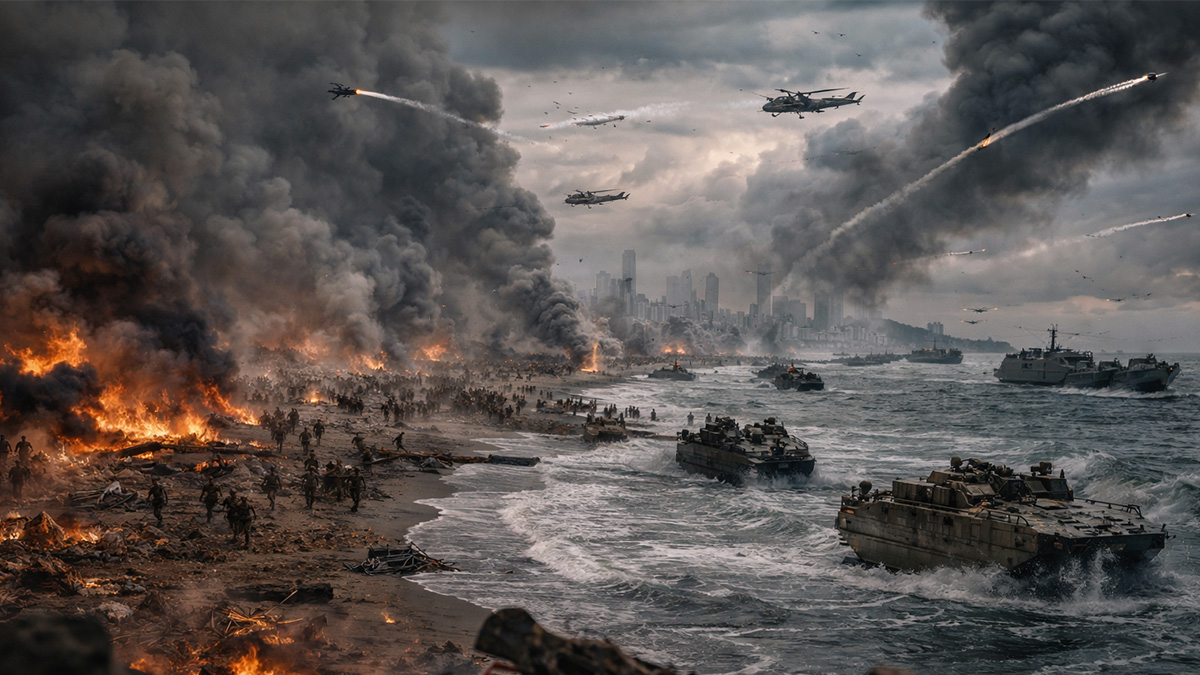
The terminal approach and beach phase in the scenario are analytically the most brutal because that is where visibility, geography, and disorganization combine. CNAS emphasizes that in the final 5 km run to shore, short-range drones, missiles, and rockets could exploit the fact that assault craft are slow, exposed, and increasingly separated from the integrated protective umbrella of the larger fleet. This aligns with Taiwan’s own official emphasis on ground defense in depth, the rapid fielding of attack drones such as the Altius-600M, and the institutional view that drones are “indispensable assets” for asymmetric warfare. If, by 2029, these systems are numerous, trained into units, and linked to local battle drills rather than treated as boutique adjuncts, the beach ceases to be the culmination of an amphibious assault and becomes its most dangerous exposure window. The invader’s hardest problem is not touching sand; it is exiting the beach in sequence, with command intact, engineering capacity available, heavy equipment unloaded, and follow-on waves still synchronized. In the user’s scenario, minefields at beach exits, drone-overwatch, disappearing strike teams, and wrecked landing craft turn the littoral into a compounding congestion trap. That is a plausible denial mechanism because amphibious success depends on tempo restoration after initial landing, not merely on surviving the crossing.
This yields five mutually exclusive strategic-driver explanations for what would determine the outcome of such a 2029 assault. Driver Set A is magazine economics: the side that forces the other into the worse expenditure ratio wins the approach battle. Driver Set B is electromagnetic resilience: if Taiwanese autonomous or semi-autonomous systems can continue functioning in degraded communications while PLA coordination suffers, the denial architecture hardens dramatically. Driver Set C is industrial depth: if procurement targets remain numerically insufficient, the concept remains elegant but porous; if mass production succeeds, quantity itself becomes tactical terrain. Driver Set D is air-denial persistence: even intermittent windows generated by shoot-and-scoot defenses may be enough to launch successive littoral strikes. Driver Set E is beach-exit paralysis: even a partially successful landing can still fail strategically if units cannot clear the shore, regroup, and drive inland. The crucial red-team counterfactual is that Beijing may try to solve this through overwhelming pre-assault missile bombardment, larger decoy packages, heavier helicopter usage, cyber disruption of civil-military coordination, and attempts to saturate Taiwan’s drone-control ecosystem before the fleet reaches the decisive bands. That counterargument cannot be dismissed; indeed, the DoD explicitly describes PRC options that include precision missile and air strikes against Taiwan’s air bases, radar sites, missile units, communications facilities, and broader political-military infrastructure. The “Hellscape” concept is therefore not a cheap substitute for hardening, dispersal, and resilience; it only works if embedded inside them.
The strategic conclusion, as of 28 March 2026, is that the user’s scenario is operationally plausible as a denial construct, but only conditionally plausible as a decisive war-winning construct. What is already official and verifiable is that Taiwan has moved further toward multi-domain denial, higher defense spending, asymmetric special budgeting, unmanned systems, AI-assisted kill chains, and whole-of-society resilience. What is also official and verifiable is that the PLA continues to prepare for a Taiwan contingency, continues amphibious and UAS-supported training, and continues coercive pressure around the island. The unresolved variable is therefore neither intent nor conceptual innovation; it is conversion speed. If by 2029 Taiwan has turned budgets into mass, doctrine, and repetition, then the invasion force in the user’s scenario could indeed encounter not a clean landing operation but a layered, low-cost, all-domain attritional environment severe enough to break chronology, confidence, and beachhead consolidation before Taipei is ever within operational reach. If that conversion stalls, however, “Hellscape” remains more deterrent narrative than battlefield reality. The central deterrence message to Beijing is thus simple: the closer Taiwan gets to fielding dense, resilient, autonomous denial in depth, the less an invasion resembles a campaign of conquest and the more it resembles a campaign of self-inflicted systems collapse.
The chart normalizes official baseline indicators onto a 0–100 comparison scale for visual readability only. The raw values used below are preserved in the table exactly as cited in the abstract.
| Indicator | Raw value | Unit / period | Normalization used in chart |
|---|---|---|---|
| Taiwan national defense budget | 949.5 | NT$ billion, 2026 | 75.96 / 100 (value ÷ 12.5) |
| MND planned budget | 806.0 | NT$ billion, 2026 | 64.48 / 100 (value ÷ 12.5) |
| Special budget ceiling for defense resilience and asymmetric capabilities | 1250.0 | NT$ billion, 2026–2033 | 100 / 100 (reference ceiling) |
| PLA aircraft entries into Taiwan ADIZ | 1641 | events, 2023 | 82.05 / 100 (value ÷ 20) |
| PLA aircraft crossings of Taiwan Strait centerline | 712 | crossings, 2023 | 35.60 / 100 (value ÷ 20) |
| Taiwan defense spending share of GDP | 3.32 | percent of GDP, 2026 | 66.40 / 100 (value × 20) |
Index
- The Mobilization Clock, Warning-Time Compression and the Real Force-Design Baseline Behind a 2029 Taiwan Strait Assault
- The 2029 Invasion Sequence: a phase-by-phase assessment of the user’s hypothetical assault, measuring where PLA timing, mass, electronic warfare, and amphibious coordination would likely fracture under layered denial.
- Deterrence, Attrition, and Decision Calculus: second-through-fifth-order consequences for Beijing, Taipei, regional allies, munitions economies, escalation ladders, and the credibility of denial by punishment versus denial by dislocation.
- Integrated Strategic Clarity Table — Taiwan 2029 Scenario (As of March 28, 2026)
The Mobilization Clock, Warning-Time Compression and the Real Force-Design Baseline Behind a 2029 Taiwan Strait Assault
The most important new datum for Chapter 1 is not the hypothetical assault geometry itself, but the fact that Taiwan’s own official defense establishment now states that the warning-and-transition interval before a PLA invasion is shrinking. The 2025 Quadrennial Defense Review says that the PRC is using legal warfare, frequent crossings of the median line, approaches toward 24 nautical miles from Taiwan’s shorelines, gray-zone incursions, cyberattacks, and cognitive warfare to change the status quo and wear down readiness. The same review states that the time of strategic warning for a PLA invasion has been reduced and that early warning signs are harder to identify, making the shift from peace to war “relatively rapid and ambiguous.” That sentence is analytically decisive because it means the center of gravity is no longer only platforms or inventories; it is mobilization speed under ambiguity.
That compression problem is reinforced by the most recent U.S. Department of Defense reporting. The 2025 China Military Power Report says China increased the scale, scope, and frequency of pressure activities against Taiwan from 2020 to 2024; in 2024 it raised PLA entries into Taiwan’s ADIZ to 3,067, up from 1,641 in 2023, and conducted 38 joint combat readiness patrols around Taiwan, effectively a near-weekly operational rhythm. The report also says those patrols are paired with named operations—JOINT SWORD-2024A and JOINT SWORD-2024B—that simulated blockading key ports, achieving maritime and air superiority, and launching precision strikes, while integrating China Coast Guard activity more deeply into the coercive pattern. This is not mere signaling theater. It is a rehearsal architecture for normalization: constant pressure as operational conditioning, not just episodic intimidation.
The strategic implication is that a future assault may begin well before the first missile, aircraft wave, or amphibious sortie. It may begin inside the defender’s decision cycle through accumulated ambiguity. The 2025 QDR states that battlespace transparency has increased because of commercial satellites, global communications, and positioning systems, and therefore military forces must prioritize concealment, camouflage, signature management, and the ability to disperse and reassemble quickly under fire. This means that a Taiwan scenario built around dense uncrewed attrition does not stand or fall first on spectacular tactical innovation; it stands or falls on whether the force can survive the pre-assault surveillance-and-exhaustion regime long enough to enter the decisive littoral fight intact.
A second new data point, and arguably the most consequential budgetary development, is that Taiwan’s Ministry of National Defense has moved beyond general pro-asymmetry language into a structured multi-year funding architecture. The MND says Taiwan’s 2026 national defense budget, using NATO standards, reaches NT$949.5 billion, or 3.32 percent of GDP, of which the MND-planned budget is NT$806 billion, up NT$161.1 billion or 25 percent from 2025. It also specifies that the allocation includes annual budget, fund budget, special budget for new fighters and sea-air combat enhancement, and additional special budgets for resilience and asymmetric force. That is not a cosmetic increment. It marks a transition from incremental preparedness to deliberate wartime-shaping expenditure.
Even more important than the topline is the internal structure of the new special funding. On 26 November 2025, the MND announced that the “Special Budget for Enhancing Defense Resilience and Asymmetric Capabilities” would run from 2026 to 2033 with an estimated ceiling of NT$1.25 trillion. The procurement categories listed by the ministry are unusually revealing: precision artillery, long-range precision strike missiles, air defense / anti-ballistic / anti-armor missiles, unmanned vehicles and countermeasure systems, equipment to enhance sustained combat capabilities, AI-assisted and C5ISR systems, and systems jointly developed or procured with the United States. The ministry further states that the package is designed to construct a multi-layered defense system, introduce AI to accelerate the kill chain, and build a non-red supply chain. This is the closest official articulation yet of a force-design logic built for distributed attrition, resilient command, and sustained denial rather than prestige-force symmetry.
That budget structure also reveals a deeper institutional shift: Taiwan is no longer treating unmanned systems as an accessory category. It is embedding them inside a broader combat system that links magazine depth, sensing, command support, industrial policy, and supply-chain sovereignty. The phrase “non-red supply chain” matters here because a denial strategy that depends on rapid replacement of drones, communications nodes, batteries, optics, and software stacks cannot remain vulnerable to upstream dependencies penetrable by the very adversary it is designed to resist. The 2025 QDR separately states that the MND is promoting defense industrial cooperation with strategic and international partners, implementing security criteria for suppliers, and encouraging domestic firms to obtain production licenses and technology-transfer authorizations to join that non-red supply chain. This moves the center of gravity from weapons procurement alone to wartime replenishment autonomy.
A third decisive baseline change is doctrinal and organizational rather than merely fiscal. The MND’s policy page on asymmetric capabilities says the force is guided by four principles: developing asymmetric capabilities, enhancing operational resilience, strengthening reserve forces, and bolstering gray-zone response capacity. That formulation matters because it explicitly binds the battlefield to the pre-battlefield. In other words, the same force that must survive a landing campaign must also endure legal warfare, militia harassment, cyber pressure, disinformation, and constant air-maritime probing without exhausting its readiness beforehand. This makes reserve integration and societal endurance integral to force design rather than peripheral homeland-defense questions.
The fourth new datum is that Taiwan’s political leadership is now institutionalizing whole-of-society resilience with more operational seriousness than before. The Office of the President states that the Whole-of-Society Defense Resilience Committee exists to build a stronger and more robust democratic society capable of safeguarding national security and maintaining regional peace and stability. It also states the committee is intended to serve as a platform for social participation, a bridge for social communication, and an engine for policy effectiveness. By 27 March 2025, President Lai Ching-te had already observed field exercises involving over 1,500 participants from central and local government and the private sector, using scenarios without scripts and incorporating expanded emergency medical facilities. This matters because the decisive test in an invasion contingency is not whether the military can fight in isolation; it is whether communications, transport, medicine, civil defense, and local administration can continue operating while kinetic and cognitive pressure are applied simultaneously.
A fifth new development is that Taiwan’s drone posture is no longer purely aspirational. On 5 August 2025, the MND announced that the first batch of Altius-600M attack drone systems had been delivered to the ROC Army. In the same release, Minister of National Defense Koo Li-hsiung said drones are increasingly indispensable assets for asymmetric warfare and that the armed forces would continue to procure surveillance and attack drones, while using the Defense Innovation Office to assess emerging technologies and integrate them into capability development. This is significant not because one drone type solves the problem, but because it demonstrates movement from concept advocacy to fielded inventory, immediate combat readiness, and doctrine-adjacent bureaucratic adaptation.
Taken together, these official sources point to five mutually exclusive but competing explanations for whether Taiwan will have a credible denial architecture by 2029.
The first explanation is conversion success: the budgets, committee structures, industrial partnerships, and early drone deliveries all represent the front end of a genuine transformation, and by 2029 the armed forces could field enough distributed, replaceable, AI-enabled, and resilient systems to make a large amphibious crossing operationally chaotic from the outset. This explanation is supported by the scale and specificity of the 2026–2033 special budget and by the explicit ministry language about multi-layered defense, kill-chain acceleration, and non-red supply chains.
The second explanation is partial conversion with lethal shortfalls: Taiwan may adopt the language, procure some systems, and improve resilience, but still fail to achieve sufficient density in munitions, drones, counter-drone systems, mobile air defense, and sustainment. Under this explanation, the defense becomes more modern yet still too thin to stop a determined assault at scale. The official documents themselves imply this risk by emphasizing sustained combat capability, supplier security, and operational resilience—categories that would not require such emphasis if the bottleneck were already solved.
The third explanation is pre-assault degradation: the decisive battle may be lost not in the strait but in the months before it, if near-weekly patrols, air-maritime incursions, cyberattacks, cognitive warfare, and legal warfare succeed in normalizing crisis conditions and degrading readiness faster than reforms can restore it. This driver set is strongly supported by the QDR’s warning-time compression language and by the DoD’s documented rise in patrol frequency and named coercive operations.
The fourth explanation is industrial friction: the key determinant may not be whether drones are tactically effective, but whether Taiwan and partners can produce, secure, update, and replace them under wartime conditions without upstream compromise. That interpretation follows directly from the official emphasis on supplier vetting, technology transfer, and non-red supply chains. In this frame, the war is partly decided in factories, software update cycles, component sourcing, and repair throughput.
The fifth explanation is societal endurance as warfighting capability: even if the military fight is tactically favorable, a coercive campaign could still succeed if transport, medicine, information trust, local governance, and reserve mobilization fracture under sustained pressure. The establishment and exercise schedule of the Whole-of-Society Defense Resilience Committee indicates that Taiwan is increasingly treating this as a warfighting variable rather than a humanitarian afterthought.
The red-team counterfactual is serious. The PLA is not static. The 2025 China Military Power Report says the PLA is training and exercising around Taiwan to improve readiness for contingencies while delaying or denying third-party involvement; it also describes pressure activity that includes China Coast Guard integration and simulated blockade and strike operations. The 2025 QDR adds that the PLA may employ amphibious vessels supported by requisitioned civilian Roll-on/Roll-off ships and helicopters, while using strategic weapons to deter or strike neighboring bases to prevent intervention. If that force can combine pre-assault suppression, operational deception, massed missile fire, cyber disruption, and rapid exploitation, then even a more resilient defender could still face localized rupture.
The Chapter 1 conclusion is therefore precise: as of 28 March 2026, the decisive variable is not whether Taiwan understands the need for asymmetric defense. Officially, it does. The decisive variable is whether Taiwan can convert compressed warning time into faster mobilization, convert large budgets into dense operational mass, convert drone procurement into doctrine and repetition, and convert societal resilience into sustained command continuity before Beijing judges that the denominator of risk has shifted in its favor. On the current official baseline, the contest is no longer between abstract porcupine theory and conventional orthodoxy. It is between time-compression imposed by the PLA and adaptation-compression pursued by Taiwan. Whichever side compresses more effectively will shape the opening conditions of any future strait war.
This infographic summarizes the official 2025–2026 baseline relevant to a future Taiwan Strait invasion scenario: coercive tempo, fiscal mobilization, asymmetric-capability architecture, and societal resilience.
Coercive Tempo Shift
Fiscal and Procurement Architecture
Strategic Node Map
Interpretive Readout
| Indicator | Official value | Period | Why it matters |
|---|---|---|---|
| Taiwan defense budget | NT$949.5 bn | 2026 | Indicates accelerated mobilization of national resources toward defense. |
| MND planned budget | NT$806 bn | 2026 | Shows direct ministry-controlled expansion in force generation. |
| Special asymmetric budget ceiling | NT$1.25 tn | 2026–2033 | Funds missiles, unmanned systems, AI-assisted C5ISR, and resilience. |
| PLA ADIZ entries | 3,067 | 2024 | Reflects growing operational pressure and normalization of coercive tempo. |
| PLA ADIZ entries | 1,641 | 2023 | Provides baseline for year-on-year surge in pressure activity. |
| Joint combat readiness patrols | 38 | 2024 | Suggests near-weekly integrated operations rehearsing Taiwan contingencies. |
| Whole-of-society field exercise participation | 1,500+ | March 2025 | Indicates practical institutionalization of national resilience drills. |
The 2029 Invasion Sequence — Where PLA Tempo, Mass, EW, and Amphibious Synchronization Most Likely Fracture Under Layered Denial
A phase-by-phase assessment of the user’s 2029 scenario should begin with a hard doctrinal constraint drawn from official U.S. Department of Defense reporting: the PLA’s preferred invasion construct is the Joint Island Landing Campaign, and that campaign is described as a complex operation requiring coordinated, interlocking efforts in electronic warfare, logistics, air support, and naval support to break or bypass shore defenses, establish a beachhead, build combat power on Taiwan’s western coastline, and seize key targets. The same report stresses that a large-scale amphibious invasion would be among the most difficult operations the PLA could attempt, because it requires air and maritime superiority, rapid buildup and sustainment of supplies ashore, and uninterrupted support. That official framing is analytically decisive, because the user’s layered-denial scenario does not need to destroy every ship to succeed; it only needs to fracture one or more of those interlocking functions faster than the PLA can restore them.
The key to this chapter is therefore not a binary question of whether China can place hulls in the water. The more important question is whether the assault can preserve temporal coherence from the first hours of preparation through the first days of landing. In amphibious warfare, chronology is itself a weapon system. The first echelons must arrive on schedule; escorts must remain on station; air cover must stay synchronized with maritime movement; suppressive fires must keep defenders pinned at the correct times; engineering and logistics units must survive long enough to open exits and sustain follow-on waves. The official DoD baseline implies that if any one of those synchronized functions is broken repeatedly, the invasion’s mass begins to work against it by creating congestion, predictability, and ever-larger sustainment requirements.
Phase I: Pre-H-Hour Battlespace Conditioning and the Failure Point of False Normality
The opening phase of a real assault would probably not resemble a cinematic first salvo. Official Taiwanese and U.S. reporting instead suggests a blurred onset. The 2025 Quadrennial Defense Review says the PRC is already using legal warfare, air and maritime incursions, cyberattacks, joint exercises, and cognitive warfare to test and exhaust Taiwan’s combat preparation and training results while expanding psychological intimidation. The same review states that peace-to-war transition is becoming more rapid and ambiguous. In parallel, the 2025 China Military Power Report says Beijing used a whole-of-government pressure campaign in 2024, and that the PLA normalized named exercises, reserve airspace closures, and large surges of naval and coast guard forces around Taiwan. That means the most dangerous opening fracture may lie in ambiguity management: if preparatory coercion is indistinguishable from yet another pressure spike until too late, then sortie generation, reserve recall, dispersal, and the activation of denial systems may all start behind schedule.
Under the user’s hypothetical 2029 sequence, the first analytical question is whether Taiwan can deny the invader a “clean” transition from coercion to kinetic action. The QDR states that upon credible signs of invasion, the MND would immediately issue reserve recall orders and activate all-out mobilization mechanisms. It also stresses realistic drills, interagency coordination, and rapid transition to combat-ready status. This implies that Taiwan’s first line of defense is not a missile battery or a drone swarm but a mobilization trigger discipline able to treat abnormal PLA activity as operational warning rather than background noise. If that trigger is late, every later denial layer starts thinner than designed. If that trigger is early enough, the invader loses one of its greatest advantages: the ability to exploit normalized gray-zone behavior as camouflage for war initiation.
The first fracture point for the PLA in this phase is therefore political-operational ambiguity, not attrition. The PRC can benefit from ambiguity only until the defender stops treating it as ambiguity. Once reserve recall, dispersal, deception, stockpiling, and civil-military protection of communications and infrastructure begin in earnest, the attacker faces a materially different battlespace. The 2025 China Military Power Report notes that Taiwan’s Whole-of-Society Defense Resilience program is explicitly designed to protect communication and financial networks, secure infrastructure, improve medical and evacuation systems, and train large numbers of civilians. This is important because an invasion timetable is easier to preserve against a brittle opponent than against one that becomes progressively harder to paralyze in the first twenty-four hours.
Phase II: Strait Entry, Escort Saturation, and the Failure Point of Overextended Protection
Once the invasion fleet commits to crossing, the assault enters the first truly unforgiving phase: the point at which mass ceases to be latent power and becomes exposed geometry. Official DoD reporting says the PLA has expanded amphibious and civilian-military integration training, including loading vehicles onto civilian roll-on/roll-off vessels, conducting sea crossings, and unloading after transit. It also states that the PLA Joint Logistic Support Force exists precisely to integrate military logistics with civilian transportation, warehousing, and delivery networks, and that it is central to campaign-scale support in a Taiwan contingency. Those are strengths, but they are also dependencies. A crossing force that includes amphibious ships, escorts, logistics enablers, and requisitioned civilian shipping becomes operationally efficient only so long as its protective envelope remains coherent.
In the user’s scenario, this is where autonomous undersea attacks, decoys, cruise missiles, drone boats, and multidirectional aerial swarms begin to scatter formations. The official baseline does not confirm that such a precise future engagement will occur, but it does establish the critical logic behind why this phase is fragile: the PLA invasion concept depends on tightly coordinated EW, logistics, and air-maritime support; the fleet must maintain enough order to preserve schedule, magazine discipline, and screening integrity. Once escorts start diverting to antisubmarine warfare, counter-drone defense, damage control, or rescue, they are no longer purely escorting the timetable. They are servicing emergent disorder. The difference matters because an amphibious convoy is not just a collection of hulls. It is a moving schedule. Each diversion multiplies timing error across the formation.
The second fracture point here is defensive expenditure asymmetry. Even if Chinese warships destroy large numbers of incoming systems, layered denial can still succeed if it forces premium interceptors, radar attention, and maneuver bandwidth to be spent on cheap or ambiguous threats. Official Taiwanese planning language on the 2026–2033 special budget is revealing because it emphasizes a multi-layered defense system, AI-accelerated kill chains, multi-level attrition, and unmanned vehicles and countermeasure systems. Those official categories suggest Taiwan’s procurement logic is moving toward exactly this exchange-ratio problem: forcing the attacker to spend more defensive effort, attention, and inventory than the defender spends to create each wave of disruption. If that logic matures by 2029, the outer-strait fight becomes less about sinking capital ships outright and more about forcing the protective screen to defend in every direction at once.
A third fracture point in this phase is information reliability under EW. The DoD states that the PLA views electronic warfare as an integral component of modern warfare and ties its broader C4ISR architecture to achieving information superiority in support of long-range joint fires. That means the invader will attempt to jam, deceive, blind, and isolate the defender. But the same dependence cuts both ways. A heavily networked, tightly choreographed amphibious movement is also vulnerable to degraded tracking, reporting lag, false contacts, and command friction inside its own force. The more the invasion relies on a synchronized common operating picture, the more damaging local uncertainty becomes. A defender that uses semi-autonomous attack logic, pre-authorized kill boxes, passive sensing, and decentralized launch authority may therefore gain relative advantage precisely in the periods when both sides are electronically degraded, because the side with simpler terminal tasks often tolerates uncertainty better than the side executing a schedule-bound multi-domain maneuver. This is an inference from the official force descriptions, but it is a strong one.
Phase III: The Mid-Strait to Inner-Littoral Compression Zone and the Failure Point of Predictable Routes
The next phase begins when the invasion force leaves open-water spacing and enters a more compressed geometry closer to the landing areas. This is where the user’s scenario places mines, drone-laid obstacles, medium-range attack drones, and repeated salvos against ships funneled into killing lanes. The official baseline does not publicly detail the exact future density or location of such minefields, but it does establish the structural condition that makes them dangerous: an amphibious invasion succeeds only if supplies, personnel, and combat power can be built up onshore rapidly and without interruption. Any mechanism that forces landing craft and follow-on ships into narrower routes, slower speeds, repeated halts, or clearance drills attacks not just survivability but throughput.
Throughput is the correct analytical lens here. Amphibious operations do not fail only when ships sink; they also fail when the flow of usable combat power falls below what is needed ashore. Clearance delays, hesitation in mined waters, escort diversions, wave deconfliction problems, and route channelization all reduce the number of troops, vehicles, and engineering assets that arrive in usable sequence. This is where the PLA’s logistics achievements become paradoxically fragile. The JLSF may be central to enabling large-scale operations, but a logistics system optimized for campaign support is still vulnerable to serial interruption at the tactical transfer points where ships must offload, helicopters must land, and routes must be proven safe. A logistics architecture is strongest in depth and scale; it is weakest at bottlenecks. The littoral is a bottleneck machine.
The fourth fracture point in this phase is route predictability. Once mines, damage, and defensive fires narrow the available approaches, even large forces begin to behave like queued traffic rather than maneuver formations. Queue behavior amplifies lethality for the defender because the next likely approach can be anticipated with fewer sensing demands. It also amplifies fear, because crews and embarked troops can observe the consequences of delay and channelization ahead of them. Official Taiwanese documents emphasize AI, counter-UAV systems, and operational resilience, while the QDR emphasizes flexible, agile, and reactive capabilities. The relevance to this phase is that layered denial does not require a perfect national picture of the entire strait. It requires enough local persistence and reactivity to keep rediscovering where the attacker has been forced to go next.
A fifth fracture point in the compression zone is helicopter vulnerability. The official DoD description of invasion risk repeatedly emphasizes the need for air and maritime superiority and uninterrupted support. If fighters and helicopters are forced into more cautious standoff patterns by mobile air defense, dispersed fires, and uncertainty over aerial threats, then the assault loses one of the fastest methods for restoring schedule and bypassing damaged or congested sea approaches. The PLA can compensate partially through mass and repeated sorties, but every extra sortie under contested conditions further taxes synchronization, deconfliction, fuel planning, and recovery cycles. That is why this phase is better understood as a contest over tempo elasticity: can the attacker stretch its schedule and still preserve operational purpose, or does every delay create a larger mismatch between planned and actual combat power at the landing point? Official reporting strongly suggests the latter risk is serious.
Phase IV: Final Approach to the Beaches and the Failure Point of Visible Vulnerability
The user’s scenario next compresses the surviving force into the final kilometers before touchdown. This phase is uniquely dangerous because many of the attacker’s previous forms of protection become less efficient precisely as exposure becomes more intimate. Large-area air defense, outer escort screens, and long-range fires matter less when slow landing craft must close on visually observable beaches, maintain headings, lower ramps, and expose crowded decks. Official DoD reporting states that even assuming a successful landing and breakout past beachhead defenses, the operation would remain politically and militarily risky due to inevitable attrition, determined resistance, and the complexity of urban warfare. That wording matters because it acknowledges that the decisive violence may begin after the fleet has already accomplished what outside observers might mistakenly call “the hard part.” In reality, reaching the beach only exchanges one vulnerability profile for another.
This is where the user’s proposed use of FPV drones, short-range missiles, rooftop strike teams, and fleeting pop-up fires becomes analytically credible. The official MND line that drones are indispensable for asymmetric warfare and that attack drones have already entered army inventory suggests the institution is moving toward accepting drones as direct firepower rather than merely surveillance tools. If that evolution continues, the final approach may become a zone where Taiwanese units no longer depend primarily on large signature emitters or exposed missile batteries. Instead, they can multiply small, rapidly concealed, locally controlled attack nodes whose value lies in ambush persistence. Against slow-moving, route-bound craft, that is exactly the kind of geometry that converts shoreline visibility into kill potential.
The sixth fracture point here is embarked troop degradation before disembarkation. Amphibious doctrine tends to assume that once forces reach the shore, the defender’s opportunity is narrowing. But the opposite may be true if troops arrive already disorganized by repeated alarms, course changes, damage, delayed sequencing, missing commanders, destroyed communications, or the loss of specific vehicles and breaching equipment. The official DoD report emphasizes that success depends on uninterrupted support and rapid onshore buildup. A force that touches sand without coherent command, engineering tools, intact communications, and synchronized follow-on waves has not solved the problem of assault; it has simply relocated the problem onto a narrower strip of terrain.
Phase V: Beach Exit, Sustainment, and the Failure Point of the Interrupted Breakout
The final and most decisive phase is not the landing itself but the breakout from the beach. Official DoD reporting states that the objective of the invasion campaign is not merely to establish a beachhead but to build combat power along Taiwan’s western coastline and seize key targets or the entire island. That means the invasion fails strategically unless the beach becomes a functioning logistics and maneuver gateway. In the user’s scenario, minefields at exits, wrecked craft, drone overwatch, and persistent strikes on trapped troops convert the beach into a cul-de-sac. This is analytically persuasive because beaches are not just landing zones; they are transfer nodes. If exits stay blocked or contested, the force ashore consumes ammunition, medical capacity, and command attention faster than it expands inland.
This phase exposes the sharpest contradiction inside the invasion concept: the PLA needs mass ashore, but ashore mass is only useful if it can be turned into inland maneuver and sustained combat power. The more damaged and cluttered the landing area becomes, the harder it is to unload follow-on echelons, evacuate casualties, recover vehicles, distribute fuel, and establish command posts. The JLSF can support campaign logistics, but no logistics system can wish away physically blocked exits, burning hulks, cratered transfer points, or repeated low-cost drone harassment over a tightly congested node. That is why the beach is the point where attrition becomes architecture. Damage is no longer just a matter of destroyed equipment; it becomes part of the terrain that prevents the next echelon from functioning.
The seventh fracture point in this final phase is cumulative dis-sequencing. An invasion force can survive losses and still succeed if critical functions arrive in the right order. It is much less tolerant of the wrong functions arriving first. Infantry without breaching assets, armor without fuel, engineers without security, air defense without ammunition, or commanders without communications all represent “present but unusable” combat power. The user’s scenario correctly stresses scattered arrival, missing commanders, and absent heavy equipment, because amphibious success depends not only on how much lands but on whether the correct bundles land together. The official DoD description of the invasion’s dependence on interlocking campaigns and uninterrupted support directly supports this logic. The most lethal outcome for the attacker is not necessarily mass destruction at sea; it is partial survival in the wrong sequence.
Five Mutually Exclusive Explanatory Frameworks for Where the 2029 Assault Would Break
The first framework is temporal fracture. Under this explanation, the invasion fails because each defensive layer imposes delay faster than the PLA can recover schedule. The decisive indicator is not ship loss alone but cumulative slippage between intended and actual arrival times for escorts, landing waves, and support elements. This framework best fits official descriptions of the invasion as a tightly coordinated joint campaign dependent on uninterrupted support.
The second framework is screen-collapse fracture. Here, the decisive break comes when escorts can no longer protect transports against simultaneous underwater, surface, aerial, and electronic threats. The assault remains numerically large, but its protection architecture becomes too thin in too many directions at once. This framework follows directly from the official requirement for air and maritime superiority and the broader PLA emphasis on integrated joint operations.
The third framework is logistics-bottleneck fracture. In this interpretation, the invasion is not defeated by dramatic destruction in blue water but by repeated interruptions at the loading, crossing, offloading, and beach-exit stages. The JLSF and civilian logistics integration create impressive campaign reach, but the littoral transfer points remain unforgiving chokepoints.
The fourth framework is information-friction fracture. Here, the key break occurs because EW, jamming, false contacts, damaged sensors, and reporting lag degrade the attacker’s synchronization more than the defender’s decentralized denial architecture. The side executing the more complicated schedule suffers more from uncertainty. Official reporting on the PLA’s dependence on C4ISR, EW, and joint command makes this a plausible fault line.
The fifth framework is beachhead-nonconversion fracture. In this view, the PLA may achieve tactical landing on some beaches yet still fail operationally because the force ashore cannot convert presence into breakout, resupply, and inland seizure of decisive objectives. This framework is the most consistent with the official acknowledgment that even after landing and breaking past beach defenses, the operation would remain subject to determined resistance, urban warfare, and political-military risk.
Red-Team Counterfactual
A serious red-team view must acknowledge that the PLA could try to solve many of these problems before the crossing begins. Official DoD reporting states the PRC has options short of invasion, including blockade, joint firepower strikes, EW, network attacks, information operations, and limited force campaigns against political, military, and communications targets. A smart attacker would try to combine those tools to suppress air defense, fracture communications, degrade reserve mobilization, disable port and coastal infrastructure, and confuse the defender about which beaches or even which campaign form is primary. The counterargument, then, is that a layered denial scheme may never get to fight its ideal battle if it is partially blinded and disorganized in the opening hours. That is a valid challenge. But it still does not eliminate the core vulnerability identified by official sources: a large-scale amphibious invasion remains an exceptionally difficult operation whose success depends on synchronized support, rapid onshore buildup, and sustained tempo. The more the defender preserves even partial resilience into the landing phase, the more those structural vulnerabilities reassert themselves.
The Chapter 2 conclusion is therefore clear. In the user’s 2029 invasion sequence, the most likely breaking points are not singular moments of catastrophic fleet destruction. They are sequential fractures in coherence: first ambiguity management, then escort overextension, then route compression, then final-approach vulnerability, then beachhead nonconversion. Official U.S. and Taiwanese documents support the underlying logic that the PLA can assemble formidable mass, powerful EW, and improving amphibious support, while also remaining exposed to commander proficiency gaps, long-distance logistics strain, urban warfare difficulty, and the extreme coordination burden inherent in invasion. A layered denial concept becomes credible not because it is guaranteed to annihilate the assault at one distance band, but because it attacks the specific functions the official record says the invasion cannot succeed without.
This dashboard converts the chapter’s phase-by-phase analysis into a visual stress test: where a large-scale amphibious assault is most likely to lose coherence under layered denial.
Phase Fracture Risk
Function Dependency Stress
Five Operational Phases
Coherence Decay Curve
| Phase | Main PLA requirement | Main denial mechanism | Likely fracture output |
|---|---|---|---|
| Pre-H-Hour | Ambiguity exploitation and suppression of mobilization | Early reserve recall, dispersal, infrastructure protection | Loss of surprise in transition timing |
| Crossing | Escort integrity and schedule preservation | Multi-axis cheap threats, decoys, underwater disruption | Screen overextension and timing slip |
| Compression zone | Predictable throughput into landing corridors | Mines, route channelization, repeated local strikes | Bottlenecks and wave dis-sequencing |
| Final approach | Protected disembarkation close to shore | FPV drones, short-range missiles, ambush teams | Embarked troop degradation before landing |
| Beach breakout | Rapid inland conversion of combat power | Blocked exits, overwatch drones, wreck congestion | Beachhead nonconversion and sustainment failure |
Deterrence, Attrition, and Decision Calculus — Second-Through-Fifth-Order Consequences for Beijing, Taipei, Regional Allies, Munitions Economies, Escalation Ladders, and the Credibility of Denial by Punishment versus Denial by Dislocation
The strategic consequence of a successful Taiwanese layered-denial concept in 2029 is not only that an amphibious landing becomes harder; it is that Beijing’s preferred menu of coercive options becomes less cleanly separable. The U.S. Department of Defense assesses that the PLA maintains multiple military pathways against Taiwan—including a Joint Firepower Strike Campaign, a Joint Blockade Campaign, and a Joint Island Landing Campaign—and that in 2024 it exercised essential components of these options, including simulated blockades, precision strikes, and operations designed to delay or deny third-party involvement Annual Report to Congress: Military and Security Developments Involving the People’s Republic of China – U.S. Department of Defense – December 2025. If a beach assault is transformed into a high-chaos, high-loss, low-tempo undertaking, the second-order effect is that Beijing is pushed away from the image of a short, decisive fait accompli and toward a choice among slower, more visible, more economically disruptive coercive forms. That shift matters because deterrence becomes less about whether China can initiate war and more about whether it can still control the tempo, scope, and political narrative of war once denial begins to dislocate its choreography.
That is where the distinction between denial by punishment and denial by dislocation becomes analytically decisive. Punishment seeks to deter by threatening painful retaliatory costs—strikes, losses, sanctions, or broader escalation—after aggression has begun. Dislocation seeks to deter by demonstrating that the aggressor’s operational design will not function as intended, even if the aggressor is willing to absorb losses. Official Taiwanese planning language now leans much more heavily toward the second logic. The MND’s 2026–2033 special budget explicitly states that it is meant to construct a multi-layered defense system, accelerate the kill chain with AI, support multi-level attrition, enhance operational resilience, and build a non-red supply chain Ministry of National Defense Issues Press Release on “Special Budget for Enhancing Defense Resilience and Asymmetric Capabilities” – Taiwan MND – November 2025. The deeper significance is that Taipei is signaling a theory of victory based less on symmetric retaliation against the mainland and more on breaking the invasion’s sequencing, throughput, and sustainment. If that signal becomes credible by 2029, then the deterrent message to Beijing is not merely “you will suffer,” but “you may fail without ever reaching a stable military-political position from which suffering can be redeemed by strategic gain.”
For Beijing, the second-through-fourth-order consequences of that shift are severe. First, a dislocation-heavy defender increases the probability that an invasion generates visible military disorder rather than images of inexorable momentum. Second, visible disorder undermines the political utility of force, because the regime’s domestic and external audience sees not clean coercive dominance but prolonged friction. Third, prolonged friction enlarges the window for sanctions, alliance coordination, maritime insurance shocks, financial de-risking, and third-party military positioning. Fourth, a longer and more visibly disordered campaign intensifies the contradiction between CCP prestige and operational uncertainty. Official Japanese strategy documents are important here because they show that Taiwan Strait instability is already treated not as a remote contingency but as a direct regional security problem. Japan’s National Defense Strategy states that China has intensified coercive military activities around Taiwan, that concerns about peace and stability in the Taiwan Strait are rapidly growing, and that such activity presents an unprecedented and the greatest strategic challenge to Japan’s security environment National Defense Strategy – Ministry of Defense of Japan – December 2022. In other words, the more an invasion drags and degrades, the more it ceases to be a bilateral PRC–Taiwan episode and becomes a systemic Indo-Pacific crisis.
For Taipei, the logic cuts both ways. A credible denial architecture raises deterrence, but it also changes the state’s peacetime obligations. The 2025 Quadrennial Defense Review says the warning interval before a PLA invasion has been compressed and that the transition from peace to war may be rapid and ambiguous 2025 Quadrennial Defense Review – Taiwan MND – March 2025. That means deterrence is not just an acquisition problem; it is a readiness-governance problem. If Taiwan chooses dislocation, it must fund stockpiles, reserve responsiveness, concealment, dispersal, infrastructure redundancy, civil protection, and repair capacity with the same seriousness it funds missiles and drones. The official 2026 defense budget posture shows movement in that direction: Taiwan’s MND states the national defense budget, under NATO-style accounting, reaches NT$949.5 billion or 3.32 percent of GDP National Defense Budget – Taiwan MND – 2026. The strategic implication is that once Taipei accepts denial by dislocation as its main wartime logic, it also accepts a more expensive peacetime discipline: every weak link in mobilization, logistics, social resilience, or industrial replacement becomes part of deterrence itself.
That leads directly to the fifth-order societal consequence: deterrence becomes partly civilianized. The DoD says President Lai’s Whole-of-Society Defense Resilience effort integrates government agencies, non-governmental organizations, and corporations across five pillars—civilian training, stockpiling critical materials, infrastructure security, medical and evacuation systems, and protection of communication and financial networks—and adds that the administration has set a goal of training 400,000 citizens to contribute to societal resilience Annual Report to Congress: Military and Security Developments Involving the People’s Republic of China – U.S. Department of Defense – December 2025. The Office of the President further states that the first field exercises in March 2025 involved over 1,500 participants from central and local government and private-sector entities, and that the goal is to rely not only on the armed forces but on the forces of defense resilience throughout society President Lai observes 2025 Whole-of-Society Defense Resilience Committee field exercises – Office of the President, ROC (Taiwan) – March 2025. The deeper consequence is that a successful denial strategy makes invasion harder, but it also turns civil defense competence, emergency medicine, energy continuity, and communications trust into strategic variables. A society that cannot keep essential systems running under attack will struggle to convert tactical denial into political endurance.
For regional allies, the central effect is alliance activation by graduated necessity rather than by single dramatic trigger. The White House and Japan stated in February 2025 that peace and stability across the Taiwan Strait are indispensable to the security and prosperity of the international community and opposed unilateral changes to the status quo by force or coercion United States-Japan Joint Leaders’ Statement – The White House – February 2025. Japan’s National Defense Strategy separately states that China’s coercive military activities around Taiwan are a matter of serious concern for Japan and the international community and explicitly links Taiwan-related instability to the security of Japan itself National Defense Strategy – Ministry of Defense of Japan – December 2022. The second-order implication is not automatically that allies intervene kinetically on day one; it is that a prolonged, dislocated invasion sharply raises the probability of allied intelligence support, logistics hardening, force dispersal, sanctions alignment, maritime coordination, rear-area preparation, and political declarations that narrow Beijing’s room for controlled escalation. The more the invasion becomes protracted and visibly uncertain, the more allied policy can evolve from declaratory concern to operational preparation without immediately crossing into maximal-war thresholds.
The munitions-economy consequence is equally important and often underestimated. A denial strategy based on layered attrition can be tactically elegant and still fail if replacement rates collapse. Official DoD data on allied armaments expansion show how quickly modern war pushes production into strategy. In January 2025, the department stated that the United States had invested $5.5 billion to expand domestic production capacity and that monthly output had risen from 14,400 to 40,000 for 155mm projectiles, from 833 to 1,167 for GMLRS, from 175 to 200 for Javelin, and from 21 to 48.6 for PAC-3 MSE Fact Sheet on Efforts of Ukraine Defense Contact Group National Armaments Directors – U.S. Department of Defense – January 2025. In September 2023, DoD also said 155mm output was expected to reach 80,000–100,000 rounds per month by the late-2025 timeframe National Armaments Directors Meet in Support of Ukraine – U.S. Department of Defense – September 2023. For a Taiwan contingency, the strategic lesson is not simply “make more shells.” It is that industrial throughput, subcomponent security, transport capacity, repair pipelines, and multinational co-production determine whether denial remains credible beyond the opening weeks. A force designed to dislocate an invasion needs an economy designed to replenish dislocation.
This is also where Taiwan’s own special budget reveals a broader industrial ambition than simple procurement. The MND says the 2026–2033 package is meant not only to buy weapons but to increase armament capacity and generate national-defense-driven economic benefits while building a non-red supply chain Ministry of National Defense Issues Press Release on “Special Budget for Enhancing Defense Resilience and Asymmetric Capabilities” – Taiwan MND – November 2025. That matters because the fifth-order consequence of a serious denial posture is industrial restructuring. Capital allocation shifts toward batteries, optics, autonomy software, propulsion, secure communications, repair depots, dispersed warehousing, and dual-use manufacturing. In effect, deterrence starts to reorganize the state’s political economy. The result is a paradox: the more credible Taiwan’s denial posture becomes, the more it may need to look like a semi-mobilized innovation and sustainment ecosystem even in peacetime.
The escalation ladder also changes under a dislocation model. If Beijing concludes that a rapid landing campaign is unlikely to remain rapid, it may prefer earlier resort to blockade, joint firepower strike, cyber disruption, information operations, political warfare, or coercive economic strangulation. The DoD explicitly states that China could employ a Joint Blockade Campaign lasting weeks or months while conducting missile strikes, possible seizures of offshore islands, and concurrent electronic warfare, network attacks, and information operations to isolate the island and shape the international narrative Annual Report to Congress: Military and Security Developments Involving the People’s Republic of China – U.S. Department of Defense – December 2025. The same report states China’s nuclear stockpile remained in the low 600s through 2024 and that the PLA remains on track to have over 1,000 warheads by 2030 Annual Report to Congress: Military and Security Developments Involving the People’s Republic of China – U.S. Department of Defense – December 2025. The implication is not that a Taiwan war automatically goes nuclear; it is that as conventional success becomes less assured, coercive signaling options above and below the conventional threshold become more valuable to Beijing. Denial by dislocation may lower the probability of a clean amphibious success while raising the salience of prolonged blockade, strategic intimidation, and nuclear-backed coercive shadowing.
A related consequence concerns U.S. security assistance and alliance signaling. Official DSCA records show that in 2025 Washington notified Congress of possible sales to Taiwan involving ALTIUS-700M and ALTIUS-600 systems, HIMARS, M107A7 self-propelled howitzers, Javelin, TOW, and Harpoon missile repair follow-on support Major Arms Sales – Defense Security Cooperation Agency – December 2025. The consequence is strategic selectivity: the portfolio tilts toward mobility, precision fires, sustainment, and expendable or attritable systems rather than toward a purely prestige-platform logic. That portfolio alignment strengthens denial by dislocation more than denial by punishment. It helps the defender keep breaking the invasion’s operational sequence, but it does less to support deep retaliatory punishment against the mainland. So the credibility balance shifts: dislocation becomes more operationally believable, while punishment remains politically and escalatorily more fraught.
The final decision calculus therefore hinges on what each side believes it can still control after first contact. For Beijing, the worst-case outcome is not simply losses; it is loss of campaign controllability, followed by widening allied alignment, industrial strain, reputational damage, and a conflict pathway that drifts from invasion to blockade to strategic coercion without decisive closure. For Taipei, the best-case deterrent outcome is not destroying every landing force; it is persuading Beijing that the invasion will not remain synchronized long enough to produce a politically usable victory, while ensuring society can survive the longer coercive contest that might follow. For allies, the key effect is that a dislocated invasion expands the time horizon for coordination and reduces the attractiveness of standing aside. On the official baseline available as of 28 March 2026, denial by dislocation looks more credible for Taiwan than denial by punishment, because that is where the budget architecture, industrial language, resilience planning, and incoming security assistance are all converging Ministry of National Defense Issues Press Release on “Special Budget for Enhancing Defense Resilience and Asymmetric Capabilities” – Taiwan MND – November 2025 Annual Report to Congress: Military and Security Developments Involving the People’s Republic of China – U.S. Department of Defense – December 2025. The sharper conclusion is that a future Taiwan Strait war may be decided less by who can threaten the larger abstract cost and more by who can make the other side’s operational design come apart first.
This dashboard summarizes the chapter’s core conclusion: the credibility center of gravity is shifting from punishment to dislocation, but that shift increases the importance of resilience, replenishment, and allied coordination.
Credibility Balance
Munitions Economy Stress
Decision-Calculus Nodes
Escalation Pathways
| Category | Official baseline | Second-order effect | Higher-order consequence |
|---|---|---|---|
| Deterrence logic | Taiwan special budget emphasizes multi-layered defense, AI kill-chain acceleration, and multi-level attrition | Dislocation gains credibility over punishment | Campaign control becomes Beijing’s main uncertainty |
| Allied politics | U.S.-Japan leaders reaffirm Taiwan Strait stability as indispensable | Longer conflicts raise coordination incentives | Broader coalition pressure and rear-area preparation |
| Munitions output | 155mm: 14,400 → 40,000 per month; PAC-3 MSE: 21 → 48.6 per month | Industrial throughput becomes warfighting relevance | Peacetime political economy is reshaped by replenishment needs |
| Societal resilience | WoSDR integrates civilian training, stockpiles, medical systems, and network protection | Civil systems become part of deterrence | National endurance influences military credibility |
| Escalation ladder | PLA options include firepower strike, blockade, and invasion | Failed rapid landing increases attraction of blockade and coercive isolation | Conflict may widen in duration and coercive scope even without decisive invasion success |
Integrated Strategic Clarity Table — Taiwan 2029 Scenario (As of March 28, 2026)
| Core Concept / Argument Cluster | Key Empirical Elements & Metrics | Geopolitical Drivers & Competing Hypotheses (≥5) | Systemic Implications & 2nd–5th Order Cascades | Current Status & Update (2026) |
|---|---|---|---|---|
| Strategic Warning Compression & Gray-Zone Conditioning | Reduced warning time; ambiguous peace-to-war transition 2025 Quadrennial Defense Review – Taiwan MND – March 2025 ; 3,067 ADIZ incursions in 2024 DoD China Report – Dec 2025 | 1. Coercion as rehearsal 2. Normalization masking invasion prep 3. Psychological fatigue strategy 4. ISR calibration 5. Legal warfare boundary shifting | Creates pre-war entropy saturation → mobilization delay → degraded initial readiness → misaligned force sequencing → increases probability of early-stage operational collapse OR overreaction escalation | Confirmed sustained high-frequency pressure + doctrinal recognition of compressed warning window |
| PLA Joint Campaign Dependency Structure | PLA requires synchronized EW, logistics, air/naval support DoD China Report – 2024 | 1. High coordination strength 2. Vulnerability to disruption 3. Over-centralized command fragility 4. EW superiority assumption 5. Logistics dependence hypothesis | Multi-domain interdependence → single-point failure cascades → localized disruption spreads system-wide → timing collapse → operational desynchronization → potential campaign failure without decisive losses | PLA capability improving but dependency complexity remains high |
| Denial by Dislocation vs Punishment | Multi-layered defense, AI kill-chain, attrition doctrine Taiwan MND – Nov 2025 | 1. Dislocation dominance 2. Hybrid deterrence mix 3. Punishment still necessary 4. Economic deterrence layer 5. Psychological deterrence | Shifts war logic → from “can you win?” to “can you execute?” → increases uncertainty → deters via operational infeasibility → raises escalation unpredictability | Clear doctrinal shift toward asymmetric layered denial |
| Amphibious Throughput Bottleneck | Amphibious ops require rapid build-up ashore DoD 2024 Report | 1. Logistics sufficiency 2. Throughput collapse risk 3. Engineering bottleneck 4. Port/shore dependency 5. Beachhead fragility | Throughput disruption → reduced combat power density → inability to expand beachhead → attrition exceeds reinforcement → invasion stagnation spiral | Remains central structural vulnerability of any invasion |
| Escort Saturation & Magazine Depletion | Finite interceptor inventories (implicit doctrinal constraint) | 1. Missile-defense exhaustion 2. Drone saturation effectiveness 3. EW degradation of targeting 4. Decoy effectiveness 5. Multi-vector overload | Cheap vs expensive exchange → defensive exhaustion → increasing vulnerability over time → nonlinear collapse of fleet protection → cascade failure in later phases | Increasing relevance due to drone warfare trends |
| Industrial War Sustainability (Munitions Economy) | 155mm production: 14,400→40,000/month DoD – Jan 2025 ; PAC-3 MSE: 21→48.6/month same source | 1. Industrial surge capacity 2. Supply chain fragility 3. Alliance co-production 4. Wartime scaling limits 5. Economic exhaustion risk | War shifts to industrial throughput competition → sustained denial depends on production → economic mobilization becomes decisive → long war favors industrial alliances | Demonstrated rapid scaling but still constrained |
| Whole-of-Society Defense Transformation | 400,000 civilians targeted for resilience DoD 2025 Report | 1. Civil resilience success 2. Partial effectiveness 3. Coordination failure 4. Psychological breakdown 5. Infrastructure fragility | Civil systems become warfighting domain → resilience determines endurance → failure leads to internal collapse → success multiplies military effectiveness → societal resilience = deterrence multiplier | Institutionalization underway with real exercises |
| Alliance Activation Dynamics | Taiwan Strait stability declared critical by US-Japan White House – Feb 2025 | 1. Rapid intervention 2. Gradual escalation 3. Limited support only 4. Economic-only response 5. Fragmented alliance | Longer war → more alliance involvement → escalation ladder broadens → economic + military convergence → increased cost for aggressor | Political alignment strengthening but operational uncertainty remains |
| Escalation Ladder Evolution | PLA options: blockade, strikes, invasion DoD 2025 Report | 1. Blockade-first strategy 2. Escalation after failure 3. Hybrid campaign 4. Nuclear signaling 5. Controlled escalation doctrine | Failure of rapid invasion → shift to blockade → prolonged conflict → economic warfare intensifies → nuclear shadow increases → strategic instability expansion | PLA retains full-spectrum escalation toolkit |
| Nuclear Shadow & Strategic Deterrence | PRC nuclear stockpile low 600s; >1000 by 2030 DoD 2025 Report | 1. Deterrence stability 2. Coercive signaling 3. Escalation risk 4. Limited nuclear use theory 5. Strategic ambiguity | Conventional uncertainty → nuclear signaling importance increases → deterrence becomes multi-layered → risk of miscalculation rises → global strategic ripple effects | Rapid expansion trajectory confirmed |
| Information & Cognitive Warfare Layer | Cognitive warfare explicitly referenced in QDR Taiwan QDR 2025 | 1. Narrative control success 2. Psychological destabilization 3. Information resilience 4. Social fragmentation 5. Propaganda counter-effect | Information domain shapes legitimacy → affects mobilization → impacts alliance decisions → can accelerate or delay escalation → war outcome partially decided in perception space | Fully integrated into doctrine |
| Non-Red Supply Chain & Industrial Sovereignty | Explicit priority in MND budget Taiwan MND 2025 | 1. Secure supply success 2. Partial dependency 3. Hidden vulnerabilities 4. Sabotage risk 5. Allied integration success | Supply chain = warfighting backbone → disruption leads to capability collapse → secure chain enables sustained denial → geopolitical industrial blocs solidify | Strategic priority confirmed |
Alliance Strength & Dislocation
Domain Escalation Trends
Multi-Vector Capability
| Vector ID | Classification | Current Intensity | Response Protocol | Status |
|---|---|---|---|---|
| ALPHA-01 | Industrial Capacity | 88.4% | Standard Augmentation | STABLE |
| SIGMA-09 | Societal Resilience | 72.1% | Information Integrity | MONITOR |
| KILO-04 | Alliance Sync | 94.0% | Joint Task Force | OPTIMAL |


