











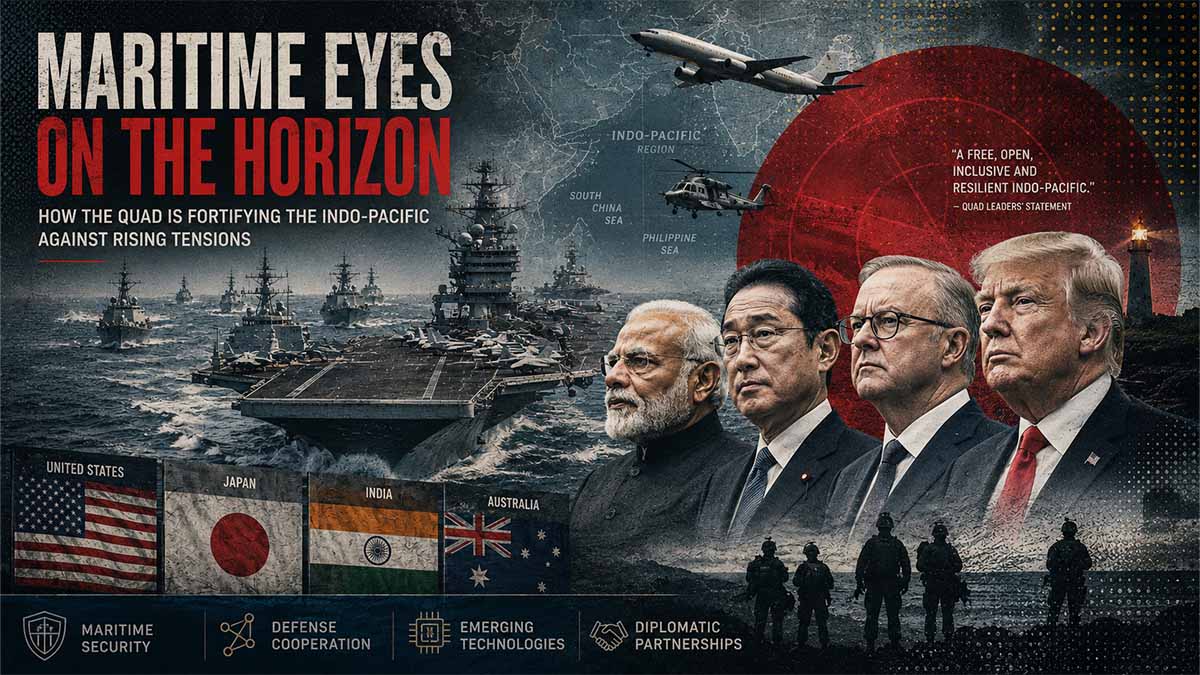
In the vast expanse of the Indo-Pacific, where shipping lanes carry the lifeblood of global trade, four maritime democracies are drawing clearer lines on the map. On a Tuesday in New Delhi, U.S. Secretary of State Marco Rubio stood alongside his counterparts from India, Japan, and Australia to announce initiatives that signal a shift from periodic dialogue to coordinated action. The Quadrilateral Security Dialogue, known as the Quad, is moving to enhance its collective gaze over the region’s waters while strengthening supply chains for the materials that will power the coming decades.
The timing feels deliberate. As geopolitical currents swirl—with concerns over freedom of navigation, resource dependencies, and regional stability—the Quad’s foreign ministers gathered not merely to talk, but to deliver tangible outcomes. Rubio’s remarks captured the moment’s urgency: the group, representing nearly two billion people and about one-third of global GDP, aims to evolve into a mechanism for practical cooperation rather than just a forum for discussion.
At the heart of the announcements lies a new focus on maritime awareness. The partners are launching the Indo-Pacific Maritime Surveillance Cooperation Initiative, which will pool each country’s surveillance capabilities to improve information sharing across the region. This builds on existing efforts like the Indo-Pacific Partnership for Maritime Domain Awareness (IPMDA), expanding the ability to provide near-real-time data on commercial shipping and other activities. India has committed to hosting the next Quad-at-Sea mission, bringing coast guards together aboard a single vessel to foster interoperability.
Imagine the world’s busiest maritime theater, where roughly 60 percent of global trade passes through key chokepoints. In such a space, gaps in visibility can quickly become vulnerabilities. By leveraging satellite data, radar, and other tools from the four nations, the initiative seeks to create a more comprehensive common operating picture. This is not about militarizing the seas in a provocative sense, but about enabling better governance—tracking illicit fishing, supporting law enforcement, and ensuring safe passage for legitimate commerce. Analysts note that such transparency benefits not only the Quad members but also smaller regional states that lack the resources for extensive monitoring on their own.
Complementing this maritime push is a parallel effort on economic resilience. The ministers announced the Quad Critical Minerals Framework, designed to guide coordinated investments and policy tools aimed at diversifying supply chains. Critical minerals—lithium, cobalt, rare earths, and others—are the building blocks of modern technologies, from electric vehicle batteries to renewable energy systems and advanced electronics. Dependence on concentrated sources has long raised alarms about potential disruptions, whether from market volatility or strategic maneuvering.
The framework emphasizes mining, processing, and recycling, encouraging the Quad nations to align their economic policies and direct investments toward more secure and sustainable options. This aligns with broader global trends: as the energy transition accelerates, demand for these materials is projected to surge. By working together, the United States, Japan, Australia, and India hope to create alternatives that reduce risks without fragmenting markets. Rubio highlighted how this cooperation extends to technology, governance, policy, market analysis, and even joint emergency response exercises.
Port infrastructure also featured prominently. The partners agreed to collaborate on development projects in the Indo-Pacific, with specific nods to initiatives like those in Pacific Island nations. Reliable ports and undersea cables are the arteries of the digital and physical economy; strengthening them helps counterbalance other influences while supporting regional connectivity on terms rooted in transparency and sustainability.
These steps reflect the Quad’s maturation. Born in the wake of the 2004 Indian Ocean tsunami as a humanitarian coordination effort, the group was later formalized with a clearer strategic focus on a “free and open Indo-Pacific.” It has faced skepticism at times—questions about its cohesion given the diverse interests of its members, or whether it risks escalating tensions. Yet the recent meeting in New Delhi underscores continuity and adaptation. India, as host, emphasized practical outcomes in supply chains, trusted technologies, and maritime security. Japan and Australia brought their long-standing expertise in regional engagement, while the U.S. signaled commitment under its current leadership.
What makes this evolution noteworthy is its emphasis on inclusivity. The initiatives are framed as open to collaboration with other like-minded partners and regional countries. Rather than creating exclusive clubs, the Quad positions itself as a catalyst—offering tools, data, and investment frameworks that smaller nations can tap into. This approach acknowledges a fundamental reality of the Indo-Pacific: no single power can dominate or secure such an immense domain alone. Cooperation among capable democracies can amplify collective capacity.
Consider the broader context. Maritime security is not an abstract concern. Disruptions—whether from piracy, illegal activities, or gray-zone tactics—ripple through energy prices, food security, and manufacturing supply lines worldwide. The Quad’s expanded domain awareness efforts aim to provide actionable intelligence that supports enforcement of international norms, particularly those enshrined in the United Nations Convention on the Law of the Sea. Freedom of navigation is not just a slogan; it underpins the prosperity of billions.
On the economic front, the critical minerals push addresses a structural weakness in the global green transition. Today, processing of many key materials remains heavily concentrated. Diversifying these chains through coordinated Quad action could foster more resilient markets, encourage responsible mining practices, and create opportunities for partner countries rich in resources but lacking in technology or capital.
Of course, challenges remain. Implementing information-sharing protocols requires overcoming technical, legal, and trust hurdles. Coordinating investments across four sovereign governments demands sustained political will. And while the Quad stresses it is not aimed against any specific country, its focus on rules-based order inevitably draws comparisons to other regional dynamics. The ministers have been careful to frame their work positively—emphasizing stability, prosperity, and partnership—rather than confrontation.
Looking ahead, these announcements set the stage for further deliverables. A leaders’ summit later in the year could build on this foundation, potentially announcing more concrete projects. The Quad-at-Sea missions and expanded IPMDA efforts will test the group’s ability to deliver joint operations. Success will be measured not in press statements but in improved regional capabilities and more diversified supply lines.
In the end, the Quad’s latest moves reflect a pragmatic response to an era of strategic competition and technological transformation. By focusing on maritime transparency and resource security, the four partners are investing in the foundations of stability. In a region where the stakes are as high as the waters are deep, clearer sightlines and stronger economic ties may prove to be the most effective stabilizers. The question now is whether this momentum can translate into enduring regional benefits—and whether other nations will see value in joining the effort.
QUAD – New Delhi, Indo-Pacific
| Category → Sub-Metric | Value / Status / Interconnection Notes |
|---|---|
| 📊 Core Composition | United States, Japan, Australia, India |
| ↳ Economic Scale | About one-third of global GDP |
| ↳ Population Scale | Nearly 2 billion people |
| 🛡️ Strategic Objective | Evolve from forum for periodic discussions to mechanism for practical action |
| 🌍 Regional Focus | Indo-Pacific region |
| 📅 Announcement Date | Tuesday (May 26, 2026 inferred from context) |
Indo-Pacific Maritime Surveillance Cooperation Initiative – Indo-Pacific
| Category → Sub-Metric | Value / Status / Interconnection Notes |
|---|---|
| 📊 Initiative Name | Indo-Pacific Maritime Surveillance Cooperation Initiative [Announced] |
| ↳ Purpose | Leverage each country’s maritime surveillance capabilities to enhance information sharing |
| ↳ Expansion | Expand maritime domain awareness; provides regional countries with near-real-time data on commercial shipping |
| 🔗 Dependency | Builds on existing efforts like IPMDA |
| ↓ Impacts | Maritime security for QUAD countries and many other states |
| 🌍 Trade Context | 60% of global maritime trade passes through the Indo-Pacific region |
Quad-at-Sea Mission – Indo-Pacific
| Category → Sub-Metric | Value / Status / Interconnection Notes |
|---|---|
| 📊 Operational Initiative | Next iteration of the QUAD at sea mission [India hosting] |
| ↳ Description | Brings together respective coast guards together in one place on one ship |
| 🔗 Host Commitment | India committing to hosting |
Quad Critical Minerals Framework – Indo-Pacific
| Category → Sub-Metric | Value / Status / Interconnection Notes |
|---|---|
| 📊 Framework Name | QUAD critical minerals framework [Announced] |
| ↳ Purpose | Guide each country to leverage economic policy tools and coordinate investment to strengthen critical mineral supply chains |
| ↳ Scope | Includes mining and processing, and in critical minerals recycling |
| 🔗 Collaboration Areas | Technology, governance, and policy, as well as market analysis |
| ↓ Impacts | Strengthen critical mineral supply chains ↔ [See: QUAD – New Delhi table] |
Port Infrastructure Collaboration – Indo-Pacific
| Category → Sub-Metric | Value / Status / Interconnection Notes |
|---|---|
| 📊 Initiative | Collaboration on the development of port infrastructure in the Indo-Pacific region |
| ↳ Status | Agreed to collaborate [Announced by US Secretary of State Marco Rubio] |
Broader Context – QUAD Initiatives
| Category → Sub-Metric | Value / Status / Interconnection Notes |
|---|---|
| 🛡️ Joint Activities | Conduct joint emergency response exercises |
| 🔗 Overall Goal | Enhance information sharing among members of the group |
| ↓ Impacts | Maritime security is of key importance not only for the QUAD countries but also for many other states |
Sources:
- Quad Foreign Ministers’ Meeting Joint Statement – Australian Department of Foreign Affairs and Trade – May 26, 2026 – https://www.foreignminister.gov.au/minister/penny-wong/media-release/quad-foreign-ministers-meeting-joint-statement
- Media Address / Remarks by U.S. Secretary of State Marco Rubio following Quad Foreign Ministers’ Meeting – U.S. Department of State / Verified transcripts via official channels – May 26, 2026
- Press Release on Quad Foreign Ministers’ Meeting – Ministry of External Affairs, Government of India – May 2026 – https://www.mea.gov.in/press-releases.htm?dtl/41216/Quad_Foreign_Ministers_Meeting_May_26_2026
- The Quad – Official Overview – U.S. Department of State – Verified ongoing initiatives including IPMDA – https://www.state.gov/the-quad


