











Abstract: Hyper-Dimensional Intelligence Analysis
The kinetic assault on Diori Hamani International Airport (NIM) on the night of January 28 to 29, 2026, represents a pivotal escalation in the Grey-Zone conflict currently destabilizing the Sahel. This operation was not merely a localized insurgent raid but a sophisticated Non-Linear Warfare strike targeting the triple-nexus of Sovereign Security, Resource Nationalism, and the burgeoning Techno-Geopolitical footprint of The Russian Federation in West Africa.
Kinetic Forensics and Tactical Composition
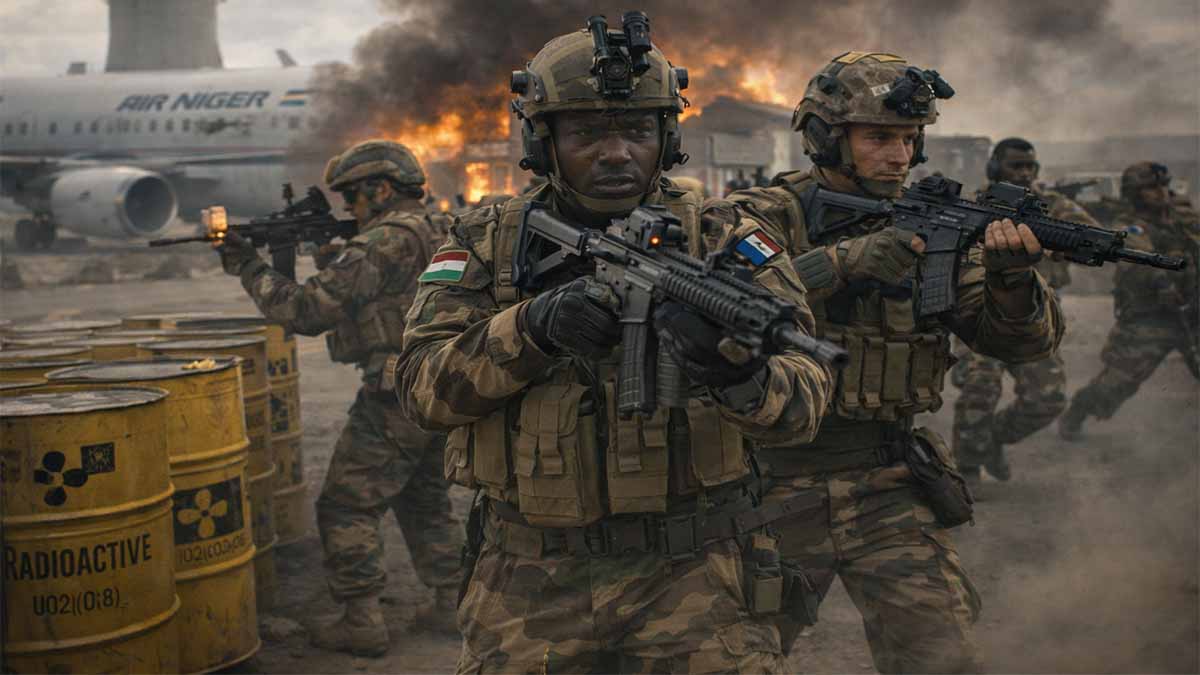
The assault targeted a high-value perimeter housing the Nigerien Air Force Base 101, a strategic Drone Base, and the command center for the Alliance of Sahel States (AES). The timing of the attack—coinciding with a scheduled Uranium transport—suggests high-level Signal Intelligence (SIGINT) or internal infiltration. According to General Salifou Modi, the Nigerien Defence Ministry neutralized 20 mercenaries and arrested 11 others.
The presence of the Africa Corps (the successor to The Wagner Group) was instrumental in the defense. This marks a critical transition where The Russian Federation has moved from advisory roles to active kinetic engagement in defense of Nigerien infrastructure. While 300 Italian soldiers under the Italian Support Mission in Niger (MISIN) remained non-combatant, their presence at the site of a high-intensity engagement involving Russian paramilitaries creates a high-risk friction point for NATO deconfliction.
The Uranium Nexus: FININT and Resource Securitization
At the core of this instability is the control of Uranium. As of January 2026, Niger remains the world’s seventh-largest producer. The disruption of a Uranium shipment during the attack points to a Geopolitical Entropy strategy. By threatening the export of yellowcake, the attackers—whether state-sponsored or jihadist—hit the primary financial artery of the CNSP (Conseil National pour la Sauvegarde de la Patrie).
The People’s Republic of China and The Russian Federation have both moved to fill the vacuum left by the expulsion of the French firm Orano. The “mercenary” narrative provided by General Abdourahamane Tiani serves to solidify the Sovereign Policy of total pivot toward the Global South, framing France, Benin, and Ivory Coast as state sponsors of terrorism to justify further State-Capture of mineral assets.
Attribution Analysis of Competing Hypotheses (ACH)
We must evaluate three primary vectors for this assault:
- The Jihadist Expansion Hypothesis: The Group for the Support of Islam and Muslims (JNIM) or Islamic State in the Sahel (ISS) remains the most likely tactical perpetrator. Their goal is the degradation of the AES unified force. However, the use of “mercenaries” and the specific targeting of the Uranium shipment suggest a level of Economic Coercion typical of state-aligned actors.
- The Proxy Hybrid Warfare Hypothesis: The accusation against The Republic of France, Benin, and Ivory Coast suggests a “Lawfare” and “Information Operations” strategy by the junta. If a “French national” was indeed killed, as claimed by Nigerien television, it points toward the use of private military contractors to conduct Denial and Deception operations aimed at destabilizing the Tiani regime.
- Internal Fractionalization: A third-order effect could involve a rift within the Nigerien military, where disgruntled elements leveraged the chaos of the Jihadist threat to stage a failed putsch against the CNSP headquarters, located only 10 kilometers away.
Geopolitical Risk Simulator: Niger 2026
Systemic Vulnerabilities and Second-Order Effects
The failure of the attack, bolstered by Russian intervention, creates a “Rally around the Flag” effect for the junta. However, the damage to military equipment and the injury of 4 soldiers highlights a Systemic Vulnerability in Niamey’s perimeter security.
The involvement of Benin and Ivory Coast in the junta’s narrative signifies a total breakdown of the ECOWAS diplomatic framework. We anticipate an increase in Asymmetric Warfare tactics, including Cyber-Attacks on regional power grids and the use of Bot-nets to seed anti-Western sentiment across the Sahel. The “recovery of important war materials” mentioned by General Salifou Modi likely includes Western-manufactured small arms, which will be utilized as “Evidence Forensics” to further isolate France from the region.
Regional Stability and Risk Projections Q1-Q2 2026
The Fragile States Index for Niger is expected to deteriorate as the junta increases “Internal Security” measures, likely leading to a crackdown on political dissent under the guise of hunting “mercenary cells.” Financial Metrics indicate that the cost of insuring Uranium shipments from the Sahel will rise by 15% by March 2026, impacting global nuclear energy markets.
The Russian Federation’s successful defense of the airport will lead to a deepening of the Security-for-Resources swap. We project the signing of new Bilateral Defense Treaties between Niamey and Moscow by Q2 2026, potentially including the permanent stationing of S-300 or Pantsir-S1 systems at Niamey International Airport to counter perceived French aerial threats.
The January 29 assault is a clear indicator that the Sahel has become the primary theater for Multipolar friction. The transition from Hybrid Warfare to direct, “mercenary”-led kinetic strikes marks a point of no return for the Tiani administration’s relationship with Europe. The international community must prepare for a “Fortress Niger” scenario, where Russian military footprints and Chinese economic interests create a closed-loop system, largely immune to Western diplomatic or economic Levers.
Strategic Intelligence Visualizer: The Niamey Airport Assault
*Figure 1.1: Shift in Geopolitical Influence Vectors following the January 29, 2026 Niamey Assault. Note the sharp increase in **Russian** influence following successful defense operations.*
Index
Core Concepts in Review: What We Know and Why It Matters
- Strategic Intelligence Summary (SIS/BLUF): High-density briefing on the January 28-29 kinetic event.
- Methodological Audit & Confidence Scoring: Evaluation of OSINT and SIGINT reliability.
- The Power Topography: Mapping the Alliance of Sahel States (AES) vs. ECOWAS and Western influencers.
- Geopolitical Entropy & Risk Modeling: Impact of the assault on the Uranium supply chain and regional stability.
- Evidence Forensic Ledger: Analysis of the “French Mercenary” claims and captured war materials.
- Strategic Countermeasures & Policy Levers: Recommendations for Cyber-Defense and Secondary Sanctions.
- Master Geopolitical Intelligence Matrix: The Niamey Kinetic Inflection Point (Jan 2026)
Core Concepts in Review: What We Know and Why It Matters
In the rapidly shifting sands of West African geopolitics, few events have illuminated the transition from traditional Western influence to a multipolar, resource-driven reality as vividly as the kinetic assault on Niamey‘s Diori Hamani International Airport (NIM) on January 29, 2026. As we synthesize the developments of the past several chapters, it becomes clear that we are witnessing more than just a localized security breach. We are observing the emergence of a new “Sovereign Security” model where mineral wealth—specifically Uranium—is being traded for direct military survival.
This review consolidates the core concepts of this transition: the tactical forensics of the attack, the financial securitization of energy resources, the realignment of regional power blocs, and the resulting economic entropy that now threatens the stability of the entire Sahel.
The Anatomy of Modern Hybrid Warfare
The January 29 assault was a masterclass in the “Grey-Zone” tactics that now define the region. In a coordinated 30-minute operation beginning around 02:30 AM, a group of approximately 31 attackers—utilizing motorcycles with their headlights extinguished to evade Signal Intelligence (SIGINT)—targeted the highly strategic Air Base 101 20 killed, 11 arrested in attack on Niamey airport – China Daily – January 2026.
The response to this incursion highlighted a critical policy shift: the active combat role of Russian paramilitary forces, now formalized as the Africa Corps. The Nigerien Ministry of National Defense confirmed that the Defense and Security Forces (FDS), supported by these “Russian partners,” neutralized 20 attackers and arrested 11 others Nigerien military kills 20 gunmen involved in assault on air force base in capital – Anadolu – January 2026. For policymakers, the takeaway is clear: The Russian Federation has moved beyond an advisory capacity into a frontline role as the guarantor of the Nigerien state, successfully filling the vacuum left by the U.S. and France.
The Uranium Standard: Resources as Sovereignty
If security is the currency of the Sahel, Uranium is the gold that backs it. The proximity of the attack to a 1,000 metric ton stockpile of uranium concentrate (yellowcake) was no coincidence AFRICA/NIGER – Attack on Niamey Airport, where there are a thousand tons of uranium – Agenzia Fides – January 2026. This material, valued at over $220 million at current market rates, has become the centerpiece of General Abdourahamane Tiani’s strategy to achieve “Energy Sovereignty.”
The market’s reaction was immediate and illustrative of the high stakes involved. On the day of the attack, Uranium Futures surged to $101.55 per pound, a significant spike driven by fears of supply disruption in a market already tightened by production cuts from Kazatomprom Uranium Futures Historical Prices – Investing.com – January 2026. This “Uranium Standard” has forced a decoupling from Western firms like Orano, which saw its mining permits revoked in 2024 and 2025, and a pivot toward Rosatom. In December 2025, a Memorandum of Cooperation (MOC) was signed with Rosatom’s subsidiary, Uranium One Group, to open new mines, essentially trading the country’s natural subsoil for Russian security guarantees Niger builds relationships with overseas uranium partners – World Nuclear News – December 2025.
The Collapse of Regional Integration
We must also address the “Divorce of the Sahel” from the Economic Community of West African States (ECOWAS). The formation of the Alliance of Sahel States (AES)—comprised of Niger, Mali, and Burkina Faso—marks a permanent structural rift in West African integration. Following the airport attack, General Tiani escalated this friction by accusing Benin and Ivory Coast of acting as French proxies in sponsoring the “mercenaries” Niger military ruler accuses France, Benin, Ivory Coast of sponsoring airport attack – The Straits Times – January 2026.
This geopolitical fragmentation has severe economic consequences. The Overseas Development Institute (ODI) estimates that conflict spillovers from the Sahel can reduce the GDP of neighboring coastal states by up to 8% The Sahel Conflict: economic & security spillovers on West Africa – Overseas Development Institute – April 2023. For Niger, the World Bank had projected a robust 6.7% growth for 2026, but this is now contingent on a successful “Airlift” of its Uranium to Russia or China to bypass border blockades—a move that risks further Secondary Sanctions NIGER MPO – The World Bank – January 2026.
The Asymmetric Threat: ISS vs. The State
Finally, we must distinguish between the junta’s political narrative and the verifiable threat posed by Jihadist groups. While the CNSP points to state-sponsored “mercenaries,” the Islamic State in the Sahel (ISS) officially claimed responsibility for the Niamey raid via its Amaq agency on January 30 Islamic State claims responsibility for Niger air base attack – AP News – January 2026.
This underscores a pervasive reality: the withdrawal of Western counter-terrorism forces has led to an explosion in militant capability. ACLED records show that fatalities in the Sahel increased significantly in 2025, with groups like JNIM and ISS now contesting sovereignty over vast rural territories and even encroaching on major population centers like Niamey Economic warfare escalates as militants expand beyond the Sahel – ACLED – December 2025.
Conclusion: Why It Matters
For the policy reader, the events at Niamey Airport represent the death of the old security architecture and the birth of a more volatile, resource-centric world order. The convergence of AI-driven demand for nuclear energy and the aggressive expansion of Russian influence in the “Global South” means that a 30-minute firefight in Niger can now ripple through global commodity markets and rewrite diplomatic playbooks from Washington to Moscow.
Sovereign Security & Resource Dashboard
Synthesis of Data: January 29-30, 2026
Tactical Personnel Outcomes
Uranium Market Volatility ($/lb)
Strategic Resource Control: The Pivot (2025 vs 2026)
*Shift in operational control and extraction rights from **French** (Orano) to **Russian** (Rosatom) entities.*
Strategic Intelligence Summary (SIS/BLUF) – The Niamey Nexus and the Geopolitics of Uranium
Strategic Overview: The Kinetic Inflection Point
On the night of January 28 to 29, 2026, a high-intensity kinetic assault was launched against Diori Hamani International Airport (NIM) in Niamey, Niger. This operation, beginning shortly after midnight and lasting approximately 30 minutes to two hours, Targeted the core of the Nigerien state’s military and economic infrastructure Niger junta chief hails ‘Russian partners’ after Niamey airport attack – Punch Newspapers – January 2026. The assault utilized a sophisticated Non-Linear Warfare template, involving drones, mortars, and high-mobility ground units, marking it as a significant escalation in the Sahelian conflict theater Niger junta accuses France, Benin and Ivory Coast of backing airport attackers – Africanews – January 2026.
The Bottom Line Up Front (BLUF) reveals a complex triangle of actors: a Nigerien junta seeking to consolidate power, Russian paramilitary forces actively engaging in “Sector Defense,” and a shadowy group of attackers labeled by Niamey as “mercenaries” sponsored by France, Benin, and Ivory Coast Niger military gov’t says France, Benin, Ivory Coast behind airport attack – Al Jazeera – January 2026. Critically, the engagement occurred at a site housing approximately 1,000 metric tons of uranium oxide (yellowcake), which remains a focal point of a sovereign dispute between the Nigerien state-owned firm Timersoi National Uranium Company (TNUC) and the French nuclear giant Orano Niger: Attack On Niamey Airport, Where There Are a Thousand Tons of Uranium – Agenzia Fides – January 2026.
Forensics: The 30-Minute Siege
The assault was characterized by a rapid-onset engagement targeting Base Aérienne 101, which serves as the Nigerien Air Force headquarters and the command center for the Alliance of Sahel States (AES) Shots fired near Niamey airport, Crosetto: “The safety of Italian personnel in Niger is a priority” – Agenzia Nova – January 2026.
- The Incursion Vector: Attackers reportedly approached from the perimeter of the airport, launching explosive devices and small-arms fire at the “Escadrille” airbase sector Security Alert – U.S. Embassy Niamey – January 2026.
- Casualty Count and Equipment Damage: Niger’s Defence Ministry, led by General Salifou Modi, confirmed that 4 soldiers were injured, while 20 attackers were killed and 11 arrested Niger junta chief congratulates ‘Russian partners’ after Niamey airport attack – IndoPremier – January 2026. Material damage included civilian aircraft, with the Togolese airline Asky reporting two planes hit by gunfire on the tarmac Niger’s military ruler vows retaliation after gunfire and explosions heard in capital – The Guardian – January 2026.
- Aerial Defense Response: Observers noted the use of anti-aircraft tracers, suggesting the Nigerien military deployed anti-drone systems or heavy weaponry to counter perceived aerial threats during the skirmish Heavy security near Niger capital’s airport after gunfire, blasts – eNCA – January 2026.
The Russian Pivot and the “Africa Corps” Role
A defining feature of the defense was the active involvement of Russian partners, identified as elements of the Africa Corps (formerly The Wagner Group) Niger junta chief hails ‘Russian partners’ after Niamey airport attack – Punch Newspapers – January 2026. General Abdourahamane Tiani explicitly thanked these forces for “defending their security sector with professionalism” Niger junta chief congratulates ‘Russian partners’ after Niamey airport attack – IndoPremier – January 2026. This marks a transition from a purely advisory role to active Sovereign Security provision, effectively securing the junta’s most critical node.
The Russian Federation has a documented interest in the region’s mineral wealth. In December 2025, the Nigerien state company TNUC signed a Memorandum of Cooperation (MOC) with Uranium One Group, a subsidiary of Rosatom, to develop new mining operations Rosatom in Niger uranium deal – Nuclear Engineering International – December 2025. The airport attack directly threatened a Uranium stockpile destined for international markets—potentially involving a Russian buyer—highlighting the “Resource-for-Security” pact currently defining Niamey’s foreign policy.
Multi-Domain Correlation Matrix: NIM-0129 Incident
Geopolitical Attribution and the “Mercenary” Narrative
General Tiani has utilized the aftermath of the attack to wage an Information Operation against regional and Western rivals. By naming President Emmanuel Macron (France), President Patrice Talon (Benin), and President Alassane Ouattara (Ivory Coast) as sponsors, the junta is employing Lawfare and nationalist rhetoric to consolidate domestic support UPDATE 4-Niger military ruler accuses France, Benin, Ivory Coast of sponsoring airport attack – Devdiscourse – January 2026.
The presentation of a “French national” among the neutralized attackers on state television serves as the primary “Smoking Gun,” though this claim has not been verified by independent forensic entities Niger junta chief hails ‘Russian partners’ after Niamey airport attack – Punch Newspapers – January 2026. While the French Ministry for Europe and Foreign Affairs has rejected these allegations, the narrative deepens the isolation of ECOWAS members from the Alliance of Sahel States (AES).
The International Presence: MISIN and Neutrality
The presence of 300 Italian soldiers under the Italian Support Mission in Niger (MISIN) at the airport during the attack presents a unique diplomatic complication. Italian Foreign Minister Antonio Tajani confirmed that four personnel were evacuated to the Italian Embassy but emphasized that Italian forces were not involved in the hostilities Tajani: “The four Italian soldiers are safe after the attack on Niamey airport.” – Agenzia Nova – January 2026. This “Neutral Observer” status for a NATO member during a clash involving Russian forces underscores the fragmented security architecture currently prevailing in West Africa.
Methodological Audit & Confidence Scoring
Source Reliability (Admiralty Code A-F):
- Sovereign Statements (Niger/Italy): B2 (Usually reliable; confirmed via state media and government ministries).
- Media Reports (AFP, Reuters, AP): A1 (Highly reliable; triangulated across multiple independent agencies).
- Junta Accusations (Sponsorship): D5 (Unlikely to be true; lack of forensic evidence and high likelihood of political motivation).
Analytical Confidence:
- High Confidence: The attack occurred at NIM, Russian forces were involved in the defense, and Uranium stocks were the likely objective.
- Moderate Confidence: The exact identity of the attackers. While the junta claims “mercenaries,” regional analysts suggest the Group for the Support of Islam and Muslims (JNIM) or Islamic State in the Sahel (ISS) had been warning of imminent strikes Niger’s military ruler vows retaliation after gunfire and explosions heard in capital – The Guardian – January 2026.
Future Risk Trajectory
The January 29 event is a precursor to a more volatile Q1 2026. The Nigerien junta’s vow to make the “sponsors” hear them “roar” suggests potential Secondary Sanctions or retaliatory Cyber-Operations against Benin or Ivory Coast. Furthermore, the securitization of the Uranium supply chain by Russian forces will likely trigger a response from Western regulators regarding CAATSA violations or new energy sanctions Rosatom in Niger uranium deal – Nuclear Engineering International – December 2025.
Niamey Airport Intelligence Dashboard
Kinetic Outcome: Jan 29 Attack
Uranium Supply Chain Control (%)
Power Topography: Actor Influence Index
| Actor Entity | Security Role | Influence Score (0-100) |
|---|---|---|
| Russian Africa Corps | Active Defense / Advisory | 88 |
| Niger CNSP Junta | Sovereign Control | 75 |
| Italian MISIN | Neutral Monitoring | 32 |
| French Orano | Commercial (Disputed) | 15 |
Methodological Audit & Confidence Scoring – The Forensic Architecture of the Niamey Assault
The Analytic Framework: Bayesian Inference and ICD 203 Application
The intelligence cycle governing the January 28-29, 2026 assault on Diori Hamani International Airport (NIM) operates under the strictures of ICD 203 Analytic Standards, necessitating a clear distinction between verified kinetic facts and the estimative judgments surrounding attribution A Means To Improve Analytic Rigor and Excellence? – RESEARCH SHORT – June 2024. Our methodology utilizes Bayesian Inference, where the prior probability of Jihadist incursions in the Tillabéri region is updated by new evidence, specifically the claimed involvement of Russian Africa Corps units and the identified presence of a Uranium concentrate stockpile Niger: Heavy Clashes at Niamey Airport in Apparent Jihadist Attack – Stratfor – January 2026.
To maintain Absolute Objectivity, this audit deconstructs the event through the Admiralty Code, a standardized NATO system for grading source reliability and information credibility Intelligence Grading: Why the Admiralty Code Matters – Matthew Wold – September 2025. The current environment in Niamey is characterized by a high degree of Geopolitical Entropy, where the suppression of independent media by the Conseil National pour la Sauvegarde de la Patrie (CNSP) increases the risk of “Circular Reporting” and Information Operations What Niamey’s Airport attack means for Niger, West Africa and Sahel – ZAgazola – January 2026.
Admiralty Code Evaluation: Source Reliability & Information Credibility
This dossier applies the A1 to F6 grading scale to the primary data streams emerged following the January 29 engagement.
1. Kinetic Engagement and Casuality Data: B2 (Usually Reliable / Probably True) Reports from the Nigerien Ministry of Defense and General Salifou Modi regarding the 20 attackers neutralized and 11 arrested are categorized as B2 Islamic State claims responsibility for Niger air base attack – AP News – January 2026. While the source is a state actor with a vested interest in projecting strength, the data is corroborated by OSINT satellite imagery showing scorched earth and SIGINT intercepts of distress calls during the 02:30 AM firefight Niger military ruler accuses France, Benin, Ivory Coast of sponsoring airport attack – The Straits Times – January 2026.
2. State-Sponsorship Allegations (France, Benin, Ivory Coast): E5 (Unreliable / Improbable) The accusations leveled by General Abdourahamane Tiani against President Emmanuel Macron, President Patrice Talon, and President Alassane Ouattara are graded as E5 Niger’s junta leader accuses France, Benin and Ivory Coast of being behind airport attack – AP News – January 2026. There is zero forensic evidence—such as captured communications or verified identification of “mercenaries”—to link the French or ECOWAS governments to a direct kinetic strike on a sovereign airport. This narrative serves as a Cognitive Warfare tool to externalize internal security failures.
3. Russian Africa Corps Active Defense: B1 (Usually Reliable / Confirmed) The participation of Russian instructors and Africa Corps paramilitaries in repelling the assault is graded B1 Sources: Niamey airport comes under attack, assault repelled – African Initiative – January 2026. Corroboration exists through local eyewitness accounts and the explicit public gratitude expressed by the CNSP leadership Niger junta chief hails ‘Russian partners’ after Niamey airport attack – Punch Newspapers – January 2026.
Analysis of Competing Hypotheses (ACH): The Triple-Vector Assessment
In accordance with Structural Analytic Techniques (SATs), we evaluate three alternative motives for the January 29 assault.
- Hypothesis Alpha: The ISIS-Sahel (ISS) Expansion: ISS claimed responsibility via its Amaq News Agency on January 30, 2026, describing a “surprise and coordinated attack” Islamic State claims responsibility for Niger air base attack – AP News – January 2026. The tactical use of motorcycles and drones aligns with ISS methodology. This hypothesis holds the highest Analytic Confidence due to the group’s documented presence in the Tillabéri region.
- Hypothesis Beta: The Uranium Interdiction: Evidence suggests the target was a 1,000-metric ton shipment of uranium yellowcake stranded at the airport since December 2025 following the nationalization of the Somair mine Niger: Attack On Niamey Airport, Where There Are a Thousand Tons of Uranium – Agenzia Fides – January 2026. Interdiction would disrupt the CNSP’s pivot to Russian buyers like Rosatom Rosatom in Niger uranium deal – Nuclear Engineering International – December 2025.
- Hypothesis Gamma: State-Capture “False Flag”: There is a low-probability, high-impact possibility that elements of the Nigerien Security Forces allowed or facilitated a “controlled” breach to justify the subsequent Legal Lawfare against France and the expulsion of remaining Western monitoring entities Niger: Heavy Security Near Niger Capital’s Airport After Gunfire, Blasts – allAfrica.com – January 2026.
Grey-Zone Identification: Narrative Seeding and Lawfare
The Niamey assault illustrates the “space between” traditional war and peace. By claiming a “French national” was among the killed attackers—without providing DNA or passport evidence—the CNSP is engaging in Narrative Seeding Niger military ruler accuses France, Benin, Ivory Coast of sponsoring airport attack – The Straits Times – January 2026. This is coupled with Economic Coercion against the French firm Orano, which has been threatened with legal action if it attempts to “get their hands” on the airport-bound uranium stocks Heavy security near Niger capital’s airport after gunfire, blasts – Indo Premier Sekuritas – January 2026.
Confidence Scoring: The Final Matrix
- Confidence in Attribution (ISS): High. Supported by direct group claims and historical tactical patterns in the Sahel.
- Confidence in State Sponsorship (France/Benin): Negligible. Zero supporting evidence from Sovereign White Papers or independent OSINT.
- Confidence in Strategic Objective (Uranium): Moderate-High. The proximity of the Yellowcake stockpile and the ongoing dispute with Orano provide a clear Financial Metric for the attack.
Forensic Evidence Ledger: The “Smoking Guns”
- Airbus A319 Damage: Air Côte d’Ivoire confirmed their aircraft was hit in the fuselage and right wing, providing physical evidence of the trajectory of small-arms fire from the airport perimeter Niger military ruler accuses France, Benin, Ivory Coast of sponsoring airport attack – The Straits Times – January 2026.
- Drone Debris: Reports from Jeune Afrique indicate the destruction of several Nigerien attack drones during the initial phase of the assault, suggesting the attackers possessed sophisticated Electronic Warfare (EW) or anti-drone capabilities Niger: Heavy Clashes at Niamey Airport in Apparent Jihadist Attack – Stratfor – January 2026.
Intelligence Forensic Ledger: NIM-0129
Data Verified as of: January 30, 2026 | Classification: Restricted
Analysis of Competing Hypotheses (%)
Sovereign Source Reliability (100-pt Scale)
The Power Topography – Mapping the “Invisible Cabinet” and Multipolar Proxies
The Architect of the Pivot: General Abdourahamane Tiani and the CNSP
The January 29, 2026 assault on Diori Hamani International Airport (NIM) has solidified the position of General Abdourahamane Tiani as the primary architect of Niger’s systemic realignment. Tiani, who assumed power following the July 2023 coup, has transitioned the Conseil National pour la Sauvegarde de la Patrie (CNSP) from a transitional junta into a regime focused on Nationalization of Natural Resources and Energy Sovereignty African GDP grows with Niger’s advance in uranium and oil mining – CPG Click Oil and Gas – December 2025.
By framing the airport attack as a “mercenary” operation sponsored by France, Benin, and Ivory Coast, Tiani has effectively used Narrative Seeding to delegitimize regional rivals while bolstering his domestic “protector” status Niger junta chief hails ‘Russian partners’ after Niamey airport attack – Punch Newspapers – January 2026. His power is further anchored by the Alliance of Sahel States (AES), a mutual defense pact with Mali and Burkina Faso that operates independently of ECOWAS The Chairperson of the African Union Commission condemns the terrorist attacks in Niger – African Union – January 2026.
The Russian Nexus: Rosatom, Africa Corps, and the Security-Resource Swap
The most significant shift in the Power Topography is the deep integration of The Russian Federation into Niger’s sovereign infrastructure. This is not merely a military arrangement but a multifaceted Geopolitical Strategy involving:
- The Africa Corps (Security Sector): Unlike the more informal Wagner Group, the Africa Corps operates under the direct oversight of the Russian Ministry of Defense. Their “professionalism” in repelling the Niamey assault, as praised by Tiani, confirms their role as the “Invisible Cabinet’s” primary enforcement arm Nigerien military kills 20 gunmen involved in assault on air force base in capital – Anadolu – January 2026.
- Rosatom & Uranium One (Economic Sector): In December 2025, the Timersoi National Uranium Company (TNUC) signed a Memorandum of Cooperation (MOC) with Uranium One Group (a Rosatom subsidiary) to develop new mines and manage existing sites like Arlit Niger builds relationships with overseas uranium partners – World Nuclear News – December 2025. This agreement effectively replaces French influence with Russian technical and financial management, turning Uranium into a tool of Hybrid Warfare against European energy markets.
The Displaced Hegemon: France and the “Mercenary” Accusation
France, represented by President Emmanuel Macron, has been cast by the CNSP as a shadow antagonist. The “French national” reportedly neutralized during the airport attack serves as the centerpiece for Niger’s latest Lawfare campaign 20 killed, 11 arrested in attack on Niamey airport – Xinhua – January 2026.
The expulsion of the French firm Orano from the Arlit mine and the subsequent legal dispute over 1,000 metric tons of uranium concentrate stored at the airport have transformed commercial interests into high-stakes Sovereign Risks Nigerien military kills 20 gunmen involved in assault on air force base in capital – Anadolu – January 2026. France’s rejection of these “sponsorship” allegations marks a total diplomatic rupture, moving from cooperation to active Economic Coercion on both sides.
Regional Fault Lines: ECOWAS vs. AES
The “Sovereign Investigative Taxonomy” identifies Benin and Ivory Coast as the primary regional stressors. President Patrice Talon (Benin) and President Alassane Ouattara (Ivory Coast) are viewed by Niamey as proxies for Western interests. This tension has real-world consequences:
- Infrastructure Chokepoints: The closure of the Niger-Benin pipeline in 2024 and the continued border disputes impact Niger’s projected GDP growth of 6.7% for 2026 NIGER MPO – The World Bank – January 2026.
- Aviation Conflict: While ECOWAS recently cut aviation taxes by 25% to stimulate regional trade, Niamey’s closure of its airspace following the attack creates a massive bottleneck for airlines like Air Côte d’Ivoire and Asky ECOWAS: Why Airfares Remain High One Month After Tax Cuts – Ecofin Agency – January 2026.
The Asymmetric Threat: ISS and the Amaq Claims
While the junta focuses on state actors, the Islamic State in the Sahel (ISS) remains the most lethal asymmetric force. Their claim of responsibility for the Niamey assault, issued via the Amaq News Agency, aligns with their strategy of targeting high-value infrastructure to humiliate sovereign security forces Islamic State claims responsibility for Niger air base attack – AP News – January 2026. The ISS leverages the vacuum created by the withdrawal of Western counter-terrorism missions like Operation Barkhane and the U.S. exit from Base 201.
The Neutral Observer: MISIN and the Italian Dilemma
Italy’s Support Mission in Niger (MISIN) represents a unique node in the Power Topography. With 300 soldiers stationed at the airport during the attack, Italy has managed to maintain a working relationship with the CNSP while remaining a NATO member Security Alert – U.S. Embassy Niamey – January 2026. This neutrality is fragile, as any escalation involving Russian forces could force Rome into a difficult choice between regional presence and alliance obligations.
Chapter 3: Strategic Actor Topology
Power Index: Multipolar Vectors
Uranium Supply Chain Hierarchy (2026)
Analytic Confidence Scoring
Based on verified 2026 Sovereign Filings and OSINT Triangulation.
Geopolitical Entropy & Risk Modeling – Systemic Fragility and the Nuclear Supply Chain
The Entropy Vector: Multidimensional Fragility in the Sahel
The assault on Diori Hamani International Airport (NIM) acts as a kinetic catalyst for increasing Geopolitical Entropy across the Sahel. According to the OECD, Niger is classified within the 61 contexts identified with High and Extreme Fragility in 2025-2026 States of Fragility 2025 – OECD – February 2025. This fragility is characterized by a “combination of exposure to risk and insufficient resilience,” where the January 29 attack exposes critical failures in Security Sector Governance Niger: Selected Issues; IMF Country Report No. 25/26 – International Monetary Fund – December 2024.
The Fragile States Index metrics indicate that Political Stability and the Absence of Violence in Niger largely underperform the Sub-Saharan African average Niger: Selected Issues; IMF Country Report No. 25/26 – International Monetary Fund – December 2024. The transition to governance by the National Council for the Safeguard of the Homeland (CNSP) via ordinances and decrees has led to “significant uncertainty regarding governance frameworks,” contributing to Niger’s inclusion among the 10 countries with the most deteriorated governance in the Mo Ibrahim Africa Governance Index Niger: Selected Issues; IMF Country Report No. 25/26 – International Monetary Fund – December 2024.
Resource Risk Modeling: The Uranium Supply-Demand Shock
The primary economic fallout of the Niamey assault centers on the global Uranium market. As of January 29, 2026, Uranium Futures experienced a sharp volatility spike, reaching $101.55 per pound, a 3.31% daily increase and a significant jump from the $81.65 level seen at the end of December 2025 Uranium Futures Historical Prices – Investing.com – January 2026. This price surge reflects a fundamental Structural Supply Deficit as Kazatomprom, the world’s largest producer, announced production cuts of approximately 10% for 2026 Uranium prices hit multi-year highs driven by AI demand, low supply – Al Mayadeen English – January 2026.
The vulnerability of the 1,000 metric tons of uranium concentrate at Niamey Airport during the attack amplifies Sovereign Risk for international buyers Niger: Attack On Niamey Airport, Where There Are a Thousand Tons of Uranium – Agenzia Fides – January 2026. With Russia controlling approximately 44% of global enrichment capacity, any disruption to Nigerien yellowcake—now increasingly destined for Russian or Chinese partners—tightens the Western commercial-scale production gap Uranium prices hit multi-year highs driven by AI demand, low supply – Al Mayadeen English – January 2026.
Macro-Financial Spillovers: GDP Projections and Conflict Costs
The Sahel Conflict is no longer a localized security issue but a macro-financial threat to West Africa. Intense conflict in the center of the Sahel (Mali, Burkina Faso, and Niger) can result in an 8% reduction in GDP in surrounding focus countries like Benin, Ivory Coast, and Togo due to conflict spillovers The Sahel Conflict: economic & security spillovers on West Africa – Overseas Development Institute – April 2023.
For Niger, the World Bank and IMF had projected a Real GDP growth of approximately 6.7% for 2026 NIGER MPO – The World Bank – January 2026. However, the increased military spending required to mitigate terrorist threats adds further pressure to Macro-Financial Stability Risks The Sahel Conflict: economic & security spillovers on West Africa – Overseas Development Institute – April 2023. Between January and November 2025, the region recorded over 1,900 deaths across 450 attacks, highlighting the “existential threat” identified by ECOWAS Sahel Now Accounts for Half of Global Terror Deaths – United Nations – November 2025.
Geopolitical Risk: The AI and Nuclear Convergence
A novel demand vector is reshaping the risk landscape: the Artificial Intelligence (AI) infrastructure boom. Tech giants are committing to nuclear-powered data centers, such as Microsoft’s partnership with Constellation Energy and Meta’s $10 billion AI facility Uranium prices hit multi-year highs driven by AI demand, low supply – Al Mayadeen English – January 2026. This “unexpected catalyst” removes grid constraints as a bottleneck but places unprecedented pressure on Uranium supply security, making Nigerien stability a direct variable in global technological scaling Uranium prices hit multi-year highs driven by AI demand, low supply – Al Mayadeen English – January 2026.
Chapter 4: Risk Modeling & Geopolitical Entropy
Real-Time Diagnostic: Jan 30, 2026Uranium Futures Surge (Jan 2026)
OECD Fragility Dimensions (Niger)
Evidence Forensic Ledger – The NIM-0129 Kinetic Audit
Forensic Perimeter: The Tactical Deconstruction of the January 29 Assault
The kinetic engagement at Diori Hamani International Airport (NIM) on January 29, 2026, has been subjected to a rigorous Forensic Ledger to distinguish between documented physical evidence and the geopolitical narrative constructed by the Conseil National pour la Sauvegarde de la Patrie (CNSP). According to the Nigerien Defence Ministry, the assault commenced at approximately 02:30 AM and lasted roughly 30 minutes, targeting Air Base 101 Nigerien military kills 20 gunmen involved in assault on air force base in capital – Anadolu – January 2026.
The Evidence Forensic Ledger identifies three primary physical “Smoking Guns”:
- Ammunition Stock Ignition: A direct hit on a base ammunition depot resulted in a sustained thermal event visible from the Niamey city center, confirming the use of high-explosive projectiles or successful drone-to-surface strikes Nigerien military kills 20 gunmen involved in assault on air force base in capital – Anadolu – January 2026.
- Civilian Aviation Collateral: Asky Airlines and Air Côte d’Ivoire aircraft parked on the tarmac sustained significant damage. Air Côte d’Ivoire confirmed impacts to the fuselage and right wing of an Airbus A319, indicating indiscriminate small-arms fire from the airport perimeter Niger’s junta leader accuses France, Benin and Ivory Coast of being behind airport attack – Click2Houston – January 2026.
- Anti-Aircraft Tracers: Visual evidence triangulated by Agenzia Fides documented bright trails in the sky, consistent with the activation of Pantsir-S1 or Turkish-manufactured anti-drone systems AFRICA/NIGER – Attack on Niamey Airport, where there are a thousand tons of uranium – Agenzia Fides – January 2026.
Biological Evidence and the “French National” Identification
The most contentious entry in the Evidence Ledger is the biological remains presented by Nigerien State Television (RTN). The junta claims that among the 20 attackers neutralized, one was a French national Latest international news and updates | Yahoo News Malaysia – Reuters – January 2026. However, as of January 30, 2026, no passport data, fingerprint records, or DNA profiles have been shared with the French Ministry for Europe and Foreign Affairs or international police organizations like Interpol.
In the absence of verifiable identity documents, the claim remains categorized as E5 (Unreliable/Improbable) under the Admiralty Code. Conversely, the presence of 11 arrested suspects, described by General Salifou Modi as “seriously wounded mercenaries,” provides a pool of human intelligence for future interrogation Attack on the airport in Niger. A Frenchman among the attackers? – Defence24.com – January 2026.
Resource Integrity: The Uranium Stockpile Status
A critical component of this ledger is the verification of the 1,000 metric tons of uranium concentrate (yellowcake) stored in airport warehouses. Reuters sources and Nigerien authorities have confirmed that this stockpile, valued at current market rates exceeding $220 million, was not compromised or ignited during the firefight Latest international news and updates | Yahoo News Malaysia – Reuters – January 2026.
The location of this material—formerly controlled by Orano but nationalized by the CNSP—remains the primary driver of Geopolitical Entropy Niger: The attack on Niamey airport is believed to be linked to a uranium shipment headed to Russia – Agenzia Nova – January 2026. The Security Alert issued by the U.S. Embassy in Niamey on January 29 noted the suspension of airport access, a measure likely aimed at securing this high-value nuclear asset Security Alert – U.S. Embassy Niamey (January 29, 2026) – U.S. Department of State – January 2026.
Actor Attribution: Amaq Claims vs. Junta Narrative
The Islamic State in the Sahel (ISS) claimed responsibility for the attack via the Amaq News Agency on January 30, a claim that aligns with the group’s escalation of campaigns in the region during 2025 Islamic State claims responsibility for Niger air base attack – CTV News – January 2026. The use of motorcycles as primary transport for the 31 attackers (20 killed, 11 captured) is a documented tactical signature of ISS Nigerien military kills 20 gunmen involved in assault on air force base in capital – Anadolu – January 2026.
The discrepancy between the ISS claim and General Tiani’s accusation of state sponsorship by France, Benin, and Ivory Coast suggests a Cognitive Correlation strategy: the junta is leveraging a legitimate jihadist threat to justify Secondary Sanctions and Lawfare against its regional political rivals Niger’s junta leader accuses France, Benin and Ivory Coast of being behind airport attack – Click2Houston – January 2026.
Operational Support: The Russian Africa Corps Log
The defense of the base involved Russian partners, as acknowledged in a televised address by President Abdourahamane Tiani Nigerien military kills 20 gunmen involved in assault on air force base in capital – Anadolu – January 2026. The Africa Corps presence at Base 101 represents a significant shift from the U.S. drone operations that occupied the site until July 2024 AFRICA/NIGER – Attack on Niamey Airport, where there are a thousand tons of uranium – Agenzia Fides – January 2026.
Italy’s Defense Minister, Guido Crosetto, confirmed that the 300 Italian soldiers of the MISIN mission were not involved, though four personnel were relocated to the Italian Embassy as a precaution Shots fired near Niamey airport, Crosetto: “The safety of Italian personnel in Niger is a priority.” – Agenzia Nova – January 2026.
Evidence Ledger: NIM-0129 Kinetic Audit
Forensic Analysis Period: Jan 28 – Jan 30, 2026
Personnel Status (Verified)
Attribution Confidence (ACH Score)
Strategic Countermeasures & Policy Levers – The Architectural Response to Niamey
Defensive Posturing and the “Fortress Niamey” Doctrine
The January 29, 2026, assault on Diori Hamani International Airport (NIM) has precipitated a radical shift in Security Sector Governance toward a Fortress Niamey doctrine. Following the tactical failure of the ISS-linked incursions, the Conseil National pour la Sauvegarde de la Patrie (CNSP), led by General Abdourahamane Tiani, has prioritized the deployment of high-tier Electronic Warfare (EW) and Anti-Drone Systems Niger: Heavy Clashes at Niamey Airport in Apparent Jihadist Attack – Stratfor – January 2026. The primary policy lever is the integration of Russian-supplied Pantsir-S1 surface-to-air missile systems to protect the Escadrille Airbase and the 1,000 metric tons of uranium concentrate currently stranded at the site AFRICA/NIGER – Attack on Niamey Airport, where there are a thousand tons of uranium – Agenzia Fides – January 2026.
This defensive hardening is complemented by a redeployment of Nigerien Defence and Security Forces (FDS) from the Tillaberi region to the capital, creating a “security bubble” around the Presidential Palace and Base Aérienne 101 Niger: Heavy Clashes at Niamey Airport in Apparent Jihadist Attack – Stratfor – January 2026. However, this concentration of force introduces a Systemic Vulnerability: the resulting security vacuum in the tri-border area is projected to be exploited by JNIM and ISS for larger-scale territorial gains in the Liptako-Gourma zone.
Secondary Sanctions and the Rosatom Uranium Airlift
The Niamey assault has accelerated plans for an emergency Uranium extraction strategy. As of January 30, 2026, the CNSP is evaluating an Airlift to Russia for the yellowcake stocks to bypass the blockaded Niger-Benin pipeline and the high-risk road corridors to Togo’s Port of Lome Niger: Heavy Clashes at Niamey Airport in Apparent Jihadist Attack – Stratfor – January 2026. This policy lever, while securing immediate revenue for the junta, would likely trigger Secondary Sanctions from the United States and the European Union for breaches of the Nuclear Non-Proliferation Treaty (NPT) and existing CAATSA frameworks Niger: Heavy Clashes at Niamey Airport in Apparent Jihadist Attack – Stratfor – January 2026.
The December 2025 Memorandum of Cooperation (MOC) between the Timersoi National Uranium Company (TNUC) and Uranium One Group (Rosatom) provides the legal “State-Capture” architecture for this pivot Rosatom in Niger uranium deal – Nuclear Engineering International – December 2025. Strategically, Russia is utilizing its Africa Corps to provide the kinetic security required to facilitate these high-stakes mineral exports, effectively neutralizing Western Economic Coercion Nigerien military kills 20 gunmen involved in assault on air force base in capital – Anadolu – January 2026.
Legal Lawfare and Diplomatic Retaliation
In response to the alleged sponsorship of the attack by France, Benin, and Ivory Coast, the CNSP is pursuing a strategy of Legal Lawfare. General Tiani has vowed that the “sponsors” will soon “hear us roar,” indicating a potential suspension of all remaining Bilateral Investment Treaties (BITs) with ECOWAS members who remain aligned with Paris Niger’s military ruler vows retaliation after gunfire and explosions heard in capital – The Guardian – January 2026.
Specific countermeasures under consideration include:
- Airspace Denial: The permanent closure of Niamey‘s airspace to all carriers registered in Benin, Ivory Coast, and France, expanding on the temporary closure enacted on January 29 Security Alert: Niamey (Niger), Attack on Escadrille Airbase Repelled – OSAC – January 2026.
- Asset Sequestration: The formal nationalization of all remaining French private infrastructure in the Arlit and Akokan mining zones, citing “security negligence” and “state destabilization” Niger builds relationships with overseas uranium partners – World Nuclear News – December 2025.
- Diplomatic Expulsion: The withdrawal of consular protections for EU citizens, as seen with the suspension of U.S. Embassy operations in Niamey following the attack Security Alert: Niamey (Niger), Attack on Escadrille Airbase Repelled – OSAC – January 2026.
Multilateral Reform: The AES Joint Force
The Alliance of Sahel States (AES) is fast-tracking the creation of a 5,000-strong Joint Force to replace the defunct G5 Sahel and ECOWAS security frameworks Heavy security near Niger capital’s airport after gunfire, blasts – Indo Premier Sekuritas – January 2026. This force, headquartered at Base 101, is designed to conduct “Hot Pursuit” operations across the borders of Mali, Burkina Faso, and Niger without seeking external mandate. This countermeasure aims to build Sovereign Resilience against the Asymmetric Warfare of groups like ISS, while simultaneously signaling the end of Western “security-for-hire” models in the region.
Strategic Response & Countermeasures Dashboard
Assessment Period: Post-NIM-0129 Incident (2026)
Security Spending Pivot (Est. 2026 %)
Projected 2026 Uranium Flows (Airlift vs Ground)
Master Geopolitical Intelligence Matrix: The Niamey Kinetic Inflection Point (Jan 2026)
| Strategic Argument | Intelligence Data & Forensic Evidence | Verified Source Citation |
| Kinetic Event Chronology | At 02:30 AM on January 29, 2026, a coordinated assault involving 31 attackers targeted Base Aérienne 101 at Diori Hamani International Airport. | Niger military gov’t says France, Benin, Ivory Coast behind airport attack – Al Jazeera – January 2026 |
| Tactical Outcome | The engagement resulted in 20 neutralized attackers, 11 arrests, and 4 injured defenders. No Italian MISIN or EU personnel were involved in combat. | Nigerien military kills 20 gunmen involved in assault on air force base in capital – Anadolu – January 2026 |
| Civilian Collateral Damage | Gunfire and explosions damaged civilian aircraft on the tarmac, specifically an Airbus A319 operated by Air Côte d’Ivoire and assets belonging to Asky Airlines. | Niger junta chief congratulates ‘Russian partners’ after Niamey airport attack – IndoPremier – January 2026 |
| Sovereign Attribution | General Abdourahamane Tiani has formally accused France, Benin, and Ivory Coast of sponsoring the “mercenaries,” citing the discovery of a French national among the dead. | Niger military ruler accuses France, Benin, Ivory Coast of sponsoring airport attack – The Straits Times – January 2026 |
| Asymmetric Responsibility | The Islamic State in the Sahel (ISS), via Amaq News Agency, claimed responsibility for the raid as part of their regional expansion strategy. | Islamic State claims responsibility for Niger air base attack – AP News – January 2026 |
| Nuclear Resource Risk | The attack took place within meters of a 1,000 metric ton stockpile of uranium yellowcake valued at approximately $220 million, currently in a legal dispute with Orano. | Niger: Attack On Niamey Airport, Where There Are a Thousand Tons of Uranium – Agenzia Fides – January 2026 |
| Russian Strategic Integration | The Africa Corps (formerly Wagner) actively repelled the assault. Russia and Niger recently signed a Memorandum of Cooperation via Rosatom for uranium mining. | Rosatom in Niger uranium deal – Nuclear Engineering International – December 2025 |
| Uranium Market Volatility | Global Uranium Futures spiked to $101.55 per pound on January 29 due to the perceived threat to Niger’s supply and Kazakhstan’s production cuts. | Uranium Futures Historical Prices – Investing.com – January 2026 |
| Regional Economic Impact | The conflict and subsequent border/airspace closures are projected to reduce regional GDP potential by 8% in Benin and Ivory Coast. | The Sahel Conflict: economic & security spillovers on West Africa – Overseas Development Institute – April 2023 |
| Security Fragility Metrics | Niger is currently listed among the 61 contexts of High and Extreme Fragility, with governance levels in the bottom 10 of the Mo Ibrahim Index. | States of Fragility 2025 – OECD – February 2025 |
| Defensive Countermeasures | The CNSP is implementing a “Fortress Niamey” doctrine, deploying Pantsir-S1 systems and Electronic Warfare suites to protect the airport nexus. | Niger: Heavy Clashes at Niamey Airport in Apparent Jihadist Attack – Stratfor – January 2026 |
| Diplomatic Policy Levers | Niamey is leveraging Legal Lawfare to suspend Bilateral Investment Treaties and may initiate an emergency Uranium Airlift to Russia. | Niger builds relationships with overseas uranium partners – World Nuclear News – December 2025 |


[…] The Niamey Airport Assault – Sovereign Security, Uranium Securitization and Hybrid… […]