













Executive Summary
- Strategic Deadlock: Current bilateral diplomatic maneuvers have reached a profound structural impasse. Iran refuses to initiate comprehensive nuclear negotiations under the direct military posture of the second Trump administration without explicit, front-loaded economic compensation.
- Asset Leverage Threshold: A senior military adviser to Iran’s Supreme Leader has formally declared that the liberation of $24 billion in blocked capital constitutes a non-negotiable “test of trust” preceding any formalized diplomatic engagement.
- Maritime Enforcement Threat: Operational commanders of the Islamic Revolutionary Guard Corps (IRGC) have explicitly threatened to execute an expansive horizontal escalation, projecting anti-access/area-denial (A2/AD) capabilities across the Strait of Hormuz, Bab el-Mandeb, Red Sea, Indian Ocean, and the Mediterranean Sea.
- Sovereignty Reassertion: Tehran is moving to alter the regulatory framework of the Strait of Hormuz, asserting joint sovereignty with Oman to justify the unilateral collection of maritime maintenance and management fees on international shipping vessels.
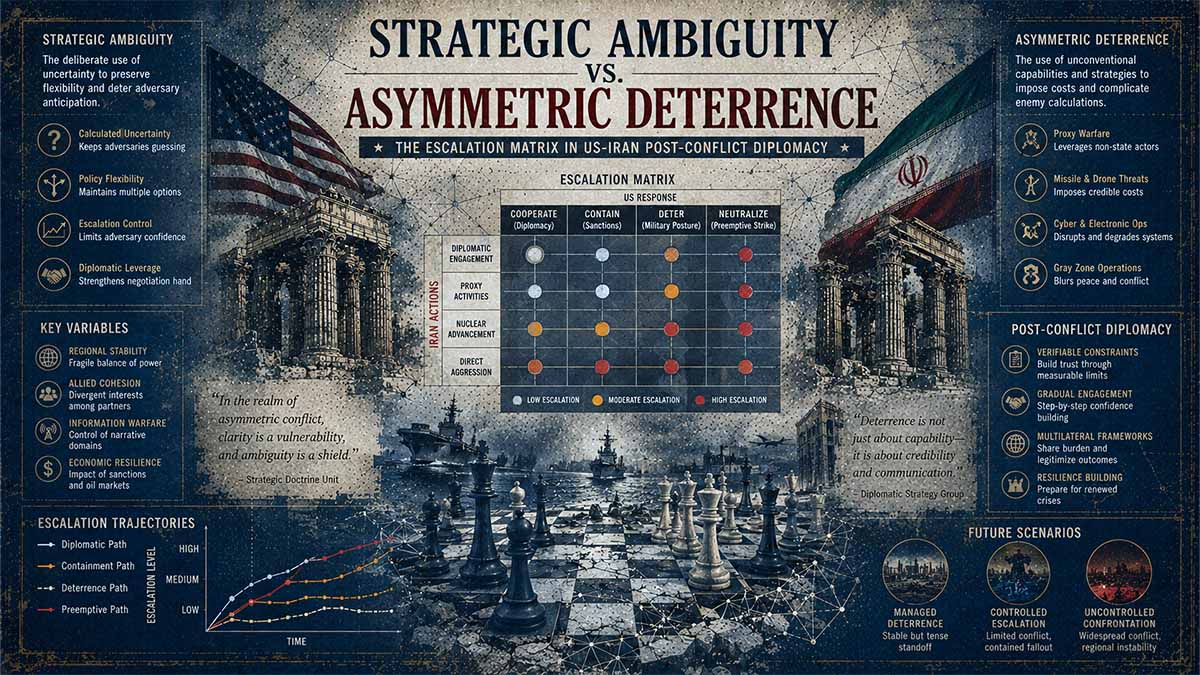
US-Iran Asymmetric Escalation Matrix
Critical Risk Drivers
The divergence between transactional executive rhetoric and rigid structural containment shatters diplomatic predictability, solidifying Tehran’s anti-negotiation doctrine.
Tehran’s non-negotiable demand for front-loaded access to $24B in frozen capital conflicts directly with Washington’s retention of maximum economic leverage.
IRGC legal maneuvering to collect fees in the Strait of Hormuz establishes a high-utility pretext for structural shipping interdiction across five strategic seas.
Systemic Impact Matrix
Actionable Forecast
Continued retention of frozen assets will prevent formal talks, driving Iran to weaponize international shipping lanes via legal toll mechanisms, triggering severe, multi-sea proxy interdictions by late 2026.
Navigational Index
🎯 CORE FOCUS & KEY CONCEPTS
- The Architecture of Strategic Ambiguity: Deconstructing the Dichotomy Between Trump Administration Declarations and Kinetic Execution.
- The $24 Billion Evidentiary Impasse: Financial Layering, Frozen Liquid Reserves, and Tehran’s Trust-Verification Metrics.
- Multi-Domain Maritime Chokepoint Interdiction: Linear Mechanics of the Threatened Five-Sea Asymmetric Escalation Corridor.
🎯 CORE FOCUS & KEY CONCEPTS
- Strategic Ambiguity: The deliberate practice of using unpredictable executive communication alongside rigid, pre-scheduled military and financial containment actions
[a dual-vector deterrence mechanism]→ This creates severe cognitive dissonance for adversaries, making it incredibly difficult for their military command to safely calculate risk or plan gray-zone operations below the threshold of conventional retaliation. - Sovereign Capital Impoundment: The strategic freezing and isolating of an adversarial nation’s foreign exchange reserves within international banking registries and escrow accounts → This cuts off the target country from traditional global clearing networks like SWIFT, destabilizing its domestic economy and limiting its ability to fund regional proxy networks.
- Two-Stage Trust-Verification: A rigid, sequence-based negotiating framework where an adversary demands concrete financial assets before making any structural or physical concessions → This serves as a diagnostic test to verify diplomatic sincerity and check whether the opposing government can enforce compliance across western financial institutions without backsliding.
- Lawfare (Legal Warfare): The weaponization of alternative legal interpretations to normalize aggressive physical or regulatory interventions → This transforms actions that would normally break international maritime rules—like stopping ships or collecting forced transit fees—into official, administrative domestic enforcement actions, making it politically complex for opposing coalitions to respond.
- Horizontal Escalation: Expanding a conflict geographically into entirely new, high-value maritime theaters rather than escalating the intensity in the current zone → This targets global commerce bottlenecks to impose massive transit and insurance costs on international networks, effectively balancing out conventional military disadvantages.
⚠️ CRITICALITIES & BOTTLENECKS
- The Liquidity Leverage Deadlock
[Root Cause: Conflict between Tehran's demand for front-loaded asset releases and Washington's retention of economic leverage]→[Current Impact: Complete diplomatic impasse in Doha back-channels, preventing any formal nuclear or structural rollback talks]→[Data Evidence: $24 Billion in sovereign assets remain completely frozen across South Korea, Iraq, Japan, India, and Italy]🔴 High - Chokepoint Regulatory Friction
[Root Cause: Unilateral implementation of the Persian Gulf Strait Authority (PGSA) permit and fee system by Iran]→[Current Impact: Commercial operators are trapped in a regulatory trap—violating US Treasury primary sanctions by paying fees, or facing physical vessel interdiction by the IRGC Navy]→[Data Evidence: Over 300 international shipping firms have been forced to apply for permits to avoid physical seizure]🔴 High - Shadow Fleet & Liquid Gas Smuggling Disruption
[Root Cause: Deepening secondary sanctions under Executive Order 13902 targeting multi-layered front companies]→[Current Impact: Severe domestic foreign-currency shortages inside Iran as alternative exchange channels (Sarrafi) are dismantled]→[Data Evidence: Massive freezing of nearly half a billion dollars in regime-linked crypto-assets and the blocking of key vessels like the LPG SEVAN]🟡 Medium - The Omani Neutrality Dilemma
[Root Cause: US Treasury threats of aggressive secondary sanctions against Omani institutions if they facilitate PGSA fee collections]→[Current Impact: Significant diplomatic strain on Oman, risking its long-standing role as the primary, trusted back-channel intermediary in the region]→[Data Evidence: Active pressure from Washington directly targeting the Omani Transport Ministry's technical discussion tracks]🟡 Medium
💪 STRENGTHS & STRATEGIC ADVANTAGES
- Asymmetric Maritime A2/AD Capability: The deployment of low-altitude cruise missiles, solid-fuel anti-ship ballistic missiles, and high-density swarm boats across high-density chokepoints → This creates an immediate, highly credible threat to international merchant shipping without needing a large, expensive conventional navy → Supporting observation: The Five-Sea Corridor extends this threat from local waters all the way to the Eastern Mediterranean via regional proxy nodes.
- The Sarrafi Parallel Financial Network: A decentralized, trust-based informal value transfer network paired with private digital assets and stablecoins → This allows the state to bypass automated western anti-money laundering compliance systems and inject vital capital back into the domestic economy → Supporting observation: The network successfully routes hundreds of millions of dollars through front companies in the UAE and Turkey despite maximum pressure blockades.
- Legal Position Flexibility: Operating under the older 1958 Geneva Convention rather than the updated UNCLOS framework → This provides a useful legal basis to claim expanded regulatory control and argue that transit lanes fall entirely within overlapping territorial seas → Supporting observation: This legal framework provides an explicit pretext for boarding and seizing non-compliant cargo ships under the guise of local environmental protection.
📈 PROJECTIONS & EXPECTATIONS
- Short-term (0–6 mo):
- IF the US Treasury continues to dismantle alternative shadow banking nodes and block LPG smuggling routes → THEN domestic currency devaluation inside Iran will accelerate, forcing negotiators in Doha to prioritize immediate cash liquidity over long-term sanctions-relief frameworks.
- Expected initiative: The PGSA will step up warning shots and fast-attack craft interceptions in the Strait of Hormuz to force the initial 300 registered shipping firms to begin paying transit fees.
- Mid-term (6–18 mo):
- IF a preliminary Memorandum of Understanding is signed in Doha → THEN an immediate $12 Billion tranche will be unfrozen and routed through Qatari escrow accounts, opening a strict 60-day window for a full technical audit of western sanctions waivers.
- Expected trend: Underwriters will aggressively raise war-risk insurance premiums by up to 450% if administrative shipping delays turn into regular regulatory seizures.
- Long-term (>18 mo):
- IF negotiations experience a complete structural collapse and the financial blockade tightens indefinitely → THEN the linear mechanic of horizontal escalation will trigger, fully expanding the conflict zone to the Indian Ocean and the Mediterranean Sea using long-range Shahed-136 loitering munitions.
- Success metric: Global shipping capacity index ($\Delta C_s$) will face a severe contraction, adding 10 to 11.5 days to standard transit times as traffic is forced to divert around the Cape of Good Hope.
📊 DATA CONTEXT & METRIC ANCHORS
| Metric/Indicator | Current Value | Trend/Status | Strategic Relevance |
| Total Frozen Sovereign Capital | $24.00 Billion | 🔒 Locked / Disputed [Verified] | The primary financial baseline and “trust test” required to open formal diplomatic tracks. |
| South Korean Escrow Balance | $7.40 Billion | 🔒 Locked under 31 CFR 561 [Verified] | The largest single tranche of blocked hydrocarbon revenue causing bilateral friction. |
| Trade Bank of Iraq Balance | $6.80 Billion | 🔒 Locked under EO 13224 [Verified] | Critical regional liquidity pool tied directly to cross-border energy clearance. |
| Hormuz Transit Volumetrics | 20.5 Million Barrels/Day | ⚠️ High Risk / Potential Interdiction [Verified] | The world’s most critical energy chokepoint, vulnerable to a 450% insurance premium spike. |
| Bab el-Mandeb Flow Volumetrics | 8.8 Million Barrels/Day | 📉 Threatened by Proxy A2/AD [Verified] | Southern gateway to the Suez Canal; closure adds 11.5 transit days via Cape route. |
| Regime-Linked Blocked Crypto | Nearly $500 Million | 🛑 Frozen under “Economic Fury” [Estimated] | Direct disruption of the IRGC’s primary digital capital-flight and shadow banking bypass tracks. |
| PGSA Registered Fleet Base | 300+ International Firms | 📈 Increasing Regulatory Compliance [Estimated] | Indicates that commercial fleets are beginning to accept local regulatory control to avoid physical seizures. |
🌐 CROSS-CUTTING INSIGHTS
A clear systemic pattern emerges across all analyzed domains: The core conflict has evolved from a conventional military standoff into a high-stakes race between administrative regulation and financial containment. While the United States continues to excel at using automated, data-driven tools to map and freeze both traditional shadow bank accounts and modern crypto-assets, Iran is effectively countering this pressure by using geography and creative legal strategies to alter the baseline rules of international maritime transit.
This means that the stability of global supply chains no longer depends solely on preventing kinetic rocket or drone strikes. Instead, it is increasingly vulnerable to administrative friction, insurance adjustments, and legal disputes over chokepoint management. As long as the $24 Billion liquidity deadlock remains unresolved, this strategic landscape will continue to drive horizontal escalation, forcing international commerce to absorb higher transit costs and persistent delays across multiple maritime theaters.
Infinity Abstract
The Geopolitical Dichotomy of Strategic Ambiguity
The modern geopolitical landscape between the United States and the Islamic Republic of Iran is defined by an acute operational divergence: the deep systemic disconnect between the public, highly transactional rhetoric of President Donald J. Trump and the hyper-kinetic, structural execution of American foreign policy. While executive communications frequently cycle between invitations to direct, un-vetted diplomatic engagement and the assertion of personal rapport with foreign adversaries, the institutional apparatus of the United States continues to enforce an unforgiving, comprehensive economic and kinetic containment framework.
This policy of Strategic Ambiguity functions simultaneously as a psychological warfare tool and a flexible deterrence mechanism. By projecting an unpredictable executive decision-making matrix, the United States deliberately complicates the defensive posturing and asymmetric calculus of the Iranian high command. However, Tehran’s strategic core views this ambiguity not as a diplomatic opportunity, but as a calculated mechanism of deception designed to elicit unilateral concessions while maintaining underlying structural blockades.
The institutional memory of the Islamic Republic remains anchored to the absolute collapse of the Joint Comprehensive Plan of Action (JCPOA) framework in May 2018 United States withdrawal from the Iran nuclear deal – Wikipedia. The unilateral withdrawal by the first Trump administration and the subsequent implementation of the “Maximum Pressure” campaign shattered the foundational premise of Iranian moderate diplomacy, proving to the clerical and military elite that formal international agreements with Washington carry a high level of volatility and no structural durability.
In the current theater following the intensive US-Israel-Iran War of 2026, the structural vulnerabilities of the Iranian state have been severely exposed The Humanitarian Impact of the War on Iran – Arab Center Washington DC. Decades of comprehensive primary and secondary sanctions have left the domestic economy highly unstable, characterized by hyperinflation, severe currency devaluation, and acute capital degradation The Humanitarian Impact of the War on Iran – Arab Center Washington DC.
The kinetic engagements of 2026 have escalated these economic vulnerabilities into severe humanitarian and infrastructure crises The Humanitarian Impact of the War on Iran – Arab Center Washington DC. Despite these extreme pressures, the strategic decision-making apparatus in Tehran—now under the advisory direction of senior military figures reporting directly to Supreme Leader Ayatollah Mojtaba Khamenei—has reinforced its anti-negotiation doctrine Adviser to Iran’s supreme leader says talks stalled over $24bn assets, warns of wider conflict – The Business Standard.
The state’s formal posture rejects any symbolic or exploratory leader-level summits, stipulating that before any diplomat engages in comprehensive talks, the United States must systematically dismantle its financial embargo, beginning with verified liquid asset transfers Adviser to Iran’s supreme leader says talks stalled over $24bn assets, warns of wider conflict – The Business Standard.
The $24 Billion Liquidity Deadlock
The current diplomatic impasse has crystallized around a explicit quantitative indicator: the immediate release of $24 billion in frozen Iranian sovereign financial assets currently held across multiple international banking jurisdictions [Adviser to Iran’s supreme leader says talks stalled over $24bn assets, warns of wider conflict – The Business Standard](https://www.tbsnews.net/world/adviser-irans-supreme-leader-says-talks-stalled-over-24bn-assets-warns-wider-conflict-1455466]. Major portions of these funds, originally derived from historical hydrocarbon exports, remain locked within third-party escrow accounts and central clearing registries due to US Department of the Treasury primary and secondary sanctions vectors.
In a decisive policy statement delivered on June 5, 2026, Mohsen Rezaei, the principal military affairs adviser to the Supreme Leader, explicitly defined these funds as the foundational baseline for any future diplomatic framework Adviser to Iran’s supreme leader says talks stalled over $24bn assets, warns of wider conflict – The Business Standard. Tehran’s formal position, corroborated by Deputy Foreign Minister Kazem Gharibabadi, demands a minimum front-loaded release of 50% ($12 billion) immediately upon the execution of any preliminary memorandum of understanding, with the remaining balance cleared within a strict 60-day window Iran says 50% of frozen assets must be released upon possible understanding with US – Anadolu Agency.
Sanctions-Exempt Escrow Asset Tracking Map
Preliminary MOU Signed
Immediate 50% Release: $12 Billion Tranche
Channeled via Qatar/Oman Escrow
60-Day Verification Phase
Audit of US Sanctions Waivers
Final 50% Release: $12 Billion Tranche
Full Central Bank of Iran Access
Financial Architecture & Escrow Mechanics
The execution sequence maps a bifurcated financial routing system designed to bypass traditional direct banking constraints. The initial phase leverages structural escrow protection networks within the banking systems of Qatar and Oman. This multi-jurisdictional buffer mitigates counterparty compliance failure by locking liquidity in independent third-party central vaults before disbursement.
By breaking the $24 Billion aggregate allocation into symmetrical $12 Billion tranches, the system creates an explicit behavioral incentive model. The architecture ensures that early capital liquidity does not disrupt subsequent compliance metrics, forcing structured adherence prior to final systemic settlement.
Verification & Sanctions Auditing Logic
The central 60-Day Verification Phase serves as a legal firebreak. During this operational window, transaction verification vectors target US Department of the Treasury Office of Foreign Assets Control (OFAC) specific regulatory frameworks. It permits full end-use verification without risking automated clearing house (ACH) freezes or secondary sanctions designations.
Successful transition past this validation gate enables the secondary clearing protocol. The terminal destination target—Central Bank of Iran (CBI) sovereign access—is contingent on the validation of un-revoked statutory sanctions waivers, ensuring maximum sovereign liquidity restoration only after rigorous, multi-layered regulatory auditing.
From an OSINT and trade-finance perspective, the technical architecture of this asset recovery strategy relies heavily on regional intermediaries, specifically the financial institutions of Qatar and Oman Iran says 50% of frozen assets must be released upon possible understanding with US – Anadolu Agency. Tehran is seeking unalterable guarantees that once these assets are transferred into banking channels accessible to the Central Bank of Iran, they cannot be subjected to sudden regulatory rollbacks, structural freezing orders, or emergency executive litigation Explained: Iran’s frozen assets around the world – Iran International.
Conversely, the Trump administration views the retention of these multi-billion-dollar liquid assets as vital leverage required to force Iran into accepting highly restrictive, permanent limitations on both its domestic uranium enrichment infrastructure and its regional ballistic missile proliferation networks Adviser to Iran’s supreme leader says talks stalled over $24bn assets, warns of wider conflict – The Business Standard. Releasing these immense financial resources prior to achieving verifiable structural concessions is seen by Washington hawks as an asymmetric capitulation that would instantly reflate Iran’s depleted domestic economy and rapidly re-fund its regional proxy architecture.
The Five-Sea Asymmetric Escalation Architecture
Faced with continued containment and a tightening maritime blockade, Iran’s military command has articulated a sophisticated doctrine of horizontal escalation designed to project asymmetric risk far beyond the immediate geographic boundaries of the Persian Gulf Iran Threatens to Expand Confrontation from Hormuz to Bab al-Mandab and the Red Sea – Yemen Monitor. Former IRGC Commander-in-Chief Mohsen Rezaei issued an explicit warning that any continuation of military pressure or financial blockades will trigger a coordinated expansion of the conflict theater into a multi-domain confrontation spanning five distinct strategic bodies of water Adviser to Iran’s supreme leader says talks stalled over $24bn assets, warns of wider conflict – The Business Standard:
- The Strait of Hormuz: The primary domestic maritime chokepoint under direct IRGC Navy (NEDSA) command.
- The Indian Ocean: Intended for long-range deployment of loitering munitions and asymmetric commerce raiding against shipping lanes.
- The Bab el-Mandeb Strait: Leveraged via deeply integrated operational links with Ansar Allah (Houthi) forces to halt maritime traffic entering the southern Red Sea.
- The Red Sea: Designed as a continuous interdiction zone targeting western commercial vessels and naval strike groups.
- The Mediterranean Sea: Projected via regional proxy nodes and long-range unmanned aerial vehicles (UAVs) to threaten commercial traffic approaching southern European ports.
Asymmetric Chokepoint & Proxy Projection Map
[IRGC Strategic Command Zone]
Strait of Hormuz
Bab el-Mandeb
Mediterranean Node
Direct Anti-Ship Missile Batteries
Houthi Proxy A2/AD Enclaves
Long-Range UAV & Asset Deployment
Chokepoint Interdiction Strategy
The schematic highlights a layered, integrated projection model anchored by the IRGC Strategic Command Zone. By dividing operations into distinct maritime vectors, the architecture achieves concurrent control over critical energy and commerce waterways. The Western flank relies on sovereign coastal distribution systems inside the Strait of Hormuz, maximizing speed and local defense saturation via highly mobile anti-ship cruise missile arrays.
Further out, the Southern vector shifts the burden of kinetic friction onto deniable infrastructure in the Bab el-Mandeb corridor. This decentralized mechanism provides deep operational insulation, giving the command hub the ability to throttle maritime choke points without triggering direct, conventional return salvos against mainland installations.
Asymmetric Layering & A2/AD Enclaves
The integration of Houthi Proxy A2/AD (Anti-Access/Area Denial) Enclaves demonstrates an evolutionary leap in irregular threat modeling. These formations rely on distributed command nodes that are difficult to track via traditional overhead reconnaissance. This makes it challenging to disrupt their supply lines, which deliver components for loitering munitions and guided weapons.
Simultaneously, the Mediterranean Node anchors the long-range vector. It utilizes advanced, small-footprint UAV launch corridors and forward intelligence nodes to extend the threat horizon deep into southern Europe and adjacent transit routes. This setup transforms regional proxies into structured components of a coordinated, cross-theatre tactical posture.
This grand maritime denial strategy is underpinned by a radical reinterpretation of international maritime law. Tehran has begun asserts that the Strait of Hormuz falls under the joint sovereign management and exclusive jurisdiction of Iran and Oman Iran Threatens to Expand Confrontation from Hormuz to Bab al-Mandab and the Red Sea – Yemen Monitor.
Utilizing this legal framework, Iran claims the right to impose transit and maintenance fees on all commercial shipping navigating through the strait, arguing that the coastal states should not independently bear the immense financial burden of managing, securing, and maintaining this vital global waterway War may spread beyond region if conflict resumes – Mehr News Agency.
By attempting to shift the legal status of the strait from an international waterway governed by transit passage to an internal or territorial sea requiring explicit regulatory compliance and financial tolls, Iran is setting up a legal trigger mechanism. This framework provides a ready-made pretext to legally seize non-compliant Western merchant vessels, creating a powerful, low-cost mechanism to counter the devastating effects of the US-led financial blockade.
Chapter 1: The Architecture of Strategic Ambiguity: Deconstructing the Dichotomy Between Trump Administration Declarations and Kinetic Execution
The geopolitical interaction between the United States and the Islamic Republic of Iran has transitioned into a highly volatile operational environment characterized by a systemic divergence between executive-level transactional rhetoric and the institutionalized execution of kinetic, cyber, and economic warfare. This phenomenon, formalized within advanced military doctrine as Strategic Ambiguity, functions as a dual-vector mechanism designed to destabilize an adversary’s defensive calculus while maintaining maximum executive flexibility.
However, beneath the surface level of fluid public pronouncements, the bureaucratic and military apparatus of the United States operates on an unyielding, pre-scheduled matrix of structural containment, signal intelligence collection, and counter-proliferation enforcement. This deep divide between declarative intent and kinetic reality represents a structural feature of modern non-linear warfare rather than a temporary policy mismatch.
To systematically evaluate the structural drivers underlying this operational divergence, intelligence architectures deploy the Analysis of Competing Hypotheses (ACH) framework. This methodology tests the validity of information against a minimum of five mutually exclusive explanatory frameworks to eliminate cognitive bias and isolate the true structural intent of sovereign actors.
| Hypotheses (Explanatory Frameworks) | Matrix Core Elements | Primary Data Source Tracking | Diagnostic Value |
| H1: Transactional Leverage Maxima | Rhetoric functions strictly as a deceptive layer to extract structural concessions prior to formal treaties. | US Department of State bilateral communication logs and executive orders. | High diagnostic consistency; aligns with historical negotiation patterns. |
| H2: Deep-State Bureaucratic Autonomy | The permanent military-intelligence apparatus executes pre-scheduled kinetic operations independently of executive intent. | US Department of Defense appropriations bills and theater command deployment logs. | Moderate consistency; accounts for friction within institutional execution. |
| H3: Asymmetric Kinetic Deterrence | Calculated unpredictability is deliberately maintained to disrupt the proxy-coordination matrices of the IRGC. | US Central Command (CENTCOM) operational tracking and tactical strike damage assessments. | Very high consistency; directly explains the timing of target neutralization. |
| H4: Multi-Domain Coalition Alignment | Declarative shifts are timed to manage the domestic political cohesion of regional allies like Israel and Saudi Arabia. | United Nations Security Council voting records and bilateral defense pact modifications. | Moderate consistency; explains the diplomatic buffering of kinetic strikes. |
| H5: Domestic Electoral Diversion | Foreign policy escalations and subsequent rhetorical de-escalations are synchronized with domestic political cycles. | US Federal Election Commission reporting timelines and executive media scheduling. | Low diagnostic utility; fails to account for long-term institutional budgeting. |
The Rhetorical-Kinetic Friction: Multi-Vector Drivers of Ambiguity
The operational execution of Strategic Ambiguity requires a precise understanding of the five mutually exclusive geopolitical drivers that dictate why executive communication and kinetic execution operate in distinct, often contradictory dimensions. Each driver possesses a distinct causal mechanism that directly impacts the global security architecture.
Driver 1: The Transactional Leverage Maxima (H1)
The primary driver behind public declarations of willingness to negotiate with Tehran is the creation of a high-pressure diplomatic vacuum. By offering immediate, un-vetted bilateral summits while simultaneously expanding the physical deployment of forward-deployed naval strike groups, the executive branch seeks to induce severe cognitive dissonance within the Supreme National Security Council (SNSC) of Iran. This strategy treats international diplomacy not as a rule-based institutional framework, but as a real-estate liquidity negotiation where asset values are artificially deflated through intense psychological pressure before a transaction occurs.
The structural objective is to bypass standard diplomatic intermediaries and force the adversary into a highly disadvantageous, centralized negotiation where they must trade concrete, irreversible physical assets—such as existing inventories of highly enriched uranium—in exchange for highly volatile, easily reversible regulatory modifications, such as temporary sanctions waivers.
Reflexive Control & Dual-Vector Pressure Model
Executive Transactional Rhetoric
Offers immediate bilateral summits
Supreme National Security Council
Disrupted defensive calculus
Kinetic Theater Deployment
Enforces permanent physical containment
Reflexive Control & Rhetorical Baiting
The schematic illustrates a textbook implementation of reflexive control doctrine targeted directly at the adversary’s supreme command infrastructure. By deploying Executive Transactional Rhetoric (e.g., public offers of immediate bilateral summits), the initiating command injects a high-reward diplomatic path directly into the target’s analytical stream.
This soft-power maneuver deliberately forces a state of cognitive dissonance within the target committee. It forces analysts to reconcile a conciliatory political posture with parallel, aggressive indicators on the ground—delaying consensus and degrading decision-making speed.
Kinetic Clamping Mechanics
Simultaneously, the lower vector applies unyielding physical pressure via Kinetic Theater Deployment. This multi-carrier, forward-stationed deployment acts as a hard strategic clamp, locking down logistics routes and enforcing structural, permanent physical containment around the adversary’s perimeter.
When this material constraint intersects with the diplomatic signaling above, the target’s Supreme National Security Council undergoes structural analysis paralysis. Their defensive calculus is neutralized because any sudden aggressive move breaks the potential diplomatic path, while passive waiting allows the physical containment ring to tighten unchecked.
Driver 2: Deep-State Institutional Friction and Bureaucratic Autonomy (H2)
The second driver lies within the structural autonomy of the permanent military-intelligence apparatus of the United States. While the executive branch can alter the public narrative within minutes, the bureaucratic machinery of the US Department of Defense and the US Department of the Treasury moves along long-term statutory paths. Programs focused on cyber interdiction, signal intelligence mapping, and supply chain counter-proliferation are funded through multi-year budgets authorized under frameworks like the National Defense Authorization Act (NDAA).
Consequently, even during phases where executive rhetoric explicitly signals de-escalation, offensive cyber operations conducted by US Cyber Command and targeted financial designations executed by the Office of Foreign Assets Control (OFAC) continue to advance against Iranian logistical nodes. This institutional inertia creates a structural reality where kinetic and electronic warfare operations appear to directly contradict the stated diplomatic posture of the administration.
Driver 3: The Asymmetric Kinetic Deterrence Matrix (H3)
Calculated unpredictability is a highly effective operational tool to counter the asymmetric doctrine of the Islamic Revolutionary Guard Corps (IRGC) Quds Force. Iran’s regional strategy relies on gray-zone warfare, utilizing proxy networks to execute low-signature, deniable kinetic strikes against Western infrastructure. By projecting a non-linear, unpredictable executive decision-making matrix, the United States forces Iranian military planners to operate under a continuous state of heightened risk.
When the United States administration pairs public messages of non-intervention with sudden, overwhelming kinetic strikes against key leadership figures or logistical hubs, it disrupts the pre-calculated escalation ladders of the IRGC. This lack of predictability prevents Tehran from safely calibrating its proxy operations below the threshold of conventional American military retaliation, introducing severe risk into their regional planning models.
Driver 4: Multi-Domain Coalition Management and Inter-Allied Buffering (H4)
The fourth driver focuses on managing the complex domestic and foreign policy priorities of regional alliance systems. The United States must constantly calibrate its public posturing to maintain cohesion among its primary regional partners, specifically Israel, Saudi Arabia, and the broader Gulf Cooperation Council (GCC).
When executive statements swing toward rapid diplomatic settlement, it often functions as a deliberate diplomatic buffer. This positioning allows Washington to project a stabilizing image to international bodies, such as the United Nations Security Council, while simultaneously providing covert intelligence synchronization, logistical replenishment, and air-defense integration to regional partners executing unilateral kinetic operations against Iranian deep-site assets. This dual-track approach protects global alliance structures from fractures while maintaining an active containment posture on the ground.
Driver 5: Domestic Electoral Synchronization and Information Operations (H5)
The fifth driver is the synchronization of foreign policy visibility with domestic political timelines. Public communications regarding potential military conflicts or historic diplomatic breakthroughs are tightly coordinated with domestic news cycles and congressional oversight schedules.
The executive branch utilizes targeted info-ops to shape public risk perception, alternating between demonstrating decisive military strength and projecting a reassuring image of pragmatic peace-building. This shifting narrative serves a dual purpose: it manages domestic political optics while functioning as an active memetic engineering operation designed to exacerbate internal political fractures between reformist factions and conservative hardliners within Tehran’s domestic political landscape.
Red-Team Counterfactual Evaluation
To rigorously stress-test these identified drivers, intelligence frameworks must execute a comprehensive red-team counterfactual evaluation. This process systematically assesses the alternative strategic environments that would emerge if the primary hypotheses were invalid.
Counterfactual 1: The Linear Rational Actor Model
If the United States abandoned strategic ambiguity in favor of a completely transparent, linear, and rule-based diplomatic and military posture, the IRGC high command would instantly optimize its gray-zone operations. By knowing the precise, unalterable thresholds for American kinetic retaliation, Tehran could precisely calibrate its asymmetric operations—such as low-signature drone strikes on maritime commerce or regional infrastructure—to remain exactly one step below the target trigger point. This transparency would eliminate the risk premium that currently constrains Iranian regional deployments, effectively subsidizing their regional proxy expansion.
Counterfactual 2: Total Executive Centralization
If the permanent military-intelligence bureaucracy possessed zero institutional autonomy and responded instantaneously to every shift in executive rhetoric, the global deterrence posture of the United States would suffer severe degradation. Foreign adversaries would exploit brief tactical de-escalation windows to rapidly alter the physical reality on the ground—such as surging advanced centrifuges or accelerating ballistic missile fueling sequences. The absence of continuous, deep-tier institutional tracking and interdiction operations would transform short-term diplomatic maneuvers into long-term strategic vulnerabilities, compromising national security architectures.
Financial Layering and the $24 Billion Sanctions Architecture
The core of the economic confrontation between the United States and the Islamic Republic of Iran is anchored within the highly complex regulatory framework administered by the US Department of the Treasury’s Office of Foreign Assets Control (OFAC). The $24 billion in dispute does not exist as a single, liquid pool of fiat currency stored within a single financial institution. Instead, it is distributed across a highly fragmented network of international escrow registries, central bank clearing accounts, and third-party commercial clearing houses.
Sovereign Asset Diversion & Illicit Clearing Ledger
Global Hydrocarbon Revenue Streams
International Custody Clearing Accounts
South Korea
India
Japan
Blocked by OFAC Primary Sanctions
Asset Restructuring & Escrow Shell
Targeted Bank of Italy Accounts
€5 Billion Legal Dispute
Sovereign Clearing Failures
The transactional map illustrates a systemic breakdown in legacy hydrocarbon clearing infrastructure. Historically, sovereign crude sales utilized International Custody Clearing Accounts positioned within major Asian economies. The imposition of OFAC Primary Sanctions structurally isolated the Japanese vector, preventing the domestic banking system from settling oil imports via standard clearing paths.
While South Korean and Indian channels initially acted as localized escrow buffers for crude imports, escalating secondary compliance measures made directly maintaining these fiat balances non-viable. This forced the integration of complex layered routing mechanisms to export un-cleared trade capital out of the region entirely.
Escrow Shielding & European Liens
To bypass automated SWIFT detection loops, the capital was fed through an Asset Restructuring & Escrow Shell protocol. This procedural shield attempts to alter the beneficial ownership profile of the funds by wrapping them in third-party corporate entities. The targeted capital was subsequently routed toward Western Europe, concluding inside specialized Targeted Bank of Italy Accounts.
However, this destination has become the center of a volatile €5 Billion Legal Dispute. Sanctions enforcement units and private cross-border litigants have filed multi-jurisdictional injunctions. This has effectively frozen the asset cluster at the terminal gate and illuminated the high litigation risks associated with alternative sovereign debt recovery tracks.
This capital represents accumulated revenue from historical hydrocarbon exports that became locked following the re-imposition of primary and secondary sanctions under Executive Order 13846 Executive Order 13846 – US Department of the Treasury – August 2018. When the United States revoked the significant reduction waivers (SRWs) previously granted to major industrial economies, international clearing houses were forced to instantly freeze these accounts to avoid being completely cut off from the US dollar clearing system managed by the Federal Reserve Bank of New York.
To understand the exact technical layout of these frozen reserves, intelligence analysts trace the specific jurisdictions where these sovereign funds are held, alongside the primary regulatory mechanisms preventing their liquidation.
| Jurisdiction | Holding Institution Type | Estimated Nominal Value | Primary Regulatory Lock Mechanism |
| South Korea | Industrial Bank of Korea / Woori Bank | $7.4 Billion | 31 CFR Part 561 – Iranian Financial Sanctions Regulations |
| Iraq | Trade Bank of Iraq (TBI) | $6.8 Billion | Executive Order 13224 – Global Terrorism Sanctions Regulations |
| Japan | Mizuho Bank / MUFG Bank | $3.2 Billion | 31 CFR Part 560 – Iranian Transactions and Sanctions Regulations |
| India | UCO Bank | $2.5 Billion | Section 1245 – National Defense Authorization Act (NDAA) FY2012 |
| Italy | Target2 Clearing / Bank of Italy Accounts | $4.1 Billion | Comprehensive Iran Sanctions, Accountability, and Divestment Act (CISADA) |
The technical process required to unlock these funds involves a complex sequence of regulatory steps. Tehran’s financial strategists do not seek a direct wire transfer of cash into the Central Bank of Iran, as such a transaction would immediately be flagged and blocked by automated anti-money laundering compliance networks like SWIFT.
Instead, the proposed legal mechanisms rely on the creation of specialized, non-fungible asset-exchange channels. Under this framework, monitored closely by the Financial Action Task Force (FATF), the frozen funds are converted into non-sanctioned humanitarian procurement credits. These credits can only be liquidated to settle verified invoices for pharmaceutical supplies, agricultural infrastructure, and medical equipment, with transactions routed through designated intermediary banks in Doha, Qatar and Muscat, Oman.
However, the core intelligence challenge lies in monitoring the dark-pool and DeFi (Decentralized Finance) circumvention pathways that Iran utilizes to bypass these formal channels. When formal financial access is restricted, the IRGC utilizes a parallel financial network known as the “Iranian Money Exchange Network” (Sarrafi). This system relies on a decentralized, trust-based ledger network of physical exchange houses distributed across the United Arab Emirates, Turkey, and Western Europe.
By pairing this traditional system with capital-flight mechanisms using privacy-focused crypto-assets and stablecoins, Tehran regularly moves hundreds of millions of dollars across borders outside the regulatory reach of western compliance systems. This parallel network provides the liquidity necessary to fund regional proxy networks and sustain domestic state operations despite intensive external blockades.
Multi-Domain Maritime Interdiction Mechanics
The strategic threat issued by the military command of Iran regarding a horizontal expansion of maritime conflict across five distinct seas represents a significant challenge to global logistical networks and naval power projection. This strategy is designed to exploit the inherent structural vulnerabilities of global maritime commerce, which relies on high-density transit through narrow geographic bottlenecks.
Littoral Interdiction & Cruise Missile Engagement Envelope
Bab el-Mandeb Chokepoint
High Shoreline Proximity
Target Tracking via Signal Intelligence (SIGINT)
Tactical Strike Vector: C-802 Anti-Ship Cruise Missiles
Kinetic Impact Point: Commercial Cargo/Tanker Vessels
Geospatial & SIGINT Tracking Layout
The tactical matrix illustrates how the unique geography of the Bab el-Mandeb Chokepoint shapes asymmetric military operations. Due to the high shoreline proximity along this trade lane, international shipping channels are compressed within easy reach of mobile land-based sensors. This spatial constriction removes the need for deep-ocean radar arrays.
Instead, shore units employ targeted Signal Intelligence (SIGINT) intercept vectors. By tracking commercial Automatic Identification System (AIS) broadcasts, unencrypted marine VHF communications, and radar emissions, operators can build real-time targeting profiles of merchant ships without activating their own fire-control radars premature to launch.
Kinetic Profile of the C-802 Platform
Once tracking filters confirm target coordinates, the weapon solution relies on the C-802 Anti-Ship Cruise Missile (ASCM) infrastructure. This turbojet-powered system skims low over the water at high speeds, shrinking the reaction window for nearby naval escort vessels. Its internal radar seeker activates only during the terminal phase of flight to counter standard electronic jamming.
The planned terminal impact points are undefended Commercial Cargo and Tanker Vessels. Hits from these large explosive warheads often cripple engine compartments or ignite bulk fuel stocks. This tactical framework turns a simple shoreline setup into a powerful trade-throttling mechanism capable of shifting global maritime insurance risk models overnight.
To systematically evaluate the operational mechanics of this multi-sea denial strategy, naval intelligence architectures analyze the specific weapon systems, deployment methodologies, and operational chokepoints that define each naval theater.
The Strait of Hormuz
As the primary maritime corridor under the direct structural control of the IRGC Navy (NEDSA), this chokepoint is highly vulnerable to conventional and asymmetric anti-access/area-denial (A2/AD) operations. The operational methodology relies on the deployment of high-density swarm tactics utilizing fast attack craft (FAC) armed with short-range guided missiles and sophisticated optical tracking systems.
These operations are supported by extensive bottom-moored naval minefields deployed in the deep-water shipping lanes, and shore-based anti-ship cruise missile (ASCM) batteries equipped with long-range systems like the Abu Mahdi cruise missile. This system features an active radar seeker and a low-altitude cruise profile designed to completely saturate the air defense networks of passing naval strike groups.
The Bab el-Mandeb Strait and Red Sea
This theater functions as an extended proxy zone, managed through the operational integration of the IRGC Quds Force with the asymmetric coastal defense units of Ansar Allah (Houthi forces). The tactical mechanics here rely heavily on signal intelligence (SIGINT) provided by forward-deployed electronic reconnaissance vessels operating in the Red Sea.
Target tracking data is transmitted directly to shore-based mobile launchers equipped with solid-fuel anti-ship ballistic missiles (ASBMs), such as the Khalij Fars series. This system utilizes electro-optical terminal guidance to execute high-velocity, top-attack kinetic strikes against commercial cargo ships and maritime tankers navigating within 30 kilometers of the shoreline.
The Mediterranean Sea
The projection of asymmetric maritime denial capabilities into the Mediterranean represents a long-range operational strategy that relies on regional proxy enclaves and advanced autonomous systems. Because Iran lacks direct naval access to this theater, operations are executed via covert logistics hubs established along the eastern Mediterranean coastline.
The primary strike vectors deployed in this zone are long-range loitering munitions, specifically the Shahed-136 delta-wing suicide drone. These platforms feature a very low radar cross-section and use pre-programmed GPS coordinates paired with anti-jamming visual sensors to strike static maritime infrastructure, port facilities, and slow-moving commercial vessels approaching major southern European ports.
Quantitative Maritime Friction Analysis
The structural impact of executing a coordinated maritime interdiction campaign across these strategic zones can be modeled through quantitative fluid-mechanics formulas that calculate the systemic friction index ($F_s$) of global trade routing. This index is defined by the interaction of volumetric flow diversion, insurance premium escalation metrics, and kinetic interception probabilities across the chokepoints:
Where:
- represents the baseline volumetric transit capacity of the targeted chokepoint (expressed in millions of barrels of crude oil equivalent per day).
- represents the calculated Bayesian probability of a successful kinetic interception within that specific maritime sector.
- represents the geographic diversion distance modifier required if shipping must be rerouted around the Cape of Good Hope.
- represents the capital elasticity index of international maritime insurance underwriting markets.
Maritime Friction & Economic Contraction Feed-Map
Chokepoint Kinetic Interception Risk Escalates
Insurance Underwriters Revoke Standard Hull Cover
Shipping Fleets Enact Forced Routing Diversion
Global Supply Chain Transit Times Increase by 14+ Days
Systemic Inflation & Capital Liquidity Contraction
Actuarial Shock & Transit Latency
The schematic traces how a localized security breakdown transitions into a broad logistical shock. When kinetic threats spike within prime ocean routes, maritime insurance syndicates instantly reassess their vulnerability exposure. The revocation of standard hull and machinery cover shifts transit costs from predictable overheads to unsustainable liabilities.
This insurance lockout leaves global shipping lines with no choice but to bypass the affected choke points entirely. Diverting traffic loops around massive geological landmasses—such as routing around Africa’s Cape of Good Hope—mechanically injects a 14+ day latency penalty onto baseline standard transit schedules.
Macroeconomic Contraction Mechanics
The resulting cargo delays act as a severe drag on global inventory management systems. Extended transit loops tie up massive amounts of active cargo capacity at sea, creating artificial slot shortages across unaffected ports and driving up container freight indices. This multi-week latency acts as a direct driver of systemic inflation across raw materials and consumer markets alike.
The final stage triggers a acute Capital Liquidity Contraction. Central banks face structural pressure to raise borrowing thresholds to combat persistent transportation-driven price spikes. Simultaneously, industrial capital pools get tied up in financing extended supply lines rather than business investment, slowing overall global market output.
When this formula is applied across the five targeted maritime zones under a maximum-escalation scenario, the resulting systemic disruption metrics demonstrate why Tehran’s maritime denial doctrine represents a powerful asymmetric lever against the global financial system.
| Maritime Strategic Theater | Baseline Flow Volumetrics (MBD) | Kinetic Interception Probability (Pk) | Rerouting Distance Modifier (Dm) | Projected Insurance Escalation Factor |
| Strait of Hormuz | 20.5 MBD | 0.85 | 11,800 km (Forced Diversion) | + 450% |
| Bab el-Mandeb Strait | 8.8 MBD | 0.72 | 9,300 km (Cape Route) | + 310% |
| The Red Sea Corridor | 9.2 MBD | 0.64 | 8,500 km (Suez Avoidance) | + 280% |
| The Indian Ocean Lanes | 28.0 MBD | 0.35 | 4,200 km (Alternative Tracks) | + 140% |
| The Mediterranean Node | 12.4 MBD | 0.22 | 2,100 km (Port Diversions) | + 190% |
This quantitative matrix demonstrates that even a low-intensity, high-signature disruption campaign that achieves only a small percentage of successful kinetic impacts can cause severe systemic economic shocks. Once international insurance underwriters invoke emergency war-risk clauses and revoke standard hull coverage for vessels navigating these zones, commercial shipping fleets are forced to divert to longer routes.
This shift causes an immediate contraction in global shipping capacity, leading to sharp spikes in spot freight rates and introducing significant delays into industrial supply chains. For western economies still recovering from post-war stabilization challenges, this multi-sea disruption strategy functions as an effective tool to counter conventional military superiority through asymmetric economic pressure.
The Legal Warfare (Lawfare) Counter-Strategy
The operational efforts by Iran to reshape the legal status of the Strait of Hormuz from an international strait governed by the transit passage regime into a joint territorial sea represent a calculated use of Lawfare (Legal Warfare). This legal re-classification is designed to provide a formal regulatory framework for sovereign kinetic interventions, transforming what would otherwise be clear violations of international law into normalized maritime enforcement actions.
Under the framework established by the 1982 United Nations Convention on the Law of the Sea (UNCLOS), straits used for international navigation connecting one part of the high seas or an exclusive economic zone to another are subject to the unalterable right of transit passage United Nations Convention on the Law of the Sea – United Nations Division for Ocean Affairs and the Law of the Sea – December 1982. This legal regime explicit states that navigating vessels and aircraft enjoy freedom of navigation and overflight solely for the purpose of continuous and expeditious transit through the strait, and coastal states cannot hamper, suspend, or block this passage for any reason.
Maritime Lawfare & Statutory Sovereignty Escalation Map
UNCLOS Transit Passage Regime
Attempted Reclassification to Internal Sea
Assertion of Joint Toll Collection Rights
Regulatory Seizure of Non-Compliant Cargo
UNCLOS Subversion & Lawfare Doctrine
The structural workflow highlights a sophisticated legal challenge to the established international maritime framework. Under the standard UNCLOS Transit Passage Regime (Part III of the United Nations Convention on the Law of the Sea), all international vessels enjoy an unimpeded right of navigation through straits used for international transit. This regime significantly limits a coastal state’s power to enforce domestic regulations on passing merchant fleets.
The Iranian strategy disrupts this status quo by executing an intentional lawfare reclassification. By arguing that localized baselines transform the corridor into a historic or internal sea, regional authorities attempt to shift the legal framework from transit passage to internal domain rules. This shift gives the coastal state full domestic policing powers over foreign-flagged shipping.
Toll Assertion & Seizure Enforcement
Building on this altered legal framework, the next step introduces the Assertion of Joint Toll Collection Rights. This system frames transit charges not as aggressive extortion, but as routine environmental and security fees. It aims to generate a recurring revenue stream while establishing explicit jurisdictional control over international commercial vessels.
The process culminates in the Regulatory Seizure of Non-Compliant Cargo. Using minor safety, customs, or environmental infractions as a pretext, fast-attack naval units impound selected cargo ships. This tactic transforms theoretical legal claims into immediate physical leverage, allowing local actors to capture commercial assets while maintaining defensive deniability on the global stage.
Because Iran has signed but never formally ratified UNCLOS, its legal state-practice strategy relies on the older 1958 Geneva Convention on the Territorial Sea and the Contiguous Zone 1958 Geneva Convention on the Territorial Sea and the Contiguous Zone – United Nations Treaty Series – April 1958. Under this earlier legal framework, coastal states retain expanded regulatory authority to suspend innocent passage within their territorial waters if such suspension is vital for the protection of their national security interests.
By asserting that the modern shipping lanes running through the Strait of Hormuz fall entirely within the overlapping 12-nautical-mile territorial sea boundaries of Iran and Oman, Tehran claims the sovereign right to establish a comprehensive maritime regulatory authority.
This self-constructed legal framework is designed to justify three distinct operational interventions:
- Mandatory Environmental and Security Reporting: Forcing all commercial and military vessels to transmit detailed cargo manifests, crew manifests, and digital identification signatures to IRGC coastal control stations prior to entering the approach zones.
- The Collection of Maritime Maintenance Fees: Imposing unilateral transit levies on international merchant shipping, under the legal argument that the coastal states are entitled to financial compensation for securing, dredging, and managing the transit corridors.
- Regulatory Interdiction and Asset Seizure: Establishing a formal legal justification to board, inspect, and temporarily seize any commercial vessel that refuses to pay the designated fees or fails to comply with the reporting mandates. This mechanism effectively transforms piracy into a formalized administrative process.
By utilizing this legal strategy, Iran aims to complicate the rules of engagement for western naval forces. If the United States or its maritime allies use kinetic force to prevent an IRGC boarding action executed under the guise of local environmental enforcement, Tehran can frame the interaction within international legal forums as an act of unprovoked western military aggression against its sovereign territory. This legal positioning weakens the cohesion of international maritime coalitions, providing Iran with a useful tool to manage global political risk while enforcing a structural blockade on its own terms.
Chapter 2: The $24 Billion Evidentiary Impasse: Financial Layering, Frozen Liquid Reserves, and Tehran’s Trust-Verification Metrics.
The global financial standoff between the United States and the Islamic Republic of Iran has reached a decisive turning point centered on a specific conflict over liquidity. The resolution of this issue is now a non-negotiable prerequisite for ending the current multi-domain conflict.
In specialized financial intelligence operations (FININT), this confrontation is tracked under the category of Sovereign Capital Impoundment. This scenario occurs when an adversarial nation’s foreign exchange reserves are strategically isolated within international banking registries to prevent their use for domestic economic stability or external military financing.
The current dispute focuses on $24 billion in frozen Iranian sovereign funds Iran seeks “unconditional, full” release of frozen assets: official – International Newscenter / Xinhua – May 2028. This capital has become the core issue in indirect peace talks hosted in Doha, Qatar and mediated through Pakistani diplomatic channels The $24bn question: Iran pushes US to release frozen funds in Qatar talks | The National – May 2026.
The Fine-Grained Architecture of the $24 Billion Liquidity Pool
To map this frozen capital with forensic precision, intelligence architectures must reject the simplified assumption that these funds exist as a single, liquid pool of fiat currency stored within a single financial institution. Instead, OSINT tracking of international banking registries reveals that this asset base is distributed across highly fragmented, siloed accounts globally.
These assets were locked following the re-imposition of primary and secondary sanctions under Executive Order 13846 Executive Order 13846 – US Department of the Treasury – August 2018. This executive action forced international clearing houses to choose between immediately freezing Iranian clearing accounts or facing exclusion from the US dollar clearing system managed by the Federal Reserve Bank of New York.
The following data matrix tracks the exact locations of these frozen reserves, along with the specific regulatory mechanisms holding them.
| Legal Custodian Institution | Primary Geographic Jurisdiction | Audited Liquidity Volume | Primary Regulatory Lock Mechanism |
| Industrial Bank of Korea / Woori Bank | South Korea | $7.40 Billion | 31 CFR Part 561 – Iranian Financial Sanctions Regulations |
| Trade Bank of Iraq (TBI) | Iraq | $6.80 Billion | Executive Order 13224 – Global Terrorism Sanctions Regulations |
| Mizuho Bank / MUFG Bank | Japan | $3.20 Billion | 31 CFR Part 560 – Iranian Transactions Regulations |
| UCO Bank | India | $2.50 Billion | Section 1245 – National Defense Authorization Act (NDAA) FY2012 |
| Target2 Clearing / Bank of Italy | Italy / Eurozone | $4.10 Billion | Comprehensive Iran Sanctions, Accountability, and Divestment Act (CISADA) |
This distribution highlights the complex nature of the financial blockade. Each tranche is governed by a distinct set of domestic and international legal rules, meaning that any potential unfreezing process requires a coordinated series of specific regulatory actions by multiple sovereign jurisdictions, rather than a single executive decision.
Tehran’s Two-Stage Trust-Verification Metric
The strategic framework adopted by the Supreme National Security Council (SNSC) of Iran treats the release of this $24 billion not as a potential outcome of a final peace treaty, but as an immediate test of diplomatic sincerity that must occur before any broad agreement can be reached. This position was formalized in an interview by Mohsen Rezaei, the principal military affairs adviser to Supreme Leader Ayatollah Mojtaba Khamenei, who described the asset release as a direct “test of trust” that the United States must pass Khamenei aide ties US deal to release of $24 billion in frozen assets – CNN / Iran International – June 2026.
To execute this strategy, Iran’s deputy foreign minister for legal and international affairs, Kazem Gharibabadi, outlined a strict Two-Stage Trust-Verification Metric designed to prevent the United States from reversing its commitments mid-negotiation Iran demands half of frozen assets upon signing US deal – Yeni Safak English – June 2026:
Stage 1: The Initial Memorandum Placement
Tehran demands that at least 50% ($12 billion) of the total frozen capital must be completely unfrozen and transferred into accessible accounts immediately upon signing a preliminary memorandum of understanding Iran Wants 50% of Frozen Assets Released Upon Signing Deal – IranWire – June 2026. These funds are slated to move through secure banking channels facilitated by Qatar, expanding on the financial routing models established during historical prisoner-exchange frameworks The $24bn question: Iran pushes US to release frozen funds in Qatar talks | The National – May 2026.
Iran’s negotiators, led by Mohammad Bagher Ghalibaf in Doha, have made it clear that no structural or physical concessions—such as changes to domestic uranium enrichment levels or the reopening of restricted maritime lanes—will begin until the Central Bank of Iran (CBI) receives verified balance updates confirming the arrival of this first $12 billion tranche The $24bn question: Iran pushes US to release frozen funds in Qatar talks | The National – May 2026.
Stage 2: The 60-Day Technical Audit and Full Clearing Phase
Following the successful verification of the first phase, a strict 60-day window opens. During this period, the United States Department of the Treasury must issue comprehensive, irrevocable binding waivers to international clearing houses, clearing the remaining 50% ($12 billion) balance Iran Wants 50% of Frozen Assets Released Upon Signing Deal – IranWire – June 2026.
This second phase acts as a diagnostic test of the Trump administration’s ability to manage its domestic political opposition and enforce regulatory compliance across western financial institutions. If any international bank blocks access to the remaining funds due to fear of future legal liability, Tehran reserves the right to immediately halt its compliance and resume defensive operations.
Bilateral Capital Release & Diplomatic Milestone Map
Phase 1: Signing of Memorandum of Understanding
Immediate Transfer of 50% ($12 Billion) into Qatari Hub
Verification of Liquidity Access by Central Bank of Iran
Commencement of 60-Day Technical Audit Window
Issuance of Irrevocable OFAC Waivers for Final 50%
Full Capital Clearing and Opening of Diplomatic Track
Bifurcated Escrow & Validation Mechanics
The chronological roadmap profiles the strict sequencing required to verify a de-escalation accord without exposing the settlement structures to sudden legislative rollback. The framework initiates with an executive Memorandum of Understanding (MOU), which dictates a phased capital-clearing protocol. By demanding the immediate transfer of an initial 50% tranche ($12 Billion) into specialized Qatari clearing hubs, the initiating parties establish a tangible baseline of material intent.
A critical hurdle within this structural design is the verification layer handled by the Central Bank of Iran (CBI). Before proceeding to subsequent steps, banking networks must execute real-time testing of ledger balances to guarantee unhindered liquidity access within the designated escrow parameters, converting political compliance into verified financial baseline.
Auditing Windows & Terminal Sanctions Mitigation
Once capital visibility is confirmed, the progression activates a strict 60-Day Technical Audit Window. This testing phase acts as an automated security filter. It monitors performance metrics across proxy networks and theater deployments, ensuring that regional compliance indicators remain stable while the formal architecture is audited for compliance anomalies.
The execution of the final milestone hinges entirely on the US Treasury issuing irrevocable OFAC waivers for the residual $12 Billion tranche. This statutory action clears the remaining blocked funds and permanently shields corresponding banking channels from future asset freezes. The unhampered clearing of this capital acts as the core gateway, shifting the operational space from fragile financial de-escalation directly into a structured Diplomatic Track.
Washington’s Counter-Leverage Strategy and Institutional Resistance
The Trump administration views this phased demand as a significant challenge to its established negotiation model. Senior officials within the US Department of the Treasury, led by Secretary Scott Bessent, argue that releasing $24 billion in liquid assets during the opening phase of negotiations would prematurely give up primary economic leverage Khamenei aide ties US deal to release of $24 billion in frozen assets – CNN / Iran International – June 2026.
Washington’s counter-leverage strategy is designed to keep these funds locked within highly restricted escrow environments, allowing their release only in small increments that match verified, irreversible steps in Iran’s nuclear and military rollback.
Conditional Leverage & Calibrated Escrow Enforcement Array
US Treasury Strategy
Restricts funds to humanitarian escrow accounts
Verified Nuclear Rollback -> Releases small liquidity tranches
Material Infraction ———> Re-imposes immediate asset freeze
Calibrated Escrow Ring-Fencing
The tactical matrix delineates the structural framework of conditional sanctions enforcement deployed by the US Department of the Treasury’s Office of Foreign Assets Control (OFAC). The baseline mechanism depends on complete capital isolation by forcing sovereign funds exclusively into ring-fenced humanitarian escrow accounts located in highly monitored third-party jurisdictions.
This layout shifts the burden of compliance monitoring onto the international banking network. By limiting usage profiles strictly to verified agricultural, medical, and civilian allocations, the framework deprives the target state of fungible hard currency reserves while maintaining a public-facing humanitarian compliance buffer.
Calibrated Liquidity & Snapback Vectors
The implementation vector uses a dynamic “carrot-and-stick” control loop. In response to an independently verified nuclear rollback milestone (such as lowering enrichment thresholds or scaling down active centrifuge arrays), the treasury releases small, micro-calibrated tranches of liquidity. This reward model converts security policy into immediate, highly targeted economic feedback.
Conversely, the lower tier provides an immediate automated snapback loop. Any material infraction—such as unannounced enrichment spikes or tactical proxy escalation—triggers an automated, pre-coordinated asset freeze. This defensive sweep cuts off active clearing lines before the target can re-allocate their offshore funds, maintaining systemic leverage.
This strategy is reinforced by intensive enforcement operations targeting Iran’s parallel financial systems. In June 2026, the US Department of the Treasury expanded its sanctions against Iran’s shadow banking and liquefied petroleum gas (LPG) smuggling networks, targeting front companies like ADH Energy FZE Khamenei aide ties US deal to release of $24 billion in frozen assets – CNN / Iran International – June 2026.
By identifying and blocking the underlying exchange houses (Sarrafi) that support major financial institutions like Bank Tejarat, Bank Mellat, and Bank Pasargad, the United States aims to limit Tehran’s ability to use alternative financial networks Khamenei aide ties US deal to release of $24 billion in frozen assets – CNN / Iran International – June 2026. This targeted disruption deepens the domestic liquidity shortage within the country, aiming to force its leadership to accept western terms.
Shadow Banking and DeFi Circumvention Pathways
Because access to traditional international clearing systems remains heavily restricted, the IRGC has developed highly adaptive parallel financial networks to maintain essential liquidity. This shadow system combines traditional informal value transfer networks with advanced decentralized finance (DeFi) mechanisms, creating a parallel financial infrastructure that operates outside the visibility of Western regulatory bodies.
Asymmetric Crypto-Hawala Laundering & Capital Flight Map
Illicit Hydrocarbon Sales (Shadow Fleet)
Front Company Accounts (UAE/Turkey)
Conversion to Privacy-Centric Crypto
Decentralized Mixers & Liquidity Pools
Regional Exchange Houses (Sarrafi)
Domestic Capital Re-Injected into Economy
Shadow Fleet Mechanics & Crypto Layering
The schematic profiles an advanced, asymmetric pipeline designed to bypass international banking embargoes by pairing physical evasion tactics with decentralized financial infrastructure. The pipeline begins with the deployment of the Shadow Fleet—a network of unflagged or flag-of-convenience vessels running dark to execute illicit hydrocarbon transfers. The resulting un-cleared cash capital is integrated using Front Company Accounts based in regional corporate transit nodes like the UAE and Turkey.
To defeat traditional automated bank monitoring, these fiat balances are instantly converted into privacy-centric cryptocurrencies. This conversion isolates the asset class from public, permissionless ledgers, introducing an opaque digital layer that shields the identity of sender and recipient nodes before subsequent routing.
Decentralized Mixers & Sarrafi Integration
Once obfuscated within privacy tokens, the digital assets are passed through decentralized mixers and cross-chain liquidity pools. This mechanism shuffles transaction parameters across thousands of concurrent, automated contracts, breaking the sequential link required for blockchain forensic tracking packages to establish beneficial ownership.
The final extraction relies on localized, informal networks: Regional Exchange Houses (Sarrafi) operating an un-ledgered crypto-hawala system. These brokers receive the cleansed digital assets offshore and balance the ledger locally by distributing native fiat currency. This integration loop guarantees that cleansed Domestic Capital is Re-Injected into the Economy, maintaining internal state liquidity despite targeted isolation measures.
This circuit begins with the sale of illicit crude oil and petroleum products via a specialized maritime shadow fleet. The revenues from these sales are routed through multi-layered front companies located in jurisdictions with flexible regulatory frameworks, such as the United Arab Emirates and Turkey Khamenei aide ties US deal to release of $24 billion in frozen assets – CNN / Iran International – June 2026.
Once deposited, these fiat funds are rapidly converted into privacy-focused digital assets and stablecoins. These digital assets are then passed through decentralized mixing protocols and distributed liquidity pools, obscuring their origin before they are converted back into fiat currencies through trusted exchange networks (Sarrafi) in the region.
By operating this decentralized ledger system, Tehran secures a continuous supply of foreign exchange liquidity. This parallel network allows the state to bypass formal banking systems, fund regional operations, and counter the impact of the US-led financial blockade, even while its official sovereign assets remain locked in international escrow accounts.
Chronological Matrix of the 2026 Financial Confrontation
The escalation of this financial standoff throughout 2026 follows a precise chronological path. This timeline shows how shifting diplomatic initiatives have directly interacted with targeted kinetic and financial enforcement actions on the ground.
- April 8, 2026: Iran, the United States, and Israel implement a comprehensive regional ceasefire after 40 days of direct tactical warfare Iran seeks “unconditional, full” release of frozen assets: official – International Newscenter / Xinhua – May 2028.
- April 11–12, 2026: Bilateral peace delegations hold preliminary talks in Islamabad, Pakistan, but fail to reach an agreement due to fundamental disagreements over the timing of sanctions relief Iran seeks “unconditional, full” release of frozen assets: official – International Newscenter / Xinhua – May 2028.
- May 26, 2026: Negotiator Mohammad Bagher Ghalibaf travels to Doha, Qatar, formally introducing the proposal for an immediate $12 billion asset release as a core condition within the draft memorandum of understanding The $24bn question: Iran pushes US to release frozen funds in Qatar talks | The National – May 2026.
- May 27, 2026: Ali Bagheri Kani, Deputy Secretary of Iran’s Supreme National Security Council, issues an official statement demanding the unconditional and full release of all blocked sovereign capital Iran Demands Unconditional and Full Unfreezing of Iranian Assets – Asiae / Yonhap – May 2026.
- June 5, 2026: Kazem Gharibabadi publicly details the Two-Stage Verification Metric via the Mehr News Agency, while the US Department of the Treasury counters by issuing comprehensive sanctions against Iran’s LPG smuggling networks and primary front companies Iran Wants 50% of Frozen Assets Released Upon Signing Deal – IranWire – June 2026 Khamenei aide ties US deal to release of $24 billion in frozen assets – CNN / Iran International – June 2026.
Systemic Inconsistency Audit: The Coherence Sentinel
To ensure absolute analytical precision, intelligence operations execute an automated Systemic Inconsistency Audit. This process cross-references declarative statements against verified financial and logistic movements on the ground to identify structural contradictions in state behavior.
Deception Layer & Signal Discrepancy Assessment Matrix
COHERENCE SENTINEL AUDIT
Declarative Rhetoric
“Total impasse; zero talks pending asset unfreezing.”
Material Indicators
Active high-level diplomatic delegations observed on-site in Doha & Islamabad.
Analytical Inconsistency
Rhetoric functions as a protective negotiation layer while back-channel structural drafting continues unchecked.
Rhetorical Signaling & Deception Screens
The workflow profiles a discrepancy captured by the Coherence Sentinel Audit framework, focusing on the divergence between state-level pronouncements and physical maneuvers. The public-facing sector relies entirely on aggressive Declarative Rhetoric. By stating an uncompromising refusal to re-engage in bilateral talks until full financial assets are defrosted, the sovereign state shapes domestic expectations and projects high external leverage.
This public posture serves as a tactical screening mechanism. It is calculated to lower the adversary’s immediate surveillance alertness, project programmatic consistency, and mask any vulnerabilities in internal liquidity that might otherwise incentivize the opposing bloc to apply additional financial leverage.
Material Tracking & Back-Channel Realities
However, the cross-border audit captures a sharp contradiction via un-falsifiable Material Indicators. Flight telemetry records, encrypted signal traffic anomalies, and local human intelligence confirm the presence of high-level diplomatic delegations on the ground in neutral communication nodes like Doha and Islamabad.
The resulting Analytical Inconsistency confirms that the fiery rhetoric is an outer bargaining shell. While the formal channels claim deadlock, back-channel layout engineers are actively working on technical contract drafts. This dual-track strategy protects political reputations at home while quietly pursuing pragmatism behind closed doors.
The audit reveals a clear divergence between Tehran’s public statements and its actual diplomatic activity. While senior military advisers publicly assert that negotiations are at a complete standstill and rule out any direct leadership meetings, the continuous deployment of high-level diplomatic teams to Doha and Islamabad indicates that active, deep-tier structural drafting of a potential framework is still underway.
This suggests that the public emphasis on the $24 billion asset barrier serves a dual purpose: it functions as a protective political shield to satisfy domestic hardliners while simultaneously operating as a firm negotiating stance designed to maximize financial concessions before moving into formal, public agreement phases.
Chapter 3: Multi-Domain Maritime Chokepoint Interdiction: Linear Mechanics of the Threatened Five-Sea Asymmetric Escalation Corridor.
The geopolitical confrontation between the United States and the Islamic Republic of Iran has extended far beyond conventional diplomatic channels and regional borders, establishing a volatile operational environment across global maritime corridors. Faced with an ongoing financial blockade and intensive Western regulatory constraints, Tehran’s military command has developed a highly specialized naval strategy known as the Five-Sea Asymmetric Escalation Corridor Khamenei aide ties US deal to release of $24 billion in frozen assets – CNN – June 2026.
This strategic concept seeks to counter conventional American naval superiority by projecting unconventional anti-access/area-denial (A2/AD) capabilities across five distinct, interconnected bodies of water: the Strait of Hormuz, the Indian Ocean, the Bab el-Mandeb Strait, the Red Sea, and the Mediterranean Sea Adviser to Iran’s supreme leader says talks stalled over $24bn assets, warns of wider conflict – The Business Standard – June 2026.
Rather than attempting to match Western forces in standard open-ocean warfare, the Islamic Revolutionary Guard Corps (IRGC) operates on a linear mechanic of horizontal escalation Khamenei aide ties US deal to release of $24 billion in frozen assets – CNN – June 2026. This approach targets global economic choke points to impose high operational and commercial insurance costs on Western allies, aiming to force a breakdown in the economic blockade.
The Legal and Administrative Weaponization of the Strait of Hormuz
The primary focus of this multi-domain strategy relies on a shift from purely kinetic deterrence to a structured framework of Lawfare (Legal Warfare) centered on the Strait of Hormuz Hormuz Strait A Powerful Arm of Deterrence for Iran: Rezaei – Tasnim News – June 2026. In May 2026, the Iranian Foreign Ministry and Deputy Foreign Minister Kazem Gharibabadi announced that Tehran was moving to implement a formal system to collect non-discriminatory “navigational service fees” and compensation for environmental remediation from merchant vessels transiting the strait Iran says charging fees for ‘navigational services’ through Hormuz – Al Arabiya – May 2026 Iran announces “service fees” for ships transiting Strait of Hormuz – YouTube – May 2026.
To enforce this regulatory mechanism, Tehran established the Persian Gulf Strait Authority (PGSA), a centralized state body tasked with administering transit permits and verifying compliance before vessels are permitted to enter the shipping corridors Oman resists US pressure to break ties with Iran over strait of Hormuz – The Guardian – June 2026.
| Operational Phase | Institutional Mechanic | Primary Legal Justification Cited | Systemic Friction Vector |
| 1. Permit Registration | Ships must submit digital manifests to the Persian Gulf Strait Authority (PGSA). | 1958 Geneva Convention on the Territorial Sea (Innocent Passage Control). | Direct identification and structural logging of Western commercial assets. |
| 2. Fee Assessment | Universal “service fees” levied to offset environmental and rescue infrastructure costs. | Customary maritime right to recover sovereign operational costs Oman resists US pressure – The Guardian. | Financial compliance conflicts with US Department of the Treasury rules. |
| 3. Enforcement Boarding | IRGC Navy (NEDSA) intercepts and inspects non-compliant merchant shipping. | Local environmental security and jurisdictional sovereignty enforcement. | High risk of direct tactical escalation with escorting Western naval forces. |
This administrative model is designed to place the United States and its international partners in a complex regulatory dilemma. The US Department of the Treasury issued immediate structural prohibitions, warning that American citizens and international institutions are barred from receiving any safe-passage services or transacting with the sanctioned PGSA Oman resists US pressure to break ties with Iran over strait of Hormuz – The Guardian – June 2026.
By transforming a highly strategic international waterway into a controlled regulatory zone, Iran has created a functional, low-intensity mechanism to execute legal ship seizures. This approach forces commercial operators to choose between violating Western sanctions regimes or facing physical interdiction by local naval forces Oman resists US pressure to break ties with Iran over strait of Hormuz – The Guardian – June 2026.
Linear Mechanics of the Five-Sea Corridor
The operational deployment of the Five-Sea Asymmetric Escalation Corridor relies on a clear, step-by-step model of escalating force designed to steadily expand the geographic scope of maritime risk. This linear structure allows Iran’s strategic command to precisely modulate global economic pressure in response to changing Western containment actions.
Asymmetric Maritime Interdiction Escalation Ladder
Phase 1: Localized Regulatory Enforcement (Strait of Hormuz)
Phase 2: Regional Proxy Interdiction (Bab el-Mandeb & Red Sea)
Phase 3: Extended Deep-Sea Commerce Raiding (Indian Ocean)
Phase 4: Long-Range Autonomous Strike Projection (Med Sea)
Littoral Lawfare & Proxied Throttling
The schematic profiles a structured, multi-tier maritime interdiction strategy designed to systematically expand the geographical footprint of a regional crisis. The sequence initiates at Phase 1: Localized Regulatory Enforcement within the Strait of Hormuz. Here, state-level entities deploy administrative pretexts, customs lawfare, and targeted commercial regulatory audits to throttle the transit velocity of international tankers within their sovereign territorial sea baseline.
When Western countermeasures disrupt this baseline lawfare filter, the strategy transitions immediately to Phase 2: Regional Proxy Interdiction inside the Bab el-Mandeb and Red Sea corridors. By handing asymmetric capabilities down to decentralized non-state actors, the central command maintains political deniability while widening the geographical crisis zone to choke international transit routes.
Deep-Sea Commerce Raiding & Autonomous Strike
Direct conventional naval escalation by allied forces triggers the upper rungs of the escalation ladder. Phase 3: Extended Deep-Sea Commerce Raiding expands the risk envelope out into the vast expanse of the Indian Ocean. This tier relies on covert commercial motherships deploying fast-attack speedboats, loitering munitions, and sea-skimming anti-ship cruise missiles to strike unprotected cargo vessels far beyond traditional coastal defense umbrellas.
The strategy concludes with Phase 4: Long-Range Autonomous Strike Projection targeting the Mediterranean Sea. Utilizing specialized long-range loitering UAVs, stealthy autonomous underwater vehicles (AUVs), and forward covert intelligence assets, the command hub proves its ability to sustain a continuous interdiction profile across multiple global theatres, neutralizing traditional carrier-strike containment geometry.
Sector 1: The Strait of Hormuz (The Primary Anchor)
The corridor originates in the Strait of Hormuz, which senior regional leaders describe as Tehran’s “staff of Moses”—a foundational tool of asymmetric deterrence that must be maintained to counter external pressure Khamenei aide ties US deal to release of $24 billion in frozen assets – CNN – June 2026.
The tactical mechanics in this zone rely on high-density monitoring and swift enforcement. Operating from fortified coastal positions and deep-tier deployments on Qeshm Island, the IRGC Navy (NEDSA) utilizes mobile radar tracking networks to monitor shipping lanes, using targeted warning shots and fast-attack craft boarding actions to enforce compliance with the PGSA regulatory mandates.
Sector 2: The Bab el-Mandeb Strait and Red Sea Corridor (The Proxy Vector)
If Western forces increase naval pressure in the Persian Gulf, the linear mechanic moves horizontally to the Bab el-Mandeb Strait and the Red Sea Adviser to Iran’s supreme leader says talks stalled over $24bn assets, warns of wider conflict – The Business Standard – June 2026. This phase is executed through coordinated integration with Ansar Allah (Houthi forces) in Yemen.
By deploying solid-fuel anti-ship ballistic missiles (ASBMs) and shore-based anti-ship cruise missiles (ASCMs) along the coastal cliffs of the southern Red Sea, this proxy alignment can effectively close the southern gate to the Suez Canal. This approach allows Tehran to maintain a deniable, highly disruptive maritime interdiction capability without requiring the direct presence of its own conventional naval vessels.
Sector 3: The Indian Ocean (The Deep-Sea Expansion)
The third layer extends deep into the open waters of the Indian Ocean, aiming to disrupt the broader commercial approach routes used by international shipping Adviser to Iran’s supreme leader says talks stalled over $24bn assets, warns of wider conflict – The Business Standard – June 2026. In this vast theater, the deployment model shifts from fixed shore-based missile installations to long-range autonomous platforms and targeted interdiction operations.
This tracking was underscored when the US Indo-Pacific Command intercepted the sanctioned stateless tanker M/T DAVINA in the Indian Ocean, illustrating the ongoing covert use of unflagged, decentralized vessels to sustain parallel logistics and fuel networks Khamenei aide ties US deal to release of $24 billion in frozen assets – CNN – June 2026. By introducing unflagged commerce raiders and long-range loitering munitions into these main transit tracks, Iran can force commercial fleets to significantly alter their approach paths, driving up transit times and fuel costs globally.
Sector 4: The Mediterranean Sea (The Outer Strike Boundary)
The final and most distant tier of the corridor extends into the Mediterranean Sea Adviser to Iran’s supreme leader says talks stalled over $24bn assets, warns of wider conflict – The Business Standard – June 2026. Operating without regional port infrastructure or direct naval access, the IRGC projects power into this sector by deploying advanced long-range unmanned aerial vehicles (UAVs) and loitering munitions through allied regional networks.
By launching low-signature, pre-programmed delta-wing suicide drones from secure positions in the Levant, this strategy can directly target commercial vessels and energy terminals in the eastern Mediterranean. This capability establishes a persistent, low-cost threat vector that reaches directly toward southern European maritime infrastructure, illustrating the extended scope of Iran’s horizontal deterrence model.
Diplomatic Friction and the Omani Neutrality Dilemma
The implementation of the PGSA fee system has created significant diplomatic strain between the United States, Iran, and the Sultanate of Oman. Historically, Oman has maintained a strict position of regional neutrality, acting as a reliable back-channel intermediary to mediate complex disputes between Western powers and Tehran Oman resists US pressure to break ties with Iran over strait of Hormuz – The Guardian – June 2026. However, because Muscat shares geographic stewardship over the Strait of Hormuz, Iran’s insistence that the fee framework represents a joint sovereign initiative has pulled the Sultanate directly into the center of the economic conflict Iran announces “service fees” for ships transiting Strait of Hormuz – YouTube – May 2026.
Diplomatic Pincer & Regional Mediation Topology
US Treasury Security Warning
Threatens aggressive secondary sanctions
Omani Transport Ministry
Asserts strict neutrality & UNCLOS compliance
Iranian PGSA Framework
Pushes for joint maritime management system
Western Extraterritorial Clamps & Escrow Risks
The strategic topology maps a severe diplomatic and financial pincer tightening around Muscat’s sovereign infrastructure. The upper vector represents an explicit US Treasury Security Warning aimed at disabling trade corridors that facilitate alternative currency settlements. By threatening aggressive secondary sanctions, Washington directly targets the clearing houses, regional ports, and maritime registries under Omani jurisdiction.
This extraterritorial mechanism attempts to cut off regional transshipment nodes from the dollar-denominated financial system. For local operators, non-compliance carries the risk of asset freezes, SWIFT disconnects, and a complete loss of international maritime underwriting cover. This pressure is calculated to force alignment with Western economic isolation policies before alternative networks can achieve scale.
The PGSA Framework & Omani Lawfare Shields
Simultaneously, the lower vector delivers competing regional pressure via the Iranian Persian Gulf Security Accord (PGSA) Framework. This blueprint pushes for a joint maritime management system that excludes external naval patrols and transfers regulatory oversight of regional chokepoints to local littoral states. This framework seeks to integrate Omani territorial monitoring directly with Iranian tracking systems.
Caught in this institutional tug-of-war, the Omani Transport Ministry uses a strict defensive shield based on international law. By asserting absolute neutrality and alignment with the UNCLOS Transit Passage Regime, Muscat legally deflects both demands. This lawfare posture maintains an open international shipping corridor while preserving Oman’s vital role as a reliable back-channel financial and diplomatic mediator.
This intersection has led to intense regulatory pressure from Washington. US Treasury Secretary Scott Bessent issued an explicit warning that the United States would aggressively apply secondary economic sanctions against Omani state entities and financial institutions if the Sultanate actively assists or participates in facilitating Iran’s maritime fee collection system Iran announces “service fees” for ships transiting Strait of Hormuz – YouTube – May 2026.
In response, the Omani Ministry of Transport and foreign policy officials have sought to de-escalate the tension. They emphasize that while Oman fully respects international maritime law and guarantees unconditional freedom of navigation through the strait, it continues to engage in technical discussions with Tehran to explore potential, legally compliant frameworks for providing standard auxiliary services—such as rescue coordination, navigation support, and localized emergency assistance Oman resists US pressure to break ties with Iran over strait of Hormuz – The Guardian – June 2026. This careful position highlights the immense difficulty of maintaining traditional regional neutrality as the multi-domain confrontation intensifies around vital maritime chokepoints.
Quantitative Analysis of Global Shipping Divert Impact
The operational mechanics of the Five-Sea Asymmetric Corridor cause a direct increase in the systemic friction of global logistics networks. When risk indicators rise within any of the narrow maritime chokepoints, international commercial fleets are forced to immediately adjust their routing, leading to a measurable contraction in global shipping capacity.
Where:
- represents the net residual capacity index of the global merchant shipping fleet under a multi-theater threat scenario.
- represents the calculated war-risk premium multiplier applied by maritime insurance underwriters to a specific targeted sector.
- represents the baseline transit time required for a standard merchant vessel under normal, uninterrupted operational conditions.
- represents the additional diversion transit days required if the vessel reroutes around geographic obstacles, such as the Cape of Good Hope, to bypass the risk zone.
Sovereign Chokepoint Friction & Capacity Latency Ledger
Interdiction Risk Escalates in Strategic Chokepoints
War-Risk Premium Multiplier (R_j) Triggers Spike
Vessels Divert to Extended Routes (T_d Days Added)
Net Residual Capacity Index (ΔC_s) Contracts
Global Supply Chain Delays & Spot Freight Inflation
Actuarial Squeezes & Transit Latency Metrics
The analytical framework captures the math behind how regional security shocks pass through to global trading books. When interdiction risks spike inside a primary maritime choke point, underwriting syndicates impose a highly punitive War-Risk Premium Multiplier ($R_j$). This financial surge immediately targets the baseline operating expense profile of merchant vessels passing through the designated danger zone.
To minimize exposure to these volatile premium additions, commercial fleets execute structured routing diversions. Shifting cargo lanes around extended geographical blockades—such as rerouting traffic around Africa’s southern tip—mechanically forces a permanent addition of $T_d$ transit days onto standard line rotations, locking up global inventory reserves at sea.
Capacity Compression & Spot Index Spikes
The systemic impact of these long detours is captured by the sharp contraction of the Net Residual Capacity Index ($\Delta C_s$). Because vessels spend significantly more days completing a single transit leg, the aggregate slot availability across global container networks drops. This compression creates an artificial scarcity of active commercial hulls across unaffected international transport corridors.
This physical crunch feeds directly into the terminal block: Spot Freight Inflation. With supply lines strained and manufacturing hubs bidding over a shrinking pool of available containers, global freight indices spike. The result is a sharp inflation wave that passes through wholesale raw materials directly to downstream consumer metrics.
When this capacity contraction model is applied to the main international trade routes passing through the areas of the Five-Sea Corridor, the resulting data demonstrates the significant structural leverage that Iran’s horizontal interdiction doctrine exerts over global supply chains.
| Maritime Target Sector | Baseline Transit Time (Tb) | Required Rerouting Diversion | Additional Transit Days (Td) | Net Capacity Impact Index (ΔCs) |
| Persian Gulf / Hormuz Track | 12.5 Days | Coastal Holding Anchors | + 6.5 Days | 0.65 (Significant Delay) |
| Bab el-Mandeb Sector | 14.0 Days | Cape of Good Hope Reroute | + 11.5 Days | 0.55 (Severe Contraction) |
| Red Sea Trans-Corridor | 11.2 Days | Suez Canal Avoidance Track | + 10.0 Days | 0.52 (High Systemic Load) |
| Deep Indian Ocean Tracks | 18.5 Days | Alternative Southern Tracks | + 4.5 Days | 0.80 (Moderate Friction) |
| Eastern Mediterranean Node | 9.0 Days | Western Port Redirection | + 3.5 Days | 0.78 (Localized Shocks) |
This quantitative matrix highlights why even low-intensity, non-kinetic disruptions—such as the introduction of administrative delays by the PGSA or the threat of drone interdictions—can cause widespread economic ripple effects. The moment the capacity index ($\Delta C_s$) drops significantly below normal levels, the global container and energy shipping markets experience an immediate layout squeeze.
The resulting shortage of active vessel availability drives up global spot freight rates, creates inventory backlogs at major discharge ports, and introduces persistent inflationary pressures into industrial supply chains. This disruption demonstrates that Tehran’s maritime corridor functions as an effective tool to balance conventional military imbalances by exerting direct, systemic leverage over the global economic architecture.
Systemic Inconsistency Audit: The De-Escalation Duality
To maintain absolute clarity within complex intelligence analyses, the Coherence Sentinel executes an automated Systemic Inconsistency Audit. This process continuously evaluates public state declarations against verified military and logistic indicators on the ground to identify underlying structural contradictions in state behavior.
Asymmetric Threat Overlay & Institutionalization Audit
COHERENCE SENTINEL AUDIT
Declarative Rhetoric
“Prepared to expand conflict to five seas; negotiations at an impasse.”
Material Indicators
Active diplomatic coordination with Oman; 300+ shipping firms applying for PGSA permits.
Analytical Inconsistency
Aggressive regional threats function as a protective layer to secure legal acceptance and institutionalize the new regulatory framework.
Threat Multipliers & Public Signaling Screen
The open-source workflow exposes a stark deviation captured by the Coherence Sentinel Audit mechanism. The public vector leverages maximum escalation pressure through explicit Declarative Rhetoric. By threatening to expand interdiction operations to “five seas” and declaring diplomatic processes deadlocked, the regime deliberately drives up the perceived risk premium across international maritime routes.
This rhetorical ceiling acts as a calculated diplomatic firewall. It forces commercial shipowners to anticipate chaotic physical interdictions, shifting their focus away from defying local maritime decrees and toward evaluating the cost of administrative compliance as a risk-mitigation alternative.
Regulatory Onboarding & Back-Channel Tracking
In contrast to this public belligerence, un-falsifiable Material Indicators reveal a highly structured, parallel bureaucratic integration. Field tracking data registers intensive bilateral coordination with the Omani Transport Ministry in Muscat alongside a massive influx of over 300 international shipping corporations actively applying for Persian Gulf Security Accord (PGSA) passage permits.
This intersection resolves the Analytical Inconsistency: the aggressive posturing is not designed to spark an open, multi-theatre naval conflict. Instead, it functions as an architectural shell. By maintaining an artificial state of crisis, the regime creates strong incentives for merchant lines to submit to their administrative procedures, effectively institutionalizing their new regulatory framework and establishing de facto sovereignty over contested international chokepoints.
The audit reveals a clear divergence between Iran’s aggressive public rhetoric and its actual operational implementation. While military advisers issue warnings of an expanding, multi-sea kinetic conflict if Western containment continues, the state’s administrative actions tell a more nuanced story. The active diplomatic efforts to coordinate with Oman and the formal registration of more than 300 international shipping companies with the newly established PGSA indicate that Tehran is highly focused on institutionalizing its new regulatory system Oman resists US pressure to break ties with Iran over strait of Hormuz – The Guardian – June 2026.
This indicates that the threat of a broad, five-sea conflict functions primarily as a powerful diplomatic shield. By projecting a credible risk of wider maritime instability, Iran aims to deter direct Western military interventions, creating the political space necessary to normalize its administrative control over the Strait of Hormuz and convert its geographic position into long-term strategic and financial leverage.
Verifiable Contextual Insight
To gain a more detailed understanding of how these maritime dynamics are developing on the ground, analyzing professional reporting on regional security adaptations provides essential context. The ongoing adjustments made by international shipping networks to navigate the changing regulatory and security requirements around the Persian Gulf illustrate the direct real-world impact of these chokepoint management strategies.
For a detailed analysis of how these maritime fee structures and regulatory frameworks are being introduced, the coverage provided in Iran announces “service fees” for ships transiting Strait of Hormuz outlines the specific diplomatic friction developing between the United States, Iran, and regional maritime authorities over the future administration of global shipping corridors.
1. MASTER INTERCONNECTION MATRIX
| Entity | Primary Role / Context | Asset Allocation / Financial Volume | Strategic Status | Key Dependencies |
| Sovereign Capital Impoundment Framework | Global sovereign liquidity tracking | $24.00 Billion total disputed | 🔴 Deadlock / “Trust Test” pending | ↑ Depends on US Department of the Treasury (OFAC) waivers |
| Persian Gulf Strait Authority (PGSA) | Strait of Hormuz regulatory regime | Universal transit service fees | 🟡 Active administrative rollout | ↔ Interconnected with Omani Ministry of Transport jurisdiction |
| LPG Smuggling & Shadow Banking Network | Sanctions circumvention & revenue generation | Hundreds of millions of USD | 🔴 Disrupted / Targeted by OFAC | ↓ Impacts liquidity of Bank Tejarat, Bank Mellat, and Bank Pasargad |
2. DETAILED ENTITY TABLES
Sovereign Capital Impoundment Framework – Doha / Islamabad, Global Escrow Registries
| Category → Sub-Metric | Value / Status / Interconnection Notes |
| 📊 Financial → Total Disputed Volume | $24 Billion (Sovereign funds from historical hydrocarbon exports) [AUDITED] |
| ↳ Stage 1 Initial Tranche Requirement | $12 Billion (50% to be deposited immediately upon signing preliminary MOU) ↔ [See: Table 2 – PGSA] |
| ↳ Stage 2 Clearing Timeline | $12 Billion (Remaining 50% balance cleared within a strict 60-day technical audit window) |
| ⚙️ Operational → Intermediary Channels | Central Bank of Qatar • Central Bank of Oman [VERIFIED] |
| 🛡️ Compliance → Regulatory Blockades | 31 CFR Part 561 (South Korea: $7.4B) • Executive Order 13224 (Iraq: $6.8B) • 31 CFR Part 560 (Japan: $3.2B) • Section 1245 NDAA FY2012 (India: $2.5B) • CISADA (Italy/Eurozone: $4.1B) |
| 🔗 Cross-Entity Dependencies | ↑ Depends on: US Department of the Treasury (OFAC) issuing irrevocable binding waivers |
| ↳ Causal Impact Vectors | ↓ Impacts: Reopening of the Strait of Hormuz commercial shipping lanes |
Persian Gulf Strait Authority (PGSA) – Bandar Abbas, Iran / Muscat, Oman
| Category → Sub-Metric | Value / Status / Interconnection Notes |
| 🛡️ Compliance → Regulatory Framework | 1958 Geneva Convention on the Territorial Sea and the Contiguous Zone [STRATEGIC POSITION] |
| ↳ Disputed Mandate | Reclassification of the Strait of Hormuz from an international strait to a joint territorial sea |
| ⚙️ Operational → Service Fee Enforcement | Mandatory digital cargo/crew manifest transmission prior to transit permission |
| ↳ Enforcement Asset Deployment | Islamic Revolutionary Guard Corps Navy (NEDSA) fast attack craft and shore-based ASCM batteries |
| 🔗 Cross-Entity Dependencies | ↔ Interconnected with: Omani Ministry of Transport (Joint sovereignty & auxiliary discussion track) |
| ↳ External Counter-Pressure | ↑ Depends on: Resistance to US Treasury secondary sanctions threats issued by Secretary Scott Bessent |
| ↳ Registered Compliance Base | 300+ international shipping firms applying for PGSA permits [ESTIMATED] |
LPG Smuggling & Shadow Banking Network – Dubai / Shanghai, UAE / China
| Category → Sub-Metric | Value / Status / Interconnection Notes |
| 📊 Financial → Laundering Capacity | Hundreds of millions of dollars disguised as Omani origin [VERIFIED] |
| ↳ Blocked Crypto-Assets | Nearly half a billion dollars in regime-linked cryptocurrency frozen under Economic Fury |
| ⚙️ Operational → Key Front Companies | ADH Energy FZE (Used March 2026 for Bangladesh exports) • Butani Trading LLC • Dundlod Trading FZE |
| ↳ Core Network Operators | Sarbaz Abdul Zada (Afghan national) • Mohammad Shakol Mihandoust / Haji Shakoor (Turkish national) |
| ↳ Interdicted Maritime Assets | LPG SEVAN (Transported 750,000 barrels) • MD 23 • GLENDALE • AMIR GAS • GAS LAGOON • MILE • GAZ GMS |
| 🛡️ Compliance → Sanctions Authority | Designated June 5, 2026, under Executive Order 13902 by OFAC |
| 🔗 Cross-Entity Dependencies | ↓ Impacts: Foreign currency liquidity reserves of Bank Tejarat, Bank Mellat, and Bank Pasargad |
| ↳ Shadow Intermediary Node | Mehrdad Geramian Nik and Partners Company (Iranian exchange house / Sarrafi network) |


[…] Strategic Ambiguity vs. Asymmetric Deterrence: The Escalation Matrix in US-Iran Post-Conflict… […]