

















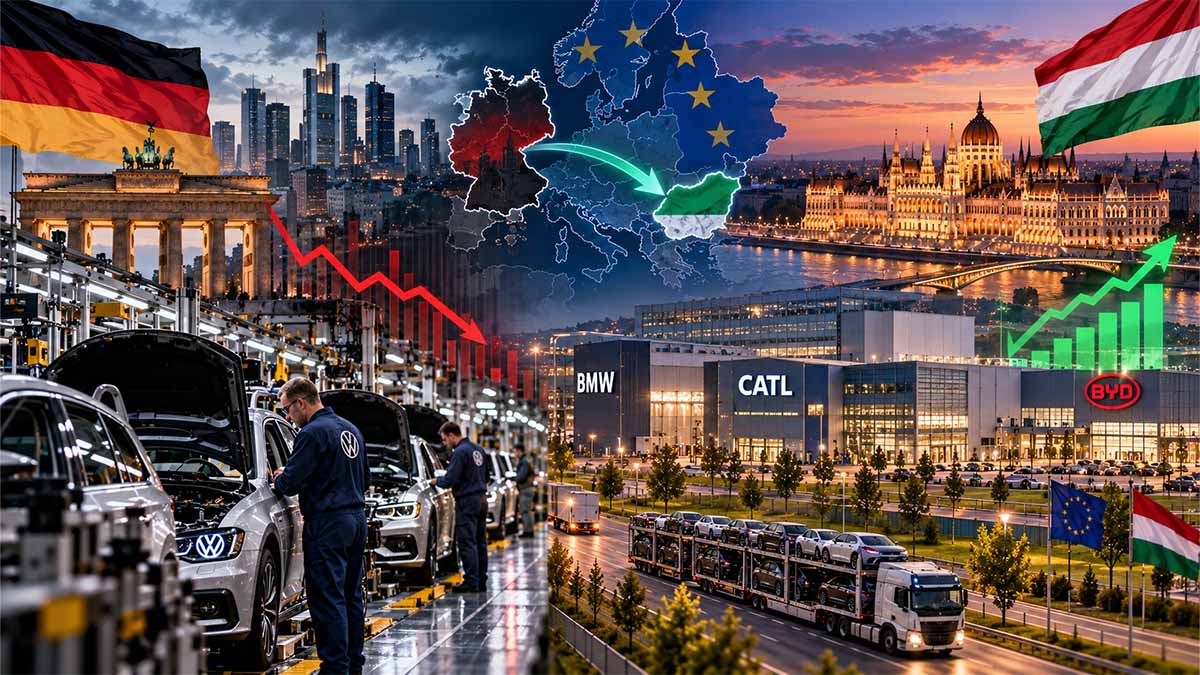
Industrial restructuring, transnational production networks, capital reallocation and the future of European automotive sovereignty, 1989–2031.
Scope: This assessment examines Germany, Hungary and the wider Central European automotive manufacturing system, focusing on Volkswagen/Audi, Mercedes-Benz and BMW, their production and investment decisions through 29 October 2026, and the industrial, employment and economic-security implications for the European Union through 2031. Italy, France and the United Kingdom are included as separate comparative policy cases.
Executive Summary / Bottom Line Up Front
The principal finding is that the German automotive crisis is simultaneously a profitability crisis, a domestic industrial-adjustment crisis and a reconfiguration of transnational production. These three processes overlap but are not identical. Hungary’s success in attracting new models, electric-vehicle capacity and capital does not establish that German automotive manufacturing is becoming obsolete; equally, the international profitability of German-owned manufacturers cannot be taken as evidence that Germany is preserving its industrial capabilities.
Volkswagen’s results published on 29 October 2026 make the deterioration explicit: the group recorded a €5.822 billion net loss in the third quarter, a €5.860 billion operating loss, and only €71 million in operating profit over the first nine months, compared with €5.408 billion a year earlier. The first-nine-month net result was negative €2.720 billion, on revenue of €233.378 billion. Special charges, principally relating to Porsche, Chinese assets and restructuring, explain much of the reported collapse, but do not eliminate the underlying pressure from weaker volumes, international tariffs and lower electric-vehicle margins. Volkswagen Group: Nine-month results underline urgent need for action — Volkswagen Group — Oct 2026. Volkswagen Group
At the same time, Volkswagen’s December 2024 German restructuring agreement provides for more than 35,000 workforce reductions by 2030 and a 734,000-unit reduction in annual domestic production capacity. These are negotiated restructuring objectives, not proof that all reductions have already occurred. Agreement reached: Volkswagen AG positions itself competitively for the future — Volkswagen Group — Dec 2024. Volkswagen Group
Hungary presents the contrasting capital-allocation trajectory. Audi produced 200,756 vehicles and 1,585,290 drive systems at Győr in 2025; Mercedes-Benz has expanded Kecskemét through an investment of approximately €1 billion, with stated capacity of up to 400,000 vehicles annually; and BMW has invested more than €2 billion in Debrecen, where the new electric iX3 entered production and a third shift was introduced in September 2026. Audi Hungaria: Stable Production Volume — Audi — Mar 2026; Mercedes-Benz Group Full Year Results 2025 — Mercedes-Benz — Feb 2026; BMW Group Plant Debrecen Production Expansion — BMW Group — Sep 2026. audi.com+2
However, the aggregate statistics prevent an oversimplified relocation narrative: Germany produced 4.149 million passenger cars in 2025, 2% more than in 2024, while Hungarian production fell by approximately 5% to 414,758 vehicles. Germany nevertheless remained roughly 11% below its 2019 production level. The distinction between realised national output and future allocations is therefore decisive. Automobile Production — VDA — Feb 2026. VDA
Strategic judgment: The cross-border production model remains viable where Hungarian cost efficiency and industrial depth complement renewed German engineering, advanced manufacturing and innovation. It becomes strategically damaging when the transfer of new models is accompanied by permanent losses of tooling, engineering, supplier investment and workforce renewal within Germany.
The appropriate European response is not to obstruct intra-EU investment in Hungary, but to reduce avoidable operating-cost disadvantages, safeguard strategically important capabilities across the Union, strengthen industrial skills and ensure that public incentives support productive complementarity rather than permanent capacity displacement.
Germany Is Losing Automotive Capacity While Hungary Builds the Next Generation: The Industrial Contradiction Threatening Europe
Volkswagen’s €5.82 billion quarterly loss exposes a deeper European problem: German manufacturers can preserve their international production networks while the industrial capabilities of their home country progressively weaken.
Germany’s automotive crisis is no longer simply a question of electric-vehicle demand, Chinese competition or expensive domestic manufacturing. It concerns the geographical redistribution of an industrial system that Germany spent decades constructing. Volkswagen is cutting capacity and employment at home while Audi, Mercedes-Benz and BMW continue assigning investment and new vehicle programmes to Hungary. The contradiction is not that German manufacturers are abandoning Europe; Hungary is part of the European Union and an established component of their production networks. It is that the economic survival of German automotive companies can increasingly be separated from the industrial prosperity of Germany itself. The decisive question is whether cross-border restructuring finances another generation of European automotive technology or gradually dismantles the engineering, supplier and manufacturing capabilities that made the system competitive.
Volkswagen’s €5.82 Billion Loss Exposes the Limits of Cost-Cutting
On 29 October 2026, Volkswagen reported a third-quarter net loss of €5.822 billion and an operating loss of €5.860 billion. For the first nine months, operating profit collapsed by 98.7%, from €5.408 billion to just €71 million, while the group recorded a net loss of €2.720 billion against a profit of €3.405 billion a year earlier. Revenue declined 2.2% to €233.378 billion, customer deliveries fell 9.0% to 6.011 million vehicles, and worldwide production contracted 10.3%. The figures reveal a manufacturer confronting simultaneous pressure on volumes, margins and the financial resources required to sustain technological renewal. Volkswagen Group: Nine-Month Results Underline Urgent Need for Action — October 2026.
The headline loss nevertheless requires interpretation. Volkswagen recorded €8.7 billion in special items during the nine-month period, including €6.4 billion in Porsche goodwill impairments and approximately €1 billion in adjustments relating to Chinese assets. Excluding special items, operating profit remained positive at €8.8 billion, equivalent to a 3.8% margin. Automotive net cash flow reached €4.394 billion, partly reflecting reduced investment and portfolio measures. Volkswagen is therefore not confronting an immediate disappearance of operating earnings. Its problem is that the profitability remaining after extraordinary charges is insufficient to sustain its investment ambitions without further structural adjustment. The approximately €31 billion cost-reduction programme is consequently not an ordinary efficiency exercise: it will influence which factories, engineering functions and vehicle programmes receive the capital necessary to survive.
The manufacturing consequences were already institutionalised in Volkswagen’s December 2024 restructuring agreement, which envisages the elimination of 734,000 units of annual German production capacity and more than 35,000 positions by 2030. Wolfsburg is to consolidate assembly operations from four lines to two, with conventional Golf production scheduled to move to Mexico in 2027, while technical development faces approximately 4,000 position reductions. Zwickau is assigned a narrower production structure, Dresden’s vehicle assembly was scheduled to end in 2025, and Osnabrück faces an uncertain future beyond the T-Roc Cabriolet programme ending in 2027. These are distinct restructuring decisions and targets, not a single completed national shutdown. Their significance lies in the permanent industrial capabilities that could disappear as implementation proceeds. Volkswagen’s German Restructuring Agreement — December 2024.
Hungary Is Becoming a Production Centre, Not Merely a Low-Wage Workshop
The foundations of Hungary’s automotive position were established after 1989, when German manufacturers integrated Central Europe into their production networks. Audi founded its Győr operation in 1993, introduced vehicle production in 1998, added technical development in 2001 and industrial tooling in 2005, and began manufacturing electric motors in 2018. Cooperation with Széchenyi István University subsequently institutionalised engineering training and technical development. What began as geographically advantageous powertrain manufacturing evolved into an integrated industrial complex whose capabilities now influence the allocation of future investment.
In 2025, Audi Hungaria manufactured 200,756 vehicles and 1,585,290 drive systems, including 264,871 electric units, an increase of approximately 74.4% in electric-drive production over 2024. Revenue reached €9.222 billion and annual investment €375 million, bringing cumulative investment since 1993 to €13.2 billion. Yet employment declined from 11,930 to 11,430. The result illustrates a defining characteristic of modern automotive restructuring: greater technological intensity, investment and production do not necessarily translate into more jobs. Audi Hungaria: 2025 Financial and Production Results — March 2026.
Mercedes-Benz offers more explicit evidence of geographical reallocation. Its approximately €1 billion Kecskemét expansion enlarged the manufacturing site from 200 to 440 hectares, adding production infrastructure, including body manufacturing, pressing, painting and battery assembly. The new electric C-Class entered production there in July 2026. The company’s European manufacturing strategy envisages increasing Kecskemét’s annual capacity from approximately 200,000 to 400,000 vehicles, while reducing capacity in its German-centred Western European network. Mercedes-Benz also intends to raise its European best-cost-country production share from 15% in 2024 to 30% by 2027. This is an identifiable corporate strategy to change the geography and economics of manufacturing, not merely an incidental foreign investment. Mercedes-Benz: Kecskemét Expansion.
BMW represents a third configuration. Its new Debrecen factory has absorbed more than €2 billion in investment, occupies over 400 hectares and produces the Neue Klasse iX3. The plant reached its 50,000th vehicle in July 2026 and introduced a third shift in September, moving to continuous operations. Its nominal design capacity reaches 150,000 vehicles annually, although that figure must not be confused with realised annual output. Unlike Mercedes-Benz’s expansion of an established assembly complex, Debrecen was designed around a new electric-vehicle manufacturing generation. BMW Group: Debrecen Production Expansion — September 2026.
The Wage Advantage Is Real, but Industrial Sovereignty Is Not Measured in Euros per Hour
The economic attraction is measurable. In 2025, German manufacturing labour costs averaged €49.50 per hour, compared with €15.60 in Hungary, according to Destatis calculations based on Eurostat data. Germany’s manufacturing labour cost was therefore approximately 3.17 times Hungary’s. The difference is substantial, particularly for activities in which labour remains a significant component of production expenditure. Yet it does not establish an equivalent difference in manufacturing costs per vehicle, which also depend on automation, productivity, energy, capital depreciation and utilisation. Labour Cost Comparison Across EU Countries — Destatis — April 2026.
Germany’s energy disadvantage compounds the pressure. In the second half of 2025, its non-household electricity price reached €226.40 per MWh for the specified industrial and commercial consumption category, compared with an EU average of €183.70. Industrial natural gas stood at €71.30 per MWh against an EU average of €60.50. These are statistical consumption-band benchmarks, not the confidential tariffs paid by individual automotive plants. Nevertheless, they help explain why new investment in older German production systems faces demanding economic conditions. Hungary’s apparent advantage also carries vulnerabilities: the European Commission reported that the country imported approximately 50% of its energy in 2024, while Russian sources accounted for 74% of natural-gas imports and more than 90% of oil imports in 2025. Its working-age population is shrinking by approximately 30,000 people annually. 2026 Country Report: Hungary — European Commission.
The deeper issue is technological control. Bosch employed approximately 16,800 people in Hungary at the end of 2025 and spent HUF 127 billion on research and development during the year. This is evidence of a sophisticated engineering environment, not simply low-cost assembly. But research performed locally does not automatically confer ownership of patents, product architectures or global investment decisions. Similarly, CATL’s announced €7.34 billion Debrecen battery investment, designed around a proposed 100 GWh annual capacity, could strengthen European cell manufacturing without establishing European control of battery chemistry, critical materials or the associated intellectual property. Announced capacity must also be distinguished from completed operational output. Bosch Hungary: Annual Results — May 2026.
Germany Can Lose Industrial Capabilities Without Losing Its Carmakers
The distinction between corporate resilience and national industrial strength becomes decisive when manufacturing activities are separated from the engineering and supplier systems supporting them. Germany produced 4.149 million passenger cars in 2025, approximately 2% more than in 2024, while Hungary produced 414,758, approximately 5% fewer. The German figure nevertheless remained about 27.8% below its 2016 production level. These data contradict the assertion that Hungary has already replaced German vehicle manufacturing, while remaining consistent with a longer-term contraction in Germany’s industrial scale. Automobile Production — VDA — 2025 Annual Series.
BMW’s domestic investment demonstrates why German decline is not inevitable. Its Munich factory began producing the Neue Klasse i3 in August 2026 following extensive modernisation, with BMW reporting a further 10% reduction in manufacturing costs and preparing the location for exclusively electric production from 2027. Batteries manufactured in Bavaria, electric motors produced at Steyr in Austria and components supplied from Landshut illustrate a production model in which international specialisation complements investment in the German industrial base. Hungary’s Debrecen facility and Germany’s Munich operation are therefore not inherently competing alternatives. BMW i3 Enters Series Production in Munich — August 2026.
The danger emerges when relocation removes not only vehicle volumes but also the industrial relationships that make future innovation possible. Toolmaking, specialised machinery, powertrain engineering, supplier testing and manufacturing development depend upon accumulated technical experience. Once factories close, equipment is removed and engineering teams disperse, the cost of rebuilding these capabilities can exceed the savings generated by their initial elimination. Volkswagen’s planned technical-development reductions at Wolfsburg therefore carry implications different from an ordinary adjustment in assembly employment.
The European consequences extend beyond Germany. Italy manufactured only 238,000 passenger cars in 2025, a decline of 19.8%, while its automotive industrial-production index fell 10.3% and parts production contracted 4.8%. Italian suppliers remain exposed to decisions made by German and other European manufacturers, regardless of whether final assembly occurs in Wolfsburg, Kecskemét or Debrecen. France faces a comparable high-wage manufacturing problem, with average manufacturing labour costs of €47.10 per hour in 2025. The United Kingdom manufactured 717,371 passenger cars in 2025, an 8% decline, while managing automotive supply chains outside the EU Single Market. These countries face different adjustment problems, but all depend on retaining commercially viable production alongside engineering and supplier capabilities. ANFIA: Italian Automotive Production 2025; SMMT: UK Vehicle Production 2025.
Brussels Can Finance Industrial Renewal, but Also Subsidise Displacement
The European Union faces a policy contradiction of its own. Investment in Hungary can advance economic convergence and strengthen manufacturing within the Single Market. Yet public support that primarily transfers production between member states may redistribute employment without improving Europe’s aggregate competitiveness. Articles 107–109 of the Treaty on the Functioning of the European Union and the Regional State Aid Guidelines provide the legal framework governing selective assistance, including safeguards against subsidised relocation. Legal compatibility, however, is not synonymous with economic additionality.
The Clean Industrial Deal State Aid Framework, adopted on 25 June 2025 and applicable until 31 December 2030, allows eligible support for industrial electricity costs, decarbonisation and clean-technology investment. The Strategic Technologies for Europe Platform provides additional mechanisms for supporting critical technologies through existing EU programmes. These instruments can reinforce manufacturing, but their effectiveness depends on whether public money generates capabilities that would otherwise be unavailable or merely finances investment that manufacturers had already decided to undertake. Clean Industrial Deal State Aid Framework — European Commission — June 2025.
Regulatory uncertainty adds another constraint. Regulation (EU) 2025/1214 introduced three-year averaging for manufacturers’ 2025–2027 CO₂ compliance, while the Commission’s December 2025 Automotive Package proposed further changes to the 2035 framework, including a 90% tailpipe-emissions-reduction target subject to legislative adoption. Enacted flexibility and proposed future regulation cannot be treated as identical. Manufacturers must finance production systems over several model generations, while uncertainty about the applicable technology mix can alter investment decisions before legislation is finalised. Regulation (EU) 2025/1214 — European Parliament and Council; Automotive Package — European Commission — December 2025.
The Critical Raw Materials Act exposes the limits of focusing on assembly capacity. Its 2030 benchmarks include 10% EU extraction, 40% processing and 25% recycling of relevant strategic raw materials, alongside a diversification threshold limiting dependence on a single third country to 65% at the relevant processing stage. These objectives address vulnerabilities that cannot be eliminated merely by locating battery or vehicle manufacturing in Hungary. Europe can retain the assembly of electric cars while remaining dependent on external materials, electronics and proprietary technologies. Critical Raw Materials Act — Council of the European Union.
The Next 24 Months Will Determine Who Pays for the Adjustment
Between October 2026 and October 2028, the decisive indicators will be the implementation of Volkswagen’s German restructuring, the utilisation of Mercedes-Benz’s expanded Kecskemét facilities, BMW’s progression from Debrecen’s initial ramp-up toward stable production, and the capacity of German manufacturers to restore profitability without sacrificing successive generations of technical investment. Volkswagen’s scheduled Golf transfer in 2027, Mercedes-Benz’s best-cost-country production objective and the end of the EU’s 2025–2027 emissions averaging period create immediate commercial and institutional tests.
Three outcomes remain possible. European manufacturers may restore margins while maintaining complementary investment in German engineering and Hungarian manufacturing. They may preserve corporate profitability while progressively reducing German employment and supplier depth. Or cost reductions may prove insufficient to counter international competition, leaving German industrial regions weakened and Hungarian facilities exposed to underutilisation. The existing evidence does not justify assigning probabilities to these outcomes, but it establishes which developments will distinguish them.
For Berlin, the immediate cost of insufficient action will fall on specialised workers, suppliers and industrial regions whose capabilities cannot be reconstructed quickly. For Budapest, it will appear through infrastructure demands, skilled-labour constraints and increasing dependence on multinational capital allocation. For Brussels, it will take the form of public expenditure that redistributes production without increasing European control over critical technologies. Investors and manufacturers will face the consequences through weak returns, underused assets and reduced capacity to finance future vehicle generations.
The German automotive industry can survive the contraction of its domestic manufacturing base. What remains unresolved is whether Europe can preserve the technological and industrial system on which that survival ultimately depends. Over the next 12–24 months, the distinction between productive reorganisation and permanent capability loss will become measurable through investment, engineering employment, model allocation and actual factory utilisation. The cost of making the wrong distinction will be borne less by corporate headquarters than by the industrial regions and specialised suppliers whose disappearance would narrow Europe’s future manufacturing options.
Navigational Index
Three analytical pillars | Twelve chapters | 2026 baseline and five-year strategic horizon
PILLAR I — Industrial Geography and the Restructuring of German Automotive Capital
Chapter 1 — The Post-1989 Integration of Hungary into German Automotive Production
The industrial origins of the Central European automotive network; Audi’s establishment in Győr in 1993; the expansion of assembly, powertrain production, precision engineering and supplier manufacturing; German corporate governance; the role of technical training and Hungarian universities; and the progression from labour-cost arbitrage toward increasingly complex industrial functions.
Chapter 2 — Germany’s Automotive Crisis: Production, Employment, Profitability and Plant Restructuring
Volkswagen’s third-quarter 2026 loss and nine-month financial position; German capacity reductions, negotiated workforce adjustments and site-level programmes; Mercedes-Benz manufacturing restructuring; the countervailing modernisation of BMW’s domestic production; and the effects on German regions, suppliers and engineering capabilities.
Chapter 3 — Hungary’s Three Automotive Anchors: Győr, Kecskemét and Debrecen
Verified automotive output, powertrain production, employment, capital expenditure, model allocation and installed or announced capacity at Audi, Mercedes-Benz and BMW; the iX3 and Neue Klasse industrial programme; the new electric C-Class; and distinctions between operational achievements and future commitments.
Chapter 4 — The Geography of Substitution and Complementarity
A comparative German-Hungarian industrial-capacity assessment distinguishing assembly, combustion engines, electric drive systems, batteries, component manufacturing, product engineering and technical services; tracing which functions can move between sites, which remain complementary and which are difficult to reproduce after closure.
PILLAR II — Competitiveness, Industrial Ecosystems and European Economic Security
Chapter 5 — Labour Costs, Productivity, Energy and the Economics of Factory Location
Comparative hourly compensation, productivity, automation, utilisation rates, industrial electricity and natural-gas prices, logistics, taxation, financing and employment arrangements; bounded plant-cost scenarios and their sensitivity to wage convergence and energy-policy changes.
Chapter 6 — Hungarian Supplier Networks, Universities and Technological Independence
Domestic and foreign-owned supplier tiers; automotive engineering, tooling, electronics, battery and software capabilities; university partnerships, technical training and research infrastructure; the extent of indigenous technological decision-making; and continuing dependence on German platforms, procurement and intellectual property.
Chapter 7 — Central Europe’s Automotive Corridor: Resilience, Dependencies and Chokepoints
The industrial links connecting Hungary with Germany, Austria, Czechia, Slovakia, Poland and Romania; cross-border transport, electricity and component flows; just-in-time vulnerabilities; Chinese battery-sector investment; geopolitical and regulatory exposures; and the relationship between network efficiency and systemic concentration risk.
Chapter 8 — Germany, Italy, France and the United Kingdom: Divergent Industrial Responses
Germany’s manufacturing and employment dilemma; Italy’s supplier exposure and vehicle-production weakness; France’s domestic industrial-policy and electrification choices; the United Kingdom’s post-Brexit automotive competitiveness; and the implications for European coordination.
PILLAR III — Strategic Autonomy, Future Scenarios and Policy Decisions
Chapter 9 — EU Industrial Governance, State Aid and Cohesion Policy
Single Market principles, competition and state-aid rules, EU automotive emissions policy, cohesion funding, clean-technology investment, industrial decarbonisation and the tension between national subsidies and European supply-chain resilience.
Chapter 10 — Three Competing Trajectories for 2027–2031
An integrated industrial-renewal pathway; an asymmetric dual-track adjustment in which Hungarian expansion coexists with German capability erosion; and a wider European competitiveness deterioration in which neither location fully offsets global market and technological pressures.
Chapter 11 — Decision Framework for Berlin, Budapest, Brussels and European Industry
National and European policy instruments; industrial electricity reform; workforce adjustment; supplier financing; research and manufacturing linkages; investment conditionality; skills development; implementation costs, decision thresholds and measurable indicators.
Chapter 12 — Final Net Assessment: The Future of the German-Central European Automotive System
The long-term industrial viability of the German-led production network, the limits of relocation as a competitiveness strategy, the distribution of industrial value added and the conditions required for European automotive manufacturing to retain technological depth and strategic autonomy.
Master Abstract
The central contradiction: corporate adaptation and national industrial contraction
The transformations underway in Germany and Hungary cannot be explained adequately through a conventional narrative of deindustrialisation, nor through the equally reassuring proposition that international expansion automatically protects the competitiveness of German automotive manufacturers. Both interpretations obscure the difference between the performance of a multinational enterprise and the industrial capacity retained within the country where that enterprise originated.
German automotive manufacturers developed their Central European production systems over more than three decades, beginning in the economic and institutional reorganisation that followed 1989. Their investments in Hungary were initially supported by comparatively inexpensive skilled labour, geographic proximity to established German industrial centres, improving transport connections and access to a progressively integrated European market. Over time, however, capital accumulation, supplier localisation, engineering experience and technical training transformed these subsidiaries into increasingly capable manufacturing locations. Audi’s Győr operation illustrates this progression: established in 1993, it developed from powertrain manufacturing into integrated vehicle assembly, electric-drive production, tooling and technical development. The resulting infrastructure now connects Hungary directly to production requirements across the Volkswagen Group.
The contemporary challenge is that a manufacturing arrangement originally built to extend German industrial capacity can increasingly serve as an alternative location for new capital expenditure and vehicle programmes. That transformation may preserve company profitability and European vehicle production, but it does not guarantee the survival of the corresponding industrial ecosystem in Germany.
Volkswagen’s October 2026 deterioration changes the financial context
Volkswagen’s latest financial statements strengthen the case that its restructuring is not simply a precautionary adjustment to future electric-vehicle production. The group’s third-quarter operating result deteriorated to a loss of €5.860 billion, compared with a loss of €1.299 billion a year earlier. Its net result for the quarter was a loss of €5.822 billion, while nine-month operating earnings declined by 98.7% to €71 million.
The accounting composition is essential. Volkswagen disclosed €8.7 billion in special items during the first nine months, including €6.4 billion in impairment charges relating to Porsche goodwill, approximately €1 billion in adjustments to consolidated Chinese assets, and expenses connected with its planned Osnabrück transaction. Excluding special items, the group generated an operating result of €8.8 billion and an operating margin of 3.8%. Thus, the company continues to generate underlying operating earnings, but at a level management considers insufficient to sustain investment ambitions. Volkswagen Group: Nine-month results underline urgent need for action — Volkswagen Group — Oct 2026. Volkswagen Group
The distinction matters for policy. An accounting impairment does not directly demonstrate a comparable loss of industrial cash generation. Nevertheless, lower profitability, weaker sales, international trade restrictions and the capital demands of electrification can collectively reduce the financial capacity available for manufacturing renewal. Volkswagen’s announced approximately €31 billion cost programme is therefore a consequential industrial-development decision, not merely a temporary earnings response.
Hungary’s expansion is substantial, but not uniformly insulated from adjustment
The Hungarian evidence confirms that the three main German premium manufacturers continue to regard the country as a strategically valuable manufacturing platform. Their operations, however, are neither identical nor immune to the competitive pressures affecting their German parent companies.
Audi’s Győr operation produced more than 200,000 vehicles in 2025 while developing its next generation of electric-drive manufacturing. Yet its workforce declined from 11,930 at the end of 2024 to 11,430 at the end of 2025, demonstrating that a successful Hungarian facility can simultaneously attract technological investment and reduce employment. Mercedes-Benz has increased manufacturing flexibility at Kecskemét, opened new production facilities and allocated electric C-Class production to the site. BMW has established a new plant at Debrecen for the electric Neue Klasse and accelerated iX3 production to continuous three-shift operation.
These developments support the hypothesis that the transnational industrial network can retain operational vitality amid difficulties in Germany. They do not prove that Hungary possesses an independently self-sustaining automotive innovation system, nor that incremental Hungarian capacity can replace the complex industrial functions lost through German retrenchment. The key distinction is between operational competence inside Hungary and the geographic location of the decisions, intellectual property, product architectures, research resources and supplier-financing relationships that make that competence commercially sustainable.
European strategic autonomy depends on the distribution of capabilities, not simply ownership
From a European economic-security perspective, investment in Hungary should not automatically be classified as industrial flight. Hungary and Germany operate inside the EU Single Market, and the relocation of vehicle manufacturing within the Union is fundamentally different from a transfer to an external jurisdiction.
Nevertheless, intra-European relocation can redistribute production and employment while leaving the Union’s most consequential technological dependencies unresolved. The location of final assembly does not establish where battery materials are sourced, software is designed, electronics are developed, capital equipment is manufactured or technological standards are controlled.
There is therefore an important distinction between European manufacturing capacity and European technological sovereignty. An EU-based automotive network can become more efficient without becoming more autonomous. It can also preserve final-assembly volumes while losing specialised skills, machinery suppliers and high-value engineering functions in particular regions.
The decisive strategic requirement is to avoid a configuration in which Germany loses cumulative industrial knowledge while Hungary gains manufacturing volume without sufficient capacity to replace the innovation and supplier functions embedded in Germany’s historic automotive centres.
Key Evidence Table
The following figures distinguish realised financial or production outcomes from announced capacity, investment and restructuring objectives.
| Indicator | Value/status | Reference date | Definition/scope | Issuer | Exact source |
|---|---|---|---|---|---|
| Volkswagen Q3 net result | −€5.822bn | Q3 2026 | Consolidated earnings after tax | Volkswagen Group | 9M Results 2026 |
| Volkswagen Q3 operating result | −€5.860bn | Q3 2026 | IFRS operating result | Volkswagen Group | 9M Results 2026 |
| Volkswagen 9M revenue | €233.378bn, −2.2% | Jan–Sep 2026 | Consolidated sales revenue | Volkswagen Group | 9M Results 2026 |
| Volkswagen 9M operating result | €71m, −98.7% | Jan–Sep 2026 | IFRS operating result, including special items | Volkswagen Group | 9M Results 2026 |
| Volkswagen 9M net result | −€2.720bn | Jan–Sep 2026 | Earnings after tax | Volkswagen Group | 9M Results 2026 |
| Volkswagen special items | €8.7bn | Jan–Sep 2026 | Impairments and other special charges | Volkswagen Group | 9M Results 2026 |
| VW German capacity reduction | 734,000 units/year | Agreement Dec 2024; target 2030 | Planned reduction, not realised production | Volkswagen AG | Future Volkswagen Agreement |
| VW German workforce adjustment | More than 35,000 | Target 2030 | Negotiated domestic workforce reduction | Volkswagen AG | Future Volkswagen Agreement |
| German vehicle output | 4,148,836 cars, +2.0% | 2025 | Passenger cars assembled domestically | VDA | Automobile Production |
| Hungarian vehicle output | 414,758 cars, approximately −5% | 2025 | National passenger-car production | VDA | Automobile Production |
| Audi Győr vehicle output | 200,756 vehicles | 2025 | Audi Q3/Q3 Sportback and Cupra Terramar | Audi Hungaria | 2025 Results |
| Audi Győr powertrain output | 1,585,290 units | 2025 | Combustion and electric drive systems | Audi Hungaria | 2025 Results |
| Audi Győr employment | 11,430 | 31 Dec 2025 | Audi Hungaria including AHEAD subsidiary | Audi Hungaria | 2025 Results |
| Mercedes Kecskemét investment | Approximately €1bn | Expansion confirmed 2026 | Facility expansion and flexibility investments | Mercedes-Benz Group | Production Network Expansion |
| Mercedes Kecskemét capacity | Up to 400,000 vehicles/year | Corporate plan published Feb 2026 | Planned annual capability, not realised output | Mercedes-Benz Group | 2025 Full-Year Results |
| Mercedes German capacity | 900,000 vehicles/year | Corporate plan published Feb 2026 | German production-network capacity objective | Mercedes-Benz Group | 2025 Full-Year Results |
| BMW Debrecen investment | More than €2bn | Confirmed Sep 2026 | Cumulative site development investment | BMW Group | Debrecen Production Expansion |
| BMW Debrecen capacity | Up to 150,000 vehicles/year | Published 2025 | Installed/design capacity indication, not output | HIPA | BMW Plant Inaugurated |
| BMW Debrecen operating milestone | 50,000th iX3 produced; third shift introduced | Jul–Sep 2026 | Cumulative production milestone and operating schedule | BMW Group | Debrecen Production Expansion |
| Hungarian economy-wide labour costs | €15.20/hour | 2025 | Average employee labour costs, not automotive-specific | Eurostat | Hourly Labour Costs 2025 |
| German industrial electricity price | €226.40/MWh | H2 2025 | Non-household consumers, 500–2,000 MWh/year band | Eurostat | Electricity Prices H2 2025 |
Source governance: Company-reported investment and production figures are first-party records; VDA and Eurostat provide industry and statistical benchmarks. The Volkswagen capacity and employment targets and the Mercedes-Benz/BMW production-capacity figures must not be summed into realised output or job losses. The Volkswagen operating-loss entry is €5.860bn; its distinct net-loss entry is €5.822bn.
Competing Explanations and Future Pathways
The evidence supports three substantial, overlapping hypotheses. Their purpose is to test the industrial mechanism, not to impose artificial exclusivity on decisions made by different companies.
| Hypothesis | Diagnostic support | Disconfirming evidence | Indicators | Current standing |
|---|---|---|---|---|
| H1 — Efficient transnational adaptation | New Hungarian vehicle programmes, investment and operating flexibility; common EU market; established German-Hungarian production links | Persistent pressure on German profitability; workforce and capacity reductions; Hungarian employment adjustments | Group operating margins; plant utilisation; new R&D investment in both countries; new product launches | Partially supported. Strong evidence for production-network adaptation, but not yet for sustainable overall profitability |
| H2 — Progressive transfer and German capability erosion | VW’s planned German capacity reduction; larger Hungarian manufacturing responsibilities; ongoing German employment adjustment | German 2025 production increased; BMW simultaneously modernised Munich; European networks remain technologically interconnected | German engineering and tooling employment; replacement investment; product ownership; domestic supplier closures | Credible and material, but not established as a uniform industry-wide outcome |
| H3 — Systemic European competitiveness deterioration | VW earnings deterioration; Chinese competition; trade restrictions; electric-vehicle margin pressure; Hungarian output decline in 2025 | Continued EU investment; new vehicle launches; positive European EV orders; BMW’s accelerated production | Europe-wide market share; energy prices; supplier solvency; battery and software competitiveness; investment returns | Serious downside pathway. The evidence does not support treating relocation as a sufficient remedy |
Why the competing explanations matter
The first hypothesis is supported by the continued allocation of investment and models across national borders. Audi’s high-volume drive-system operation and BMW’s Debrecen ramp-up demonstrate that multinational manufacturers can sustain and expand production functions even while their German facilities face different pressures.
The second hypothesis becomes more compelling where reductions in Germany occur alongside permanent transfers of functions that would otherwise be renewed domestically. It is less compelling when domestic investment proceeds simultaneously. BMW’s August 2026 launch of Neue Klasse i3 production in Munich is a particularly important counterexample: the manufacturer reports a further 10% reduction in manufacturing costs at the renovated site and plans an exclusively electric Munich operation from 2027. This demonstrates that a high-cost German location can remain central to product and manufacturing renewal. BMW i3 Enters Series Production in Munich — BMW Group — Aug 2026. bmwgroup.com
The third hypothesis is supported by pressures that transcend the Germany-Hungary cost differential. European manufacturers face competition in electric-vehicle architectures, software, batteries and global markets. Relocating vehicle assembly inside Europe does not, by itself, solve any of those challenges.
Consequently, the evidence is strongest for an asymmetric industrial adjustment, rather than for either an uncomplicated Hungarian success story or a comprehensive German automotive collapse.
Preliminary Competitiveness Assessment
Labour costs: a measurable advantage, but not a complete productivity comparison
Eurostat’s 2025 data establish a substantial difference in average hourly labour costs across the European economy, with Hungary at €15.20 per hour. The figure is a national, whole-economy measure. It should not be treated as the actual cost of an automotive production hour in Győr, Kecskemét or Debrecen, where skill requirements, employer remuneration and automated manufacturing intensity differ from economy-wide averages.
The Hungarian advantage is most relevant to labour-intensive production tasks, logistics, component assembly and support operations. Its importance declines as the share of total manufacturing cost attributable to direct labour declines.
The appropriate decision variable is therefore labour cost per unit of quality-adjusted output, rather than nominal hourly compensation alone.
To illustrate the sensitivity without presenting hypothetical values as observed data, the following bounded example assumes:
- A German labour cost of €40–€50 per paid production hour and a Hungarian cost of €15–€20 per hour.
- A requirement of 20–30 paid labour hours per completed vehicle or equivalent allocated production workload.
- Equal productivity and quality performance in the first calculation, excluding automation differences, capital amortisation, logistics and supplier costs.
Under those assumptions, the direct labour-cost differential is between €400 and €1,050 per vehicle. This is a scenario calculation, not an estimate of any manufacturer’s confidential unit economics. The difference can narrow if Hungarian production requires more hours per vehicle, experiences shortages of specialised labour, or faces faster wage growth.
The durability of Hungary’s advantage will therefore depend on whether investment in automation, worker training and supplier productivity can offset wage convergence. Eurostat reports that Hungarian hourly labour costs increased by 8.9% in national currency in 2025, underlining why long-term comparisons cannot assume a permanently fixed wage gap. EU Hourly Labour Costs Ranged from €12 to €57 in 2025 — Eurostat — Mar 2026. Eurostat
Energy: Germany’s disadvantage must be measured at the industrial tariff level
Energy costs can influence automotive location decisions through stamping, painting, thermal processes, component production, battery operations and suppliers. Yet country-level household electricity prices are inappropriate evidence for comparing industrial plants.
Eurostat recorded a German non-household electricity price of €226.40/MWh in the second half of 2025 for consumers in the specified 500–2,000 MWh annual consumption category. The EU average for that category was €183.70/MWh. This demonstrates a German price disadvantage against the EU aggregate in that consumption band, but does not independently establish the corresponding price paid by a large Hungarian vehicle manufacturer or its direct German competitor. Large industrial customers may operate under different contract, network-charge, levy and procurement arrangements. Non-household Electricity Prices in the Second Half of 2025 — Eurostat — May 2026. Eurostat
The industrial-policy implication is that a credible Germany-Hungary comparison must examine delivered electricity and gas costs at comparable consumption levels, including the cost of network access and contracted energy, rather than relying on national household-price differences or political claims about subsidised energy.
Regulation and investment incentives: a distinction between EU obligations and national implementation
Hungary and Germany operate within substantially the same EU product-regulatory framework for vehicles entering the Single Market. Their differences in competitiveness are therefore not adequately explained by implying that Hungarian-produced cars can avoid European automotive regulations.
More relevant differentials arise from national tax structures, administrative execution, investment incentives, employment arrangements, industrial-site availability and implementation of EU-permitted support measures.
These differences create potential advantages for new Hungarian facilities, particularly when investors can construct integrated, modern plants rather than renovate older factories subject to physical constraints and legacy operating structures.
But regulatory flexibility is not identical to reduced regulation, and incentives are not a free economic resource. They redistribute part of the investment cost to the public sector and must ultimately be judged against additional employment, innovation, tax receipts, regional development and the possibility that support merely shifts activity between EU member states.
Principal Gaps and Watch Indicators
The following records are consequential to determining whether the current transition is primarily adaptive or destructive.
| Decision-critical question | Required observation or record | Why it matters |
|---|---|---|
| Is German manufacturing capacity actually being displaced by Hungary? | Comparable plant-level annual capacity, utilisation, production and model allocation across 2024–2028 | Separates substitution from coincident investment and restructuring |
| What proportion of VW’s German employment programme has occurred? | Annual workforce disclosures, negotiated restructuring implementation and German plant-level employment | Prevents planned reductions being presented as realised losses |
| Are Hungarian plants gaining high-value functions beyond assembly? | R&D employment, technical-development spending, patent ownership, tooling and supplier engineering activity | Tests industrial independence rather than merely output volume |
| Are energy and labour advantages sustainable? | Eurostat industrial energy series, national labour-cost data, plant productivity, exchange rates and wage settlements | Establishes whether Hungary’s cost differential persists |
| Does the Central European corridor increase European autonomy? | Origin of batteries, critical electronics, software, materials and production equipment | Separates intra-EU production from technological and supply-chain sovereignty |
| Is VW’s restructuring producing lasting improvements? | Quarterly operating results before special items, automotive cash flow, gross investment and brand-level margins | Distinguishes accounting recovery from restored competitiveness |
| Does German domestic industrial renewal continue? | New model allocations, new electric powertrain investments, supplier capital expenditure and skilled-worker hiring | Tests whether international expansion is complementary or substitutive |
Strategic watch indicators, 2027–2031
Three observable developments would materially strengthen the assessment that the transnational model is preserving European competitiveness.
First, German manufacturers would need to demonstrate a durable restoration of operating margins and sufficient cash generation to fund new products, manufacturing technology and supplier development without repeated reductions to strategic engineering capabilities. The critical variable is not a single quarter of profit, but the capacity to finance successive vehicle generations.
Second, Hungarian facilities would need to continue progressing toward greater technical and industrial depth while remaining linked to productive research, capital-equipment and component relationships across Europe. Growth confined to final assembly would produce employment and exports, but provide a narrower contribution to strategic autonomy.
Third, German industrial centres would need to retain new generations of manufacturing capability, including electric drive systems, advanced vehicle architectures, production engineering and specialised supplier networks. The loss of these functions is more consequential than a temporary reduction in vehicle volumes because their recovery requires cumulative technical experience and extensive investment.
Conversely, prolonged underinvestment at German plants, the withdrawal of new model programmes without replacement, the decline of domestic tooling and component suppliers, and weaker German engineering employment would indicate that cross-border optimisation is becoming structural capability displacement.
Preliminary Policy Implications
The immediate German policy challenge is to improve the economics of productive domestic investment without attempting to prevent manufacturers from operating across the EU. Investment in modernisation, industrial-energy competitiveness, workforce conversion and research-to-production integration should be assessed against measurable improvements in unit costs, capacity utilisation and technological capability.
For Hungary, the principal policy challenge is to convert major foreign investments into a broader and more resilient domestic industrial ecosystem. The objective should extend beyond vehicle output and direct employment to advanced supplier functions, technical education, locally embedded research and the capacity to adapt to future vehicle technologies.
For Brussels, the issue is not whether manufacturing should remain in Germany or expand in Hungary. It is whether European public support strengthens the total productive and technological capacity of the Union, or subsidises a redistribution of manufacturing that leaves aggregate competitive weaknesses unresolved. The relevant policy choices involve state-aid discipline, cross-border research networks, strategically important component production, industrial-energy markets and the distribution of transition costs.
For Italy, the policy relevance is particularly strong because its automotive and component industries are exposed to investment and procurement decisions made by German and other European manufacturers. France faces the related challenge of combining industrial decarbonisation with domestic manufacturing commitments, while the United Kingdom must manage automotive investment and supply-chain competitiveness from outside the EU Single Market. These country-specific consequences require separate analysis rather than treating the four economies as interchangeable industrial cases.
Preliminary Net Assessment
The evidence currently supports a qualified transnational-resilience hypothesis. Hungary is not merely a low-wage production destination. Its automotive industrial platform now combines mature manufacturing operations, complex powertrain production, new electric-vehicle investment and established participation in the German-led European automotive system. The activities at Győr, Kecskemét and Debrecen demonstrate that manufacturers continue to deploy substantial capital within this integrated network even as the German automotive sector confronts severe profitability and restructuring pressures.
Nevertheless, the available evidence does not establish a simple transfer of the entire German automotive system to Hungary. German national production increased during 2025; BMW invested in advanced domestic electric-vehicle production; and Audi’s Hungarian operation itself reduced employment while maintaining substantial output. These observations show why industrial trajectories must be assessed by manufacturer, facility, function and time period.
The principal strategic risk is not the relocation of individual vehicle models, but the separation of competitive manufacturing activity from the engineering, supplier and innovation ecosystems that historically sustained German automotive leadership.
European industrial policy should therefore seek to preserve productive interdependence while preventing the permanent erosion of non-substitutable capabilities. A stronger Hungarian industrial base can reinforce European competitiveness, provided that German restructuring restores rather than destroys the technological foundations of the wider network.
The decisive test through 2031 will be whether the German-Central European automotive system produces more competitive vehicles, higher-value technologies and durable productive employment across its constituent regions—or whether individual corporations preserve operational flexibility while Europe’s aggregate industrial depth progressively weakens.
No decision-useful visualisation is supportable from the verified record beyond the comparative tables presented in this opening assessment, without introducing non-comparable plant-capacity and realised-production figures.
GERMANY’S AUTOMOTIVE RETREAT
HUNGARY’S INDUSTRIAL EXPANSION
A comparative assessment of industrial restructuring, cross-border manufacturing, workforce adjustments and strategic autonomy in Europe’s automotive sector.
Assessment date: 29 October 2026. Financial data: January–September 2026. Production baseline: 2025. Forecast horizon: 2027–2031.
The €5.82 Billion Quarterly Loss
Volkswagen’s third-quarter results illustrate the financial pressure behind German automotive restructuring. Net and operating losses must be distinguished, as must reported earnings from underlying operating performance.
Operating Profit Collapse
Common linear scale: maximum bar = €5.408bn. The 2026 bar is approximately 1.3% of the 2025 bar. Reported IFRS operating results include special items.
How the Earnings Shock Should Be Interpreted
The chart compares the absolute magnitude of two different accounting measures, not additive revenue components. Underlying operating profit remained positive, but the reported operating result was nearly eliminated by special items. Figures are rounded company disclosures.
German Industrial Scale Versus Hungarian Expansion
The national production baseline challenges any assertion that German vehicle output has already been replaced by Hungarian production. The structural issue concerns future investment and model allocation, not simply annual production volumes.
Passenger Car Production, 2025
Common zero-based scale; country-wide production, all manufacturers. Germany produced approximately ten times Hungary’s passenger-car volume in 2025. Values must not be interpreted as plant capacity or future allocation.
Hungary’s Automotive Manufacturing Platform
Győr combines vehicle assembly, powertrain production and technical activities. Its production depth makes it more than a conventional final-assembly facility, although product architecture and strategic corporate decisions remain linked to the wider Audi and Volkswagen network.
The Kecskemét expansion strengthens manufacturing flexibility and creates scope for further electric-vehicle production. Its announced annual capacity is a production-network plan, not an actual count of completed vehicles.
BMW’s Debrecen operation is a dedicated electric-vehicle industrial investment associated with Neue Klasse and the iX3. The company introduced a third shift in September 2026. The production milestone is cumulative and cannot be compared with full-year production at mature plants.
Comparative Industrial Footprint
| Manufacturer / Site | Assembly | Powertrain / Technology | Verified / Announced Indicator | Status |
|---|---|---|---|---|
| Audi — Győr | Q3, Q3 Sportback, Cupra Terramar | Combustion and electric drive systems | 200,756 vehicles and 1,585,290 drive systems in 2025 | Realised |
| Mercedes — Kecskemét | Multi-model passenger-car assembly | Flexible electric-vehicle manufacturing | Up to 400,000 vehicles/year | Planned capacity |
| BMW — Debrecen | Neue Klasse iX3 | Dedicated electric-vehicle production | Up to 150,000 vehicles/year | Design capacity |
Audi’s realised annual output, Mercedes-Benz’s capacity target and BMW’s design capacity are different statistical categories and must not be added into a single output total.
Industrial Adjustment: German Reductions and Hungarian Capacity
Hungarian Annual Capacity Indicators
The graph compares only Mercedes-Benz and BMW annual capacity indications. Audi’s actual 2025 vehicle production is deliberately excluded to avoid mixing output and capacity.
Annual nominal capacities, not 2026 production forecasts. The facilities have different maturity and utilisation levels. The chart does not imply a direct transfer from a particular German site.
Why a Direct Relocation Balance Cannot Yet Be Calculated
| Industrial measure | German side | Hungarian side | Interpretation |
|---|---|---|---|
| Planned annual capacity change | VW: −734,000 units by 2030 | Mercedes: up to 400,000; BMW: up to 150,000 | Different OEMs, horizons and definitions |
| Realised output | Germany: 4.149m passenger cars in 2025 | Hungary: 414,758 passenger cars in 2025 | Comparable national annual production |
| Employment | VW: more than 35,000 reductions targeted by 2030 | Audi Győr: 11,430 employees at end-2025 | Targeted workforce reduction versus actual employment stock |
| Capital expenditure | Domestic electric-vehicle modernisation continues | BMW: >€2bn; Mercedes: ~€1bn | Investments are not a measure of net German capital outflow |
Labour, Energy and Production-Cost Differentials
Illustrative Direct Labour-Cost Scenarios
These are transparent analytical assumptions rather than observed automotive-plant wage data. Both countries are assigned the same paid labour hours per vehicle, with no productivity differential in the calculation.
| Scenario | Germany €/hour | Hungary €/hour | Hours per vehicle | Illustrative Germany–Hungary saving |
|---|---|---|---|---|
| Lower differential | €40 | €20 | 20 | €400/vehicle |
| Mid-range | €45 | €17.50 | 25 | €687.50/vehicle |
| Upper differential | €50 | €15 | 30 | €1,050/vehicle |
Formula: (German hourly cost − Hungarian hourly cost) × paid hours per vehicle. Scenario range €400–€1,050. Common zero-based chart scale. Excludes differences in productivity, automation, capital cost, energy, logistics, materials, taxes and quality.
These measures use different populations and units. No Hungarian industrial electricity-price observation is asserted here, and no whole-economy wage figure is treated as an automotive-factory wage.
How the German–Hungarian Production System Functions
The network is best understood as a division of industrial functions rather than a simple exchange of complete factories. The following schematic presents the documented relationship categories without assigning unverified sourcing percentages.
Corporate product decisions, advanced engineering, established supplier ecosystems, production technology, brand ownership and domestic manufacturing.
Vehicle assembly, powertrain operations, EV manufacturing, supplier integration, technical training and local industrial services.
Cross-border logistics, components, materials, equipment, labour mobility and common EU regulatory and market conditions.
Industrial Capabilities That Cannot Be Assumed Substitutable
| Industrial function | Potential relocation | Strategic constraint |
|---|---|---|
| Vehicle assembly | Relatively transferable with investment and model planning | Tooling, capacity, workforce and production qualification |
| Powertrain production | Transferable, but capital intensive | Equipment, process knowledge and technical supply chains |
| Product engineering | Partially distributed | Specialised teams, accumulated expertise and integration |
| Supplier research and tooling | Selective relocation possible | Dense regional networks and long qualification cycles |
| Automotive software and electronics | Geographically distributed | Architectural control, talent and external dependencies |
| Battery supply chain | New regional capacity possible | Materials, processing technology and ownership structure |
Qualitative technical assessment. This table does not rank individual plants or claim measured transfer costs.
Three Strategic Pathways for European Automotive Manufacturing
Scenario A — Complementary Industrial Renewal
Hungarian manufacturing expansion supports new vehicle generations while Germany preserves high-value engineering, specialised suppliers and modern production capacity. European competitiveness improves through technological investment, lower operating costs and coordinated skills development.
Confirmation: stronger margins, new German model programmes, technical investment in both countries and improving European supplier competitiveness.
Scenario B — Asymmetric Dual-Track Adjustment
Hungarian plants continue gaining models and investment, while German manufacturing regions experience gradual reductions in employment and capital renewal. OEM networks remain viable, but the distribution of industrial capabilities becomes increasingly uneven.
Confirmation: falling German engineering and supplier investment, persistent domestic capacity cuts and new programme allocation away from legacy locations.
Scenario C — Wider European Competitiveness Erosion
Cost reductions and intra-European relocation prove insufficient to offset international competitive pressure. German capabilities weaken while the Hungarian platform faces lower utilisation, labour constraints or supply-chain disruptions.
Confirmation: prolonged weak margins, declining European market shares, supplier failures and insufficient returns from new electric-vehicle investment.
Scenario pathways are analytical possibilities, not a probability distribution. No numerical likelihood or unsupported risk score has been assigned.
Industrial Policy: Four National Lenses and the EU
| Jurisdiction | Primary concern | Priority policy lever | Observable outcome |
|---|---|---|---|
| Germany | Domestic industrial capability and workforce erosion | Competitive industrial energy, factory modernisation and skills conversion | Renewed investment, model allocation and engineering employment |
| Hungary | Dependence on foreign-owned OEM networks | Supplier upgrading, universities, engineering and local R&D | More domestic technical capability and higher-value supplier activity |
| Italy | Component-supplier exposure and weak domestic assembly | Supplier modernisation, investment access and diversification | Export resilience and higher-value component production |
| France | Competitive electrification and domestic industrial continuity | Industrial investment, technology and energy competitiveness | Retained productive capacity and technology development |
| United Kingdom | Investment competitiveness outside the EU Single Market | Supply-chain cooperation, technology and trade facilitation | New manufacturing commitments and stable component access |
| European Union | Fragmentation and loss of aggregate industrial depth | Coordinated state aid, research networks and strategic components | Higher EU capability, diversified dependencies and resilient investment |
Corporate Resilience Is Not the Same as National Industrial Resilience
Hungary’s expansion demonstrates that the German-led transnational automotive production model retains the capacity to deploy capital, introduce new vehicles and adapt its manufacturing geography.
The unresolved question is whether these developments complement the regeneration of Germany’s industrial base or gradually substitute for capabilities that cannot be recreated quickly elsewhere.
The decisive measure of European automotive sovereignty is not the number of vehicles assembled within EU territory alone, but the continued European control of engineering, production technology, suppliers, critical components and the capacity to develop successive vehicle generations.
Industrial Geography and the Restructuring of German Automotive Capital
Germany’s Automotive Retrenchment and Hungary’s Industrial Expansion: The Transformation of a European Production System
Institutional Economic-Security Dossier | 29 October 2026 | Historical baseline: 1989–2026 | Strategic horizon: 2027–2031
Chapter 1 — The Post-1989 Integration of Hungary into German Automotive Production
Principal judgment: Hungary’s integration into German automotive manufacturing represents one of the most consequential examples of post-Cold War industrial reorganisation within Europe. What began as the geographical extension of Western European production systems into a lower-cost, technically educated Central European economy progressively evolved into a sophisticated multinational manufacturing network encompassing engines, complete vehicles, electric powertrains, industrial tooling, technical development and specialised training. The distinction is fundamental: Hungary did not merely absorb production outsourced from Germany, but accumulated productive capabilities that subsequently influenced where German automotive manufacturers chose to invest, allocate new vehicle programmes and develop manufacturing technologies. Nevertheless, this accumulation of operational competence has not automatically transferred the corresponding strategic authority over product architecture, intellectual property, capital allocation or corporate development priorities.
The post-1989 transformation of Central Europe’s industrial geography
The political and economic changes that followed 1989 altered the geographical organisation of European manufacturing by removing barriers between established Western European industrial economies and Central European countries undertaking market-oriented reforms. For German automotive companies, the opening of Hungary, the former Czechoslovakia and Poland created an opportunity to extend existing production networks into neighbouring economies without fundamentally abandoning the technological, financial and managerial structures concentrated in Germany. This was not simply an exercise in exploiting lower wages. It was a reorganisation of industrial geography in which transport distances, production reliability, technical skills, access to suppliers and institutional convergence became increasingly important determinants of investment decisions. Hungary offered an industrial workforce with experience in mechanical manufacturing, an established technical-education tradition and a geographical position that allowed multinational producers to connect newly established facilities to existing Central European transport corridors.
The economic logic initially favoured separating industrial activities according to their relative production costs. Labour-intensive manufacturing, selected component operations and standardised assembly processes could be located where wages and certain operating costs were lower, while headquarters functions, advanced engineering, product development and strategic procurement remained concentrated in established industrial centres. Such a structure could improve the competitiveness of the multinational manufacturer without requiring a complete relocation of its operations. German plants could retain technologically demanding and higher-value functions, while Hungarian factories contributed additional output and more favourable cost structures. The underlying economic mechanism was therefore one of cross-border production specialisation, rather than the simple replacement of one national manufacturing base with another.
That distinction became progressively more difficult to maintain as investment accumulated. A newly established engine factory may initially depend heavily on imported machinery, foreign technical supervision and specifications supplied by its parent company. After several production cycles, however, the workforce becomes experienced in process improvement, quality management, industrial maintenance, production engineering and supplier qualification. As the factory expands, these capabilities create an increasingly attractive environment for subsequent investment. The original cost advantage is supplemented by accumulated operational knowledge, existing production infrastructure and an increasingly specialised labour market. The decisive transformation occurs when a subsidiary is no longer selected merely because it is cheaper, but because it has become an established and technically capable location within the manufacturer’s industrial network.
This historical process explains why Hungary’s present automotive position cannot be interpreted as a recent reaction to Germany’s economic difficulties. The substantial investments announced and implemented during the electric-vehicle transition rest upon industrial relationships developed over several decades. Audi’s Győr complex is the clearest documented example, while Mercedes-Benz’s later establishment at Kecskemét and BMW’s more recent investment at Debrecen demonstrate how the Hungarian manufacturing platform subsequently attracted different generations of German automotive capital.
Audi Győr: from an engine-production location to an integrated manufacturing complex
Audi Hungaria was established in 1993, initially concentrating on powertrain production. Its subsequent industrial development provides an unusually clear chronology of the transition from specialised manufacturing subsidiary to integrated automotive production centre. Vehicle manufacturing began in 1998, technical development was incorporated into the company’s activities in 2001, and a major tooling operation was established in 2005. The completion of additional press-shop, body-shop and paint-shop capabilities in 2013 expanded the site’s ability to conduct the principal stages of vehicle manufacturing. In 2018, Audi Hungaria began series production of electric motors, introducing a further technological function into an industrial organisation originally constructed around conventional powertrains. These milestones, documented by the company itself, illustrate successive changes in industrial responsibility rather than a single investment decision. Audi Hungaria — Company Overview and Industrial History — Audi Hungaria.
The significance of this sequence is best understood through the relationship between capital investment and the accumulation of technical capability. Engine production requires precision machining, dimensional control, advanced maintenance, testing and reliable industrial processes. Complete vehicle production introduces additional requirements in body manufacturing, material handling, corrosion protection, surface treatment, logistics and final assembly. Tool manufacturing creates a further layer of industrial expertise because it involves the design, production and maintenance of equipment used by other manufacturing operations. Technical development introduces still more specialised functions, including testing, engineering calculations, component integration and product validation. By accumulating these activities within a single regional industrial environment, Győr developed a platform whose competitive characteristics could no longer be explained primarily by hourly wages.
The transition also had consequences for the surrounding regional economy. Large automotive investments generate demand for technical services, industrial construction, logistics, maintenance, quality assurance and professional training. Over time, this demand can support the emergence of specialised suppliers and engineering businesses, although the presence of such firms does not itself establish domestic ownership or independent technological control. A local subsidiary of a German supplier contributes employment and production to Hungary while potentially retaining strategic decision-making, product design and intellectual property outside the country. Consequently, the development of an industrial ecosystem must be assessed through both its geographical concentration and the distribution of ownership and technological authority within it.
Audi’s own financial and production disclosures demonstrate the cumulative scale reached by this strategy. In its March 2026 report covering the 2025 financial year, the company stated that investment since its foundation had reached €13.2 billion, while investment during 2025 amounted to €375 million, compared with €340 million in 2024. Revenue increased from approximately €8.611 billion in 2024 to €9.222 billion in 2025. The company also reported continued investment in integrating the new Audi Q3 generation and preparing production equipment for the MEBeco electric-drive generation. The distinction between historic cumulative investment and current annual expenditure is important: the former demonstrates the long-term industrial commitment, while the latter establishes that the site continues to receive capital for manufacturing renewal. Audi Hungaria: Stable Production Volumes and Efficiency Gains in FY 2025 — Audi Hungaria — March 2026.
The institutional importance of technical education and university cooperation
One of the strongest indicators that Hungarian automotive integration extended beyond simple assembly is the documented development of structured relationships between manufacturers and educational institutions. In Győr, Audi Hungaria’s cooperation with Széchenyi István University developed into a system encompassing specialised academic departments, research cooperation, practical engineering education and pathways into industrial employment. These arrangements are strategically relevant because they help transform factory-specific experience into a reproducible regional skills base.
A particularly important milestone occurred in September 2013, when Audi Hungaria and Széchenyi István University established a department dedicated to vehicle development. This was the fourth Audi-associated department at the university, following existing structures concerned with materials science and technology, internal combustion engines and vehicle manufacturing. The new department incorporated specialist lectures, simulation methods and testing technologies, while supporting students’ access to industrial expertise and future engineering careers. Its educational approach also recognised that participation in a transnational production network requires technical communication, project management and familiarity with international engineering practices. Audi Hungaria: New Vehicle Development Department Established — Audi Hungaria — September 2013.
This relationship subsequently broadened. Audi Hungaria reported the establishment of its fifth university department in November 2014, dedicated to management and organisational communication. The Audi Hungaria Faculty of Automotive Engineering followed in 2015, with a further external departmental structure introduced in 2019. The evolution of these arrangements indicates that the company’s long-term recruitment strategy increasingly depended on local educational capacity rather than exclusively on importing established technical expertise from Germany. Audi Hungaria Starts Fifth Department at Széchenyi István University — Audi Hungaria — November 2014. Audi Development Camp: Young Talents at the Summer Training of Széchenyi István University — Audi Hungaria — August 2024.
The relationship between manufacturing and higher education has implications extending well beyond Audi’s individual workforce requirements. Universities can provide a regional mechanism for preserving knowledge when workers change employers, companies alter production programmes or technologies evolve. They can also strengthen the recruitment capabilities of smaller engineering businesses and suppliers that would otherwise struggle to compete directly with multinational manufacturers for technical personnel. However, their contribution to industrial autonomy depends upon whether research activities generate locally retained expertise, independent intellectual property and transferable technological capabilities, rather than serving almost exclusively as a recruitment and training system for foreign-owned corporations.
The evidence of more advanced technical cooperation became visible through the company’s engineering activities. Audi Hungaria’s Shared Competence Center describes work involving whole-vehicle development, electrical and electronic systems integration, product-data management, homologation support, virtual development, acoustic testing, hardware-in-the-loop testing, thermal management and durability engineering. Such functions are materially different from routine production tasks. They demonstrate that technical capabilities can be located in Hungary while remaining integrated into Audi’s wider development organisation. Shared Competence Center Portfolio — Audi Hungaria.
The distinction between technical capability and strategic independence remains decisive. A Hungarian engineering department may perform sophisticated simulation and testing activities without controlling the decision to launch a vehicle platform, determining the corporate software architecture or owning the relevant intellectual property. Conversely, the fact that a parent company retains formal product authority does not make the Hungarian engineering function economically insignificant. Its capabilities can influence development costs, production reliability, engineering workloads and future investment allocations. A defensible assessment therefore requires a layered understanding of autonomy: operational independence, engineering competence, product-development authority and ownership of strategic technologies are related but distinct dimensions.
From powertrain specialisation to electric mobility
The transition toward electric propulsion has further changed the relationship between established German factories and their Hungarian counterparts. Traditional combustion-engine manufacturing is characterised by highly developed mechanical production capabilities, including precision machining, combustion systems, transmission components and thermal engineering. Electric propulsion changes the technological composition of the drivetrain, increasing the importance of electrical engineering, power electronics, battery integration, software-controlled power management and new forms of production automation.
Audi’s decision to begin electric-motor production at Győr in 2018 therefore represented more than diversification of a conventional engine plant. It established the foundation for preserving the site’s industrial relevance as the technological composition of automotive powertrains changed. In 2025, Audi Hungaria manufactured 264,871 electric drive systems, compared with 151,899 in 2024. This represents an increase of approximately 74.4%, calculated from the company-reported production figures. Electric units consequently accounted for approximately 16.7% of total drive-system production in 2025, compared with approximately 9.6% in 2024. These calculations measure physical production units, not revenue or profitability, and they should not be interpreted as the electrification share of vehicles assembled at Győr because the drive systems are supplied across a wider manufacturing network. Audi Hungaria: Stable Production Volumes and Efficiency Gains in FY 2025 — Audi Hungaria — March 2026.
This development illustrates a broader industrial principle: a multinational manufacturer can preserve the value of an established subsidiary by transferring new technological responsibilities to that location. Whether this represents genuine industrial renewal or the displacement of capabilities elsewhere depends on what happens simultaneously at other facilities. If new electric-drive investment in Hungary complements new battery production, electronics development and specialised engineering in Germany, the resulting network may become more capable than either national system operating independently. If, however, Hungarian expansion occurs alongside the disappearance of corresponding German competencies without replacement by higher-value activities, the manufacturer’s international production system may become more efficient while Germany’s domestic industrial capacity becomes narrower.
The successive formation of three German automotive investment centres
Audi’s early establishment at Győr created a reference point for Hungary’s automotive investment environment, but the later arrival of Mercedes-Benz and BMW altered the structure of the national industry. Mercedes-Benz Manufacturing Hungary was established in 2008, and its Kecskemét factory opened in 2012. Unlike Audi’s initial development around powertrain manufacturing, Mercedes-Benz entered Hungary through an integrated vehicle-production investment, eventually expanding its ability to manufacture several types of propulsion technology. BMW’s Debrecen investment represents a still later generation of industrial location decisions, centred on a new production complex designed around electric-vehicle manufacturing rather than the gradual conversion of a historic combustion-engine factory. Mercedes-Benz Manufacturing Hungary, Kecskemét — Mercedes-Benz Group. BMW Group Plant Debrecen Production Expansion — BMW Group — September 2026.
The coexistence of these three manufacturing centres is important because it prevents Hungary’s automotive development from being reduced to the strategy of a single company. Győr demonstrates the cumulative upgrading of a mature powertrain and vehicle-production system; Kecskemét demonstrates the expansion of flexible assembly capabilities within a premium-vehicle manufacturer; and Debrecen illustrates the construction of a new manufacturing location associated with a new electric-vehicle architecture. Together, these cases establish that Hungary’s attractiveness has survived several generations of automotive technology and substantial changes in European market conditions.
They also demonstrate different dependencies. Audi’s Győr business is deeply integrated into the existing Volkswagen production and development system. Mercedes-Benz Kecskemét is increasingly important within a flexible multi-location European assembly network. BMW Debrecen depends on successful deployment and market acceptance of the Neue Klasse product generation, while drawing on manufacturing engineering and component expertise developed across BMW’s wider organisation. These differences matter because the risks associated with reduced European demand, technological change or the loss of corporate profitability will not be transmitted identically to all three locations.
Historical chronology and the accumulation of industrial functions
| Year or period | Documented development | Industrial function added | Strategic significance | Primary source |
|---|---|---|---|---|
| 1989–early 1990s | Central European economic opening and industrial restructuring | New cross-border investment environment | Enabled integration with established Western European production systems | Historical analytical context |
| 1993 | Audi Hungaria established in Győr | Powertrain manufacturing | Beginning of a major German automotive production presence | Audi Hungaria |
| 1998 | Vehicle manufacturing begins at Győr | Vehicle assembly | Expansion beyond engine specialisation | Audi Hungaria |
| 2001 | Technical development added | Engineering and development services | Initial formal expansion of local technical responsibilities | Audi Hungaria |
| 2005 | Tool manufacturing established at Győr | Industrial tooling | Greater production-system and manufacturing-engineering depth | Audi Hungaria |
| 2008 | Mercedes-Benz Manufacturing Hungary founded | Vehicle-manufacturing investment | Diversification of Hungary’s German OEM base | Mercedes-Benz |
| 2012 | Mercedes-Benz Kecskemét factory opens | Premium passenger-car assembly | Second major German OEM production centre | Mercedes-Benz |
| 2013 | Audi completes major production integration in Győr | Pressing, body manufacturing and painting | Greater completeness of vehicle production | Audi Hungaria |
| 2013 | Audi-backed vehicle-development university department | Technical education and research cooperation | Regional engineering workforce development | Audi Hungaria |
| 2015 | Audi Hungaria Faculty of Automotive Engineering established | Specialised higher education | Institutionalisation of automotive technical training | Audi Hungaria |
| 2018 | Audi begins electric-motor series production | Electric propulsion | Technology transition beyond combustion engines | Audi Hungaria |
| 2025–2026 | BMW Debrecen enters the Neue Klasse production phase | Dedicated electric-vehicle manufacturing | New generation of greenfield automotive investment | BMW Group |
The political economy of Hungarian industrial integration
Hungary’s automotive development also raises a fundamental question concerning the distribution of economic benefits between the host economy and multinational investors. Foreign direct investment can generate exports, employment, tax revenues, productivity improvements and technical training, but these benefits do not necessarily arise in the same proportions. A factory that imports expensive components, performs final assembly and exports completed vehicles may generate substantial gross export revenue while contributing a much smaller amount of domestically retained value added. Similarly, employment growth can strengthen local economic activity without creating a domestically controlled technological platform. The relevant economic indicators therefore include domestic supplier expenditure, locally retained earnings, research and development activity, workforce remuneration, taxes paid and the ownership of high-value production technologies, rather than vehicle output and investment announcements alone.
This distinction is particularly important for Hungary because its integration into German automotive production has produced considerable manufacturing capabilities without dissolving the asymmetry between corporate headquarters and manufacturing subsidiaries. Product architecture, global capital allocation, financial strategy and the distribution of new model programmes are normally determined within the international corporate organisation. Hungarian facilities compete for investment and production responsibilities, but their long-term position depends partly on decisions taken beyond Hungary’s national jurisdiction. Their economic importance is therefore compatible with a significant degree of strategic dependence.
The resulting arrangement creates benefits and risks for both countries. Germany gains access to productive capacity, technical labour and manufacturing flexibility within a geographically connected European region, but may face incentives to shift incremental production investment away from older domestic facilities. Hungary gains investment and technical development, but becomes exposed to the financial performance, product strategies and global competitive position of foreign-owned manufacturers. Over time, stronger Hungarian skills and supplier capabilities can reduce some operational dependencies while increasing the country’s exposure to the automotive industry’s overall business cycle.
The historical conclusion is therefore more demanding than the observation that Hungary attracted German investment after 1989. The Hungarian automotive platform has become an accumulated industrial asset whose existing capabilities can influence future investment decisions, including decisions that affect production and employment in Germany. Whether that relationship remains mutually reinforcing depends upon the continuing renewal of Germany’s technological base and the capacity of Hungarian institutions and suppliers to deepen their own capabilities without becoming excessively dependent upon a narrow group of foreign industrial decision-makers.
Key judgments — Chapter 1
Hungary’s automotive integration began as a geographically advantageous extension of Western European manufacturing but developed into a technologically more complex industrial platform. Audi’s progression from powertrain manufacturing to vehicle assembly, tooling, electric propulsion and technical development provides direct evidence of this transformation. University partnerships established a mechanism for developing local engineering capabilities and supporting workforce renewal, although the existence of sophisticated technical functions does not establish independent control over product architecture or corporate investment decisions. The subsequent development of Mercedes-Benz Kecskemét and BMW Debrecen demonstrates that Hungary’s attractiveness continued across successive technological generations rather than depending exclusively upon the original post-1989 labour-cost differential.
What would change the assessment: Evidence showing that locally owned Hungarian suppliers and research institutions increasingly control proprietary automotive technologies would strengthen the case for an independently developing industrial platform. Conversely, sustained reductions in local engineering investment, reliance on imported high-value components and the transfer of technical functions back to parent-company locations would indicate that manufacturing sophistication has not translated into greater technological autonomy.
Open official record: Detailed, comparable information on domestically retained automotive value added, supplier ownership, local research expenditure, intellectual-property control and the geographic distribution of corporate procurement authority remains necessary to quantify Hungary’s transition from integrated manufacturing subsidiary to independently capable industrial ecosystem.
Chapter 2 — Germany’s Automotive Crisis: Production, Employment, Profitability and Plant Restructuring
Principal judgment: Germany’s automotive crisis has progressed beyond a cyclical reduction in vehicle demand and now encompasses a fundamental reassessment of domestic manufacturing capacity, workforce structures, model portfolios and the financial returns available from established production assets. Volkswagen’s financial deterioration in the third quarter of 2026 demonstrates the severity of the pressure, but the national industrial evidence requires a more differentiated conclusion than the assertion that German automotive production is collapsing uniformly. The restructuring of Volkswagen’s domestic manufacturing network, Mercedes-Benz’s explicit reallocation of planned European capacity and BMW’s simultaneous modernisation of its Munich operations reveal three distinct responses to comparable international competitive pressures. The central economic-security issue is whether these adjustments release resources for industrial renewal or progressively weaken the productive and technological foundations upon which Germany’s automotive leadership has historically depended.
Volkswagen’s October 2026 financial deterioration: the distinction between exceptional charges and operating weakness
Volkswagen’s financial results released on 29 October 2026 establish an unusually severe deterioration in reported profitability. During the third quarter, the group recorded revenue of €75.277 billion, compared with €80.305 billion in the equivalent period of 2025, a contraction of approximately 6.3%. Its operating result deteriorated from a loss of €1.299 billion to a loss of €5.860 billion, while earnings after tax moved from a negative €1.072 billion to a negative €5.822 billion. For the first nine months of 2026, group revenue reached €233.378 billion, compared with €238.669 billion a year earlier, and reported operating profit fell from €5.408 billion to €71 million, a decline of 98.7%. The consolidated net result reversed from a profit of €3.405 billion to a loss of €2.720 billion. These figures are taken from Volkswagen’s consolidated IFRS disclosures and concern the entire group, not German production operations alone. Volkswagen Group: Nine-month Results Underline Urgent Need for Action — Volkswagen Group — October 2026.
The accounting composition of the deterioration is essential to understanding its industrial significance. Volkswagen reported approximately €8.7 billion in special items over the nine-month period, including €7.8 billion recorded in the third quarter. The largest individual element was a €6.4 billion non-cash impairment of Porsche goodwill, accompanied by approximately €1 billion in impairment adjustments relating to assets of fully consolidated companies in China and additional expenses connected with the planned sale of Volkswagen Osnabrück GmbH. Excluding special items, the group recorded operating profit of €8.8 billion, equivalent to a 3.8% operating margin. The company therefore remained operationally profitable before exceptional charges, even though the headline financial result deteriorated dramatically. Treating the entire €5.822 billion quarterly net loss as the result of ordinary manufacturing inefficiency would misrepresent the published accounts, just as dismissing the deterioration as a purely accounting phenomenon would underestimate the underlying profitability pressures. Volkswagen Group: Interim Report and Nine-Month Results 2026 — Volkswagen Group — October 2026.
The distinction becomes clearer when volume developments are examined. Volkswagen reported 6.011 million vehicle deliveries to customers during the first nine months of 2026, compared with 6.604 million during the equivalent period of 2025, a decline of 9.0%. Group vehicle sales, a different reporting measure, fell from 6.581 million to 5.880 million, or 10.6%, while worldwide production decreased from 6.644 million to 5.957 million vehicles, a reduction of 10.3%. Third-quarter production alone declined by 15.9%, from 2.125 million to 1.786 million units. These reductions directly affect the economics of a manufacturer whose production networks contain large fixed-cost assets, dedicated machinery, specialised workforces and supplier commitments that cannot all adjust proportionately to falling output. When vehicle demand decreases, the financial burden of underutilised manufacturing capacity increases unless the company can reduce operating expenses, change product allocation or restore production volumes. Volkswagen Group: Nine-month Results Underline Urgent Need for Action — Volkswagen Group — October 2026.
The group’s financial position nevertheless contains an important countervailing observation. Automotive Division net cash flow increased from approximately €1.797 billion in the first nine months of 2025 to €4.394 billion in 2026, while automotive net liquidity stood at approximately €32.982 billion at the end of September. These indicators show that Volkswagen’s earnings crisis should not be equated automatically with an immediate liquidity crisis. However, the company stated that stronger net cash flow reflected lower investment and portfolio measures. Improving cash flow through investment restraint can provide temporary financial flexibility while potentially reducing the resources devoted to future product development and manufacturing renewal. For industrial policymakers, the relevant issue is therefore the composition and sustainability of the cash-flow improvement, rather than the headline increase in isolation.
The crisis also has a geographical dimension that cannot be separated from international market exposure. Volkswagen identified weaker Chinese demand, intense competition, trade restrictions and the lower current profitability of battery-electric vehicles as significant pressures on group performance. Importantly, the company simultaneously reported 39% growth in European battery-electric vehicle orders during the first nine months of 2026 and an electric-vehicle share of approximately 40% of its European order bank. This combination contradicts the simple explanation that Volkswagen’s difficulties arise solely from a disappearance of demand for electric mobility. The more difficult problem concerns the ability to manufacture and sell increasingly important electric vehicles at margins sufficient to finance technological development, capital expenditure and the continuation of large production networks.
Volkswagen Group: financial and industrial indicators, 2025–2026
| Financial or operational indicator | Q3 2025 | Q3 2026 | 9M 2025 | 9M 2026 | Interpretation |
|---|---|---|---|---|---|
| Sales revenue | €80.305bn | €75.277bn | €238.669bn | €233.378bn | Group-wide revenue decline |
| Operating result | −€1.299bn | −€5.860bn | €5.408bn | €0.071bn | Severe reported earnings deterioration |
| Operating margin | −1.6% | −7.8% | 2.3% | Approximately 0.0% | Reported profitability |
| Earnings before tax | −€0.364bn | −€4.230bn | €6.059bn | €0.544bn | Income before tax |
| Earnings after tax | −€1.072bn | −€5.822bn | €3.405bn | −€2.720bn | Consolidated net result |
| Deliveries to customers | 2.199m | 1.885m | 6.604m | 6.011m | Customer deliveries |
| Vehicle sales | 2.218m | 1.883m | 6.581m | 5.880m | Group sales measure |
| Vehicle production | 2.125m | 1.786m | 6.644m | 5.957m | Worldwide production |
| Automotive Division net cash flow | €3.147bn | €1.228bn | €1.797bn | €4.394bn | Cash-flow improvement for the nine-month period despite weaker Q3 |
| Special items | Not directly reconciled here | €7.8bn | — | €8.7bn | Material effect on reported profit |
| Operating profit before special items | — | — | — | €8.8bn | Adjusted operating profitability |
| Operating margin before special items | — | — | — | 3.8% | Management’s underlying profitability measure |
The table demonstrates why three separate financial assessments are necessary. Volkswagen experienced a substantial contraction in sales and production, creating an underlying operating challenge; exceptional charges then converted that weakness into a much larger reported accounting loss; and cash-flow management partly offset the immediate financial consequences without establishing that long-term competitiveness had been restored. The distinction matters particularly when assessing future German plant closures and employment reductions because the underlying industrial decisions depend upon expected production economics over several years, whereas goodwill impairments reflect revised valuations of future business prospects.
The December 2024 restructuring agreement: a measurable contraction in Germany’s production capacity
Volkswagen’s December 2024 agreement with employee representatives, entitled Zukunft Volkswagen, established the framework for a major restructuring of the company’s German manufacturing operations. The agreement provided for a permanent reduction of approximately 734,000 units in annual German production capacity and a socially negotiated workforce reduction of more than 35,000 positions by 2030. It also established the objective of generating more than €15 billion in annual savings over the medium term, including more than €4 billion associated with the negotiated combination of labour, production, structural and development measures. Volkswagen identified approximately €1.5 billion in annual labour-cost effects arising from the settlement. These are company-level restructuring commitments and targets, not a verified measure of realised capacity removals or completed redundancies as of October 2026. Agreement Reached: Volkswagen AG Positions Itself Competitively for the Future — Volkswagen AG — December 2024.
The most consequential feature of the agreement is that it combines the permanent removal of nominal production capacity with the reorganisation of individual sites and their future model allocations. An automotive factory does not possess an economically meaningful capacity figure independently of the vehicle platforms, line configurations, operating shifts and manufacturing technologies used to produce them. A reduction of 734,000 units therefore signifies more than a temporary decision to manufacture fewer vehicles. It indicates an intention to reduce the productive scale that the German network is designed to sustain. The full economic implications depend upon whether the capacity being removed is genuinely redundant, whether production can be concentrated into more efficient facilities, and whether the remaining plants receive sufficient investment and new products to maintain competitiveness.
The employment consequences must likewise be interpreted through the structure of Volkswagen’s German industrial system. Direct assembly workers form only one component of the relevant workforce. Technical development, production engineering, tool manufacturing, industrial maintenance, quality assurance, logistics, administration and component production all contribute to the company’s domestic industrial capabilities. A reduction in engineering positions can have consequences different from a reduction in assembly labour because it affects the firm’s capacity to develop new products and production methods. Similarly, the loss of a specialised manufacturing activity may alter the commercial prospects of suppliers and service companies whose viability depends upon sustained demand from a specific factory.
Volkswagen’s December 2024 agreement also provided an important distinction between restructuring and indiscriminate closure. The company and employee representatives negotiated a framework intended to preserve the continuity of the German manufacturing network while reducing capacity and employment. Nevertheless, particular locations were assigned narrower or substantially altered future responsibilities, creating significant industrial uncertainty at the regional level.
The German plant-level restructuring: Wolfsburg, Zwickau, Dresden and Osnabrück
At Wolfsburg, Volkswagen’s agreement envisaged concentrating vehicle production on two assembly lines rather than four, with production of the conventional Golf and Golf Estate scheduled to transfer to Puebla, Mexico, from 2027. The future product allocation included the ID.3 and Cupra Born, with an electric Golf and another model based on the future SSP architecture envisaged for the end of the decade. Wolfsburg also faced a separate adjustment in technical development: approximately 4,000 engineering and development positions were to be eliminated by 2030, alongside a reorganisation of responsibilities within the group’s development network. These measures illustrate the distinction between assembly rationalisation and the restructuring of technical capabilities. The former concerns the efficient use of manufacturing assets; the latter directly affects the location and organisational structure of product-development activities. Agreement Reached: Volkswagen AG Positions Itself Competitively for the Future — Volkswagen AG — December 2024.
At Zwickau, the agreement retained production of the Audi Q4 e-tron and Q4 e-tron Sportback while concentrating vehicle manufacturing on a single assembly line from 2027. It also contemplated the development of additional activities associated with the circular economy. This arrangement demonstrates that investment in electric-vehicle production does not automatically guarantee long-term utilisation of the manufacturing capacity dedicated to it. An electrified factory remains exposed to product demand, model-cycle changes, production costs and the wider allocation decisions of the manufacturer. The possibility of developing circular-economy activities may offer alternative industrial functions, but these cannot be assumed to replace assembly employment, value added or production capabilities on an equivalent basis without corresponding operational evidence.
The industrial position of Dresden was more restrictive. Volkswagen’s agreement provided for the termination of vehicle production at its Transparent Factory at the end of 2025 and the examination of alternative uses. The distinction between the termination of vehicle manufacturing and the closure of an entire industrial location is important. A building may remain occupied and economically active without preserving the production processes, supply-chain relationships and specialised employment associated with vehicle assembly. The relevant industrial outcome therefore depends upon the functions actually retained or introduced after manufacturing ceases, not simply upon whether the site continues to appear in the company’s property portfolio.
At Osnabrück, production of the T-Roc Cabriolet was scheduled to continue until mid-2027, with Volkswagen exploring alternative uses for the facility. By October 2026, the group’s financial disclosures also identified expenses associated with a planned transaction involving Volkswagen Osnabrück GmbH. It would therefore be inaccurate to classify the factory’s future as an already completed and fully quantified closure without distinguishing the existing production schedule, the proposed transaction and any subsequently completed change of ownership or industrial activity. The financial significance of restructuring charges is nevertheless clear: the company is recognising costs associated with changes to the future configuration of its German manufacturing assets.
Other sites illustrate the selective nature of the restructuring. Emden was designated to continue producing the ID.7 saloon, ID.7 Tourer and ID.4, while Volkswagen Commercial Vehicles’ Hanover operation was to retain the ID. Buzz and Multivan. The German component operations at Kassel, Braunschweig, Salzgitter, Hanover, Wolfsburg and Chemnitz were also intended to remain part of the manufacturing network, subject to efficiency programmes and increased flexibility. The agreement identified a cumulative efficiency objective of up to €3 billion by 2030 for Volkswagen Group Components, together with approximately €500 million in targeted labour-cost reductions. These measures indicate that Volkswagen’s strategy is not simply to abandon domestic manufacturing. It is to retain a smaller and reorganised industrial base with a different distribution of capacity, products and employment. Agreement Reached: Volkswagen AG Positions Itself Competitively for the Future — Volkswagen AG — December 2024.
Volkswagen’s German industrial restructuring by site
| German location | Documented industrial measure | Quantitative element | Implementation horizon | Economic-security consequence |
|---|---|---|---|---|
| Wolfsburg — assembly | Consolidation of production lines; planned Golf/Golf Estate transfer to Mexico | Two assembly lines instead of four | From 2027 and subsequent model cycles | Lower capacity concentration; dependence on successful replacement programmes |
| Wolfsburg — technical development | Reorganisation of engineering responsibilities | Approximately 4,000 positions targeted for reduction | By 2030 | Potential impact on development capabilities and technical employment |
| Zwickau | Concentration of vehicle assembly on one line | One line from 2027 | From 2027 | Reduced manufacturing footprint; need for alternative activities |
| Dresden | Discontinuation of vehicle assembly and investigation of alternative uses | Vehicle production termination scheduled for end-2025 | From end-2025 | Loss of assembly function unless replaced by equivalent industrial activity |
| Osnabrück | Continued T-Roc Cabriolet production pending alternative arrangements | Current programme scheduled to mid-2027 | 2027 transition | Uncertainty over future manufacturing continuity |
| Emden | Continued production of ID.4 and ID.7 family | Model allocation confirmed in agreement | Ongoing | Retention of domestic electric-vehicle assembly |
| Hanover — commercial vehicles | Continued ID. Buzz and Multivan production | Retention of product responsibilities | Ongoing | Continued industrial specialisation |
| Group Components locations | Efficiency and flexibility measures | Up to €3bn cumulative efficiency improvement by 2030 | Through 2030 | Preservation of component functions conditional on productivity improvement |
| German Volkswagen AG network | Capacity reduction | Approximately 734,000 units/year | Structural target | Permanent reduction in planned domestic capacity |
| German Volkswagen AG workforce | Negotiated employment adjustment | More than 35,000 positions | By 2030 | Regional employment and skills consequences |
Mercedes-Benz: the explicit reallocation of production capacity toward Hungary
Mercedes-Benz provides particularly direct evidence of the changing geography of European automotive production because its own manufacturing strategy identifies capacity adjustments in both Germany and Hungary. In its 2026 financial presentation, the company described a production network with approximately 900,000 units of annual capacity in Western Europe, principally Germany, compared with 400,000 units planned for Kecskemét. The Hungarian figure represented a doubling of the site’s previously indicated capacity, while the German-centred Western European network was identified as undergoing a capacity reduction. Mercedes-Benz also outlined a broader objective of reducing global capacity to approximately 2.2 million vehicles by 2028, compared with approximately 2.4 million in 2026. Mercedes-Benz Group: Financial Momentum 2026, Production Network and Capacity — Mercedes-Benz Group — 2026.
The importance of this disclosure lies in the connection between geographical cost differences and corporate capital allocation. Mercedes-Benz explicitly associated its manufacturing strategy with lower production costs, higher equipment utilisation, automation, digitalisation, logistical optimisation and the greater role of locations it categorised as best-cost countries. Its presentation identified a European best-cost-country production share of approximately 15% in 2024 and a 30% target for 2027. It also described a production-cost reduction objective exceeding 10% by 2027 relative to the 2024 actual baseline, with a reduction of approximately 4% achieved in 2025. These are management-reported achievements and targets whose precise cost-accounting coverage cannot be reconstructed from the presentation alone. Nevertheless, they establish that Hungary’s expansion forms part of an explicit attempt to alter the cost structure and geographical distribution of the manufacturer’s European production network.
This is stronger evidence of planned geographical reallocation than a simple observation that a new Hungarian plant has opened. The manufacturer is identifying a change in capacity distribution and linking that change to measurable economic objectives. However, even in this case, the relationship should not automatically be treated as one-for-one relocation. Capacity additions at Kecskemét may support products, demand segments or model generations different from those previously manufactured at German facilities. Some German capacity may be removed because demand has declined, while other capacity may be retained for technologically complex or higher-value vehicles. Establishing direct substitution requires product-level manufacturing allocation, actual utilisation and investment data over comparable time periods.
Mercedes-Benz manufacturing adjustment: disclosed capacity and productivity indicators
| Corporate indicator | Published figure | Basis | Industrial interpretation |
|---|---|---|---|
| Western European production capacity, mainly Germany | Approximately 900,000 vehicles/year | 2026 capacity framework | Continued major domestic industrial base |
| Kecskemét planned capacity | Up to 400,000 vehicles/year | Expansion programme | Greater Hungarian role in European production |
| Kecskemét capacity increase | Approximately 200,000 vehicles/year | Increase from prior 200,000-unit reference | Planned capacity expansion, not additional realised sales |
| Global production capacity | Approximately 2.4m vehicles/year | 2026 framework | Worldwide manufacturing capacity |
| Global capacity objective | Approximately 2.2m vehicles/year | Target 2028 | Global production-network rationalisation |
| European best-cost-country share | 15% | 2024 reference | Historical production distribution |
| European best-cost-country share | 30% | Target 2027 | Intended geographical shift |
| Manufacturing cost reduction | Approximately 4% | Company-reported 2025 achievement | Reported manufacturing efficiency improvement |
| Manufacturing cost reduction | More than 10% | Objective for 2027 relative to 2024 | Target, not realised cost performance |
Source: Mercedes-Benz Group: Financial Momentum 2026 — Mercedes-Benz Group — 2026.
The policy significance is substantial because Mercedes-Benz’s figures demonstrate that the Germany-Hungary contrast is not merely the result of independent factories pursuing unrelated investment programmes. The company is seeking a different geographical composition of European manufacturing capacity. For Germany, the potential consequence is a lower share of future production and associated manufacturing employment. For Hungary, the prospective benefit is a larger role in the production network, but also greater exposure to the manufacturer’s future model allocations and production cycles. For Europe as a whole, the principal question is whether this reallocation strengthens the competitiveness of Mercedes-Benz against external manufacturers or merely redistributes a shrinking volume of European automotive production.
BMW Munich: the counterexample to inevitable German industrial decline
BMW’s industrial strategy provides an important counterweight to the interpretation that Germany’s high-cost manufacturing environment necessarily requires the progressive transfer of new electric-vehicle production abroad. In August 2026, BMW began series production of the new BMW i3 at its Munich plant, following an extensive transformation of the historic facility. The company stated that the conversion process had taken approximately four years while manufacturing operations continued, and that the renovated production system would reduce manufacturing costs by a further 10%. BMW also confirmed its intention to make Munich an exclusively battery-electric vehicle production location from 2027. BMW i3 Enters Series Production in Munich — BMW Group — August 2026.
The industrial significance of this investment lies in BMW’s decision to modernise an established German factory rather than treat its age and location as insurmountable disadvantages. The transformation incorporated new body-manufacturing and assembly facilities, integrated logistics, automation and digital production systems. The company reported that production continued during the conversion, with the plant delivering up to approximately 1,000 vehicles per day during the relevant operating period. These details demonstrate that the competitiveness of mature industrial locations depends not only on wages and electricity prices but also on the technical and organisational characteristics of the production system.
BMW’s Munich strategy further illustrates the difference between retaining vehicle assembly and preserving an interconnected industrial ecosystem. The company’s sixth-generation high-voltage batteries for the new i3 are manufactured at Irlbach-Straßkirchen in Bavaria, while its Gen6 electric motors are produced at Steyr in Austria. Aluminium motor housings originate from BMW’s Landshut facility. The resulting configuration distributes production across multiple specialised European locations while retaining high-value manufacturing relationships in and around Germany. It therefore provides an example of transnational industrial integration that does not depend upon the simple replacement of a German plant by a lower-cost Hungarian site.
This evidence does not establish that all German manufacturers can replicate BMW’s investment economics or that every existing plant should be preserved regardless of demand. BMW’s product mix, corporate profitability, manufacturing systems and investment strategy differ from those of Volkswagen and Mercedes-Benz. It does, however, disprove the stronger proposition that the structural disadvantages of German manufacturing necessarily make domestic electric-vehicle production commercially irrelevant. The decisive variables include product competitiveness, the design of the factory, production efficiency, the integration of engineering and manufacturing, and the ability to allocate sufficient output to amortise new capital investment.
Germany’s national production figures: a long-term contraction without a uniform recent collapse
The national production series provides an essential benchmark against which company-level restructuring announcements must be assessed. According to the German automotive industry association VDA, domestic passenger-car production reached 4,148,836 vehicles in 2025, compared with 4,069,222 in 2024, an increase of approximately 2.0%. German output was nevertheless considerably below the 5,746,808 vehicles manufactured in 2016, and also below the 4,663,749 vehicles produced in 2019. The difference between 2016 and 2025 was approximately 1.598 million vehicles, representing a decline of 27.8%, calculated from the VDA series. Relative to 2019, the decline was approximately 11.0%. Automobile Production: Domestic Passenger-Car Production, 1957–2025 — VDA — February 2026.
This distinction matters because annual increases in output can coexist with structural industrial contraction. A factory network may produce more vehicles than in the previous year while operating with lower capacity, fewer employees, a narrower model range or reduced domestic value added. Conversely, a temporary decline in vehicle output does not prove that production capabilities have been permanently lost. Capacity, utilisation, employment, capital expenditure and the technological content of domestic manufacturing must therefore be assessed as separate variables.
The composition of production also changes the interpretation. In 2025, German production of SUVs and off-road vehicles reached approximately 1.945 million units, compared with 1.798 million in 2024, representing an increase of approximately 8.2%. By contrast, production in the medium passenger-car segment declined by approximately 12.6%, and luxury-car production fell by approximately 25.4%. These changes demonstrate that industrial restructuring cannot be reduced to an aggregate national quantity. Different vehicle segments require different manufacturing systems, commercial strategies and supplier configurations, and their production trajectories may diverge substantially even within the same country.
German passenger-car production: selected historical benchmarks
| Year | Vehicles produced in Germany | Change relative to 2025 | Industrial interpretation |
|---|---|---|---|
| 2007 | 5,709,139 | 2025 output approximately 27.3% lower | Pre-financial-crisis production scale |
| 2011 | 5,871,918 | Approximately 29.3% lower | High-output historical reference |
| 2016 | 5,746,808 | Approximately 27.8% lower | Pre-2018 production benchmark |
| 2019 | 4,663,749 | Approximately 11.0% lower | Pre-pandemic benchmark |
| 2020 | 3,515,488 | 2025 approximately 18.0% higher | Pandemic-period disruption |
| 2021 | 3,096,165 | 2025 approximately 34.0% higher | Supply-constrained low-output period |
| 2023 | 4,109,371 | 2025 approximately 1.0% higher | Post-disruption production recovery |
| 2024 | 4,069,222 | 2025 approximately 2.0% higher | Immediate previous-year baseline |
| 2025 | 4,148,836 | Reference year | Latest completed annual series |
Source: Automobile Production — VDA — February 2026. Percentage differences are calculated from the published annual output figures and rounded to one decimal place.
Germany’s regional industrial exposure
Automotive restructuring has consequences that extend beyond the factories directly affected. Germany’s automotive industry is embedded within regional industrial systems containing suppliers, engineering service providers, universities, technical institutes, vocational training establishments and specialised capital-equipment manufacturers. These relationships create considerable productivity advantages when manufacturing activity remains concentrated, but they also introduce vulnerabilities when major producers reduce their operations. A decline in output at an anchor manufacturer can reduce orders to component suppliers, undermine the economics of specialised tooling companies and weaken the recruitment prospects of engineering graduates whose skills were developed around a particular regional industrial specialisation.
In Lower Saxony, Volkswagen’s restructuring directly affects the industrial environment associated with Wolfsburg, Hanover, Braunschweig and other component-manufacturing locations. The economic consequences depend not only on the number of direct positions eliminated but also on the continued allocation of new products and development functions. The restructuring of technical development is particularly consequential because engineering capability supports future manufacturing investment, supplier collaboration and the transfer of knowledge between production sites. If technical functions become more concentrated elsewhere, the region may retain vehicle production while losing part of the capacity to shape the technologies incorporated into those vehicles.
In Saxony, the changing responsibilities of Zwickau and Dresden demonstrate the challenge of preserving industrial value following investment in electric mobility. Zwickau’s conversion into an electric-vehicle manufacturing location required substantial industrial adaptation, but the subsequent decision to concentrate production on fewer lines indicates that technological modernisation does not eliminate utilisation risk. Dresden’s changing role illustrates the difficulty of preserving an industrial ecosystem when assembly operations cease. Alternative activities can maintain employment and infrastructure, but their strategic importance must be measured by the technical capabilities they preserve rather than their ability to occupy a former automotive site.
In Bavaria and Baden-Württemberg, the industrial challenge has a different configuration because the regional economies contain important premium manufacturers, highly specialised suppliers and extensive engineering capabilities. BMW’s investment in Munich demonstrates one possible path of modernisation, while Mercedes-Benz’s European capacity adjustments illustrate the pressure to maintain cost competitiveness through international production allocation. These regions are not economically interchangeable with Volkswagen’s manufacturing centres because their corporate structures, product portfolios and supplier networks differ. Nevertheless, all are exposed to the long-term consequences of technological transition, international competition and the need to finance increasingly complex vehicle platforms.
The fiscal implications are equally important. Lower industrial employment can affect local income-tax bases, household spending, social-security contributions and municipal finances. The consequences depend upon the employment status of displaced workers, the availability of alternative industrial jobs and the effectiveness of retraining programmes. A restructuring programme relying on retirement and negotiated workforce reductions may reduce immediate social disruption without fully resolving the longer-term problem of replacing industrial careers and preserving regional technical expertise. For public authorities, employment adjustment is therefore not simply a short-term labour-market question; it is a problem of maintaining the institutional and commercial foundations of industrial regions.
Key judgments — Chapter 2
Volkswagen’s October 2026 financial results demonstrate severe reported profitability deterioration, but the magnitude of exceptional charges requires a distinction between accounting losses and underlying operating weakness. Its German restructuring programme represents a substantial and explicitly quantified reduction in domestic production capacity and employment objectives, although the available disclosures do not justify treating all planned changes as completed. Mercedes-Benz’s production strategy establishes an explicit geographical adjustment favouring a larger Hungarian role, while BMW’s investment in Munich demonstrates that technologically modernised German manufacturing can remain central to new electric-vehicle programmes. German passenger-car production increased in 2025 but remained approximately 27.8% below its 2016 level, confirming that short-term recovery and long-term contraction can coexist.
What would change the assessment: Sustained improvements in domestic factory utilisation, additional German model allocations, rising engineering investment and stable supplier employment would support the proposition that restructuring is producing a smaller but more competitive industrial base. Persistent reductions in development employment, further removal of manufacturing capacity without technologically equivalent replacement and weaker supplier investment would instead indicate cumulative industrial erosion.
Open official record: Comparable realised 2026 plant-level output, workforce reductions by location and function, domestic automotive capital expenditure and regional supplier employment data are necessary to quantify the difference between negotiated restructuring objectives and actual industrial outcomes.
Chapter 3 — Hungary’s Three Automotive Anchors: Győr, Kecskemét and Debrecen
Principal judgment: Hungary’s three principal German automotive investments now represent different stages of industrial development and distinct forms of technological specialisation. Audi Hungaria operates a mature, capital-intensive manufacturing and engineering platform with substantial vehicle and powertrain output; Mercedes-Benz is expanding an established assembly complex into a larger, technologically flexible production location; and BMW has deployed a new electric-vehicle manufacturing system whose rapid production ramp-up gives Hungary a significant role in the commercial introduction of the Neue Klasse. Their combined importance cannot be measured by adding nominal vehicle capacities or corporate investment announcements, because those figures refer to different production functions, reporting periods and industrial maturities. The central finding is that all three manufacturers have assigned economically significant responsibilities to Hungary, although their operations also reveal different degrees of employment vulnerability, technological dependence and exposure to the future allocation of production programmes.
Audi Győr: industrial maturity, high-volume drive-system production and technological transition
Audi Hungaria’s industrial scale is most clearly established by its reported production volumes and financial accounts. During 2025, the Győr operation manufactured 200,756 complete vehicles, an increase from 179,710 in 2024, while producing 1,585,290 drive systems, compared with 1,580,991 in the preceding year. The increase in vehicle output was approximately 11.7%, whereas total drive-system production remained broadly stable, growing by approximately 0.3%. The diverging growth rates are important because they demonstrate that the plant’s vehicle-production and powertrain businesses follow different operational dynamics. A factory may experience rising demand for newly allocated vehicle models while the much larger powertrain business undergoes changes in propulsion technology and customer demand across multiple production networks. Audi Hungaria: Stable Production Volumes and Efficiency Gains in FY 2025 — Audi Hungaria — March 2026.
The composition of vehicle output underwent a particularly significant change. Audi reported production of 128,946 Audi Q3 and Q3 Sportback vehicles in 2025, compared with 163,047 in 2024, a decline of approximately 20.9%. By contrast, production of the Cupra Terramar increased from 16,663 to 71,810 vehicles, more than quadrupling. These changes demonstrate how the allocation and ramp-up of individual models can reshape a plant’s manufacturing activity independently of broader national production trends. The increase in total vehicle output was therefore not the result of uniform growth across all programmes, but of substantial differences in the volumes associated with particular product lines.
The Cupra Terramar is also strategically relevant because it shows how a Hungarian manufacturing location can serve more than one brand within a multinational group. Audi Hungaria is not simply a national production base for Audi-branded vehicles; it forms part of a wider Volkswagen Group manufacturing architecture in which facilities can be assigned responsibilities across different brands. This increases the potential for utilisation flexibility and broader allocation of production volumes, while also exposing the plant to strategic decisions made across the group as a whole. Its competitive position is consequently influenced by the economics of the Audi brand, the requirements of other Volkswagen Group brands and the organisation of shared manufacturing systems.
The powertrain business provides an additional dimension of industrial complexity. Of the 1,585,290 drive systems manufactured in Győr during 2025, 264,871 were electric, compared with 151,899 in 2024. The corresponding increase of approximately 74.4% substantially exceeded the growth of total drive-system production. It reflects a significant change in the composition of the plant’s output, even though conventional drive systems continued to account for most production units. Audi also reported preparations for manufacturing its next MEBeco electric-drive generation, including investment in production equipment and technical capabilities. This establishes that Győr was not merely using existing electric-motor equipment without further capital development; the company was allocating investment to a subsequent generation of electric-drive manufacturing.
A more complete assessment of industrial performance must nevertheless incorporate employment. Audi Hungaria reported 11,430 employees at the end of 2025, including its wholly owned AHEAD subsidiary, compared with 11,930 at the end of 2024. The decrease of 500 employees represented approximately 4.2% of the previous year-end workforce. The company attributed its operational strategy to efficiency improvements, organisational streamlining and the optimisation of administrative and production-support functions. This combination of rising vehicle production, increasing electric-drive output and declining employment is important because it demonstrates that industrial competitiveness and employment preservation are not necessarily aligned. Greater automation, organisational consolidation and changes in product mix can support increased output while reducing the number of workers required or employed at the end of the reporting period.
The financial performance provides further evidence of this dynamic. Audi Hungaria’s reported revenue increased by approximately 7.1%, from €8.611 billion in 2024 to €9.222 billion in 2025, while annual investment increased by approximately 10.3%, from €340 million to €375 million. These figures establish continued capital deployment and substantial business activity, although they do not independently establish the profitability of each vehicle or drive-system programme. The relationship between revenue, investment and workforce also cannot be converted directly into a productivity statistic without accounting for changes in product value, intermediate inputs, inventory, working hours and the distribution of activities across the company.
Audi Hungaria: detailed production, financial and employment results
| Indicator | 2024 | 2025 | Calculated change | Statistical interpretation |
|---|---|---|---|---|
| Complete vehicles produced | 179,710 | 200,756 | +11.7% | Realised annual vehicle output |
| Audi Q3 and Q3 Sportback | 163,047 | 128,946 | −20.9% | Model-family output |
| Cupra Terramar | 16,663 | 71,810 | +331.0% | Model output following ramp-up |
| Total drive systems | 1,580,991 | 1,585,290 | +0.3% | All propulsion-system units |
| Electric drive systems | 151,899 | 264,871 | +74.4% | Electric propulsion production |
| Other drive systems, calculated | 1,429,092 | 1,320,419 | −7.6% | Total less electric units |
| Electric share of drive systems | 9.6% | 16.7% | +7.1 percentage points | Unit-based product-mix share |
| Revenue | €8.611bn | €9.222bn | +7.1% | Company-reported annual sales |
| Annual investment | €340m | €375m | +10.3% | Company-reported investment |
| Employees at year-end | 11,930 | 11,430 | −4.2% | Employment stock including AHEAD |
Source: Audi Hungaria: Stable Production Volumes and Efficiency Gains in FY 2025 — Audi Hungaria — March 2026. Changes are calculated from company-reported figures; percentages are rounded. The derived category of other drive systems is a residual obtained by subtracting reported electric-drive units from total production.
Audi’s engineering position: beyond assembly but within multinational governance
Audi Hungaria’s engineering activities reinforce the view that Győr has developed beyond a conventional manufacturing subsidiary. Its development organisation describes capabilities in vehicle properties, acoustics, durability, electrical and electronic integration, virtual engineering, testing and homologation support. The existence of such functions can generate several economic advantages. Technical problems can be addressed closer to production, engineering feedback can be incorporated into manufacturing processes, and experienced technical personnel can support successive generations of products. The resulting combination of manufacturing and engineering competence can reduce the practical risks associated with allocating new models to the factory.
Nevertheless, the site’s technological depth should not be confused with comprehensive strategic independence. The company remains part of Audi and Volkswagen Group’s international development and production networks. Decisions concerning the launch of new vehicle platforms, major product architectures, global procurement and overall capital expenditure are embedded within the wider corporate organisation. A Hungarian engineering department may therefore possess substantial technical expertise without independently determining the manufacturer’s long-term product strategy.
This relationship is significant because it introduces a potential difference between the resilience of the Hungarian location and the resilience of the wider corporation. Győr can remain technically attractive while its parent group confronts declining profitability. Conversely, deterioration in the parent group’s financial position can constrain the resources available for future programmes even if the Hungarian site performs efficiently. The continuation of electric-drive investment indicates that Győr retains strategic relevance, but its future cannot be evaluated independently of Volkswagen Group’s broader restructuring.
Mercedes-Benz Kecskemét: the transformation of an established plant into a larger European production centre
Mercedes-Benz’s investment in Kecskemét represents a different industrial development path. The site was established as a passenger-car production facility and subsequently expanded to accommodate a broader range of technologies and models. The company’s July 2026 announcement confirmed an expansion programme involving approximately €1 billion of investment, including new facilities for body manufacturing and vehicle assembly, a second press shop, a new paint shop and a battery-assembly facility. The physical footprint of the plant increased from approximately 200 hectares to 440 hectares, a substantial enlargement of the industrial area available for production and supporting operations. Production Start of the New Electric C-Class and Expansion of the Kecskemét Plant — Mercedes-Benz Group — July 2026.
The new facilities are important because they expand the range of production activities that can be conducted at Kecskemét. A plant with additional body, pressing, painting and battery-assembly operations possesses more extensive manufacturing infrastructure than a site dedicated narrowly to final vehicle assembly. It can also provide greater flexibility in allocating production across different propulsion technologies, provided that its equipment, vehicle architectures and production planning permit the required combinations. The industrial relevance of the expansion therefore concerns not only the number of vehicles that could theoretically be manufactured but also the ability to adapt the plant to changing model requirements.
In July 2026, Mercedes-Benz confirmed the manufacturing launch of the new electric C-Class at Kecskemét, making it the site’s first all-electric core-segment model. This allocation is strategically important because the C-Class occupies a central position in the company’s passenger-car portfolio, and its electric successor requires integration into the manufacturer’s evolving vehicle architecture and production system. Allocating such a programme to Hungary demonstrates confidence in the plant’s ability to meet the technical and quality requirements of a new vehicle generation. It also establishes that Hungary is receiving new electric-vehicle production responsibilities rather than merely continuing to manufacture older combustion-engine products after their replacement elsewhere.
The company’s published location information identifies the A-Class, GLB and electric C-Class among the Kecskemét production programmes and describes the facility as employing approximately 4,500 people. That employee figure is a corporate site description rather than an independently audited October 2026 workforce census, and should be used accordingly. Mercedes-Benz Manufacturing Hungary, Kecskemét — Mercedes-Benz Group.
The distinction between plant expansion and actual output remains fundamental. Mercedes-Benz’s manufacturing strategy identifies planned capacity of up to 400,000 vehicles per year at Kecskemét, approximately double the previous 200,000-unit capacity reference. This represents a substantial increase in the manufacturing scale available to the company. However, a capacity target does not establish that the plant has produced 400,000 vehicles during any completed calendar year, nor does it imply that all available production capacity will be utilised immediately. The rate at which the expansion contributes to actual vehicle output depends upon model launches, customer demand, component availability, labour deployment and production-system stabilisation.
Mercedes-Benz Kecskemét: investment, infrastructure and model allocation
| Industrial indicator | Documented value or status | Reference period | Evidence classification |
|---|---|---|---|
| Manufacturing company established | 2008 | Historical | Corporate record |
| Factory opened | 2012 | Historical | Corporate record |
| Employment | Approximately 4,500 | Corporate site disclosure | Approximate workforce figure |
| Expansion investment | Approximately €1bn | Programme confirmed July 2026 | Company-reported investment |
| Industrial site area before expansion | Approximately 200 hectares | Pre-expansion reference | Reported physical footprint |
| Industrial site area after expansion | Approximately 440 hectares | July 2026 | Reported expanded footprint |
| Additional industrial area | Approximately 240 hectares | Calculated | Difference between reported areas |
| Body-manufacturing infrastructure | Two new halls covering bodywork and assembly | July 2026 | Facility expansion |
| Pressing operations | Second press shop | July 2026 | Additional manufacturing capability |
| Painting operations | New paint shop | July 2026 | Additional manufacturing capability |
| Battery-related operations | Battery-assembly facility | July 2026 | Manufacturing capability; not evidence of cell production |
| Electric C-Class | Production launched | July 2026 | Operational model allocation |
| GLB and A-Class | Listed production programmes | Current corporate site description | Model allocation |
| Previous capacity reference | Approximately 200,000 vehicles/year | Pre-expansion | Nominal capacity |
| Expanded capacity objective | Up to 400,000 vehicles/year | 2026–2027 production strategy | Capacity objective, not realised output |
Sources: Production Start of the New Electric C-Class and Expansion of the Kecskemét Plant — Mercedes-Benz Group — July 2026. Mercedes-Benz Manufacturing Hungary, Kecskemét — Mercedes-Benz Group. Mercedes-Benz Group: Financial Momentum 2026 — Mercedes-Benz Group — 2026.
Kecskemét’s strategic position within Mercedes-Benz’s European production system
The expansion of Kecskemét must be interpreted in conjunction with Mercedes-Benz’s broader manufacturing strategy. The company has explicitly identified lower unit costs, improved equipment utilisation, production flexibility and greater use of best-cost-country locations as important components of its competitiveness programme. Kecskemét therefore serves two related objectives: it provides capacity for new vehicle generations, and it contributes to a different geographical cost structure for the European production network.
The enlarged site also gives Mercedes-Benz additional flexibility in managing the transition between combustion-engine, hybrid and battery-electric vehicles. Demand for these technologies does not necessarily evolve at the same rate in every market. Flexible production facilities can reduce the risk of excessive dependence on one propulsion category, provided that the underlying vehicle architectures and manufacturing systems permit economically efficient switching. The company has described flexibility across propulsion technologies as an important part of its production-network design.
The industrial-policy consequences are not entirely positive or negative for either country. Hungary gains more advanced production responsibilities, additional capital investment and opportunities for supplier participation. Germany may benefit if the resulting cost structure enables Mercedes-Benz to preserve its overall competitiveness, sustain engineering investment and retain higher-value manufacturing functions domestically. However, if the Hungarian increase is accompanied by reductions in German employment and investment without adequate replacement, the economic outcome becomes more asymmetric. The company may improve its international manufacturing economics while the regional distribution of employment and industrial value added becomes less favourable to Germany.
The existence of an enlarged battery-assembly facility should also be interpreted carefully. Battery assembly is not equivalent to battery-cell production, cathode-material processing, mineral refining or control of battery chemistry. The presence of battery-related manufacturing infrastructure increases the technological scope of the Kecskemét operation, but does not demonstrate that the full electric-vehicle battery value chain has become localised in Hungary or within the European Union.
BMW Debrecen: a new manufacturing platform for the Neue Klasse
BMW’s Debrecen investment differs from both Audi Győr and Mercedes-Benz Kecskemét because the Hungarian site was developed as a new industrial complex associated with an electric-vehicle product generation. Rather than adding electric-vehicle production to an established factory with decades of conventional powertrain and assembly experience, BMW constructed a dedicated manufacturing platform intended to incorporate modern digital and automated production methods from the outset. The site is therefore an important test of the economics of new electric-vehicle manufacturing within the European Union.
BMW confirmed in September 2026 that its investment in the Debrecen site exceeded €2 billion and that the facility occupied more than 400 hectares. The company also stated that more than 5,000 employees had contributed to its production achievements. Its manufacturing organisation operates under BMW’s iFACTORY principles, emphasising production efficiency, digitalisation and sustainability. The figures establish the substantial scale of the development, although cumulative investment should not be confused with the annual capital expenditure of a mature plant and the employee count should not automatically be treated as a fully audited permanent workforce figure. BMW Group Plant Debrecen Accelerates iX3 Production with 24-Hour Operations — BMW Group — September 2026.
The Debrecen plant manufactures the BMW iX3, the first series-production vehicle associated with the Neue Klasse generation. The programme is strategically important because Neue Klasse forms a central component of BMW’s next generation of electric-vehicle architecture and production technologies. The decision to introduce the first series-production model at Debrecen indicates that Hungary was entrusted with a major manufacturing responsibility within the company’s transition rather than being assigned only secondary or mature vehicle programmes.
The production ramp-up provides more concrete evidence than the investment announcement alone. BMW reported that Debrecen had manufactured its 50,000th iX3 by July 2026, only months after series production began. The manufacturer stated that a second shift had been introduced in February 2026, and confirmed the introduction of a third shift in September 2026, enabling a 24-hour production schedule. The progression from initial production to multiple shifts is a significant operational milestone because it indicates that the plant was moving beyond the earliest commissioning phase toward higher-volume manufacturing. However, the cumulative production milestone cannot be treated as an annual output figure, and the introduction of continuous shift operations does not demonstrate that the facility has reached its maximum nominal capacity.
The Hungarian investment-promotion authority has described Debrecen as having a design capacity of up to approximately 150,000 vehicles annually. This provides an indication of the scale of the manufacturing system, but not its realised production during 2026. The economic contribution of Debrecen will depend on how rapidly actual output approaches an efficient utilisation level, the profitability of the models manufactured and the industrial value added generated by production and supporting suppliers.
BMW Debrecen: investment and operating milestones
| Indicator | Value or event | Date or basis | Interpretation |
|---|---|---|---|
| Industrial location | Debrecen, Hungary | Established investment programme | New automotive manufacturing complex |
| Cumulative investment | More than €2bn | Confirmed September 2026 | Site-development expenditure |
| Site area | More than 400 hectares | Company disclosure | Physical industrial footprint |
| Workforce involvement | More than 5,000 employees | September 2026 company disclosure | Workforce involved in operations |
| Principal product | BMW iX3 | Neue Klasse | First series-production model of the new generation |
| Series-production development | Initial production phase | Late 2025–early 2026 | Operational launch and ramp-up |
| Second shift | Introduced | February 2026 | Increased production schedule |
| 50,000th iX3 | Cumulative milestone | July 2026 | Realised cumulative production |
| Third shift | Introduced | September 2026 | 24-hour manufacturing schedule |
| Annual design capacity | Up to 150,000 vehicles | Investment-promotion disclosure | Design capacity; not actual annual output |
| Manufacturing concept | BMW iFACTORY | Current operating model | Digitalised and automated manufacturing |
Sources: BMW Group Plant Debrecen Accelerates iX3 Production with 24-Hour Operations — BMW Group — September 2026. BMW Plant Debrecen Inaugurated in Hungary — Hungarian Investment Promotion Agency — 2025.
The iX3 programme and its implications for the distribution of technical knowledge
The Debrecen programme raises an important question concerning the relationship between modern factory technology and the location of engineering capabilities. A new facility designed around a common corporate production system can incorporate advanced automation, digital planning, process control and quality assurance from its establishment. This can reduce the operating disadvantages normally associated with the start-up of a new manufacturing location and provide opportunities to introduce technologies that are more difficult to deploy in older factories constrained by existing buildings, equipment and production schedules.
However, the economic value of such a facility depends partly upon technological knowledge accumulated elsewhere. Production systems are developed through engineering, testing, supplier cooperation and successive manufacturing programmes, and new factories often benefit from the transfer of expertise across the manufacturer’s established network. BMW itself has emphasised the importance of cooperation between its production locations in accelerating the Debrecen ramp-up. The successful operation of a new Hungarian factory should therefore be interpreted as evidence of effective technological transfer and organisational coordination, not as proof that the new location can independently reproduce the corporate knowledge system that supports it.
At the same time, the development of Debrecen creates opportunities for additional local technical capabilities to emerge. A large, continuously operating electric-vehicle plant requires production engineers, maintenance specialists, automation technicians, software-support personnel, logistics professionals and quality-control teams. Experience accumulated through high-volume electric-vehicle production can subsequently support other industrial activities, particularly where specialised suppliers and educational institutions develop relationships with the facility. The extent to which these opportunities lead to lasting Hungarian technological autonomy depends upon the distribution of advanced engineering functions, procurement authority, training programmes and supplier ownership.
Three manufacturers, three different industrial risk profiles
The most consequential differences between the Hungarian operations concern their industrial maturity, technological configuration and dependence on future corporate decisions. Audi possesses a diversified manufacturing platform with substantial powertrain and vehicle-production activity, established tooling and technical-development capabilities. This provides a broader range of industrial functions but also exposes the company to the continuing transformation of conventional propulsion systems and the profitability challenges facing the Volkswagen Group.
Mercedes-Benz Kecskemét is expanding its capacity and technical flexibility within an established production network. Its principal risk concerns the relationship between newly created capacity, actual demand for allocated models and the economic performance of the wider European manufacturing system. A larger plant can reduce unit costs if production volumes and equipment utilisation are sufficient, but it can also increase the financial burden of underutilisation if market demand weakens.
BMW Debrecen has the advantage of a new manufacturing system designed around electric vehicles, but its future operating performance is closely linked to the commercial success of the Neue Klasse generation and the economics of its production ramp-up. A newly established factory may have fewer inherited physical constraints than an older facility, but it must still demonstrate stable quality, efficient production, reliable suppliers and sufficient volumes to support the substantial investment committed to it.
These differences make it inappropriate to assess the Hungarian platform through a single generalised claim that all German manufacturers are expanding there while reducing employment in Germany. Audi has reduced its own Hungarian workforce. Mercedes-Benz is increasing Hungarian capacity within a broader global rationalisation programme. BMW is simultaneously investing in Debrecen and modernising its Munich headquarters plant. The evidence establishes continued Hungarian attractiveness, but the mechanisms differ across companies.
Comparative assessment of the three Hungarian automotive anchors
| Dimension | Audi Győr | Mercedes-Benz Kecskemét | BMW Debrecen |
|---|---|---|---|
| Industrial development model | Progressive upgrading of a mature site | Expansion of established assembly operations | New dedicated manufacturing platform |
| Principal manufacturing activity | Vehicles and drive systems | Passenger-car assembly | Battery-electric vehicles |
| Verified 2025 vehicle output | 200,756 | Not established in the consulted site disclosures | Not comparable with mature full-year output |
| Verified 2025 powertrain output | 1,585,290 drive systems | Not separately established | Not separately established |
| Electric-drive production | 264,871 units in 2025 | Battery assembly and electric-vehicle manufacturing capabilities | Integrated electric-vehicle production |
| Capital expenditure or commitment | €375m invested in 2025; €13.2bn cumulative since 1993 | Approximately €1bn expansion programme | More than €2bn cumulative investment |
| Employment disclosure | 11,430 at end-2025 | Approximately 4,500 | More than 5,000 involved in operations |
| Main recent model development | New Q3 generation; Cupra Terramar | Electric C-Class; expanded GLB and multi-model production | Neue Klasse BMW iX3 |
| Operational maturity | Established high-volume production | Mature plant undergoing major expansion | New plant undergoing accelerated ramp-up |
| Strategic industrial advantage | Deep powertrain, tooling and engineering capabilities | Production flexibility and increased scale | Purpose-designed electric-vehicle manufacturing |
| Principal exposure | Group restructuring and propulsion-system transformation | Utilisation and future allocation of expanded capacity | Successful ramp-up and Neue Klasse commercial performance |
| Corporate dependence | Audi/Volkswagen Group architecture and procurement | Mercedes-Benz global production strategy | BMW production and technology network |
The comparative table deliberately avoids aggregating inconsistent categories. Audi’s 2025 vehicle production is a realised annual flow, Mercedes-Benz’s expanded capacity is a planned production capability, and BMW’s 50,000-vehicle milestone is cumulative output during a ramp-up period. Similarly, investment figures refer to different time horizons and scopes. Their value lies in establishing the scale and character of each industrial operation, not in producing an artificial numerical ranking.
Key judgments — Chapter 3
Audi Győr has achieved substantial technological depth, combining high-volume drive-system production with vehicle assembly, tooling and engineering services. Its 2025 results demonstrate continued capital investment, increasing electric-drive production and rising vehicle output, but also a decline in employment. Mercedes-Benz Kecskemét has received approximately €1 billion in expansion investment, substantial additional industrial infrastructure and production responsibility for the new electric C-Class, while its annual capacity objective reaches up to 400,000 vehicles. BMW Debrecen has received more than €2 billion in cumulative investment and demonstrated rapid operational development through the iX3 production milestone and introduction of a third shift. These developments establish three different forms of Hungarian industrial strength rather than a uniform process of expansion.
What would change the assessment: Future annual production and utilisation figures, model-level profitability, realised employment and the allocation of research and development responsibilities would materially clarify whether Hungarian expansion is generating sustainable industrial value or principally increasing nominal capacity. Evidence of broader domestic supplier participation and locally controlled technology would strengthen the case for a more independent Hungarian industrial ecosystem.
Open official record: Comparable 2026 annual vehicle output for all three manufacturers, plant-level unit-production costs, domestic procurement expenditure, detailed employment classifications and the distribution of research and development responsibilities remain necessary for a complete assessment of Hungarian automotive productivity and industrial autonomy.
Chapter 4 — The Geography of Substitution and Complementarity
Principal judgment: The redistribution of automotive manufacturing between Germany and Hungary cannot be assessed adequately through vehicle-assembly capacity alone. Automotive production is a vertically interconnected industrial system in which complete-vehicle manufacturing depends upon powertrain production, batteries, electronics, mechanical components, tooling, industrial software, technical development and specialised engineering services. These functions differ considerably in their capital requirements, transferability, labour intensity and contribution to technological competitiveness. The evidence indicates that Hungary is acquiring increasingly sophisticated production responsibilities, but does not establish that its expanding manufacturing base can fully substitute for the technical and industrial capabilities potentially lost through German restructuring. The most important strategic distinction is therefore between the movement of production volumes and the redistribution of capabilities that determine whether future generations of vehicles can be designed, industrialised and manufactured competitively within Europe.
Why manufacturing capacity cannot be treated as a homogeneous industrial asset
The concept of automotive capacity is frequently expressed in vehicles per year, but this measure conceals substantial differences between production systems. A plant designed to assemble 150,000 battery-electric vehicles annually is not necessarily interchangeable with a factory configured to produce 150,000 combustion-engine vehicles, nor does the establishment of a vehicle-assembly facility imply that the corresponding engines, electric drive systems, battery cells, control electronics and production equipment are manufactured in the same country. The economically relevant capacity of an automotive system therefore consists of several interdependent capabilities whose relationship changes as vehicle technologies evolve.
Final vehicle assembly is only the last major stage in a much longer production sequence. Before a vehicle can be completed, manufacturers must develop its architecture, qualify components, manufacture or source major systems, configure industrial processes and establish a reliable supply of materials and subassemblies. The resulting manufacturing network combines physical assets with technical knowledge accumulated through product development, production experience, testing and supplier relationships. Some of these activities can be transferred between locations through sufficiently large investment programmes. Others are embedded within established industrial ecosystems and may be considerably more difficult to reproduce following sustained disinvestment.
This distinction is central to the Germany-Hungary comparison. Hungarian plants can increase European vehicle output without acquiring every capability required to design or manufacture their products. German facilities can lose assembly volumes while retaining important engineering and component-production functions. Conversely, Germany can preserve corporate headquarters and research establishments while losing manufacturing processes that provide essential feedback for future engineering. The strategic implications depend on the particular combination of capabilities transferred, retained or discontinued.
The question is consequently not whether a vehicle assembled in Hungary should be classified as German or Hungarian industrial production. In statistical terms, its assembly contributes to Hungarian manufacturing output, while the corresponding intermediate inputs, engineering services and corporate income may be distributed across several jurisdictions. The question for economic security is where the capabilities necessary to sustain successive product generations are located, who controls them and whether their continued operation remains commercially viable.
Vehicle assembly: the most visible but not necessarily the most strategically important function
Vehicle assembly is among the most visible dimensions of industrial restructuring because plants employ large workforces and their output can be measured directly. It is also relatively amenable to geographical reallocation when compared with certain specialised engineering and production-technology functions. Manufacturers can construct new assembly facilities, introduce automated equipment, deploy established production standards and train workers to manufacture new vehicle models. Nevertheless, such transfers remain capital intensive and require sufficient time for construction, equipment installation, supplier qualification and production stabilisation.
The Hungary-Germany comparison demonstrates several distinct forms of assembly reallocation. Mercedes-Benz has increased its planned Kecskemét capacity while pursuing a broader European production-cost adjustment. BMW established Debrecen as a new electric-vehicle manufacturing facility while simultaneously investing in Munich. Volkswagen has reduced planned German capacity while its wider group maintains a major manufacturing presence at Audi Győr. These developments cannot be combined into a single numerical transfer because they concern different manufacturers, programmes and time periods.
The clearest evidence of planned geographic substitution comes from Mercedes-Benz’s own disclosures. Its production strategy identifies the doubling of Kecskemét’s capacity to approximately 400,000 vehicles annually alongside a reduction in the capacity of its German-centred Western European operations. That relationship establishes a deliberate change in the geographical distribution of the manufacturer’s European manufacturing capabilities. However, the disclosed figures do not establish that every additional vehicle produced in Kecskemét replaces a vehicle previously manufactured in Germany. Such a conclusion would require model-specific evidence showing where production responsibilities were previously located, what capacity was removed and whether the corresponding output or employment disappeared from the German system. Mercedes-Benz Group: Financial Momentum 2026 — Mercedes-Benz Group — 2026.
BMW provides a different example because its manufacturing strategy explicitly demonstrates complementarity between new Hungarian capacity and domestic German investment. Debrecen produces the iX3, while Munich began producing the new i3 in August 2026. The two vehicles belong to the Neue Klasse generation, but their assembly responsibilities are distributed across different facilities. BMW’s continued investment in German production therefore prevents its Hungarian expansion from being classified as evidence of a straightforward retreat from Germany. BMW i3 Enters Series Production in Munich — BMW Group — August 2026.
Powertrain manufacturing: the restructuring of a foundational German industrial specialisation
The transition from combustion engines toward electric propulsion represents a more profound industrial change than the relocation of final assembly. Germany’s historic automotive manufacturing capabilities include highly specialised mechanical production technologies, precision machining, internal combustion engines, transmissions and associated engineering services. Electric vehicles require a different combination of motors, inverters, electronic control systems, power distribution equipment, battery integration and software-dependent operating functions.
Some existing industrial capabilities remain useful across both propulsion systems. Precision manufacturing, thermal management, materials engineering, industrial automation and quality-control expertise continue to be relevant. Others are substantially reconfigured, while certain combustion-engine-specific processes face declining demand as the share of electric propulsion increases. The strategic question is whether the technological transition allows existing manufacturing regions to acquire new industrial functions or causes accumulated expertise and production infrastructure to become economically stranded.
Audi Győr demonstrates how an established powertrain manufacturing centre can participate in this transition. Its 2025 output of 264,871 electric drive systems, compared with 151,899 a year earlier, indicates a substantial increase in electric-propulsion manufacturing. The planned introduction of the MEBeco generation also demonstrates continued investment in the next stage of electric-drive production. The industrial implication is that the Hungarian operation is not simply retaining employment through conventional engine manufacturing; it is participating in the technological replacement of part of its existing product base. Audi Hungaria: Stable Production Volumes and Efficiency Gains in FY 2025 — Audi Hungaria — March 2026.
Germany’s position must be assessed against the same technological requirements. BMW’s Neue Klasse production network demonstrates the continued importance of specialised European component manufacturing, with electric motors produced in Steyr and related components supplied from Landshut. Its Munich operations are also supported by battery production in Bavaria. This configuration shows that electric-vehicle manufacturing can retain a geographically distributed industrial structure in which different facilities specialise in complementary components and final assembly. BMW i3 Enters Series Production in Munich — BMW Group — August 2026.
The risk of industrial erosion arises when traditional powertrain capabilities disappear without corresponding investment in new technologies. The closure of an engine-machining operation may be commercially rational if demand for its products is permanently declining. However, the strategic consequences depend upon whether the workforce, technical infrastructure and supplier relationships can be redeployed into electric motors, power electronics, industrial equipment or other advanced manufacturing applications. If those capabilities are lost entirely, the domestic industrial system may become less capable of participating in future technological developments even where the multinational manufacturer continues producing vehicles elsewhere.
Batteries and power electronics: the limits of local assembly as evidence of strategic autonomy
Battery manufacturing represents one of the most important areas in which nominal automotive capacity can diverge from genuine technological sovereignty. Electric vehicles require battery cells, modules or packs, thermal-management systems, power electronics and control software. These activities do not necessarily occur in the same locations, and their industrial value depends on different technologies, suppliers and raw-material requirements.
The establishment of a battery-assembly operation at Mercedes-Benz Kecskemét expands the technical scope of the Hungarian manufacturing platform, but the presence of such a facility does not prove that battery cells, cathode materials or critical processing technologies are produced domestically. Battery-cell manufacturing is a separate industrial process requiring specialised equipment, controlled environments, chemical materials and substantial investment. Similarly, the manufacture of battery packs does not establish control over the underlying battery chemistry, manufacturing intellectual property or the sourcing of critical minerals.
For European strategic autonomy, the geographical distinction is consequential. An electric vehicle assembled inside the European Union may incorporate components and materials originating outside the Union. The strategic benefit of intra-European assembly therefore depends partly upon the location, ownership and resilience of upstream production. Hungary’s role as an increasingly important electric-vehicle manufacturing location can contribute to European industrial capacity, but it does not automatically remove external dependencies associated with critical electronics, battery materials or processing technologies.
Germany confronts the same challenge. Retaining final vehicle assembly cannot guarantee technological autonomy if the most important high-value components are sourced from outside Europe. The relevant policy question is therefore how European manufacturers distribute investment across the complete electric-vehicle value chain, rather than whether individual assembly plants are located in Germany or Hungary.
Tooling, industrial equipment and production engineering: capabilities that are difficult to rebuild
Tooling and production engineering are particularly important because their economic significance extends beyond the output of a single factory. Automotive manufacturers require dies, moulds, manufacturing fixtures, specialised equipment, automated handling systems, inspection technologies and production-control software. These assets are developed through close cooperation between vehicle manufacturers, equipment suppliers and engineering specialists. Their production and integration require cumulative expertise that cannot always be recreated rapidly through capital expenditure alone.
Audi Győr’s long-established tooling operations illustrate that Hungary has acquired capabilities in this part of the industrial system. The site’s tooling activities support the wider production network and contribute to the industrial experience accumulated locally. However, the existence of Hungarian tooling competence does not imply that it can replace the whole of Germany’s specialised automotive machinery and production-engineering ecosystem. Germany’s established industrial clusters contain interconnected companies whose capabilities extend across different vehicle manufacturers and industrial sectors.
The difference matters because the closure of a manufacturing operation can affect demand for engineering services and production equipment even when the corresponding vehicle output is transferred to another European country. New Hungarian production may create orders for European equipment suppliers, including German firms, but the location and ownership of those orders cannot be inferred from the vehicle-assembly decision alone. In one possible configuration, Hungarian expansion strengthens demand for German machinery and engineering. In another, manufacturers increasingly procure equipment and technical services elsewhere, reducing the industrial benefits retained within Germany.
This is the central distinction between complementary production specialisation and the progressive erosion of a regional industrial cluster. A production network remains mutually reinforcing when investment in one location generates sustained demand for capabilities in another. It becomes economically asymmetric when the expanding location acquires production functions while the contracting location loses both its former manufacturing activities and the upstream capabilities that might otherwise have benefited from the expansion.
Product development, software and engineering knowledge
The distribution of engineering activities introduces an additional complication because many technically important capabilities are not visible in vehicle-output statistics. Product development includes architecture design, systems integration, software engineering, testing, simulation, safety validation and production engineering. These activities can be distributed internationally, but their economic significance depends upon the responsibilities assigned to each location and the authority to make technological decisions.
Audi Hungaria’s technical-development activities demonstrate that Hungary possesses meaningful engineering capabilities, particularly in testing, simulation and vehicle-system integration. Nevertheless, these functions operate within the wider Audi development structure. Their existence is evidence of technological competence but not of independent control over vehicle architecture or corporate intellectual property. Shared Competence Center Portfolio — Audi Hungaria.
For Germany, the industrial risk arises when manufacturing contraction is accompanied by sustained reductions in technical development. Volkswagen’s planned reduction of approximately 4,000 technical-development positions at Wolfsburg by 2030 is relevant because it concerns the organisation of future engineering capability, not simply the number of workers employed in assembly. If improved development efficiency allows the company to produce better vehicles with fewer engineering resources while preserving critical expertise, the restructuring could support competitiveness. If it reduces cumulative engineering knowledge, weakens supplier cooperation or delays product development, the consequences may extend well beyond the immediate employment adjustment. Agreement Reached: Volkswagen AG Positions Itself Competitively for the Future — Volkswagen AG — December 2024.
This creates a potential long-term feedback effect. Advanced manufacturing benefits from proximity to engineering, while engineering benefits from access to production systems in which technologies can be tested, modified and industrialised. When manufacturing and engineering become increasingly separated, companies may require additional coordination, testing and knowledge-transfer arrangements to preserve the effectiveness of the overall system. Such separation is not necessarily harmful, as multinational manufacturers routinely coordinate geographically distributed operations, but it increases the importance of organisational integration and the capacity to retain production-related knowledge.
A functional comparison of industrial substitution
| Industrial function | Existing German strengths | Documented Hungarian capability | Transferability | Principal strategic constraint |
|---|---|---|---|---|
| Final vehicle assembly | Large established OEM networks | Audi Győr; Mercedes Kecskemét; BMW Debrecen | Relatively high with sufficient investment | Model allocation, capital costs, qualification and utilisation |
| Combustion-engine production | Established mechanical manufacturing and engineering | Audi Győr high-volume powertrain operations | Medium | Dedicated machinery, technical experience and declining technology-specific demand |
| Electric-drive production | BMW and other European production and development networks | Audi Győr electric-drive manufacturing | Medium | Power electronics, engineering capability and technological change |
| Battery-pack or battery-system assembly | BMW Bavarian operations and other EU facilities | Mercedes Kecskemét battery-assembly facility | Medium | Cell supply, automation, process qualification and systems integration |
| Battery-cell technology | Developing European industrial capabilities | Not established by the three OEM site records alone | Low to medium | Materials, capital intensity, equipment and proprietary technology |
| Industrial tooling | Extensive specialised German supplier networks | Audi Győr tooling operations | Medium | Accumulated expertise and customer-specific production knowledge |
| Product engineering | Major OEM development centres and specialised suppliers | Audi Hungaria technical-development activities | Selectively transferable | Intellectual property, architecture control and accumulated expertise |
| Software and electronics | Corporate development organisations and specialised suppliers | Selected engineering and integration functions | Geographically distributable | Systems architecture, cybersecurity and proprietary technology |
| Production engineering | Mature industrial clusters and equipment manufacturers | All three Hungarian OEM sites, particularly mature Audi operations | Medium | Equipment integration and process knowledge |
| Technical education | Established German university and vocational systems | Documented university and industrial training partnerships | Developable over time | Advanced skills, institutional continuity and research depth |
| Global capital allocation | Corporate headquarters and central investment governance | Host-country manufacturing subsidiaries | Limited through site investment alone | Ownership and strategic corporate authority |
The classifications of transferability are qualitative analytical judgments, not estimated probabilities or measured relocation costs. They reflect differences in capital intensity, production-specific knowledge, intellectual-property requirements and dependence on regional industrial ecosystems.
The quantitative problem: why German reductions cannot be subtracted directly from Hungarian expansion
A comparison of the announced 734,000-unit German Volkswagen capacity reduction with Hungary’s new Mercedes-Benz and BMW capacities might suggest that one country is losing production while the other gains an equivalent amount. Such a calculation would be methodologically invalid for several reasons. The figures refer to different corporate groups, different stages of implementation and different vehicle-production arrangements. Volkswagen’s German reduction is a restructuring target, Mercedes-Benz’s Kecskemét expansion is a planned increase in manufacturing capacity, and BMW’s Debrecen capacity is the nominal capability of a newly established factory. None of these measures establishes the actual number of vehicles transferred from one particular German site to a Hungarian facility.
A meaningful geographical substitution calculation would require a consistent framework. For each manufacturer and vehicle platform, the analysis would need to identify the German plant’s productive capacity before restructuring, the capacity removed, actual annual production, the destination of transferred vehicle programmes and the output subsequently achieved at the receiving plant. It would also need to identify whether production transferred abroad was replaced by new German models or different industrial activities. Without such data, the comparison can establish a pattern of geographical adjustment but cannot support a precise estimate of net capacity displacement.
The national statistics reinforce this limitation. VDA reported 4,148,836 passenger cars manufactured in Germany in 2025, compared with 414,758 in Hungary. The corresponding annual changes were approximately +2% for Germany and −5% for Hungary. These data do not contradict the evidence of major investment in Hungary; rather, they demonstrate that plant investment, nominal manufacturing capacity and realised national production may move in different directions over the same period. Automobile Production — VDA — February 2026.
A substantial part of Hungary’s newly allocated capacity may become visible in production statistics only after the completion of ramp-up periods. Equally, German restructuring agreements may affect domestic production gradually as individual vehicle programmes end or new manufacturing arrangements begin. Consequently, the 2025 national production baseline should be treated as a reference point for evaluating future changes, not as a complete measure of the structural consequences of decisions made during 2024–2026.
A European industrial geography larger than the bilateral Germany-Hungary relationship
The German-Hungarian production relationship forms part of a much wider Central European manufacturing corridor. The surrounding region includes substantial automotive production in Czechia, Slovakia, Poland, Austria and Romania, with manufacturing sites connected through cross-border logistics, supplier relationships and corporate production networks. This wider geography matters because components may travel between several countries before reaching final assembly, and the competitive advantages of an individual plant partly depend upon its access to the surrounding industrial ecosystem.
VDA’s 2025 figures reported 1,445,776 passenger cars produced in Czechia, 1,008,363 in Slovakia, 545,510 in Romania and 291,900 in Poland, in addition to Hungary’s 414,758 vehicles and Germany’s 4,148,836. These figures demonstrate the scale of the manufacturing system extending across Central Europe, although they do not identify what proportion of each country’s production belongs to German-owned manufacturers or to their direct suppliers. Automobile Production — VDA — February 2026.
Selected Central European automotive production, 2025
| Country | Passenger cars produced in 2025 | Change from 2024 | Industrial relevance |
|---|---|---|---|
| Germany | 4,148,836 | +2% | Principal historic manufacturing and engineering core |
| Czechia | 1,445,776 | Approximately 0% | Major Central European assembly and supplier location |
| Slovakia | 1,008,363 | +2% | High-volume international automotive manufacturing |
| Romania | 545,510 | −3% | Important regional assembly and component production |
| Hungary | 414,758 | −5% | Audi, Mercedes-Benz and new BMW investment |
| Poland | 291,900 | −7% | Vehicle assembly and extensive component-manufacturing links |
| Combined six-country production | 7,855,143 | Not calculated as a comparable aggregate growth rate | Combined realised output of the listed countries |
Source: Automobile Production — VDA — February 2026. The combined figure is calculated from the six national production totals. It is not a measure of German-owned OEM production and should not be interpreted as the output of a single integrated corporate network.
The geographical concentration of automotive manufacturing creates both opportunities and vulnerabilities. Proximity can reduce transport distances, simplify coordination and support supplier specialisation. Shared industrial standards and established commercial relationships can facilitate the transfer of production programmes between factories. At the same time, production systems organised around tightly coordinated component flows may become vulnerable to transport interruptions, energy shortages, labour-market constraints or difficulties affecting a small number of critical suppliers. The resilience of the corridor therefore depends not simply on its total capacity but also on the availability of alternative sources, the flexibility of logistics systems and the extent to which production knowledge is distributed among several capable locations.
The employment paradox of cross-border manufacturing efficiency
A multinational production system can become more efficient while generating uneven employment outcomes across its constituent countries. If a manufacturer reduces labour requirements through automation, consolidates production into better-utilised facilities or relocates selected operations to lower-cost sites, it may improve its profitability without increasing total employment. The distribution of jobs can also change even when total vehicle production remains stable, because new manufacturing technologies require different combinations of production workers, engineers, software specialists and maintenance personnel.
Audi Hungaria’s 2025 results provide a concrete example of this mechanism: higher vehicle output and increased investment coincided with lower year-end employment. Volkswagen’s restructuring programme similarly aims to reduce employment and capacity in Germany while improving production efficiency. These developments show why the financial resilience of a multinational manufacturer cannot be used as a sufficient indicator of national labour-market resilience.
For Germany, a prolonged reduction in traditional automotive employment creates the risk of weakening labour markets that have been organised around specialised industrial occupations. Skilled production workers may possess substantial experience in precision manufacturing, assembly operations, quality assurance and equipment maintenance, but their ability to transfer into new sectors depends on the similarity of required skills and the availability of investment in alternative industrial activities. A region that loses vehicle assembly may also lose the commercial demand that supports apprenticeship programmes, technical suppliers and local engineering services.
For Hungary, the expansion of manufacturing operations creates employment opportunities, but automation and operational rationalisation may limit the number of jobs generated per unit of new capacity. A new electric-vehicle plant can be significantly more technologically advanced than an older factory while employing fewer workers than might be expected from its nominal annual output. Moreover, manufacturers competing for scarce engineering and technical personnel may intensify wage pressures and recruitment difficulties, gradually narrowing some of the cost advantages that initially encouraged investment.
The relevant policy objective is therefore not simply to maximise the number of workers employed in existing production tasks. It is to preserve and develop industrial skills that remain useful across technological transitions, ensure the availability of technically demanding employment and maintain the productive institutions required for future investment.
Distinguishing corporate competitiveness from European strategic autonomy
The most consequential analytical distinction concerns the difference between the competitiveness of a German-owned automotive manufacturer and the strategic autonomy of the European industrial system. A company may reduce costs by moving production between countries while preserving or improving its global market position. From the firm’s perspective, the relevant indicators include profitability, investment returns, production flexibility, product quality and market share. From the perspective of Germany and the European Union, additional variables become essential: domestic and European value added, employment quality, control over technology, supplier resilience and the capacity to sustain critical manufacturing functions during external disruptions.
The transfer of automotive production from Germany to Hungary remains an intra-EU movement of industrial activity, and therefore differs from relocation to a country outside the Single Market. Nevertheless, European production does not necessarily establish European technological sovereignty. An EU manufacturer may rely upon externally sourced battery materials, electronic components or specialised machinery. The strategic objective should consequently be to strengthen the depth and resilience of the European production system rather than to treat every additional vehicle assembled within EU territory as an equivalent improvement in autonomy.
The distinction also applies to ownership. A manufacturing subsidiary located in Hungary may be controlled by a German parent company, while its products incorporate components sourced from several countries. The factory contributes to Hungarian production and employment, but corporate profits, technology ownership and investment decisions may be distributed elsewhere. Similarly, a German company can remain profitable internationally while its domestic industrial employment declines. These outcomes are not inherently contradictory; they reflect the different geographical boundaries of corporate accounting, national statistics and industrial policy.
Conditions for complementary growth and conditions for industrial erosion
A complementary German-Hungarian automotive system would preserve the strengths of both locations while allowing each to develop capabilities appropriate to its industrial structure. Hungary could provide increasingly advanced manufacturing capacity, specialised suppliers and technical skills, while Germany retained a substantial role in product development, engineering, industrial equipment, strategic components and technologically modernised assembly. Cross-border production would then contribute to the competitiveness of German manufacturers while preserving important employment and productive capabilities in both countries.
The system would become more asymmetric if Hungarian expansion were accompanied by a sustained reduction in German manufacturing investment, the disappearance of specialised supplier capabilities and the transfer of technical responsibilities without adequate replacement. Under such conditions, the multinational manufacturer might preserve operational flexibility while Germany experienced declining industrial depth. The consequences would be more severe if the Hungarian platform remained heavily dependent on externally controlled product architectures and critical technologies, because European manufacturing output could then be redistributed without creating an equally strong replacement for the capabilities lost from the German industrial core.
A third possibility is that neither location obtains the expected benefits. If European manufacturers continue to face weak profitability, intense international competition and insufficient returns on new vehicle platforms, cost reductions achieved through intra-European relocation may prove inadequate. German facilities could lose production and employment while Hungarian investments face weaker utilisation and pressure to reduce operating costs. Such an outcome would represent a deterioration in the competitiveness of the broader European automotive system rather than a successful reallocation of production between two member states.
Functional conditions determining the future of the production system
| Strategic condition | Complementary industrial outcome | Asymmetric adjustment | Systemic deterioration |
|---|---|---|---|
| German plant investment | Continued renewal of competitive facilities | Selective investment and declining domestic capacity | Persistent underinvestment |
| Hungarian capacity utilisation | New production programmes reach efficient operating levels | Hungarian output expands while German utilisation weakens | New capacity remains underutilised |
| Product development | Strong integration of engineering and manufacturing | Increasing geographical separation of technical functions | Reduced development effectiveness |
| Supplier networks | Cross-border specialisation supports wider European industry | Selected supplier activity migrates toward expanding plants | Supplier failures and loss of technical capacity |
| Labour markets | Training and technological upgrading in both countries | German employment contracts while Hungarian recruitment pressures rise | Employment weakness spreads across the network |
| Electric-drive capabilities | Complementary European motor, battery and electronics production | Uneven technological development | Greater dependence on external suppliers |
| Corporate profitability | Sufficient earnings to finance successive vehicle generations | Corporate efficiency improves but national outcomes diverge | Cost reductions fail to restore sustainable returns |
| European strategic autonomy | Greater European control of high-value capabilities | Production remains European but capability distribution weakens | Reduced aggregate industrial resilience |
These pathways are conditional analytical outcomes, not predetermined scenarios or probability estimates. Their purpose is to identify the mechanisms through which individual investment decisions may influence the wider industrial system.
The implications of irreversible industrial-capability losses
Industrial restructuring becomes particularly consequential when the capabilities affected are costly or slow to reconstruct. A manufacturer can reduce output temporarily and subsequently restore it if the necessary production facilities, workforce and supplier relationships remain available. Once a specialised factory closes, equipment is removed, technical teams disperse and suppliers abandon the relevant production processes, restoration becomes more difficult. The economic costs of closure therefore extend beyond the immediate loss of annual output and employment.
The same principle applies to engineering capabilities. Product development depends upon cumulative experience accumulated through successive programmes. Teams develop knowledge of materials, manufacturing constraints, system integration, supplier performance and technical problems encountered during production. When these teams are disbanded or their institutional connections weakened, the resulting knowledge may not remain fully available to the original industrial region. Some skills can be transferred to other employers, but others are specific to particular technologies, production systems and organisational relationships.
This is why an industrial-policy assessment focused exclusively on current profitability may produce decisions that are rational for individual firms but damaging to long-term national capabilities. Preserving every existing factory would be economically inefficient, particularly where products are technologically obsolete or demand has permanently declined. Yet allowing all investment decisions to be determined by immediate private cost advantages can also understate the economic value of regional industrial networks, specialised skills and technologies with applications beyond one manufacturer.
The appropriate distinction is therefore between maintaining economically uncompetitive capacity without a credible future and preserving capabilities that can support competitive industrial renewal. The latter may justify investment in technological conversion, workforce development, production engineering and supplier modernisation, provided that the relevant projects have credible commercial applications and measurable economic outcomes.
Net assessment of the geography of substitution
The German-Hungarian automotive relationship has entered a phase in which new manufacturing investments and domestic restructuring decisions are increasingly interconnected, but the public record does not yet support the conclusion that Hungary is replacing Germany as the principal industrial centre of German automotive manufacturing. Germany continues to possess a much larger vehicle-production base, substantial engineering capabilities and major investments in technologically advanced manufacturing. Hungary has nevertheless accumulated industrial assets that make it an important destination for new vehicle programmes, electric-drive production and additional manufacturing capacity.
The most decisive evidence of geographical reallocation comes from Mercedes-Benz’s explicit capacity strategy, while Audi demonstrates the long-term upgrading of an established Hungarian production centre and BMW provides evidence of simultaneous Hungarian expansion and German industrial renewal. These three cases establish that transnational automotive integration can produce different economic outcomes depending upon company strategy, investment patterns and the specific industrial functions involved.
The central strategic conclusion is that the German automotive industry’s international production model can remain operationally resilient while parts of Germany’s domestic industrial system experience persistent contraction. Whether that combination becomes economically sustainable depends upon the preservation of engineering capabilities, the renewal of competitive German manufacturing, the development of Hungarian industrial depth and the ability of the wider European production network to generate sufficient profitability to finance technological change.
Key judgments — Chapter 4
Vehicle-assembly capacity is an incomplete measure of automotive industrial strength because its economic value depends upon powertrains, batteries, electronics, tooling, technical development and supplier relationships. Hungary has acquired meaningful capabilities across several of these functions, but the available evidence does not establish complete technological independence from German corporate networks or other international suppliers. Mercedes-Benz provides direct evidence of planned geographical capacity reallocation, while BMW illustrates how new Hungarian manufacturing can coexist with substantial German industrial investment. The greatest risk arises when domestic German contraction affects specialised knowledge and production capabilities that cannot be replaced rapidly or economically elsewhere.
What would change the assessment: Comparable plant-level production and utilisation data, new model allocations, detailed supplier-origin information, research and development expenditure, technical employment and evidence of ownership of critical technologies would permit a more precise determination of whether Hungarian growth complements or substitutes for German industrial capabilities.
Open official record: A defensible quantitative balance of German capacity losses and Hungarian capacity gains requires consistent manufacturer-level production records, the geographic distribution of capital expenditure, comparable employment data by industrial function and information on the ownership and location of strategically important suppliers and technologies.
Final Pillar I judgment: Germany’s automotive restructuring and Hungary’s continued industrial expansion are not mutually exclusive developments, nor do they establish an automatic transfer of the German automotive industry from one country to another. They reveal a more complex reorganisation of capital, production responsibilities, technological capabilities and industrial employment within Europe. The economic viability of this system will depend upon whether the resulting geographical specialisation strengthens European manufacturing as a whole or permits the cumulative erosion of capabilities that the expanding production locations cannot fully replace.
Pillar I is complete. Its findings establish the industrial and historical baseline for Pillar II, which will examine labour and energy-cost competitiveness, supplier ownership, technological autonomy and the resilience of Central Europe’s automotive manufacturing corridor.
PILLAR II — Competitiveness, Industrial Ecosystems and European Economic Security
Chapter 5 — Labour Costs, Productivity, Energy and the Economics of Factory Location
Principal judgment: Hungary’s continuing attractiveness to German automotive manufacturers rests on a substantial labour-cost advantage, but its durability increasingly depends upon productivity growth, industrial-energy reliability, investment incentives, automation and the ability to recruit technically qualified workers. The most important finding is that Hungary’s nominal wage advantage remains considerable, while its broader economic-security position is less favourable than the wage comparison suggests. The European Commission’s 2026 assessment identifies rapid wage growth, shrinking working-age population, high energy intensity, significant dependence on Russian fossil fuels and weaknesses in the predictability of economic policy. Germany’s competitiveness problem is consequently real but not absolute, while Hungary’s cost advantage is substantial but neither permanent nor immune to industrial expansion itself.
The actual labour-cost differential: manufacturing wages provide a stronger comparison than economy-wide averages
The first requirement for assessing the location economics of German and Hungarian automotive plants is to distinguish the labour cost paid by an employer from the wages received by employees, and both from the labour cost attributable to a completed vehicle. Eurostat and Germany’s Federal Statistical Office provide comparable information on hourly employer labour costs across European economies, including manufacturing. Their data incorporate wages, salaries and relevant non-wage employer costs, thereby providing a more meaningful basis for industrial comparison than average monthly earnings or statutory minimum wages.
According to Destatis calculations based on Eurostat data available in April 2026, the average hourly labour cost in German manufacturing reached €49.50 in 2025, compared with €15.60 in Hungarian manufacturing. The German figure was therefore approximately 3.17 times the Hungarian level, representing an absolute differential of €33.90 per hour worked. The corresponding figures for the broader business economy were €45.00 in Germany and €15.20 in Hungary. The manufacturing-specific comparison is especially important because automotive plants are capital intensive and generally employ workers whose skills, remuneration and contractual arrangements differ from the national average. Nevertheless, even the manufacturing average is not an automotive-plant-specific wage estimate: it includes a broad range of industries with different skill requirements, capital structures and production technologies. Labour Cost Comparison Across EU Countries — Federal Statistical Office of Germany — April 2026.
The magnitude of this difference provides an important explanation for Hungary’s attractiveness, especially in production activities where labour remains a significant component of operating expenditure. However, a manufacturer does not pay for hours in isolation; it pays for usable output produced at specified quality, reliability and delivery standards. A highly automated German operation can require fewer direct labour hours per vehicle or component than a less automated Hungarian facility, potentially narrowing the difference in unit labour costs. Equally, a recently constructed Hungarian factory equipped with the latest automation may combine lower labour compensation with high physical productivity, creating a stronger advantage than the wage comparison alone implies.
The economic question is therefore not whether Hungarian workers are less expensive, which is established by the statistical record, but how much of the difference survives after adjusting for productivity, indirect labour, automation, equipment depreciation, logistics and differences in product complexity. This requires plant-level information that companies generally do not publish in a sufficiently comparable form. Consequently, the observed manufacturing wage differential is strong evidence of one location advantage, but cannot independently establish the total production-cost advantage of a Hungarian automotive factory.
Manufacturing labour-cost comparison, 2025
| Country | Business-economy labour cost, €/hour | Manufacturing labour cost, €/hour | Manufacturing cost relative to Germany | Difference from German manufacturing, €/hour |
|---|---|---|---|---|
| Germany | 45.00 | 49.50 | 100.0% | Reference |
| Austria | 46.30 | 51.30 | 103.6% | +1.80 |
| France | 44.30 | 47.10 | 95.2% | −2.40 |
| Italy | 32.00 | 32.80 | 66.3% | −16.70 |
| Slovenia | 29.70 | 29.80 | 60.2% | −19.70 |
| Czechia | 19.80 | 20.20 | 40.8% | −29.30 |
| Slovakia | 19.80 | 19.30 | 39.0% | −30.20 |
| Poland | 19.10 | 17.10 | 34.5% | −32.40 |
| Hungary | 15.20 | 15.60 | 31.5% | −33.90 |
| Romania | 13.60 | 12.00 | 24.2% | −37.50 |
Source: Labour Cost Comparison Across EU Countries — Destatis, Based on Eurostat — April 2026. Ratios and differences are calculated from published manufacturing labour costs, with Germany as the reference. These data describe average manufacturing employment, not individual automotive factories.
The comparative table reveals that Hungary’s competitive position is not determined exclusively by its relationship with Germany. Its manufacturing labour costs also remain below those of Czechia, Slovakia and Poland, countries that already possess extensive automotive manufacturing activities. This creates a potential advantage within the broader Central European industrial network, particularly where manufacturers are choosing between different potential locations for new production. However, lower labour costs must be weighed against the availability of workers, industrial infrastructure, supplier depth and the ability to sustain reliable operations. A nominally cheaper location can become economically less attractive if it suffers from recruitment constraints, greater logistical complexity or lower productivity.
The same figures also demonstrate the importance of product and operational strategy for Germany. German manufacturers face a considerable structural labour-cost disadvantage compared with several Central European locations. That disadvantage cannot realistically be eliminated through ordinary wage restraint alone without imposing substantial social and economic costs. The more credible response is to increase output per paid hour, improve equipment utilisation and retain production activities whose value depends on capabilities not fully reflected in hourly wage statistics.
Productivity-adjusted labour costs: the critical variable for location decisions
A useful way to examine the relationship between wages and productivity is to calculate the labour expenditure associated with a comparable manufacturing task. Let Germany and Hungary each produce the same technically specified component or completed vehicle under equivalent quality requirements. Labour cost per unit is the product of hourly employer compensation and the number of paid labour hours required to produce that unit.
Using the verified 2025 manufacturing wage benchmarks, the German labour cost would be €49.50 per hour and the Hungarian cost €15.60. If both locations required 20 paid hours to complete the same production workload, the associated direct and allocated labour expense would be €990 in Germany and €312 in Hungary, implying a differential of €678. If the German operation required only 15 hours while Hungary required 20, the respective costs would be €742.50 and €312, reducing but not eliminating the Hungarian advantage. The German location would need to demonstrate a sufficiently large difference in labour hours per comparable unit to offset the wage gap through labour productivity alone.
Mathematically, equal labour expenditure would require the German facility to use approximately 31.5% as many labour hours as the Hungarian facility, assuming the published national manufacturing hourly costs applied to both plants. Equivalently, Germany would need approximately 3.17 times the physical output per paid labour hour for an otherwise equivalent product. Such a difference cannot be inferred from national labour productivity data and should not be treated as an observed characteristic of any particular German or Hungarian factory.
The implication is that advanced automation can narrow labour-cost differences, but its effectiveness must be assessed against capital expenditure, depreciation, maintenance and production flexibility. Automation substitutes capital for selected forms of labour, yet the resulting financial advantage depends on whether machines are sufficiently utilised and whether the product remains commercially successful over the equipment’s economic life.
Illustrative productivity-adjusted labour-cost scenarios
Analytical calculations using official 2025 manufacturing hourly labour costs; not observed OEM unit costs.
| Scenario | German paid hours per unit | Hungarian paid hours per unit | German labour cost | Hungarian labour cost | Hungarian cost advantage |
|---|---|---|---|---|---|
| Equal hours | 20 | 20 | €990.00 | €312.00 | €678.00 |
| German productivity advantage | 15 | 20 | €742.50 | €312.00 | €430.50 |
| Strong German productivity advantage | 12 | 20 | €594.00 | €312.00 | €282.00 |
| Higher Hungarian labour requirement | 20 | 25 | €990.00 | €390.00 | €600.00 |
| German efficiency and Hungarian higher hours | 12 | 25 | €594.00 | €390.00 | €204.00 |
| Illustrative equal-cost threshold | 6.30 | 20 | €311.85 | €312.00 | Approximately zero |
All calculations use €49.50 per hour for Germany and €15.60 for Hungary. The unit of output is an identical hypothetical production workload, not a reported vehicle model. The equality threshold is calculated as 20 × 15.60 ÷ 49.50, rounded to two decimals.
This exercise reveals an important limitation of wage-based competitiveness analysis. A large difference in hourly compensation creates a strong initial advantage, but the financial importance of that advantage depends on how many paid hours are required. In highly automated production processes, direct labour may account for a relatively small proportion of the total manufacturing cost, making materials, capital expenditure, energy and process efficiency more important. In labour-intensive supplier operations, assembly tasks or production-support functions, the wage differential can remain a major determinant of location decisions. The same manufacturer may therefore rationally maintain advanced automated production in Germany while assigning other activities to Hungary.
Wage convergence and Hungary’s demographic constraint
The durability of Hungary’s advantage must be evaluated against labour-market developments. Eurostat reported that hourly labour costs in Hungary increased by 8.9% in national currency during 2025, compared with an EU average increase of 4.1% in euro terms. Differences in currency and statistical conventions mean these figures cannot be treated as a mechanically comparable exchange-rate-adjusted growth differential. Nevertheless, they establish that Hungarian labour costs have been rising rapidly. EU Hourly Labour Costs Ranged from €12 to €57 in 2025 — Eurostat — March 2026.
The European Commission’s 2026 country assessment identifies a more fundamental constraint: Hungary’s working-age population is shrinking by approximately 30,000 people annually. The Commission argues that future economic growth will increasingly depend on productivity, innovation and higher-value activities rather than continued expansion of employment. It also identifies weaknesses in skills, significant regional disparities and the need to improve human-capital formation. 2026 Country Report: Hungary — European Commission — June 2026.
This demographic development is especially relevant to automotive investment because major manufacturers and suppliers require overlapping categories of labour. Engineers, industrial electricians, automation technicians, maintenance specialists, quality-control personnel and experienced production managers cannot be created immediately through new hiring campaigns. As several large manufacturers expand within the same labour market, competition for these skills can increase wages and recruitment costs. Investments that initially benefit from a low-cost workforce can therefore contribute to the erosion of that advantage.
The problem is not necessarily an absolute shortage of workers across the entire country. Labour-market constraints can be highly regional and occupational. An automotive factory may face difficulty recruiting specialised technicians even when unemployment remains available elsewhere. Housing costs, commuting distances, language requirements, technical training capacity and the geographic distribution of workers can all influence recruitment. The appropriate policy response therefore concerns the effective supply of qualified labour, not merely the national employment rate.
Energy costs: a second competitiveness variable with a different risk structure
Germany’s industrial-energy disadvantage is frequently presented as a principal explanation for production relocation, but a rigorous comparison must distinguish electricity from natural gas, industrial consumption categories from household prices, and national averages from actual large-factory procurement contracts. Eurostat’s second-half 2025 data recorded a German non-household electricity price of €226.40 per MWh in the 500–2,000 MWh annual-consumption category, compared with an EU average of approximately €183.70 per MWh. The resulting difference was €42.70 per MWh, equivalent to approximately 23.2% above the EU benchmark. Germany was among the highest-price member states in the specified category. Non-Household Electricity Prices in the Second Half of 2025 — Eurostat — May 2026.
The natural-gas comparison is also significant. Eurostat reported a German non-household gas price of €71.30 per MWh during the second half of 2025 for industrial and commercial consumers within the 10,000–100,000 GJ annual-consumption category, compared with an EU average of €60.50 per MWh. Germany therefore stood approximately 17.9% above the EU average in that band. Hungary recorded a year-on-year reduction of 14.4% in industrial gas prices for the same statistical comparison, although the retrieved publication does not provide a sufficiently specific Hungarian absolute price to calculate a verified Germany-Hungary differential here. Non-Household Gas Prices in the Second Half of 2025 — Eurostat — May 2026.
These figures establish German energy-price pressure relative to the EU average, but do not establish that every Hungarian automotive manufacturer purchases energy more cheaply than its German counterpart. Large industrial users may negotiate specialised contracts, purchase electricity through long-term agreements, operate onsite generation or face different arrangements for network charges and recoverable taxes. Furthermore, energy intensity differs considerably between vehicle assembly, metal stamping, painting, precision machining and battery manufacturing. A manufacturer deciding where to produce a complete vehicle must therefore examine the entire manufacturing process and the prices actually paid by the relevant facilities.
Industrial-energy benchmarks and sensitivity
| Indicator | Verified observation | Period and scope | Economic interpretation |
|---|---|---|---|
| German non-household electricity | €226.40/MWh | H2 2025; 500–2,000 MWh/year users | High electricity-cost benchmark |
| EU non-household electricity | €183.70/MWh | Same period and consumption category | EU comparison |
| German electricity premium | €42.70/MWh | Calculated | Approximately 23.2% above EU benchmark |
| German non-household natural gas | €71.30/MWh | H2 2025; 10,000–100,000 GJ/year users | Industrial gas-price benchmark |
| EU non-household natural gas | €60.50/MWh | Same category | EU comparison |
| German natural-gas premium | €10.80/MWh | Calculated | Approximately 17.9% above EU benchmark |
| Hungarian non-household gas-price change | −14.4% | H2 2025 versus H2 2024 | Annual price movement, not an absolute tariff |
Sources: Eurostat Non-Household Electricity Prices — May 2026 and Eurostat Non-Household Gas Prices — May 2026. Prices are converted to €/MWh for consistent presentation.
The wider economic-security context complicates the argument that Hungary necessarily enjoys a more resilient energy position. The European Commission reported that Hungary imported approximately 50% of its total energy in 2024, that its economy required approximately 70% more energy per unit of value added than the EU average, and that net energy imports amounted to 2.6% of GDP in 2025. The Commission also identified extensive reliance on Russian energy, reporting that more than 90% of Hungary’s imported oil and 74% of imported natural gas came from Russia in 2025. These figures describe national energy exposure and should not be interpreted as the direct sourcing arrangements of individual automotive plants. They nevertheless establish a material vulnerability affecting the industrial environment in which automotive and battery investments operate. 2026 Country Report: Hungary — European Commission — June 2026.
A country can consequently offer an attractive operating-cost environment while remaining exposed to substantial energy-security risks. Hungary’s expanding battery and automotive industries increase the economic importance of reliable electricity supply, industrial-grid capacity, cross-border energy trade and diversified fuel imports. A disruption affecting national energy availability would not necessarily halt all automotive factories, but it could raise production costs, affect suppliers or create competition for available power. These vulnerabilities become increasingly relevant as industrial electricity demand grows.
Taxation, financing and the economic effect of investment incentives
The Hungarian corporate tax system offers a further potential location advantage, particularly through its low statutory corporate income-tax rate. However, the effective financial benefit for a multinational automotive manufacturer depends upon the interaction between ordinary corporate taxation, local business taxes, eligible investment incentives, depreciation rules, group financing and the international minimum-tax regime applicable to large multinational groups. A simple comparison of statutory rates cannot be treated as a reliable estimate of the difference in taxes paid by German and Hungarian automotive subsidiaries.
The economics of investment incentives also require careful separation between announced investment value and public financial support. An investment announcement may include construction, machinery, infrastructure, workforce training and other expenditure, but does not necessarily reveal how much is financed by the company, how much is supported through public grants and what conditions attach to those incentives. The fiscal efficiency of support should be evaluated against incremental value added, employment, skills development, tax revenues and the probability that the investment would have occurred without the subsidy.
For Hungary, public support can help attract high-value manufacturing projects and strengthen supplier networks. The corresponding risk is that fiscal resources become concentrated in large capital-intensive foreign investments whose long-term economic benefits depend upon decisions taken outside the country. For Germany, subsidising domestic investment may preserve critical industrial capabilities, but can also consume substantial public funds without restoring competitiveness if the underlying energy, productivity or product-market disadvantages remain unresolved. At the European level, competition between member states for the same multinational investment can produce an inefficient allocation of public resources if subsidies primarily influence geographical distribution rather than aggregate European production.
The investment-location decision as a multi-variable economic problem
The final manufacturing-location decision is best understood as a comparison of expected unit-production economics over the operating life of a facility. Labour costs influence recurring operating expenditure; electricity and gas prices affect energy-intensive production; capital expenditure determines depreciation and financing requirements; logistics influences delivery costs and working capital; taxation and public incentives alter after-tax returns; and product allocation determines whether the plant can operate at an efficient level of utilisation.
These factors do not have equal importance for every manufacturing activity. Energy and equipment costs may dominate selected materials-processing operations, while labour costs remain more important for certain assembly and supplier activities. A modern electric-vehicle factory may require substantial upfront investment but benefit from streamlined process design, lower maintenance requirements and extensive automation. An older German plant may already possess valuable equipment and a highly skilled workforce but face higher costs when adapting existing structures to new vehicle architectures.
The economically rational location therefore depends upon the incremental cost of producing a specific vehicle or component at a particular site, rather than national averages alone. A plant with lower nominal wages may be less competitive if its production volumes are too small to amortise its investment, while a higher-wage plant may remain attractive where productivity, manufacturing quality, logistics and engineering integration offset part of the wage difference.
Five-year wage-convergence sensitivity
A transparent scenario can illustrate the potential durability of the observed wage differential without claiming to predict actual wages. Starting from the verified 2025 manufacturing averages of €49.50 per hour in Germany and €15.60 in Hungary, assume German hourly labour costs rise by 3% annually during the following five years. Hungarian labour costs are then examined under three hypothetical annual increases: 5%, 8% and 12%.
| Scenario | German annual growth | Hungarian annual growth | German hourly cost after five years | Hungarian hourly cost after five years | Remaining differential |
|---|---|---|---|---|---|
| Gradual convergence | 3% | 5% | €57.38 | €19.91 | €37.47/hour |
| Faster convergence | 3% | 8% | €57.38 | €22.92 | €34.46/hour |
| Rapid convergence | 3% | 12% | €57.38 | €27.49 | €29.89/hour |
Values are nominal scenario calculations, not forecasts. They assume unchanged exchange-rate relationships and comparable statistical definitions. No inflation adjustment or productivity response is imposed.
The scenario demonstrates that a substantial wage differential can survive several years of faster Hungarian labour-cost growth, although the relative advantage narrows. Under rapid convergence, Hungarian hourly costs would rise considerably faster than German costs, but still remain below half the German level in the fifth year. The economic significance of this persistence depends upon changes in productivity, automation and non-labour production costs. If Hungarian wage increases are accompanied by comparable productivity improvements, the effect on unit labour costs may be limited. If wage growth exceeds productivity growth, the original investment advantage can narrow more rapidly.
Key judgments — Chapter 5
The verified 2025 manufacturing labour-cost differential of €49.50 per hour in Germany against €15.60 in Hungary is sufficiently large to influence automotive location decisions, but it is not an estimate of total production-cost savings. Germany’s competitiveness depends upon automation, productivity, utilisation and the ability to retain technologically demanding activities, while Hungary’s advantage faces gradual erosion through wage growth and increasingly constrained labour supply. Germany’s industrial electricity and natural-gas prices remained materially above EU averages in the second half of 2025, but Hungary’s dependence on energy imports and the energy intensity of its economy introduce important countervailing risks. Public incentives and taxation can influence investment decisions, but their economic efficiency must be assessed through incremental productive activity rather than the nominal value of investment announcements.
What would change the assessment: Comparable plant-level unit-production costs, actual energy contracts, capital expenditure per vehicle, utilisation rates and productivity-adjusted labour costs would establish whether Hungary’s advantage is as large in final production economics as it is in nominal labour compensation. Sustained improvements in Hungarian productivity and energy diversification would strengthen its long-term competitiveness, while a reduction in German industrial-energy costs and successful factory modernisation would narrow the reasons for further production relocation.
Open official record: Reliable manufacturer-specific comparisons require cost-accounting information that separates labour, materials, depreciation, energy, logistics and public incentives by plant and product, together with consistent information on actual workforce hours and production volumes.
Chapter 6 — Hungarian Supplier Networks, Universities and Technological Independence
Principal judgment: Hungary has developed an automotive industrial ecosystem extending considerably beyond the three German vehicle manufacturers examined in Pillar I. Its industrial base includes multinational component manufacturers, automotive electronics, engineering services, research and development operations, battery-sector investments and specialised higher education. The presence of substantial research expenditure and technical employment demonstrates that Hungary is not merely an assembly location. However, the prevailing ownership and governance structure makes it necessary to distinguish domestic technological capability from domestic technological sovereignty. A foreign-owned engineering centre can employ thousands of Hungarian specialists and generate valuable research without transferring strategic control of intellectual property, product platforms or global procurement to Hungary. The most important policy question is therefore whether continued investment is creating a self-reinforcing Hungarian innovation system or an increasingly sophisticated but externally governed production platform.
The supplier ecosystem as the foundation of an automotive manufacturing economy
The industrial importance of an automotive manufacturing location depends upon the suppliers and technical institutions capable of supporting it. Vehicle producers require thousands of components and specialised services, including mechanical parts, electronics, connectors, sensors, electrical systems, tooling, software, testing, logistics and manufacturing equipment. The economic value of locating several vehicle manufacturers within the same country depends partly upon whether suppliers can serve multiple customers, share technical resources and sustain production volumes independently of one manufacturer’s product cycle.
An industrial ecosystem becomes progressively stronger when its suppliers develop the ability to participate directly in product development, qualify components for several manufacturers and introduce proprietary production technologies. The distinction between different supplier levels is particularly important. Companies that supply complete systems directly to vehicle manufacturers generally operate under demanding technical, financial and quality requirements. Firms producing specialised subcomponents or supplying materials may depend upon larger system integrators, while industrial-service companies support maintenance, automation, logistics and production engineering. These categories can generate different levels of domestic value added even when all are counted within the automotive supply chain.
Hungary’s supplier network includes both long-established multinational companies and domestically controlled enterprises. The former provide access to international technology, established customer relationships and large research budgets; the latter potentially contribute greater domestic ownership and the retention of profits and intellectual property. A national automotive industry dominated by foreign-owned firms can remain highly productive, but its strategic autonomy depends upon the degree to which local operations control their own technologies, financing and customer diversification.
The challenge for industrial policy is therefore not to replace foreign ownership with domestic ownership as an end in itself. It is to build a sufficiently broad domestic supplier base capable of retaining technical skills, generating commercially valuable knowledge and adapting when individual multinational manufacturers change their production strategies. Such diversification reduces dependence upon a narrow set of corporate decisions and increases the probability that industrial capabilities remain economically useful even when particular vehicle programmes are discontinued.
Bosch Hungary: documented evidence of advanced research and industrial depth
Bosch provides particularly substantial evidence of the technological capabilities developed by foreign-owned suppliers in Hungary. In May 2026, the company reported that its Hungarian operations employed approximately 16,800 people at the end of 2025, generated total net sales of approximately HUF 1,926 billion, and recorded consolidated third-party sales in the Hungarian domestic market of HUF 303 billion. The company also stated that it had invested HUF 127 billion in research and development during 2025, following HUF 135 billion in 2024. These figures establish a significant concentration of technical and research activity, although the different sales definitions must not be interpreted as interchangeable measures of domestic demand or national value added. Bosch Hungary Demonstrates Stable Performance in a Changing Economic Environment — Bosch — May 2026.
The company’s previous annual disclosure reported that approximately 3,800 people were employed in research and development in Hungary at the end of 2024, within a total workforce exceeding 17,400. This provides a more direct indication of research intensity than factory investment announcements alone. At that date, roughly one employee in five was associated with research and development, calculated from the reported approximate figures. The proportion should not be projected mechanically into 2025 because the company subsequently reduced its total workforce and the retrieved 2025 disclosure does not establish a directly comparable updated research headcount. Bosch Hungary Annual Financial Results 2024 — Bosch — May 2025.
The significance of Bosch’s research activity is that it changes the analytical interpretation of Hungary’s automotive supplier base. A large engineering workforce contributes capabilities that can support product development, software systems, industrial automation, electronics and manufacturing improvement. These activities may also create opportunities for collaboration with universities and smaller technology companies. They increase the sophistication of the Hungarian labour market and provide potential career paths for engineers outside the country’s principal vehicle manufacturers.
Nevertheless, the same evidence illustrates the limits of a purely geographical definition of technological sovereignty. Bosch is a German multinational company operating an international research and development network. The location of its Hungarian engineering workforce does not establish that Hungary controls the resulting patents, determines the company’s technological priorities or independently finances future development programmes. The industrial contribution is substantial, but the allocation of strategic authority remains an additional question requiring different evidence.
Bosch Hungary: research intensity and industrial scale
| Indicator | 2024 | 2025 | Interpretation |
|---|---|---|---|
| Hungarian workforce | More than 17,400 | Approximately 16,800 | Overall employment stock |
| Employees in R&D | Approximately 3,800 | Comparable updated figure not established | Direct measure of technical employment |
| R&D expenditure | HUF 135bn | HUF 127bn | Annual company-reported research expenditure |
| Change in R&D expenditure | Reference | Approximately −5.9% | Calculated nominal change |
| Total net sales | Not used for a directly reconciled comparison | Approximately HUF 1,926bn | Includes intra-group and other reported sales categories |
| Consolidated third-party Hungarian market sales | HUF 313bn | HUF 303bn | Domestic-market sales measure |
| Number of Hungarian group companies | — | 10 | Corporate operating structure |
| Approximate R&D employment share | About 22% | Not calculated | 2024 research workforce relative to total reported employment |
Sources: Bosch Hungary Annual Financial Results 2024 — Bosch — May 2025 and Bosch Hungary Annual Financial Results 2025 — Bosch — May 2026. Calculated ratios use rounded corporate disclosures and should be interpreted accordingly.
The 2025 expenditure of HUF 127 billion is particularly significant because research spending can support activities that are not directly visible in vehicle-production statistics. Engineering teams may improve manufacturing processes, develop electronic systems, implement automation and perform testing across several product generations. However, the approximately 5.9% nominal decline from the previous year’s research spending also demonstrates that the development of technical capabilities does not guarantee continuously rising annual research investment. Corporate financial pressures, changing project schedules and reallocations of development activity can affect investment even in technologically advanced locations.
Battery manufacturing: industrial integration and the emergence of new external dependencies
Hungary’s automotive industrial development has increasingly attracted investment from battery manufacturers headquartered outside Europe. This changes the country’s position in the value chain because battery-cell manufacturing is technologically and commercially distinct from conventional automotive assembly. It can generate substantial fixed investment and create new relationships with electric-vehicle manufacturers, but it also introduces different dependencies involving raw materials, chemical processing, industrial electricity, water supply, production equipment and proprietary technology.
The Hungarian Investment Promotion Agency announced in August and September 2022 that China’s CATL planned an investment of approximately €7.34 billion in Debrecen, with a proposed annual battery-production capacity of 100 GWh and a projected employment contribution exceeding 9,000 jobs. The agency described the project as covering approximately 221 hectares. These figures establish the scale of the original investment announcement, but do not establish that the complete 100 GWh capacity was operational by October 2026 or that all projected employment had been realised. CATL’s New Battery Plant to Become Hungary’s Largest Greenfield FDI Project — HIPA — August 2022.
The investment has strategic implications for both Hungary and the European Union. Geographically locating battery manufacturing near electric-vehicle production can reduce certain logistical requirements and potentially improve responsiveness between suppliers and manufacturers. However, the presence of a Chinese-owned battery facility within the European Union does not automatically establish European control over cell chemistry, proprietary manufacturing technology or upstream material processing. The factory’s contribution to European autonomy depends upon its actual operating capability, the origin of critical inputs, the distribution of intellectual property and the availability of alternative suppliers.
The distinction also matters when evaluating Hungarian industrial policy. A large battery investment can increase manufacturing exports and employment, but its net economic contribution must account for energy consumption, water requirements, imported intermediate inputs, public incentives and environmental management. The European Commission’s 2026 Hungary assessment specifically identifies the country’s encouragement of resource-intensive industries, including battery manufacturing, as a factor increasing pressure on energy, water and labour resources. 2026 Country Report: Hungary — European Commission — June 2026.
The presence of international battery manufacturers therefore strengthens Hungary’s relevance as an electric-vehicle production location, but also increases its exposure to external technological ownership and resource constraints. A more autonomous industrial platform would require deeper capabilities in battery engineering, materials, equipment, recycling, process innovation and the development of domestically controlled suppliers rather than relying exclusively on the presence of large cell-manufacturing facilities.
Selected supplier and technology indicators
| Organisation or industrial activity | Verified investment or operating indicator | Industrial significance | Strategic limitation |
|---|---|---|---|
| Bosch Hungary | Approximately 16,800 employees at end-2025 | Large industrial and engineering presence | International corporate ownership and governance |
| Bosch Hungary R&D | HUF 127bn expenditure in 2025 | Substantial locally performed technical activity | Research spending does not establish local IP ownership |
| Bosch Hungary R&D employment | Approximately 3,800 employees at end-2024 | Significant engineering workforce | Not a verified 2025 headcount |
| CATL Debrecen | €7.34bn originally announced investment | Large planned battery-production investment | Announced commitment is not completed investment |
| CATL Debrecen design capacity | 100 GWh annually, announced | Potentially significant European battery-cell output | Not a verified operational production figure |
| CATL Debrecen employment | More than 9,000 jobs projected | Prospective labour-market contribution | Forecast rather than realised workforce |
| CATL industrial site | Approximately 221 hectares | Major land and infrastructure requirement | Physical scale does not establish economic return |
Sources: Bosch Hungary Annual Financial Results 2025 — Bosch — May 2026 and CATL’s New Battery Plant to Become Hungary’s Largest Greenfield FDI Project — HIPA — August 2022.
Universities, vocational education and the reproduction of industrial skills
Hungary’s long-term industrial position will depend less on whether major manufacturers continue to build facilities and more on whether domestic institutions can reproduce and expand the skills those facilities require. Automotive manufacturing increasingly combines mechanical engineering, electrical engineering, industrial software, advanced materials, industrial automation and production-data analysis. This creates demand for interdisciplinary technical education and close cooperation between universities and industry.
The most important institutional challenge is the distinction between training workers for existing factory requirements and developing independent research capacity. A university programme designed primarily to prepare technicians and engineers for a multinational employer can provide a substantial economic benefit, but its contribution to national technological autonomy remains narrower than that of an institution capable of generating independent research, supporting new firms and retaining intellectual property. The two functions are complementary, but their objectives and economic outcomes are not identical.
Industrial universities can strengthen supplier ecosystems by providing engineering talent, specialised laboratories and opportunities for applied research. Their effectiveness depends upon the availability of stable financing, technically qualified academic staff, modern equipment and research partnerships extending beyond individual employers. If educational institutions become excessively dependent upon a small number of multinational companies, changes in those companies’ investment priorities can affect the sustainability of the associated programmes.
The policy objective should therefore be to preserve the advantages of close industrial cooperation while ensuring that technical knowledge remains transferable across employers and industrial sectors. Hungary’s automotive research ecosystem would be more resilient if engineers trained through major manufacturing programmes could subsequently establish independent businesses, enter advanced component industries or participate in research projects not controlled exclusively by the original corporate sponsor.
Testing the independence of the Hungarian industrial platform
A self-sustaining industrial platform should not be defined simply by the number of factories operating within a national territory. The relevant questions concern whether local firms can obtain financing independently, diversify their customer base, develop proprietary technology, participate in product engineering and sustain production following the withdrawal or restructuring of a major foreign investor.
Hungary demonstrates clear strength in operational manufacturing and meaningful competence in engineering. The Bosch research workforce and expenditure figures confirm that substantial technical activity takes place within the country. The continuing development of multinational supplier networks provides access to global standards, specialised knowledge and investment resources. However, these benefits coexist with a significant dependence upon foreign-owned companies for product allocation, capital investment and the commercialisation of technology.
The most consequential weakness is not necessarily foreign ownership itself, but limited domestic control over the highest-value decisions. An international company may employ highly skilled engineers in Hungary while determining which products they develop from headquarters elsewhere. A locally established component manufacturer may supply a foreign-owned system integrator without controlling the design of the final system. A battery factory may manufacture cells domestically while relying upon foreign technology, equipment and materials. Each activity contributes to local manufacturing capability, but none automatically establishes the ability to reproduce the entire value chain independently.
For economic security, this distinction implies that Hungary’s automotive strategy should be evaluated through several complementary dimensions: manufacturing performance, technical employment, research intensity, supplier diversification, domestic ownership and control over strategically important technologies. A country can perform strongly in the first three while remaining dependent in the last three.
Assessment of Hungarian industrial autonomy by capability
| Capability | Evidence of domestic activity | Principal dependence | Assessment |
|---|---|---|---|
| High-volume vehicle manufacturing | Established multinational production operations | Corporate model allocation | Strong operational capability |
| Automotive component manufacturing | Large foreign-owned supplier presence | International customers and product specifications | Significant but externally integrated |
| Applied automotive R&D | Bosch research spending and technical employment | Global research governance and IP ownership | Substantial technical capability |
| Battery manufacturing | Major foreign investment commitments | Foreign technology and upstream materials | Developing industrial capacity; autonomy not established |
| Industrial automation | Multinational engineering and production systems | Imported equipment and corporate standards | Meaningful implementation capability |
| Higher education and workforce development | Established industry-university cooperation | Employer concentration and institutional funding | Important enabling capability |
| Indigenous platform development | Insufficient comprehensive evidence | Product architecture and capital requirements | Not established at system-wide scale |
| Domestic ownership of critical technology | Insufficient comparable disclosures | Foreign corporate and patent ownership | Consequential unresolved limitation |
| Independent supplier diversification | Requires company-level revenue and customer data | Dependence upon major multinational buyers | Not quantified sufficiently |
This table classifies documented capabilities and structural limitations rather than assigning arbitrary numerical scores. Its principal implication is that Hungary’s industrial development cannot be characterised either as technologically dependent assembly alone or as fully autonomous automotive manufacturing.
Key judgments — Chapter 6
Hungary possesses a sophisticated foreign-invested automotive supplier and research ecosystem, with Bosch providing particularly strong evidence of locally performed technological activity. The country’s battery-sector investments increase its industrial significance but introduce additional dependencies involving energy, materials and foreign-owned technology. The central unresolved issue is whether locally performed engineering and manufacturing generate sufficient domestically controlled knowledge, supplier diversification and investment capacity to sustain the industrial ecosystem independently of major multinational corporate decisions.
What would change the assessment: Rising domestic supplier value added, independent product-development contracts, increasing Hungarian ownership of commercial intellectual property and greater customer diversification would strengthen the case for a self-sustaining industrial platform. Conversely, reductions in multinational research employment, weak indigenous technology development and increasing concentration of battery and automotive investment among a small number of foreign firms would indicate persistent structural dependence.
Open official record: The most consequential gaps concern the ownership of automotive patents, supplier revenue by customer and country, domestic content in electric vehicles and batteries, realised battery-factory output, and consistent statistics separating locally controlled research from development performed on behalf of multinational parent companies.
Chapter 7 — Central Europe’s Automotive Corridor: Resilience, Dependencies and Chokepoints
Principal judgment: The Central European automotive corridor has become a major source of manufacturing flexibility for European producers, but the same geographical concentration that supports lower operating costs and tightly integrated production also creates systemic vulnerabilities. The relevant industrial system extends across Germany, Austria, Czechia, Slovakia, Poland, Hungary and Romania, connecting final-assembly facilities with powertrain operations, component suppliers, logistics infrastructure and energy networks. Its resilience depends upon the ability to absorb disruptions without interrupting critical production processes. Its principal weaknesses arise from dependence on cross-border component flows, the concentration of specialised suppliers, energy-system constraints, demographic pressures and the increasingly complex interaction between European vehicle manufacturing and non-European battery and electronics supply chains.
The corridor as a network of productive interdependence
Central Europe’s automotive geography is not merely a collection of national manufacturing industries. It operates through a system of interconnected production locations in which components, equipment and engineering services move repeatedly across borders before reaching final vehicle assembly. A factory in Hungary may receive specialised components from Germany or Austria, rely upon intermediate manufacturing operations in Slovakia or Czechia, and serve manufacturers with assembly operations elsewhere in Europe. The economic advantages arise from the ability to distribute production functions according to technical specialisation, established supplier relationships and operating costs while maintaining relatively short transport distances.
This network structure allows manufacturers to develop greater production flexibility than would be available through completely independent national systems. A supplier located in one country can potentially serve several vehicle plants, while manufacturers can allocate production programmes across established facilities. Industrial equipment and engineering services may also be shared across the network, reducing the need to duplicate every technical function at each assembly location.
However, these advantages depend on the continuous operation of supporting infrastructure. Automotive factories typically coordinate production schedules with component deliveries, inventory-management systems and supplier capacity. Disruptions affecting a small number of critical inputs can therefore propagate through several manufacturing locations, even when the affected supplier accounts for only a modest share of the final vehicle’s value.
The system’s resilience cannot consequently be measured through geographical proximity alone. A network with many factories but only one qualified supplier for a critical component may remain highly vulnerable. Conversely, a geographically concentrated network can be relatively resilient if it possesses alternative suppliers, flexible transport routes, compatible production systems and adequate inventories.
Transport corridors and the physical economics of supply-chain integration
The relationship between Hungary and Germany depends upon road, rail and multimodal transport infrastructure connecting manufacturing regions across Central Europe. Transport performance influences the cost of moving components, the amount of inventory manufacturers must hold and the ability of suppliers to respond to changes in production schedules. Shorter distances can reduce some transport costs, but their economic benefits depend on border procedures, infrastructure reliability, road congestion, rail capacity and the availability of specialised logistics services.
Within the EU Single Market, the absence of routine customs barriers between member states is an important advantage for integrated manufacturing. Components can move between German, Austrian, Czech, Slovak and Hungarian facilities without the customs arrangements normally associated with trade across the Union’s external border. This reduces administrative friction and supports complex production networks in which goods may cross national boundaries several times.
The relevant industrial geography nevertheless includes bottlenecks that cannot be resolved simply through common market rules. Congestion on major road corridors, shortages of qualified drivers, rail infrastructure limitations and disruptions affecting individual transport nodes can increase delivery times or require manufacturers to hold larger inventories. The financial consequences depend on the value of the affected components and the duration of the disruption. An interruption involving a low-cost but technically indispensable electronic component can have a larger production effect than delays affecting a more expensive but readily substitutable item.
The corridor’s strategic importance therefore rests on the combination of physical infrastructure and the technical relationships between manufacturing locations. Investment in roads and railways can improve reliability, but supply-chain resilience also requires understanding which components lack alternative sources and how quickly production can be redirected.
The energy system as a potential industrial chokepoint
Energy infrastructure is a particularly consequential vulnerability because automotive manufacturing increasingly combines conventional industrial processes with electricity-intensive technologies. Metal processing, painting, industrial heating, battery manufacturing and advanced production equipment require reliable energy supplies. Production interruptions can generate costs not only through lost operating hours but also through equipment shutdowns, material waste, delayed deliveries and the need to restart complex manufacturing processes.
The European Commission’s 2026 assessment identifies several important weaknesses in Hungary’s energy system. The country’s high dependence on imported fossil fuels creates exposure to geopolitical and supply-chain developments, while the electricity system must accommodate increasing industrial demand and the variability of renewable generation. The Commission reported that solar power accounted for approximately 28% of Hungarian electricity generation, compared with approximately 1.5% for wind. Although solar expansion increases domestic electricity generation, the resulting output varies substantially over the day and with weather conditions. The Commission therefore emphasised the importance of electricity storage, cross-border trade, grid investment and more flexible balancing arrangements. 2026 Country Report: Hungary — European Commission — June 2026.
The importance of these issues increases as Hungary attracts battery and electric-vehicle investments. A battery-cell factory introduces different patterns of energy demand from a conventional assembly operation. Electricity reliability, industrial water availability and the capacity of local infrastructure can become important determinants of production economics. The nominal attractiveness of a manufacturing location therefore needs to be evaluated against the cost of providing the infrastructure required by a more energy-intensive industrial base.
The Commission also reported that Hungary had expanded battery-energy-storage deployment during 2025 and early 2026 and invested in electricity networks, including through EU-supported programmes. It identified progress toward greater participation in cross-border balancing platforms and noted that Hungary had made at least 70% of cross-border electricity capacity available for trading. These developments may improve system flexibility, but their existence does not establish that all future industrial energy requirements have been secured. The operational adequacy of the electricity system will depend on the interaction between industrial demand, domestic generation, imports, storage and transmission capacity.
Energy-security indicators relevant to automotive manufacturing
| Indicator | Commission-reported figure | Reference period | Industrial relevance |
|---|---|---|---|
| Hungarian energy import dependence | Approximately 50% | 2024 | Exposure to external energy markets |
| Energy required per unit of value added | Approximately 70% above EU average | Commission’s 2026 assessment | High economy-wide energy intensity |
| Net energy imports | 2.6% of GDP | 2025 | Macroeconomic exposure to energy imports |
| Russian share of imported oil | More than 90% | 2025 | Concentrated fossil-fuel sourcing |
| Russian share of imported gas | 74% | 2025 | Concentrated gas-supply exposure |
| Solar share of electricity generation | Approximately 28% | Commission-reported current structure | Variable domestic generation |
| Wind share of electricity generation | Approximately 1.5% | Commission-reported current structure | Limited generation diversification |
| Cross-border electricity capacity available for trade | At least 70% | 2026 reported position | Electricity-market integration |
| Working-age population decline | Approximately 30,000 annually | Structural demographic trend | Labour supply for industrial expansion |
Source: 2026 Country Report: Hungary — European Commission — June 2026.
The energy figures should not be combined into a single risk index because they measure different phenomena. Import dependence concerns the sourcing of energy; energy intensity concerns the relationship between energy consumption and economic output; generation mix describes electricity production; and cross-border trading capacity concerns market integration. Their analytical value lies in identifying distinct pathways through which industrial production may become exposed to energy-system conditions.
Chinese battery investment and the changing structure of strategic dependence
The growth of battery manufacturing in Hungary introduces an additional dimension to the Central European industrial corridor. Automotive supply chains traditionally linked Western European vehicle manufacturers to mechanical-component production, engineering and assembly operations in Central Europe. Electric vehicles increasingly require integration with battery manufacturers whose technology, ownership and upstream supply chains may be concentrated outside Europe.
The announced CATL project at Debrecen illustrates the scale of this transition. The company’s proposed €7.34 billion investment and 100 GWh design capacity would, if fully implemented and effectively utilised, represent a substantial addition to battery manufacturing within the European Union. However, industrial location and strategic control remain different matters. A Chinese-owned battery factory located in Hungary can contribute to European production while retaining technological and corporate dependencies outside the EU. CATL’s New Battery Plant to Become Hungary’s Largest Greenfield FDI Project — HIPA — August 2022.
The relevant economic-security question is not whether foreign battery investment should be excluded from European production networks. Such investment can improve manufacturing capacity, create employment and support vehicle electrification. The more important issue concerns the degree to which European manufacturers can maintain production if an external supplier experiences technological, commercial, regulatory or geopolitical disruption.
Supply-chain resilience depends upon the availability of alternative battery suppliers, the compatibility of vehicle platforms with different cell technologies, the ability to qualify substitute components and the geographical distribution of upstream materials. A large battery factory provides useful production capacity, but cannot eliminate vulnerabilities if critical inputs remain concentrated elsewhere.
This distinction is relevant to the German-Hungarian relationship because the relocation of vehicle assembly within Europe may occur simultaneously with the increased importance of non-European component technologies. The resulting production network can become more efficient without necessarily increasing Europe’s technological independence.
Supplier concentration and just-in-time vulnerability
Automotive supply chains are particularly sensitive to disruptions involving components that have few qualified alternatives. A manufacturer may have access to several suppliers in a broad product category while depending on one supplier for a specific electronic module, manufacturing tool or material specification. The existence of multiple suppliers at the sector level does not therefore establish effective redundancy for individual vehicle programmes.
Just-in-time manufacturing can reduce inventory requirements and working-capital costs, but it also increases dependence on reliable deliveries. In a geographically integrated industrial corridor, a disruption can affect several factories because suppliers and customers are connected through tightly coordinated production schedules.
The appropriate measure of resilience is not simply the number of suppliers but the time required to restore production after a failure. A component with readily available substitutes creates a different risk from one requiring extensive testing, software integration or regulatory qualification. Industrial-policy analysis must therefore distinguish ordinary supply interruptions from disruptions involving critical components whose replacement would require substantial engineering work.
The same principle applies to transport. Alternative routes may exist physically, but they may lack sufficient capacity or suitable infrastructure to support the required production volumes. A road or railway corridor can therefore become a practical chokepoint when several major manufacturing locations depend upon it simultaneously.
Risk transmission across the Central European automotive corridor
| Disruption | Initial industrial effect | Transmission mechanism | Potential consequence | Relevant resilience measure |
|---|---|---|---|---|
| Electricity supply interruption | Production delays or shutdowns | Direct factory operations and dependent suppliers | Lost output and delayed deliveries | Backup arrangements, storage and grid resilience |
| Natural-gas price or supply shock | Higher process-energy costs | Energy-intensive component manufacturing | Reduced margins and supplier stress | Fuel diversification and efficiency |
| Critical electronics shortage | Unavailable vehicle systems | Limited qualified alternative suppliers | Assembly interruption across several sites | Component redesign and supplier diversification |
| Battery-cell supply disruption | Reduced electric-vehicle production | Dependence on qualified cell formats and suppliers | Model-specific production losses | Alternative qualification and procurement |
| Cross-border transport interruption | Delayed components | Road, rail and logistics concentration | Inventory depletion and production delays | Route diversification and strategic inventory |
| Skilled-labour shortage | Lower effective production capacity | Recruitment and technical maintenance constraints | Higher costs and slower ramp-up | Training and workforce mobility |
| Regulatory or trade-policy change | Higher compliance or transaction costs | Changes in supply arrangements | Investment uncertainty and repricing | Policy coordination and compliance planning |
| Decline in German supplier investment | Reduced technological renewal | Lower demand for specialised capabilities | Long-term loss of component innovation | Supplier finance and R&D investment |
The pathways are qualitative mechanisms rather than quantified estimates of expected losses. Their relative importance depends upon the actual sourcing and operational arrangements of individual manufacturers.
The resilience paradox: concentration improves efficiency but can magnify shocks
The Central European automotive corridor has developed through the concentration of complementary industrial activities. Concentration can reduce costs because suppliers serve multiple manufacturers, skilled workers develop specialised experience and production facilities benefit from established logistics and technical infrastructure. However, the same concentration may increase systemic risk when several manufacturers depend upon common suppliers, energy networks or transport routes.
The economic value of the corridor consequently depends on the balance between specialisation and redundancy. Excessive duplication of every production function would increase costs and reduce competitiveness. Excessive concentration could make the network vulnerable to disruptions that affect many factories simultaneously. The appropriate objective is therefore selective redundancy in the most strategically important components and services, rather than an attempt to reproduce the entire automotive supply chain separately in every country.
The distinction between local operational resilience and European strategic autonomy is equally important. A Hungarian factory may possess sufficient spare equipment and labour flexibility to manage ordinary production fluctuations while remaining dependent upon externally controlled technologies. Conversely, a European production network may possess several technically capable plants but remain exposed to a common supply interruption involving a critical material.
Key judgments — Chapter 7
Central Europe’s automotive corridor provides substantial advantages through geographical proximity, supplier integration and common European market conditions. Its resilience is nevertheless constrained by energy dependence, specialised supplier concentration, labour-market pressures and the increasing importance of battery and electronics supply chains. Hungary’s energy-import exposure and the resource requirements of battery manufacturing introduce particular vulnerabilities that should be evaluated alongside its cost advantages. The expansion of foreign-owned battery manufacturing strengthens productive capacity inside Europe but does not automatically establish European control over critical technologies.
What would change the assessment: Documented diversification of critical suppliers, improved industrial-grid reliability, reduced dependence on concentrated energy sources and greater European control of battery and electronics technologies would strengthen the resilience case. Evidence of persistent supplier failures, energy-system constraints or prolonged transport disruptions would indicate that the corridor’s cost advantages are accompanied by greater systemic vulnerability than currently visible.
Open official record: The principal gaps concern component-level supplier concentration, cross-border transport flows by industrial category, actual energy requirements of major battery investments, critical-component inventories and verified contingency arrangements across the principal automotive manufacturers.
Chapter 8 — Germany, Italy, France and the United Kingdom: Divergent Industrial Responses
Principal judgment: Germany, Italy, France and the United Kingdom face related but structurally different automotive industrial challenges. Germany must reconcile the international competitiveness of its multinational manufacturers with the preservation of a large domestic engineering and manufacturing base. Italy faces a more acute imbalance between its extensive component-manufacturing capabilities and the declining volume of domestic vehicle assembly. France combines industrial competitiveness objectives with an active strategy of domestic manufacturing renewal and electrification. The United Kingdom must preserve internationally competitive automotive production while operating outside the EU Single Market and managing additional trade, investment and supply-chain constraints. These differences imply that a uniform European automotive policy would be insufficient: industrial coordination must recognise distinct national capabilities while addressing common technological dependencies and the costs of transition.
Germany: the tension between multinational competitiveness and domestic industrial continuity
Germany’s principal difficulty arises from the scale and complexity of its automotive industrial system. The country hosts major global manufacturers, extensive engineering and component-production capabilities, specialised machinery companies and regional economies strongly linked to vehicle manufacturing. This provides a substantial technological foundation, but it also increases the economic consequences when manufacturers reduce domestic capacity or restructure their workforces.
The cost comparison in Chapter 5 establishes that German manufacturing faces a significant labour-cost disadvantage relative to Hungary and several other Central European economies. Energy prices add further pressure, particularly in industrial activities that consume substantial electricity or natural gas. Yet these cost disadvantages do not establish that Germany lacks viable manufacturing opportunities. They indicate that domestic factories must compete through productivity, technological sophistication, product quality and efficient utilisation of capital rather than attempting to match Central European nominal wages.
The principal policy challenge is therefore to distinguish industrial activities that require technological renewal from those whose long-term commercial justification has disappeared. Public authorities cannot sustainably preserve all existing production capacity regardless of demand or product competitiveness. However, they can influence the conditions under which firms invest in modern factories, develop new products and retain specialised engineering capabilities.
The relevant instruments include industrial electricity-market reform, predictable investment conditions, workforce retraining, infrastructure modernisation and support for research and production technologies with credible commercial applications. Their effectiveness should be measured by sustained private investment, higher productive efficiency and the retention of strategic industrial functions rather than by the nominal value of subsidies awarded.
A second policy challenge concerns the distribution of adjustment costs. Large manufacturers may be able to finance restructuring through negotiated workforce programmes, internal capital allocation and international production flexibility. Smaller suppliers often possess fewer alternatives and may face substantial financial pressure when major customers reduce orders or change technologies. Industrial policy focused exclusively on vehicle manufacturers may consequently fail to preserve important regional engineering and component capabilities.
Germany therefore needs a strategy that links factory modernisation to supplier investment and workforce development. The objective should be to maintain the capacity to develop and industrialise future vehicle generations, not simply to preserve current employment categories or manufacturing processes that may become technologically obsolete.
Italy: industrial depth confronted by declining domestic vehicle assembly
Italy’s automotive position differs fundamentally from Germany’s because the country possesses extensive industrial capabilities across components, machinery, engineering and specialised manufacturing while domestic vehicle production has weakened substantially. This creates a structural imbalance: a large supplier and engineering ecosystem requires sufficient demand from manufacturers, yet the country’s domestic assembly base no longer provides the same volume of activity as in earlier periods.
The Italian automotive industry association ANFIA reported that 238,000 passenger cars were manufactured in Italy in 2025, approximately 19.8% fewer than in 2024, while total motor-vehicle production reached approximately 474,000 units, also declining by 19.8%. The index of automotive industrial production declined by 10.3% over the full year, with vehicle manufacturing falling by 15.3% and the production of parts and accessories declining by 4.8%. These figures establish that the weakness was not confined to the final assembly of passenger cars but extended into parts of the supporting industrial system. Italian Automotive Industrial Production, December and Full Year 2025 — ANFIA — February 2026.
The relationship between production and domestic demand illustrates the scale of the challenge. ANFIA reported approximately 1.526 million new passenger-car registrations in Italy during 2025, compared with 238,000 passenger cars manufactured domestically. The ratio of domestic vehicle production to new registrations was therefore approximately 15.6%. This is an indicative scale comparison rather than a measure of domestic market supply, because vehicles manufactured in Italy may be exported while registrations include imported vehicles. Nevertheless, it demonstrates the substantial difference between the country’s domestic passenger-car market and its manufacturing output. Italian Passenger-Car Market Results 2025 — ANFIA — January 2026.
Italy’s exposure to German automotive restructuring is particularly relevant because its supplier industries participate in international production networks. Italian companies specialising in machinery, automation, precision components, electronics and technical services may supply manufacturers operating in Germany, Hungary or other European countries. The expansion of Hungarian vehicle production can therefore generate opportunities for Italian firms where procurement remains open to cross-border European suppliers. However, it can also increase competitive pressure if new investment encourages the development of suppliers closer to the Hungarian assembly locations.
The strategic problem is that supplier strength alone does not guarantee long-term industrial resilience. Automotive suppliers depend upon product volumes, research expenditure and stable procurement relationships. A sustained reduction in European vehicle production or a technological transition that eliminates demand for existing components can weaken companies even when they possess considerable technical expertise.
For Italy, a credible industrial strategy should therefore combine the renewal of domestic vehicle manufacturing with efforts to strengthen advanced components, production equipment and cross-border supplier participation. It should avoid treating electric-vehicle assembly as the only relevant measure of automotive competitiveness. Industrial software, electronics, thermal systems, automation and specialised machinery can contribute substantial economic value, provided that firms retain access to investment, research capabilities and international customers.
Italy: documented production and market indicators
| Indicator | 2025 result | Annual change | Industrial implication |
|---|---|---|---|
| Passenger cars manufactured | 238,000 | −19.8% | Continued contraction of domestic assembly |
| Total motor vehicles manufactured | 474,000 | −19.8% | Wider vehicle-production weakness |
| Automotive industrial production index | — | −10.3% | Sector-wide industrial contraction |
| Motor-vehicle manufacturing production index | — | −15.3% | Weakness in core vehicle manufacturing |
| Parts and accessories production index | — | −4.8% | Pressure extending into the supply chain |
| New passenger-car registrations | 1,525,722 | −2.1% | Substantial domestic vehicle market |
| Domestic passenger-car production relative to registrations | Approximately 15.6% | Calculated | Scale comparison, not a domestic-content measure |
Sources: Italian Automotive Industrial Production 2025 — ANFIA — February 2026 and Italian Passenger-Car Market 2025 — ANFIA — January 2026.
The Italian policy response must also account for regional industrial geography. Automotive manufacturing and suppliers are concentrated in areas with established engineering traditions and specialised industrial capabilities. When assembly volumes decline, the effects can extend to machinery producers, technical-service companies and vocational training institutions. The opportunity lies in converting these capabilities toward new vehicle technologies and adjacent industrial sectors without losing the manufacturing knowledge already accumulated.
A policy focused exclusively on attracting a new vehicle-assembly investment might fail to address the wider technological requirements of the supplier industry. Conversely, concentrating only on component manufacturing without a credible strategy for maintaining domestic vehicle programmes could increase dependence on external customers. Italy therefore needs a balanced approach that preserves advanced supplier capabilities while improving the investment conditions for competitive vehicle production.
France: domestic industrial renewal and the economics of electrification
France approaches the automotive transition from a different institutional and industrial position. Its policy framework places substantial emphasis on industrial decarbonisation, technological development and the maintenance of manufacturing activity within the national economy. This includes efforts to strengthen electric-vehicle production and associated supply chains while retaining research and engineering capabilities.
The principal difference from Germany lies in the historical scale and composition of the domestic automotive manufacturing system. France possesses important vehicle manufacturers and suppliers, but its production geography has already undergone significant international reorganisation. The national industrial challenge is therefore not simply to prevent an initial movement of production away from established domestic locations, but to support the renewal of manufacturing activities within an industry that has long operated through international production networks.
France’s manufacturing labour cost of approximately €47.10 per hour in 2025 was close to Germany’s €49.50, demonstrating that the two countries face broadly comparable high-wage conditions. Consequently, France cannot rely on labour-cost competition with Hungary as its principal industrial strategy. Its competitiveness must depend upon productive investment, factory modernisation, energy conditions, technological development and the ability to sustain commercially attractive vehicle programmes. Labour Cost Comparison Across EU Countries — Destatis, Based on Eurostat — April 2026.
France’s policy position also involves a different relationship between industrial strategy and public intervention. The transition toward electrification creates opportunities to support new production technologies and strategic components, but the effectiveness of such programmes depends upon private investment and market demand. Public support can reduce the initial cost of establishing advanced manufacturing, but cannot independently guarantee that the resulting products will remain competitive.
The French experience is relevant to the German-Hungarian comparison because it demonstrates that the future distribution of European automotive production will be influenced not only by wage differences but also by national policies affecting investment, energy and technological ecosystems. A high-cost location may remain attractive if it offers sufficiently advanced industrial infrastructure and stable conditions for long-term investment.
The risk is that competition between national support programmes could fragment European industrial policy. If Germany, France and Hungary offer competing incentives for the same investment without increasing Europe’s overall technological capability, public spending may primarily redistribute production rather than strengthen the industry against external competitors.
The United Kingdom: automotive competitiveness outside the EU Single Market
The United Kingdom faces a distinct set of constraints because its automotive manufacturing industry operates outside the EU Single Market while remaining commercially and technologically connected to European suppliers and customers. Its industrial competitiveness therefore depends upon both domestic production economics and the conditions governing international trade, regulatory cooperation and component sourcing.
The Society of Motor Manufacturers and Traders reported that UK vehicle production declined by 15.5% in 2025, reaching 764,715 vehicles, including 717,371 passenger cars and 47,344 commercial vehicles. Passenger-car output declined by 8.0%, while commercial-vehicle production fell by 62.3%. The association attributed the difficult year to several factors, including industrial restructuring, tariff uncertainty, the consolidation of commercial-vehicle production and a cyber incident that interrupted manufacturing at a major producer. Tough Year for Auto, but New Models and Industrial Strategy Can Deliver Growth — SMMT — January 2026.
These figures demonstrate that automotive restructuring is not confined to Germany or the European Union. The United Kingdom’s position also illustrates how competitiveness can be affected by disruptions unrelated to wage costs or electric-vehicle demand. A cyber incident affecting a major manufacturing operation can reduce national production, while changes in trade conditions influence investment decisions and the economics of exporting vehicles.
The government’s Advanced Manufacturing Sector Plan, published in June 2025, identifies automotive manufacturing and batteries among the strategic industries targeted for investment and growth. The plan aims to increase annual business investment across advanced manufacturing and strengthen the country’s position in technologies associated with industrial transformation. Advanced Manufacturing Sector Plan — UK Government — June 2025.
The industrial-policy challenge for the United Kingdom concerns the interaction between investment incentives, trade arrangements, energy costs and technological development. Its manufacturers require access to competitive supply chains while navigating additional trade-related requirements associated with operating outside the EU. The potential costs of these arrangements are particularly relevant where vehicle production depends upon components crossing the UK-EU border.
Nevertheless, the United Kingdom retains important manufacturing and engineering capabilities. The question is whether its industrial strategy can sustain sufficient production scale and technological investment to support those capabilities over time. As in Germany, maintaining sophisticated engineering institutions without adequate manufacturing activity may weaken the long-term relationship between product development and industrial production.
United Kingdom: production results and industrial-policy context
| Indicator | 2025 result | Annual change | Implication |
|---|---|---|---|
| Total vehicle production | 764,715 | −15.5% | Broad manufacturing contraction |
| Passenger-car production | 717,371 | −8.0% | Lower domestic car output |
| Commercial-vehicle production | 47,344 | −62.3% | Severe segment-specific contraction |
| Automotive industrial strategy | Advanced Manufacturing Sector Plan | Published June 2025 | Government investment and competitiveness framework |
| Principal structural exposure | Trade and supply-chain integration outside the EU Single Market | Continuing | Additional investment and regulatory considerations |
Sources: UK Vehicle Production Results 2025 — SMMT — January 2026 and Advanced Manufacturing Sector Plan — UK Government — June 2025.
Comparative national positions: the distribution of industrial strengths and vulnerabilities
The four countries illustrate why European automotive competitiveness cannot be addressed through a single national model. Germany retains extensive manufacturing and engineering capabilities but faces substantial restructuring pressures and high operating costs. Italy possesses important supplier and technical capabilities but has experienced a pronounced reduction in domestic vehicle production. France combines a high-cost manufacturing environment with an industrial-policy approach focused on technological renewal and domestic production. The United Kingdom seeks to preserve internationally competitive manufacturing while operating under different trade and regulatory conditions.
These differences create opportunities for cooperation as well as potential conflicts. German manufacturers require competitive suppliers and technologies that may be developed in Italy, France or the United Kingdom. Hungarian factories can generate demand for components and industrial equipment supplied by companies elsewhere in Europe. France’s investment in electric-vehicle technologies can support wider supply-chain development, while UK engineering and manufacturing companies remain relevant to European automotive production.
However, national governments face strong incentives to preserve domestic employment and attract new investments. These incentives can encourage competing support programmes and divergent regulatory priorities. The resulting fragmentation may weaken the collective ability of European manufacturers to compete internationally.
The most important European policy objective is therefore to ensure that national industrial strategies remain compatible with the development of a competitive and resilient continental production system.
Comparative industrial-policy matrix
| Dimension | Germany | Italy | France | United Kingdom |
|---|---|---|---|---|
| Principal industrial strength | Large OEM and engineering base | Components, machinery and specialised engineering | Vehicle manufacturers, suppliers and industrial research | Manufacturing, engineering and specialised technologies |
| Primary structural challenge | High costs and domestic capacity adjustment | Weak domestic vehicle production and supplier exposure | Competitive renewal of domestic manufacturing | Scale, trade conditions and investment competitiveness |
| 2025 manufacturing labour cost | €49.50/hour | €32.80/hour | €47.10/hour | Not comparable within the EU dataset used |
| Verified 2025 production indicator | 4.149m passenger cars | 238,000 passenger cars | No directly reconciled 2025 national figure established here | 717,371 passenger cars |
| Main employment exposure | OEM and supplier restructuring | Supplier contraction and assembly weakness | Technological conversion and manufacturing competitiveness | Production restructuring and trade exposure |
| Principal technological priority | Advanced manufacturing and electrification | Supplier upgrading and new vehicle technologies | Electrification and industrial renewal | Batteries, advanced manufacturing and automotive innovation |
| Principal policy constraint | Fiscal efficiency of support and industrial operating costs | Insufficient domestic manufacturing scale | High-cost industrial production and subsidy effectiveness | Trade friction and investment uncertainty |
| European coordination relevance | Preservation of technological and manufacturing core | Integration of specialised suppliers | Development of strategic technologies | Cross-border industrial and research cooperation |
Labour-cost source: Labour Cost Comparison Across EU Countries — Destatis — April 2026. Production sources: VDA Automobile Production, ANFIA Italian Automotive Production 2025 and SMMT UK Vehicle Production 2025.
The comparison deliberately avoids inserting a French production value from an incompatible year or mixing the United Kingdom’s national series with EU labour-cost statistics. This preserves statistical comparability while identifying the available evidence.
Brussels and the challenge of coordinating national industrial strategies
The European Commission formally recognised the severity of the automotive industry’s challenges in its Action Plan on the Future of the Automotive Sector, published on 5 March 2025. The programme was developed through a strategic dialogue addressing technological change, international competition, the clean-energy transition, industrial value chains and employment. It was complemented by an additional automotive package in December 2025. Action Plan on the Future of the Automotive Sector — European Commission — March 2025.
The importance of the European framework lies in the fact that many automotive challenges cannot be resolved efficiently by individual member states. Battery technologies, semiconductor supply chains, industrial electricity markets, advanced manufacturing equipment and common vehicle standards involve production networks extending across national borders. Fragmented investment policies may encourage competition between European locations without improving the industry’s overall technological capabilities.
The Commission’s policy challenge is therefore to reconcile three objectives that can generate tension: maintaining competitive manufacturing, supporting technological and environmental transition, and preserving economically important regional industrial systems. An approach focused exclusively on lowering production costs may accelerate the movement of investment toward already attractive manufacturing locations. An approach focused exclusively on protecting existing employment may discourage necessary technological change. A strategy based solely on subsidising new manufacturing facilities may increase capacity without resolving demand, profitability or technological dependence.
The appropriate European objective is to strengthen the relationship between innovation, component manufacturing and final vehicle production across the Single Market. Public support should be evaluated according to its contribution to technological capability, supply-chain resilience and commercially sustainable production rather than the geographical distribution of announced investment alone.
State aid, cohesion and the risk of subsidised industrial displacement
The German-Hungarian comparison raises a particularly important issue for European cohesion policy. Investment in lower-cost member states can support economic convergence and create productive capacity within the Union. Such investment is consistent with the broader objective of reducing regional economic disparities. However, public incentives may become problematic if they primarily encourage manufacturers to move capacity between European locations without improving productivity or creating additional technological capabilities.
The distinction between productive convergence and subsidised displacement is therefore essential. A project that introduces new technology, develops suppliers and creates durable employment may contribute to European competitiveness even if it changes the geographical distribution of production. A project that largely replaces an existing European factory with equivalent production, supported by substantial public subsidies, may generate a smaller aggregate benefit.
This does not imply that lower-income member states should be prevented from attracting investment. It implies that investment incentives should be assessed through transparent economic criteria, including additionality, productivity, technological development, environmental costs and long-term fiscal returns.
For Germany, the corresponding policy challenge is to improve the conditions for domestic industrial investment without attempting to preserve production solely through subsidies. For Hungary, it is to ensure that large foreign investments contribute to domestic capability development and do not create excessive dependence on a limited number of multinational manufacturers. For the European Union, it is to prevent competition between national support programmes from undermining collective industrial priorities.
European strategic autonomy: from vehicle production to control of critical capabilities
Strategic autonomy in automotive manufacturing cannot be reduced to the number of vehicles assembled inside the European Union. A vehicle incorporates technologies, materials and components whose supply chains may extend far beyond Europe. The strategic question concerns the ability of European manufacturers and institutions to maintain production, develop future technologies and manage disruptions affecting critical inputs.
This requires attention to several distinct industrial functions. Product engineering determines vehicle architecture and technological development. Semiconductor and electronic-component production influence control systems and digital capabilities. Battery technologies affect electric-vehicle competitiveness and energy-storage performance. Industrial machinery and automation determine the ability to manufacture products efficiently. Supplier networks support the translation of technology into reliable production.
A European strategy that strengthens only final assembly may preserve employment and some industrial activity while leaving important technological dependencies unresolved. Conversely, investment in research without sufficient manufacturing capability can weaken the industrial feedback required to commercialise new technologies.
The economic value of the Central European automotive corridor must therefore be assessed according to its contribution to the entire production and innovation system. Hungary’s manufacturing expansion can strengthen European autonomy if it supports a more competitive network with substantial European capabilities in engineering, critical components and industrial equipment. It may contribute less to autonomy if its growth remains dependent upon externally controlled technologies and imported high-value inputs.
The policy trade-off: industrial efficiency, employment and technological capability
Germany, Italy, France and the United Kingdom face different versions of the same underlying policy problem: how to preserve strategically valuable industrial capabilities while allowing manufacturers to adapt to technological change and international competition.
For Germany, the challenge concerns the relationship between corporate restructuring and the continued economic viability of established industrial regions. For Italy, it concerns the survival and upgrading of specialised supplier industries amid weak domestic vehicle production. For France, it involves the effectiveness of investment-led industrial renewal in a high-cost manufacturing economy. For the United Kingdom, it concerns investment and supply-chain competitiveness outside the EU Single Market.
These challenges cannot be resolved through a single measure of employment preservation or capital expenditure. The quality of industrial adjustment depends upon whether workers can move into productive technical activities, whether firms retain access to competitive investment conditions and whether the resulting manufacturing system preserves the capabilities required for future product generations.
The fundamental economic-security risk is that individual companies optimise their international operations while national industrial systems experience cumulative losses in employment, engineering knowledge and supplier depth. Conversely, an excessively defensive policy could preserve expensive legacy production while reducing the resources available for future technologies. The policy objective should therefore be to distinguish obsolete production capacity from strategically valuable capabilities that can support competitive renewal.
Final assessment of national and European industrial responses
The contrasting trajectories of Germany, Italy, France and the United Kingdom demonstrate that the European automotive crisis is not a uniform process of manufacturing decline. It is a redistribution of industrial investment, technological responsibilities, production volumes and employment under conditions of intense international competition. Countries with different industrial structures face different adjustment costs, but their long-term prospects remain interconnected through suppliers, capital investment, research and trade.
Hungary’s expanding automotive role provides opportunities for the wider European industrial system, but those opportunities cannot be evaluated independently of the capabilities retained elsewhere. Germany’s restructuring may improve corporate competitiveness if it enables investment in more productive and technologically advanced manufacturing. It may instead weaken the wider production network if the reduction of domestic capacity is accompanied by the loss of engineering and supplier capabilities that are not effectively replaced.
Italy’s industrial position demonstrates the consequences of a substantial imbalance between domestic vehicle manufacturing and the continued importance of suppliers. France illustrates the role of industrial policy in attempting to preserve domestic production and technological investment. The United Kingdom demonstrates the additional complexity introduced by external trade arrangements and exposure to disruptions affecting globally integrated manufacturing.
The central European policy requirement is therefore not to prevent the geographical redistribution of automotive production, but to ensure that such redistribution strengthens the Union’s aggregate manufacturing competitiveness and technological capabilities rather than merely transferring industrial activity between countries.
Key judgments — Chapter 8
Germany’s principal strategic exposure lies in the potential erosion of domestic engineering and manufacturing capabilities during corporate restructuring. Italy’s automotive weakness is reflected in a substantial decline in 2025 passenger-car production and wider pressure on the supplier industry. France faces similar high-wage manufacturing conditions to Germany but pursues industrial renewal through a different national policy structure. The United Kingdom’s production contraction demonstrates that automotive adjustment extends beyond the EU and that trade conditions and operational disruptions can materially affect manufacturing performance. European industrial policy must therefore coordinate technological investment, supply-chain development and economic-security objectives while recognising the distinct circumstances of individual countries.
What would change the assessment: Sustained increases in productive industrial investment, stronger European supplier competitiveness, successful commercialisation of new vehicle technologies and greater resilience in strategic components would strengthen the case for coordinated European industrial renewal. Persistent national competition for subsidised investment, declining supplier capabilities and growing dependence on externally controlled technologies would indicate that industrial reallocation is weakening rather than strengthening European competitiveness.
Open official record: A comprehensive comparison requires harmonised automotive value-added statistics, consistent production and employment series, detailed information on national industrial subsidies, supplier ownership and research expenditure, and evidence on the geographical distribution of strategic technologies across European vehicle-production networks.
Pillar II — Integrated Net Assessment
The economic foundations of Hungary’s automotive attractiveness are substantial but more complex than the conventional explanation based on lower wages. The verified manufacturing labour-cost differential provides a significant commercial incentive for investment, while the country’s established supplier networks, technical workforce and research activities reduce the operational risks associated with manufacturing complex vehicles and components. These advantages are reinforced by the wider Central European production corridor, which allows manufacturers to distribute specialised activities across several countries within an integrated market.
However, the same evidence identifies important constraints. Hungary faces rapid wage growth, demographic pressures, high energy intensity and substantial dependence on imported fossil fuels. The expansion of battery manufacturing introduces new industrial opportunities but also creates exposure to electricity requirements, resource constraints and foreign-owned technologies. Its large multinational research and supplier operations demonstrate meaningful technical competence without establishing comprehensive domestic control over the technologies and decisions governing future automotive development.
For Germany, the relevant policy challenge is not to eliminate Hungary’s cost advantage, an objective that would be economically unrealistic and inconsistent with European integration. It is to maintain competitive domestic production through technological investment, energy-cost improvements, advanced manufacturing and the preservation of specialised engineering capabilities. The viability of a multinational production system cannot be inferred from the financial performance of the parent company alone, just as the industrial welfare of Germany cannot be inferred from the international expansion of German-owned manufacturers.
For the European Union, the strategic implications extend beyond the bilateral German-Hungarian relationship. Industrial investment distributed across several member states can improve efficiency and strengthen the European manufacturing base, but only if the resulting system retains sufficient technological depth, supplier resilience and capacity for innovation. A network that expands assembly capacity while allowing strategically important engineering and component capabilities to deteriorate may become more geographically diversified without becoming more autonomous.
The principal conclusion of Pillar II is that the German-Central European automotive model remains economically credible, but its resilience depends upon the continued renewal of technological capabilities, not simply the redistribution of manufacturing costs. Hungary’s success in attracting capital is an important component of European industrial adaptation; it is not, by itself, proof that Europe’s automotive sector has solved its competitiveness problem. The decisive test will be whether lower operating costs, stronger suppliers, reliable energy systems and sustained engineering investment combine to improve the productivity and strategic autonomy of the entire European manufacturing network.
PILLAR III — Strategic Autonomy, Future Scenarios and Policy Decisions
Chapter 9 — EU Industrial Governance, State Aid and Cohesion Policy
Principal judgment: The European Union possesses a substantially developed regulatory and financial architecture for managing the automotive transition, but its instruments do not yet constitute a fully integrated industrial strategy capable of reconciling competition between manufacturing locations with the preservation of Europe’s aggregate technological capabilities. The fundamental governance problem is not whether German companies should be permitted to invest in Hungary; such investment is an integral part of the Single Market. It is whether the interaction of state aid, regional development funding, emissions regulation, energy policy and national industrial incentives produces additional European productive capacity or primarily changes its geographical distribution. This distinction becomes especially consequential when public resources support new industrial facilities while existing regions experience the permanent loss of manufacturing capabilities, engineering knowledge and specialised suppliers.
The Single Market and the limits of national industrial intervention
The economic integration of German and Hungarian automotive production rests upon the legal and institutional foundations of the European Single Market. Freedom of establishment and the movement of goods, capital, services and workers create the framework within which manufacturers can allocate production between member states, develop transnational supplier relationships and organise investment according to commercial requirements. The Treaty on the Functioning of the European Union establishes the relevant principles, while its competition and state-aid provisions determine the conditions under which public authorities may support particular enterprises or industrial projects.
Articles 107–109 TFEU are particularly important because they establish the legal framework governing state aid. Article 107(1) sets out the general principle that state resources conferring selective advantages capable of distorting competition and affecting trade between member states are incompatible with the internal market unless an applicable exception or compatibility basis exists. Article 107(3) identifies circumstances in which aid may be considered compatible, including regional development, certain projects of common European interest and the development of specified economic activities. These provisions do not establish an absolute prohibition on industrial support. They require that support be assessed according to its legal basis, economic objectives, competitive effects and conditions of implementation. Consolidated Version of the Treaty on the Functioning of the European Union — European Union, Articles 107–109.
The distinction is central to the German-Hungarian investment relationship. Public support for a factory in Hungary is not inherently inconsistent with the Single Market simply because the same manufacturer operates facilities in Germany. Regional economic development is itself a recognised European policy objective. However, an investment subsidy becomes economically and legally more sensitive where the assisted project is linked to the transfer of activities from another European establishment. The relevant question concerns whether public support generates additional investment and productive capability or subsidises relocation that would otherwise have occurred for commercial reasons.
From an industrial-strategy perspective, the consequences are broader than those addressed by competition law alone. A subsidy can comply with applicable state-aid rules while contributing to a geographical redistribution of employment that creates substantial political difficulties elsewhere. Conversely, an economically valuable investment may be difficult to finance without public assistance even where it strengthens the competitiveness of the wider European production system. Legal compatibility and industrial-policy effectiveness therefore require separate evaluation.
Regional state aid and the protection against subsidised relocation
The Commission’s Guidelines on Regional State Aid, applicable from 1 January 2022, provide an important framework for supporting investment in economically disadvantaged regions. They are designed to facilitate regional development while limiting distortions of competition and trade. The guidelines incorporate safeguards intended to prevent member states from using public resources to encourage the transfer of jobs and economic activities between EU locations. Their application depends upon the beneficiary, investment, eligible costs, location, applicable aid intensity and evidence concerning relocation. Guidelines on Regional State Aid — European Commission — April 2021.
This framework should not be interpreted as prohibiting manufacturers from rationalising their European operations. A company may decide to discontinue one production programme and establish another elsewhere without necessarily violating state-aid law. The legal question becomes more specific when public support is involved and when the supported investment is connected to the transfer of the same or similar activity from another establishment.
The industrial-policy problem extends beyond the formal definition of relocation. Automotive manufacturers frequently reorganise production through successive model generations. A German plant may discontinue a vehicle programme while a Hungarian facility receives a new model using a different architecture, manufacturing process or commercial positioning. The resulting investment pattern may shift employment and capital without constituting a simple transfer of identical activities. It would therefore be incorrect to classify every increase in Hungarian production accompanied by German restructuring as prohibited subsidised relocation.
Nevertheless, the absence of a legally prohibited relocation does not establish that the economic consequences are collectively beneficial. A sequence of independently lawful investment decisions can produce an aggregate reduction in productive capabilities within established industrial regions. European policy must therefore consider not only whether individual projects satisfy state-aid rules but also whether the combined results reinforce or weaken the Union’s manufacturing system.
The Clean Industrial Deal State Aid Framework: a new industrial-financing architecture
The European Commission adopted the Clean Industrial Deal State Aid Framework (CISAF) on 25 June 2025, establishing a framework that remains applicable until 31 December 2030. It provides pathways for member states to support clean-energy deployment, electricity costs for energy-intensive users, industrial decarbonisation, manufacturing capacity in clean technologies and measures designed to reduce private-investment risk. The framework is particularly relevant to automotive manufacturing because decarbonisation and technological conversion require substantial capital expenditure while industrial electricity costs influence the economics of existing and future facilities. Clean Industrial Deal State Aid Framework — European Commission — June 2025. Competition Policy
CISAF introduces an important possibility for industrial policy: support need not be confined to financing new factories. Measures addressing the operating cost of electricity, decarbonisation of industrial processes and the mobilisation of private investment can influence whether established facilities remain competitive. This is particularly important for Germany because a substantial proportion of its automotive industrial base consists of mature manufacturing locations whose economic viability depends upon the cost of technological conversion and the efficiency of continued operations.
However, the framework’s effectiveness will depend on national fiscal capacity and implementation. Member states differ in their ability to finance large support programmes, even when EU rules permit comparable categories of aid. A wealthier country may possess greater budgetary capacity to subsidise electricity costs or industrial transformation, while a less wealthy country may depend more heavily on EU funds and targeted investment support. The resulting asymmetry can influence where manufacturers invest, potentially reinforcing differences in fiscal capacity rather than correcting differences in underlying industrial competitiveness.
The challenge for Brussels is therefore not simply to permit more support. It is to ensure that national measures do not produce an escalating competition for investment in which public funds substitute for private expenditure without generating corresponding increases in European technological capability. This requires scrutiny of additionality, market failure, financing gaps and the long-term commercial sustainability of supported projects.
Principal European industrial instruments and their implications
| Instrument | Legal or institutional status at 29 October 2026 | Quantitative parameters | Automotive relevance | Principal limitation |
|---|---|---|---|---|
| TFEU state-aid framework | Binding primary law | Articles 107–109 | Governs selective public support to manufacturers and suppliers | Compatibility does not guarantee aggregate industrial benefit |
| Regional State Aid Guidelines | Applicable framework | 2022 onward; regional aid intensities depend on approved maps | Supports eligible investment in disadvantaged regions | Relocation safeguards and aid limits |
| Clean Industrial Deal State Aid Framework | Adopted 25 June 2025 | Applicable until 31 December 2030 | Energy costs, decarbonisation, clean-technology investment | National financing capacity differs |
| Strategic Technologies for Europe Platform | Established EU initiative | Selected cohesion priorities can receive 100% EU co-financing and 30% pre-financing under applicable rules | Critical technology, clean production and industrial upgrading | Eligibility and programme availability vary |
| Net-Zero Industry Act | Binding EU regulation | Manufacturing-capacity benchmark of at least 40% of annual deployment needs by 2030 | Relevant clean-energy and manufacturing technologies | Benchmark is not an automotive-assembly target |
| Critical Raw Materials Act | Binding EU regulation | 2030 benchmarks of 10% extraction, 40% processing, 25% recycling; diversification threshold of 65% | Battery materials, motors and industrial technologies | Benchmarks are not guarantees of achieved self-sufficiency |
| CO₂ standards for cars and vans | Binding EU regulatory framework | Three-year averaging for 2025–2027 adopted in 2025 | Influences vehicle technology and model allocation | Compliance costs differ by manufacturer |
| December 2025 Automotive Package | Commission package including legislative proposals | Proposed 90% tailpipe reduction in 2035, subject to legislative adoption | Potential modification of future propulsion requirements | Proposal must not be presented as enacted law |
| Battery Booster | Commission policy programme | €1.8bn, including proposed €1.5bn interest-free loan support for cell producers | European battery manufacturing and financing | Programme announcements differ from completed disbursements |
Sources: Clean Industrial Deal State Aid Framework — European Commission — June 2025; Strategic Technologies for Europe Platform — European Commission; Net-Zero Industry Act — European Commission; Critical Raw Materials Act — Council of the European Union; Automotive Package — European Commission — December 2025. Competition Policy+3
EU automotive emissions policy: enacted obligations and proposed flexibility
The distinction between current law and proposed amendments is essential to any assessment of future vehicle investment. Regulation (EU) 2019/631 establishes the framework for fleet-average CO₂ emissions from newly registered passenger cars and light commercial vehicles. As amended by Regulation (EU) 2025/1214, manufacturers may comply with the relevant 2025–2027 targets through a three-year averaging mechanism rather than being assessed independently for each year. The averaging calculation is weighted by the number of newly registered vehicles, and the amendment also provides corresponding rules for pooling and excess-emissions premiums. This is an enacted regulatory flexibility, not merely a Commission intention. Regulation (EU) 2025/1214 Amending Regulation (EU) 2019/631 — European Parliament and Council — June 2025. EUR-Lex
The three-year mechanism is economically relevant because it changes the timing of compliance, allowing manufacturers to manage fluctuations in electric-vehicle deliveries and the introduction of new models over the specified period. It does not eliminate emissions obligations or establish that particular vehicle technologies will remain commercially successful. For manufacturers investing in new production lines, the distinction between temporary flexibility and long-term regulatory certainty is significant because automotive development programmes and industrial facilities operate over periods considerably longer than one compliance year.
The Commission’s 16 December 2025 Automotive Package proposed a revision of the 2035 framework, including a 90% tailpipe emissions-reduction target and compensation of the remaining 10% through specified low-carbon materials or sustainable fuels. The proposal also introduced incentives for small electric cars manufactured within the Union and additional flexibility for selected future compliance periods. At the October 2026 cut-off, the package must be treated as a legislative proposal insofar as these provisions have not been enacted, rather than as a definitive replacement of the existing regulatory requirements. Automotive Package — European Commission — December 2025; CO₂ Emission Standards for Cars and Vans — European Commission. European Commission+1
The strategic implications extend beyond the choice between combustion engines and battery-electric vehicles. Regulatory flexibility can influence demand for propulsion systems, the useful life of existing manufacturing equipment and the timing of investment in new factories. However, uncertainty over future requirements can also discourage capital expenditure if manufacturers postpone decisions until the legal framework becomes clearer. A credible policy therefore requires balancing technological flexibility with sufficient predictability to finance industrial investments.
The European automotive industry also faces a commercial challenge that cannot be resolved through emissions regulation alone. Volkswagen’s October 2026 results show that increasing demand for electric vehicles does not necessarily produce sufficient profitability. Its European battery-electric vehicle orders rose substantially, but management stated that electric models currently generate lower margins than conventional vehicles, contributing to earnings pressure. The regulatory objective of expanding lower-emission mobility must therefore be accompanied by policies addressing manufacturing costs, infrastructure, battery supply and the commercial competitiveness of the resulting products. Volkswagen Group: Nine-month Results Underline Urgent Need for Action — Volkswagen Group — October 2026. Volkswagen Group
Cohesion policy and the danger of confusing investment attraction with industrial convergence
Cohesion policy is especially important for Hungary because European integration has historically supported investment in infrastructure, skills and regional development. The Strategic Technologies for Europe Platform provides mechanisms through which participating EU funding programmes can be directed toward critical technologies and related investments. The Commission identifies possibilities for 100% EU co-financing of eligible STEP priorities under the 2021–2027 programming period, together with a one-time 30% pre-financing option for relevant programme amendments. It also identifies expanded possibilities for productive investments in larger enterprises in eligible regions and the potential allocation of part of national Recovery and Resilience Facility envelopes to STEP-relevant financial products. These are conditional financing mechanisms, not unrestricted grants available to every automotive investment. Strategic Technologies for Europe Platform — European Commission. European Commission
The central policy question is how these resources should be used when multinational companies already possess established production systems within Europe. Funding a technical university, testing infrastructure or a supplier innovation programme may produce benefits extending across several firms and future technologies. Funding an additional assembly operation may generate substantial local employment but could produce a narrower European benefit if it largely replaces production elsewhere and does not create new technological capability.
The most defensible investment criteria should therefore include domestic and European value added, additional private expenditure, technology diffusion, supplier diversification and the long-term commercial durability of the supported activity. Gross investment alone is inadequate because large capital expenditure may be accompanied by relatively limited local procurement or substantial dependence on imported equipment.
Cohesion policy also introduces governance and fiscal risks that require explicit consideration. Hungary’s access to portions of EU funding has been affected by rule-of-law conditionality measures. On 23 September 2026, the Commission proposed lifting measures under the relevant conditionality mechanism and announced a proposal to unlock approximately €4.2 billion in cohesion funding, alongside restoration of access to specified EU programmes. This proposal was not equivalent to a completed Council decision or the disbursement of all affected funds. On 9 October 2026, the Commission’s draft amending budget similarly addressed the possible reintroduction of suspended Hungarian commitments, conditional upon the required institutional decisions. Rule of Law Conditionality Regulation — European Commission — September 2026 Update; Draft Amending Budget No 3/2026 — European Commission — October 2026. European Commission+1
The development is relevant to industrial strategy because the availability, predictability and administrative management of European funds influence infrastructure and innovation investment. However, the amount proposed for release should not be characterised as an automotive subsidy or as funding already received by Hungarian manufacturers. The distinction between budgetary commitments, payment appropriations, authorisations and actual expenditure must be maintained.
Critical raw materials and the practical limits of European sovereignty
The European Critical Raw Materials Act establishes a more direct connection between industrial policy and economic security. Its 2030 benchmarks seek to ensure that EU extraction capacity covers at least 10% of annual consumption for relevant strategic raw materials, processing capacity covers at least 40%, and recycling capacity reaches at least 25%. It also establishes a diversification benchmark under which no single third country should supply more than 65% of EU annual consumption of a strategic raw material at a relevant processing stage. These benchmarks express strategic objectives and are not equivalent to verified achievements. The Critical Raw Materials Act: An EU Pivot — Council of the European Union. Consilium
For automotive production, these targets matter because electric powertrains, batteries and electronics depend on material supply chains that are not necessarily controlled by the vehicle manufacturer. A country may possess substantial assembly and battery-cell manufacturing capacity while remaining exposed to imported processed materials and specialised technologies. The Act therefore addresses a different layer of industrial sovereignty from the allocation of vehicle production between Germany and Hungary.
Its success will depend on whether European projects achieve commercially viable output, not simply whether they receive strategic designations. Processing and recycling capacity require technical expertise, competitive energy supplies, environmental compliance and sustained demand. The European Union must therefore evaluate material-security projects according to their contribution to actual supply diversification and resilience.
The fiscal and political trade-off facing Brussels
The EU’s central industrial-policy dilemma is that measures increasing national investment can have ambiguous effects on aggregate European competitiveness. Subsidies can accelerate technological adoption, compensate for infrastructure deficiencies and support socially valuable innovation. They can also increase fiscal costs, encourage investment that would have occurred without assistance and shift existing production between member states.
The appropriate policy response is not uniform subsidy restraint or unrestricted industrial support. It is to differentiate projects according to the market failures they address and the capabilities they create. Research infrastructure, strategically important supplier diversification and energy-system resilience can generate benefits extending beyond individual firms. By contrast, support for ordinary commercial capacity expansion requires particularly careful evaluation where the same producer is simultaneously reducing capacity elsewhere in the Union.
The governing principle should be additional European industrial capability per euro of public support, adjusted for displacement, technological dependence and long-term operating viability. This approach is consistent with the objectives of competition policy, cohesion and strategic autonomy without treating any one of them as sufficient on its own.
State-aid and cohesion decision matrix
| Proposed intervention | Potential legal or institutional route | Principal beneficiary | Required evidence | Main risk | Appropriate success measure |
|---|---|---|---|---|---|
| Modernisation of an established automotive factory | Applicable state-aid compatibility framework | OEM and regional industrial workforce | Investment additionality, productivity and decarbonisation | Subsidising commercially obsolete capacity | Sustained output per unit of capital and energy |
| Industrial electricity support | CISAF-compatible national measures where eligibility conditions are met | Eligible industrial users | Electricity-cost exposure and compliance conditions | Fiscal cost and distorted energy incentives | Competitiveness improvement alongside efficiency |
| Regional supplier upgrading | Regional aid, applicable SME instruments or programme funding | Suppliers and technical SMEs | Technological and regional development benefit | Dependence on one customer | Diversified sales and higher technical value added |
| Battery-related industrial investment | Applicable clean-technology support and EU programmes | Technology producers and supply chains | Supply security, financial viability and technology contribution | Imported technology with limited European control | European production and sourcing resilience |
| Cross-border industrial research | Relevant EU research and innovation programmes | Universities, OEMs and suppliers | Additional research, knowledge transfer and exploitation arrangements | Concentration of results within existing corporate structures | Transferable technology and productive applications |
| Technical workforce conversion | National and eligible EU employment and skills instruments | Workers and industrial regions | Demonstrable skill demand and employment outcomes | Training disconnected from actual vacancies | Durable technical employment |
| Industrial-grid reinforcement | Energy and infrastructure investment frameworks | Multiple industrial users | Network constraints, future demand and cost-benefit evidence | Overinvestment or delayed connection | Reliable delivered electricity capacity |
Key judgments — Chapter 9
The European Union possesses instruments capable of supporting industrial renewal, but their effectiveness depends on distinguishing genuine additional capability from the geographical redistribution of existing production. The Clean Industrial Deal State Aid Framework provides relevant pathways for electricity-cost support, decarbonisation and clean-technology investment through 2030, while STEP and cohesion funding can support technological and regional development under applicable eligibility rules. The EU automotive emissions framework combines enacted 2025–2027 averaging flexibility with a separate December 2025 proposal concerning later targets; these must not be conflated. The Critical Raw Materials Act addresses upstream strategic dependencies that cannot be resolved through final vehicle assembly alone. Hungary’s evolving EU funding position also demonstrates that institutional governance can affect the availability and predictability of industrial-development resources.
What would change the assessment: Evidence that public support is systematically generating additional European supplier capabilities, demonstrable productivity growth and diversified technological ownership would strengthen confidence in the existing policy architecture. A rise in subsidy-financed relocation without corresponding improvement in European value added would support the opposite conclusion.
Open official record: Project-level state-aid decisions, beneficiary investment commitments, counterfactual location assessments, realised eligible expenditure and measurable post-investment outcomes remain essential for evaluating whether public intervention is increasing or merely redistributing European industrial capacity.
Chapter 10 — Three Competing Trajectories for 2027–2031
Principal judgment: The most consequential uncertainty is not whether Hungarian automotive production will continue expanding, but whether the additional capacity will become part of a more competitive and technologically sophisticated European industrial system. Three pathways are consistent with the existing evidence: coordinated industrial renewal, asymmetric adjustment in which multinational networks remain operationally viable while German capabilities contract, and wider European competitiveness deterioration. The pathways are not entirely mutually exclusive because different manufacturers and industrial regions may experience different outcomes simultaneously. The present evidence supports the plausibility of continued asymmetric adjustment but does not justify assigning numerical probabilities to the three outcomes. A defensible forecast must therefore identify the conditions, observable developments and decision points that would cause one pathway to dominate.
Forecasting framework: the difference between visible commitments and future outcomes
The horizon from 2027 to 2031 covers several important industrial decision cycles. Existing German restructuring agreements contain measures scheduled through 2030, while Hungarian investments are moving through different stages of commissioning, expansion and production ramp-up. European industrial-policy instruments also contain important dates: CISAF applies through the end of 2030, the 2025–2027 emissions averaging arrangement reaches the end of its three-year period, and the principal critical raw-material and clean-technology manufacturing benchmarks fall in 2030.
These dates establish a useful framework for assessing industrial adjustment, but they are not themselves forecasts. A scheduled production-capacity reduction remains a corporate objective until implemented; an installed factory’s nominal capacity is not equivalent to realised output; and a European manufacturing benchmark does not prove that the corresponding supply capability will exist by the deadline.
The forecasting problem is further complicated by the interaction of corporate profitability and national industrial outcomes. A manufacturer may increase profitability by consolidating production while reducing employment in its historic industrial regions. Another manufacturer may invest in both Hungary and Germany, supporting technological renewal across several locations. A third may experience insufficient demand to utilise newly constructed capacity effectively. These outcomes can coexist within the same European industrial system.
The relevant forecast must therefore examine three levels of performance: individual company profitability and investment capacity; national manufacturing, employment and technological capabilities; and the aggregate competitiveness and resilience of the European automotive production network.
Pathway A — Integrated industrial renewal
The first pathway assumes that German automotive manufacturers restore sufficient profitability to finance successive vehicle generations while maintaining a productive division of labour across their European operations. Hungarian factories would continue developing specialised manufacturing activities, but their growth would be accompanied by substantial investment in German engineering, advanced production and strategic components. European suppliers would benefit from new programmes and additional technical requirements, while industrial-energy reforms and manufacturing productivity improvements would reduce avoidable cost disadvantages.
This pathway does not require the preservation of every historic German production line. Some existing activities would disappear because demand changes, manufacturing technologies become obsolete or production can be organised more efficiently elsewhere. The decisive distinction is that capabilities lost through restructuring would be replaced by economically viable functions supporting future products and technologies. German industrial regions could therefore experience changes in employment composition without suffering an equivalent deterioration in their long-term capacity to innovate and manufacture.
Several elements of the existing record are compatible with this outcome. BMW’s simultaneous development of Debrecen and modernisation of Munich demonstrates that transnational production investment can coexist with domestic technological renewal. Audi’s technical and powertrain operations in Hungary illustrate the accumulation of complementary capabilities within an established European manufacturing network. Volkswagen’s own cost programme could support renewal if lower operating expenses translate into sustained investment capacity rather than primarily improving short-term financial indicators.
The profitability requirement is substantial. Volkswagen’s October 2026 results recorded an operating margin before special items of 3.8% over the first nine months, which management explicitly described as insufficient to sustain the desired investment programme. At the same time, the company reported approximately €8.8 billion in operating profit before special items and €4.4 billion in Automotive Division net cash flow, demonstrating that financial resources remained available despite the severe reported accounting loss. The central test is whether restructuring can convert these resources into commercially successful products and durable manufacturing competitiveness. Volkswagen Group: Nine-month Results Underline Urgent Need for Action — Volkswagen Group — October 2026. Volkswagen Group
Under this pathway, the Hungarian platform would become more valuable because its production functions would be connected to a financially and technologically healthy German-led network. The benefits would not be limited to Hungarian vehicle output. They could include demand for European machinery, engineering services, software, electronics and specialised components. The condition is that the relevant upstream capabilities remain competitive and are not progressively replaced by externally controlled technologies.
The pathway would be weakened if improvements in operating margins depended mainly on reducing investment, delaying product development or extracting short-term savings from suppliers. Such measures can temporarily improve reported performance while undermining the technical capabilities required for future competitiveness.
Pathway B — Asymmetric dual-track adjustment
The second pathway assumes that German automotive manufacturers preserve the operational viability of their multinational production networks while Germany experiences a prolonged contraction in selected industrial functions. Hungarian manufacturing investments would continue gaining importance, but domestic German renewal would become increasingly selective. The result would be a divergence between corporate resilience and national industrial outcomes.
This pathway is particularly relevant because it does not require an outright collapse in German manufacturing or a dramatic transfer of every vehicle programme to Hungary. It could emerge gradually through the cumulative effects of fewer domestic model allocations, lower replacement investment, shrinking engineering departments, supplier consolidation and reduced technical recruitment. National vehicle production might remain substantial, and individual German plants could continue operating efficiently, even as the breadth of the country’s automotive industrial ecosystem narrowed.
The mechanism would be reinforced where new Hungarian facilities possess modern equipment, sufficient production flexibility and established technical workforces, while older German factories face expensive conversion requirements and higher operating costs. Manufacturers would then have a commercial incentive to allocate incremental production to the locations requiring the lowest additional investment for a given product programme. Over several vehicle generations, these decisions could materially change the distribution of capital and employment even without a single formal decision to abandon Germany.
The greatest risk would arise if German industrial contraction extended from assembly into technical development and supplier engineering. Manufacturing capacity can sometimes be restored through new construction, but specialised industrial ecosystems depend upon long-term relationships and accumulated knowledge. Once engineering teams disperse and suppliers cease investing in relevant capabilities, future recovery becomes more costly and uncertain.
For Hungary, this pathway would create a mixed outcome. Manufacturing output and investment could grow, but the local platform would remain exposed to corporate decisions and technological systems developed elsewhere. A larger share of production would not automatically imply greater control over intellectual property or global investment priorities. Moreover, the growth of several major manufacturing centres could intensify labour-market pressures, increase infrastructure requirements and reduce some of Hungary’s original cost advantages.
This scenario would be particularly politically sensitive because the benefits and costs would be distributed differently. Multinational shareholders and consumers could benefit from improved production economics, Hungarian regions could gain manufacturing activity, and German industrial regions could face persistent employment and supplier adjustment. European institutions would confront competing demands for cohesion, industrial competitiveness and the preservation of strategic capabilities.
Pathway C — Wider European competitiveness deterioration
The third pathway assumes that the cost reductions and production reallocations undertaken by European automotive manufacturers prove insufficient to offset international competitive pressures. New Hungarian investments would not necessarily prevent weaker utilisation or profitability, while German restructuring could reduce industrial employment and investment without delivering a sustained recovery in corporate performance.
The mechanism is different from the asymmetric pathway. Under asymmetric adjustment, the multinational network remains commercially viable even as some national regions lose industrial activity. Under systemic deterioration, the competitiveness of the broader network weakens because lower production costs cannot compensate for insufficient demand, product disadvantages, technological dependencies or international market pressures.
Volkswagen’s October 2026 disclosures identify several mechanisms consistent with this risk, including pressure from Chinese competition, international tariffs, lower electric-vehicle margins and weaker sales. Its nine-month global production fell 10.3%, while European electric-vehicle orders increased 39%, demonstrating that the relationship between demand, production and profitability differs across markets and vehicle technologies. Volkswagen Group: Nine-month Results Underline Urgent Need for Action — Volkswagen Group — October 2026. Volkswagen Group
An important characteristic of this pathway is that apparently favourable investments could become sources of vulnerability. New factories create substantial fixed-capital commitments. If production volumes fail to reach levels sufficient to amortise investment, their unit costs may remain elevated despite lower wages or modern technology. Suppliers similarly depend upon sustained orders to recover investments in tooling, research and equipment.
The systemic pathway would be reinforced by energy disruptions, constrained technical labour markets, weak supplier finances or persistent dependence on externally controlled critical technologies. Under those conditions, production relocation would alter the geography of industrial weakness rather than eliminate it.
Three pathways: diagnostic comparison
| Analytical dimension | Pathway A: Integrated renewal | Pathway B: Asymmetric adjustment | Pathway C: Systemic deterioration |
|---|---|---|---|
| OEM profitability | Durable improvement sufficient to finance investment | Improvement through consolidation and selective cost reduction | Persistent weak margins and investment pressure |
| German capacity | Rationalised but technologically renewed | Progressive contraction of selected functions | Decline with insufficient replacement investment |
| Hungarian manufacturing | Expands with strong utilisation and technical upgrading | Expands selectively while dependence persists | Exposed to weak demand and underutilisation |
| Engineering | Strong integration across European locations | Geographical concentration and selective reduction | Underinvestment and declining development effectiveness |
| Suppliers | New programmes support diversification | Consolidation and greater dependence on major OEMs | Financial distress and loss of specialist capabilities |
| Workforce | Technical upgrading and adjustment into viable positions | Uneven employment outcomes between regions | Broader employment contraction |
| Energy | Cost and supply risks become more manageable | Uneven improvements across locations | Persistent shocks and operating-cost pressure |
| Battery and electronics | Deeper European capabilities | Partial localisation without full autonomy | Continued external dependency and weak returns |
| European industrial value added | Strengthens through higher productivity and technology | Redistributed unevenly | Contracts or shifts toward lower-value activities |
| Strategic autonomy | Improves through controlled capabilities and diversification | Manufacturing presence exceeds technological control | Weakens across the production system |
The pathways are conditional analytical configurations rather than mutually exclusive statistical categories. They may occur simultaneously across different firms, technologies or regions. No numerical probability is assigned because the available record does not provide a defensible empirical base rate or likelihood model.
The 2027–2031 sequence: what each year can reveal
The first important observation period is 2027, when announced manufacturing changes and the end of the EU’s 2025–2027 emissions averaging period create a useful combination of commercial and regulatory evidence. The central question will be whether manufacturers can translate new vehicle programmes into sustainable production volumes and earnings while implementing the first stages of their restructuring plans. For Germany, evidence of new domestic model allocations and investment will be especially important; for Hungary, realised production and utilisation will reveal more than nominal factory capacities.
During 2028, the analysis should focus increasingly on the effectiveness of capital deployment. A new factory may have completed its initial ramp-up, allowing a clearer comparison of actual output, quality, workforce requirements and recurring investment needs. Global and European production-network rationalisation programmes may also be sufficiently advanced to distinguish genuine productivity improvements from temporary reductions in expenditure.
By 2029, the cumulative effects of successive investment decisions should become more apparent in supplier networks and engineering employment. A sustained reduction in domestic technical recruitment or supplier capital expenditure would provide stronger evidence of structural erosion than temporary fluctuations in vehicle output. Conversely, additional production-engineering investment and successful product launches would support the integrated-renewal pathway.
2030 represents an important regulatory and industrial milestone because several major EU manufacturing and critical-material benchmarks converge with the target horizon of Volkswagen’s restructuring programme and the scheduled end of CISAF. At that point, policymakers should be able to compare announced objectives with realised production capacity, employment, investment and technological outcomes. The distinction between successful restructuring and permanent capability loss will be considerably easier to evaluate if consistent records are available.
The 2031 horizon should then be used to assess whether the industrial model has developed sufficient capacity to sustain the next investment cycle. A production system that has improved profitability through one generation of restructuring but remains unable to finance future technologies cannot be considered durably competitive.
Five-year monitoring timetable
| Assessment year | Primary observation | Evidence required | Positive signpost | Adverse signpost |
|---|---|---|---|---|
| 2027 | Model transitions and initial capacity adjustment | Plant output, model allocation, utilisation | New programmes achieve stable production | Persistent underutilisation or unfilled German replacement programmes |
| 2028 | Capital efficiency | Factory economics, investment and quality data | Productivity improvements support private investment | Rising fixed-cost burden and weak returns |
| 2029 | Supplier and engineering effects | R&D employment, supplier finances, tooling investment | Technical ecosystems remain active | Loss of specialised suppliers and engineering capacity |
| 2030 | Restructuring and EU policy milestones | Realised capacity changes, employment, policy results | Industrial renewal accompanies rationalisation | Permanent capability loss without equivalent replacement |
| 2031 | Long-term competitive position | Product profitability, new investment commitments, technology ownership | Network finances the next technology cycle | Continued dependence on cost reductions and asset contraction |
Scenario sensitivity: profitability, utilisation and the economics of capital recovery
The decisive relationship between manufacturing capacity and industrial viability concerns the number of vehicles or components produced relative to the capital required. To illustrate this mechanism without inventing manufacturer-specific economics, consider a hypothetical new production facility with annualised fixed costs of €600 million. These costs might include depreciation and other expenses that do not decline proportionately with output. If the facility produced 100,000 vehicles annually, the fixed-cost allocation would be €6,000 per vehicle; at 150,000 vehicles, it would fall to €4,000; at 200,000 vehicles, it would fall to €3,000. The example is intentionally abstract and does not represent BMW Debrecen, Mercedes-Benz Kecskemét or any other identified plant.
| Annual output in hypothetical model | Annual fixed costs | Fixed cost allocated per vehicle | Difference versus 150,000-unit reference |
|---|---|---|---|
| 75,000 vehicles | €600m | €8,000 | +€4,000 |
| 100,000 vehicles | €600m | €6,000 | +€2,000 |
| 125,000 vehicles | €600m | €4,800 | +€800 |
| 150,000 vehicles | €600m | €4,000 | Reference |
| 175,000 vehicles | €600m | €3,429 | −€571 |
| 200,000 vehicles | €600m | €3,000 | −€1,000 |
The calculation assumes fixed costs remain constant over the illustrated output range and excludes variable costs, financing changes, production mix and capacity constraints. It is a sensitivity example, not an operational forecast.
The implication is substantial. Lower labour costs cannot guarantee the competitiveness of a new manufacturing location if actual utilisation is insufficient. Equally, a mature German factory with high nominal wages can remain economically competitive when equipment is efficiently utilised and its manufacturing processes are technologically advanced. The comparison between Germany and Hungary must therefore be assessed over the operating life of the investment rather than at the moment of construction.
The decisive uncertainties
The first uncertainty concerns the commercial success of the next generations of vehicles. Manufacturers can improve production efficiency without restoring profitability if their products fail to achieve sufficient volumes or pricing. The second concerns the distribution of technology investment: capacity expansion may strengthen European manufacturing while leaving critical component dependencies unresolved. The third concerns the response of labour markets and suppliers, which can either adapt to new technologies or become sources of persistent cost and capability constraints. The fourth concerns the durability of European industrial-policy instruments and the predictability of regulation over investment cycles.
These uncertainties interact. Weak profitability can reduce research and development expenditure, which may weaken future products and reinforce financial pressure. Conversely, successful products can improve utilisation, strengthen supplier demand and release resources for further innovation. The resulting feedback effects explain why industrial resilience cannot be established from one year’s production volumes or one quarter’s financial results.
Key judgments — Chapter 10
The evidence supports three materially different pathways for 2027–2031, but does not justify assigning numerical probabilities. Integrated renewal requires sustained profitability and continued technological investment across the German-Central European network. Asymmetric adjustment allows multinational manufacturers to remain viable while specific German industrial regions lose capabilities. Systemic deterioration occurs if lower production costs and geographical reallocation fail to compensate for international competitive pressures and weak investment returns. The most diagnostic indicators are realised factory utilisation, engineering expenditure, supplier investment, product profitability and the replacement of discontinued German activities with viable industrial functions.
What would change the assessment: Demonstrable profitability improvements accompanied by rising productive investment would strengthen the renewal pathway. Persistent German technical-employment losses alongside successful Hungarian expansion would strengthen the asymmetric pathway. Broadly weakening utilisation and supplier finances across several countries would strengthen the systemic-deterioration assessment.
Open official record: Consistent plant-level utilisation, product profitability, supplier-concentration and engineering-employment data are necessary to discriminate more confidently among the pathways.
Chapter 11 — Decision Framework for Berlin, Budapest, Brussels and European Industry
Principal judgment: The most effective response to German automotive restructuring and Hungarian manufacturing expansion is neither indiscriminate protection of existing national production nor unrestricted public financing of new capacity. The priority is to improve the economic conditions under which technologically valuable manufacturing and engineering functions remain competitive, while ensuring that cross-border investment generates additional European capability. Berlin must reduce avoidable domestic operating disadvantages and manage the conversion of industrial regions; Budapest must increase locally retained value added and reduce infrastructure and technological dependencies; Brussels must coordinate industrial support and safeguard the Single Market; and manufacturers must demonstrate that production-network restructuring improves sustainable profitability without degrading their capacity to develop future products.
Berlin: restructuring domestic industry without sacrificing its capacity for renewal
Germany’s central policy problem concerns the relationship between high industrial operating costs, the technological conversion of established manufacturing facilities and the social consequences of employment adjustment. The historical importance of automotive manufacturing makes politically motivated preservation of existing capacity understandable, but the economic value of a factory depends upon the competitiveness of the products and processes it can sustain. Supporting production that has no credible commercial future may consume resources that would otherwise finance technically viable activities. Conversely, allowing specialised industrial capabilities to disappear simply because their immediate private returns do not reflect their wider economic value can undermine regional innovation and future manufacturing opportunities.
The first German priority should therefore be a rigorous distinction between obsolete capacity and strategically valuable capabilities requiring modernisation. Public authorities should examine whether a proposed factory closure reflects permanently inadequate demand, technological obsolescence, high energy or production costs, insufficient investment, or a corporate decision to concentrate activity elsewhere. These explanations imply different policy responses. Where demand has permanently disappeared, workforce conversion and alternative industrial investment may be more effective than subsidies for continued production. Where the problem concerns outdated equipment or energy-system constraints, modernisation may offer a commercially credible alternative.
The second priority concerns industrial electricity. Germany’s high non-household energy prices affect the economics of manufacturing, but broad subsidies that reduce electricity prices without encouraging efficiency can create significant fiscal costs. Support should therefore be targeted toward eligible industrial activities where high electricity expenditure materially affects investment and where beneficiaries commit to verifiable efficiency or decarbonisation improvements. The CISAF framework provides potential legal pathways for such measures, subject to its conditions and implementation requirements. Clean Industrial Deal State Aid Framework — European Commission — June 2025. Competition Policy
The third priority is the preservation of engineering and supplier capabilities during industrial restructuring. A region that loses a vehicle-assembly programme may retain valuable technical workers, capital equipment and supplier businesses capable of serving future automotive or adjacent industrial markets. However, these capabilities require new demand, commercial financing and technical investment. Retraining without credible industrial employment opportunities is unlikely to preserve regional economic performance. Similarly, supplier assistance that merely postpones insolvency without supporting technological conversion may fail to generate durable value.
Germany should therefore concentrate support on projects capable of demonstrating commercial demand, technical feasibility and measurable productivity improvement. The policy objective is not the indefinite continuation of every existing plant, but the preservation and renewal of manufacturing capabilities that remain economically and strategically relevant.
Budapest: moving from investment attraction toward domestic capability accumulation
Hungary’s policy challenge is different because the principal risk is not the immediate disappearance of its large multinational manufacturing base, but the possibility that continued foreign investment increases industrial scale without generating equivalent domestic technological autonomy. The country has demonstrated an ability to attract major automotive investments and support complex production operations. The next phase requires strengthening domestic suppliers, technical institutions and the infrastructure necessary to sustain increasingly demanding industrial activities.
The first priority should be supplier development. Automotive suppliers operating at lower tiers of the production network may possess specialised manufacturing skills but lack the financing, engineering capacity or certifications required to participate directly in new vehicle programmes. Public support can assist such firms in upgrading production equipment, improving quality systems and developing technical capabilities, provided that support is linked to credible customer demand and commercial viability.
The second priority concerns research and development. Hungary already hosts substantial technical activities undertaken by multinational companies, but the country’s longer-term industrial resilience would benefit from greater independent capability in product development, industrial software, electronics, materials and advanced production technologies. Universities and research institutions can help create these capabilities when funding arrangements encourage the development of transferable knowledge rather than dependence on one manufacturer.
The third priority concerns infrastructure and resource management. Major automotive and battery investments increase demand for skilled workers, electricity, industrial water, transport capacity and local services. The European Commission’s 2026 assessment identifies structural pressures associated with energy dependence, resource intensity and demographic change. Hungary should therefore assess major investment incentives not only through the announced capital expenditure and employment figures, but also through the infrastructure required to support production and the long-term cost of providing it. 2026 Country Report: Hungary — European Commission — June 2026. European Commission
A large manufacturing investment can be economically beneficial while imposing substantial requirements on electricity networks, housing, transport and technical training. The appropriate fiscal evaluation must therefore compare public incentives and infrastructure expenditure with additional tax revenues, locally retained value added, employment quality and opportunities for domestic suppliers.
Brussels: from national subsidy competition toward European capability development
For European institutions, the principal challenge is the fragmentation of industrial-policy incentives. Member states have different fiscal resources, industrial structures and political priorities, yet automotive manufacturers operate across borders and compete internationally. A national subsidy may support employment in one region while influencing investment decisions elsewhere. The European Commission must therefore consider the combined effects of state aid, cohesion funding, competition policy and strategic-technology programmes.
The first EU-level priority should be more transparent assessment of investment additionality. Where a manufacturer receives public support for an industrial project, authorities should establish whether the investment creates productive capabilities that would not otherwise exist, accelerates technological innovation or addresses a demonstrable infrastructure or market failure. An investment that mainly reallocates an existing vehicle programme between member states requires different scrutiny from one that develops a new battery technology or establishes a previously unavailable component-production capability.
The second priority concerns strategic supplier resilience. Automotive manufacturers depend on specialised companies that may be financially vulnerable during the transition toward electric vehicles. The value of such suppliers cannot always be measured by their current sales alone because they may possess technical capabilities required for future products. European policy can support research, investment and diversification where credible projects demonstrate the potential to preserve or develop strategically important capabilities.
The third priority is industrial coordination across energy, transport and technological infrastructure. A competitive automotive factory depends upon more than the manufacturer’s own capital expenditure. Reliable electricity, advanced transport infrastructure and qualified workers are essential complements. EU instruments can support these conditions while preserving national responsibility for implementation.
The fourth priority concerns the distribution of technological ownership and supply-chain dependencies. European strategic autonomy requires reliable access to critical components and the ability to develop alternative technologies when external supply relationships become unreliable. This objective cannot be achieved through final-assembly subsidies alone. The Critical Raw Materials Act, Net-Zero Industry Act and relevant strategic-technology programmes should therefore be assessed according to actual production and technological outcomes. The Critical Raw Materials Act: An EU Pivot — Council of the European Union; Net-Zero Industry Act — European Commission. Consilium+1
European industry: the obligation to demonstrate that restructuring preserves future competitiveness
Manufacturers possess the most detailed information concerning plant-level costs, production quality, product profitability and investment alternatives. Public authorities cannot fully evaluate industrial restructuring without access to credible company evidence. At the same time, commercial confidentiality is legitimate, particularly where information concerns product architecture, supplier contracts or future investment plans.
A practical solution is to require sufficiently detailed economic assessments for projects receiving significant public support, without demanding unrestricted disclosure of commercially sensitive information. Such assessments should distinguish realised production from nominal capacity, identify the commercial objectives of the investment, and demonstrate how public assistance contributes to additional technological or industrial capabilities.
Manufacturers should also evaluate the consequences of production-network changes for suppliers and engineering functions. A plant closure may reduce direct operating costs while weakening access to specialised production knowledge. The company may retain the ability to manufacture vehicles elsewhere but lose supplier capabilities that would be expensive to reconstruct. These indirect costs should be considered in investment decisions where they materially affect long-term competitiveness.
The same principle applies to workforce adjustment. Reducing employment may improve immediate cost structures, but the loss of experienced engineers and production specialists can affect future product development and manufacturing reliability. Restructuring programmes should therefore distinguish positions associated with declining technologies from skills that remain critical for future industrial activities.
Policy options: authority, implementation burden and risks
| Policy option | Primary authority | Expected effect | Implementation burden | Indicative time to effect | Reversibility | Principal risk |
|---|---|---|---|---|---|---|
| Targeted industrial electricity support | National governments under applicable EU rules | Reduces eligible operating-cost pressure | Fiscal expenditure and compliance administration | Approximately 1–3 years, depending on scheme | Medium | Subsidising inefficient consumption |
| Modernisation of viable German plants | Manufacturers, national and regional authorities | Improves productivity and technical competitiveness | High capital expenditure | Approximately 2–5 years | Low after investment | Poor returns if demand is insufficient |
| Supplier technology-conversion finance | National authorities, EU programmes, financial institutions | Supports technical upgrading and diversification | Financing and project screening | Approximately 2–4 years | Medium | Supporting commercially unsustainable suppliers |
| Hungarian supplier-development programmes | Hungarian authorities and eligible EU instruments | Increases domestic value added and supplier capability | Training, investment and technical support | Approximately 3–5 years | Medium | Dependence on limited OEM demand |
| Cross-border engineering partnerships | Companies, universities and eligible EU programmes | Preserves and develops transferable technical knowledge | Research funding and governance agreements | Approximately 2–5 years | Medium | Benefits concentrated in parent companies |
| Industrial-grid investment | Energy and infrastructure authorities | Improves electricity availability and reliability | High infrastructure expenditure and permits | Approximately 3–7 years | Low | Delays or infrastructure overcapacity |
| Strategic component diversification | OEMs, suppliers and EU institutions | Reduces concentrated external dependencies | Qualification, investment and procurement | Approximately 3–6 years | Medium | Higher unit costs |
| Enhanced disclosure for subsidised projects | National granting authorities and Commission where applicable | Improves evidence on additionality and displacement | Administrative and reporting systems | Approximately 1–2 years | High | Excessive compliance burden |
| Automotive workforce conversion | National labour and education authorities | Supports employment transition | Training capacity and employer participation | Approximately 1–4 years | Medium | Mismatch between qualifications and vacancies |
The implementation periods are illustrative planning ranges rather than published programme commitments. Actual schedules depend upon legal authority, procurement, construction, project maturity and available financing.
Decision thresholds: when public support is justified
A government should not evaluate a major automotive investment solely through the number of announced jobs or the total capital expenditure. The more appropriate decision framework distinguishes commercial viability, additionality, technological significance, regional effects and fiscal exposure.
A project has a stronger case for public support where it creates capabilities not already available within the relevant industrial network, addresses a demonstrated market failure, offers credible private co-investment and has measurable long-term operating prospects. Conversely, support should be more restricted where the main benefit is the transfer of an existing production activity from another European region, without significant productivity improvement or additional technological capability.
For an existing German factory, the central threshold is whether the proposed modernisation can produce commercially competitive output after accounting for investment costs, energy, labour and expected utilisation. Where the answer is negative, public policy should concentrate on workforce conversion and alternative industrial activities rather than preserving production indefinitely.
For Hungary, the relevant threshold concerns domestic capability development. A large factory investment should not automatically be treated as a contribution to technological sovereignty merely because it increases vehicle or battery output. The evaluation should examine supplier participation, research activity, training and the geographical distribution of strategic technologies.
For Brussels, the decisive threshold is European additionality: whether public intervention strengthens the Union’s aggregate productive and technological capacity rather than merely shifting investment between locations.
Proposed monitoring framework
| Indicator | Measurement | Reporting frequency | Decision relevance | Trigger for reassessment |
|---|---|---|---|---|
| German automotive capital expenditure | Realised investment by plant and function | Annual | Tests domestic industrial renewal | Sustained decline without replacement projects |
| Hungarian automotive utilisation | Realised output relative to applicable capacity | Quarterly or annual | Tests return on new capacity | Persistent material underutilisation |
| Automotive engineering employment | Employment by location and technical function | Annual | Tests preservation of innovation capacity | Repeated losses in strategically important skills |
| Supplier research expenditure | R&D investment and programme development | Annual | Measures technological renewal | Declining investment across multiple suppliers |
| Industrial electricity costs | Comparable delivered €/MWh by usage category | Semiannual or annual | Tests operating-cost disadvantage | Persistent material divergence affecting investment |
| Critical-component sourcing | Number and concentration of qualified suppliers | Annual | Measures supply resilience | Single-source dependence without credible contingency |
| Public-aid additionality | Incremental investment and capabilities attributable to support | At approval and ex-post review | Tests fiscal efficiency | Subsidy-funded displacement without material additional benefit |
| Workforce conversion | Durable technical employment after restructuring | Annual | Tests social and industrial adjustment | Persistent mismatch between training and vacancies |
| Technology ownership | Control of patents, platforms and key production systems | Annual or programme-based | Tests strategic autonomy | Increased external dependence in critical functions |
| Product profitability | Sustainable margins and cash generation | Quarterly and annual | Tests financial viability | Persistent inability to finance successive product generations |
Numerical thresholds should be calibrated to each manufacturer, component and production process rather than imposed uniformly across the sector. A utilisation level that is financially sustainable for one vehicle platform may be inadequate for another with different fixed costs, product prices or production flexibility.
The institutional allocation of responsibility
A credible industrial strategy requires a division of responsibilities reflecting the capabilities of different institutions. National governments can influence energy taxation, industrial infrastructure, workforce training and investment incentives within applicable EU rules. Regional authorities are often better positioned to understand local labour markets and supplier networks. European institutions can establish common regulatory conditions, coordinate strategic investment priorities and prevent distortive subsidy competition. Manufacturers remain responsible for product competitiveness, operational efficiency and commercial investment decisions.
The central difficulty is that no institution controls all relevant variables. Germany cannot unilaterally determine the investment strategies of its multinational manufacturers. Hungary cannot guarantee the commercial success of new vehicle programmes developed by foreign parent companies. The Commission cannot independently create a competitive automotive industry through regulation or subsidies. Industrial resilience therefore depends upon coordination between public infrastructure, private investment, research institutions and commercial markets.
The most appropriate governance model is one in which public support addresses identifiable constraints while preserving the responsibility of manufacturers to demonstrate commercial viability. That principle protects public finances and reduces the risk that industrial policy becomes a mechanism for financing repeated adjustments without lasting competitiveness improvements.
Key judgments — Chapter 11
Berlin should prioritise the modernisation of commercially viable industrial capabilities, targeted energy competitiveness and the preservation of specialised engineering and supplier networks. Budapest should strengthen domestic supplier participation, research capabilities, energy infrastructure and workforce development rather than relying primarily on new foreign-investment announcements. Brussels should assess industrial support through additionality, technological capability and supply-chain resilience while maintaining discipline against subsidy-driven displacement. Manufacturers must demonstrate that restructuring restores sustainable investment capacity and does not merely improve short-term financial performance through asset and workforce reductions.
What would change the assessment: Evidence of sustained private capital formation, stronger European supplier capabilities, rising technical employment and improved product profitability would support the proposed policy orientation. If public support primarily finances capacity redistribution without improving aggregate competitiveness, the framework would require stricter investment conditions and greater emphasis on market-based adjustment.
Open official record: Effective implementation requires more consistent disclosure of plant-level investment outcomes, eligible public support, technical employment, supplier concentration and realised productivity improvements.
Chapter 12 — Final Net Assessment: The Future of the German-Central European Automotive System
Principal judgment: The evidence supports a structural transformation of German automotive manufacturing rather than the disappearance of the industry or a straightforward transfer of its entire production base to Hungary. German-owned manufacturers continue to operate through an extensive European production network, and Hungarian facilities have become increasingly important locations for investment, manufacturing and selected technical functions. However, corporate survival and international production flexibility do not guarantee the preservation of Germany’s domestic industrial capabilities. The long-term viability of the model depends upon whether the gains from geographical specialisation are reinvested in technological development, competitive manufacturing and resilient suppliers, or whether production reallocation gradually erodes the industrial ecosystem upon which the multinational system itself depends.
The structural meaning of the German-Hungarian divergence
The German-Hungarian automotive relationship illustrates a fundamental transformation in the organisation of industrial capitalism within Europe. Manufacturers historically associated with a particular national industrial base increasingly operate through production systems distributed across several countries, while corporate ownership, research responsibilities and commercial markets remain geographically interconnected.
This arrangement allows manufacturers to use the advantages of different industrial locations. However, the consequences for individual countries are not symmetrical. The parent company may preserve its competitive position while reducing manufacturing activity in its historic industrial regions. The receiving country may gain production and employment without obtaining corresponding control over the technologies and decisions governing future investment.
The central analytical distinction is therefore between the geographical distribution of production and the geographical distribution of industrial capabilities. Vehicle output is measurable and visible, but it does not capture the full economic value of product development, tooling, software, materials engineering, technical training or supplier relationships. A country can increase vehicle production while remaining dependent upon externally controlled technologies. Another can retain a substantial engineering sector while losing manufacturing activities required to sustain industrial innovation over successive generations.
The viability of the transnational model depends upon maintaining productive connections among these functions. It is not sufficient for manufacturers to identify the lowest-cost location for each production activity independently. They must also preserve the organisational and technological relationships that make the entire network competitive.
Volkswagen’s financial shock as a test of the industrial model
Volkswagen’s October 2026 financial deterioration provides a particularly severe test of this relationship. The group’s third-quarter net loss of €5.822 billion and operating loss of €5.860 billion demonstrate substantial reported financial stress, while its nine-month operating profit before special items of €8.8 billion shows that the underlying business retained positive operating earnings. The group nevertheless acknowledged that its adjusted operating margin of 3.8% was insufficient to support its desired level of future investment.
The company also identified an approximately €31 billion cost programme involving model-range simplification, reduced overheads, manufacturing efficiency, lower vehicle costs and faster technological development. This programme extends beyond the geographical allocation of production; it represents an attempt to change the economics of the overall business. Volkswagen Group: Nine-month Results Underline Urgent Need for Action — Volkswagen Group — October 2026. Volkswagen Group
The strategic significance is that the company’s financial recovery cannot be established merely through successful cost reduction. The decisive measure is whether those savings support competitive vehicles, sustainable margins and sufficient investment in future technologies. A restructuring that improves profitability while weakening engineering capacity may produce a temporary financial benefit at the expense of future competitiveness.
The opposite outcome is also possible. Rationalising underutilised capacity and simplifying manufacturing structures can free resources for product development and modern production systems. The industrial consequences therefore depend upon how cost savings are generated and how the resulting financial resources are allocated.
The economic limits of relocation
Relocation can reduce production costs where a receiving location possesses lower wages, suitable infrastructure and sufficient technical capabilities. It can also improve manufacturing flexibility and allow companies to develop facilities designed around new technologies. These advantages help explain the continuing attractiveness of Hungarian automotive locations.
However, relocation cannot independently resolve weak product competitiveness, insufficient customer demand, technological dependence or inadequate investment returns. Moving production from a higher-cost country to a lower-cost location changes the cost structure but does not guarantee that the resulting products will be commercially successful.
The effectiveness of relocation also declines when new industrial capacity faces rising wages, labour shortages, energy constraints or infrastructure costs. Hungary’s expansion creates opportunities but also increases demand for the resources required to operate a more technologically intensive manufacturing system. The country must therefore continue improving productivity and industrial infrastructure if its competitive position is to remain durable.
For Germany, the principal risk is that repeated production reallocations reduce the scale required to sustain domestic supplier and engineering ecosystems. An individual relocation may be financially rational for a manufacturer, but the cumulative effect of many such decisions can weaken the industrial environment upon which future investment depends.
This risk is especially consequential where the capabilities affected are difficult to reproduce. Industrial tooling, specialised engineering and experienced supplier networks represent accumulated economic assets. Their disappearance may reduce future investment options even when immediate manufacturing costs decline.
Industrial sovereignty and the ownership of future technologies
European strategic autonomy requires more than the continued presence of major automotive brands or the location of vehicle assembly within the Union. It depends upon the ability to develop, manufacture and sustain critical technologies across successive product generations.
The European Union’s Critical Raw Materials Act and Net-Zero Industry Act establish important objectives for strengthening production capabilities and reducing concentrated dependencies. However, regulatory benchmarks and industrial-support programmes must ultimately be evaluated according to realised technical and productive outcomes. The Critical Raw Materials Act: An EU Pivot — Council of the European Union; Net-Zero Industry Act — European Commission. Consilium+1
The German-Hungarian relationship can contribute positively to this objective if Hungary’s manufacturing capabilities reinforce a European network retaining advanced engineering, critical components and industrial equipment. It contributes less to autonomy where increased assembly or battery production remains dependent upon externally controlled materials, technologies and investment decisions.
The critical policy issue is therefore not whether production is concentrated in Germany or dispersed across Central Europe. It is whether the overall European system possesses sufficient technological control, production flexibility and supplier resilience to remain competitive under changing market and geopolitical conditions.
Final comparative judgment
| Strategic question | Established finding | Limitation of available evidence | Final assessment |
|---|---|---|---|
| Is German automotive manufacturing undergoing restructuring? | Major company programmes and employment adjustments are documented | Targets are not equivalent to completed reductions | Established |
| Is Hungary attracting significant German automotive investment? | Major investments and operating programmes are documented | Investment values have different periods and scopes | Established |
| Is Hungarian expansion replacing German production directly? | Certain manufacturers explicitly redistribute capacity | No complete model-level substitution balance | Partially established; not quantified comprehensively |
| Is Hungary more competitive in nominal manufacturing labour costs? | Large verified hourly compensation differential | Productivity and full unit costs remain plant-specific | Established for nominal labour costs |
| Is Hungary technologically independent of German manufacturers? | Significant local engineering and manufacturing competence | Corporate governance and IP remain externally integrated | Not established |
| Can relocation restore German OEM profitability? | Lower costs can contribute to improved margins | Product competitiveness and investment returns remain decisive | Conditional, not sufficient alone |
| Can European production expand while German employment declines? | Corporate and national outcomes differ | Future magnitude depends on implementation | Economically plausible and already relevant to restructuring |
| Does intra-EU investment automatically improve strategic autonomy? | Manufacturing capacity remains within the Union | Critical technologies and materials may remain external | No |
| Can domestic German manufacturing remain competitive? | Modernisation programmes demonstrate continued investment | Results vary by product and plant | Yes, under commercially viable conditions |
| Is the transnational model durably sustainable? | Established industrial integration and substantial investment | Future profitability and capabilities remain uncertain | Conditionally viable |
The final strategic balance
The strongest interpretation of the available evidence is that the German automotive industry is undergoing an asymmetric transformation in which established multinational production networks continue to operate and attract investment while parts of the domestic industrial base experience severe restructuring pressure. Hungary represents an important beneficiary of the geographical reorganisation of manufacturing, but its expanding role does not establish that it can fully replace the technological and supplier capabilities concentrated in Germany.
The distinction between corporate resilience and national industrial resilience must therefore remain central to European policy. A German manufacturer may improve its financial position through international production reallocation while German employment and regional industrial capabilities decline. Equally, a Hungarian factory may become increasingly advanced while remaining dependent upon foreign-controlled product architectures and investment decisions. These outcomes can coexist because multinational corporate competitiveness, national economic performance and European technological sovereignty are related but different objectives.
The German-Hungarian production model will remain strategically valuable if it continues to support the development of competitive vehicles, retains strong European engineering and supplier capabilities, generates adequate investment returns and distributes technological knowledge across an integrated manufacturing system. It will become increasingly problematic if geographical reallocation is used primarily to reduce current costs while manufacturing knowledge, technical employment and specialised suppliers progressively disappear from established industrial regions.
The most important long-term risk is not the reduction of production at a particular German factory, but the cumulative loss of capabilities necessary to develop and industrialise future vehicle generations. Such losses could weaken both Germany and Hungary because the Hungarian platform remains connected to the technological and commercial performance of the wider corporate production network.
For Berlin, the priority is to retain commercially viable manufacturing and engineering capabilities through productivity improvement, technological investment and competitive industrial conditions. For Budapest, it is to convert foreign investment into greater domestic technological depth, resilient infrastructure and diversified suppliers. For Brussels, it is to ensure that industrial support increases Europe’s aggregate capabilities rather than merely subsidising the transfer of production between member states.
The final conclusion is that the crisis of German automotive manufacturing does not automatically constitute the collapse of its transnational production model. Nor does the continued expansion of that model guarantee the preservation of Germany’s industrial base. The decisive test is whether international production efficiency and domestic technological renewal reinforce one another, allowing Europe to remain an integrated centre of automotive innovation, advanced manufacturing and strategic industrial capability.
Final policy priorities and decision consequences
| Decision-maker | Most consequential priority | Required implementation evidence | Strategic consequence of success | Principal consequence of failure |
|---|---|---|---|---|
| German federal and regional authorities | Preserve and renew competitive engineering and manufacturing capabilities | Private investment, productivity, technical employment and new programmes | Sustained domestic industrial depth | Permanent erosion of specialised clusters |
| Hungarian government | Increase locally retained value added and technological independence | Supplier diversification, R&D capabilities and infrastructure performance | More resilient national industrial platform | Larger production base with persistent external dependence |
| European Commission | Improve additionality and coordination of industrial support | Project-level benefits, strategic supply capabilities and displacement assessments | Stronger aggregate European competitiveness | Subsidy-driven fragmentation |
| Automotive manufacturers | Restore sustainable profitability through competitive products and productive investment | Margins, cash generation, utilisation and new technology investment | Durable multinational production networks | Repeated restructuring without restored competitiveness |
| European suppliers | Diversify products, customers and technologies | Investment, R&D and financial resilience | Greater industrial flexibility | Concentration risk and capability loss |
| Research and education institutions | Preserve and develop transferable technical knowledge | Research outputs, training and industrial application | Long-term technological renewal | Skills mismatch and regional industrial weakening |
Final net assessment — Pillar III and the complete dossier
The three-pillar assessment establishes that Germany and Hungary are not engaged in a simple zero-sum contest over automotive manufacturing. Their production systems are interdependent, their economic advantages differ and their industrial prospects remain tied to the commercial performance of the manufacturers and suppliers connecting them.
The evidence also demonstrates that the benefits of transnational integration are not distributed automatically or equally. The ability to move investment and production between countries can improve corporate flexibility, but it creates challenges for national employment, regional industrial capabilities and the governance of public financial support.
The strategic priority for 2027–2031 is therefore to preserve the economic advantages of European production integration while addressing the vulnerabilities associated with technological dependence, uneven investment and the possible loss of specialised manufacturing capabilities.
Europe’s automotive future will be determined less by the nationality of its assembly plants than by its capacity to retain engineering knowledge, control critical technologies, finance successive industrial transitions and sustain commercially competitive production across an interconnected European manufacturing system.


