













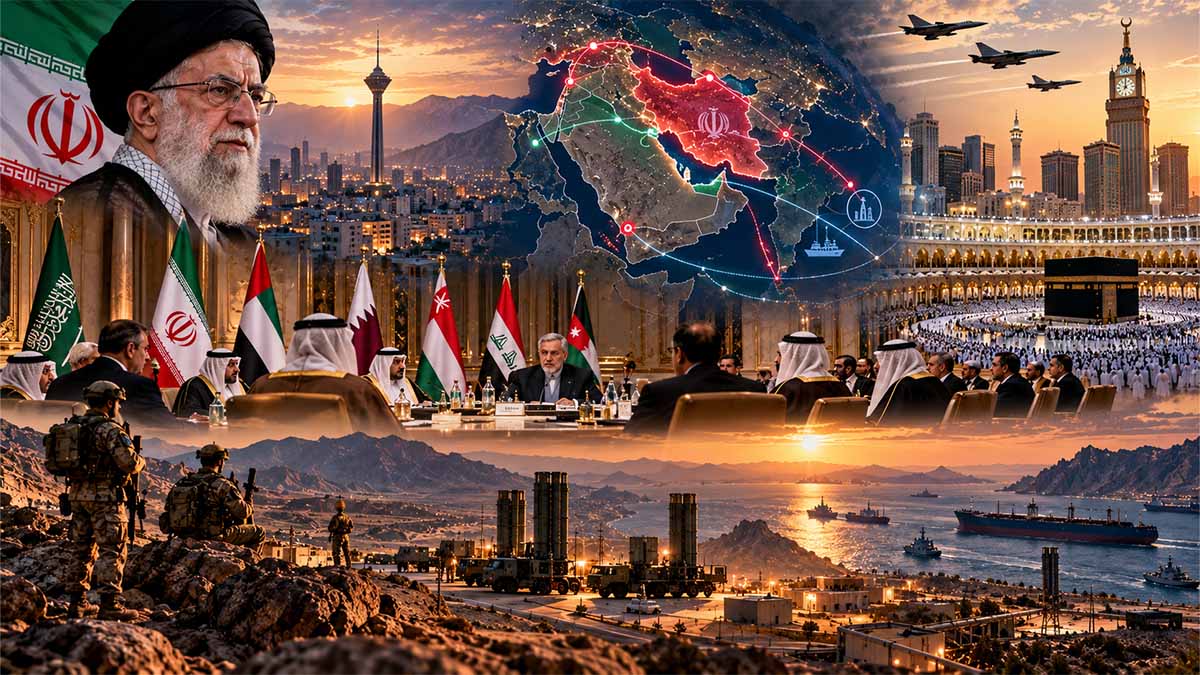
Scope: This assessment examines the 26 October 2026 quadrilateral security meeting in Tehran, the emerging Saudi–Turkish–Pakistani defence framework, Iran’s strategic position, the Yemen conflict, the United States and Israel, and the consequences for Gulf security, international energy markets, maritime trade and European strategic interests through 2031.
Executive Summary / BLUF
The Tehran meeting of 26 October 2026 marked an important diplomatic development in the regional security architecture, bringing Iran into direct consultations with the three participants in the newly established Makkah Joint Defence Agreement. Its immediate result, however, was an agreement to continue dialogue, not the creation of a four-country security organisation or a negotiated settlement.
The distinction is fundamental. The Saudi–Turkish–Pakistani agreement, signed on 7 August 2026, contains a collective-defence commitment under which an armed attack against one signatory is regarded as an attack against all three. Iran is not a party to that agreement, and the available official record contains no commitment to extend collective-defence obligations to Tehran.
The negotiations take place against the background of the 2026 US–Israeli conflict with Iran, renewed hostilities involving Saudi Arabia and Yemen’s Ansarallah movement, and disruptions to energy transportation through the Strait of Hormuz.
The principal strategic question is whether regional governments can establish mechanisms for preventing military escalation while maintaining fundamentally different relationships with Washington, Tehran, Israel and Yemeni armed actors.
Economic exposure gives this question international significance. US Energy Information Administration data show that petroleum liquids moving through Hormuz declined from 21.6 million barrels per day in Q4 2025 to 4.9 million in Q2 2026, a reduction of approximately 77.3% between those quarterly observations. These are historical measured flows, not a verified October 2026 traffic estimate. U.S. Energy Information Administration (EIA)+1
Yemen remains an indispensable element of any durable regional settlement. The UN’s 2026 humanitarian planning framework estimated 22.3 million people requiring assistance, including 18.3 million experiencing acute food insecurity. United Nations in Yemen+1
For European governments, the immediate priorities are maritime security, energy-market resilience, protection of critical infrastructure and diplomatic arrangements that reduce the likelihood of renewed regional warfare.
Principal judgment: The diplomatic significance of the Tehran summit lies in the opening of a security dialogue across previously incompatible strategic alignments. Whether this becomes an effective regional mechanism depends on verifiable commitments, conflict-management arrangements and the participation of actors capable of independently sustaining hostilities.
Tehran’s Security Bargain: Why Regional Diplomacy Cannot Replace Deterrence, Yemen or the Global Energy System
The 26 October 2026 security meeting in Tehran exposed a contradiction at the centre of the emerging Middle Eastern order: Saudi Arabia, Türkiye and Pakistan have formalised a collective-defence agreement while simultaneously seeking a regional accommodation with Iran, the principal power excluded from that arrangement. The consequence reaches beyond military diplomacy. The 2026 conflict has disrupted energy transportation, increased Europe’s import expenditure and forced governments to reconcile external security commitments with the economic cost of prolonged confrontation. The meeting produced no binding security guarantees, no ceasefire and no new regional institution. Yet it established a channel between governments whose conflicting alliances could otherwise magnify the consequences of military incidents. The central question is whether regional security can be managed through enforceable cooperation without requiring governments to abandon their existing alliances or sacrifice their independent strategic interests.
The Makkah Pact Cannot Deliver What Tehran Has Not Agreed to
The institutional contradiction was visible in the composition of the Tehran meeting. Iran was represented by Mohsen Rezaei, Secretary of the Supreme National Security Council; Saudi Arabia by Defence Minister Prince Khalid bin Salman; Pakistan by Field Marshal Asim Munir; and Türkiye by National Intelligence Organization Director Ibrahim Kalın. Their joint statement committed the four governments to continued consultations on regional cooperation and security. It did not establish a permanent organisation or modify their existing defence commitments. That limited outcome is significant precisely because the participants arrived with different national mandates and incompatible interpretations of regional military security.
On 7 August 2026, Saudi Crown Prince and Prime Minister Mohammed bin Salman, Turkish President Recep Tayyip Erdoğan and Pakistani Prime Minister Muhammad Shehbaz Sharif signed the Makkah Joint Defence Agreement. Its declared principle—that an armed attack against one signatory would be regarded as an attack against all three—created a collective-defence commitment without publicly establishing an integrated command, standing multinational force or automatic deployment mechanism. Pakistan subsequently characterised the agreement as defensive and consistent with Article 51 of the United Nations Charter. The distinction between a political commitment to collective defence and the operational capacity to implement it is the agreement’s central vulnerability.
Türkiye’s NATO membership adds a further constraint. Article 5 of the North Atlantic Treaty does not require every ally to undertake an identical military response, and the treaty’s geographical limitations prevent every conflict involving a Turkish partner from automatically becoming a NATO contingency. Pakistan, meanwhile, has combined membership in the Makkah framework with diplomatic engagement toward Iran. Islamabad’s reported initiative in arranging the Tehran consultation illustrates a policy built around overlapping relationships rather than exclusive alignment. Saudi Arabia must therefore distinguish between the deterrent value of its new agreement and the willingness of its partners to participate in specific military operations.
The precedent is the Saudi–Iranian agreement announced in Beijing on 10 March 2023, following negotiations supported by China and earlier consultations hosted by Iraq and Oman. That agreement restored diplomatic relations and referred to bilateral cooperation instruments dating from 1998 and 2001. Tehran’s October meeting did not replace that framework or resolve the conflicts that followed. It added another diplomatic channel to a region already governed by overlapping, and potentially contradictory, commitments.
The Energy Figures Expose the Price of Military Uncertainty
The economic consequences of the 2026 confrontation are measurable. According to the US Energy Information Administration, petroleum liquids passing through the Strait of Hormuz fell from 21.6 million barrels per day in the fourth quarter of 2025 to 14.9 million in the first quarter of 2026 and 4.9 million in the second quarter. The contraction between the two endpoint quarters amounted to approximately 77.3%. LNG transit declined from 10.5 billion to 0.8 billion cubic feet per day over the same period. These figures describe historical transport flows, not permanently eliminated production, but they demonstrate how military confrontation can radically alter the functioning of a principal international energy corridor.
Other routes did not follow the same trajectory. Petroleum transit through Bab el-Mandeb increased from 5.4 million barrels per day in the fourth quarter of 2025 to 8.1 million in the second quarter of 2026, while Suez Canal and SUMED flows remained comparatively stable, moving from 5.9 million to 5.8 million barrels per day. These figures cannot simply be aggregated: the same cargo may cross multiple corridors, and changes reflect different trade patterns. The lesson is that maritime insecurity redistributes commercial exposure rather than producing a uniform contraction in every route.
The human cost was equally concrete. On 28 August 2026, the International Maritime Organization reported at least 70 verified attacks on international shipping and 19 seafarer deaths during the preceding six months. By 16 September, its reporting identified 80 verified attacks in and around Hormuz since 28 February and at least 22 fatalities. The August assessment also indicated that up to 400 vessels carrying approximately 6,000 seafarers had been unable to leave the Persian Gulf safely. These figures describe different reporting dates and cannot be treated as separate incidents to be added together.
Europe absorbed the financial consequences even where physical supplies continued. Eurostat reported that the value of EU petroleum imports increased by 55.8% in the second quarter of 2026, while imported volumes remained broadly stable at 36.7 million tonnes per month, only 1.2% above the 2025 monthly average. That divergence explains why geographical diversification cannot fully protect European industry from international energy shocks. Alternative suppliers can preserve physical availability without preventing higher prices from affecting manufacturing, transport, agriculture and consumers.
Pipelines Move the Vulnerability; They Do Not Remove It
Saudi Arabia’s East–West pipeline demonstrates both the value and the limitations of infrastructure diversification. The EIA identified total capacity of approximately 7 million barrels per day, with roughly 5 million available for exports after domestic requirements. The United Arab Emirates possessed an alternative pipeline connecting Abu Dhabi production to Fujairah, with maximum capacity of 1.8 million barrels per day and an announced expansion intended to double that capacity by 2027. These installations provide genuine alternatives to Hormuz, but nominal capacity is not equivalent to immediately available additional throughput.
The Saudi pipeline moves crude toward Yanbu on the Red Sea, transferring part of the export system’s geographical exposure to another maritime environment. The UAE’s Fujairah terminal provides access outside Hormuz, but remains constrained by pipeline throughput, terminal operations and the security of onward shipping. Neither arrangement can independently replace the international transport system on which Gulf producers depend. LNG faces even greater substitution constraints because production, liquefaction, specialised vessels and receiving terminals must remain connected.
Commercial insurance and shipping operations compound these physical restrictions. A route may remain technically navigable while becoming financially unattractive because of war-risk premiums, vessel availability, crew safety or contractual uncertainty. Longer voyages increase vessel utilisation time and operating costs; interruptions to refined-product supplies can affect industrial activity even where crude oil remains available.
Governments have attempted to absorb part of the shock through emergency inventories. The International Energy Agency’s March 2026 collective action originally committed 400 million barrels. On 15 October, the IEA reported approximately 330 million barrels released, with additional volumes under implementation and particular attention to diesel markets. Emergency stocks provide temporary relief, not new production capacity. Their release also creates future replenishment requirements.
The industrial consequence is that military security, transport redundancy and inventory management are complementary investments, not substitutes. A protected tanker cannot compensate for absent refinery capacity; a pipeline cannot guarantee safe passage beyond its terminal; and strategic reserves cannot permanently offset reduced international supply.
Yemen Remains Outside Any Settlement Negotiated Over Its Head
Yemen is the most consequential political limitation of a security bargain restricted to regional governments. On 9 October 2026, UN Special Envoy Hans Grundberg informed the Security Council that the country had returned to full-scale war, with fighting around Mokha, Bab el-Mandeb, Taiz, Lahj, Marib, Al-Jawf and Hajjah. The confrontation involved territorial control, competing Yemeni authorities and attacks affecting Saudi territory and infrastructure.
Ansarallah’s relationship with Iran is strategically significant, but shared military and political interests do not establish complete Iranian control over the movement’s decisions. The internationally recognised Yemeni government, Ansarallah-controlled institutions, southern organisations and local authorities exercise different forms of authority and possess distinct interests. A settlement confined to Tehran and Riyadh cannot automatically determine the political obligations of those actors or resolve disputes over territory, public revenues, armed forces and the future structure of the Yemeni state.
The economic baseline makes exclusion particularly costly. The World Bank reported a 1.5% contraction in Yemeni GDP in 2025 and projected a further 0.5% decline in 2026. Government revenues had fallen to approximately 5.6% of GDP, while oil-export restrictions continued to weaken public finances and foreign-exchange availability. The United Nations estimated that 22.3 million people required humanitarian assistance in 2026, including 18.3 million facing acute food insecurity and more than 2.2 million children under five suffering acute malnutrition.
The 2026 humanitarian plan requested US$2.16 billion to assist 12 million people, prioritising 9.4 million under a US$1.6 billion component. These are financing requirements and operational targets, not completed disbursements. The distinction matters because an agreement that reduces attacks on Saudi infrastructure while leaving Yemeni institutions without revenues, functioning services or humanitarian access would deliver only partial de-escalation.
The political consequence is unavoidable: Iran can participate in regional negotiations, but it cannot substitute its consent for a Yemeni settlement. Any arrangement that leaves armed organisations, local authorities and competing national institutions outside its implementation structure risks preserving the conditions for renewed conflict.
Europe Possesses a Maritime Mandate, Not a Regional Security Guarantee
The European Union’s response illustrates the distance between economic exposure and military authority. EUNAVFOR ASPIDES, established under Council Decision (CFSP) 2024/583, received an extension until 28 February 2027. The Council identified nearly €15 million in common costs for the following twelve-month period, a figure that excludes significant national expenditure associated with participating forces.
The mission’s mandate concerns defensive maritime operations, including vessel protection and maritime awareness. Amendments adopted on 30 March 2026 expanded cooperation involving critical submarine infrastructure, Djiboutian maritime forces and the Yemeni Coast Guard. By 27 May, the European External Action Service reported support for more than 1,960 merchant vessels and protection for more than 650. These are documented operational activities, but they do not establish universal security of the maritime corridors or authorise unrestricted offensive action.
Germany provides a particularly revealing example of the national constraints underlying European commitments. On 15 October 2026, the Bundestag approved continued German participation with a ceiling of 350 military personnel until 31 October 2027. The vote was 421 in favour, 66 against and 90 abstentions, with estimated additional expenditure of €18.9 million. Those national costs are distinct from the EU common-cost reference. The parliamentary decision demonstrates that European operational capability depends on nationally authorised resources, not simply Council-level declarations.
Italy’s exposure is concentrated in Mediterranean logistics, refining, manufacturing inputs and the reliability of international transport. France combines maritime-security responsibilities, national military authority and diplomatic relationships extending beyond EU institutions. Germany’s industrial system is particularly sensitive to freight reliability, energy-product prices and interruptions to international manufacturing supply chains. The United Kingdom, outside the EU’s institutional decision-making process, maintains separate defence responsibilities and commercial exposure through shipping, financial services and insurance.
These national differences limit the usefulness of treating Europe as a single military or economic actor. The EU can coordinate maritime protection and energy contingency measures, but national governments retain important powers over deployments, budgets and diplomatic commitments. NATO provides another institutional framework, yet its obligations cannot automatically be extended to conflicts involving non-member regional partners.
The resulting European problem is not the absence of instruments. It is the difficulty of matching their legal authority and financing to a crisis whose costs move across energy markets, shipping services, industrial production and national security budgets.
The Next Two Years Will Measure Implementation, Not Diplomatic Attendance
Over the following 12–24 months, the decisive test of the Tehran process will be whether the four governments establish written consultation procedures, military incident-management mechanisms or reciprocal commitments capable of operating during renewed confrontation. Further meetings would demonstrate diplomatic continuity; authenticated agreements and their implementation would demonstrate institutional development. The distinction will determine whether the October 2026 initiative becomes a functional mechanism or remains a channel for managing disagreements without resolving them.
For Saudi Arabia, the economic constraint is already visible in the IMF’s July 2026 projections: GDP growth of 1.7% for 2026, non-oil growth of 2.6%, a fiscal deficit of 3.7% of GDP and government debt of 32.1% of GDP. Higher petroleum revenues can support public finances, but they cannot eliminate investment uncertainty or the costs of protecting infrastructure. Iran faces a different constraint, with the IMF projecting a 5.4% economic contraction in 2026 and inflation of 68.9%. Neither military resilience nor diplomatic leverage automatically translates into fiscal or industrial recovery.
For Europe, the immediate financial burden falls on energy consumers, freight-dependent businesses, industrial producers and public authorities financing security and emergency measures. Continued maritime insecurity raises operating costs even when ships and cargoes remain physically available. Delayed infrastructure investment preserves vulnerability; premature military commitments create additional financial and political obligations; and the depletion of emergency inventories transfers part of today’s energy-security costs into future replenishment requirements.
For Yemen, the cost of failure is more direct: further deterioration of public revenues, interrupted services, displacement and the widening gap between humanitarian needs and deliverable assistance. International donors and neighbouring governments will face additional financing requirements without a guarantee that expenditure can produce durable recovery under continued conflict.
The Tehran meeting has established a diplomatic channel between Iran and the three Makkah agreement states, but it has not reconciled their defence commitments, settled Yemen or restored secure international navigation. By October 2028, the measurable distinction will be between an arrangement that has produced functioning rules and one that has merely preserved communication.
The cost of inaction will not fall exclusively on the governments negotiating regional security. It will be distributed across sovereign budgets, commercial shipping, European industry, energy consumers and Yemen’s already weakened civilian economy.
Navigational Index
PILLAR I — STRATEGIC ORDER, DIPLOMACY AND ALLIANCE ARCHITECTURE
- Chapter 1 — From Confrontation to Quadrilateral Security Dialogue :The Tehran summit, participating institutions, diplomatic sequence and the distinction between negotiation and binding commitments.
- Chapter 2 — The Makkah Joint Defence Agreement: Treaty Commitments and Strategic Limits : Collective defence, military coordination, political constraints, Turkish and Pakistani interests, and Saudi security requirements.
- Chapter 3 — Iran, the United States and Israel: Regional Deterrence and Strategic Competition : Military coercion, foreign military presence, diplomatic positioning, escalation management and the implications of competing security doctrines.
PILLAR II — YEMEN, MILITARY ESCALATION AND CRITICAL ECONOMIC SYSTEMS
- Chapter 4 — Yemen as an Independent Strategic Actor : Ansarallah, competing Yemeni authorities, relations with Iran, Saudi security, humanitarian conditions and requirements for a political settlement.
- Chapter 5 — Military Capabilities, Deterrence and Escalation Pathways : Missile and unmanned-system threats, air and missile defence, coalition interoperability, operational limitations and risks of miscalculation.
- Chapter 6 — Hormuz, Bab el-Mandeb and the Economic Geography of Regional Conflict : Energy transit, pipeline alternatives, shipping disruptions, insurance, infrastructure and supply-chain exposure.
- Chapter 7 — The Economic and Humanitarian Cost of Protracted Regional Conflict : Saudi economic resilience, Iran’s external economic constraints, reconstruction requirements, Yemeni humanitarian needs and financial transmission.
PILLAR III — INTERNATIONAL CONSEQUENCES, SCENARIOS AND POLICY OPTIONS
- Chapter 8 — The European Strategic Exposure: EU, Italy, France, Germany and the United Kingdom : National maritime interests, energy security, defence capabilities, diplomatic choices and European coordination constraints.
- Chapter 9 — International Law, Diplomatic Guarantees and Regional Security Governance : Sovereignty, collective defence, armed conflict, freedom of navigation, verification and potential confidence-building mechanisms.
- Chapter 10 — Strategic Scenarios and Early-Warning Indicators, 2026–2031 :Diplomatic accommodation, managed confrontation, coalition fragmentation and renewed regional escalation.
- Chapter 11 — Policy Options and Final Net Strategic Assessment : Actionable choices, institutional responsibilities, implementation requirements and long-term strategic consequences.
Master Abstract
A security dialogue that does not yet constitute a regional security system
The 26 October meeting in Tehran brought together four governments whose security relationships and regional priorities differ substantially. Iran was represented by Mohsen Rezaei, Secretary of the Supreme National Security Council; Saudi Arabia by Defence Minister Prince Khalid bin Salman; Pakistan by Field Marshal Asim Munir; and Türkiye by National Intelligence Organization Director Ibrahim Kalın. The short joint statement identified the meeting as an initial quadrilateral consultation and committed the participants to continuing dialogue on cooperation, peace and security. It did not announce a treaty, a ceasefire, a mutual non-aggression obligation or a permanent institutional secretariat. This limited outcome nevertheless matters because the participation of the three Makkah agreement states in talks hosted by Tehran creates a diplomatic channel between an existing collective-defence grouping and a regional power outside that grouping. Press Statement after Four-Way Tehran Meeting — Iranian State News Agency IRNA — Oct 2026 ایرنا
The emerging structure should not be understood as the straightforward replacement of American security guarantees with an Iranian-centred order. Türkiye maintains NATO obligations, Pakistan has longstanding defence relationships extending beyond the Gulf, and Saudi Arabia continues to combine external defence partnerships with regional diplomacy. Iran, meanwhile, has articulated a preference for security arrangements based on regional states and opposition to outside military intervention. These positions can coexist within a consultative process, but they do not automatically support a common defence doctrine. The most plausible institutional function of continued quadrilateral meetings is therefore initially conflict management: communication among security establishments, procedures for preventing miscalculation, and the identification of issues on which limited reciprocal commitments are possible.
Yemen, alliance commitments and the limits of diplomatic bargaining
The conflict involving Saudi Arabia and Yemen’s Ansarallah movement creates a second, more difficult dimension. Any security arrangement that seeks to constrain cross-border military operations must distinguish Iran’s influence over regional armed partners from its capacity to determine their decisions. Diplomatic engagement between Tehran and Riyadh may facilitate communication or incentives for restraint, but it cannot substitute for negotiations addressing Yemeni political representation, territorial administration, economic access, security guarantees and civilian protection. The distinction between the internationally recognised Yemeni government, Ansarallah-controlled institutions and other armed and political actors is essential. Treating Yemen as a single subordinate component of Iranian strategy would produce an incomplete account of the conflict and potentially a defective settlement mechanism.
The economic and humanitarian consequences of continued warfare further undermine approaches based exclusively on military deterrence. The United Nations estimates that 18.3 million people in Yemen face acute food insecurity, more than 2.2 million children under five suffer acute malnutrition, and only 59.3% of health facilities are fully functional. These figures establish a national humanitarian constraint that exists independently of any particular regional negotiating formula. A regional arrangement capable of reducing attacks on energy infrastructure while leaving Yemen’s humanitarian and political conditions unresolved would constitute limited de-escalation rather than comprehensive peace. Yemen Humanitarian Needs and Response Plan 2026 — OCHA — Mar 2026
Maritime economics and the international consequences of escalation
The strategic importance of these negotiations extends well beyond the four participants because the Gulf and adjacent waterways connect energy production, maritime transportation and industrial consumption across multiple continents. EIA observations indicate that flows through Hormuz fell sharply between late 2025 and the second quarter of 2026, while traffic patterns through Bab el-Mandeb changed substantially. These movements demonstrate both the vulnerability of established oil-trade routes and the need to distinguish short-term rerouting from sustainable replacement capacity. A negotiated reduction in military attacks would not automatically restore earlier shipping patterns: insurance conditions, commercial confidence, port accessibility, sanctions and maritime security arrangements would still influence decisions by shipowners, commodity traders and energy companies. Global Energy Security Data — US Energy Information Administration — Aug 2026
European exposure adds a separate institutional dimension. The European Union extended Operation EUNAVFOR ASPIDES until 28 February 2027 and subsequently expanded elements of its maritime-security mandate, including attention to critical submarine infrastructure and cooperation with regional maritime authorities. European governments consequently have an established operational stake in the conditions surrounding the Tehran dialogue, while remaining external to the quadrilateral negotiations themselves. A sustainable regional security architecture would need to reconcile the participants’ desire for regional control with the legitimate commercial interests of states dependent on freedom of navigation. The decisive evidence of progress will not be the frequency of diplomatic meetings, but whether they generate observable restraints on attacks, functioning communication arrangements and enforceable procedures for managing crises. Red Sea: Council Extends the Mandate of Operation ASPIDES — Council of the European Union — Feb 2026
Key Evidence Table
The following indicators establish the documentary baseline for the assessment. Figures are reported according to their original definitions and reference periods; they should not be interpreted as contemporaneous measurements of the same phenomenon.
| Indicator | Value / status | Reference date | Definition / scope | Issuer | Exact source |
|---|---|---|---|---|---|
| Quadrilateral Tehran meeting | Four participating states; agreement to continue dialogue | 26 Oct 2026 | Iran, Saudi Arabia, Türkiye, Pakistan | Iranian state media, reproducing joint statement | Joint Press Statement — Oct 2026 |
| Makkah Joint Defence Agreement | Signed by three states | 7 Aug 2026 | Saudi Arabia, Türkiye, Pakistan | Turkish Directorate of Communications | Joint Defence Agreement — Aug 2026 |
| Collective-defence provision | Attack against one regarded as attack against all three | Aug 2026 | Treaty principle; implementation provisions not fully established by published communiqué | Turkish Directorate of Communications | Official Communiqué — Aug 2026 |
| Saudi–Iranian diplomatic restoration | Bilateral agreement mediated by China | 10 Mar 2023 | Diplomatic relations and implementation of earlier bilateral agreements | Chinese Ministry of Foreign Affairs | Joint Trilateral Statement — Mar 2023 |
| Hormuz petroleum transit | 21.6 → 4.9 million b/d | Q4 2025 → Q2 2026 | Crude oil and petroleum liquids | US EIA | Global Energy Security Data — Aug 2026 |
| Hormuz LNG transit | 10.5 → 0.8 billion cubic feet/day | Q4 2025 → Q2 2026 | Liquefied natural gas | US EIA | Global Energy Security Data — Aug 2026 |
| Bab el-Mandeb petroleum transit | 5.4 → 8.1 million b/d | Q4 2025 → Q2 2026 | Petroleum liquids; does not establish freedom from maritime threats | US EIA | Global Energy Security Data — Aug 2026 |
| Yemeni population requiring assistance | 22.3 million | 2026 planning year | Humanitarian needs estimate | UN OCHA | Humanitarian Needs and Response Plan — Mar 2026 |
| Acute food insecurity | 18.3 million people | 2026 planning year | National humanitarian estimate | UN OCHA | Humanitarian Needs and Response Plan — Mar 2026 |
| Humanitarian financing requirement | US$2.16 billion requested | 2026 | Appeal requirement, not disbursement | UN OCHA | Humanitarian Needs and Response Plan — Mar 2026 |
| EUNAVFOR ASPIDES | Mandate extended to 28 Feb 2027 | 23 Feb 2026 | EU defensive maritime operation | Council of the EU | ASPIDES Extension — Feb 2026 |
| ASPIDES common-cost reference | Nearly €15 million | Mar 2026–Feb 2027 | Common costs, not total operational expenditure | Council of the EU | ASPIDES Extension — Feb 2026 |
The strategic significance of the evidence
Three observations are decisive.
First, the Makkah agreement and the Tehran consultations are legally and institutionally different. The former establishes a stated collective-defence principle among three governments; the latter records an intention to continue negotiations among four. No official document examined establishes the incorporation of Iran into the Makkah agreement or the conversion of the quadrilateral forum into a military alliance.
Second, regional diplomacy must be evaluated against the actual economic geography of conflict. The substantial contraction in Hormuz energy flows during the first half of 2026 illustrates the exposure of exporters, importers and commercial shipping. Yet it does not, by itself, establish who exercised operational control over individual vessels, the precise causes of every movement, or the effectiveness of any particular military strategy. Those conclusions require separate operational evidence.
Third, Yemen represents both a military-security problem and a conflict involving sovereign political interests and a severe humanitarian emergency. A negotiation concerning Iran’s relations with Saudi Arabia cannot be treated as equivalent to an agreement ending hostilities in Yemen.
Competing Explanations and Strategic Pathways
The present evidence supports three distinct, potentially overlapping interpretations of the diplomatic process. They should not be treated as mutually exclusive accounts of the participants’ intentions.
| Hypothesis | Diagnostic support | Disconfirming evidence or limitation | Indicators | Current standing |
|---|---|---|---|---|
| H1 — Negotiated regional accommodation | Four-country dialogue; history of Saudi–Iranian diplomatic restoration; expressed willingness to continue consultations | No published common security framework or binding non-aggression mechanism | Regular meetings, technical working groups, incident-prevention arrangements | A credible diplomatic objective, not an established outcome |
| H2 — Crisis management without strategic realignment | Existing alliances remain; joint statement is deliberately limited; Saudi and Iranian security doctrines differ | Sustained cooperation could eventually change the scope of negotiations | Continued consultations without treaty changes; practical de-escalation measures | Consistent with the currently documented institutional position |
| H3 — Diplomatic bargaining under continued military pressure | Active regional conflicts, unresolved Yemen question, competing security relationships and economic disruption | The public communiqué does not establish coercive bargaining terms or agreed concessions | Escalatory incidents during negotiations, conditional demands, military mobilisation | A material risk pathway requiring further evidence |
Assessment of the competing explanations
The available documentary record establishes the existence of a diplomatic channel and limited political agreement to keep that channel open. It does not yet establish convergence around a regional security doctrine.
The coexistence of negotiations and persistent military competition would not be contradictory. Governments routinely maintain communication with adversaries while preserving military deterrence and existing alliances. In the present circumstances, Saudi Arabia has reason to protect energy infrastructure and reduce cross-border attacks, Iran has an interest in limiting further external military pressure, Türkiye has interests spanning NATO and regional diplomacy, and Pakistan can facilitate dialogue while retaining its own defence commitments.
An early-warning assessment should consequently focus on implementation rather than language. A further meeting would indicate continuity; a mutually accepted incident-management procedure would indicate practical institutional development; a verified reduction in attacks under an agreed mechanism would constitute more substantial evidence of effectiveness.
Principal Gaps and Watch Indicators
| Consequential uncertainty | Documentary or observable test | Strategic implication |
|---|---|---|
| Full implementation provisions of the Makkah agreement | Ratified treaty text, national parliamentary records and implementing measures | Determines the actual scope of defence obligations |
| Institutional future of the Tehran dialogue | Subsequent joint communiqués, agreed meeting schedule, working-group mandates | Distinguishes ad hoc diplomacy from structured cooperation |
| Yemen’s place in future negotiations | Explicit agreements involving relevant Yemeni actors or UN-sponsored political processes | Tests whether regional de-escalation can extend to the underlying conflict |
| Conditions for restoring maritime flows | Verified transit data, shipping advisories, port-access rules and insurance conditions | Measures the commercial consequences of diplomatic progress |
| Military limitations and operational commitments | Official deployment decisions, authenticated operational statements and deconfliction arrangements | Tests whether political undertakings translate into restraint |
| Relationship with Washington and other external powers | Formal diplomatic statements and defence-policy decisions | Clarifies the compatibility of regional consultation and external alliances |
| Humanitarian access in Yemen | UN OCHA operational reporting, funding records and access restrictions | Measures whether political and military developments improve civilian conditions |
Strategic Economic Visualisation
Petroleum flows through major regional chokepoints
Million barrels per day. US EIA historical observations for Q4 2025 and Q2 2026.
Q4 2025
Q2 2026
06121824HormuzBab el-MandebSuez / SUMED
Source: US Energy Information Administration, Global Energy Security Data, August 2026. Quarterly historical observations; figures are not October 2026 estimates.
Source: US EIA — Global Energy Security Data, August 2026. Individual chokepoint flows should not be summed, because a shipment may transit more than one route.
The divergence is significant. Whereas the recorded flow of petroleum liquids through Hormuz contracted sharply, Bab el-Mandeb experienced an increase over the same observation period. This should not be interpreted as evidence that the two waterways are interchangeable or that commercial and security conditions improved across the Red Sea. Their cargo composition, geography, exposure to armed threats and connections to export infrastructure differ.
For policymakers, the principal consequence is the inadequacy of treating regional maritime disruption as a single uniform phenomenon. Security arrangements must distinguish the Persian Gulf exit route, the Red Sea access system, the Suez–SUMED corridor and alternative pipeline infrastructure.
No further decision-useful visualisation is supportable from the verified record without introducing additional operational or quantitative evidence.
Preliminary Strategic Implications for Europe
The European Union’s maritime presence already provides an institutional basis for evaluating the implications of the Tehran diplomatic process. ASPIDES was launched in February 2024 as a defensive operation and, following the Council’s decisions of February and March 2026, has an extended mandate and additional tasks concerning maritime information-sharing and regional cooperation. Its legal and operational purpose is distinct from offensive military action against Yemen or participation in a regional collective-defence pact. Maritime Security: Council Updates Mandates of EU Naval Operations — Council of the EU — Mar 2026
Italy faces exposure through Mediterranean maritime transport, petroleum refining, industrial energy inputs and the security of international commercial shipping. Its policy considerations include the relationship between European maritime protection, national naval commitments and the resilience of import-dependent industrial supply chains.
France combines maritime-security interests with an independent national defence and diplomatic apparatus. Its assessment must account for the requirements of defending commercial navigation, maintaining regional relationships and avoiding the automatic extension of defensive commitments into broader military confrontation.
Germany faces transmission primarily through industrial energy costs, logistics chains and the consequences of persistent disruption to maritime transportation. The strategic problem is not limited to direct oil and gas imports from the Gulf, because prices and shipping costs propagate through internationally integrated markets.
The United Kingdom has interests in Gulf defence cooperation, maritime security and the continuity of international energy and trade flows. Its position also requires examining the relationship between bilateral defence arrangements, coordination with Washington and the management of escalation risks.
At European Union level, the central challenge is coordination between national foreign policies, EU maritime-security mandates, NATO commitments where applicable, and the commercial requirements of European importers and shipping operators. These dimensions intersect but are not legally or institutionally interchangeable.
Five-Year Strategic Outlook: 2026–2031
The medium-term outlook should be assessed through observable institutional developments rather than unsupported numerical probabilities.
A structured regional accommodation would involve recurring negotiations, working mechanisms for incident prevention and commitments addressing specific military or maritime risks. Such an arrangement would not necessarily require a common alliance or the withdrawal of existing external security partners. Its test would be whether participating governments adopt procedures capable of operating during renewed crises.
A managed confrontation would preserve diplomatic communication while leaving essential military disagreements unresolved. This pathway could involve intermittent de-escalation, continuing defence cooperation among the Makkah agreement members and unresolved security disputes involving Iran, Israel and Yemen.
A fragmented security environment would emerge if the respective governments continued developing overlapping bilateral and multilateral arrangements without common escalation-management procedures. In that setting, military assistance commitments, national operational restrictions and diplomatic bargaining could produce inconsistent responses to the same incident.
A renewed escalation cycle would be characterised by intensified attacks, further disruption of energy transit, expanding military commitments and a deterioration of the humanitarian situation. Its economic consequences would depend on the duration of disruptions, the availability of alternative transportation, commercial access and the response of energy markets.
These pathways are not assigned numerical probabilities because the presently available records do not provide a defensible quantitative forecasting basis.
Net Assessment of the Opening Evidence
The Tehran meeting should be understood as an opening in regional security diplomacy rather than evidence of a completed geopolitical realignment. Its importance lies in direct engagement among governments whose defence commitments, political relationships and interpretations of regional stability remain significantly different.
The Makkah Joint Defence Agreement provides one institutional foundation for security coordination among Saudi Arabia, Türkiye and Pakistan, but the operational scope of its collective-defence commitments cannot be established solely from the published summary. The Tehran meeting provides a second, less formal framework in which Iran can engage with the agreement’s participants without becoming a signatory.
The principal unresolved issue is whether these two diplomatic and security frameworks can coexist with practical mechanisms for preventing conflict. Yemen, US–Iranian relations, Israeli military operations, maritime access and the security of energy infrastructure will determine the value of any subsequent negotiations.
For institutional decision-makers, the appropriate distinction is between diplomatic access, negotiated commitments and demonstrated implementation. The first is established. The second remains limited. The third requires observable developments beyond the 26 October meeting.
The subsequent chapters will examine these distinctions in depth, beginning with the institutional and historical foundations of the quadrilateral dialogue and the strategic calculations of the four participating governments.
TEHRAN 2026
THE REGIONAL SECURITY RESET
The strategic intersection of Iranian regional diplomacy, the Saudi–Turkish–Pakistani defence framework, Yemen, maritime chokepoints and European security.
26 October 2026
7 August 2026
UN 2026 planning estimate
Two overlapping security frameworks
Four governments participated in the Tehran consultation. Three are members of a separate collective-defence agreement. Iran participated in the consultation without becoming a signatory to that agreement.
Saudi Arabia + Türkiye + Pakistan
Collective-defence principle announced 7 August 2026
Collective defence
The three signatories recognise an armed attack against one party as an attack against all three.
Specific implementation provisions and operational conditions require examination of the treaty record.
Regional consultation
Four governments agreed to continue dialogue on regional peace, security and cooperation.
No four-party collective-defence treaty or permanent security institution was announced.
The changing geography of petroleum transit
Historical US Energy Information Administration observations. Three-dimensional shading is illustrative; bar lengths use a common linear scale from 0 to 25 million barrels per day.
Hormuz LNG Transit
Billion cubic feet per day, Q4 2025 to Q2 2026.
The figures represent historical transit observations. They are not October 2026 flow estimates.
Energy security transmission
Maritime disruption can influence tanker routing, freight charges, insurance conditions, supply availability, energy pricing and downstream industrial costs.
These are transmission mechanisms, not estimates of financial losses or causal attribution for every recorded change in traffic.
Humanitarian and political constraints
UN humanitarian estimates for 2026 establish the magnitude of civilian needs independently of the diplomatic outcome of the Tehran consultations.
People requiring humanitarian support
People experiencing acute food insecurity
Children under five with acute malnutrition
2026 requested funding, not disbursements
Functionality of health infrastructure
Share of health facilities fully functional. The remaining share should not be assumed entirely closed; it includes other functionality conditions.
Settlement requirements
Regional diplomacy must distinguish Iranian influence from the independent decisions of Yemeni actors.
Sustainable de-escalation requires political participation, civilian protection, economic access and credible security arrangements.
Diplomatic and security record
| Event / Instrument | Date | Established Status | Analytical Limitation |
|---|---|---|---|
| Saudi–Iranian diplomatic restoration | 10 Mar 2023 | Joint statement | Restoration of diplomatic relations is not a regional defence treaty. |
| Makkah Joint Defence Agreement | 7 Aug 2026 | Defence agreement | Operational obligations require the applicable treaty provisions and implementation record. |
| Quadrilateral Tehran summit | 26 Oct 2026 | Security dialogue | No published four-party mutual-defence commitment. |
| Yemen humanitarian response framework | Mar 2026 | UN planning record | Requirements and needs are not equivalent to completed aid delivery. |
| EUNAVFOR ASPIDES extension | 23 Feb 2026 | EU Council decision | Defensive maritime mandate; does not establish offensive intervention authority. |
Three institutional pathways, 2026–2031
Qualitative scenarios derived from documented institutional relationships and identified strategic constraints. No probabilities or numerical risk scores are assigned.
Structured accommodation
Recurring consultations develop into agreed crisis-management and incident-prevention procedures.
Watch: Formal working groups, incident channels, documented reciprocal commitments.
Managed confrontation
Diplomatic communication continues while existing alliances and military disagreements remain.
Watch: Meetings without treaty changes, limited restraint, persistent deployments.
Renewed escalation
Additional attacks or military incidents undermine confidence and disrupt commercial or diplomatic activity.
Watch: Hostilities, maritime restrictions, mobilisation and interruption of dialogue.
National priorities and EU coordination
Mediterranean maritime connectivity, energy imports, petroleum refining, industrial energy costs and national naval commitments.
Regional defence partnerships, maritime security, national diplomatic engagement and management of military escalation.
Industrial energy exposure, freight costs, international manufacturing supply chains and trade-route continuity.
Gulf defence relationships, freedom of navigation, commercial shipping and coordination of external security commitments.
Defensive maritime security operation with mandate extended to 28 February 2027. The February 2026 extension referenced approximately €15 million in common costs for the following 12-month period, not total operational expenditure.
Indicators connecting diplomacy to implementation
| Decision Domain | Observable Indicator | Meaning | Primary Record |
|---|---|---|---|
| Diplomatic coordination | Scheduled follow-up meetings | Continuity of the consultation channel | Joint communiqués |
| Institutional development | Mandated technical working groups | Movement beyond general diplomatic contact | Agreed institutional documents |
| Military de-escalation | Authenticated mutual restraints and deconfliction procedures | Potential operational implementation | Official defence and diplomatic records |
| Yemen | Inclusive political negotiations and verified changes in hostilities | Connection between regional diplomacy and conflict settlement | UN and competent national records |
| Maritime trade | Transit, insurance and shipping advisories | Commercial impact of security conditions | EIA, maritime authorities and published commercial data |
| European security | Mandate revisions, deployments and Council decisions | Institutional adaptation to regional conditions | EU Council and national defence authorities |
Official source record
- IRNA — Press Statement after Four-Way Tehran Meeting, October 2026 . Quadrilateral diplomatic statement.
- Turkish Directorate of Communications — Joint Defence Agreement, August 2026 . Agreement framework and announced defence principle.
- Chinese Ministry of Foreign Affairs — Saudi–Iranian Joint Trilateral Statement, March 2023 . Diplomatic restoration.
- US Energy Information Administration — Global Energy Security Data, August 2026 . Quarterly petroleum and LNG transit observations.
- UN OCHA — Yemen Humanitarian Needs and Response Plan, March 2026 . Humanitarian needs and appeal statistics.
- Council of the European Union — ASPIDES Mandate Extension, February 2026 . Maritime-security mandate and common costs.
- Council of the European Union — Maritime Security Mandate Updates, March 2026 . Subsequent mandate developments.
PILLAR I — STRATEGIC ORDER, DIPLOMACY AND ALLIANCE ARCHITECTURE
Chapter 1 — From Confrontation to Quadrilateral Security Dialogue
The Tehran meeting and the emergence of a contested regional security architecture
The quadrilateral meeting held in Tehran on 26 October 2026 represents an institutional opening between governments with different strategic commitments, but its principal significance is not the formation of a new alliance. It is the establishment of a diplomatic channel through which Iran, Saudi Arabia, Türkiye and Pakistan can explore regional security arrangements without first resolving their disagreements over foreign military presence, collective defence, Israel, Yemen or the future of regional deterrence. That distinction determines how the event should be interpreted by governments, military planners and financial institutions. A gathering of senior security officials does not by itself modify existing defence treaties, create common operational authority or establish enforceable restrictions on the employment of military force. It can, however, provide a mechanism for communicating intentions, reducing uncertainty and exploring limited forms of cooperation between governments that otherwise operate within competing security systems.
The official communiqué establishes the date, location, principal participants and immediate diplomatic result. Iran’s Supreme National Security Council Secretary, Mohsen Rezaei, hosted Saudi Defence Minister Prince Khalid bin Salman, Pakistan’s Field Marshal Asim Munir, identified in the communiqué as Chief of Army Staff and Chief of Defence Forces, and Ibrahim Kalın, Director of Türkiye’s National Intelligence Organization. The text described the gathering as the first meeting of the four regional countries and recorded their agreement to continue dialogue aimed at strengthening cooperation, including in regional peace and security. The document contains no announced mutual-defence arrangement, no joint command structure, no permanent secretariat, no agreed military deployment and no timetable for implementing a collective regional-security programme. The appropriate starting point is therefore the formation of a consultative diplomatic process, not an asserted transformation of the regional military balance. Press Statement after Four-Way Tehran Meeting — IRNA — October 2026
The institutional composition of the delegations is particularly revealing. This was not a conventional foreign-ministerial meeting organised exclusively around diplomatic representation. Iran’s delegation was headed by the secretary of its principal national-security coordination body; Saudi Arabia sent the minister responsible for national defence; Pakistan was represented by its senior military leadership; and Türkiye selected the head of its national intelligence organisation. These different institutional mandates indicate that security considerations extended beyond ordinary bilateral political relations, although they do not establish the existence of undisclosed military negotiations. Defence ministries, military commands, intelligence organisations and national security councils operate through different decision-making procedures and possess different authorities to make commitments. Consequently, the presence of their senior officials provides evidence of high-level political attention but not proof that each participant possessed an equivalent mandate to negotiate or approve binding operational obligations.
The meeting also needs to be placed within the longer institutional history of Saudi–Iranian relations. The restoration of diplomatic relations announced in Beijing on 10 March 2023 followed negotiations conducted from 6 to 10 March under Chinese sponsorship, after previous rounds hosted by Iraq and Oman during 2021–2022. The Beijing statement committed Saudi Arabia and Iran to reopening diplomatic missions, respecting national sovereignty and non-interference, and implementing existing bilateral agreements. Importantly, those earlier instruments included the security cooperation agreement signed on 17 April 2001 and the general cooperation agreement signed on 27 May 1998, covering economic, trade, investment, technological, scientific and cultural matters. The restoration of diplomatic ties in 2023 therefore did not create bilateral security cooperation from nothing; it reactivated a diplomatic relationship with an earlier treaty framework that had survived in the documentary record despite subsequent political antagonism. Joint Trilateral Statement by Saudi Arabia, Iran and China — Ministry of Foreign Affairs of China — March 2023
The chronological sequence matters because the 2026 Tehran consultation follows two different institutional developments that should not be conflated. The first was the Saudi–Iranian diplomatic restoration of March 2023, based on sovereignty, non-interference and implementation of previously signed agreements. The second was the Saudi–Turkish–Pakistani defence agreement of 7 August 2026, which established a stated collective-defence principle among three governments, excluding Iran. The Tehran summit brought these relationships into the same diplomatic setting for the first time under the new agreement, but without merging their obligations. The resulting structure is not a single regional alliance; it is an environment containing bilateral diplomatic commitments, a three-party defence agreement, NATO obligations applicable to Türkiye, and a new four-party consultation. The distinction between these layers is indispensable to evaluating their potential interaction and their points of friction. Makkah Al-Mukarramah Summit for Joint Defence — Ministry of Foreign Affairs of Pakistan — August 2026 and North Atlantic Treaty — NATO — April 1949.
Diplomatic chronology and the development of security institutions
| Date | Event or instrument | Participating institutions | Formal significance | Relevance to the 2026 negotiations |
|---|---|---|---|---|
| 27 May 1998 | Saudi–Iranian general cooperation agreement | Saudi Arabia and Iran | Cooperation across economic, investment, scientific, technological and other civilian fields | Establishes the earlier institutional basis for bilateral cooperation |
| 17 April 2001 | Saudi–Iranian security cooperation agreement | Saudi Arabia and Iran | Bilateral security cooperation instrument | Recognised for implementation in the 2023 rapprochement |
| 2021–2022 | Saudi–Iranian dialogue in Iraq and Oman | Bilateral delegations; Iraqi and Omani hosts | Diplomatic negotiations | Established a process preceding the Beijing agreement |
| 6–10 March 2023 | Beijing negotiations | Saudi Arabia, Iran and China | Agreement to restore diplomatic relations | Provided the diplomatic foundation for subsequent contacts |
| 10 March 2023 | Joint trilateral statement | Representatives of the three governments | Sovereignty, non-interference and restoration commitments | Re-established an official bilateral political framework |
| 7 August 2026 | Makkah Joint Defence Agreement | Saudi Arabia, Türkiye and Pakistan | Announced three-state collective-defence principle | Created the defence framework whose members subsequently met Iran |
| October 2026 | Pakistani diplomatic initiative | Pakistan and Iran | Proposal for a quadrilateral security consultation, according to Iranian official statements | Explains the reported immediate origin of the Tehran meeting |
| 26 October 2026 | Tehran quadrilateral consultation | Senior Iranian, Saudi, Turkish and Pakistani security officials | Public commitment to continue regional security dialogue | Establishes a four-government diplomatic channel |
Sources: Joint Trilateral Statement — Ministry of Foreign Affairs of China — March 2023; Makkah Summit for Joint Defence — Ministry of Foreign Affairs of Pakistan — August 2026; Official Tehran Meeting Record — Iran Press — October 2026; Quadrilateral Press Statement — IRNA — October 2026.
The reported Pakistani role in proposing the consultation warrants separate attention because it helps explain why a government participating in the Makkah agreement would also promote dialogue with Iran. Iranian Foreign Ministry spokesman Esmaeil Baqaei stated on 26 October that the meeting followed a proposal made during Asim Munir’s visit to Tehran the preceding week. He presented the initiative as a practical contribution to regional security based on the interests and capabilities of the countries concerned. That is an attributed Iranian official explanation of the meeting’s origins; it should not be treated as evidence that Pakistan negotiated or obtained agreement on a substantive security settlement before the delegations assembled. Nevertheless, a proposal by a government participating in the three-party defence agreement is institutionally important because it illustrates that membership in that agreement does not, in itself, prohibit diplomatic engagement with Tehran. Iran, Pakistan, Saudi Arabia and Türkiye Hold Quadrilateral Meeting — Iran Press — October 2026.
The political mandates of the four delegations
The selection of representatives creates a useful basis for examining what each government could reasonably seek from continued consultations. These are analytical assessments of institutional interests rather than assertions about undisclosed negotiating instructions.
| Government | Principal representative, 26 October | Institutional capacity | Security interests relevant to negotiations | Limitation of the public record |
|---|---|---|---|---|
| Iran | Mohsen Rezaei | Secretary, Supreme National Security Council | Regional security arrangements, deterrence, foreign military presence, sovereignty | No published four-party operational agreement |
| Saudi Arabia | Prince Khalid bin Salman | Minister of Defence | Territorial protection, regional stability, defence coordination, prevention of escalation | No published concession altering Saudi defence arrangements |
| Türkiye | Ibrahim Kalın | Director, National Intelligence Organization | Strategic intelligence, regional diplomatic coordination, security risk assessment | Participation does not establish a NATO or Turkish military commitment |
| Pakistan | Field Marshal Asim Munir | Senior armed-forces leadership | Defence cooperation, military diplomacy, stability involving partner governments | No published agreement defining Pakistani military duties toward Iran |
Source: Press Statement after Four-Way Tehran Meeting — October 2026.
The different institutional positions mean that any future agreement will require translation into each government’s own constitutional, political and military processes. An intelligence director may facilitate security dialogue or convey the position of national leadership without possessing the same treaty-making authority as a head of government. A defence minister may negotiate military cooperation but remain constrained by domestic approval procedures, operational feasibility and wider alliance commitments. A senior military commander can discuss deterrence, readiness and military communication while the formal diplomatic position remains subject to the national executive. These distinctions are not merely procedural. They determine whether a consultation can generate enforceable commitments, whether military organisations can implement them and whether conflicting interpretations can be resolved through recognised institutional channels.
Iran’s doctrine of regional security and the question of external guarantees
Iran’s publicly articulated position emphasises a regional security environment constructed through cooperation among neighbouring states rather than dependence on external military powers. During the 26 October discussions, Iranian Foreign Ministry spokesman Baqaei argued that reliable security requires mutual confidence among regional governments and consideration of their own priorities and capabilities. His remarks also identified the consequences of military confrontation involving the United States, Israeli military policy, Palestine and Lebanon as matters relevant to the regional security environment. These statements establish Iran’s declared diplomatic framework, but they do not demonstrate that Saudi Arabia, Türkiye or Pakistan accepted the Iranian interpretation of the proper role of foreign forces. Iran, Pakistan, Saudi Arabia and Türkiye Hold Quadrilateral Meeting — Iran Press — October 2026.
A security framework based on regional participation could take several institutional forms without requiring a comprehensive military alliance. The least demanding would involve regular diplomatic consultations and the exchange of assessments regarding emerging crises. A more developed arrangement could establish military communication procedures, notification of exercises, or mechanisms for investigating incidents affecting territorial sovereignty or maritime navigation. A still more ambitious structure might require agreed restrictions on military activities and reciprocal commitments concerning the use of national territory by foreign forces. Each additional step would require a higher degree of trust, more specific definitions, stronger verification and greater domestic political authorisation. The Tehran communiqué supports the first of these stages: continued consultation. It does not establish the others.
The distinction is particularly important in relation to the United States. Iran regards American military involvement as a source of strategic threat, whereas several of the governments participating in the summit maintain security or defence relationships with Washington. Regional dialogue does not automatically invalidate those relationships, nor does cooperation with Washington necessarily prevent negotiations with Tehran. The institutional challenge is whether states possessing incompatible views of American regional military power can establish limited rules governing their own conduct, especially where military operations by external actors create direct security consequences for neighbouring countries. This is a question of sovereignty, operational control, diplomatic authorisation and the management of conflicting commitments rather than a simple contest between an exclusively regional system and an exclusively external system.
The gap between diplomatic inclusion and political settlement
The Tehran meeting should also be distinguished from the resolution of the conflicts and disputes surrounding it. The official joint statement contains no explicit settlement framework for the Iranian–American confrontation, no accepted interpretation of Israeli military activity, no provision concerning Lebanon or Palestine, and no agreement addressing the political future of Yemen. The absence of these subjects from the short published communiqué does not prove that they were absent from every discussion, but it prevents the analyst from presenting alleged concessions or negotiating outcomes as jointly established facts. Statements made separately by Iranian officials may accurately reflect their government’s priorities, yet they do not have the same evidentiary status as language approved and published by all four participants.
This limitation is especially consequential for negotiations involving armed groups or authorities outside the four participating governments. Even a comprehensive Saudi–Iranian understanding would not automatically determine the obligations of organisations exercising separate political and military authority. The effectiveness of any arrangement would depend on the parties whose conduct it intends to regulate, the incentives available to them, the legal status of the proposed obligations and the means by which compliance could be established. Treating regional diplomacy as a substitute for the consent and participation of directly involved parties would risk producing agreements whose implementation depends on actors not represented in their negotiation.
Institutional pathways from consultation to operational cooperation
| Institutional stage | Required documentary development | Possible security function | Verification requirement | Status at 29 October 2026 |
|---|---|---|---|---|
| Diplomatic contact | Joint statement identifying participants and purpose | Communication and political engagement | Authenticated communiqué | Established |
| Continuing consultation | Subsequent official meetings or agreed schedule | Continuity of dialogue | Further official records | Intention announced |
| Formal working mechanism | Agreed mandate and designated representatives | Technical discussion and issue management | Published or authenticated mandate | Not established by the summit statement |
| Incident-prevention procedure | Agreed communications and notification rules | Reduction of accidental escalation | Operational procedure and implementation evidence | Not established |
| Reciprocal security commitments | Written obligations specifying parties and conduct | Restraints on specified military activities | Binding text and domestic implementation | Not established |
| Permanent regional institution | Constitutive agreement, authority and financing | Sustained regional security governance | Founding instrument and implementation record | Not established |
The sequence is analytically important because each institutional stage creates different expectations. A diplomatic commitment to continue talking can be fulfilled through further meetings even if no concrete military restraint results. An incident-prevention procedure must be assessed against the behaviour it is intended to govern, such as notification practices or the response to an unexpected military event. A binding treaty requires examination of its provisions, applicable domestic procedures and international legal consequences. A permanent regional security institution requires additional information concerning membership, financing, voting, secretariat responsibilities and the relationship between political and military authority.
Key judgments — Chapter 1
The Tehran meeting constitutes a documented diplomatic consultation among four governments, while the Makkah agreement remains a separate three-party defence arrangement. The March 2023 Saudi–Iranian rapprochement provides an important institutional antecedent, particularly because it explicitly referred to the earlier 1998 and 2001 bilateral cooperation agreements. Pakistan’s reported role in proposing the October 2026 consultation illustrates the possibility of diplomatic engagement across these frameworks, but does not establish a change in Pakistan’s defence obligations. The decisive next development would be the publication of an agreed institutional mechanism defining a specific security function, its participants and its implementation procedures.
The assessment would change materially if the four governments published a joint mandate for a permanent body, concluded a mutually binding restraint agreement or established a verified incident-management system. Further meetings without such provisions would demonstrate continued diplomacy but not necessarily institutional integration.
Chapter 2 — The Makkah Joint Defence Agreement: Treaty Commitments and Strategic Limits
Collective defence as a political commitment and an operational problem
The Makkah Joint Defence Agreement, signed on 7 August 2026 by Saudi Arabia, Türkiye and Pakistan, introduced a formal collective-defence commitment into a regional environment already characterised by overlapping military partnerships, different threat perceptions and extensive relationships with powers outside the agreement. Its strategic importance derives from the commitment that an armed attack against one of the three signatories will be regarded as an attack against all, but the public record does not establish the detailed military procedures through which that principle must be implemented. The distinction between an expressed collective-defence obligation and an operationally integrated military alliance is central to determining the pact’s actual capacity to influence regional crises.
The formal statement issued by Pakistan’s Ministry of Foreign Affairs records the meeting of Crown Prince and Prime Minister Mohammed bin Salman, Turkish President Recep Tayyip Erdoğan and Pakistani Prime Minister Muhammad Shehbaz Sharif at Al-Safa Palace in Makkah on 7 August. The three leaders signed an agreement described as intended to strengthen collective deterrence against aggression and enhance defence cooperation in all its aspects. The same statement identifies regional peace, stability and the protection of the three governments’ shared security interests as central objectives. It does not, in the publicly available summary, specify integrated headquarters, command relationships, standing force assignments, force-generation targets, mandatory response timelines or common rules of engagement. Consequently, its stated collective-defence principle can be treated as established, whereas the existence of a NATO-equivalent operational structure cannot. Makkah Al-Mukarramah Summit for Joint Defence — Ministry of Foreign Affairs of Pakistan — August 2026.
The agreement’s credibility depends on several different relationships that should not be collapsed into a single measure of military strength. Political credibility concerns whether national leaders are prepared to honour an agreement under pressure. Legal credibility concerns whether the treaty defines applicable obligations with sufficient clarity and whether those obligations have been lawfully incorporated into national decision-making. Operational credibility concerns the ability of armed forces to communicate, deploy, sustain and coordinate military activity. Strategic credibility concerns whether potential adversaries believe that aggression against one member will produce costs beyond the attacked country’s individual response. A defence agreement may possess considerable political significance even before its members establish an integrated command system, but political commitments alone do not resolve the logistical, doctrinal and legal questions associated with military intervention.
Pakistan’s government described the agreement as defensive, directed against no specific country and consistent with Article 51 of the United Nations Charter. This official interpretation matters because it limits what can properly be inferred from the pact’s appearance during an acute regional confrontation. The Pakistani statement does not present the agreement as an authorised instrument for initiating military operations against Iran, Yemen or any other state. Rather, it characterises the arrangement as one intended to deter external aggression, preserve sovereignty and reinforce collective defence. Such an official declaration does not eliminate every possibility of disagreement over future implementation, but it prevents a defensible assessment from treating the agreement as an openly declared offensive coalition. Message to the Nation on the Signing of the Makkah Joint Defence Agreement — Ministry of Foreign Affairs of Pakistan — August 2026.
The legal meaning of collective defence
International law distinguishes between the recognition of collective self-defence and a legally valid justification for a particular use of military force. Article 51 of the United Nations Charter recognises the inherent right of individual or collective self-defence following an armed attack against a UN member state, subject to the Charter’s framework and the continuing authority of the Security Council. The existence of a collective-defence treaty does not independently remove the prohibition on the threat or use of force contained in Article 2(4), nor does it automatically establish that every armed incident satisfies the conditions for invoking self-defence. Any assessment of military action undertaken pursuant to the Makkah agreement would therefore require examination of the relevant events, the applicable international legal standards, the positions of the states concerned and the measures actually taken. Charter of the United Nations, Articles 2 and 51 — United Nations.
This legal framework also clarifies why the agreement’s public summary cannot answer several important questions. It does not explain whether the parties have adopted a common definition of an armed attack for treaty purposes, what consultation procedures are required, how a request for assistance must be made, whether assistance is mandatory in a particular military form, or which governmental authorities are responsible for authorising deployment. Those questions cannot be answered by assuming that the Makkah arrangement copies NATO’s institutional structure. Although the language of collective defence resembles the political principle underlying Article 5 of the North Atlantic Treaty, legal consequences must be determined from the provisions of the applicable agreement rather than from linguistic similarity alone.
NATO provides a useful comparator precisely because its treaty provisions and institutional explanations are publicly available. Article 5 states that an armed attack against one or more members within the applicable geographical scope shall be considered an attack against all, but it also recognises that each member takes such action as it deems necessary, which may include armed force. Article 6 defines important geographic boundaries; Article 4 provides for consultations when members consider their security threatened; and Article 3 concerns the maintenance and development of collective and individual capabilities. NATO’s official explanation also distinguishes the political obligation to assist an attacked ally from any automatic requirement for every member to employ military force. These provisions demonstrate that even a mature collective-defence organisation requires close examination of legal scope, national discretion and implementation mechanisms. The North Atlantic Treaty, Articles 3–6 — NATO — April 1949 and Collective Defence and Article 5 — NATO — November 2025.
Comparative legal and institutional architecture
| Dimension | Makkah agreement | NATO framework | Implication for regional security |
|---|---|---|---|
| Signatories relevant to this assessment | Saudi Arabia, Türkiye, Pakistan | Türkiye is a NATO member | Türkiye participates in two distinct security frameworks |
| Collective-defence principle | Armed attack against one considered attack against all three | Armed attack within Article 5 and Article 6 scope considered attack against all | Similar political language does not establish identical obligations |
| Publicly documented legal foundation | Agreement announced on 7 August 2026 | North Atlantic Treaty signed 4 April 1949 | Different instruments and treaty histories |
| Geographic limits | Not specified in retrieved public agreement summary | Express limitations in Article 6 | The Makkah agreement’s detailed scope requires treaty examination |
| Consultation provisions | Detailed procedures not established in available summary | Article 4 and North Atlantic Council | Formal crisis-management mechanisms cannot be presumed equivalent |
| Operational command | No integrated command publicly established by the reviewed statement | NATO possesses a developed political and military command structure | Operational interoperability remains a separate evidentiary question |
| Military response | Collective-defence principle announced; implementation conditions not specified | Each ally determines necessary assistance within treaty framework | No automatic identical military response can be inferred |
| Legal basis for force | Subject to UN Charter requirements | Expressly references Article 51 | Collective-defence treaties do not supersede the Charter |
| Relationship with Iran | Iran is not a signatory | Iran is not a NATO member | Tehran dialogue does not amend either framework |
| Verification of actual military integration | Requires implementing agreements and operational records | Documented command and planning institutions | Announcements and fielded capabilities must be distinguished |
Sources: Official Makkah Agreement Statement — Turkish Directorate of Communications — August 2026; Makkah Agreement — Ministry of Foreign Affairs of Pakistan — August 2026; North Atlantic Treaty — NATO; United Nations Charter — United Nations.
Türkiye: the intersection of NATO obligations and regional strategic autonomy
Türkiye occupies a distinctive position because it is a signatory to the Makkah agreement while remaining a member of NATO, which it joined on 18 February 1952. The country therefore participates in an established transatlantic collective-defence system and a more recent three-government regional arrangement. The existence of overlapping commitments is not inherently contradictory, since states may participate in multiple cooperative security structures, but it requires clarity concerning geographic scope, the nature of the contemplated assistance, the domestic authority for military action and the circumstances in which obligations might intersect. NATO’s official historical account identifies its membership as a longstanding foundation of Turkish defence policy and emphasises the country’s strategic importance at the intersection of Europe, the Mediterranean, the Black Sea and neighbouring regions. Türkiye and NATO — NATO Historical Record.
From Ankara’s perspective, the practical value of the Makkah agreement can be examined through several distinct functions. It may facilitate defence-policy consultations with Saudi Arabia and Pakistan, support greater interoperability, provide a political framework for cooperation and broaden diplomatic relationships with governments concerned about regional escalation. None of these functions necessarily requires participation in offensive military operations against another regional actor. Indeed, the use of Türkiye’s intelligence leadership as its principal representation at the Tehran meeting is consistent with an approach placing considerable emphasis on information, consultation and political communication, although the public record does not establish the reasons for that particular appointment.
The principal institutional constraint arises when political solidarity under one agreement might be interpreted as demanding action with consequences for another security relationship. A Turkish decision to participate in a military operation pursuant to a separate regional agreement would require its own legal and political basis; it would not automatically transform that operation into a NATO mission or create new NATO obligations for other allies. Conversely, NATO membership does not prevent Türkiye from pursuing political or diplomatic cooperation with regional governments outside NATO. The distinction between national Turkish action and action formally undertaken by the North Atlantic Alliance is therefore essential. The geographic and substantive limitations contained in the North Atlantic Treaty make it analytically incorrect to assume that every crisis involving a Turkish partner outside NATO would activate NATO’s collective-defence guarantees. The North Atlantic Treaty, Articles 4–6 — NATO.
Türkiye’s participation also introduces a question of operational interoperability. Developing the capacity to coordinate armed forces requires more than political agreement: forces must possess compatible communications arrangements, common procedures for identification and airspace management, logistical access, operational planning mechanisms and rules governing the protection and exchange of sensitive information. Where one member belongs to NATO and others do not, information-sharing arrangements must also respect applicable restrictions on classified or otherwise protected material. The Makkah agreement’s public statement does not identify the standards that the three signatories have adopted for these purposes. Accordingly, joint political commitments cannot be taken as evidence of common military readiness.
Pakistan: military diplomacy, defence commitments and national discretion
Pakistan’s participation gives the agreement a geographical and institutional dimension extending beyond the Arabian Peninsula and Anatolia. Its role is not confined to the signature of the August agreement: the public record also attributes to Pakistan the proposal that led to the October quadrilateral consultation. These two actions place Islamabad within both a defence-cooperation framework and a diplomatic process involving Iran. The combination is important because it demonstrates that Pakistani security policy cannot be adequately interpreted through a single bilateral relationship. Islamabad has national interests associated with regional stability, its own territorial security, the defence requirements of its partners and the avoidance of military commitments whose operational or political consequences may exceed the anticipated benefits.
Pakistan’s foreign minister described the Makkah agreement as a defensive instrument and explicitly linked its collective-defence provision to Article 51 of the UN Charter. This official language imposes an important evidentiary limit on claims that Islamabad had already accepted a mandate to conduct particular military operations in an unrelated conflict. The agreement creates a collective-defence principle; whether a specific incident triggers obligations, what assistance is appropriate and which forces could be employed remain questions to be resolved under the governing treaty and national law. Message to the Nation on the Makkah Joint Defence Agreement — Ministry of Foreign Affairs of Pakistan — August 2026.
Pakistan’s position also raises broader strategic questions concerning the difference between available national military capability and capability that can be committed to a partner. The size of an armed force, its experience, the existence of long-range weapons or its possession of strategic systems does not independently establish that a government is prepared or legally required to employ those resources in another country’s conflict. Effective assistance depends on political authorisation, operational access, military logistics, force readiness and the consequences of reallocating assets from national defence requirements. Any attempt to quantify Pakistan’s available contribution to Saudi security would require verified deployment records, sustainment plans and applicable commitments rather than simply reproducing headline military inventory figures.
The same distinction applies to Pakistan’s nuclear status. The existence of Pakistani nuclear capabilities does not establish that the Makkah agreement extends nuclear deterrence to Saudi Arabia or Türkiye. Such a conclusion would require explicit, authoritative evidence concerning command authority, declared nuclear policy, consultation procedures and the circumstances in which strategic capabilities could be employed. The reviewed joint statement and Pakistani explanatory declaration do not establish a nuclear-sharing arrangement, a transfer of command authority or a specified extended nuclear-deterrence guarantee. Presenting the agreement as equivalent to a formally documented nuclear umbrella would therefore exceed the available evidence.
Saudi Arabia: the problem of guaranteeing security without escalating every crisis
Saudi Arabia’s position is shaped by the requirement to defend national territory, preserve the security of strategic infrastructure, maintain effective relations with security partners and reduce the possibility that regional disputes will generate sustained military confrontation. These objectives interact but are not identical. A defence agreement may enhance deterrence by increasing the potential costs of attacking a signatory, yet it may also create expectations of assistance that become politically difficult to reconcile when members interpret a crisis differently. The central issue is therefore not merely whether Saudi Arabia can attract security partners; it is whether those partners possess common views concerning threats, the use of force and the acceptable political outcomes of regional conflicts.
This distinction is particularly relevant to military confrontations involving non-state armed organisations or authorities whose international legal status is disputed. An incident involving missile or unmanned-system attacks on Saudi territory could present difficult questions concerning attribution, the nature of an armed attack, the legality of a response and the geographical scope of any assistance obligation. Evidence that a weapon originated from a particular territory would not necessarily establish which government or organisation ordered the operation, supplied the capability or exercised operational control over its use. A credible collective-defence arrangement must therefore develop procedures capable of distinguishing military warning, attack attribution, political consultation and authorised response. Without those distinctions, a general commitment to collective defence could generate divergent expectations among partners during a fast-moving crisis.
The Saudi calculation must also take account of the benefits and limitations of diplomatic engagement with Iran. The restoration of relations in 2023 offered a recognised channel through which bilateral disagreements could be addressed, while the 2026 Makkah agreement introduced additional defence commitments involving Türkiye and Pakistan. These approaches need not be mutually exclusive. Riyadh can pursue deterrence through partners while seeking direct diplomatic communication with a regional government whose conduct, influence and security interests affect the risk environment. The strategic question is whether the combination produces complementary mechanisms for reducing conflict or competing expectations that complicate crisis management.
From military resources to actual collective-defence capacity
A reliable assessment of the Makkah framework must separate the availability of national assets from their integration into a functional collective defence system. Aggregate military expenditure, active personnel, combat aircraft, naval vessels and missile inventories are frequently used as indicators of potential military power, but none independently establishes coalition effectiveness. The relevant variables include the availability of forces for the mission in question, their operational readiness, geographical access, communications compatibility, logistical support, intelligence-sharing arrangements, authorisation procedures and the ability to maintain operations beyond the initial response.
| Operational domain | Requirement for effective cooperation | Essential evidence | Principal implementation constraint |
|---|---|---|---|
| Political authority | Agreed crisis consultation and approval procedures | Treaty provisions and national implementing decisions | Different national constitutional and executive procedures |
| Strategic command | Defined responsibilities and coordination arrangements | Authenticated command agreements | Separate national chains of command |
| Air and missile defence | Compatible identification, warning and engagement procedures | Technical agreements and operational tests | Interoperability and protection of sensitive systems |
| Intelligence cooperation | Rules for collection, classification and dissemination | Information-sharing agreements | National secrecy and alliance restrictions |
| Air operations | Airspace coordination and mission authorisation | Operational procedures and applicable access agreements | Sovereignty and rules of engagement |
| Naval cooperation | Communications, maritime awareness and lawful deployment authority | Naval cooperation arrangements and exercise records | Geographic dispersion and different maritime priorities |
| Logistics | Supply, access, transport and maintenance arrangements | Support agreements and verified exercise performance | Sustainment capacity and cross-border permissions |
| Joint training | Repeated tests of coordination and readiness | Published exercise reports and evaluative records | Different equipment, doctrine and training cycles |
| Incident attribution | Agreed evidence procedures | Authenticated investigative and consultation mechanisms | Technical ambiguity and competing political interpretations |
| Strategic deterrence | Credible communication of actual obligations | Approved declarations and applicable treaty text | Risk of overstating commitments or capabilities |
These requirements explain why a collective-defence pact should not be evaluated solely by the prestige of its signatories or the theoretical aggregate size of their armed forces. Political solidarity may have deterrent value, but operational integration requires continuous investment, compatible institutions and clear decision-making. The reviewed official statement confirms the intention to enhance defence cooperation; it does not establish completion of every capability listed in the table.
The significance of the agreement for Iran
From Tehran’s perspective, the formation of a three-government defence arrangement involving Saudi Arabia, Türkiye and Pakistan creates a new institutional fact that must be incorporated into regional security calculations. Iran is outside the agreement, but it has diplomatic relations or channels with its participants, and the October quadrilateral consultation demonstrates that these relationships are not necessarily subordinated to a common policy of excluding Tehran. The distinction between the agreement’s declared defensive purpose and possible future military applications is essential. Iran may have strategic reasons to examine whether the pact could affect military balances, partner deployments or the use of regional territory by foreign forces, but concerns about possible future developments are not equivalent to evidence that the agreement was established for a specific hostile operation against Iran.
The more consequential question is whether the Makkah agreement creates incentives for predictable crisis management. If the three signatories develop common expectations concerning consultation and restraint, their coordination could help prevent bilateral incidents from producing wider escalation. If, however, the agreement’s provisions remain open to conflicting interpretation, one signatory could expect extensive assistance while another views its obligations as limited to political support, intelligence or defensive coordination. The existence of the Tehran dialogue provides a mechanism through which some of these concerns might be discussed with Iran, but it cannot substitute for the three signatories’ own clarification of their treaty commitments.
Key judgments — Chapter 2
The Makkah agreement establishes a documented three-state collective-defence principle, but the publicly reviewed material does not demonstrate the creation of an integrated military alliance comparable in its institutional development to NATO. Türkiye’s NATO membership creates an additional layer of obligations requiring careful legal differentiation; Pakistan’s official position characterises the agreement as defensive and does not establish a nuclear-sharing arrangement; and Saudi Arabia’s ability to benefit from the agreement depends on political cohesion, military interoperability and reliable procedures for managing crises. The pact’s strategic consequences will be determined less by its general declaratory language than by the adoption of implementable measures.
The assessment would change substantially if the signatories released the complete operative treaty, established a standing command mechanism, published joint operational procedures or demonstrated sustained multinational readiness through documented exercises and deployments. Without such evidence, claims concerning automatic military intervention, specific integrated force capabilities or the extension of nuclear deterrence remain unsupported.
Chapter 3 — Iran, the United States and Israel: Regional Deterrence and Strategic Competition
Military confrontation and the transformation of regional security assumptions
The military confrontation involving Iran, the United States and Israel during 2026 has materially changed the conditions under which regional governments evaluate deterrence, external security guarantees and the risks of military escalation. The central issue is not whether one state has achieved uncontested regional superiority, but whether military operations, retaliation and economic disruption have altered the incentives for political negotiation and the design of future security arrangements. The conflict has demonstrated that military action against a regional adversary can create consequences extending beyond the states directly involved, including attacks affecting third-country territory, restrictions on maritime commerce, pressure on civilian infrastructure and increased risks of escalation between military organisations operating within overlapping geographic areas. These effects provide the broader strategic environment in which the Tehran quadrilateral consultation must be understood.
On 28 February 2026, the United Nations Secretary-General addressed the Security Council following large-scale American and Israeli military strikes against Iran. He condemned those strikes and also condemned subsequent Iranian attacks violating the sovereignty and territorial integrity of Bahrain, Iraq, Jordan, Kuwait, Qatar, Saudi Arabia and the United Arab Emirates. His statement identified international legal obligations, the protection of civilians, nuclear safety and the danger of wider regional conflict as central concerns. The account is important because it establishes that the security consequences were not confined to an exclusively bilateral confrontation between Iran and Israel or between Iran and the United States. Multiple countries that were not the principal parties to the initial strikes became exposed to military operations, demonstrating the interdependence of regional military geography and the difficulty of insulating neighbouring states from escalation. Secretary-General’s Remarks to the Security Council on the Situation in the Middle East — United Nations — February 2026.
The official positions adopted by the parties demonstrate the extent of their legal and strategic disagreement. In a letter dated 10 March 2026, circulated as United Nations Security Council document S/2026/161, the United States stated that it had commenced combat operations on 28 February in cooperation with Israel and presented those operations as measures of self-defence intended to protect American forces, regional partners and maritime commerce. Iran, in its separate communication registered as document S/2026/121, characterised its military operations against American and Israeli facilities as defensive actions undertaken pursuant to Article 51 of the UN Charter. These documents establish the respective legal positions asserted by the governments, not an independent judicial determination of their lawfulness. Their significance is that the parties describe their employment of force through incompatible accounts of threat, necessity and legitimate defence, thereby complicating the development of mutually accepted restrictions on subsequent military operations. Letter from the Permanent Representative of the United States, S/2026/161 — United Nations Security Council — March 2026 and Letter from the Permanent Representative of Iran, S/2026/121 — United Nations Digital Library — March 2026.
Competing security doctrines: deterrence, denial and military freedom of action
Iranian, American and Israeli security policies cannot be accurately represented as variants of a single regional doctrine. Each operates with different strategic priorities, military relationships and perceptions of unacceptable risk. For Iran, territorial defence, the preservation of national political authority, the ability to respond to external military threats and relationships with regional partners form important elements of its security calculations. The United States combines the defence of its forces and partners with broader regional military access, maritime security objectives and policies concerning Iran’s military and nuclear activities. Israel’s security calculations include preventing attacks against its territory and population, constraining threats from hostile armed organisations and countering military capabilities that its government considers strategically dangerous. These perspectives intersect in the same regional environment but do not produce a shared interpretation of which military actions are defensive, which are escalatory or what constitutes an acceptable political settlement.
A useful distinction is between deterrence through punishment and deterrence through denial. Deterrence through punishment seeks to influence an adversary’s behaviour by demonstrating the capacity and willingness to impose substantial costs following an attack. Deterrence through denial seeks to prevent an adversary from achieving its military objective by reducing the effectiveness of the contemplated operation. A state can pursue both approaches through different combinations of defensive systems, conventional strike capabilities, force dispersal, hardened infrastructure, maritime operations and political signalling. Yet the existence of a declared military capability is not evidence that it can be employed successfully under every operational condition. Assessments must distinguish official declarations, technical specifications, demonstrated performance, deployed capability and the demonstrated ability to sustain combat operations.
This distinction is essential when analysing the military consequences of the 2026 confrontation. Claims that an actor retains the ability to launch missiles or unmanned aircraft do not establish its complete inventory, readiness or long-term replacement capacity. Similarly, the interception of individual attacks does not demonstrate that a defensive system can provide indefinite protection against every possible combination of threats. The effective military balance depends on the interaction of reconnaissance, targeting, weapon reliability, launch opportunities, air and missile defence, logistics, maintenance, command arrangements and the ability of each party to adapt. None of these variables can be reliably reduced to a comparison of nominal inventories without evidence concerning their actual operational employment.
The resulting deterrence environment is therefore dynamic rather than fixed. A state may possess significant conventional military advantages while remaining exposed to attacks against geographically concentrated infrastructure or essential commercial routes. Another actor may retain the capacity to impose substantial costs without possessing the forces necessary to defeat an adversary in a sustained conventional campaign. For regional governments, this creates an important distinction between the ability to prevent an attack, the ability to retaliate after one and the ability to terminate the resulting conflict on acceptable terms. Military success in one of these dimensions does not automatically imply success in the others.
The United States: force projection, maritime security and operational commitments
American military policy during 2026 provides concrete evidence of the relationship between military coercion and the protection of international commercial routes. In an official announcement issued on 3 May, United States Central Command described Project Freedom as a mission supporting the restoration of commercial navigation through the Strait of Hormuz. It announced that support for the mission would include guided-missile destroyers, more than 100 land- and sea-based aircraft, multidomain unmanned platforms and approximately 15,000 service members. The announcement also described a separate maritime coordination initiative intended to combine diplomatic action with military cooperation and information-sharing. These figures are official descriptions of forces associated with the announced mission; they are not independently verified measures of the number continuously deployed, mission-capable or operationally available on 29 October 2026. U.S. Military Supports Launch of Project Freedom in Strait of Hormuz — U.S. Central Command — May 2026.
The same announcement illustrates an important feature of American regional military policy: maritime access is treated not merely as a matter of naval freedom of movement but as an economic and strategic requirement. Control over the conditions affecting commercial navigation can influence energy availability, international trade, allied confidence and the operational movement of military forces. It follows that maritime-security operations may possess both defensive and coercive characteristics, depending on their objectives, restrictions and implementation. The legal and strategic assessment of a measure therefore requires examination of what it prevents, whom it affects and the authority under which it is undertaken rather than reliance on its official designation alone.
On 4 May, CENTCOM Commander Admiral Brad Cooper described two simultaneous American military activities: enforcement of a blockade affecting commerce entering and leaving Iran, and the establishment of a passage intended to permit commercial shipping through Hormuz. The coexistence of these activities is strategically significant because it demonstrates that the protection of selected commercial movements and restrictions on another state’s maritime access can operate simultaneously within a wider military campaign. Such measures create different consequences for neutral shipping, the targeted economy, regional exporters and commercial insurers. They also raise distinct international legal questions, which cannot be resolved merely by describing both activities as components of maritime security. CENTCOM Commander Media Conference Call — U.S. Central Command — May 2026.
American military operations: documented examples and analytical limits
| Date | Officially documented development | Announced capability or measure | Operational purpose stated by issuer | Important limitation |
|---|---|---|---|---|
| 28 February 2026 | Commencement of US combat operations in cooperation with Israel | Military operations against Iran | Self-defence, protection of forces and partners, maritime security | The American legal claim does not establish an independent legal determination |
| 11 April 2026 | US Navy mine-clearance preparations in Hormuz | Two named guided-missile destroyers operating in the area | Establishing conditions for safer commercial passage | Initiation of operations does not prove complete clearance |
| 3–4 May 2026 | Project Freedom | Destroyers, more than 100 aircraft, unmanned platforms and 15,000 personnel announced | Support for commercial passage | Announced mission forces are not a verified October readiness figure |
| 4 May 2026 | CENTCOM statement on maritime restrictions | Naval blockade and commercial passage activity described concurrently | Enforcement and freedom-of-navigation objectives | The activities have different legal and commercial implications |
| 2 July 2026 | UN Security Council briefing | Diplomatic call for restraint following renewed confrontations | Preservation of ceasefire and prevention of further escalation | International concern does not establish durable ceasefire compliance |
Sources: US Letter to the Security Council, S/2026/161 — March 2026; US Forces Start Mine-Clearance Mission — CENTCOM — April 2026; Project Freedom Announcement — CENTCOM — May 2026; CENTCOM Commander’s Media Conference — May 2026; UN Security Council Briefing on the United States–Iran Ceasefire — July 2026.
The operational implications extend beyond the immediate employment of military force. A maritime campaign requires continuous surveillance, communication with commercial operators, identification of threats and coordination across different national authorities. Establishing a route considered sufficiently secure for merchant shipping does not by itself compel shipping companies to use that route. Commercial movement also depends on insurance, contractual obligations, port accessibility, sanctions, vessel availability and the willingness of shipowners to accept residual risks. Consequently, the restoration of military access and the restoration of normal commercial activity should be measured separately. The same logic applies to the cessation of hostilities: a ceasefire may reduce the immediate likelihood of attack while leaving significant uncertainty about the security of subsequent voyages.
Israel and the regional consequences of military action
Israel occupies a different institutional position from the four participants in the Tehran summit. It was not represented in the quadrilateral meeting, yet Israeli military activities and the broader confrontation involving Iran were among the issues identified by Iranian officials as relevant to discussions on regional security. This creates an asymmetry between the scope of the diplomatic consultation and the scope of the military problems affecting its participants. The four governments can exchange views on regional security and develop measures governing their own conduct, but they cannot independently impose legally binding obligations on Israel or the United States without the involvement or consent required under the applicable legal framework. This limitation affects the range of outcomes that the Tehran process could realistically produce.
The distinction between Israeli national security objectives and the wider diplomatic consequences of Israeli military action is also important. From Israel’s declared security perspective, the presence of hostile armed groups, missile capabilities and Iranian military influence creates threats requiring military and diplomatic responses. Other regional governments assess those same developments through additional considerations, including territorial sovereignty, civilian protection, the legality of military intervention, the stability of neighbouring states and the risk of broader conflict. These perspectives may produce overlapping interests in preventing uncontrolled escalation without agreement on the legitimacy or objectives of particular military operations.
The United Nations’ statements concerning the February 2026 strikes provide a useful reference because they separate the condemnation of attacks against Iran from the condemnation of subsequent Iranian attacks affecting neighbouring states. This approach demonstrates that the legality of one party’s military conduct cannot simply be inferred from the alleged illegality of another party’s actions. Each event requires examination of the applicable rules and evidence. It also illustrates why regional negotiations based solely on reciprocal accusations would be inadequate: the parties need procedures capable of identifying incidents, assessing their consequences and preventing escalation independently of their fundamental disagreements. Secretary-General’s Remarks to the Security Council — United Nations — February 2026.
The international legal architecture of escalation control
The legal basis for preventing escalation begins with the Charter’s general prohibition on the threat or use of force under Article 2(4), the requirement to settle disputes peacefully under Article 2(3), and the recognition of individual and collective self-defence under Article 51. These provisions remain relevant regardless of whether a state belongs to NATO, the Makkah agreement or another regional arrangement. A collective-defence commitment may specify when and how states undertake to assist one another, but it cannot independently authorise military conduct contrary to international law. Equally, negotiations among regional states do not extinguish existing legal rights and obligations concerning territorial sovereignty, civilian protection or international navigation. United Nations Charter — United Nations.
The institutional challenge is to translate these general principles into operational procedures that remain functional during crises. An agreement requiring parties to refrain from military escalation would need to define the conduct covered, the territory or activities concerned, applicable exceptions, the procedure for reporting alleged violations and the consequences of non-compliance. If the arrangement involved foreign military forces, additional questions would arise concerning authority over bases, national airspace, naval transit and the extent to which the host government could control operations conducted by external forces. Where non-state actors were involved, the system would also require careful separation between direct state obligations and conduct that a state may influence without exercising command over it.
A comparative framework for regional security doctrines
| Strategic dimension | Iran | United States | Israel | Relevance to Tehran consultations |
|---|---|---|---|---|
| Principal security emphasis | Territorial security, deterrence and limiting external military pressure | Protection of forces and partners, military access and maritime security | Territorial protection and countering perceived military threats | Different threat assessments complicate common definitions |
| Preferred institutional instruments evident in official positions | Regional consultations and sovereign cooperation | Defence relationships, military commands and partner coordination | National defence structures and security partnerships | No single institution encompasses all principal actors |
| Approach to foreign military presence | Iranian officials advocate reducing external interference | Maintains regional military operations and partner relationships | Depends on national security requirements and external coordination | Fundamental divergence over external military roles |
| Deterrence mechanism | Retaliatory capability, territorial defence and regional relationships | Force projection, defence cooperation and military operations | Defensive and offensive military capabilities under national authority | Escalation control requires more than declared military strength |
| Maritime dimension | Protection of national security and strategic interests around the Gulf | Freedom-of-navigation objectives and maritime operational measures | Indirect exposure through wider regional security and trade | Maritime incidents can broaden an otherwise limited crisis |
| Diplomatic constraint | Security concerns involving Washington and Israel | Disagreement over Iranian military activities and regional policy | Threat perceptions involving Iran and associated armed actors | Quadrilateral dialogue cannot independently settle all disputes |
| Evidentiary caution | Official claims are not independent proof of operational results | Announced deployments are not continuous readiness measurements | Military claims require event-specific verification | Reliable assessment requires common evidentiary standards |
This comparison is based on the publicly documented positions and operational developments addressed in the United Nations Security Council Record of February 2026, the US Communication S/2026/161 — March 2026, the Iranian Communication S/2026/121 — March 2026, the CENTCOM Project Freedom Announcement — May 2026 and the Iranian Foreign Ministry Position on the Tehran Consultations — October 2026. The table summarises different strategic positions rather than assigning responsibility for the conflict or evaluating their legitimacy.
The ceasefire problem: temporary restraint versus a durable security settlement
The events of June and July 2026 demonstrate why the announcement of reduced hostilities cannot be treated as equivalent to the establishment of a stable regional security arrangement. During a Security Council briefing on 2 July, UN Assistant Secretary-General Elizabeth Spehar referred to renewed military confrontations between the United States and Iran despite mediation efforts in Doha concerning implementation of the 17 June memorandum of understanding. She reported international concern over the fragility of the ceasefire and emphasised the need to avoid further strikes, interceptions and maritime incidents capable of generating miscalculation. The briefing provides a documented basis for distinguishing negotiated restraint from durable conflict termination, while leaving the precise terms and complete implementation record of the memorandum to the relevant primary documents. UN Calls for Maximum Restraint to Preserve Ceasefire Between the United States and Iran — UN Department of Political and Peacebuilding Affairs — July 2026.
A durable arrangement would require agreement on more than the temporary suspension of particular operations. It would need procedures governing the interpretation of threatening activity, mechanisms for communicating emergencies, methods for investigating disputed incidents and rules defining the relationship between diplomatic negotiations and military deployments. These requirements become especially difficult where one party considers an activity a lawful defensive measure and another regards it as preparation for aggression. For example, the movement of naval forces, reinforcement of defensive installations, relocation of aircraft or implementation of restrictions on maritime traffic may carry different meanings depending on the wider circumstances. Without reliable communication and agreed expectations, even measures intended to strengthen security can be interpreted as evidence of an imminent attack.
The diplomatic significance of the Tehran summit lies partly in its potential to complement existing ceasefire and crisis-management processes. The quadrilateral meeting does not replace direct American–Iranian negotiations or establish binding obligations for Israel, but it provides a channel through which neighbouring governments could communicate concerns about the consequences of renewed fighting. Such communication may have practical value because attacks affecting military facilities, commercial infrastructure or maritime routes can produce immediate consequences for states not formally party to the central dispute. The four governments therefore have possible common interests in preventing uncontrolled regional escalation even where they disagree fundamentally about the causes of the conflict.
Nuclear security and the distinction between strategic capability and verified obligations
Any assessment of Iranian security policy must also distinguish conventional military confrontation from questions concerning nuclear activity, nuclear safeguards and the legal architecture of non-proliferation. These subjects interact politically, but they are not identical. A government’s allegation concerning another state’s nuclear intentions is not a substitute for verified information about nuclear material, declared facilities, monitoring arrangements or applicable safeguards obligations. Similarly, damage to a facility during military action does not, without competent technical assessment, establish the complete condition of its equipment, the location of nuclear material or the consequences for future monitoring. These distinctions are particularly important because uncertainty concerning nuclear capabilities can intensify the security dilemma even where immediate military operations involve conventional forces.
The requirements for a durable agreement therefore extend to institutional transparency. Safeguards questions must be assessed through the relevant International Atomic Energy Agency reporting framework, applicable international agreements and documented access or verification arrangements. Nuclear deterrence claims concerning other states must likewise be separated from evidence of treaty obligations, deployment arrangements and authorised command structures. The existence of strategic weapons or nuclear-related facilities cannot by itself establish their role within the Makkah agreement or the Tehran consultation. Treating all of these matters as a single undifferentiated regional deterrence problem would obscure the different legal regimes and technical evidence required to evaluate them.
Security dilemmas and the risk of unintended escalation
The conventional security dilemma arises when measures taken by one state to increase its own security are interpreted by another as preparations for coercion or attack. The relationship among Iran, the United States and Israel presents multiple conditions under which this mechanism can operate. Reinforcing military forces may be intended to deter an adversary but can also increase that adversary’s concern about an imminent operation. Improving missile or air defence can be perceived as preparation to absorb retaliation following a first strike. Expanding surveillance or maritime interdiction may improve warning and defensive capacity while also increasing the likelihood of confrontation between deployed forces. None of these interpretations should be automatically attributed to a particular government without supporting evidence, but the mechanism itself explains why military precautions can generate political instability when communication is weak.
For the Saudi–Turkish–Pakistani agreement, the relevant danger is that a military incident involving one signatory could create pressure for responses by the others before responsibility, legal thresholds and appropriate measures have been clearly established. For Iran, uncertainty concerning the objectives and operational limits of the agreement could generate concern about the expansion of military coordination among neighbouring states. For the United States, regional defence arrangements could affect the reliability of partner access and the political conditions under which American forces operate. The result is a multilayered problem in which different governments assess the same military event through different treaty commitments and national interests.
The practical requirements of escalation prevention can be identified without presuming agreement on the underlying political disputes.
| Crisis-management function | Principal institutional requirement | Observable implementation test | Consequence of failure |
|---|---|---|---|
| Political communication | Authorised contact between national decision-makers | Documented consultation procedures | Delayed or contradictory political signals |
| Military deconfliction | Contact arrangements between relevant commands | Authenticated communication protocol | Increased risk of operational misunderstanding |
| Maritime incident management | Defined procedures involving competent maritime authorities | Notice procedures and incident records | Misidentification, commercial disruption and escalation |
| Attack attribution | Agreed evidence-handling and investigation procedures | Documented investigative mechanism | Premature assignment of responsibility |
| Protection of civilian infrastructure | Measures consistent with international humanitarian law | Verified restraint and incident investigation | Civilian harm and deterioration of political confidence |
| Ceasefire implementation | Defined obligations and verification arrangements | Compliance reporting and dispute procedures | Fragile or contested cessation of hostilities |
| External force coordination | Clarified authority over foreign military activities | Applicable agreements and official notifications | Conflicting interpretations of sovereignty and operational control |
| Treaty consultation | National procedures governing collective-defence obligations | Published implementing measures | Divergent expectations of allied assistance |
The significance of these institutional requirements is that they can improve predictability without requiring the participating governments to accept a common explanation of the conflict or a single regional security doctrine. A state can preserve its interpretation of sovereignty and self-defence while agreeing to notify other governments of specified military activities, investigate incidents through defined procedures or maintain emergency communications. Such limited cooperation may be less politically ambitious than a comprehensive regional alliance, but it can also be more directly connected to identifiable security risks and more readily assessed against observable conduct.
The diplomatic significance of the October 2026 meeting
By 26 October, the region had experienced a sequence of military operations, legal disputes and diplomatic initiatives that made additional channels of communication materially relevant. The United Nations had documented the danger of widening conflict in February, American and Iranian representatives had submitted competing self-defence claims to the Security Council in March, CENTCOM had publicly described substantial maritime operations in April and May, and the UN had warned in July about the fragility of efforts to preserve restraint. The Makkah agreement of August added a new formal defence commitment among three states, while the October quadrilateral consultation brought those governments into direct dialogue with Iran. This sequence does not establish that diplomacy superseded military competition. It establishes that military confrontation and efforts to organise diplomatic communication were proceeding simultaneously through different institutional channels.
The strategic value of Tehran’s initiative will depend on whether those channels produce arrangements capable of limiting the consequences of renewed conflict. A regional security dialogue that excludes the United States and Israel cannot alone settle their disputes with Iran. Equally, a defence system centred on external military capabilities cannot guarantee that neighbouring states will remain unaffected by military operations conducted within their wider region. The institutional challenge is therefore to identify practical areas in which regional consultation, external security commitments and direct negotiations can coexist without creating contradictory obligations.
A central question is whether the participants can move beyond broad statements of sovereignty and stability toward agreements identifying the conduct to be restrained, the governments responsible for implementing the restraint and the procedures governing alleged violations. The absence of such provisions would not render diplomacy meaningless, but it would limit the extent to which the consultation could be described as a new security architecture.
Key judgments — Chapter 3
The 2026 conflict established that military confrontation involving Iran, the United States and Israel can have consequences affecting multiple neighbouring states and essential international transport routes. Official UN and national records document fundamentally different legal interpretations of military action, while American operational announcements establish the scale of particular maritime-security efforts without demonstrating permanent control of the operational environment. The July UN briefing confirms that temporary restraint remained vulnerable to renewed military incidents. These conditions help explain the institutional relevance of the October Tehran consultation, while also defining its limits.
The principal unresolved issue is whether diplomatic communication can produce verifiable rules for managing military crises without requiring the participants to abandon their existing alliances or accept a common political interpretation of the conflict. Evidence of a functioning incident-prevention agreement, documented restraint procedures or a sustained ceasefire implementation mechanism would materially strengthen the assessment of regional institutional development. Renewed attacks, contradictory treaty interpretations or the interruption of consultations would instead demonstrate the continuing vulnerability of regional security arrangements to competing military and political calculations.
Pillar I — Consolidated Strategic Assessment
The institutional record supports a regional security environment characterised by three simultaneous processes: restoration and maintenance of diplomatic relations, the development of new collective-defence commitments, and the continuation of military competition involving powers both inside and outside the emerging consultation arrangements. These processes are related, but none automatically determines the outcome of the others. Saudi–Iranian diplomatic restoration provides an established bilateral framework; the Makkah agreement creates a distinct defence commitment among Saudi Arabia, Türkiye and Pakistan; and the Tehran summit establishes a four-country dialogue whose substantive obligations remain to be defined.
For decision-makers, the crucial measure of progress will be the conversion of diplomatic statements into specific, observable institutional practices. The existence of consultation provides a necessary channel for discussing security concerns, but the effectiveness of that channel depends on its ability to address concrete risks, clarify the relationship between different defence commitments and prevent military incidents from escalating across national boundaries.
The central strategic question is therefore not whether a new alliance has already displaced the previous regional order, but whether governments with incompatible security doctrines can develop limited arrangements that remain effective during confrontation. The answer will emerge from subsequent treaty records, operational commitments and documented behaviour rather than from the political symbolism of the Tehran meeting alone.
OPEN-SOURCE ANALYTICAL ASSESSMENT | 29 OCTOBER 2026
PILLAR I — STRATEGIC ORDER, DIPLOMACY AND ALLIANCE ARCHITECTURE
Chapter 1 — From Confrontation to Quadrilateral Security Dialogue
The Tehran meeting and the emergence of a contested regional security architecture
The quadrilateral meeting held in Tehran on 26 October 2026 represents an institutional opening between governments with different strategic commitments, but its principal significance is not the formation of a new alliance. It is the establishment of a diplomatic channel through which Iran, Saudi Arabia, Türkiye and Pakistan can explore regional security arrangements without first resolving their disagreements over foreign military presence, collective defence, Israel, Yemen or the future of regional deterrence. That distinction determines how the event should be interpreted by governments, military planners and financial institutions. A gathering of senior security officials does not by itself modify existing defence treaties, create common operational authority or establish enforceable restrictions on the employment of military force. It can, however, provide a mechanism for communicating intentions, reducing uncertainty and exploring limited forms of cooperation between governments that otherwise operate within competing security systems.
The official communiqué establishes the date, location, principal participants and immediate diplomatic result. Iran’s Supreme National Security Council Secretary, Mohsen Rezaei, hosted Saudi Defence Minister Prince Khalid bin Salman, Pakistan’s Field Marshal Asim Munir, identified in the communiqué as Chief of Army Staff and Chief of Defence Forces, and Ibrahim Kalın, Director of Türkiye’s National Intelligence Organization. The text described the gathering as the first meeting of the four regional countries and recorded their agreement to continue dialogue aimed at strengthening cooperation, including in regional peace and security. The document contains no announced mutual-defence arrangement, no joint command structure, no permanent secretariat, no agreed military deployment and no timetable for implementing a collective regional-security programme. The appropriate starting point is therefore the formation of a consultative diplomatic process, not an asserted transformation of the regional military balance. Press Statement after Four-Way Tehran Meeting — IRNA — October 2026
The institutional composition of the delegations is particularly revealing. This was not a conventional foreign-ministerial meeting organised exclusively around diplomatic representation. Iran’s delegation was headed by the secretary of its principal national-security coordination body; Saudi Arabia sent the minister responsible for national defence; Pakistan was represented by its senior military leadership; and Türkiye selected the head of its national intelligence organisation. These different institutional mandates indicate that security considerations extended beyond ordinary bilateral political relations, although they do not establish the existence of undisclosed military negotiations. Defence ministries, military commands, intelligence organisations and national security councils operate through different decision-making procedures and possess different authorities to make commitments. Consequently, the presence of their senior officials provides evidence of high-level political attention but not proof that each participant possessed an equivalent mandate to negotiate or approve binding operational obligations.
The meeting also needs to be placed within the longer institutional history of Saudi–Iranian relations. The restoration of diplomatic relations announced in Beijing on 10 March 2023 followed negotiations conducted from 6 to 10 March under Chinese sponsorship, after previous rounds hosted by Iraq and Oman during 2021–2022. The Beijing statement committed Saudi Arabia and Iran to reopening diplomatic missions, respecting national sovereignty and non-interference, and implementing existing bilateral agreements. Importantly, those earlier instruments included the security cooperation agreement signed on 17 April 2001 and the general cooperation agreement signed on 27 May 1998, covering economic, trade, investment, technological, scientific and cultural matters. The restoration of diplomatic ties in 2023 therefore did not create bilateral security cooperation from nothing; it reactivated a diplomatic relationship with an earlier treaty framework that had survived in the documentary record despite subsequent political antagonism. Joint Trilateral Statement by Saudi Arabia, Iran and China — Ministry of Foreign Affairs of China — March 2023
The chronological sequence matters because the 2026 Tehran consultation follows two different institutional developments that should not be conflated. The first was the Saudi–Iranian diplomatic restoration of March 2023, based on sovereignty, non-interference and implementation of previously signed agreements. The second was the Saudi–Turkish–Pakistani defence agreement of 7 August 2026, which established a stated collective-defence principle among three governments, excluding Iran. The Tehran summit brought these relationships into the same diplomatic setting for the first time under the new agreement, but without merging their obligations. The resulting structure is not a single regional alliance; it is an environment containing bilateral diplomatic commitments, a three-party defence agreement, NATO obligations applicable to Türkiye, and a new four-party consultation. The distinction between these layers is indispensable to evaluating their potential interaction and their points of friction. Makkah Al-Mukarramah Summit for Joint Defence — Ministry of Foreign Affairs of Pakistan — August 2026 and North Atlantic Treaty — NATO — April 1949.
Diplomatic chronology and the development of security institutions
| Date | Event or instrument | Participating institutions | Formal significance | Relevance to the 2026 negotiations |
|---|---|---|---|---|
| 27 May 1998 | Saudi–Iranian general cooperation agreement | Saudi Arabia and Iran | Cooperation across economic, investment, scientific, technological and other civilian fields | Establishes the earlier institutional basis for bilateral cooperation |
| 17 April 2001 | Saudi–Iranian security cooperation agreement | Saudi Arabia and Iran | Bilateral security cooperation instrument | Recognised for implementation in the 2023 rapprochement |
| 2021–2022 | Saudi–Iranian dialogue in Iraq and Oman | Bilateral delegations; Iraqi and Omani hosts | Diplomatic negotiations | Established a process preceding the Beijing agreement |
| 6–10 March 2023 | Beijing negotiations | Saudi Arabia, Iran and China | Agreement to restore diplomatic relations | Provided the diplomatic foundation for subsequent contacts |
| 10 March 2023 | Joint trilateral statement | Representatives of the three governments | Sovereignty, non-interference and restoration commitments | Re-established an official bilateral political framework |
| 7 August 2026 | Makkah Joint Defence Agreement | Saudi Arabia, Türkiye and Pakistan | Announced three-state collective-defence principle | Created the defence framework whose members subsequently met Iran |
| October 2026 | Pakistani diplomatic initiative | Pakistan and Iran | Proposal for a quadrilateral security consultation, according to Iranian official statements | Explains the reported immediate origin of the Tehran meeting |
| 26 October 2026 | Tehran quadrilateral consultation | Senior Iranian, Saudi, Turkish and Pakistani security officials | Public commitment to continue regional security dialogue | Establishes a four-government diplomatic channel |
Sources: Joint Trilateral Statement — Ministry of Foreign Affairs of China — March 2023; Makkah Summit for Joint Defence — Ministry of Foreign Affairs of Pakistan — August 2026; Official Tehran Meeting Record — Iran Press — October 2026; Quadrilateral Press Statement — IRNA — October 2026.
The reported Pakistani role in proposing the consultation warrants separate attention because it helps explain why a government participating in the Makkah agreement would also promote dialogue with Iran. Iranian Foreign Ministry spokesman Esmaeil Baqaei stated on 26 October that the meeting followed a proposal made during Asim Munir’s visit to Tehran the preceding week. He presented the initiative as a practical contribution to regional security based on the interests and capabilities of the countries concerned. That is an attributed Iranian official explanation of the meeting’s origins; it should not be treated as evidence that Pakistan negotiated or obtained agreement on a substantive security settlement before the delegations assembled. Nevertheless, a proposal by a government participating in the three-party defence agreement is institutionally important because it illustrates that membership in that agreement does not, in itself, prohibit diplomatic engagement with Tehran. Iran, Pakistan, Saudi Arabia and Türkiye Hold Quadrilateral Meeting — Iran Press — October 2026.
The political mandates of the four delegations
The selection of representatives creates a useful basis for examining what each government could reasonably seek from continued consultations. These are analytical assessments of institutional interests rather than assertions about undisclosed negotiating instructions.
| Government | Principal representative, 26 October | Institutional capacity | Security interests relevant to negotiations | Limitation of the public record |
|---|---|---|---|---|
| Iran | Mohsen Rezaei | Secretary, Supreme National Security Council | Regional security arrangements, deterrence, foreign military presence, sovereignty | No published four-party operational agreement |
| Saudi Arabia | Prince Khalid bin Salman | Minister of Defence | Territorial protection, regional stability, defence coordination, prevention of escalation | No published concession altering Saudi defence arrangements |
| Türkiye | Ibrahim Kalın | Director, National Intelligence Organization | Strategic intelligence, regional diplomatic coordination, security risk assessment | Participation does not establish a NATO or Turkish military commitment |
| Pakistan | Field Marshal Asim Munir | Senior armed-forces leadership | Defence cooperation, military diplomacy, stability involving partner governments | No published agreement defining Pakistani military duties toward Iran |
Source: Press Statement after Four-Way Tehran Meeting — October 2026.
The different institutional positions mean that any future agreement will require translation into each government’s own constitutional, political and military processes. An intelligence director may facilitate security dialogue or convey the position of national leadership without possessing the same treaty-making authority as a head of government. A defence minister may negotiate military cooperation but remain constrained by domestic approval procedures, operational feasibility and wider alliance commitments. A senior military commander can discuss deterrence, readiness and military communication while the formal diplomatic position remains subject to the national executive. These distinctions are not merely procedural. They determine whether a consultation can generate enforceable commitments, whether military organisations can implement them and whether conflicting interpretations can be resolved through recognised institutional channels.
Iran’s doctrine of regional security and the question of external guarantees
Iran’s publicly articulated position emphasises a regional security environment constructed through cooperation among neighbouring states rather than dependence on external military powers. During the 26 October discussions, Iranian Foreign Ministry spokesman Baqaei argued that reliable security requires mutual confidence among regional governments and consideration of their own priorities and capabilities. His remarks also identified the consequences of military confrontation involving the United States, Israeli military policy, Palestine and Lebanon as matters relevant to the regional security environment. These statements establish Iran’s declared diplomatic framework, but they do not demonstrate that Saudi Arabia, Türkiye or Pakistan accepted the Iranian interpretation of the proper role of foreign forces. Iran, Pakistan, Saudi Arabia and Türkiye Hold Quadrilateral Meeting — Iran Press — October 2026.
A security framework based on regional participation could take several institutional forms without requiring a comprehensive military alliance. The least demanding would involve regular diplomatic consultations and the exchange of assessments regarding emerging crises. A more developed arrangement could establish military communication procedures, notification of exercises, or mechanisms for investigating incidents affecting territorial sovereignty or maritime navigation. A still more ambitious structure might require agreed restrictions on military activities and reciprocal commitments concerning the use of national territory by foreign forces. Each additional step would require a higher degree of trust, more specific definitions, stronger verification and greater domestic political authorisation. The Tehran communiqué supports the first of these stages: continued consultation. It does not establish the others.
The distinction is particularly important in relation to the United States. Iran regards American military involvement as a source of strategic threat, whereas several of the governments participating in the summit maintain security or defence relationships with Washington. Regional dialogue does not automatically invalidate those relationships, nor does cooperation with Washington necessarily prevent negotiations with Tehran. The institutional challenge is whether states possessing incompatible views of American regional military power can establish limited rules governing their own conduct, especially where military operations by external actors create direct security consequences for neighbouring countries. This is a question of sovereignty, operational control, diplomatic authorisation and the management of conflicting commitments rather than a simple contest between an exclusively regional system and an exclusively external system.
The gap between diplomatic inclusion and political settlement
The Tehran meeting should also be distinguished from the resolution of the conflicts and disputes surrounding it. The official joint statement contains no explicit settlement framework for the Iranian–American confrontation, no accepted interpretation of Israeli military activity, no provision concerning Lebanon or Palestine, and no agreement addressing the political future of Yemen. The absence of these subjects from the short published communiqué does not prove that they were absent from every discussion, but it prevents the analyst from presenting alleged concessions or negotiating outcomes as jointly established facts. Statements made separately by Iranian officials may accurately reflect their government’s priorities, yet they do not have the same evidentiary status as language approved and published by all four participants.
This limitation is especially consequential for negotiations involving armed groups or authorities outside the four participating governments. Even a comprehensive Saudi–Iranian understanding would not automatically determine the obligations of organisations exercising separate political and military authority. The effectiveness of any arrangement would depend on the parties whose conduct it intends to regulate, the incentives available to them, the legal status of the proposed obligations and the means by which compliance could be established. Treating regional diplomacy as a substitute for the consent and participation of directly involved parties would risk producing agreements whose implementation depends on actors not represented in their negotiation.
Institutional pathways from consultation to operational cooperation
| Institutional stage | Required documentary development | Possible security function | Verification requirement | Status at 29 October 2026 |
|---|---|---|---|---|
| Diplomatic contact | Joint statement identifying participants and purpose | Communication and political engagement | Authenticated communiqué | Established |
| Continuing consultation | Subsequent official meetings or agreed schedule | Continuity of dialogue | Further official records | Intention announced |
| Formal working mechanism | Agreed mandate and designated representatives | Technical discussion and issue management | Published or authenticated mandate | Not established by the summit statement |
| Incident-prevention procedure | Agreed communications and notification rules | Reduction of accidental escalation | Operational procedure and implementation evidence | Not established |
| Reciprocal security commitments | Written obligations specifying parties and conduct | Restraints on specified military activities | Binding text and domestic implementation | Not established |
| Permanent regional institution | Constitutive agreement, authority and financing | Sustained regional security governance | Founding instrument and implementation record | Not established |
The sequence is analytically important because each institutional stage creates different expectations. A diplomatic commitment to continue talking can be fulfilled through further meetings even if no concrete military restraint results. An incident-prevention procedure must be assessed against the behaviour it is intended to govern, such as notification practices or the response to an unexpected military event. A binding treaty requires examination of its provisions, applicable domestic procedures and international legal consequences. A permanent regional security institution requires additional information concerning membership, financing, voting, secretariat responsibilities and the relationship between political and military authority.
Key judgments — Chapter 1
The Tehran meeting constitutes a documented diplomatic consultation among four governments, while the Makkah agreement remains a separate three-party defence arrangement. The March 2023 Saudi–Iranian rapprochement provides an important institutional antecedent, particularly because it explicitly referred to the earlier 1998 and 2001 bilateral cooperation agreements. Pakistan’s reported role in proposing the October 2026 consultation illustrates the possibility of diplomatic engagement across these frameworks, but does not establish a change in Pakistan’s defence obligations. The decisive next development would be the publication of an agreed institutional mechanism defining a specific security function, its participants and its implementation procedures.
The assessment would change materially if the four governments published a joint mandate for a permanent body, concluded a mutually binding restraint agreement or established a verified incident-management system. Further meetings without such provisions would demonstrate continued diplomacy but not necessarily institutional integration.
Chapter 2 — The Makkah Joint Defence Agreement: Treaty Commitments and Strategic Limits
Collective defence as a political commitment and an operational problem
The Makkah Joint Defence Agreement, signed on 7 August 2026 by Saudi Arabia, Türkiye and Pakistan, introduced a formal collective-defence commitment into a regional environment already characterised by overlapping military partnerships, different threat perceptions and extensive relationships with powers outside the agreement. Its strategic importance derives from the commitment that an armed attack against one of the three signatories will be regarded as an attack against all, but the public record does not establish the detailed military procedures through which that principle must be implemented. The distinction between an expressed collective-defence obligation and an operationally integrated military alliance is central to determining the pact’s actual capacity to influence regional crises.
The formal statement issued by Pakistan’s Ministry of Foreign Affairs records the meeting of Crown Prince and Prime Minister Mohammed bin Salman, Turkish President Recep Tayyip Erdoğan and Pakistani Prime Minister Muhammad Shehbaz Sharif at Al-Safa Palace in Makkah on 7 August. The three leaders signed an agreement described as intended to strengthen collective deterrence against aggression and enhance defence cooperation in all its aspects. The same statement identifies regional peace, stability and the protection of the three governments’ shared security interests as central objectives. It does not, in the publicly available summary, specify integrated headquarters, command relationships, standing force assignments, force-generation targets, mandatory response timelines or common rules of engagement. Consequently, its stated collective-defence principle can be treated as established, whereas the existence of a NATO-equivalent operational structure cannot. Makkah Al-Mukarramah Summit for Joint Defence — Ministry of Foreign Affairs of Pakistan — August 2026.
The agreement’s credibility depends on several different relationships that should not be collapsed into a single measure of military strength. Political credibility concerns whether national leaders are prepared to honour an agreement under pressure. Legal credibility concerns whether the treaty defines applicable obligations with sufficient clarity and whether those obligations have been lawfully incorporated into national decision-making. Operational credibility concerns the ability of armed forces to communicate, deploy, sustain and coordinate military activity. Strategic credibility concerns whether potential adversaries believe that aggression against one member will produce costs beyond the attacked country’s individual response. A defence agreement may possess considerable political significance even before its members establish an integrated command system, but political commitments alone do not resolve the logistical, doctrinal and legal questions associated with military intervention.
Pakistan’s government described the agreement as defensive, directed against no specific country and consistent with Article 51 of the United Nations Charter. This official interpretation matters because it limits what can properly be inferred from the pact’s appearance during an acute regional confrontation. The Pakistani statement does not present the agreement as an authorised instrument for initiating military operations against Iran, Yemen or any other state. Rather, it characterises the arrangement as one intended to deter external aggression, preserve sovereignty and reinforce collective defence. Such an official declaration does not eliminate every possibility of disagreement over future implementation, but it prevents a defensible assessment from treating the agreement as an openly declared offensive coalition. Message to the Nation on the Signing of the Makkah Joint Defence Agreement — Ministry of Foreign Affairs of Pakistan — August 2026.
The legal meaning of collective defence
International law distinguishes between the recognition of collective self-defence and a legally valid justification for a particular use of military force. Article 51 of the United Nations Charter recognises the inherent right of individual or collective self-defence following an armed attack against a UN member state, subject to the Charter’s framework and the continuing authority of the Security Council. The existence of a collective-defence treaty does not independently remove the prohibition on the threat or use of force contained in Article 2(4), nor does it automatically establish that every armed incident satisfies the conditions for invoking self-defence. Any assessment of military action undertaken pursuant to the Makkah agreement would therefore require examination of the relevant events, the applicable international legal standards, the positions of the states concerned and the measures actually taken. Charter of the United Nations, Articles 2 and 51 — United Nations.
This legal framework also clarifies why the agreement’s public summary cannot answer several important questions. It does not explain whether the parties have adopted a common definition of an armed attack for treaty purposes, what consultation procedures are required, how a request for assistance must be made, whether assistance is mandatory in a particular military form, or which governmental authorities are responsible for authorising deployment. Those questions cannot be answered by assuming that the Makkah arrangement copies NATO’s institutional structure. Although the language of collective defence resembles the political principle underlying Article 5 of the North Atlantic Treaty, legal consequences must be determined from the provisions of the applicable agreement rather than from linguistic similarity alone.
NATO provides a useful comparator precisely because its treaty provisions and institutional explanations are publicly available. Article 5 states that an armed attack against one or more members within the applicable geographical scope shall be considered an attack against all, but it also recognises that each member takes such action as it deems necessary, which may include armed force. Article 6 defines important geographic boundaries; Article 4 provides for consultations when members consider their security threatened; and Article 3 concerns the maintenance and development of collective and individual capabilities. NATO’s official explanation also distinguishes the political obligation to assist an attacked ally from any automatic requirement for every member to employ military force. These provisions demonstrate that even a mature collective-defence organisation requires close examination of legal scope, national discretion and implementation mechanisms. The North Atlantic Treaty, Articles 3–6 — NATO — April 1949 and Collective Defence and Article 5 — NATO — November 2025.
Comparative legal and institutional architecture
| Dimension | Makkah agreement | NATO framework | Implication for regional security |
|---|---|---|---|
| Signatories relevant to this assessment | Saudi Arabia, Türkiye, Pakistan | Türkiye is a NATO member | Türkiye participates in two distinct security frameworks |
| Collective-defence principle | Armed attack against one considered attack against all three | Armed attack within Article 5 and Article 6 scope considered attack against all | Similar political language does not establish identical obligations |
| Publicly documented legal foundation | Agreement announced on 7 August 2026 | North Atlantic Treaty signed 4 April 1949 | Different instruments and treaty histories |
| Geographic limits | Not specified in retrieved public agreement summary | Express limitations in Article 6 | The Makkah agreement’s detailed scope requires treaty examination |
| Consultation provisions | Detailed procedures not established in available summary | Article 4 and North Atlantic Council | Formal crisis-management mechanisms cannot be presumed equivalent |
| Operational command | No integrated command publicly established by the reviewed statement | NATO possesses a developed political and military command structure | Operational interoperability remains a separate evidentiary question |
| Military response | Collective-defence principle announced; implementation conditions not specified | Each ally determines necessary assistance within treaty framework | No automatic identical military response can be inferred |
| Legal basis for force | Subject to UN Charter requirements | Expressly references Article 51 | Collective-defence treaties do not supersede the Charter |
| Relationship with Iran | Iran is not a signatory | Iran is not a NATO member | Tehran dialogue does not amend either framework |
| Verification of actual military integration | Requires implementing agreements and operational records | Documented command and planning institutions | Announcements and fielded capabilities must be distinguished |
Sources: Official Makkah Agreement Statement — Turkish Directorate of Communications — August 2026; Makkah Agreement — Ministry of Foreign Affairs of Pakistan — August 2026; North Atlantic Treaty — NATO; United Nations Charter — United Nations.
Türkiye: the intersection of NATO obligations and regional strategic autonomy
Türkiye occupies a distinctive position because it is a signatory to the Makkah agreement while remaining a member of NATO, which it joined on 18 February 1952. The country therefore participates in an established transatlantic collective-defence system and a more recent three-government regional arrangement. The existence of overlapping commitments is not inherently contradictory, since states may participate in multiple cooperative security structures, but it requires clarity concerning geographic scope, the nature of the contemplated assistance, the domestic authority for military action and the circumstances in which obligations might intersect. NATO’s official historical account identifies its membership as a longstanding foundation of Turkish defence policy and emphasises the country’s strategic importance at the intersection of Europe, the Mediterranean, the Black Sea and neighbouring regions. Türkiye and NATO — NATO Historical Record.
From Ankara’s perspective, the practical value of the Makkah agreement can be examined through several distinct functions. It may facilitate defence-policy consultations with Saudi Arabia and Pakistan, support greater interoperability, provide a political framework for cooperation and broaden diplomatic relationships with governments concerned about regional escalation. None of these functions necessarily requires participation in offensive military operations against another regional actor. Indeed, the use of Türkiye’s intelligence leadership as its principal representation at the Tehran meeting is consistent with an approach placing considerable emphasis on information, consultation and political communication, although the public record does not establish the reasons for that particular appointment.
The principal institutional constraint arises when political solidarity under one agreement might be interpreted as demanding action with consequences for another security relationship. A Turkish decision to participate in a military operation pursuant to a separate regional agreement would require its own legal and political basis; it would not automatically transform that operation into a NATO mission or create new NATO obligations for other allies. Conversely, NATO membership does not prevent Türkiye from pursuing political or diplomatic cooperation with regional governments outside NATO. The distinction between national Turkish action and action formally undertaken by the North Atlantic Alliance is therefore essential. The geographic and substantive limitations contained in the North Atlantic Treaty make it analytically incorrect to assume that every crisis involving a Turkish partner outside NATO would activate NATO’s collective-defence guarantees. The North Atlantic Treaty, Articles 4–6 — NATO.
Türkiye’s participation also introduces a question of operational interoperability. Developing the capacity to coordinate armed forces requires more than political agreement: forces must possess compatible communications arrangements, common procedures for identification and airspace management, logistical access, operational planning mechanisms and rules governing the protection and exchange of sensitive information. Where one member belongs to NATO and others do not, information-sharing arrangements must also respect applicable restrictions on classified or otherwise protected material. The Makkah agreement’s public statement does not identify the standards that the three signatories have adopted for these purposes. Accordingly, joint political commitments cannot be taken as evidence of common military readiness.
Pakistan: military diplomacy, defence commitments and national discretion
Pakistan’s participation gives the agreement a geographical and institutional dimension extending beyond the Arabian Peninsula and Anatolia. Its role is not confined to the signature of the August agreement: the public record also attributes to Pakistan the proposal that led to the October quadrilateral consultation. These two actions place Islamabad within both a defence-cooperation framework and a diplomatic process involving Iran. The combination is important because it demonstrates that Pakistani security policy cannot be adequately interpreted through a single bilateral relationship. Islamabad has national interests associated with regional stability, its own territorial security, the defence requirements of its partners and the avoidance of military commitments whose operational or political consequences may exceed the anticipated benefits.
Pakistan’s foreign minister described the Makkah agreement as a defensive instrument and explicitly linked its collective-defence provision to Article 51 of the UN Charter. This official language imposes an important evidentiary limit on claims that Islamabad had already accepted a mandate to conduct particular military operations in an unrelated conflict. The agreement creates a collective-defence principle; whether a specific incident triggers obligations, what assistance is appropriate and which forces could be employed remain questions to be resolved under the governing treaty and national law. Message to the Nation on the Makkah Joint Defence Agreement — Ministry of Foreign Affairs of Pakistan — August 2026.
Pakistan’s position also raises broader strategic questions concerning the difference between available national military capability and capability that can be committed to a partner. The size of an armed force, its experience, the existence of long-range weapons or its possession of strategic systems does not independently establish that a government is prepared or legally required to employ those resources in another country’s conflict. Effective assistance depends on political authorisation, operational access, military logistics, force readiness and the consequences of reallocating assets from national defence requirements. Any attempt to quantify Pakistan’s available contribution to Saudi security would require verified deployment records, sustainment plans and applicable commitments rather than simply reproducing headline military inventory figures.
The same distinction applies to Pakistan’s nuclear status. The existence of Pakistani nuclear capabilities does not establish that the Makkah agreement extends nuclear deterrence to Saudi Arabia or Türkiye. Such a conclusion would require explicit, authoritative evidence concerning command authority, declared nuclear policy, consultation procedures and the circumstances in which strategic capabilities could be employed. The reviewed joint statement and Pakistani explanatory declaration do not establish a nuclear-sharing arrangement, a transfer of command authority or a specified extended nuclear-deterrence guarantee. Presenting the agreement as equivalent to a formally documented nuclear umbrella would therefore exceed the available evidence.
Saudi Arabia: the problem of guaranteeing security without escalating every crisis
Saudi Arabia’s position is shaped by the requirement to defend national territory, preserve the security of strategic infrastructure, maintain effective relations with security partners and reduce the possibility that regional disputes will generate sustained military confrontation. These objectives interact but are not identical. A defence agreement may enhance deterrence by increasing the potential costs of attacking a signatory, yet it may also create expectations of assistance that become politically difficult to reconcile when members interpret a crisis differently. The central issue is therefore not merely whether Saudi Arabia can attract security partners; it is whether those partners possess common views concerning threats, the use of force and the acceptable political outcomes of regional conflicts.
This distinction is particularly relevant to military confrontations involving non-state armed organisations or authorities whose international legal status is disputed. An incident involving missile or unmanned-system attacks on Saudi territory could present difficult questions concerning attribution, the nature of an armed attack, the legality of a response and the geographical scope of any assistance obligation. Evidence that a weapon originated from a particular territory would not necessarily establish which government or organisation ordered the operation, supplied the capability or exercised operational control over its use. A credible collective-defence arrangement must therefore develop procedures capable of distinguishing military warning, attack attribution, political consultation and authorised response. Without those distinctions, a general commitment to collective defence could generate divergent expectations among partners during a fast-moving crisis.
The Saudi calculation must also take account of the benefits and limitations of diplomatic engagement with Iran. The restoration of relations in 2023 offered a recognised channel through which bilateral disagreements could be addressed, while the 2026 Makkah agreement introduced additional defence commitments involving Türkiye and Pakistan. These approaches need not be mutually exclusive. Riyadh can pursue deterrence through partners while seeking direct diplomatic communication with a regional government whose conduct, influence and security interests affect the risk environment. The strategic question is whether the combination produces complementary mechanisms for reducing conflict or competing expectations that complicate crisis management.
From military resources to actual collective-defence capacity
A reliable assessment of the Makkah framework must separate the availability of national assets from their integration into a functional collective defence system. Aggregate military expenditure, active personnel, combat aircraft, naval vessels and missile inventories are frequently used as indicators of potential military power, but none independently establishes coalition effectiveness. The relevant variables include the availability of forces for the mission in question, their operational readiness, geographical access, communications compatibility, logistical support, intelligence-sharing arrangements, authorisation procedures and the ability to maintain operations beyond the initial response.
| Operational domain | Requirement for effective cooperation | Essential evidence | Principal implementation constraint |
|---|---|---|---|
| Political authority | Agreed crisis consultation and approval procedures | Treaty provisions and national implementing decisions | Different national constitutional and executive procedures |
| Strategic command | Defined responsibilities and coordination arrangements | Authenticated command agreements | Separate national chains of command |
| Air and missile defence | Compatible identification, warning and engagement procedures | Technical agreements and operational tests | Interoperability and protection of sensitive systems |
| Intelligence cooperation | Rules for collection, classification and dissemination | Information-sharing agreements | National secrecy and alliance restrictions |
| Air operations | Airspace coordination and mission authorisation | Operational procedures and applicable access agreements | Sovereignty and rules of engagement |
| Naval cooperation | Communications, maritime awareness and lawful deployment authority | Naval cooperation arrangements and exercise records | Geographic dispersion and different maritime priorities |
| Logistics | Supply, access, transport and maintenance arrangements | Support agreements and verified exercise performance | Sustainment capacity and cross-border permissions |
| Joint training | Repeated tests of coordination and readiness | Published exercise reports and evaluative records | Different equipment, doctrine and training cycles |
| Incident attribution | Agreed evidence procedures | Authenticated investigative and consultation mechanisms | Technical ambiguity and competing political interpretations |
| Strategic deterrence | Credible communication of actual obligations | Approved declarations and applicable treaty text | Risk of overstating commitments or capabilities |
These requirements explain why a collective-defence pact should not be evaluated solely by the prestige of its signatories or the theoretical aggregate size of their armed forces. Political solidarity may have deterrent value, but operational integration requires continuous investment, compatible institutions and clear decision-making. The reviewed official statement confirms the intention to enhance defence cooperation; it does not establish completion of every capability listed in the table.
The significance of the agreement for Iran
From Tehran’s perspective, the formation of a three-government defence arrangement involving Saudi Arabia, Türkiye and Pakistan creates a new institutional fact that must be incorporated into regional security calculations. Iran is outside the agreement, but it has diplomatic relations or channels with its participants, and the October quadrilateral consultation demonstrates that these relationships are not necessarily subordinated to a common policy of excluding Tehran. The distinction between the agreement’s declared defensive purpose and possible future military applications is essential. Iran may have strategic reasons to examine whether the pact could affect military balances, partner deployments or the use of regional territory by foreign forces, but concerns about possible future developments are not equivalent to evidence that the agreement was established for a specific hostile operation against Iran.
The more consequential question is whether the Makkah agreement creates incentives for predictable crisis management. If the three signatories develop common expectations concerning consultation and restraint, their coordination could help prevent bilateral incidents from producing wider escalation. If, however, the agreement’s provisions remain open to conflicting interpretation, one signatory could expect extensive assistance while another views its obligations as limited to political support, intelligence or defensive coordination. The existence of the Tehran dialogue provides a mechanism through which some of these concerns might be discussed with Iran, but it cannot substitute for the three signatories’ own clarification of their treaty commitments.
Key judgments — Chapter 2
The Makkah agreement establishes a documented three-state collective-defence principle, but the publicly reviewed material does not demonstrate the creation of an integrated military alliance comparable in its institutional development to NATO. Türkiye’s NATO membership creates an additional layer of obligations requiring careful legal differentiation; Pakistan’s official position characterises the agreement as defensive and does not establish a nuclear-sharing arrangement; and Saudi Arabia’s ability to benefit from the agreement depends on political cohesion, military interoperability and reliable procedures for managing crises. The pact’s strategic consequences will be determined less by its general declaratory language than by the adoption of implementable measures.
The assessment would change substantially if the signatories released the complete operative treaty, established a standing command mechanism, published joint operational procedures or demonstrated sustained multinational readiness through documented exercises and deployments. Without such evidence, claims concerning automatic military intervention, specific integrated force capabilities or the extension of nuclear deterrence remain unsupported.
Chapter 3 — Iran, the United States and Israel: Regional Deterrence and Strategic Competition
Military confrontation and the transformation of regional security assumptions
The military confrontation involving Iran, the United States and Israel during 2026 has materially changed the conditions under which regional governments evaluate deterrence, external security guarantees and the risks of military escalation. The central issue is not whether one state has achieved uncontested regional superiority, but whether military operations, retaliation and economic disruption have altered the incentives for political negotiation and the design of future security arrangements. The conflict has demonstrated that military action against a regional adversary can create consequences extending beyond the states directly involved, including attacks affecting third-country territory, restrictions on maritime commerce, pressure on civilian infrastructure and increased risks of escalation between military organisations operating within overlapping geographic areas. These effects provide the broader strategic environment in which the Tehran quadrilateral consultation must be understood.
On 28 February 2026, the United Nations Secretary-General addressed the Security Council following large-scale American and Israeli military strikes against Iran. He condemned those strikes and also condemned subsequent Iranian attacks violating the sovereignty and territorial integrity of Bahrain, Iraq, Jordan, Kuwait, Qatar, Saudi Arabia and the United Arab Emirates. His statement identified international legal obligations, the protection of civilians, nuclear safety and the danger of wider regional conflict as central concerns. The account is important because it establishes that the security consequences were not confined to an exclusively bilateral confrontation between Iran and Israel or between Iran and the United States. Multiple countries that were not the principal parties to the initial strikes became exposed to military operations, demonstrating the interdependence of regional military geography and the difficulty of insulating neighbouring states from escalation. Secretary-General’s Remarks to the Security Council on the Situation in the Middle East — United Nations — February 2026.
The official positions adopted by the parties demonstrate the extent of their legal and strategic disagreement. In a letter dated 10 March 2026, circulated as United Nations Security Council document S/2026/161, the United States stated that it had commenced combat operations on 28 February in cooperation with Israel and presented those operations as measures of self-defence intended to protect American forces, regional partners and maritime commerce. Iran, in its separate communication registered as document S/2026/121, characterised its military operations against American and Israeli facilities as defensive actions undertaken pursuant to Article 51 of the UN Charter. These documents establish the respective legal positions asserted by the governments, not an independent judicial determination of their lawfulness. Their significance is that the parties describe their employment of force through incompatible accounts of threat, necessity and legitimate defence, thereby complicating the development of mutually accepted restrictions on subsequent military operations. Letter from the Permanent Representative of the United States, S/2026/161 — United Nations Security Council — March 2026 and Letter from the Permanent Representative of Iran, S/2026/121 — United Nations Digital Library — March 2026.
Competing security doctrines: deterrence, denial and military freedom of action
Iranian, American and Israeli security policies cannot be accurately represented as variants of a single regional doctrine. Each operates with different strategic priorities, military relationships and perceptions of unacceptable risk. For Iran, territorial defence, the preservation of national political authority, the ability to respond to external military threats and relationships with regional partners form important elements of its security calculations. The United States combines the defence of its forces and partners with broader regional military access, maritime security objectives and policies concerning Iran’s military and nuclear activities. Israel’s security calculations include preventing attacks against its territory and population, constraining threats from hostile armed organisations and countering military capabilities that its government considers strategically dangerous. These perspectives intersect in the same regional environment but do not produce a shared interpretation of which military actions are defensive, which are escalatory or what constitutes an acceptable political settlement.
A useful distinction is between deterrence through punishment and deterrence through denial. Deterrence through punishment seeks to influence an adversary’s behaviour by demonstrating the capacity and willingness to impose substantial costs following an attack. Deterrence through denial seeks to prevent an adversary from achieving its military objective by reducing the effectiveness of the contemplated operation. A state can pursue both approaches through different combinations of defensive systems, conventional strike capabilities, force dispersal, hardened infrastructure, maritime operations and political signalling. Yet the existence of a declared military capability is not evidence that it can be employed successfully under every operational condition. Assessments must distinguish official declarations, technical specifications, demonstrated performance, deployed capability and the demonstrated ability to sustain combat operations.
This distinction is essential when analysing the military consequences of the 2026 confrontation. Claims that an actor retains the ability to launch missiles or unmanned aircraft do not establish its complete inventory, readiness or long-term replacement capacity. Similarly, the interception of individual attacks does not demonstrate that a defensive system can provide indefinite protection against every possible combination of threats. The effective military balance depends on the interaction of reconnaissance, targeting, weapon reliability, launch opportunities, air and missile defence, logistics, maintenance, command arrangements and the ability of each party to adapt. None of these variables can be reliably reduced to a comparison of nominal inventories without evidence concerning their actual operational employment.
The resulting deterrence environment is therefore dynamic rather than fixed. A state may possess significant conventional military advantages while remaining exposed to attacks against geographically concentrated infrastructure or essential commercial routes. Another actor may retain the capacity to impose substantial costs without possessing the forces necessary to defeat an adversary in a sustained conventional campaign. For regional governments, this creates an important distinction between the ability to prevent an attack, the ability to retaliate after one and the ability to terminate the resulting conflict on acceptable terms. Military success in one of these dimensions does not automatically imply success in the others.
The United States: force projection, maritime security and operational commitments
American military policy during 2026 provides concrete evidence of the relationship between military coercion and the protection of international commercial routes. In an official announcement issued on 3 May, United States Central Command described Project Freedom as a mission supporting the restoration of commercial navigation through the Strait of Hormuz. It announced that support for the mission would include guided-missile destroyers, more than 100 land- and sea-based aircraft, multidomain unmanned platforms and approximately 15,000 service members. The announcement also described a separate maritime coordination initiative intended to combine diplomatic action with military cooperation and information-sharing. These figures are official descriptions of forces associated with the announced mission; they are not independently verified measures of the number continuously deployed, mission-capable or operationally available on 29 October 2026. U.S. Military Supports Launch of Project Freedom in Strait of Hormuz — U.S. Central Command — May 2026.
The same announcement illustrates an important feature of American regional military policy: maritime access is treated not merely as a matter of naval freedom of movement but as an economic and strategic requirement. Control over the conditions affecting commercial navigation can influence energy availability, international trade, allied confidence and the operational movement of military forces. It follows that maritime-security operations may possess both defensive and coercive characteristics, depending on their objectives, restrictions and implementation. The legal and strategic assessment of a measure therefore requires examination of what it prevents, whom it affects and the authority under which it is undertaken rather than reliance on its official designation alone.
On 4 May, CENTCOM Commander Admiral Brad Cooper described two simultaneous American military activities: enforcement of a blockade affecting commerce entering and leaving Iran, and the establishment of a passage intended to permit commercial shipping through Hormuz. The coexistence of these activities is strategically significant because it demonstrates that the protection of selected commercial movements and restrictions on another state’s maritime access can operate simultaneously within a wider military campaign. Such measures create different consequences for neutral shipping, the targeted economy, regional exporters and commercial insurers. They also raise distinct international legal questions, which cannot be resolved merely by describing both activities as components of maritime security. CENTCOM Commander Media Conference Call — U.S. Central Command — May 2026.
American military operations: documented examples and analytical limits
| Date | Officially documented development | Announced capability or measure | Operational purpose stated by issuer | Important limitation |
|---|---|---|---|---|
| 28 February 2026 | Commencement of US combat operations in cooperation with Israel | Military operations against Iran | Self-defence, protection of forces and partners, maritime security | The American legal claim does not establish an independent legal determination |
| 11 April 2026 | US Navy mine-clearance preparations in Hormuz | Two named guided-missile destroyers operating in the area | Establishing conditions for safer commercial passage | Initiation of operations does not prove complete clearance |
| 3–4 May 2026 | Project Freedom | Destroyers, more than 100 aircraft, unmanned platforms and 15,000 personnel announced | Support for commercial passage | Announced mission forces are not a verified October readiness figure |
| 4 May 2026 | CENTCOM statement on maritime restrictions | Naval blockade and commercial passage activity described concurrently | Enforcement and freedom-of-navigation objectives | The activities have different legal and commercial implications |
| 2 July 2026 | UN Security Council briefing | Diplomatic call for restraint following renewed confrontations | Preservation of ceasefire and prevention of further escalation | International concern does not establish durable ceasefire compliance |
Sources: US Letter to the Security Council, S/2026/161 — March 2026; US Forces Start Mine-Clearance Mission — CENTCOM — April 2026; Project Freedom Announcement — CENTCOM — May 2026; CENTCOM Commander’s Media Conference — May 2026; UN Security Council Briefing on the United States–Iran Ceasefire — July 2026.
The operational implications extend beyond the immediate employment of military force. A maritime campaign requires continuous surveillance, communication with commercial operators, identification of threats and coordination across different national authorities. Establishing a route considered sufficiently secure for merchant shipping does not by itself compel shipping companies to use that route. Commercial movement also depends on insurance, contractual obligations, port accessibility, sanctions, vessel availability and the willingness of shipowners to accept residual risks. Consequently, the restoration of military access and the restoration of normal commercial activity should be measured separately. The same logic applies to the cessation of hostilities: a ceasefire may reduce the immediate likelihood of attack while leaving significant uncertainty about the security of subsequent voyages.
Israel and the regional consequences of military action
Israel occupies a different institutional position from the four participants in the Tehran summit. It was not represented in the quadrilateral meeting, yet Israeli military activities and the broader confrontation involving Iran were among the issues identified by Iranian officials as relevant to discussions on regional security. This creates an asymmetry between the scope of the diplomatic consultation and the scope of the military problems affecting its participants. The four governments can exchange views on regional security and develop measures governing their own conduct, but they cannot independently impose legally binding obligations on Israel or the United States without the involvement or consent required under the applicable legal framework. This limitation affects the range of outcomes that the Tehran process could realistically produce.
The distinction between Israeli national security objectives and the wider diplomatic consequences of Israeli military action is also important. From Israel’s declared security perspective, the presence of hostile armed groups, missile capabilities and Iranian military influence creates threats requiring military and diplomatic responses. Other regional governments assess those same developments through additional considerations, including territorial sovereignty, civilian protection, the legality of military intervention, the stability of neighbouring states and the risk of broader conflict. These perspectives may produce overlapping interests in preventing uncontrolled escalation without agreement on the legitimacy or objectives of particular military operations.
The United Nations’ statements concerning the February 2026 strikes provide a useful reference because they separate the condemnation of attacks against Iran from the condemnation of subsequent Iranian attacks affecting neighbouring states. This approach demonstrates that the legality of one party’s military conduct cannot simply be inferred from the alleged illegality of another party’s actions. Each event requires examination of the applicable rules and evidence. It also illustrates why regional negotiations based solely on reciprocal accusations would be inadequate: the parties need procedures capable of identifying incidents, assessing their consequences and preventing escalation independently of their fundamental disagreements. Secretary-General’s Remarks to the Security Council — United Nations — February 2026.
The international legal architecture of escalation control
The legal basis for preventing escalation begins with the Charter’s general prohibition on the threat or use of force under Article 2(4), the requirement to settle disputes peacefully under Article 2(3), and the recognition of individual and collective self-defence under Article 51. These provisions remain relevant regardless of whether a state belongs to NATO, the Makkah agreement or another regional arrangement. A collective-defence commitment may specify when and how states undertake to assist one another, but it cannot independently authorise military conduct contrary to international law. Equally, negotiations among regional states do not extinguish existing legal rights and obligations concerning territorial sovereignty, civilian protection or international navigation. United Nations Charter — United Nations.
The institutional challenge is to translate these general principles into operational procedures that remain functional during crises. An agreement requiring parties to refrain from military escalation would need to define the conduct covered, the territory or activities concerned, applicable exceptions, the procedure for reporting alleged violations and the consequences of non-compliance. If the arrangement involved foreign military forces, additional questions would arise concerning authority over bases, national airspace, naval transit and the extent to which the host government could control operations conducted by external forces. Where non-state actors were involved, the system would also require careful separation between direct state obligations and conduct that a state may influence without exercising command over it.
A comparative framework for regional security doctrines
| Strategic dimension | Iran | United States | Israel | Relevance to Tehran consultations |
|---|---|---|---|---|
| Principal security emphasis | Territorial security, deterrence and limiting external military pressure | Protection of forces and partners, military access and maritime security | Territorial protection and countering perceived military threats | Different threat assessments complicate common definitions |
| Preferred institutional instruments evident in official positions | Regional consultations and sovereign cooperation | Defence relationships, military commands and partner coordination | National defence structures and security partnerships | No single institution encompasses all principal actors |
| Approach to foreign military presence | Iranian officials advocate reducing external interference | Maintains regional military operations and partner relationships | Depends on national security requirements and external coordination | Fundamental divergence over external military roles |
| Deterrence mechanism | Retaliatory capability, territorial defence and regional relationships | Force projection, defence cooperation and military operations | Defensive and offensive military capabilities under national authority | Escalation control requires more than declared military strength |
| Maritime dimension | Protection of national security and strategic interests around the Gulf | Freedom-of-navigation objectives and maritime operational measures | Indirect exposure through wider regional security and trade | Maritime incidents can broaden an otherwise limited crisis |
| Diplomatic constraint | Security concerns involving Washington and Israel | Disagreement over Iranian military activities and regional policy | Threat perceptions involving Iran and associated armed actors | Quadrilateral dialogue cannot independently settle all disputes |
| Evidentiary caution | Official claims are not independent proof of operational results | Announced deployments are not continuous readiness measurements | Military claims require event-specific verification | Reliable assessment requires common evidentiary standards |
This comparison is based on the publicly documented positions and operational developments addressed in the United Nations Security Council Record of February 2026, the US Communication S/2026/161 — March 2026, the Iranian Communication S/2026/121 — March 2026, the CENTCOM Project Freedom Announcement — May 2026 and the Iranian Foreign Ministry Position on the Tehran Consultations — October 2026. The table summarises different strategic positions rather than assigning responsibility for the conflict or evaluating their legitimacy.
The ceasefire problem: temporary restraint versus a durable security settlement
The events of June and July 2026 demonstrate why the announcement of reduced hostilities cannot be treated as equivalent to the establishment of a stable regional security arrangement. During a Security Council briefing on 2 July, UN Assistant Secretary-General Elizabeth Spehar referred to renewed military confrontations between the United States and Iran despite mediation efforts in Doha concerning implementation of the 17 June memorandum of understanding. She reported international concern over the fragility of the ceasefire and emphasised the need to avoid further strikes, interceptions and maritime incidents capable of generating miscalculation. The briefing provides a documented basis for distinguishing negotiated restraint from durable conflict termination, while leaving the precise terms and complete implementation record of the memorandum to the relevant primary documents. UN Calls for Maximum Restraint to Preserve Ceasefire Between the United States and Iran — UN Department of Political and Peacebuilding Affairs — July 2026.
A durable arrangement would require agreement on more than the temporary suspension of particular operations. It would need procedures governing the interpretation of threatening activity, mechanisms for communicating emergencies, methods for investigating disputed incidents and rules defining the relationship between diplomatic negotiations and military deployments. These requirements become especially difficult where one party considers an activity a lawful defensive measure and another regards it as preparation for aggression. For example, the movement of naval forces, reinforcement of defensive installations, relocation of aircraft or implementation of restrictions on maritime traffic may carry different meanings depending on the wider circumstances. Without reliable communication and agreed expectations, even measures intended to strengthen security can be interpreted as evidence of an imminent attack.
The diplomatic significance of the Tehran summit lies partly in its potential to complement existing ceasefire and crisis-management processes. The quadrilateral meeting does not replace direct American–Iranian negotiations or establish binding obligations for Israel, but it provides a channel through which neighbouring governments could communicate concerns about the consequences of renewed fighting. Such communication may have practical value because attacks affecting military facilities, commercial infrastructure or maritime routes can produce immediate consequences for states not formally party to the central dispute. The four governments therefore have possible common interests in preventing uncontrolled regional escalation even where they disagree fundamentally about the causes of the conflict.
Nuclear security and the distinction between strategic capability and verified obligations
Any assessment of Iranian security policy must also distinguish conventional military confrontation from questions concerning nuclear activity, nuclear safeguards and the legal architecture of non-proliferation. These subjects interact politically, but they are not identical. A government’s allegation concerning another state’s nuclear intentions is not a substitute for verified information about nuclear material, declared facilities, monitoring arrangements or applicable safeguards obligations. Similarly, damage to a facility during military action does not, without competent technical assessment, establish the complete condition of its equipment, the location of nuclear material or the consequences for future monitoring. These distinctions are particularly important because uncertainty concerning nuclear capabilities can intensify the security dilemma even where immediate military operations involve conventional forces.
The requirements for a durable agreement therefore extend to institutional transparency. Safeguards questions must be assessed through the relevant International Atomic Energy Agency reporting framework, applicable international agreements and documented access or verification arrangements. Nuclear deterrence claims concerning other states must likewise be separated from evidence of treaty obligations, deployment arrangements and authorised command structures. The existence of strategic weapons or nuclear-related facilities cannot by itself establish their role within the Makkah agreement or the Tehran consultation. Treating all of these matters as a single undifferentiated regional deterrence problem would obscure the different legal regimes and technical evidence required to evaluate them.
Security dilemmas and the risk of unintended escalation
The conventional security dilemma arises when measures taken by one state to increase its own security are interpreted by another as preparations for coercion or attack. The relationship among Iran, the United States and Israel presents multiple conditions under which this mechanism can operate. Reinforcing military forces may be intended to deter an adversary but can also increase that adversary’s concern about an imminent operation. Improving missile or air defence can be perceived as preparation to absorb retaliation following a first strike. Expanding surveillance or maritime interdiction may improve warning and defensive capacity while also increasing the likelihood of confrontation between deployed forces. None of these interpretations should be automatically attributed to a particular government without supporting evidence, but the mechanism itself explains why military precautions can generate political instability when communication is weak.
For the Saudi–Turkish–Pakistani agreement, the relevant danger is that a military incident involving one signatory could create pressure for responses by the others before responsibility, legal thresholds and appropriate measures have been clearly established. For Iran, uncertainty concerning the objectives and operational limits of the agreement could generate concern about the expansion of military coordination among neighbouring states. For the United States, regional defence arrangements could affect the reliability of partner access and the political conditions under which American forces operate. The result is a multilayered problem in which different governments assess the same military event through different treaty commitments and national interests.
The practical requirements of escalation prevention can be identified without presuming agreement on the underlying political disputes.
| Crisis-management function | Principal institutional requirement | Observable implementation test | Consequence of failure |
|---|---|---|---|
| Political communication | Authorised contact between national decision-makers | Documented consultation procedures | Delayed or contradictory political signals |
| Military deconfliction | Contact arrangements between relevant commands | Authenticated communication protocol | Increased risk of operational misunderstanding |
| Maritime incident management | Defined procedures involving competent maritime authorities | Notice procedures and incident records | Misidentification, commercial disruption and escalation |
| Attack attribution | Agreed evidence-handling and investigation procedures | Documented investigative mechanism | Premature assignment of responsibility |
| Protection of civilian infrastructure | Measures consistent with international humanitarian law | Verified restraint and incident investigation | Civilian harm and deterioration of political confidence |
| Ceasefire implementation | Defined obligations and verification arrangements | Compliance reporting and dispute procedures | Fragile or contested cessation of hostilities |
| External force coordination | Clarified authority over foreign military activities | Applicable agreements and official notifications | Conflicting interpretations of sovereignty and operational control |
| Treaty consultation | National procedures governing collective-defence obligations | Published implementing measures | Divergent expectations of allied assistance |
The significance of these institutional requirements is that they can improve predictability without requiring the participating governments to accept a common explanation of the conflict or a single regional security doctrine. A state can preserve its interpretation of sovereignty and self-defence while agreeing to notify other governments of specified military activities, investigate incidents through defined procedures or maintain emergency communications. Such limited cooperation may be less politically ambitious than a comprehensive regional alliance, but it can also be more directly connected to identifiable security risks and more readily assessed against observable conduct.
The diplomatic significance of the October 2026 meeting
By 26 October, the region had experienced a sequence of military operations, legal disputes and diplomatic initiatives that made additional channels of communication materially relevant. The United Nations had documented the danger of widening conflict in February, American and Iranian representatives had submitted competing self-defence claims to the Security Council in March, CENTCOM had publicly described substantial maritime operations in April and May, and the UN had warned in July about the fragility of efforts to preserve restraint. The Makkah agreement of August added a new formal defence commitment among three states, while the October quadrilateral consultation brought those governments into direct dialogue with Iran. This sequence does not establish that diplomacy superseded military competition. It establishes that military confrontation and efforts to organise diplomatic communication were proceeding simultaneously through different institutional channels.
The strategic value of Tehran’s initiative will depend on whether those channels produce arrangements capable of limiting the consequences of renewed conflict. A regional security dialogue that excludes the United States and Israel cannot alone settle their disputes with Iran. Equally, a defence system centred on external military capabilities cannot guarantee that neighbouring states will remain unaffected by military operations conducted within their wider region. The institutional challenge is therefore to identify practical areas in which regional consultation, external security commitments and direct negotiations can coexist without creating contradictory obligations.
A central question is whether the participants can move beyond broad statements of sovereignty and stability toward agreements identifying the conduct to be restrained, the governments responsible for implementing the restraint and the procedures governing alleged violations. The absence of such provisions would not render diplomacy meaningless, but it would limit the extent to which the consultation could be described as a new security architecture.
Key judgments — Chapter 3
The 2026 conflict established that military confrontation involving Iran, the United States and Israel can have consequences affecting multiple neighbouring states and essential international transport routes. Official UN and national records document fundamentally different legal interpretations of military action, while American operational announcements establish the scale of particular maritime-security efforts without demonstrating permanent control of the operational environment. The July UN briefing confirms that temporary restraint remained vulnerable to renewed military incidents. These conditions help explain the institutional relevance of the October Tehran consultation, while also defining its limits.
The principal unresolved issue is whether diplomatic communication can produce verifiable rules for managing military crises without requiring the participants to abandon their existing alliances or accept a common political interpretation of the conflict. Evidence of a functioning incident-prevention agreement, documented restraint procedures or a sustained ceasefire implementation mechanism would materially strengthen the assessment of regional institutional development. Renewed attacks, contradictory treaty interpretations or the interruption of consultations would instead demonstrate the continuing vulnerability of regional security arrangements to competing military and political calculations.
Pillar I — Consolidated Strategic Assessment
The institutional record supports a regional security environment characterised by three simultaneous processes: restoration and maintenance of diplomatic relations, the development of new collective-defence commitments, and the continuation of military competition involving powers both inside and outside the emerging consultation arrangements. These processes are related, but none automatically determines the outcome of the others. Saudi–Iranian diplomatic restoration provides an established bilateral framework; the Makkah agreement creates a distinct defence commitment among Saudi Arabia, Türkiye and Pakistan; and the Tehran summit establishes a four-country dialogue whose substantive obligations remain to be defined.
For decision-makers, the crucial measure of progress will be the conversion of diplomatic statements into specific, observable institutional practices. The existence of consultation provides a necessary channel for discussing security concerns, but the effectiveness of that channel depends on its ability to address concrete risks, clarify the relationship between different defence commitments and prevent military incidents from escalating across national boundaries.
The central strategic question is therefore not whether a new alliance has already displaced the previous regional order, but whether governments with incompatible security doctrines can develop limited arrangements that remain effective during confrontation. The answer will emerge from subsequent treaty records, operational commitments and documented behaviour rather than from the political symbolism of the Tehran meeting alone.
PILLAR II — YEMEN, MILITARY ESCALATION AND CRITICAL ECONOMIC SYSTEMS
Chapter 4 — Yemen as an Independent Strategic Actor
Yemen’s internal political fragmentation is a determining variable in regional security
Yemen cannot be incorporated into a durable regional security arrangement solely through negotiations between Iran, Saudi Arabia and their respective partners, because the country’s military, territorial, political and economic fragmentation has created distinct centres of authority whose interests cannot be reduced to those of external governments. The resumption of large-scale hostilities during September and October 2026 has made that institutional reality more consequential. Ansarallah, also known as the Houthi movement, remains an organised political and military actor exercising authority over important parts of Yemen, while the internationally recognised government and other armed and political formations retain separate territorial, institutional and strategic interests. The essential question is therefore not simply whether Tehran can facilitate restraint by an allied movement, but whether the Yemeni parties themselves can negotiate a settlement that addresses the control of territory, national institutions, public revenues, armed forces, civilian protection and the constitutional future of the country.
On 9 October 2026, United Nations Special Envoy Hans Grundberg informed the Security Council that Yemen had returned to full-scale war, with fighting spreading across multiple front lines. He described Ansarallah’s preceding advances toward Mokha and the coast bordering Bab el-Mandeb, fighting in the highlands west and south of Taiz, and renewed confrontations extending into Lahj. Government forces had launched a counteroffensive and reported recapturing areas near Bab el-Mandeb, while fighting also intensified in Marib, Al-Jawf and Hajjah. The Special Envoy identified attacks on civilian and energy infrastructure in Saudi Arabia as part of the widening conflict. These developments demonstrate that Yemen’s military confrontation was no longer confined to a single territorial front or a predominantly internal struggle over political authority. By October, the fighting simultaneously affected national territorial control, Saudi infrastructure security and the maritime environment adjoining one of the world’s principal international trade corridors. Special Envoy for Yemen’s Remarks to the Security Council — United Nations Department of Political and Peacebuilding Affairs — October 2026.
The geographical distribution of these confrontations is important because each theatre performs a different political and economic function. Taiz is a major population and commercial centre whose surrounding highlands connect strategically important territories in western and southern Yemen. The approaches to Mokha and Bab el-Mandeb have direct maritime significance because their security influences access between the Red Sea and the Gulf of Aden. Marib’s importance derives partly from its energy resources and its role in the military and political geography of northern Yemen. Al-Jawf and Hajjah involve different combinations of border security, territorial control and military access. Consequently, an agreement that stabilises one front would not necessarily eliminate the incentives for fighting elsewhere. A durable national settlement would require arrangements specific enough to address the political institutions and security conditions governing these different territories.
The United Nations has consistently distinguished the internationally recognised government from the de facto authorities operating in territories controlled by Ansarallah. That distinction is not equivalent to denying the latter’s practical political influence. International recognition concerns the legal and diplomatic status of a government, whereas effective territorial administration concerns the actual exercise of authority over populations, institutions, infrastructure and armed forces. Both dimensions matter for negotiations. The internationally recognised government possesses an established position within the international diplomatic system, while authorities exercising de facto control must be considered when evaluating whether a ceasefire, humanitarian-access arrangement or public-service agreement can be implemented. Neither legal recognition alone nor military control alone can provide a complete foundation for a national settlement.
The political structure is further complicated by the presence of southern movements, local governing authorities, tribal networks and military formations whose interests do not necessarily correspond to those of either Ansarallah or the internationally recognised government’s central leadership. Questions concerning southern representation, decentralisation, security-sector integration and revenue distribution cannot be settled simply by determining which national leadership signs a peace agreement. A political process that excludes relevant territorial actors risks creating institutions that possess formal legitimacy but limited capacity to govern the territory and population for which they claim authority.
Ansarallah’s relationship with Iran: strategic alignment without proof of complete command dependence
Iran’s relationship with Ansarallah is relevant to regional deterrence, military assistance and political coordination, but the nature of that relationship must be analysed through the distinction between influence and control. Two actors can share adversaries, strategic objectives or material interests without possessing a unified political decision-making structure. Iran may have incentives to support a movement whose military activities affect the security calculations of Saudi Arabia, Israel or the United States, while Ansarallah can have independent reasons to preserve territorial authority, resist competing Yemeni formations and influence the political future of Yemen. The existence of strategic alignment therefore does not establish that every military operation, negotiating decision or ceasefire violation by Ansarallah is directed from Tehran.
This distinction is particularly important because Ansarallah’s domestic political position predates the current phase of direct regional confrontation. Its development has been shaped by internal Yemeni conflicts, religious and political identity, changing relationships with national institutions, territorial competition and successive military interventions. Iran’s involvement and relationships with the movement form part of that history, but do not eliminate it. To establish direct Iranian command over a specific operation, evidence would be required concerning the actual chain of command, the transfer and receipt of operational instructions, the degree of decision-making authority exercised by Iranian officials and the connection between those instructions and the operation undertaken. Evidence of weapons transfers, shared technology, political support or diplomatic coordination may establish important forms of assistance or influence, but it should not automatically be interpreted as proof of command responsibility for every act.
The relevant international legal framework also distinguishes the political status of armed organisations from the obligations and prohibitions applicable to military assistance. United Nations Security Council Resolution 2216, adopted on 14 April 2015, established targeted restrictions associated with Yemen’s conflict, including an arms embargo applicable to designated individuals and entities. The existence of that sanctions framework is relevant to the evaluation of military supply networks and external assistance, although determining a violation requires examination of the operative measures, the parties concerned, the applicable designations and credible evidence of specific conduct. A sanctions listing or allegations of external support do not, by themselves, resolve questions concerning the domestic legitimacy of political claims, the attribution of individual attacks or the appropriate structure of a future peace process. Security Council Resolution 2216 (2015) — United Nations Security Council — April 2015.
The practical implication for the Tehran diplomatic process is that Iran’s ability to encourage restraint should be evaluated separately from Ansarallah’s willingness to accept it. Tehran may be able to communicate proposals, influence incentives or participate in broader diplomatic arrangements. Nevertheless, Yemeni political actors would still have to assess the effects of any agreement on their control of territory, relations with rival formations, security guarantees, economic resources and prospects for political recognition. An agreement that fails to address those considerations could create an appearance of regional de-escalation without producing the conditions necessary for an enduring Yemeni settlement.
The competing centres of authority and their institutional functions
| Actor or institutional category | Principal function within Yemen | Distinct strategic interest | Requirement for settlement | Evidentiary limitation |
|---|---|---|---|---|
| Ansarallah and associated de facto institutions | Territorial administration, armed organisation and political authority in areas under their control | Preservation of political influence, security and territorial position | Agreement on governance, security, revenues and participation | Military control does not independently establish international recognition |
| Internationally recognised Yemeni government | International representation and administration of government-controlled institutions | Territorial integrity, effective governance and reconstruction of state authority | Viable national political institutions and security arrangements | Diplomatic recognition does not establish operational control nationwide |
| Presidential Leadership Council and associated institutions | Coordination of governmental and political authority | Maintaining political cohesion and institutional legitimacy | Agreed division of executive responsibilities and dispute resolution | Internal political cohesion cannot be presumed |
| Southern political and armed organisations | Representation of competing southern political interests and control of particular territories | Autonomy, representation and territorial security | Explicit treatment of southern political status and institutional participation | Interests vary among southern actors |
| Local authorities and community structures | Delivery of services, administration and local dispute management | Resources, security and institutional continuity | Functioning decentralised administration and financial transfers | National agreements may not reflect local implementation constraints |
| Saudi Arabia | External security actor and regional diplomatic participant | Border security, infrastructure protection and regional stability | Verifiable reduction of cross-border threats | Saudi interests are not identical to those of Yemeni authorities |
| Iran | External state with relations to Ansarallah | Regional security, diplomatic influence and strategic relationships | Credible arrangements respecting the autonomy of actual participants | Influence must not be conflated with operational control |
| United Nations | Mediation, humanitarian coordination and political facilitation | Inclusive political process, civilian protection and humanitarian access | Consent, access, credible monitoring and sustained cooperation | The UN cannot impose a durable settlement without implementation by parties |
The distinction between international and domestic actors is central to the design of negotiating procedures. External states can provide diplomatic guarantees, financing, security cooperation or political incentives, but they cannot necessarily substitute for Yemeni institutions responsible for delivering public services, administering territory and maintaining local security. Similarly, a settlement that recognises the formal authority of a central government without defining the role of existing territorial administrations could produce competing claims to taxation, policing, judicial authority and public expenditure. These questions have direct implications for economic recovery because investors, humanitarian organisations and ordinary households require clarity concerning the institutions responsible for contracts, payments, property rights, security and infrastructure.
The October military deterioration and its consequences for political negotiations
The October 2026 fighting demonstrates a critical problem faced by mediation: military developments can alter negotiating positions faster than political institutions can adapt. A territorial advance may increase an actor’s expectations concerning the concessions it can obtain, while a counteroffensive may encourage its opponent to delay negotiations in anticipation of additional military gains. At the same time, neither side can assume that territorial gains will automatically produce effective governance. Occupied or contested territory may require administrative structures, policing, service delivery and financial transfers that an armed formation is unable to provide on a sustainable basis. Consequently, military success may strengthen a negotiating position while simultaneously increasing the costs of maintaining it.
The United Nations’ October assessment underscores the danger of this dynamic. Grundberg called for a credible Yemeni-owned political process and warned that military developments could not substitute for negotiations. The diplomatic significance of that formulation is that the conflict cannot be reduced to a disagreement among foreign governments over their regional relationships. Yemen’s internal political contest, the authority of local institutions and the economic survival of the population remain independent determinants of whether an agreement will endure. Yemen Has Returned to Full-Scale War — United Nations Department of Political and Peacebuilding Affairs — October 2026.
The conflict also creates a problem of sequencing. A comprehensive national settlement would ultimately need to address political authority, security arrangements and public finances, but attempting to resolve every question before taking any practical measures could prolong military confrontation and humanitarian suffering. Conversely, an agreement confined to the cessation of hostilities without procedures concerning territorial administration, public-sector payments, transport routes and the status of armed forces could leave the underlying incentives for conflict intact. A credible negotiating process therefore needs to distinguish immediate measures intended to reduce harm from subsequent institutional agreements intended to determine Yemen’s political future.
The humanitarian dimension of political authority
The humanitarian crisis provides an independent measure of the consequences of Yemen’s political fragmentation. In its March 2026 Humanitarian Needs and Response Plan, the United Nations Office for the Coordination of Humanitarian Affairs estimated that 22.3 million people required assistance and protection, including approximately 5.2 million internally displaced persons, 329,000 migrants and 63,000 refugees and asylum seekers. The same plan identified 18.3 million people facing acute food insecurity, more than 2.2 million acutely malnourished children younger than five, and 516,157 children suffering from severe acute malnutrition. These figures should be understood as planning estimates for 2026, not as a completed October population census or a measurement of the effects of the most recent fighting. Yemen Humanitarian Needs and Response Plan 2026 — UN OCHA — March 2026.
The figures also reveal why humanitarian access is inseparable from governance. Food assistance depends on the availability of import channels, internal transport, warehouses and reliable distribution arrangements. Medical services require functioning facilities, trained personnel, pharmaceuticals, electricity, water and safe access for patients and staff. Income support depends on financial systems capable of reaching households without excessive leakage or interference. When territory is administered by competing authorities, humanitarian organisations must navigate different permission systems, regulatory requirements, security constraints and financial arrangements. The resulting inefficiencies cannot be eliminated through increased funding alone. They require predictable operating conditions, protection of humanitarian personnel and the willingness of authorities to allow impartial assistance to reach populations under their control.
The 2025 UN country results assessment reported that approximately 80% of humanitarian needs were concentrated in areas controlled by the Houthi de facto authorities, while detention of UN personnel, movement restrictions and seizure of organisational assets had seriously constrained humanitarian operations. This observation is important because humanitarian access does not depend solely on international donor financing or the security of transport corridors. It also depends on the conduct of the authorities exercising effective control over affected communities. A peace process that excludes humanitarian access guarantees and the protection of personnel could therefore leave major obstacles intact even if broader military confrontations declined. UN Yemen Country Results Report 2025 — United Nations Resident Coordinator Office — June 2026.
Political settlement requirements and implementation dependencies
| Settlement component | Immediate requirement | Medium-term institutional problem | Observable condition for implementation |
|---|---|---|---|
| Cessation of hostilities | Agreed restrictions on attacks and military movements | Preventing renewed mobilisation and territorial disputes | Verified reduction in hostile incidents |
| Political representation | Participation of relevant national and territorial actors | Constitutional authority and distribution of powers | Agreed negotiating mandate and representative process |
| Territorial administration | Preservation of essential local services | Relationship between central and local authority | Documented administrative arrangements |
| Security-sector governance | Defined arrangements for armed forces and policing | Integration, demobilisation or other negotiated security structures | Authenticated commitments and monitoring |
| Public finances | Continuity of essential civilian payments | Revenue collection, transfers and fiscal accountability | Transparent payment and expenditure records |
| Monetary institutions | Stabilisation of payment and currency arrangements | Monetary coordination and institutional legitimacy | Functioning financial mechanisms |
| Humanitarian access | Protection of personnel and transport routes | Long-term access across areas of control | Independent operational reporting |
| Economic infrastructure | Secure ports, roads and utilities | Rehabilitation, management and financing | Verified operational restoration |
| International guarantees | Support for implementation and dispute resolution | Scope of guarantors’ obligations | Written guarantees and agreed procedures |
| Reconstruction governance | Prioritisation of essential facilities | Procurement, property rights and public accountability | Audited financing and project records |
A settlement that advances several of these components without resolving all of them could still produce measurable improvements, provided its limits are clearly acknowledged and its implementation conditions are verifiable. For instance, maintaining health services or permitting reliable food deliveries does not require immediate agreement on every constitutional question, but it does require functioning local arrangements and protection against interference. Similarly, technical agreement on public-sector payments may reduce economic pressure without implying acceptance of a particular national political settlement. The central institutional lesson is that Yemen’s security and recovery depend on multiple interacting agreements rather than a single diplomatic exchange involving regional capitals.
Key judgments — Chapter 4
Yemen’s political and military fragmentation makes the country’s future an independent variable in regional negotiations. The October 2026 return to full-scale warfare, documented by the United Nations, demonstrates that territorial competition, cross-border attacks and maritime insecurity are simultaneously active. Ansarallah’s relationship with Iran is significant, but evidence of strategic cooperation does not eliminate the movement’s domestic political interests or prove complete Iranian operational control. A durable political settlement must therefore involve the relevant Yemeni authorities and address both immediate security and the institutional conditions required for governance, public expenditure and humanitarian access.
The assessment would materially change if the parties adopted a credible nationwide ceasefire mechanism, agreed a representative political process, restored essential financial transfers or established independently verifiable arrangements for humanitarian and commercial access. Without such developments, regional diplomatic understanding would remain distinct from resolution of Yemen’s internal conflict.
Chapter 5 — Military Capabilities, Deterrence and Escalation Pathways
Military effectiveness depends on operational systems, not the nominal size of armed forces
The military dimension of the renewed confrontation between Saudi Arabia and Yemeni armed actors cannot be assessed reliably through a simple comparison of defence expenditure, combat aircraft or missile inventories. Its determining features are the interaction between offensive systems, defensive coverage, geographic exposure, intelligence, logistics, operational readiness and the ability of the parties to sustain military activity under pressure. A militarily superior state may possess the capacity to conduct extensive conventional operations without being able to guarantee continuous protection of every civilian installation, transport corridor or economic facility. Conversely, an armed organisation with considerably fewer resources may retain the ability to impose disruption through limited attacks against exposed infrastructure without possessing the capacity to achieve broader conventional military objectives. This asymmetry helps explain why regional security calculations increasingly include the protection of economic systems alongside traditional territorial defence.
The October 2026 escalation illustrates the need to distinguish battlefield developments from strategic outcomes. The United Nations reported fighting across multiple Yemeni fronts, including advances toward Mokha and Bab el-Mandeb, government counteroffensives and attacks affecting civilian and energy infrastructure in Saudi Arabia. These developments establish the existence of simultaneous territorial and cross-border military threats. They do not establish the precise number of weapons employed, the operational readiness of either side’s entire inventory, the interception rate of particular defensive systems or the current quantity of serviceable missiles and unmanned aircraft. Each of those conclusions would require a separate technical and operational evidence base. Special Envoy for Yemen’s Remarks to the Security Council — UN DPPA — October 2026.
The basic operational challenge involves the difference between protecting a limited set of military objectives and protecting a geographically dispersed national economy. A military installation can be designed around layered access controls, hardened structures, redundancy and dedicated defensive procedures. Civilian infrastructure, by contrast, must remain connected to transport networks, workers, suppliers, telecommunications and commercial operations. Oil facilities, electricity networks, ports and airports may therefore possess operational vulnerabilities that cannot be eliminated by assigning military protection to every location. Effective national resilience depends on a combination of defensive capability, continuity planning, physical protection, emergency response and the availability of replacement capacity.
Missile and unmanned-system threats: technical distinctions that determine defensive requirements
Missiles and unmanned systems should not be grouped into a single homogeneous category. Their propulsion, flight behaviour, guidance, payload, operational range and launch requirements can differ substantially, producing different demands for detection, identification and defensive engagement. A ballistic missile follows a flight trajectory that differs from that of a cruise missile; an unmanned aerial system may possess flight characteristics and operational flexibility unlike either category. These differences influence the requirements placed on radar systems, airborne surveillance, command networks, defensive interceptors and the personnel responsible for authorising defensive action.
However, technical classification must not be mistaken for evidence of particular Yemeni inventories. The existence of a general weapon category does not establish the quantity, reliability, production capacity or current availability of corresponding systems possessed by Ansarallah or any other actor. Similarly, public displays of weapons or announcements of successful attacks do not provide a complete basis for assessing serviceability, targeting performance or sustained operational capacity. A defensible assessment requires authenticated technical evidence, competent official reporting and consideration of the interests of the party making each claim.
The strategic consequence of mixed threats is that defensive systems must be organised around more than a single interception capability. Warning systems need to identify approaching objects; command arrangements must determine whether a threat requires engagement; and protection measures must account for the possibility that an incident affects an installation even when an attempted attack does not achieve its intended military objective. Recovery is therefore part of defence. A state that can restore essential services rapidly may reduce the broader consequences of an attack even if a particular defensive layer fails.
| Military or security domain | Relevant operational distinction | Evidence required to establish capability | Consequence for national resilience |
|---|---|---|---|
| Ballistic missile threat | Flight profile, payload and operational availability | Authenticated technical and operational records | Requirement for appropriate warning and missile defence |
| Cruise missile threat | Different flight and detection characteristics | Verified system identification and engagement evidence | Requirement for integrated air surveillance |
| Unmanned aerial systems | Variation in size, endurance, guidance and mission | Confirmed equipment and operational observations | Need for proportionate detection and response |
| Air and missile defence | Detection, command, engagement and sustainment | Tested performance and operational availability | Protection cannot be inferred from nominal inventories |
| Maritime threats | Vessel identification, warning and protection of navigation | Verified incident reports and maritime authority records | Commercial confidence and crew safety |
| Ground-force operations | Territorial control, logistics and local support | Authenticated battlefield and administrative reporting | Military gains may generate governance burdens |
| Electronic and communications systems | Availability and resilience of command communications | Technical assessment and verified outages | Disruption may affect both defensive and civilian functions |
| Infrastructure recovery | Repair, substitution and continuity procedures | Restoration records and audited investment | Determines duration of economic interruption |
The table identifies the evidentiary standards applicable to the different capability categories. It does not attribute particular systems, performance levels or operational tactics to any actor without supporting documentation.
Air and missile defence: the difference between interception and protection
Air and missile defence is often evaluated through the visible outcome of individual engagements, but national protection depends on a much broader set of factors. A successful interception establishes that a defensive system achieved a particular result under the circumstances observed; it does not establish permanent coverage of the defended territory. The ability to sustain protection depends on availability of personnel, maintenance, communications, replacement equipment, logistical support and the compatibility of different defensive assets. It also requires the prioritisation of assets, because protecting national leadership facilities, military bases, population centres and dispersed industrial installations can involve competing demands on the same resources.
This distinction creates a material problem for coalition defence. Members may possess capable national systems without having established the procedures required to coordinate them effectively. Shared situational awareness, procedures for identifying aircraft and missiles, national authorisation requirements and communication security all influence whether separate defensive organisations can function as a coordinated network. A diplomatic commitment to support an ally does not establish the existence of those arrangements. Even when systems are technically compatible, political restrictions on data exchange or military employment may limit the forms of assistance that can be provided.
An additional limitation concerns the relationship between defensive action and civilian protection. A defensive response must account for the risks created by the threat, the location of protected persons and infrastructure, and the consequences of military activity in populated areas. Effective defence cannot be assessed exclusively through the number of threats engaged. It must also consider civilian harm, service continuity and whether defensive actions reduce the overall consequences of the incident.
The maritime dimension: verified incidents and the vulnerability of commercial shipping
The International Maritime Organization’s records provide a concrete evidentiary basis for evaluating the impact of military activity on commercial shipping. On 23 July 2026, IMO Secretary-General Arsenio Dominguez condemned renewed attacks on international shipping in the Red Sea, emphasising the risks to seafarers, the marine environment and international supply chains. On 12 August, the IMO issued a further statement following a projectile attack on the cargo vessel TIHAMAH off the coast of Al Mokha, Yemen, confirming multiple seafarer fatalities. These statements establish that the maritime security problem was not hypothetical: it included documented attacks affecting civilian commercial vessels and the safety of their crews. Statement on Recent Attacks on Ships in the Red Sea — International Maritime Organization — July 2026 and Statement on Deadly Ship Attack in the Red Sea — International Maritime Organization — August 2026.
The distinction between vessel protection and the restoration of maritime commerce is important. Naval deployments, surveillance and shipboard defensive measures may reduce certain risks, but commercial operators must independently assess crew safety, insurance obligations, contractual requirements and the consequences of rerouting. A maritime route can remain legally open while becoming commercially unattractive because its risk profile has changed. Conversely, a reduction in attacks may encourage some vessels to return before insurers, shipping companies and cargo owners regard the environment as fully normalised. Maritime security is therefore partly a matter of military capability and partly a matter of the expectations governing private commercial decisions.
The IMO maintains a dedicated reporting system concerning attacks in the Red Sea under Security Council mandates. Its incident register distinguishes events reported to and confirmed by the organisation from other claims circulating in public accounts. This is an important evidentiary distinction because the number of reported claims is not necessarily equivalent to the number of independently established incidents. The organisation identifies 57 confirmed incidents between 10 January 2024 and 31 December 2025 under the relevant reporting framework, with subsequent events recorded separately. It also identifies 17 incidents reported for the earlier period from November 2023 to 9 January 2024. These populations must not be combined indiscriminately with other incident datasets using different geographical boundaries, reporting dates or definitions. Red Sea Area: Confirmed Incidents and Maritime Security — International Maritime Organization — 2026.
Coalition interoperability and the problem of military assistance
For Saudi Arabia, assistance from defence partners can take forms that differ substantially in political and military significance. Intelligence-sharing, training, technical maintenance, defensive equipment support, logistical coordination and the deployment of combat forces are not interchangeable commitments. Each requires different resources, political approval and legal arrangements. A partner may be prepared to provide information or defensive technical assistance without authorising direct participation in military operations. Another may be willing to maintain readiness for a contingency without permanently deploying forces abroad. It is consequently inaccurate to treat the absence of a particular military deployment as proof that a broader defence relationship has no practical value, just as it would be inaccurate to treat a general declaration of solidarity as evidence of a specific operational commitment.
The operational constraints become more pronounced when cooperation involves governments with different national priorities. Türkiye must consider its national defence commitments and the security implications of military activity across several neighbouring regions. Pakistan must evaluate military assistance in relation to its own national security requirements and the political consequences of operations beyond its territory. Saudi Arabia’s immediate concern is the protection of national territory and critical infrastructure. These interests can overlap without producing identical priorities concerning the use of force, especially when a contemplated operation might involve significant escalation or a prolonged commitment of military resources.
A functional coalition must therefore develop procedures for defining the mission, identifying which government exercises operational authority, establishing the applicable rules and determining how responsibilities are allocated. These procedures are especially important when a crisis involves ambiguous attribution or threats from non-state armed actors. Without common expectations, one partner may consider a particular incident sufficient to justify intervention while another regards consultation or limited defensive assistance as the appropriate response.
Escalation pathways and the interaction of military and political decisions
| Escalation pathway | Initiating condition | Principal consequence | Relevant monitoring evidence |
|---|---|---|---|
| Renewed territorial offensive | Expansion of fighting across contested Yemeni areas | Population displacement and wider mobilisation | UN field reporting and authenticated territorial assessments |
| Cross-border military incident | Attack affecting Saudi territory or infrastructure | Pressure for retaliation or coalition consultation | Official incident records and verified damage |
| Maritime attack | Incident involving commercial shipping | Crew casualties, rerouting and higher perceived risk | IMO reporting and maritime-security advisories |
| Misattributed attack | Incomplete or disputed evidence concerning responsibility | Premature escalation between states or armed actors | Independent investigation and official attribution |
| Defence-coordination failure | Incompatible procedures or delayed political authorisation | Reduced response effectiveness | Exercise and operational evaluation records |
| Diplomatic interruption | Breakdown of communication during active confrontation | Increased uncertainty and competing interpretations | Cancellation of official contacts and public policy decisions |
| Humanitarian-access disruption | Fighting or administrative restrictions affecting relief operations | Worsening civilian conditions and institutional distrust | UN operational reporting |
| Infrastructure attack and delayed repair | Damage to essential national systems | Economic losses extending beyond the military incident | Verified outage, repair and commercial records |
These pathways are not mutually exclusive. A territorial offensive may generate displacement, which increases humanitarian pressure and complicates political negotiations; a maritime attack may influence commercial decisions even when it causes limited physical damage; and a disputed cross-border incident may affect the interpretation of defence obligations. The relevant policy objective is therefore to prevent one form of confrontation from automatically expanding into another through unclear attribution, delayed communication or incompatible expectations of military assistance.
Key judgments — Chapter 5
The operational balance surrounding Yemen and Saudi Arabia is shaped by the interaction of military threats with the resilience of civilian and strategic infrastructure. Official UN reporting establishes renewed multi-front warfare and cross-border attacks, while IMO records establish serious incidents involving merchant shipping and seafarer fatalities. These events demonstrate the practical consequences of military escalation without providing a sufficiently complete technical basis for assigning interception rates, remaining weapons inventories or coalition readiness levels.
A stronger assessment of military effectiveness would require authenticated operational records, documented deployment and availability figures, independently verified incident attribution and evidence of functioning multinational coordination arrangements. The absence of those records should not be replaced by theoretical inventory totals or assumptions concerning the automatic military intervention of defence partners.
Chapter 6 — Hormuz, Bab el-Mandeb and the Economic Geography of Regional Conflict
The regional energy system is a network of unequal and only partially substitutable corridors
The economic consequences of military confrontation in the Persian Gulf and Red Sea are determined not simply by the volume of oil exposed to disruption, but by the physical configuration of production facilities, export terminals, pipelines, maritime corridors and importing markets. The Strait of Hormuz, Bab el-Mandeb, the Suez Canal, the SUMED pipeline and alternative routes around the Arabian Peninsula perform different functions within the international energy system. They are connected through shipping networks and commercial decisions, but they are not interchangeable. Their differences explain why the disruption of one corridor can affect markets far beyond its immediate geography, why the availability of an alternative route does not necessarily compensate for lost capacity, and why national energy security cannot be measured solely by domestic production or the nominal size of strategic reserves.
The United States Energy Information Administration’s August 2026 Global Energy Security Data provides an unusually detailed basis for assessing the effects of regional conflict during the first half of the year. Its estimates show that petroleum liquids transported through Hormuz declined from 21.6 million barrels per day in the fourth quarter of 2025 to 14.9 million in the first quarter of 2026 and 4.9 million in the second quarter. The sequence is important because it demonstrates both the scale and the timing of the contraction. The second-quarter observation was approximately 16.7 million barrels per day below the final quarter of 2025, equivalent to a reduction of 77.3% calculated from the published rounded values. These figures describe observed shipping flows over defined quarterly periods, rather than the production lost by individual countries, the volume permanently removed from the market or the status of maritime navigation on 29 October. Global Energy Security Data — U.S. Energy Information Administration — August 2026.
The composition of that reduction provides further insight. Crude oil and condensate movements through Hormuz fell from 15.9 million barrels per day in the fourth quarter of 2025 to 3.7 million in the second quarter of 2026, while petroleum-product flows declined from 5.7 million to 1.1 million barrels per day. Over the same period, liquefied natural gas movements fell from 10.5 billion cubic feet per day to 0.8 billion. These are different commodity markets with different production, processing, storage and transport requirements. Crude oil can sometimes be redirected through pipelines or alternative export terminals, subject to available capacity and product compatibility. Refined products depend on refinery operations and specialised logistics. LNG requires liquefaction facilities, suitable terminals, specialised carriers and access to regasification infrastructure. The existence of alternative oil-export routes cannot therefore be treated as evidence of equivalent flexibility in LNG transportation.
The six-quarter evolution of major petroleum corridors
The following series preserves the EIA’s original quarterly observations rather than reducing the data to a comparison of two endpoints.
| Corridor | Q1 2025 | Q2 2025 | Q3 2025 | Q4 2025 | Q1 2026 | Q2 2026 |
|---|---|---|---|---|---|---|
| Strait of Hormuz | 20.9 | 21.0 | 21.3 | 21.6 | 14.9 | 4.9 |
| Bab el-Mandeb | 3.9 | 4.5 | 4.6 | 5.4 | 5.6 | 8.1 |
| Suez Canal / SUMED | 4.6 | 5.1 | 5.6 | 5.9 | 5.7 | 5.8 |
| Strait of Malacca | 22.3 | 23.8 | 23.4 | 24.9 | 21.3 | 16.6 |
| Turkish Straits | 3.8 | 3.7 | 3.7 | 3.7 | 3.3 | 4.1 |
| Danish Straits | 5.0 | 4.8 | 4.9 | 5.0 | 4.9 | 4.7 |
| Panama Canal | 2.8 | 2.5 | 2.8 | 2.8 | 2.9 | 3.2 |
| Cape of Good Hope | 9.0 | 9.3 | 9.0 | 9.9 | 8.2 | 9.4 |
| World oil supply | 105.0 | 107.7 | 108.2 | 103.9 | 96.1 | 99.7 |
All quantities in million barrels per day. Source: Global Energy Security Data, Table 2 — U.S. Energy Information Administration — August 2026. Figures are historical estimates based on EIA analysis and underlying shipping and statistical information. The corridors overlap geographically and must not be summed as independent flows.
The data reveal that the disruption did not produce a uniform decline across every maritime corridor. While Hormuz experienced an exceptionally large contraction, the recorded volume passing through Bab el-Mandeb increased from 5.4 million barrels per day in the fourth quarter of 2025 to 8.1 million in the second quarter of 2026. Suez and SUMED volumes remained comparatively stable, while flows through Malacca declined markedly. These differences underline the importance of distinguishing the geographical origin of petroleum, the route chosen by the carrier and the final destination of the cargo. An increase in traffic through one chokepoint does not establish that another chokepoint’s lost flows have been fully replaced, particularly when the underlying shipments may have different origins, destinations and commercial functions.
The EIA’s world oil-supply observations also provide necessary context. World supply averaged 103.9 million barrels per day in the fourth quarter of 2025, fell to 96.1 million in the first quarter of 2026 and recovered to 99.7 million in the second quarter. These figures are not measures of shipping through any single corridor. The relationship between supply and maritime movement depends on production decisions, storage, refinery operations, shipping availability and the ability of exporters to reach alternative markets. A reduction in Hormuz transit exceeding the net change in global oil supply is therefore not contradictory. Some affected volumes may be redirected, stored, consumed domestically or displaced by production and transport adjustments elsewhere.
The alternative pipeline system: capacity, geography and constraints
The principal infrastructure alternatives to Hormuz are not hypothetical. Saudi Arabia operates the East–West pipeline system connecting production areas in the eastern part of the country to the Red Sea, while the United Arab Emirates has the Abu Dhabi Crude Oil Pipeline connecting inland production infrastructure to Fujairah on the Gulf of Oman. These routes were developed to provide additional export flexibility and reduce dependence on a single maritime passage. Their significance increased during the 2026 disruption, but their capacity must be interpreted carefully because pipeline throughput, available export capacity, domestic requirements and terminal loading capacity represent different physical constraints.
In June 2026, the EIA reported that the Saudi East–West pipeline possessed a capacity of 7 million barrels per day, of which approximately 5 million barrels per day was available for exports, with the remainder associated with domestic consumption requirements. The same EIA analysis identified the UAE’s Abu Dhabi Crude Oil Pipeline as having a maximum capacity of 1.8 million barrels per day and reported an announced intention to double that capacity by 2027. The announced UAE expansion is a prospective development, not completed infrastructure. More importantly, adding the headline capacities of these pipelines would not establish the amount of additional oil that could immediately be exported: actual throughput depends on existing utilisation, upstream connectivity, available crude, maintenance conditions, storage and terminal constraints. UAE’s Exit from OPEC+ Reduced the Group’s Share of Crude Oil Production and Capacity — U.S. Energy Information Administration — June 2026.
The Saudi route creates a second geographical dependency. Transporting crude oil across the Arabian Peninsula to Yanbu reduces reliance on Hormuz for the affected volumes, but exports from the Red Sea remain exposed to the security conditions governing onward navigation. A cargo departing Yanbu for a destination outside the Red Sea must follow a commercially and operationally viable maritime route. Depending on its destination, it may require passage through Suez or Bab el-Mandeb, both of which are embedded in their own regional security environments. Consequently, the East–West pipeline transfers part of the transport exposure away from the Persian Gulf without eliminating every maritime chokepoint risk.
The UAE’s Fujairah route offers a different form of geographical diversification because its export terminal lies on the Gulf of Oman, outside the Strait of Hormuz. Its effectiveness nevertheless remains limited by the pipeline’s capacity, the infrastructure connected to it and the continuing security of maritime operations in the Gulf of Oman and the Indian Ocean. A pipeline bypass should therefore be regarded as an instrument of partial resilience rather than a complete substitute for secure regional maritime navigation.
| Infrastructure | Country | Route and destination | Capacity identified by EIA | Strategic function | Principal limitation |
|---|---|---|---|---|---|
| East–West pipeline | Saudi Arabia | Eastern production system to Yanbu, Red Sea | 7.0 million b/d total; approximately 5.0 million b/d available for exports | Allows certain crude exports to bypass Hormuz | Domestic allocation, actual utilisation, terminal capacity and onward Red Sea transport |
| Abu Dhabi Crude Oil Pipeline | United Arab Emirates | Abu Dhabi production system to Fujairah | 1.8 million b/d maximum | Provides crude export access outside Hormuz | Capacity and upstream/downstream constraints |
| Announced ADCOP expansion | United Arab Emirates | Expansion of Fujairah export access | Stated intention to double capacity by 2027 | Prospective increase in route flexibility | Announced capacity is not completed capacity |
| Suez Canal | Egypt | Mediterranean–Red Sea maritime connection | Cargo throughput varies; not a single oil-pipeline capacity | Reduces voyage distance between Europe and Asia | Vessel restrictions, route security and commercial access |
| SUMED pipeline | Egypt | Red Sea–Mediterranean oil transport connection | Not quantified here as currently available spare capacity | Alternative petroleum transport connection | Product suitability, loading infrastructure and actual availability |
| Cape of Good Hope route | International maritime route | Passage around southern Africa | No fixed petroleum throughput capacity comparable to a pipeline | Maritime alternative when northern routes are disrupted | Additional voyage requirements, vessel allocation and operating cost |
Source for the quantified Saudi and UAE infrastructure capacities: UAE’s Exit from OPEC+ Reduced the Group’s Share of Crude Oil Production and Capacity — U.S. Energy Information Administration — June 2026.
Maritime security, commercial insurance and the cost of uncertainty
The commercial impact of maritime insecurity cannot be evaluated solely through the physical availability of a route. Shipping companies operate under contractual obligations, insurance requirements, financing arrangements and legal duties concerning the safety of crews and cargo. The decision to transit a particular area depends on the expected value of the voyage, the possibility of damage or delay, the cost and availability of insurance, and the commercial consequences of choosing an alternative route. As a result, military forces may improve certain aspects of maritime security without immediately restoring the level of commercial activity observed before a conflict.
The human dimension of the crisis was documented in unusually concrete terms by the International Maritime Organization on 28 August 2026. Six months after the beginning of the regional conflict, the organisation reported at least 70 verified attacks on international shipping and 19 seafarer deaths. It also reported that as many as 400 vessels carrying approximately 6,000 seafarers had been unable to leave the Persian Gulf safely. These figures refer to the IMO’s stated reporting scope and reference date; they should not be merged indiscriminately with its separate Red Sea incident series, which uses a different geographical and reporting framework. The figures demonstrate that maritime insecurity imposed costs extending beyond freight rates and commodity prices, including prolonged exposure of civilian crews to risk, restrictions on vessel movement and uncertainty concerning the ability to perform ordinary commercial voyages. Six Months of Uncertainty for Seafarers in the Strait of Hormuz — International Maritime Organization — August 2026.
Insurance is one of the principal mechanisms through which security concerns become economic costs. Hull and machinery policies, war-risk coverage, protection and indemnity arrangements, and cargo insurance address different categories of risk. Their applicability and pricing depend on policy terms, insurer assessments, vessel characteristics and the location and duration of the voyage. Additional premiums or restrictions may affect commercial decisions even where a particular ship has not suffered physical damage. Insurance capacity can also change when losses become difficult to evaluate or when operators cannot reliably determine whether a route will remain accessible during the voyage. Nevertheless, without verified policy-level and market-level data it would be inappropriate to assign a single war-risk premium to all ships transiting Hormuz or Bab el-Mandeb.
Shipping costs also depend on the economic consequences of rerouting. A longer voyage increases the time during which a vessel and crew are committed to a particular movement, potentially reducing the number of cargoes that the same vessel can carry over a given period. It may also increase fuel consumption, operating costs and the need for additional vessels to sustain the same transport volume. The resulting financial effects depend on vessel type, speed, fuel prices, availability of ships, port congestion and contractual arrangements. A rise in freight costs can therefore occur even without a proportionate fall in the total quantity of oil produced.
Commercial transmission channels
| Transmission channel | Immediate mechanism | Economic exposure | Data required for quantification |
|---|---|---|---|
| Freight costs | Longer voyages, vessel scarcity and operational delay | Commodity traders, importers and final consumers | Vessel-class freight rates and voyage data |
| War-risk insurance | Reassessment of exposure to hostile activity | Shipowners, charterers and cargo owners | Policy quotations and insured exposure |
| Oil availability | Delayed exports, production restrictions and storage constraints | Refiners, traders and consuming states | Production, inventories and shipment records |
| LNG transport | Restricted access to export routes and specialised vessels | Gas importers, electricity systems and industrial users | LNG production, cargo tracking and destination data |
| Port accessibility | Security restrictions, damage or congestion | Exporters, logistics operators and port-dependent industries | Terminal operating records |
| Refining | Changes in crude supply, feedstock quality and product availability | Fuels, petrochemicals and industrial supply chains | Refinery utilisation and product balances |
| Financial conditions | Increased uncertainty and financing requirements | Corporations, lenders and insurers | Credit spreads, financing terms and corporate disclosures |
| Public finances | Changes in export receipts, expenditure and emergency costs | Sovereign budgets and public investment | Official revenue and expenditure data |
This framework illustrates why a disruption affecting a relatively narrow geographical area can generate consequences across industries that do not directly purchase Gulf crude. Higher transport and energy costs may influence chemicals, manufacturing, aviation, agriculture, logistics and electricity production. The strength of those effects depends on the energy intensity of individual sectors, the structure of contracts, the availability of alternative inputs and the capacity of firms to pass additional costs to customers. A comprehensive economic assessment must therefore distinguish direct physical supply constraints from the broader transmission of prices, expectations and financing costs.
The strategic reserves dimension
The EIA’s August 2026 data also provide estimates of strategic petroleum inventories held by selected countries. In the second quarter of 2026, the agency reported approximately 1.492 billion barrels for China, 321 million barrels for the United States, 187 million for Japan, 130 million for the category designated Other OECD Europe, 74 million for Saudi Arabia, 88 million for Iran and 33 million for France. The data are estimates derived from several official and commercial information sources and do not constitute a uniform measure of barrels immediately available for market release. Differences in ownership, quality, location, storage infrastructure, legal release authority and reporting methodology affect comparability. Global Energy Security Data, Strategic Oil Inventories — U.S. Energy Information Administration — August 2026.
Strategic inventories can moderate the consequences of a temporary disruption, but their effectiveness depends on the duration of the shock and the ability to distribute released volumes. A reserve located far from the affected consuming market may require considerable transport time. A reserve containing crude unsuitable for a particular refinery configuration may have limited immediate substitutability. Furthermore, the release of inventories represents the use of an existing stock rather than an increase in sustainable production capacity. A government that draws down reserves to address an immediate shortage may subsequently need to replenish them, potentially creating additional future demand.
| EIA inventory category | Q4 2025 | Q1 2026 | Q2 2026 |
|---|---|---|---|
| China | 1,397 | 1,541 | 1,492 |
| United States | 413 | 413 | 321 |
| Japan | 263 | 263 | 187 |
| Other OECD Europe | 134 | 132 | 130 |
| Saudi Arabia | 82 | 88 | 74 |
| Iran | 71 | 74 | 88 |
| South Korea | 79 | 78 | 69 |
| United Arab Emirates | 34 | 41 | 35 |
| France | 33 | 33 | 33 |
| India | 21 | 21 | 21 |
| Spain | 12 | 12 | 12 |
Million barrels. Source: Global Energy Security Data, Table 1 — U.S. Energy Information Administration — August 2026. These are the agency’s estimated inventory categories, not a complete global reserve census or a measure of immediately releasable quantities.
The strategic relevance of these figures lies in the distinction between inventories and production. Inventories can buy time during a disruption but cannot independently resolve prolonged restrictions on export corridors or energy infrastructure. The effective duration of protection also depends on the rate at which inventories are drawn down, the scale of lost supply and the availability of substitute production. Deriving a national number of days of protection from the table alone would require additional data concerning the applicable demand base, accessibility of stocks and release constraints.
Key judgments — Chapter 6
The 2026 disruption demonstrates that energy security depends on the configuration of the complete production and transport network, not simply on production capacity or aggregate reserves. The EIA’s six-quarter series shows a substantial contraction in Hormuz petroleum and LNG flows while other corridors followed different trajectories. Saudi Arabia and the UAE possessed documented pipeline alternatives, but those assets provided partial rather than unlimited substitution. IMO records establish that maritime insecurity also imposed substantial human and commercial consequences, including verified attacks, seafarer fatalities and prolonged restrictions on vessel movement.
The principal evidence needed to assess subsequent normalisation consists of updated shipping flows, actual pipeline throughput, port operating records, inventories, insurance conditions and verified incident data. Historical second-quarter quantities should not be presented as October traffic levels without additional observations.
Chapter 7 — The Economic and Humanitarian Cost of Protracted Regional Conflict
Economic resilience and the capacity to sustain conflict are not equivalent
The economic sustainability of prolonged regional confrontation depends on the ability of governments to preserve fiscal stability, maintain essential infrastructure, finance public services and protect productive investment while absorbing the direct and indirect costs of insecurity. Saudi Arabia, Iran and Yemen enter this problem from fundamentally different economic positions, and the distinction between macroeconomic resilience and the capacity to sustain military or political confrontation is essential. An economy may maintain substantial financial reserves while suffering losses to investment confidence, trade or industrial activity. Another may possess significant military capabilities while facing severe monetary instability and constrained access to international finance. In Yemen, prolonged conflict has eroded state revenues, productive capacity and public-service delivery to such an extent that the immediate economic problem extends beyond the financing of military operations to the preservation of basic livelihoods and institutions.
The International Monetary Fund’s July 2026 assessment of Saudi Arabia provides a detailed baseline. Following Article IV consultations concluded by its Executive Board on 22 July and reported on 29 July, the Fund projected real GDP growth of 1.7% in 2026, compared with 4.6% in 2025, followed by a projected recovery to 5.5% in 2027. Non-oil GDP growth was expected to slow from 4.2% in 2025 to 2.6% in 2026 before recovering to 4.5% in 2027. The Fund also projected average consumer-price inflation of 2.2% for 2026. These projections reflect a macroeconomic scenario incorporating conflict-related disruptions, policy responses and assumptions concerning the restoration of maritime activity. They are not completed annual outcomes, and the projected recovery depends on conditions that may change. IMF Executive Board Concludes 2026 Article IV Consultation with Saudi Arabia — International Monetary Fund — July 2026.
The IMF’s conclusions are particularly important because they distinguish short-term shock absorption from longer-term fiscal adjustment. Saudi Arabia’s diversified transport infrastructure and the ability to redirect crude through the East–West pipeline reduced some of the immediate consequences of the Hormuz disruption. The Fund also reported that higher oil prices had more than offset the effects of reduced export volumes on oil revenues, creating a revenue windfall under the circumstances examined. This does not imply that the conflict was economically beneficial in aggregate. Higher oil receipts can coexist with weaker non-oil activity, increased freight and insurance costs, delayed investment, uncertainty concerning infrastructure protection and additional public expenditure. A fiscal improvement arising from commodity prices must therefore be assessed alongside its effects on real economic activity, private investment and the distribution of income across sectors. IMF Executive Board Concludes 2026 Article IV Consultation with Saudi Arabia — International Monetary Fund — July 2026.
Saudi Arabia: fiscal space, debt and the investment consequences of instability
Saudi Arabia’s government finances provide a useful quantitative example of the difference between resilience and immunity from external shocks. The IMF projected total government revenue at 23.5% of GDP in 2026 and expenditure at 27.2%, producing an overall fiscal deficit of approximately 3.7% of GDP. Government debt was expected to reach 32.1% of GDP in 2026, compared with 31.8% in 2025, while the current-account deficit was forecast to narrow from 2.6% of GDP in 2025 to 0.3% in 2026. These numbers suggest that the government retained meaningful fiscal and external financial capacity, but they also demonstrate that fiscal balance, debt accumulation and the current account follow different dynamics. A reduction in the external deficit does not eliminate the domestic fiscal deficit, and an increase in the value of oil exports does not necessarily translate into equivalent improvements in non-oil productivity or household purchasing power.
The non-oil primary deficit is particularly informative because it isolates a measure of fiscal policy from the immediate effects of oil-related revenue. The IMF projected Saudi Arabia’s non-oil primary deficit to decline from 23.3% of non-oil GDP in 2025 to 22.2% in 2026, with a further reduction to 20.9% in 2027. The Fund’s analysis emphasised expenditure rationalisation, improved public investment management, non-oil revenue mobilisation and fiscal institution-building as important components of medium-term sustainability. These recommendations indicate that a country can maintain substantial financial resources while still facing difficult choices about the allocation of capital between economic diversification, infrastructure protection, public services and other priorities.
Saudi Arabia: IMF economic projections
| Indicator | 2025 | 2026 projection | 2027 projection | Unit |
|---|---|---|---|---|
| Real GDP growth | 4.6 | 1.7 | 5.5 | Annual % |
| Non-oil GDP growth | 4.2 | 2.6 | 4.5 | Annual % |
| Average CPI inflation | 2.0 | 2.2 | 2.1 | Annual % |
| Government revenue | 23.3 | 23.5 | 24.1 | % of GDP |
| Government expenditure | 29.1 | 27.2 | 27.1 | % of GDP |
| Overall fiscal balance | −5.8 | −3.7 | −3.1 | % of GDP |
| Government debt | 31.8 | 32.1 | 34.4 | % of GDP |
| Non-oil primary balance | −23.3 | −22.2 | −20.9 | % of non-oil GDP |
| Current-account balance | −2.6 | −0.3 | −0.8 | % of GDP |
| External debt | 37.6 | 38.0 | 40.5 | % of GDP |
| Private-sector credit growth | 10.2 | 5.8 | 7.6 | Annual % |
| Import-cover reserves | 13.7 | 13.9 | 14.1 | Months of imports |
Source: Saudi Arabia: 2026 Article IV Consultation — International Monetary Fund — July 2026. Estimates and forecasts follow the IMF’s stated definitions. Negative fiscal and current-account figures indicate deficits.
The figures reveal several potential transmission mechanisms through which prolonged conflict could affect the Saudi economy. The projected slowdown in private-sector credit growth from 10.2% in 2025 to 5.8% in 2026 is consistent with a more restrained financial environment, although the change cannot be attributed exclusively to military confrontation. The projected increase in government debt indicates continued reliance on financing even as higher petroleum revenues contribute to the external position. Meanwhile, the difference between non-oil growth and aggregate growth reflects the importance of sectoral composition when evaluating economic performance. For investors assessing long-term projects, uncertainty about transport routes, security expenditure and the continuity of infrastructure can be relevant even when the sovereign retains access to financing.
The IMF’s June 2026 mission also warned that escalation could damage energy infrastructure, further impair maritime transport, increase uncertainty and weaken medium-term growth and investment. It recommended that any fiscal support be targeted, temporary and transparent, with expenditure reprioritisation serving as the initial response to additional pressures. The policy implication is that resilience does not necessarily require permanently increasing public expenditure. A government may instead seek to preserve buffers, adjust the timing of investment and protect economically essential functions while maintaining sufficient flexibility to respond to future disruptions. IMF Staff Completes 2026 Article IV Mission to Saudi Arabia — International Monetary Fund — June 2026.
Iran: macroeconomic contraction, inflation and external financial constraints
Iran’s economic position differs fundamentally from Saudi Arabia’s. The IMF’s July 2026 World Economic Outlook update projected a 5.4% contraction in Iranian real GDP during 2026, while its country data reported projected consumer-price inflation of 68.9%. These indicators describe an economy facing severe pressures on productive activity and purchasing power. The IMF’s most recent full Article IV consultation for Iran remains substantially older, with the last Executive Board consultation recorded in March 2018. Consequently, the current projections are useful for identifying broad macroeconomic conditions but do not provide the same level of recently published country-specific institutional detail available for Saudi Arabia. Islamic Republic of Iran: Country Data and 2026 Projections — International Monetary Fund — July 2026 and World Economic Outlook Update Press Briefing — International Monetary Fund — July 2026.
The consequences of high inflation extend beyond changes in the general price level. Persistent inflation can weaken households’ ability to plan expenditure, alter the real value of wages and savings, increase the working capital required by businesses and complicate long-term contracting. When inflation is combined with restricted access to international finance, disrupted transport and uncertainty over imports, enterprises may face difficulties obtaining machinery, components and essential intermediate goods. The effects are not confined to consumers: manufacturers and infrastructure operators require predictable payment systems, access to spare parts and financing arrangements capable of sustaining maintenance and investment. A prolonged period of economic instability can therefore reduce the economy’s capacity to replace damaged productive assets even when individual military capabilities remain operational.
Iran’s external economic constraints should also be distinguished from the immediate effects of military confrontation. Sanctions, restricted financial relationships, exchange-rate conditions and the structure of international trade can influence investment and production independently of any single episode of military action. The relevant analytical question is how these existing constraints interact with new physical or commercial disruptions. Damage to infrastructure may require imported equipment precisely when trade and payment channels are difficult to access. An interruption of exports may reduce access to foreign exchange even if domestic production facilities remain technically capable of operating. Conversely, changes in commodity prices may alter revenue per unit exported without necessarily restoring lost transport capacity.
The country’s military resilience, economic resilience and financial flexibility must consequently be assessed as separate dimensions. Retaining the capacity to conduct particular military operations does not establish that the economy can maintain pre-conflict investment or household consumption. Equally, a contraction in GDP does not provide sufficient evidence to predict the operational condition of specific military formations. A reliable assessment would require current official statistics, verified trade data, infrastructure reports and institutional information concerning public finances and external payments. The available IMF indicators establish the magnitude of macroeconomic pressure but do not justify assigning a complete financial cost to the conflict.
Yemen: the deterioration of national income and public institutions
Yemen represents a more severe case of economic fragmentation because years of warfare have damaged both productive activity and the institutions responsible for managing public resources. The World Bank’s May 2026 Yemen Economic Monitor reported that national real GDP contracted by 1.5% in 2025, with a further 0.5% contraction projected for 2026. These annual movements must be understood against the longer-term deterioration identified by the United Nations, whose June 2026 country results assessment reported that Yemen’s economy had contracted by more than half since the beginning of the conflict and that GDP per capita had fallen by more than 50%. The combination of long-term structural decline and renewed short-term contraction illustrates why a modest annual percentage change can conceal a much deeper loss of productive capacity. Economic Strain Deepens in Yemen as Regional Risks Intensify — World Bank — May 2026 and UN Yemen Country Results Report 2025 — United Nations — June 2026.
The World Bank also reported that government revenues had fallen to 5.6% of GDP, reflecting reduced external grants and severe fiscal pressures. The resulting expenditure restrictions affected salaries, subsidies and essential public spending. This is economically important because the interruption of public payments does not merely reduce government consumption; it also affects households whose income depends on public employment, local businesses supplying public institutions and the continued delivery of services. Weak government revenues can thereby produce a cycle in which reduced expenditure weakens private demand, deteriorating services reduce productivity and lower economic activity further constrains the public revenue base.
The continued blockage of oil exports was another major constraint identified by the World Bank. Export interruption affects the availability of foreign currency and public revenue while increasing dependence on external support and other financial inflows. In an economy that imports much of its food and essential goods, weakened foreign-exchange availability can translate into higher import costs and additional pressure on household purchasing power. The World Bank noted that the Yemeni rial in Aden appreciated sharply in August 2025 following central bank measures and subsequently stabilised with support from external inflows, including Saudi financial assistance. That observation refers to the monetary environment affecting the relevant authorities and should not be treated as evidence of a unified national exchange-rate system or uniform prices across territories administered by competing institutions. Economic Strain Deepens in Yemen as Regional Risks Intensify — World Bank — May 2026.
Yemen: economic indicators and institutional consequences
| Indicator | Documented value or condition | Reference period | Interpretation |
|---|---|---|---|
| Real GDP growth | −1.5% | 2025 | Annual contraction estimated by World Bank |
| Real GDP growth | −0.5% | 2026 projection | Forecast, not completed annual outcome |
| Cumulative economic deterioration | GDP contracted by more than 50% since conflict began | Long-term assessment reported June 2026 | Structural loss of economic activity |
| GDP per capita | Decline exceeding 50% | Long-term assessment | Severe deterioration in average economic output |
| Government revenue | 5.6% of GDP | World Bank May 2026 assessment | Highly constrained fiscal resources |
| Oil exports | Continued blockage reported | May 2026 | Restriction affecting foreign exchange and public revenue |
| UN response-plan funding coverage | 28% | 2025 | Reported financing coverage for that response plan |
| Previous response-plan coverage | 56.5% | 2024 | Earlier comparison reported by World Bank |
| Food imports | Approximately 90% of food sourced internationally | UN country assessment | Structural exposure to import and price shocks |
| Poverty | More than 80% of population below poverty line | UN country assessment | Severe income and welfare vulnerability |
Sources: Yemen Economic Monitor: Pushing Against the Tide — World Bank — May 2026; UN Yemen Country Results Report 2025 — United Nations — June 2026.
The decline in humanitarian financing from 56.5% of requirements in 2024 to 28% in 2025 represents a reduction of 28.5 percentage points, calculated from the World Bank’s published figures. This is a reduction in the proportion of the respective annual requirements financed, not necessarily a 28.5% reduction in the nominal amount of funding. Because annual response plans may differ in size, objectives and costing methods, the coverage percentages should not be used to calculate the change in total humanitarian expenditure without the corresponding financial requirements and disbursement data.
Humanitarian financing and the difference between requirements, targets and deliveries
The United Nations’ 2026 humanitarian plan requests US$2.16 billion to support an intended 12 million people, with a prioritised component of US$1.6 billion directed toward assistance for 9.4 million particularly vulnerable people. These figures must be distinguished from the estimated 22.3 million people requiring assistance nationwide. The first number describes total assessed needs, the second the population the response plan intends to reach, and the third the subset prioritised under resource and operational constraints. None establishes the number actually reached by 29 October or the amount disbursed by donors. Yemen Humanitarian Needs and Response Plan 2026 — UN OCHA — March 2026.
The difference between total need and planned coverage is an important policy variable. The planned response target of 12 million represents approximately 53.8% of the 22.3 million people identified as requiring assistance, while the prioritised population of 9.4 million represents approximately 42.2% of total assessed need. These ratios are calculated from rounded planning figures and should not be interpreted as guaranteed coverage or delivered assistance. The gap reflects the interaction of financing limits, operational access, prioritisation methods and the scale of needs across sectors. It also demonstrates why reconstruction and humanitarian policy cannot be evaluated solely through the headline amount of an appeal.
Humanitarian spending has different functions depending on whether it finances immediate consumption, essential services or the rehabilitation of productive infrastructure. Food distribution may prevent acute deterioration but does not independently restore agricultural production or household income. Emergency medical assistance can preserve lives while the health system remains structurally underfunded. Cash transfers can support purchasing power, but their effects depend on market availability, local prices and functioning payment systems. Infrastructure rehabilitation can produce longer-term benefits, but it requires security, maintenance capacity and institutions capable of operating the repaired facilities. An effective response therefore needs to connect immediate humanitarian priorities to the restoration of economic functions without diverting resources from life-saving assistance.
The costs of reconstruction: what can be established and what remains unknown
A comprehensive reconstruction estimate for Yemen would require a verified inventory of physical damage, current replacement costs, the availability of contractors and equipment, security conditions, land ownership, institutional responsibilities and the duration of implementation. The publicly reviewed record provides substantial evidence of humanitarian need, economic contraction and service deterioration, but it does not support a precise total reconstruction bill as of 29 October 2026. Assigning a national figure without a consistent post-conflict damage assessment would risk combining incompatible cost categories, overlooking future maintenance requirements and treating planned investment as an immediately available financing obligation.
Reconstruction should also be distinguished from economic recovery. Rebuilding a damaged power station or road may restore an important physical asset, but sustained economic benefits require reliable operation, financing and access for the intended users. A reconstructed port may remain underutilised if security restrictions prevent vessels from entering. Restored health facilities may lack trained personnel, pharmaceuticals or operating budgets. New water infrastructure may have limited effect if electricity is unreliable or local institutions cannot finance maintenance. Consequently, the economic value of reconstruction depends on the institutional environment within which repaired assets function.
The order of investment priorities is equally consequential. Essential health, water, electricity and transport services can generate benefits extending across multiple sectors because they support household welfare and business activity. Restoring monetary and payment mechanisms can improve the effectiveness of public expenditure and commercial transactions. Agricultural rehabilitation may reduce some aspects of food insecurity but cannot eliminate the need for imports in a country whose food system faces structural climatic and resource constraints. Each programme therefore requires a defined objective, measurable outputs, realistic operating expenditure and an assessment of the institutions responsible for maintaining results.
| Reconstruction and recovery domain | Principal economic function | Essential implementation condition | Evidence needed for investment appraisal |
|---|---|---|---|
| Electricity | Household services, industry and public infrastructure | Secure generation, fuel or energy supply and maintenance | Technical condition and demand assessment |
| Water and sanitation | Public health and essential consumption | Reliable operation, distribution and water-resource management | Infrastructure condition and service coverage |
| Healthcare | Human welfare and workforce resilience | Personnel, equipment, supplies and operating budgets | Facility-level functionality and needs |
| Roads and bridges | Domestic trade and access to services | Security, repair capacity and maintenance | Engineering survey and traffic demand |
| Ports and logistics | Imports, exports and commercial continuity | Maritime access and functioning administration | Port capacity, damage and trade-flow data |
| Agricultural systems | Rural livelihoods and food availability | Water access, inputs and market connectivity | Production and land-use assessments |
| Monetary and payment institutions | Public salaries, commerce and financial stability | Institutional coordination and operational systems | Central bank and banking records |
| Education | Human-capital preservation | Facilities, personnel and recurrent funding | School access and learning assessments |
| Local administration | Delivery of essential services and accountability | Defined responsibilities and transparent transfers | Administrative and fiscal audits |
| Private-sector recovery | Employment, production and investment | Legal predictability, finance and market access | Business surveys and sectoral data |
The interaction between military expenditure and long-term development
A prolonged conflict generates costs through several pathways that should remain analytically separate. Direct military expenditure includes procurement, personnel, maintenance, logistics and operational activity. Infrastructure damage creates repair and replacement requirements. Commercial disruption reduces productive activity or increases operating costs. Financial uncertainty can raise the cost of capital and delay investment. Human displacement can reduce labour-market participation, interrupt education and increase pressure on public services. Some of these effects appear in government budgets, while others are borne by businesses, households or foreign partners and may not be immediately visible in fiscal accounts.
For Saudi Arabia, the key policy challenge is preserving the investment and institutional foundations of economic diversification while maintaining effective national security. The IMF’s July assessment provides evidence that the country retained buffers and policy flexibility, but also identifies the risk that prolonged conflict could weaken confidence and investment. The cost of security therefore includes more than identifiable military expenditure. A project delayed because transport remains unreliable, or investment postponed because of uncertainty over infrastructure protection, can impose economic losses even when the government does not record a corresponding defence outlay.
For Iran, the relevant interaction is between military requirements and an economy experiencing substantial inflation and projected contraction. The ability to prioritise particular security activities does not establish that all other economic functions are adequately financed. High inflation and restricted access to external resources can increase the cost of maintaining industrial equipment, public services and civilian infrastructure. A credible assessment of sustainability would need to examine the sources of public revenue, available foreign exchange, supply-chain access and the allocation of productive resources, rather than inferring economic strength or weakness directly from the continuation of military operations.
For Yemen, the effects are more immediate because public services, productive activity and humanitarian assistance have already been seriously weakened. Additional military expenditure or infrastructure destruction can aggravate an economic system in which government revenues are extremely limited and millions of people depend on external assistance. The humanitarian and developmental consequences are cumulative: disrupted education affects future workforce capacity, malnutrition damages long-term health and productivity, and repeated displacement undermines household assets and local economic relationships. These losses cannot be repaired through short-term fiscal transfers alone.
October 2026: emerging recovery initiatives and their limits
More recent UN reporting indicates that the response to Yemen’s crisis is beginning to incorporate explicit early-recovery measures alongside humanitarian assistance. In an update dated 22 October 2026, the United Nations Development Programme reported that renewed fighting since August had displaced an additional 250,000 people. It described an initial allocation of US$1 million in core resources to a Yemen Rapid Recovery Response focused on emergency employment and community recovery, alongside measures intended to preserve institutional continuity and resilience. This allocation is an initial programme commitment, not a national reconstruction budget or evidence that the wider financing needs have been met. United Nations in Yemen — UNDP Yemen Rapid Recovery Response — October 2026.
The programme’s significance lies in its recognition that humanitarian assistance and institutional recovery perform complementary functions. Emergency employment can provide income while supporting useful community activities, but its lasting effects depend on the condition of local markets and the availability of subsequent work. Preserving institutional continuity may prevent further deterioration of services, but it also requires functioning administrative arrangements and predictable financing. A recovery programme cannot substitute for a national political settlement; nevertheless, it can reduce the damage caused by prolonged institutional paralysis and preserve capabilities needed for future reconstruction.
The institutional dimension was reinforced by the United Nations’ announcement on 27 October 2026 that it had signed a new three-year Sustainable Development Cooperation Framework with the Government of Yemen. That development indicates an effort to provide a medium-term basis for cooperation on development and institutional recovery, while remaining distinct from the immediate humanitarian response and from a negotiated settlement among all parties to the conflict. Its effectiveness will depend on implementation, territorial access, financing and the capacity of participating institutions to operate under the prevailing security conditions. United Nations in Yemen — Official Country Programme Updates — October 2026.
Economic resilience and the conditions for lasting stabilisation
The three economies illustrate different levels of vulnerability and different policy choices. Saudi Arabia possesses substantial financial and infrastructure resources but faces risks to investment, non-oil growth and transport. Iran faces severe macroeconomic pressures alongside the requirements of territorial defence and infrastructure maintenance. Yemen confronts a combination of prolonged economic contraction, fragmented public institutions, constrained revenues and extreme humanitarian need. These differences mean that the same regional event can produce fundamentally different economic consequences for each government.
A temporary reduction in military activity might improve commercial confidence and reduce some immediate risks without automatically resolving the underlying economic problems. Saudi fiscal policy would still need to reconcile diversification spending and financial sustainability. Iran would continue to face inflation and structural external financial constraints. Yemen would still require restoration of public revenues, essential services, monetary functionality and humanitarian access. Consequently, the economic benefits of de-escalation should be understood as conditional on the policies and institutions capable of translating improved security into productive activity.
The available evidence does not support an aggregate monetary estimate for the full cost of the 2026 regional confrontation. Producing one would require consistent data on direct military expenditure, capital destruction, lost production, changes in transport and insurance costs, fiscal transfers, lost investment and humanitarian consequences, with careful prevention of double counting. The available national projections and sectoral indicators are nevertheless sufficient to establish the principal transmission mechanisms and the different forms of economic vulnerability.
Key judgments — Chapter 7
Saudi Arabia’s IMF projections demonstrate continuing financial resilience alongside a slowdown in real and non-oil growth, a fiscal deficit and persistent medium-term adjustment requirements. Iran’s IMF projections indicate severe macroeconomic pressure, including real contraction and high inflation, but do not provide a sufficiently recent detailed fiscal assessment to quantify the complete economic cost of confrontation. Yemen faces a substantially deeper institutional and humanitarian crisis, with long-term output losses exceeding half of its pre-conflict level, extremely constrained revenues and severe limits on public-service delivery.
The economic assessment would change materially with updated official observations concerning shipping normalisation, investment, fiscal execution, Iranian production and prices, Yemeni export revenues and humanitarian financing. Reconstruction totals should remain provisional until supported by comprehensive damage assessments and credible implementation costs.
Pillar II — Consolidated Strategic Assessment
The evidence developed across Chapters 4–7 establishes that regional security, military effectiveness and economic sustainability are connected through identifiable mechanisms but cannot be reduced to one another. Yemen’s political fragmentation means that external diplomatic agreements cannot independently determine the behaviour of all relevant armed and governing actors. Military capabilities and defence partnerships influence the costs and risks of confrontation, but their effectiveness depends on operational readiness, coordination and the capacity to protect civilian and economic systems. The energy infrastructure of the Gulf and Red Sea creates an additional layer of interdependence, because disruptions to particular routes can affect production, transport, financing and international commodity markets through different mechanisms.
The quantitative evidence confirms the magnitude of those relationships. The EIA recorded a severe contraction in Hormuz petroleum and LNG traffic during the first half of 2026, while Saudi and Emirati pipeline alternatives offered partial transport flexibility. The IMO documented attacks on commercial shipping, seafarer fatalities and restrictions on vessel movement. The IMF identified significantly different macroeconomic conditions in Saudi Arabia and Iran, while the World Bank and United Nations documented Yemen’s continued economic deterioration, limited fiscal capacity and extraordinary humanitarian requirements.
The principal conclusion is that military de-escalation, economic normalisation and political settlement are separate but mutually dependent objectives. Security arrangements may reduce the immediate probability of attacks without restoring commercial confidence. Alternative infrastructure may preserve a portion of energy exports without eliminating maritime risk. Humanitarian assistance may prevent further civilian deterioration without repairing state institutions. A durable reduction in regional instability would require progress across these dimensions, supported by agreements whose implementation can be observed and independently assessed.
For the subsequent institutional and international assessment, the decisive questions concern how external governments and organisations can support freedom of navigation, legal compliance, financial stability and diplomatic mechanisms without assuming powers that the existing arrangements do not confer. Those questions are particularly relevant to European governments and institutions whose exposure extends across energy imports, maritime transport, industrial production and the security of international commercial corridors.
PILLAR III — INTERNATIONAL CONSEQUENCES, SCENARIOS AND POLICY OPTIONS
Chapter 8 — The European Strategic Exposure: EU, Italy, France, Germany and the United Kingdom
Europe’s strategic exposure is determined by economic interdependence, maritime jurisdiction and the limits of military autonomy
The principal European consequence of the confrontation involving Iran, the Gulf monarchies, Yemen, Israel and the United States is the emergence of a security environment in which economic exposure, maritime responsibilities and political influence no longer coincide. European governments depend on international energy and commercial routes whose security is affected by military operations beyond European territory, while their capacity to influence those operations is distributed among national governments, the European Union, NATO, international maritime institutions and diplomatic relationships with the states directly involved. The resulting challenge is not simply the protection of shipping through the Red Sea or the restoration of petroleum movements through the Strait of Hormuz. It is the ability to maintain industrial competitiveness, secure energy supplies, protect commercial personnel and infrastructure, and preserve the legal distinction between defensive maritime operations and participation in regional military confrontations.
The European Union’s vulnerability cannot be measured solely by the proportion of petroleum purchased directly from the Persian Gulf. Oil and refined petroleum products are internationally traded commodities, and disruption affecting a major export corridor can influence prices and product availability even when individual European importers obtain their supplies from other regions. This distinction was particularly visible during the second quarter of 2026. Eurostat reported that the value of EU petroleum-oil imports increased by 55.8%, while imported volumes remained broadly stable at 36.7 million tonnes per month, an increase of 1.2% compared with the monthly average of 2025. The result demonstrates how a substantial deterioration in the financial terms of energy imports can occur without a corresponding physical reduction in aggregate import quantities. This comparison is especially important for public finances and industrial competitiveness because the economic burden of energy disruption can be transmitted through prices even where physical supply continuity is maintained. EU Oil Imports Value Up by 56%, Volume Stable in Q2 2026 — Eurostat — September 2026.
The composition of European energy imports offers further evidence against treating energy security as a single geopolitical dependency. In the second quarter of 2026, the United States accounted for 18.8% of the EU’s petroleum-oil imports, Norway for 14.3% and Kazakhstan for 13.4%. The LNG market displayed a different geographical concentration: the United States supplied 63.2% of EU liquefied natural gas imports, followed by Russia at 17.3% and Algeria at 8.1%. Pipeline and other gaseous natural-gas imports followed another distribution, led by Norway with 51.2%, Algeria with 18.2% and the United Kingdom with 11.1%. These percentages are shares of specific import categories, not proportions of total European energy consumption, and their different definitions must be preserved. Together they establish that Europe has diversified some geographical supply relationships while remaining exposed to shocks transmitted through globally interconnected fuel and shipping markets. EU Oil Imports Value Up by 56%, Volume Stable in Q2 2026 — Eurostat — September 2026.
The European energy-security baseline: prices, volume and supplier concentration
| Energy indicator | Verified value | Reference period | Economic significance |
|---|---|---|---|
| EU petroleum-oil import value | +55.8% | Q2 2026 against 2025 monthly average | Substantial deterioration in import expenditure |
| EU petroleum-oil import volume | 36.7 million tonnes/month | Q2 2026 | Physical volumes remained comparatively stable |
| Petroleum-oil import-volume change | +1.2% | Same comparison | Quantity response much smaller than value response |
| LNG import-value change | +4.1% | Q2 2026 | Increased expenditure |
| LNG import-volume change | −5.6% | Q2 2026 | Reduced physical import quantity |
| Gaseous natural-gas import value | +18.5% | Q2 2026 | Higher import expenditure |
| Gaseous natural-gas import volume | +3.4% | Q2 2026 | Physical import growth |
| United States share of EU petroleum imports | 18.8% | Q2 2026 | Largest reported supplier share |
| Norway share of EU petroleum imports | 14.3% | Q2 2026 | Important neighbouring supplier |
| Kazakhstan share of EU petroleum imports | 13.4% | Q2 2026 | Significant supply diversification |
| United States share of EU LNG imports | 63.2% | Q2 2026 | Concentrated LNG supplier relationship |
| Norway share of EU gaseous gas imports | 51.2% | Q2 2026 | Leading supplier in that category |
| Total EU energy-import value | €336.7 billion | Full year 2025 | Pre-conflict annual benchmark |
| Total EU energy-import mass | 723.3 million tonnes | Full year 2025 | Aggregate energy-import baseline |
Sources: EU Petroleum and Gas Trade, Second Quarter 2026 — Eurostat — September 2026 and EU Imports of Energy Products Decreased Again in 2025 — Eurostat — March 2026.
These data demonstrate why import diversification and price protection are related but different objectives. Diversification can reduce dependence on particular suppliers, yet it cannot insulate an importing economy from a global increase in the market price of crude oil or diesel. Physical continuity of supply may preserve industrial operations, but at a financial cost that affects corporate margins, consumer expenditure, transport prices and external balances. The distinction is especially consequential for energy-intensive industries that compete internationally and cannot automatically transfer increases in input costs to final customers. A European industrial strategy concerned with resilience must consequently evaluate not only the possibility of physical shortages but also the economic consequences of maintaining supply through more expensive commercial channels.
The European Union’s maritime mandate: operational presence without unrestricted military authority
The EU already possesses a specific legal and operational instrument relevant to the crisis. EUNAVFOR ASPIDES, established by Council Decision (CFSP) 2024/583 on 8 February 2024 and launched on 19 February of that year, is a defensive maritime-security operation intended to safeguard freedom of navigation. Its geographical area, as defined by Article 1(3) of the consolidated decision, includes the Bab el-Mandeb and Hormuz straits and international waters in the Red Sea, Gulf of Aden, Arabian Sea, Gulf of Oman and Persian Gulf. The same decision defines a mission based on accompanying vessels, maritime situational awareness and protection against multidomain attacks within the operation’s means and capabilities. These are legally specified tasks; they do not amount to an unrestricted authority to conduct offensive operations against regional governments or armed formations. Council Decision (CFSP) 2024/583, Consolidated Version of 30 March 2026 — Council of the European Union.
On 23 February 2026, the Council extended the operation’s mandate until 28 February 2027 and established a financial reference amount of nearly €15 million for common costs for the period from March 2026 to February 2027. This figure is not the total cost of every participating warship, aircraft, military unit or national deployment. Member states bear additional expenditures according to applicable financing and national arrangements, making the distinction between common operational financing and total military expenditure essential. Treating the €15 million reference as the complete European cost would substantially misrepresent the scope of the operation’s resource requirements. Red Sea: Council Extends the Mandate of Operation ASPIDES — Council of the European Union — February 2026.
A further Council decision adopted on 30 March 2026 expanded the mission’s responsibilities in several important directions. Within its available means and capabilities, ASPIDES was authorised to collect and share information about suspicious activities affecting critical submarine infrastructure, train Djiboutian maritime forces, cooperate with the Yemeni Coast Guard and strengthen coordination with other EU maritime-security programmes, including CRIMARIO. These amendments demonstrate an institutional evolution from direct vessel protection toward a broader approach incorporating maritime awareness, regional partner capacity and the resilience of underwater infrastructure. The amended mandate does not, however, create unlimited investigative authority over foreign territory, remove requirements concerning host-state consent or convert the operation into a general intervention force. Council Decision (CFSP) 2026/778 — Official Journal of the European Union — March 2026.
The quantitative operational record is also relevant. On 27 May 2026, the European External Action Service reported that ASPIDES had supported more than 1,960 merchant vessels since its launch and provided protection to more than 650 ships. These two categories should not be treated as identical; the first describes the wider scope of operational support, while the second identifies vessels receiving protection. Neither figure independently measures the total number of successful interceptions, the probability of safe transit or the operational readiness of the mission’s ships on any later date. Nevertheless, the published figures establish a substantial body of practical maritime engagement rather than a merely declaratory European security commitment. EUNAVFOR ASPIDES Mandate — European External Action Service — May 2026.
European institutional capacity and its limitations
| Instrument or authority | Legal or institutional foundation | Documented function | Quantified element | Principal limitation |
|---|---|---|---|---|
| EUNAVFOR ASPIDES | Council Decision 2024/583, as amended | Defensive maritime security and vessel protection | Mandate until 28 Feb 2027 | Subject to defined mandate and available resources |
| ASPIDES common financing | Council decision of 23 Feb 2026 | Common operational costs | Nearly €15 million | Excludes many national deployment costs |
| Maritime support record | EEAS operational statement | Merchant-vessel assistance | More than 1,960 supported | Support is not equivalent to protected-vessel count |
| Direct vessel protection | EEAS operational statement | Defensive protection | More than 650 vessels | Does not establish universal route security |
| Submarine infrastructure monitoring | Decision 2026/778 | Information collection and sharing | No quantified deployment requirement in decision | Limited to means and capabilities |
| Djiboutian maritime training | Decision 2026/778 | Capacity-building | No published numerical training target in decision | Implementation depends on resources and cooperation |
| Yemeni Coast Guard cooperation | Decision 2026/778 | Maritime institutional coordination | No force-generation target specified | Does not confer general policing authority |
| IEA collective emergency action | IEA Governing Board, March 2026 | Emergency petroleum stock release | Original commitment of 400 million barrels | Temporary market support, not permanent supply |
| Updated IEA release implementation | IEA Governing Board, 15 Oct 2026 | Continued emergency supply support | Approximately 330 million barrels released | Remaining volumes and timing depend on national execution |
Sources: ASPIDES Consolidated Legal Mandate — EUR-Lex — March 2026; EUNAVFOR ASPIDES Mandate and Operations — EEAS — May 2026; IEA Governing Board Statement on Energy Markets and Security — International Energy Agency — October 2026.
The IEA’s October figures add a critical economic dimension to the European assessment. On 15 October 2026, the agency reported that approximately 330 million barrels had been released under the emergency collective action launched in March, while governments were working to complete additional releases of approximately 100 million barrels. These amounts should not be mechanically added to produce a revised universally binding target because the IEA explicitly explained that some countries had released more than initially pledged and others intended to do so, meaning the final release could exceed the original 400 million barrels. The agency also emphasised continued tightness in diesel markets and the acceleration of more than 20 million barrels of diesel within remaining releases. The distinction matters because the fuel requirements of road freight, agriculture, industry and maritime operations cannot be satisfied by crude-oil stocks alone without appropriate refining and distribution capacity. IEA Governing Board Statement on Energy Markets and Security — International Energy Agency — October 2026.
Italy: Mediterranean logistics, industrial energy security and national maritime responsibilities
Italy’s exposure to instability in the Red Sea and Persian Gulf is structurally different from that of a state whose economic relationship with the region consists primarily of petroleum imports. The Italian economy combines Mediterranean port activity, refining, industrial manufacturing, international maritime transport and complex supply chains linked to European and Asian markets. For Italian industry, the importance of maritime routes therefore extends beyond the origin of imported energy. The reliability of container services, intermediate industrial goods, petroleum products, chemical feedstocks and export logistics influences production scheduling, working capital, industrial margins and the competitiveness of manufactured goods. A disruption that lengthens delivery times can increase the amount of inventory companies must finance even when annual import volumes remain stable.
Italy’s position in the central Mediterranean also gives the security of the Suez–Red Sea system a national logistical significance. Italian ports serve domestic industrial regions and compete within wider European transport networks, while Italian manufacturers depend on reliable connections to markets and suppliers beyond the Mediterranean basin. The effect of rerouting around southern Africa depends on individual shipping services and commercial networks; it cannot be quantified simply by assuming that every Asian cargo uses Suez or that every longer voyage produces the same additional cost. The relevant industrial indicators include schedule reliability, vessel availability, port throughput, freight rates, the cost of imported inputs and the proportion of working capital tied up in inventories.
The security issue is also linked to the organisation of maritime protection. Participation in European operations must be examined in relation to the mandates of those operations, Italian national authorisation procedures, the actual availability of naval assets and the consequences of assigning forces to one theatre rather than another. A warship committed to protecting commercial navigation may perform a valuable function without giving Italy unrestricted influence over the strategic decisions of governments involved in the regional conflict. Likewise, coordination with European partners can improve information-sharing and operational coherence but does not remove the need for nationally authorised decisions concerning force deployment and employment.
For Italian policymakers, the industrial implications warrant a distinction between three categories of exposure. The first concerns physical supply security, including the availability of crude oil, refined products, gas and other inputs. The second concerns commercial cost transmission, in which prices, freight and insurance affect industrial competitiveness without necessarily reducing physical volumes. The third concerns strategic infrastructure continuity, encompassing ports, refineries, pipelines, electricity systems, telecommunications and logistical nodes whose prolonged interruption would propagate through multiple productive sectors. These categories require different indicators and different institutional responses. Increased fuel stocks may mitigate a temporary supply shortage, but they do not improve the reliability of a delayed container shipment. Naval protection may reduce certain maritime threats but cannot independently resolve the price consequences of reduced global refinery output.
Italy’s diplomatic position must also be understood within the distinction between European Union authority and national bilateral relations. Rome can participate in EU decisions concerning maritime mandates and sanctions while maintaining diplomatic and economic relationships with regional governments. It can support international legal processes and humanitarian assistance without becoming a party to the Makkah defence agreement or the Tehran consultations. The scope of Italian influence will depend less on declaratory positioning than on its ability to combine technically credible maritime contributions, economic diplomacy, industrial-risk monitoring and coordination with European and international institutions. The applicable EU operation’s mandate and its restrictions are established in the Consolidated ASPIDES Council Decision — EUR-Lex — March 2026.
France: maritime reach, diplomatic flexibility and national defence decision-making
France faces a distinct strategic configuration because it combines major industrial and commercial interests with national military capabilities, defence relationships and diplomatic institutions able to operate across several geographical theatres. Its policy choices cannot be reduced to either European Union solidarity or bilateral alignment with a single external security partner. French participation in international maritime security must be assessed through the legal authority governing the relevant operation, national command arrangements and the political consequences of military action in an environment where the interests of regional governments diverge.
France’s maritime-security exposure includes the protection of commercial shipping, support for regional stability and the prevention of escalation that could damage energy infrastructure or international navigation. It also includes the broader security of maritime communications and submarine infrastructure, particularly as the EU’s March 2026 mandate amendments explicitly incorporated information concerning suspicious activities affecting critical underwater systems. The ability to collect information, protect shipping and cooperate with regional authorities is valuable, but these tasks differ from the authority to conduct offensive military operations. French national military capabilities cannot automatically be treated as assets assigned to ASPIDES merely because France participates in the European security framework.
The French economic position also differs from that of other European industrial powers because energy-price transmission affects sectors through different combinations of electricity production, transport fuels, petrochemical inputs and international supply chains. A diversified electricity-generation structure may reduce direct sensitivity to some fuel markets without eliminating exposure to petroleum products, industrial feedstocks or international freight. The relevant question is not whether France is generally more or less exposed than another country, but which specific economic functions depend on particular products and routes, which buffers are available and how rapidly they can be mobilised. A useful comparison therefore requires harmonised data on energy consumption, import origin, refining capacity, transport activity and sectoral industrial energy use.
Diplomatically, France has an interest in arrangements capable of preserving commercial access without turning maritime protection into participation in every regional dispute. An agreement reached among Iran, Saudi Arabia, Türkiye and Pakistan would not by itself alter French treaty commitments or authorise new French operations. It could nevertheless affect threat conditions, insurance decisions and the commercial environment in which French vessels and companies operate. France’s policy choices should consequently be evaluated by their legal basis, operational feasibility and ability to reduce exposure without unintentionally expanding military commitments.
Germany: parliamentary authority, industrial logistics and documented military commitments
Germany offers the clearest recent example of a nationally authorised European contribution because its October 2026 parliamentary record specifies the legal and financial scope of continued participation in ASPIDES. On 15 October 2026, the Bundestag approved the extension of German participation for another year, with a ceiling of 350 military personnel and a mandate running to 31 October 2027. The recorded vote was 421 in favour, 66 against and 90 abstentions, with 53 members not voting. The German government’s proposal identified additional mission-related expenditure of approximately €18.9 million over the authorised period. These figures represent a national force ceiling and an expenditure estimate, not personnel necessarily deployed continuously or the total cost of the EU mission. Bundeswehreinsatz im Roten Meer soll fortgeführt werden — Deutscher Bundestag — October 2026.
The specificity of this record is significant because it allows Germany’s contribution to be evaluated through the actual institutional process rather than general assumptions about European defence solidarity. The Bundestag’s documentation identifies vessel protection, accompaniment of shipping, maritime situational awareness, reconnaissance, information-sharing, logistical cooperation and monitoring of suspicious activities concerning critical submarine infrastructure as relevant functions. It also states that operations in territorial waters require the consent of the relevant coastal state. These provisions demonstrate the interaction between domestic parliamentary authorisation, European operational requirements and the international legal rules governing maritime activity.
The parliamentary record also supplies a historical trade benchmark: the German government’s justification referred to the Red Sea route as having carried approximately 15% of worldwide maritime trade before the attacks that began in November 2023. That percentage concerns the wider maritime trade route and a defined historical baseline; it is not a measurement of Germany’s own exports, nor does it establish the precise amount of trade using the route in October 2026. Its value lies in identifying the international importance of the corridor and the resulting commercial consequences of rerouting. German Parliamentary Record on ASPIDES Participation — Deutscher Bundestag — October 2026.
Germany’s industrial exposure is transmitted through manufacturing supply chains, transport costs, petroleum products, chemical production and the reliability of imported components and machinery. Even manufacturers that do not purchase significant quantities of Gulf crude directly can experience higher costs when maritime transport becomes less reliable or when diesel and other refined products become scarce. These effects may be amplified where firms operate complex production schedules and depend on timely arrival of components from several countries. The relevant industrial-policy response therefore requires coordination among maritime authorities, transport operators, energy institutions, industrial associations and finance ministries rather than treating the issue exclusively as a naval-security problem.
The German case also illustrates a broader European political constraint. Military operations undertaken through the EU may require decisions at European level while national participation remains subject to domestic constitutional and parliamentary processes. Even where member states agree on an operation’s objectives, they may differ in force availability, national restrictions, budgetary priorities and the political threshold for particular forms of action. These constraints are part of the actual implementation environment and should be incorporated into assessments of European strategic capacity.
United Kingdom: external alliance relationships and independent maritime obligations
The United Kingdom occupies a separate institutional position because it is not an EU member state, although its economic and security interests are closely connected to European maritime trade and the stability of the Gulf and surrounding waterways. British policy combines national defence authority, NATO membership, bilateral security relationships and participation in international maritime arrangements. Its choices cannot be inferred from EU Council decisions, which do not govern British national military deployments, nor can they be reduced to the assumption that every American operation automatically establishes a corresponding British military obligation.
The United Kingdom’s economic exposure derives from international petroleum prices, maritime trade, insurance and financial services as well as the direct requirements of domestic fuel consumption and industry. The importance of the British marine insurance and commercial shipping sectors adds a financial dimension to regional maritime security. When risk conditions change, commercial consequences may arise through insurance contracts, financing and vessel operations even where the affected cargo is not destined for a British port. Evaluating this exposure requires information concerning the types of policies involved, the location of insured risks, contractual exclusions, premiums and claims rather than assigning every loss in the international maritime market to the British economy.
British defence policy must distinguish national operations from NATO missions, bilateral cooperation and participation in other multinational coalitions. A government may contribute intelligence, surveillance or maritime protection under one arrangement without accepting a general obligation to participate in offensive operations under another. The legal authority for each activity, the national decision-making process and the mission’s operational restrictions therefore remain central. This distinction is relevant to the Tehran diplomatic process because any regional accommodation could change the security environment in which British forces and commercial interests operate without directly changing Britain’s treaty commitments.
For London, the practical diplomatic question concerns the relationship between deterrence and political communication. Support for the security of partners does not eliminate the value of channels intended to prevent accidental escalation, particularly when attacks or maritime restrictions affect third-country commercial interests. At the same time, any British contribution to a security arrangement must remain within its lawful authority and should be evaluated through measurable operational functions rather than broad declarations of strategic influence.
Comparative European decision matrix
| Dimension | Italy | France | Germany | United Kingdom | EU collective level |
|---|---|---|---|---|---|
| Principal economic channel | Mediterranean logistics, industrial inputs and refining | Maritime commerce, transport fuels and industrial supply chains | Manufacturing logistics, imported inputs and energy costs | Maritime commerce, financial services and energy prices | Aggregate market, transport and supply security |
| Maritime institutional basis | National authority and EU operations where participating | National authority and EU operations where participating | Bundestag-authorised participation in ASPIDES | National and applicable multinational arrangements | CFSP Decision 2024/583, as amended |
| Specific October 2026 quantitative national record identified here | No directly comparable national force figure verified | No directly comparable national force figure verified | Up to 350 personnel; approximately €18.9m additional expenditure | No directly comparable national force figure verified | Nearly €15m ASPIDES common-cost reference |
| Defence decision constraint | National authorisation and applicable mission rules | National command and applicable mission rules | Parliamentary mandate and mission restrictions | National legal authority and applicable coalition rules | Council mandate, means and capabilities |
| Industrial resilience priority | Port continuity, fuel availability and manufacturing costs | Maritime and energy systems, infrastructure resilience | Supply-chain reliability and refined-fuel availability | Trade finance, insurance and supply continuity | Internal-market coordination and energy security |
| Diplomatic consideration | EU coordination and regional bilateral relations | National diplomacy and EU coordination | EU/NATO coordination and parliamentary accountability | NATO, bilateral diplomacy and maritime law | Consensus, national implementation and relations with partners |
| Principal analytical uncertainty | Verified national deployment and sector-specific exposure | Actual assigned assets and sectoral exposure | Actual utilisation of authorised personnel and resources | Verified national deployments and commercial exposures | Sustainable multinational force generation |
The asymmetry of the quantitative entries is deliberate. A documented German parliamentary ceiling cannot be compared with invented or unverified national personnel figures for Italy, France or the United Kingdom. Similarly, the EU common-cost reference is an accounting category different from Germany’s estimated national mission-related expenditure. Combining these values into a single European defence-spending total would produce a misleading result.
Chapter 8 — Strategic implications and decision conditions
The European evidence supports a conclusion that is more precise than the general observation that Europe depends on maritime security. Europe already possesses operational and legal instruments relevant to the crisis, but their effectiveness is limited by mandate boundaries, national implementation, force availability and the difference between physical navigation security and economic protection against global commodity shocks. The revised ASPIDES mandate demonstrates a concrete institutional commitment to vessel protection, maritime information and regional capacity-building. Germany’s October parliamentary authorisation demonstrates how national democratic processes determine actual participation. Eurostat’s import figures demonstrate that European economic costs can rise sharply even when imported petroleum volumes remain broadly stable. The IEA’s emergency actions establish a further mechanism for mitigating temporary energy-market disruption, while confirming that emergency stocks cannot permanently replace secure supply routes.
The assessment would change with updated national deployment records, harmonised country-level energy-import and industrial exposure data, evidence of sustained improvement in shipping conditions, and documented changes to the EU operational mandate. In the absence of those records, claims that Europe possesses a unified military response capability or that one national economy is categorically insulated from the crisis would exceed the available evidence.
Chapter 9 — International Law, Diplomatic Guarantees and Regional Security Governance
A regional security agreement must distinguish political accommodation from legally enforceable obligations
The international legal challenge facing any future regional security arrangement is the coexistence of sovereignty, collective self-defence, foreign military deployments and rights of international navigation within a security environment where the participating governments disagree over the legality and strategic purpose of particular military activities. Political negotiations can reduce hostility, establish channels of communication and generate expectations of restraint, but they do not automatically modify treaty obligations, suspend the rights of third states or create new legal authority to employ force. A durable arrangement must therefore specify which governments are parties, the conduct to which they are committing themselves, the territory and activities covered, the legal authority for implementation and the procedures through which violations will be identified and addressed.
This distinction is important because the legal architecture of regional security contains several overlapping regimes. The United Nations Charter regulates the use of force between states and establishes the framework for individual and collective self-defence. The law of the sea governs navigation, coastal-state jurisdiction and the legal status of maritime zones. International humanitarian law regulates conduct during armed conflict, including the protection of civilians and civilian objects. Human rights law remains relevant to the treatment of individuals within the scope of applicable obligations. Bilateral and multilateral defence agreements establish additional commitments among their parties, while domestic constitutional rules determine how governments authorise military deployments and approve treaties. None of these regimes can be treated as universally subordinate to a new regional political declaration.
The legal limits of collective self-defence
Article 2(4) of the United Nations Charter establishes the general prohibition on the threat or use of force against the territorial integrity or political independence of states, while Article 51 recognises the inherent right of individual or collective self-defence in the event of an armed attack. The scope of Article 51 is not unlimited: a claim of self-defence must be assessed against the applicable legal conditions and the facts of the particular incident. The United Nations Charter also requires measures taken in the exercise of self-defence to be reported to the Security Council and preserves the Council’s authority under the Charter framework. These provisions are especially important when evaluating defence agreements whose political language appears broader than the circumstances in which international law permits military action. Charter of the United Nations, Articles 2 and 51 — United Nations.
The existence of a collective-defence obligation does not determine that every hostile act constitutes an armed attack, nor does it establish that all members must undertake identical military measures. Questions concerning the seriousness of an incident, the entity responsible, the existence of an armed attack and the necessity and proportionality of the response remain distinct. A treaty may organise consultations and assistance, but its implementation must still comply with applicable international law. The International Court of Justice has addressed the requirements and limitations of collective self-defence in its jurisprudence, including the significance of an armed attack and the legal basis of assistance to another state. Military and Paramilitary Activities in and against Nicaragua — International Court of Justice — June 1986.
The practical importance of these distinctions increases when military incidents involve organisations whose relationship with a state is disputed. A state may allege that another government supplied weapons, financing or training to an armed organisation, but such allegations do not by themselves resolve the attribution of a specific military operation under the applicable rules of state responsibility. The legal assessment must consider the nature of the conduct, the evidence of direction or control and the particular legal question being examined. Attribution for purposes of state responsibility must also be distinguished from the factual assessment of an organisation’s military capabilities and from questions concerning individual criminal responsibility.
Freedom of navigation and the legal status of international straits
The legal regime governing international straits creates obligations that cannot be resolved solely through military or diplomatic bargaining among neighbouring powers. Part III of the United Nations Convention on the Law of the Sea addresses straits used for international navigation. Article 38 establishes the right of transit passage through straits falling within the relevant convention provisions, while Article 39 defines duties applicable to ships and aircraft exercising that right. Article 44 provides that states bordering such straits shall not hamper transit passage and that there shall be no suspension of transit passage. These provisions create a legal framework distinct from commercial shipping conditions, naval deployments or the political positions of the governments bordering a particular waterway. United Nations Convention on the Law of the Sea, Part III, Articles 37–44 — United Nations.
The application of the treaty framework requires attention to each state’s legal position and to the relationship between treaty law and customary international law. Not every government has identical treaty participation or legal interpretations, and the rights and obligations of non-parties must not be assumed to derive automatically from treaty membership. At the same time, the legal protections associated with international navigation cannot be evaluated solely through the unilateral preferences of a coastal state. A defensible legal analysis must identify the relevant maritime zone, the applicable navigation regime, the legal status of the vessel, the nature of the activity undertaken and any exceptional legal circumstances that may affect the assessment.
The distinction between maritime law and military necessity is particularly important during armed conflict. A government may invoke security considerations when regulating particular activities, but such an invocation does not automatically authorise the suspension of navigation rights or attacks against civilian commercial vessels. The law of naval warfare raises additional questions concerning belligerent rights, neutral shipping, blockades and the protection of civilian objects, which require separate legal analysis. A claim that a measure is intended to protect national security therefore does not conclusively determine its legal character.
The IMO’s July 2026 Council resolution concerning vital shipping lanes reaffirmed the importance of transit passage and called for practical cooperation to restore unimpeded navigation. Its subsequent statements documented the continuing risks faced by civilian seafarers. By 16 September 2026, the IMO had verified 80 attacks on international shipping in and around Hormuz since 28 February, resulting in at least 22 seafarer deaths. These figures strengthen the legal and institutional case for treating the protection of civilian navigation as a distinct international concern, rather than simply an extension of the military interests of the states involved in the conflict. Stop Attacking Merchant Ships and Seafarers — International Maritime Organization — September 2026.
International legal instruments and operational consequences
| Legal instrument or regime | Principal provisions | Relevance to regional security | Implementation authority | Principal legal question |
|---|---|---|---|---|
| UN Charter | Articles 2(3), 2(4), 33 and 51 | Peaceful settlement, prohibition of force and self-defence | States and competent UN organs | Whether proposed conduct complies with Charter obligations |
| UNCLOS Part III | Articles 37–44 | Transit passage through international straits | States under applicable treaty and customary law | Whether navigation rights are respected |
| UNCLOS Article 43 | Cooperation on navigation aids and pollution prevention | Technical cooperation among user and coastal states | Relevant participating states | Financing and implementation of navigation safety |
| UNCLOS Article 44 | Duties of states bordering straits | Non-impediment and non-suspension of transit passage | Coastal states under applicable law | Whether a restriction unlawfully interferes with passage |
| International humanitarian law | Applicable treaty and customary rules | Civilian protection and conduct of hostilities | Parties to armed conflict | Distinction, proportionality and precautions |
| Law of state responsibility | Rules concerning attribution and responsibility | Evaluation of state involvement in specific acts | States and competent adjudicative bodies | Whether particular conduct is attributable to a state |
| Bilateral defence agreements | Applicable negotiated treaty provisions | Assistance and security cooperation | Signatory governments | Scope and conditions of commitments |
| EU Common Security and Defence Policy | TEU Articles 42–43 and operation-specific decisions | EU military missions and operational authority | Council and applicable EU structures | Whether activities remain within the authorised mandate |
| National constitutional law | Country-specific parliamentary and executive rules | Approval of deployments and commitments | National institutions | Whether appropriate domestic authority exists |
Sources: United Nations Charter — United Nations; United Nations Convention on the Law of the Sea — United Nations; Articles on Responsibility of States for Internationally Wrongful Acts — United Nations International Law Commission; Consolidated Treaty on European Union — EUR-Lex.
The legal distinction between conflict management and formal peace guarantees
Diplomatic guarantees can take several forms, but their effectiveness depends on the precision of the commitments and the credibility of their implementation. A political declaration may express an intention not to threaten another state without creating a specific mechanism for resolving an alleged violation. A written non-aggression agreement may establish more clearly defined obligations, but still lack procedures for investigating incidents. A ceasefire agreement may prohibit specified military activities without addressing the broader political causes of the conflict. A security-guarantee treaty may establish commitments by third parties, but its practical value depends on its conditions, national authorisation and the availability of means to fulfil the obligation.
The Tehran process could therefore advance through limited agreements without necessarily producing a comprehensive regional treaty. A procedure for emergency communication might reduce the risk of accidental escalation even where the participating governments reject one another’s interpretation of the conflict. A maritime incident-notification mechanism could improve the ability of commercial operators and coastal authorities to distinguish confirmed threats from unverified reports. An agreement on humanitarian access could produce practical benefits without deciding the political status of every armed actor. Such measures would have different legal forms and different parties, but they could contribute to a more predictable security environment if their implementation were adequately documented.
The institutional design of confidence-building measures
| Confidence-building measure | Relevant participants | Required instrument | Verification | Implementation difficulty |
|---|---|---|---|---|
| Diplomatic emergency contact | Participating governments | Written contact and escalation procedure | Periodic exercises and contact records | Low institutional complexity; political cooperation required |
| Maritime incident notification | Coastal states, competent maritime authorities and participating users | Agreed reporting protocol | Time-stamped reports and independent incident records | Requires reliable information-sharing |
| Military activity notification | Governments accepting reciprocal procedures | Notification arrangement | Confirmed receipt and consistent reporting | Sensitive information and national-security restrictions |
| Investigation of disputed incidents | Relevant states and competent technical authorities | Terms of reference and evidence rules | Documented findings and access | Disagreement over jurisdiction and attribution |
| Civilian shipping protection coordination | Maritime authorities, shipowners and relevant security forces | Operational cooperation agreement | Recorded vessel assistance and incidents | Resources, geography and liability |
| Humanitarian access guarantees | Relevant territorial authorities and humanitarian organisations | Access commitments | Independent monitoring and delivery records | Fragmented territorial control |
| Ceasefire monitoring | Parties to the cessation of hostilities | Written ceasefire and monitoring agreement | Verified incident data and dispute procedures | Consent, access and enforcement |
| Infrastructure protection arrangements | Governments and competent infrastructure operators | Defined non-interference and incident procedures | Independent damage and restoration assessments | Commercial confidentiality and military sensitivity |
| Permanent regional secretariat | States adopting a constitutive agreement | Treaty or founding decision | Budget, appointments and published activities | High political and administrative commitment |
These measures should not be viewed as a single predetermined institutional ladder. Some can be implemented independently, while others require more extensive political commitments. A maritime reporting mechanism, for example, need not await settlement of every territorial dispute. Conversely, a permanent regional secretariat would provide limited practical value if the participating governments had not agreed which threats it should address or which decisions it would be authorised to make. Institutional design should follow the specific security function rather than precede it.
Verification: the difference between an announced obligation and observable compliance
A recurring weakness in diplomatic arrangements is the absence of an agreed evidentiary standard for determining whether a commitment has been respected. Governments may announce a cessation of hostile activities while retaining different definitions of prohibited conduct. They may also disagree over the responsibility for an incident, particularly when the available information is incomplete or when several actors possess similar capabilities. A credible verification system must therefore identify the events covered, the information to be collected, the competent institutions responsible for examining it and the procedure for resolving discrepancies.
Verification can draw on multiple categories of evidence, including official incident reports, maritime records, independently authenticated imagery, operational logs, public institutional decisions and reporting by competent international organisations. These sources serve different purposes. Commercial vessel-tracking data may establish certain movements but cannot necessarily determine the political purpose of an operation. Satellite observations may document physical changes without conclusively identifying the party responsible. Official military statements may provide valuable first-party information while reflecting the interests of the issuing government. The evidentiary value of each source must therefore be assessed according to the specific claim it is expected to support.
A robust arrangement also requires a mechanism for handling contested evidence. If every allegation is immediately treated as a confirmed violation, the verification process can become a source of escalation rather than restraint. Conversely, a system requiring unattainable certainty before any response may fail to provide meaningful accountability. The appropriate institutional solution is a graduated procedure distinguishing preliminary notification, initial fact-finding, technical investigation, political consultation and any decision concerning remedial measures. Such a system could preserve the ability to respond to genuine threats while reducing the risk that incomplete information automatically produces military escalation.
Regional governance without exclusive military blocs
A lasting security architecture does not necessarily require every participating government to enter the same military alliance. Regional institutions can perform useful functions through consultation, transparency, technical cooperation and dispute management while leaving existing national defence arrangements intact. The relevant question is whether the institution’s mandate is compatible with the obligations and interests of its members and whether it possesses sufficient authority to perform its assigned tasks.
For a regional process involving Iran, Saudi Arabia, Türkiye and Pakistan, the principal institutional challenge is the coexistence of different defence relationships and political positions. An agreement that implicitly required the abandonment of external alliances would involve substantially greater political commitments than a mechanism for maritime incident notification or military deconfliction. Equally, an arrangement that disregarded the interests of states directly involved in the underlying conflicts would face serious implementation constraints. Effective governance therefore depends on identifying the narrowest areas of cooperation capable of producing measurable security benefits.
The legal and institutional conclusion is that sovereignty and regional cooperation need not be opposing principles. States can retain sovereign control over their defence policies while agreeing to shared reporting, consultation and verification procedures. The effectiveness of such cooperation would depend on whether governments actually comply with those procedures during periods of heightened tension. The credibility of regional security governance is ultimately established through implementation, not by the breadth of language used in its founding declaration.
Key judgments — Chapter 9
International law provides an existing framework governing the use of force, self-defence, international navigation and civilian protection. A regional security arrangement cannot replace those obligations through political declarations or defence agreements. The most institutionally feasible confidence-building measures are those directed at identifiable risks, particularly maritime incident reporting, emergency communications, verification procedures and the protection of civilian shipping and humanitarian access. More ambitious arrangements would require explicit agreement concerning authority, membership, obligations and enforcement.
The assessment would change materially if the participating governments published binding restraint commitments, established an independently usable incident-verification mechanism or agreed procedures capable of functioning during active military confrontation. Without such instruments, regional security governance would remain primarily consultative.
Chapter 10 — Strategic Scenarios and Early-Warning Indicators, 2026–2031
The central forecasting problem is institutional implementation under persistent strategic competition
The strategic outlook for 2026–2031 is determined less by the occurrence of additional diplomatic meetings than by the ability of governments to transform limited cooperation into procedures capable of operating during military crises. A durable regional accommodation would require repeated evidence that negotiations can produce enforceable commitments, reduce the consequences of security incidents and maintain channels of communication despite continuing disagreements. Conversely, a deterioration of security conditions would not necessarily imply the complete disappearance of diplomacy. Governments can preserve negotiations while increasing military preparedness, and they can reduce military activity without agreeing on a comprehensive political settlement. The relevant forecasting problem is therefore multidimensional: diplomacy, military operations, maritime commerce, economic resilience and the behaviour of armed actors may evolve at different speeds.
The October 2026 evidence establishes several important starting conditions. The Tehran consultation created a four-government diplomatic channel but did not announce a binding regional security agreement. The Makkah framework remains a separate three-government defence commitment. The European Union has an authorised defensive maritime operation whose mandate extends into 2027, while Germany has separately authorised national participation through October 2027. The International Maritime Organization has recorded substantial risks to international shipping and civilian crews. The International Energy Agency continues to manage an emergency petroleum-market response initiated in March 2026, indicating that the consequences of the regional energy disruption had not fully disappeared by October. These conditions create the analytical baseline against which future developments should be measured. Press Statement after Four-Way Tehran Meeting — IRNA — October 2026; ASPIDES Mandate Extension — Council of the European Union — February 2026; IEA Governing Board Statement — International Energy Agency — October 2026.
The outlook should not be expressed through invented percentages. No publicly established reference class or reproducible forecasting model has been identified that would justify assigning numerical probabilities to the emergence of a new regional security architecture, renewed warfare or the fragmentation of competing defence arrangements. Historical precedents can inform an assessment, but they do not independently provide a calibrated probability distribution for the particular combination of governments, institutions and conflicts examined here. A more defensible method is to construct distinct strategic pathways, identify the conditions under which each could develop, and specify observable developments that would strengthen or weaken the assessment.
Pathway A — Structured diplomatic accommodation
A structured accommodation would involve movement beyond occasional high-level consultations toward identifiable and recurring institutional cooperation. Its defining characteristic would not be the absence of strategic competition, but the presence of mechanisms that limit the consequences of that competition. Governments could retain different defence partners and military doctrines while agreeing to notify one another of certain activities, maintain emergency communications, consult on incidents involving commercial shipping or support negotiated restrictions concerning specified categories of military conduct.
The most significant evidence supporting this pathway would be the creation of formal working arrangements with clearly defined tasks. Regular meetings alone would constitute weaker evidence because they can continue without producing substantive agreements. A written mandate specifying representatives, meeting procedures, reporting obligations and the handling of disputed incidents would represent a more substantial development. Stronger evidence would arise if those procedures were demonstrably used during an actual crisis and contributed to preventing escalation. The progression from diplomatic dialogue to operational implementation is therefore the decisive mechanism.
Such an arrangement would not necessarily resolve every dispute involving Israel, the United States or Yemen. Its institutional value could arise from reducing uncertainty among the participating regional governments and improving their ability to manage incidents affecting their own territories and commercial interests. Nevertheless, its effectiveness would remain limited where the behaviour to be regulated depends on actors that have not accepted the relevant obligations. Any assessment of successful accommodation must therefore distinguish improved communication among states from the settlement of conflicts involving other parties.
For Europe, structured accommodation could reduce the perceived risks affecting maritime transport and energy infrastructure, but commercial normalisation would also depend on the response of shipping companies, insurers and commodity markets. The practical benefits should be measured through sustained changes in verified incidents, transit conditions, operating restrictions and commercial costs rather than inferred from diplomatic declarations.
Pathway B — Managed confrontation with limited cooperation
Managed confrontation would involve continued diplomatic contact alongside persistent strategic rivalry and unresolved military disagreements. Governments might establish informal understandings or limited procedures while retaining deterrence capabilities and existing alliances. The defining feature would be the absence of a comprehensive political settlement combined with sufficient communication to reduce the risk of uncontrolled escalation.
This pathway could involve intermittent military incidents, temporary restrictions on navigation, changes in defence deployments and periodic diplomatic efforts to restore restraint. It would not necessarily represent institutional failure. In some circumstances, limited agreements may provide useful stability even where governments continue to disagree over the broader regional order. The analytical question would be whether cooperation reduces the frequency or consequences of dangerous incidents or merely accompanies them without meaningful effect.
A managed confrontation environment would also create continuing economic uncertainty. Shipping companies might adjust routes in response to particular incidents, while insurers and energy traders would monitor the risk of renewed restrictions. Governments could respond through emergency inventories, infrastructure protection and industrial contingency measures. The distinction between physical security and commercial confidence would remain important because the reduction of attacks may not immediately restore normal transport conditions.
The principal indicator of this pathway would be the coexistence of diplomatic continuity with persistent military preparedness and limited, uneven implementation of restraint measures. A durable formal regional-security organisation would weaken this interpretation, while a complete interruption of diplomatic communications combined with intensifying attacks would indicate movement toward a more severe escalation environment.
Pathway C — Coalition fragmentation and competing security arrangements
Coalition fragmentation would emerge if governments participating in overlapping security frameworks developed increasingly incompatible expectations concerning their obligations, strategic objectives and willingness to employ force. This would not necessarily require a formal withdrawal from any treaty. Fragmentation can occur when political commitments remain in place but operational cooperation becomes selective, delayed or contested.
The Makkah agreement illustrates the institutional issues that would need to be monitored. A collective-defence principle may create expectations of assistance, but actual implementation depends on applicable treaty provisions, national authority and operational feasibility. If members interpret the same incident differently, disagreement could develop over whether collective-defence obligations are engaged, what assistance is required and whether a proposed response is legally justified. Such disagreement would be particularly consequential during a crisis involving a non-state armed organisation or disputed attribution.
Fragmentation could also arise between regional diplomacy and external security partnerships. A government might seek stronger communication with Iran while remaining committed to defence arrangements involving other states. Such a combination is not inherently contradictory, but it can become difficult to manage if partners adopt mutually incompatible operational expectations. The relevant warning signs would include conflicting official statements, failure to implement agreed procedures, postponed consultations and the emergence of restrictions preventing previously announced forms of cooperation.
For European governments, fragmentation would complicate the identification of reliable interlocutors and the coordination of maritime security. It could also increase uncertainty regarding access, diplomatic guarantees and the interpretation of military incidents. The appropriate response would depend on whether the problem involved political disagreement, legal incompatibility or insufficient operational capacity. These causes should not be treated as interchangeable.
Pathway D — Renewed regional escalation
Renewed escalation would involve an increase in military activity, more extensive disruption of commercial routes or the widening of conflict to additional territories and institutions. Its consequences could extend beyond military damage through the effects on shipping, insurance, energy supply, financial confidence and humanitarian conditions. The seriousness of the outcome would depend on the geographical scope, duration, types of infrastructure affected and ability of governments and commercial operators to adapt.
The available documentary record demonstrates why this pathway requires attention. The IMO’s September 2026 reporting identified 80 verified attacks on merchant shipping in and around Hormuz, while the IEA’s October assessment confirmed continued tightness in petroleum markets, particularly diesel. These observations establish the existence of significant exposure, but they do not provide a statistical basis for predicting the number or scale of future attacks. Escalation assessment must therefore rely on observable changes in incidents, deployments, commercial restrictions and diplomatic behaviour. Stop Attacking Merchant Ships and Seafarers — IMO — September 2026 and IEA Governing Board Statement — October 2026.
A significant maritime incident could have consequences exceeding the immediate physical damage if it caused commercial operators to reassess the accessibility of an entire corridor. A prolonged restriction on refined petroleum products could affect transport and industrial activity even where crude-oil supplies remained available. Escalation involving civilian infrastructure could create humanitarian consequences that outlast the military event. These mechanisms explain why the effects of confrontation cannot be measured through battlefield outcomes alone.
Strategic pathway comparison, 2026–2031
| Dimension | Structured accommodation | Managed confrontation | Coalition fragmentation | Renewed escalation |
|---|---|---|---|---|
| Diplomatic relations | Regular and increasingly institutionalised | Continuing but limited | Selective and inconsistent | Interrupted or dominated by crisis management |
| Security commitments | Defined procedures and reciprocal measures | Limited practical restraints | Conflicting interpretations of obligations | Greater emphasis on immediate military response |
| Military activity | Reduced incidence of dangerous confrontation | Persistent deterrence and episodic incidents | Uneven coordination and disputed commitments | Expanded or intensified operations |
| Maritime environment | Gradual restoration of confidence | Variable commercial risk | Inconsistent protection and access expectations | Increased restrictions and operational disruption |
| Economic conditions | Improved predictability, conditional on implementation | Continued uncertainty and contingency costs | Investment hesitation and fragmented commercial responses | Higher risk of supply interruption and financial pressure |
| Yemen | Potential supporting diplomatic mechanisms | Unresolved internal settlement | Divergent external relationships | Increased humanitarian and territorial instability |
| European policy environment | Opportunity for sustained maritime cooperation | Requirement for defensive readiness and resilience | Greater coordination complexity | Pressure on emergency resources and military commitments |
| Diagnostic evidence | Binding procedures and verified implementation | Meetings with limited substantive results | Conflicting implementation records | Verified growth in attacks, restrictions and mobilisation |
| Forecast confidence | Qualitative only | Qualitative only | Qualitative only | Qualitative only |
The pathways describe institutional and operational configurations rather than mutually exclusive forecasts. Elements of more than one may be present simultaneously, particularly where different geographical theatres evolve differently. For example, improved diplomatic contact among Gulf governments could coexist with continued confrontation involving parties outside the consultation process. A regional assessment should therefore track changes by actor, theatre and institutional mechanism rather than reduce the entire security environment to a single label.
Early-warning indicators and assessment thresholds
The value of early-warning analysis lies in identifying observations that can change a policy decision before the consequences of deterioration become difficult to reverse. Indicators should be specific enough to distinguish meaningful developments from routine diplomatic language or ordinary military activity. They should also be connected to sources capable of documenting them reliably.
| Monitoring domain | Leading indicator | Material change in assessment | Primary official source | Policy consequence |
|---|---|---|---|---|
| Tehran consultation | Adoption of a formal work programme | Movement from general dialogue toward institutional cooperation | Joint government communiqués | Consider technical diplomatic engagement |
| Makkah framework | Publication of implementing provisions | Improved understanding of actual defence obligations | National treaty and parliamentary records | Review legal and military implications |
| Maritime incidents | Sustained change in verified attacks | Change in commercial and operational risk | IMO incident reporting | Adjust maritime security assessments |
| Shipping access | Official restrictions or restoration of passage | Change in actual route accessibility | Maritime authorities and IMO | Review shipping contingency measures |
| EU military mandate | Council amendment or strategic review | Change in authorised mission functions | Council and EUR-Lex | Reassess European capabilities and obligations |
| National deployments | New parliamentary or executive authorisation | Change in available or committed forces | National defence and parliamentary records | Reallocate operational resources if authorised |
| Petroleum supply | Updated supply and product-market balances | Change in fuel availability and price pressure | IEA and competent statistical agencies | Review stock and supply policies |
| Yemen diplomacy | Written inclusive political agreement | Change in settlement feasibility | UN Special Envoy and parties’ official records | Adjust diplomatic and humanitarian planning |
| Humanitarian access | Verified operational improvement or deterioration | Change in civilian protection and delivery conditions | UN OCHA and competent UN agencies | Adapt humanitarian priorities |
| Ceasefire compliance | Repeated verified violations or functioning monitoring | Change in confidence in restraint mechanisms | Competent monitoring and official records | Modify diplomatic and operational posture |
The thresholds in this table are evidentiary rather than arbitrary numerical triggers. For example, the publication of an authenticated treaty protocol would materially change the understanding of institutional obligations regardless of how many diplomatic meetings preceded it. A reported attack would warrant immediate attention, but a durable change in the assessment of maritime security would require consideration of its verification, severity, recurrence and commercial consequences. An official announcement of a deployment could change legal and political expectations, while the actual contribution to operational readiness would still require evidence of personnel and equipment availability.
Scenario governance and forecast revision
A credible five-year assessment requires a process for revising judgments when new evidence emerges. Such revisions should distinguish an error in the earlier factual baseline from an actual change in circumstances. If a previously unavailable treaty provision is published, the assessment may change because the evidence universe has improved. If governments formally modify an agreement, the institutional environment itself has changed. If a military incident occurs, the forecast may require adjustment depending on the event’s severity and consequences. These are analytically different reasons for revising an outlook, and they should be documented separately.
The absence of defensible numerical probabilities should not prevent governments from conducting operational planning. Contingency plans can be developed against defined conditions without asserting that one outcome possesses a particular likelihood. The appropriate planning questions concern the resources required, the speed with which measures can be implemented, the legal authority needed and the consequences of acting too early or too late. Such planning is especially important where the potential downside of an event is substantial but its probability cannot be estimated reliably.
Key judgments — Chapter 10
The 2026–2031 outlook is best represented through distinct but potentially overlapping pathways involving institutional accommodation, managed confrontation, coalition fragmentation and renewed escalation. The currently verified record establishes diplomatic contact, active defence commitments, significant maritime exposure and continuing economic contingency measures, but it does not establish the future trajectory of those relationships. The most informative indicators concern implementation: authenticated commitments, operational procedures, verified incidents, national deployment decisions and the restoration of commercial navigation.
The assessment should be revised when those indicators change materially, without assigning unsupported probabilities or treating diplomatic declarations as completed security arrangements.
Chapter 11 — Policy Options and Final Net Strategic Assessment
Policy choices must be measured against authority, feasibility and the consequences of implementation
The principal policy requirement arising from the regional security crisis is the development of complementary instruments capable of protecting commercial navigation, managing military escalation, preserving essential economic functions and supporting diplomacy without confusing these objectives with one another. No individual European government, international organisation or regional agreement possesses the authority or operational capacity to resolve every element of the confrontation. A defensible strategy must therefore specify which institution can act, what result is realistically attainable, which resources are required and how the decision could affect relationships with governments and actors outside the immediate arrangement.
Four considerations should govern the evaluation of available options. The first is legal authority: a measure that lacks a valid legal basis cannot be justified solely because its intended objective is economically or strategically attractive. The second is implementation capacity, including the availability of personnel, equipment, financing and institutional cooperation. The third is time to effect, because measures capable of reducing immediate exposure differ from investments intended to improve resilience over several years. The fourth is reversibility and secondary consequences, since decisions involving military commitments, infrastructure investment or diplomatic guarantees can create obligations and expectations that persist after the circumstances prompting them have changed.
These distinctions are particularly important for European governments. The EU possesses maritime-security and economic-policy instruments but remains dependent on national implementation in important defence matters. National governments can conduct diplomatic relations and deploy forces under applicable law, but they do not individually control international shipping markets or the decisions of foreign combatants. The IEA can coordinate emergency petroleum stocks, while commercial companies control many of the operational decisions governing shipping, insurance and industrial inventories. International organisations can facilitate negotiations and provide monitoring or humanitarian assistance, but their effectiveness depends on access, cooperation and the authority conferred by their governing instruments.
Maritime-security continuity under existing European authority
One available policy course is to maintain and, where lawfully authorised and operationally feasible, improve the effectiveness of existing defensive maritime-security arrangements. This would involve ensuring that the objectives established by the ASPIDES mandate are supported by appropriate national assets, reliable information-sharing, operational coordination and periodic strategic review. The legal foundation already exists in Council Decision (CFSP) 2024/583, as amended in March 2026, while national force contributions remain subject to the relevant domestic procedures.
The expected effect would be improved capacity to accompany and protect commercial vessels, maintain situational awareness and coordinate responses to threats affecting navigation. Implementation would require sustained personnel availability, maintenance, logistics, communications and cooperation with competent maritime authorities. The time to effect would vary: improvements in reporting and coordination may be possible through existing structures, whereas increases in deployable naval capacity may require substantially longer preparation and additional national decisions.
The principal advantage of this course is its reliance on an established legal and institutional framework. Its limitation is that defensive maritime operations cannot guarantee the elimination of all attacks, restore every disrupted commercial route or independently resolve conflicts on land. The risk of mission expansion must therefore be managed through clear mandates and national authorisation rather than through ambiguous assumptions about the meaning of maritime security. Council Decision (CFSP) 2024/583, Consolidated Version — EUR-Lex — March 2026.
Energy-market resilience and the limits of emergency petroleum reserves
A second course concerns the management of petroleum-market disruption through emergency inventories, industrial coordination and supply diversification. The IEA’s March 2026 decision to make 400 million barrels available demonstrated the capacity of member governments to undertake a coordinated response to a major international supply shock. The October update confirmed that implementation remained active, with attention shifting in part toward refined petroleum products, especially diesel. This is an important distinction because emergency crude-oil reserves may provide limited immediate relief where the principal constraint involves the availability of particular refined products, refinery operations or transport infrastructure. IEA Member Countries to Carry Out Largest-Ever Oil Stock Release — International Energy Agency — March 2026 and IEA Governing Board Statement on Energy Markets and Security — October 2026.
The expected effect of emergency stock management is to mitigate temporary supply constraints and provide time for production, transport and commercial arrangements to adapt. It is not a permanent substitute for international trade or the restoration of secure export routes. Releasing inventories reduces the stock available for future emergencies, and replenishment may create additional demand after the immediate disruption has passed. Governments therefore need to consider the composition, location and accessibility of their reserves, the timing of releases and the relationship between emergency measures and longer-term industrial requirements.
For the EU, the policy issue extends to the coordination of energy institutions and industrial users. A market may possess sufficient aggregate petroleum volumes while experiencing shortages or unusually high prices for specific fuels. Industrial policy should consequently distinguish crude oil, diesel, jet fuel, petrochemical feedstocks and other products whose demand profiles and production requirements differ. The relevant evidence would come from product balances, refinery utilisation, inventory data and commercial market observations rather than from a single headline price.
Diplomatic engagement without treaty ambiguity
A third policy course is to support regional diplomatic mechanisms that address identifiable risks without presuming that European governments or international institutions are parties to the arrangements being negotiated. Such support could involve technical cooperation on maritime incident reporting, facilitation of communication among relevant authorities, assistance with verification procedures or participation in wider international discussions concerning navigation and civilian protection.
The institutional advantage of this approach is that it does not require the creation of a comprehensive regional alliance before practical security improvements become possible. Governments can support more predictable conduct while continuing to disagree over the wider political order. The principal limitation is that technical mechanisms remain dependent on the willingness of the parties to provide information, respect agreed procedures and address violations. An incident-reporting system that lacks access to relevant evidence or is used exclusively for political accusation could have little effect on the underlying risk.
The European role should therefore be defined by the actual competencies of the institutions involved. The IMO possesses international maritime expertise and reporting functions. The EU can operate within the scope of its Common Security and Defence Policy decisions. Individual governments can conduct diplomacy and provide assistance under applicable national and international law. No one of these functions should be presented as a substitute for negotiations among the states and armed actors whose conduct directly determines the security environment.
Supporting Yemen’s political and institutional recovery
A fourth course concerns the relationship between regional security diplomacy and Yemen’s internal political settlement. The central policy challenge is to prevent external negotiations from becoming detached from the political and economic requirements of the Yemeni population. A lasting reduction in conflict requires arrangements addressing governance, territorial security, public revenues, essential services and humanitarian access. International institutions can support this process, but sustainable implementation requires the participation and cooperation of relevant Yemeni actors.
The immediate expected effect of better humanitarian access and support for essential institutions would be a reduction in civilian vulnerability. Medium-term benefits could arise from more reliable public payments, restored services and improvements in local economic activity. However, these effects would depend on financing, access, institutional capacity and security conditions. Reconstruction programmes cannot generate their intended benefits where facilities cannot be operated or maintained, and humanitarian commitments cannot be evaluated solely through amounts pledged.
The United Nations’ 2026 planning framework provides a substantial evidence base for humanitarian needs, while World Bank reporting identifies the fiscal and economic deterioration constraining recovery. These records justify continued attention to civilian welfare and institutional continuity without establishing a complete national reconstruction budget. Yemen Humanitarian Needs and Response Plan 2026 — UN OCHA — March 2026 and Economic Strain Deepens in Yemen as Regional Risks Intensify — World Bank — May 2026.
Infrastructure and industrial resilience as long-term security policy
A fifth course addresses vulnerabilities that cannot be eliminated through immediate military or diplomatic measures. Critical infrastructure, energy-processing facilities, ports, logistics systems, communications networks and industrial supply chains require investment and organisational arrangements capable of maintaining essential functions during disruption. The objective is not necessarily to eliminate dependence on international trade, which would be economically unrealistic for many sectors, but to reduce the consequences of foreseeable interruptions and improve the capacity to recover.
Resilience policy should distinguish three forms of redundancy. Physical redundancy concerns alternative facilities, transport routes and equipment. Commercial redundancy concerns alternative suppliers, contracts and logistics arrangements. Institutional redundancy concerns the ability of competent authorities and operators to continue functioning when particular systems become unavailable. These forms are complementary but cannot always substitute for one another. A business may possess an alternative supplier but remain unable to receive the product because the necessary shipping route is inaccessible. A port may possess spare capacity but lack the inland transport infrastructure needed to accommodate additional traffic. A government may hold emergency stocks while lacking the distribution system required to deliver them rapidly to affected users.
Investment decisions should therefore be grounded in infrastructure-specific evidence. The value of additional storage depends on the products held and the expected disruption duration. The value of a new transport link depends on its capacity, utilisation, maintenance cost and exposure to other risks. The value of improved communications depends on interoperability and continuity under actual operating conditions. Public expenditure should not be evaluated through the nominal number of projects announced, but through demonstrable changes in service reliability and recovery capacity.
Policy options: authority, implementation and downside exposure
| Policy course | Competent authority | Expected effect | Implementation burden | Indicative time to effect | Reversibility | Principal downside |
|---|---|---|---|---|---|---|
| Maintain defensive EU maritime operations | EU Council, mission structures and participating states | Protect selected vessels and improve maritime awareness | Sustained naval, personnel and logistical resources | Existing capability; dependent on deployment availability | Mandates and national contributions can be revised | Resource pressure and risk of mission expansion |
| Improve maritime incident reporting | IMO, national maritime authorities and cooperating states | Better verified information and crisis communication | Technical and institutional coordination | Potentially near-term using existing systems | Procedures can be amended | Incomplete participation or disputed evidence |
| Coordinate emergency petroleum inventories | IEA member governments and competent national authorities | Mitigate temporary fuel-market disruption | Stock management, transport and replenishment | Depends on available stocks and distribution | Stocks require subsequent replenishment | Depletion of emergency buffers |
| Strengthen industrial supply continuity | National economic authorities and private operators | Reduce disruption to production and logistics | Investment, planning and supply-chain coordination | Medium term; varies by sector | Some investments are long-lived | Cost and potential inefficient duplication |
| Support limited regional confidence-building | Participating governments and competent international institutions | Reduce uncertainty and escalation risk | Diplomatic cooperation and verification | Depends on negotiated commitments | Political mechanisms can be revised | Weak enforcement and selective compliance |
| Support Yemeni humanitarian access | Relevant authorities, UN agencies and donors | Improve civilian protection and essential service delivery | Financing, access and security | Immediate to medium term where access exists | Programmes adjustable; needs persist | Diversion, interference and limited access |
| Support Yemeni institutional recovery | Yemeni authorities, UN development institutions and donors | Restore essential administrative and economic functions | Long-term finance and governance capacity | Medium to long term | Institutional commitments may be difficult to reverse | Fragmented authority and implementation failure |
| Improve critical-infrastructure resilience | National authorities and infrastructure operators | Reduce duration and severity of interruptions | Capital expenditure and maintenance | Medium to long term | Often limited after major capital commitment | High costs and uncertain utilisation |
The comparison indicates that the available measures have different time horizons and different effects. Existing maritime operations can address immediate vessel-protection requirements but do not independently increase oil production. Emergency stocks can moderate supply disruption but do not eliminate threats to shipping. Diplomatic procedures can reduce uncertainty but cannot guarantee restraint by non-participants. Infrastructure investment can improve long-term resilience but requires time, financing and credible planning assumptions. A coherent institutional response must therefore combine measures according to the particular risk they address rather than attempt to substitute one for all the others.
National responsibilities and the allocation of European policy authority
The distribution of responsibilities among Italy, France, Germany, the United Kingdom and European institutions is not simply a question of political willingness. It follows from legal competencies, national decision-making rules, economic structures and existing operational commitments. The European Union can define and maintain missions within the Common Security and Defence Policy, but the availability of national forces and the domestic authorisation of their employment remain essential. EU energy and internal-market instruments can support economic resilience, while external diplomacy depends on the interaction of Union-level and national responsibilities. The United Kingdom operates outside EU institutional decision-making and must therefore coordinate through applicable bilateral, NATO and other international arrangements.
For Italy, a practical policy framework would connect maritime-security participation with industrial risk management, energy-product availability, Mediterranean logistics and port resilience. This requires cooperation among defence, foreign-affairs, economic and infrastructure authorities, as well as the private companies controlling significant parts of the transport and energy systems. The principal implementation challenge is ensuring that measures intended to protect one part of the economy do not simply shift costs to another without improving overall resilience.
For France, policy coordination must take account of national defence authority, European commitments, maritime security and the protection of critical infrastructure. France’s capacity to act through national military and diplomatic instruments does not remove the need to distinguish national decisions from operations formally undertaken by the EU. The principal challenge is maintaining coherence among these instruments and ensuring that diplomatic and military objectives remain compatible with the legal scope of the relevant missions.
For Germany, the October 2026 Bundestag decision provides a concrete basis for evaluating the relationship between parliamentary authority and operational participation. The mandate authorises up to 350 personnel and identifies additional expenditure of approximately €18.9 million, while the EU operation itself has a separate common-cost framework. German policy must therefore distinguish nationally authorised resources, actual deployments and wider European operational requirements. Its industrial concerns also require attention to transport and energy-product costs that cannot be addressed exclusively through defence measures. Bundeswehr Participation in EUNAVFOR ASPIDES — Deutscher Bundestag — October 2026.
For the United Kingdom, coordination with European governments should be evaluated through the specific legal and operational arrangements available rather than presumed EU institutional authority. British national defence and diplomatic decisions may influence maritime security, but their relationship to EU operations depends on actual cooperation agreements and the relevant mandates. The commercial importance of international shipping and insurance further requires coordination between public security authorities and private market participants.
At the European Union level, the principal governance challenge is to maintain coherence between maritime security, energy contingency measures, industrial resilience, diplomacy and humanitarian policy. These functions are distributed across different institutional authorities and financial instruments. Coordination should therefore be evaluated through documented decisions, actual expenditure, operational performance and the ability to resolve conflicts between policy objectives.
Decision thresholds and institutional accountability
A policy framework becomes operationally useful when governments know which observations require reconsideration of an existing decision. The threshold for reviewing maritime force contributions may be the adoption of a new mandate, a significant change in confirmed threats or a documented change in available national capabilities. The threshold for reviewing emergency energy measures may be a deterioration of product-market balances, a change in accessible inventories or evidence that commercial supply cannot meet essential demand. The threshold for reconsidering diplomatic engagement may be the adoption of a binding agreement, the failure of an agreed monitoring mechanism or a material change in the willingness of parties to comply.
These thresholds should be connected to institutions able to provide authoritative records. The IMO can document maritime incidents and report on the protection of seafarers. The IEA can provide assessments of energy markets and emergency response implementation. Eurostat can measure trade and import developments using defined statistical categories. The EU Council and national parliaments can establish changes in legal mandates and authorised expenditure. UN agencies can provide humanitarian and political-process reporting within their respective competencies.
Institutional accountability also requires distinguishing planned measures from delivered outcomes. A government may authorise a force ceiling without deploying the maximum number of personnel. An international organisation may announce emergency petroleum releases without every pledged barrel being immediately available. A humanitarian appeal may identify financing requirements without obtaining the resources necessary to meet them. A diplomatic declaration may express commitment to cooperation without establishing operational procedures. These distinctions should remain visible in all subsequent evaluations of the regional security environment.
Final net strategic assessment
The international consequences of the 2026 regional confrontation demonstrate the limits of security arrangements evaluated exclusively through military power, political alignment or formal treaty membership. The exposure of international shipping, the financial consequences of energy-market disruption and the institutional difficulties of responding to crises across several jurisdictions show that effective security depends on a wider combination of capabilities. Military protection, diplomatic communication, legal compliance, energy resilience, commercial adaptation and functioning civilian institutions each address different aspects of the same regional environment.
The Tehran consultation creates a possible channel for managing disagreements among Iran, Saudi Arabia, Türkiye and Pakistan, but it does not automatically reconcile their defence commitments or settle conflicts involving other governments and armed actors. The Makkah agreement creates a separate collective-defence relationship whose operational implications require continued examination of its legal and implementing provisions. European governments remain outside both arrangements while possessing substantial interests in their consequences. Their influence is therefore exercised through maritime security, diplomacy, economic policy, international institutions and national defence decisions rather than direct membership in the emerging regional consultation.
The 2026 evidence also demonstrates that economic resilience cannot be inferred from military superiority or the existence of alternative infrastructure. Oil and gas markets respond to production, shipping, insurance, storage and refining conditions. The IEA’s emergency actions provided significant temporary support, but the agency continued to report market tightness in October. European trade statistics recorded substantial increases in petroleum-import expenditure despite comparatively stable physical volumes. International maritime reporting documented attacks, fatalities and continuing risks to commercial crews. These observations establish a direct relationship between regional security conditions and the costs borne by economies far from the immediate conflict.
The available policy instruments are therefore complementary rather than mutually exclusive. Defensive maritime operations can help protect commercial navigation within their mandates. Emergency stocks can reduce the consequences of temporary supply interruption. Diplomatic confidence-building can improve communication and reduce uncertainty. Industrial resilience measures can shorten recovery periods. Humanitarian and institutional support can preserve essential functions in territories affected by prolonged conflict. None can independently guarantee a comprehensive settlement, and their effectiveness depends on competent implementation and reliable evidence.
The strategic assessment for 2026–2031 must consequently remain conditional. A regional framework capable of generating enforceable obligations and functioning crisis-management procedures would represent a substantive institutional development. Continued dialogue without implementation would provide a more limited form of stability. Divergent interpretations of defence commitments, intensified attacks and deterioration of maritime access would create additional risks for regional governments and international commercial activity. The decisive distinction is between political intentions, legally established commitments and demonstrated operational results.
The final institutional conclusion is that a sustainable regional security system requires the capacity to manage conflict among governments that do not share the same alliances, political objectives or interpretations of regional order. Such a system does not necessarily require the creation of a single military bloc. It requires identifiable procedures governing the conduct of participating states, credible mechanisms for dealing with incidents, respect for applicable international law and arrangements capable of protecting essential civilian and economic functions. Whether the October 2026 Tehran initiative contributes to that outcome will be determined by subsequent agreements, their implementation and the observable conduct of the parties.
Final verification priorities
The remaining consequential uncertainties concern the full operative provisions of the Makkah agreement, the institutional future of the Tehran consultation, the existence and implementation of any specific restraint mechanisms, changes in maritime-security conditions and the ability of Yemeni political processes to produce agreements among relevant domestic actors. These matters require continued reference to the competent treaty records, official joint statements, national deployment decisions, international maritime reporting, energy-market statistics and United Nations documentation. Unsupported assumptions concerning hidden commitments, automatic alliance intervention or complete control over armed partners would weaken rather than improve the strategic assessment.
The practical measure of regional security development is therefore not the number of participating governments, the breadth of a diplomatic communiqué or the nominal military resources associated with an alliance. It is the demonstrated ability of institutions to prevent avoidable escalation, manage disagreements lawfully and preserve the economic and civilian systems upon which regional and international stability depend.


