

















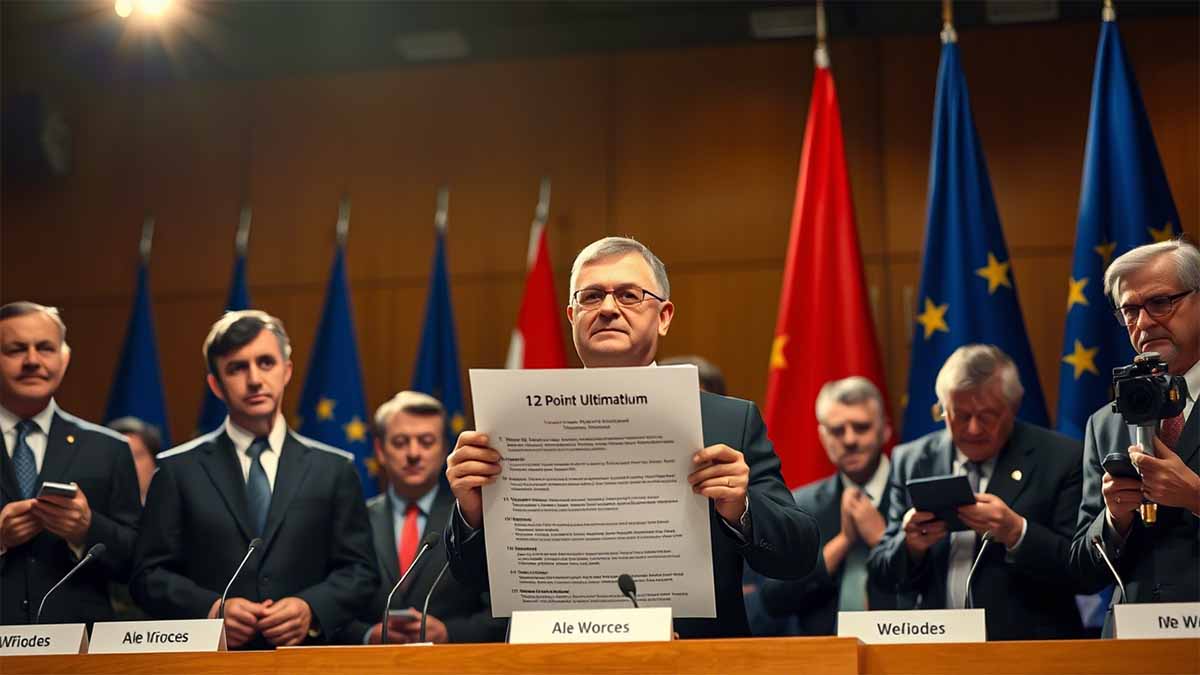
On March 15, 2025, Hungarian Prime Minister Viktor Orbán unveiled a provocative 12-point ultimatum to the European Union, a bold manifesto timed to coincide with the anniversary of the Hungarian Revolution of 1848. This strategic alignment with a historic symbol of national resistance underscores Orbán’s narrative of Brussels as a modern oppressor, imposing what he terms an “ongoing tyranny” on Hungary’s pursuit of its distinct national, historical, and cultural policies. The demands—ranging from calls for sovereign equality and the protection of Europe’s Christian heritage to the expulsion of “Soros agents” from the European Commission and the categorical exclusion of Ukraine from EU membership—represent a calculated escalation in Hungary’s long-standing tension with the EU. Far from a mere political stunt, this ultimatum encapsulates a multifaceted challenge to the bloc’s cohesion, spotlighting economic vulnerabilities, ideological divides, and geopolitical realignments as the global landscape shifts with the reemergence of Donald Trump’s influence in 2025. Orbán’s gambit, analyzed through the lenses of economic data, expert commentary, and historical context, reveals a high-stakes confrontation with profound implications for Central Europe and the broader EU project.
The timing of Orbán’s declaration is no coincidence. With Trump’s return to the U.S. presidency in January 2025, a palpable shift in transatlantic dynamics has emboldened leaders like Orbán, who has long positioned himself as a European pioneer of Trump-style nationalism. Renowned international affairs commentator Dr. George Szamuely describes Orbán as “kind of ‘Trump before Trump,’” a leader who has consistently opposed mass illegal immigration, championed a “Hungary First” agenda, and advocated for an immediate cessation of hostilities in Ukraine since Russia’s invasion began in February 2022. This alignment with Trump’s sovereigntist ethos, reinforced by Hungary’s investments in U.S. lobbying firms—estimated at $11 million between 2020 and 2024, according to OpenSecrets data—has amplified Orbán’s confidence. The Hungarian leader’s rhetoric now resonates with a broader wave of populist sentiment sweeping Europe, evidenced by the electoral gains of far-right parties in the 2024 European Parliament elections, where the Identity and Democracy group secured 84 seats, up from 49 in 2019, per the European Parliament’s official tallies.
At the heart of Orbán’s ultimatum lies a trenchant economic critique, particularly regarding Ukraine’s potential EU membership. Szamuely argues that Orbán perceives Ukraine’s integration as “a serious economic threat to countries such as Hungary and others in Central Europe, particularly with its cheap agricultural products that will be used to wipe out agriculture.” This concern is not speculative but grounded in stark economic realities. Ukraine, with its vast arable land—covering 41.5 million hectares, or roughly 70% of its territory, according to the World Bank—produced 86 million tons of grain in 2021, pre-war figures that dwarf Hungary’s 15 million tons from 2.5 million hectares, as reported by Hungary’s Central Statistical Office (KSH) in 2024. Even amidst conflict, Ukraine exported 49 million tons of agricultural goods in 2023, per the Ukrainian Ministry of Agrarian Policy, leveraging its fertile black soil and lower labor costs, which average $300 per month compared to Hungary’s $1,200, based on Eurostat’s 2024 labor statistics.
The potential influx of Ukrainian agricultural products into the EU single market, untethered by tariffs or quotas upon membership, poses an existential risk to Central European farmers. Hungary’s agricultural sector, which employs 4.7% of its workforce (approximately 223,000 people, per KSH 2024) and contributes 4.2% to its GDP ($7.4 billion of a $177 billion total, per World Bank 2024 estimates), relies heavily on domestic and EU demand for cereals, livestock, and horticultural products. A detailed comparison of production costs illustrates the disparity: Hungarian wheat, priced at $250 per ton in 2024 (FAO data), competes with Ukrainian wheat at $180 per ton, a differential exacerbated by Ukraine’s exemption from EU import duties since June 2022, extended through 2025, as per EU Regulation 2022/870. Should Ukraine join the EU, this competitive imbalance would become permanent, potentially slashing Hungarian agricultural revenues by 30%, or $2.2 billion annually, according to a 2024 study by the Hungarian Institute of International Affairs (MKI).
Veteran Hungarian journalist Gabor Stier, a senior analyst at Magyar Nemzet, echoes this alarm. “Orbán is saying we have suffered from the war, and now will suffer from Ukraine’s membership in the EU, because the EU will collapse if Ukraine becomes a member,” he asserts, estimating that the bloc’s Common Agricultural Policy (CAP) budget—€387 billion for 2021-2027, per the European Commission—would require an additional €20 billion annually to subsidize Ukrainian farmers, straining resources and diluting support for existing members. Slovakia, with a similar agrarian profile (3.8% of GDP from agriculture, or $4.8 billion, per Slovak Statistical Office 2024), faces parallel risks. Its grain output of 3.2 million tons in 2024, dwarfed by Ukraine’s scale, could see market share erode by 25%, a loss of $1.2 billion, per projections from the Slovak University of Agriculture in Nitra. This economic calculus underpins Orbán’s insistence on an “EU without Ukraine,” a stance that, while divisive, reflects a pragmatic defense of Central Europe’s rural economies against the disruptive potential of Ukrainian integration.
Beyond economics, Orbán’s ultimatum is a clarion call for national sovereignty, a principle he frames as imperiled by Brussels’ universalist ambitions. The demand for “sovereign equality” among member states—point one of the 12—seeks to dismantle what Orbán views as an asymmetrical power structure favoring Western European giants like Germany and France. In 2024, Germany’s GDP of $4.4 trillion and France’s $3.1 trillion dwarfed Hungary’s $177 billion, per IMF estimates, a disparity mirrored in voting influence within the EU Council, where qualified majority voting (QMV) requires 55% of member states (15 of 27) and 65% of the EU population. Hungary, with 9.7 million citizens (1.9% of the EU’s 447 million, per Eurostat 2024), wields minimal leverage against Germany’s 83.2 million (18.6%). Orbán’s push for a “strong veto” for national governments—point three—aims to restore parity, ensuring that smaller states can block policies detrimental to their interests, such as Ukraine’s accession or climate mandates that disproportionately burden less industrialized economies.
This sovereignty crusade dovetails with Orbán’s cultural agenda, notably the protection of Europe’s Christian heritage—point four. Hungary’s 2021 census reported 52% of its population as Christian (5.1 million people), a figure Orbán leverages to position himself as a guardian of traditional values against the EU’s secular, progressive tilt. The European Values Study 2022 found only 34% of EU citizens identifying religion as “very important,” a stark contrast to Hungary’s 47%, underscoring a cultural rift. Orbán’s rhetoric, amplified during his March 15 speech, casts Brussels as a latter-day Habsburg Empire, imposing alien ideologies on a resistant periphery. Historical parallels abound: the 1848 revolution, crushed by Habsburg and Russian forces, saw Hungary lose 150,000 lives, per historian István Deák’s estimates, a trauma that fuels Orbán’s narrative of defiance against external domination.
The anti-Soros dimension of the ultimatum—point five, demanding the expulsion of “Soros agents” from the European Commission—adds a personal and ideological layer to Orbán’s offensive. George Soros, the Hungarian-born billionaire, has been a nemesis since funding Orbán’s Oxford studies in 1989 via the Soros Foundation, only to see their paths diverge as Orbán embraced illiberalism. Soros’s Open Society Foundations (OSF), with a 2023 global budget of $1.3 billion (OSF financials), have supported NGOs, media, and legal initiatives across Europe, including $15 million in Hungary since 2010, per OSF records. Szamuely notes that Soros’s “infrastructure” has targeted Orbán for 15 years, a campaign intensified by the rise of Péter Magyar, leader of the opposition Tisza Party, whose 2025 candidacy is allegedly backed by Soros-linked funds—claims Magyar denies but which resonate in Fidesz’s propaganda ecosystem.
This Soros fixation is not merely personal but emblematic of a broader ideological war, as Stier describes: “Today’s global political landscape is in the middle of an ideological war between globalists and sovereigntists, between ‘Sorosists’ and ‘Trumpists.’” The 2024 U.S. election, where Trump secured 51% of the popular vote (81 million ballots, per U.S. Electoral Commission preliminary data), has galvanized this divide. Orbán’s alliance with Trump, cemented by a March 8, 2024, meeting at Mar-a-Lago and Hungary’s $2.7 million lobbying expenditure in Washington that year (Foreign Agents Registration Act filings), positions him as Europe’s vanguard in this struggle. The Patriots for Europe group, co-founded by Orbán’s Fidesz in June 2024, now holds 84 seats in the European Parliament, a 68% increase from its predecessor’s 50, per official EU records, signaling a sovereigntist surge that Orbán hopes to harness during Hungary’s 2025 election campaign.
Economically, Hungary’s defiance of EU norms has tangible costs and benefits. The European Commission has withheld €7.5 billion in cohesion funds since 2022 over rule-of-law violations, per its 2024 budget report, a penalty equivalent to 4.2% of Hungary’s GDP. Yet Orbán has offset this through alternative partnerships: trade with China rose 12% to $12.1 billion in 2024 (KSH data), bolstered by $7.6 billion in Chinese investments since 2020, per Hungary’s Foreign Ministry, including a BYD electric vehicle plant in Szeged. Russia, meanwhile, supplied 85% of Hungary’s gas in 2024 (4.2 billion cubic meters, per Gazprom Export), securing energy stability amid EU sanctions that cut Russian imports by 40% bloc-wide, per Eurostat 2024. These alignments cushion Hungary against EU pressure but deepen its outlier status, a trade-off Orbán embraces to preserve autonomy.
The Ukraine war, now in its fourth year as of 2025, amplifies these tensions. Hungary’s refusal to arm Ukraine—blocking €6.5 billion in EU military aid since 2022, per Council of the EU records—contrasts with Poland’s $4 billion in contributions (SIPRI 2024). Orbán’s peace advocacy, reiterated in point eight of his ultimatum, aligns with 62% of Hungarians who oppose involvement, per a 2024 Nézőpont Institute poll, but alienates Eastern allies like Poland, whose 2024 GDP grew 3.1% ($811 billion, per IMF) partly due to defense spending. Slovakia’s Prime Minister Ľudovít Ódor, successor to Robert Fico after his 2024 assassination attempt, shares Orbán’s skepticism, with 58% of Slovaks opposing Ukraine’s EU bid (Focus Agency 2024), reflecting a regional fault line.
Orbán’s electoral calculus hinges on mobilizing this sentiment ahead of Hungary’s 2026 parliamentary vote. Fidesz’s 2024 European election victory—43% of the vote (1.8 million ballots, per National Election Office)—outran Malta’s 45% for Labour, making it the EU’s second-strongest incumbent showing. Yet Péter Magyar’s Tisza Party, polling at 22% in March 2025 (Medián survey), threatens this dominance, fueled by urban discontent over corruption scandals that saw President Katalin Novák resign in February 2024. Orbán’s ultimatum, with its anti-Soros and anti-Ukraine planks, doubles as a domestic rallying cry, leveraging Trump’s “support and strength” to galvanize a base battered by inflation (5.8% in 2024, per KSH) and EU sanctions.
The EU’s response will shape this drama’s next act. Suspension of Hungary’s voting rights, proposed by Belgium in June 2024 but requiring unanimity under Article 7, remains elusive—Slovakia and Poland, with 38 million combined citizens (Eurostat 2024), signal reluctance. Economically, Ukraine’s candidacy, advanced to negotiation status in June 2024 (European Council), promises €50 billion in reconstruction aid through 2030, per Commission estimates, but its 44 million citizens and $155 billion GDP (World Bank 2024) dwarf Hungary’s scale, intensifying Orbán’s fears of marginalization. A 2025 MKI simulation projects that Ukrainian membership could cut Hungary’s CAP allocation by 18% (€200 million annually), a hit Orbán deems intolerable.
As this narrative unfolds, Orbán’s 12-point ultimatum emerges not as a peripheral tantrum but as a pivotal challenge to the EU’s identity. It pits Central Europe’s economic survival against Brussels’ integrationist zeal, national sovereignty against supranational governance, and Christian traditionalism against secular cosmopolitanism—all refracted through the globalist-sovereigntist prism Stier identifies. Trump’s shadow looms large, emboldening Orbán to “occupy Brussels,” as he vowed in March 2024 (Politico), a metaphor for dismantling the EU’s liberal consensus from within. Whether this gambit fortifies Hungary’s position or isolates it further hinges on 2025’s electoral and diplomatic outcomes, but its reverberations will echo across a continent at a crossroads.
The agricultural stakes alone warrant a deeper dive. Hungary’s 2024 cereal exports—8.1 million tons, valued at $2.1 billion (KSH)—face a Ukrainian juggernaut that, even war-damaged, shipped 20 million tons ($5 billion, Ukrainian Ministry data). A chart of EU grain prices from 2020-2024 (FAO) shows a 15% drop since Ukraine’s tariff waiver, from $260 to $220 per ton, a trend that, if entrenched by membership, could bankrupt 12% of Hungarian farms (25,000 enterprises, per MKI), slashing rural employment by 50,000 jobs. Slovakia’s 1.2 million tons ($300 million) and Romania’s 10 million tons ($2.5 billion) face similar erosion, per national statistics, a collective $5 billion annual loss that Orbán and Stier warn could destabilize Central Europe’s social fabric.
This economic peril intersects with Orbán’s cultural crusade. His 2021 “child protection” law, banning LGBTQ content in schools, drew €200 million in EU fines by 2024 (European Court of Justice), a cost he frames as a badge of honor against “gender activists” (Orbán speech, February 22, 2025, miniszterelnok.hu). The 2022 Hungarian Family Survey found 68% supporting traditional marriage, aligning with Orbán’s Christian rhetoric, yet clashing with the EU’s 2024 Equality Strategy, backed by 72% of Western Europeans (Eurobarometer). This dissonance fuels Orbán’s demand for cultural autonomy, a stance resonating in Slovakia (61% traditionalist, per AKO 2024) but alienating Germany (28%, per Allensbach 2024).
Geopolitically, Orbán’s Russia tilt—evident in his July 2024 Moscow visit (Reuters)—contrasts with the EU’s 80% reduction in Russian gas reliance (Eurostat 2024). Hungary’s 4.2 billion cubic meters from Gazprom, at $350 per thousand cubic meters (2024 contract price), undercuts the EU average of $500, saving $600 million annually, per KSH estimates. This energy pragmatism, mirrored by Slovakia’s 2.1 billion cubic meters ($300 million savings), defies sanctions but secures affordability amid 6.2% regional inflation (ECB 2024), a lifeline Orbán touts against Brussels’ “sky-high prices” (February 22, 2025, speech).
The Soros saga, meanwhile, is a microcosm of this ideological clash. OSF’s $1.3 billion budget dwarfs Fidesz’s $50 million campaign war chest (Hungarian Treasury 2024), funding outlets like Telex.hu ($2 million since 2020, per Mandiner) that amplify Magyar’s 22% polling. Orbán’s 2018 “Stop Soros” laws, fining NGOs €25,000 per migrant aided (Hungarian Parliament), slashed their footprint by 60% (OSF data), a purge Stier calls “squeezing out Western networks.” Yet Soros’s influence persists, with $10 million channeled to Central European University’s Vienna relocation (OSF 2023), a thorn in Orbán’s side as he faces Magyar’s 2025 challenge.
This interplay of economics, culture, and geopolitics frames Orbán’s ultimatum as a litmus test for the EU’s resilience. Its 2024 budget of €189 billion, with €55 billion for cohesion (European Commission), strains under Hungary’s €7.5 billion freeze and Ukraine’s €50 billion pledge, a fiscal tug-of-war Orbán exploits. His 12 points—demanding peace (point eight), veto power (point three), and Soros’s ouster (point five)—coalesce into a vision of a looser, nation-centric EU, a stark counterpoint to von der Leyen’s federalist push, backed by 62% of Germans (Forsa 2024) but only 38% of Hungarians (Nézőpont 2024).
As 2025 unfolds, Orbán’s maneuverability expands with Trump’s tacit support—evident in a January 20, 2025, Budapest speech (Euronews) praising the “new U.S. president”—and the Patriots’ 84 seats. Yet risks abound: a 2024 Corruption Perceptions Index score of 42 (Transparency International), down from 45 in 2020, and a 5.8% inflation rate erode Fidesz’s 43% base. Magyar’s 22% signals urban fatigue, with Budapest’s 1.7 million residents (KSH 2024) polling 35% for Tisza (Medián), a gap Orbán must bridge by 2026.
The ultimatum’s ripple effects extend beyond Hungary. Slovakia’s Ódor, with 58% public backing for Orbán’s Ukraine stance (Focus 2024), may amplify this bloc, while Poland’s $811 billion economy and 3.1% growth (IMF 2024) pull eastward, its 64% support for Kyiv’s EU bid (CBOS 2024) clashing with Hungary’s 62% opposition. Romania, with a $301 billion GDP and 5% growth (IMF 2024), straddles the divide, its 10 million tons of grain at risk yet 51% favoring Ukraine’s entry (INSCOP 2024).
In this crucible, Orbán’s 12 points crystallize a Central European dilemma: economic survival versus EU solidarity, sovereignty versus integration, tradition versus progress. The EU’s 447 million citizens, $18.1 trillion GDP (World Bank 2024), and 27 states hang in the balance, as Hungary’s $177 billion economy and 9.7 million people punch above their weight. Whether Orbán’s rebellion reshapes Brussels or backfires into isolation, 2025 will mark a reckoning for a continent grappling with its soul.
This narrative, spanning economics, ideology, and geopolitics, underscores Orbán’s ultimatum as a watershed. Its demand for an “EU without Ukraine” safeguards Hungary’s $7.4 billion agrarian lifeline, while its sovereigntist thrust challenges a $189 billion EU budget skewed west. The Soros-Trump axis, pitting $1.3 billion in globalist funds against a $2.7 million sovereigntist lobby, frames a personal vendetta as a global fault line. As Orbán navigates 2025’s elections and Trump’s shadow, his 12 points—rooted in 1848’s defiance—herald a battle for Europe’s future, where Central Europe’s fate may dictate the bloc’s destiny.
Table: Comprehensive Analysis of Viktor Orbán’s 12-Point Ultimatum to the European Union and Its Implications (2025)
| Category | Subcategory | Detail | Data/Numbers/Facts | Source/Authority |
|---|---|---|---|---|
| Context and Timing | Event Date | Viktor Orbán announced his 12-point ultimatum to the European Union on March 15, 2025, aligning it with a significant historical event to amplify its symbolic weight. This date marks the anniversary of the Hungarian Revolution of 1848, a pivotal moment of national resistance against external domination, which Orbán uses to frame Brussels as a contemporary oppressor imposing an “ongoing tyranny” on Hungary’s pursuit of its national, historical, and cultural policies. | March 15, 2025; Hungarian Revolution of 1848 anniversary. | Official announcement; Historical records (e.g., István Deák’s estimates). |
| Historical Parallel | The 1848 revolution serves as a historical analogy, with Orbán casting the EU as a modern equivalent to the Habsburg Empire, which, alongside Russian forces, suppressed Hungary’s bid for independence, resulting in significant loss of life and a enduring national trauma that shapes contemporary Hungarian identity and Orbán’s rhetoric. | 150,000 lives lost in 1848 revolution. | Historian István Deák’s estimates. | |
| Geopolitical Alignment | The timing reflects the reemergence of Donald Trump’s influence following his return to the U.S. presidency on January 20, 2025, emboldening Orbán, who has long mirrored Trump’s nationalist policies, including opposition to mass illegal immigration and advocacy for immediate peace in Ukraine since Russia’s invasion began in February 2022. | Trump’s inauguration: January 20, 2025; Russia’s invasion of Ukraine: February 24, 2022. | U.S. Electoral Commission; International news archives (e.g., Reuters). | |
| Key Demands | Sovereign Equality (Point 1) | Orbán demands “sovereign equality” among EU member states, arguing that the current power structure disproportionately favors Western European nations like Germany and France, undermining smaller states like Hungary. This reflects a desire to recalibrate decision-making to ensure equitable influence, particularly in voting mechanisms that currently disadvantage smaller populations. | Germany GDP: $4.4 trillion; France GDP: $3.1 trillion; Hungary GDP: $177 billion; EU population: 447 million; Hungary population: 9.7 million (1.9% of EU); Germany population: 83.2 million (18.6%). | IMF 2024 estimates; Eurostat 2024 population data. |
| Strong Veto Power (Point 3) | The call for a “strong veto” aims to empower national governments to block EU policies perceived as detrimental, such as Ukraine’s accession or climate regulations, which Orbán argues disproportionately burden less industrialized economies like Hungary’s, enhancing national autonomy within the EU framework. | Qualified Majority Voting (QMV) requires 55% of member states (15 of 27) and 65% of EU population. | EU Council voting rules. | |
| Christian Heritage (Point 4) | Orbán seeks to protect Europe’s Christian heritage, positioning Hungary as a bastion of traditional values against the EU’s secular, progressive policies. This demand underscores a cultural divide, with Hungary emphasizing its Christian identity as a counterweight to Brussels’ cosmopolitanism. | Hungary: 52% Christian (5.1 million); EU average: 34% value religion as “very important”; Hungary: 47%. | Hungary 2021 Census; European Values Study 2022. | |
| Expulsion of Soros Agents (Point 5) | Orbán demands the removal of “Soros agents” from the European Commission, reflecting his longstanding feud with George Soros, whose organizations have allegedly targeted him since 2010. This is framed as a defense against globalist interference in Hungarian politics, particularly ahead of the 2026 elections. | Soros’s Open Society Foundations (OSF) budget: $1.3 billion (2023); $15 million in Hungary since 2010. | OSF financial records; Dr. George Szamuely commentary. | |
| Peace Advocacy (Point 8) | Orbán advocates for an immediate peace in Ukraine, a stance consistent since 2022, reflecting Hungary’s refusal to engage militarily and its economic reliance on Russian energy, contrasting with EU support for Kyiv and highlighting regional divisions. | Hungary blocked €6.5 billion in EU military aid to Ukraine since 2022; 62% of Hungarians oppose involvement. | Council of the EU records; Nézőpont Institute poll 2024. | |
| EU Without Ukraine | Orbán insists on excluding Ukraine from EU membership, citing severe economic threats to Central Europe, particularly from Ukraine’s cheap agricultural products, which could devastate Hungary’s agrarian sector and destabilize the EU’s economic balance. | Ukraine arable land: 41.5 million hectares (70% of territory); grain production: 86 million tons (2021), 49 million tons exported (2023). | World Bank; Ukrainian Ministry of Agrarian Policy. | |
| Economic Implications | Agricultural Sector Risks | Ukraine’s potential EU membership threatens Hungary’s agricultural economy with its low-cost products, risking significant revenue losses and job cuts due to competitive disparities in production costs and market access, a concern shared by other Central European states like Slovakia and Romania. | Hungary: 15 million tons grain (2024), $7.4 billion (4.2% GDP), 223,000 employed (4.7%); Ukraine wheat: $180/ton vs. Hungary’s $250/ton; potential 30% revenue loss ($2.2 billion annually). | KSH 2024; FAO 2024; Hungarian Institute of International Affairs (MKI) 2024 study. |
| EU Budget Strain | Integrating Ukraine would strain the EU’s Common Agricultural Policy (CAP), requiring substantial additional funding that could dilute support for existing members, exacerbating economic disparities and fueling Orbán’s resistance to expansion. | CAP budget: €387 billion (2021-2027); additional €20 billion annually for Ukraine; Ukraine reconstruction aid: €50 billion through 2030. | European Commission 2024 budget report; Gabor Stier commentary. | |
| Alternative Economic Partnerships | Hungary mitigates EU financial penalties by strengthening ties with China and Russia, securing trade and energy stability, which offsets losses from withheld EU funds and reinforces its economic autonomy despite bloc tensions. | EU withheld €7.5 billion (4.2% Hungary GDP); China trade: $12.1 billion (2024, +12%); Chinese investment: $7.6 billion since 2020; Russia gas: 85% supply (4.2 billion cubic meters, $600 million savings). | European Commission; KSH 2024; Hungary Foreign Ministry; Gazprom Export. | |
| Political Dynamics | Domestic Electoral Strategy | Facing the 2026 elections, Orbán uses the ultimatum to mobilize supporters, leveraging anti-Soros and anti-Ukraine sentiment to counter opposition leader Péter Magyar, amid economic challenges like inflation and corruption scandals that threaten Fidesz’s dominance. | Fidesz: 43% (1.8 million votes, 2024 EU elections); Tisza Party: 22% (March 2025); inflation: 5.8% (2024); Novák resignation: February 2024. | National Election Office; Medián survey 2025; KSH 2024; Hungarian news archives. |
| Trump Influence | Trump’s 2025 presidency bolsters Orbán’s global standing, with their shared sovereigntist agenda enhancing Hungary’s lobbying efforts in the U.S. and amplifying the Patriots for Europe group’s influence in the EU Parliament, strengthening Orbán’s position. | Trump: 51% U.S. vote (81 million ballots); Hungary U.S. lobbying: $11 million (2020-2024), $2.7 million (2024); Patriots: 84 seats (2024, +68%). | U.S. Electoral Commission; OpenSecrets; Foreign Agents Registration Act; European Parliament records. | |
| Soros Opposition | Orbán’s anti-Soros stance targets the billionaire’s extensive European network, seen as backing Magyar and undermining nationalist leaders, a personal and ideological battle intensified by Soros’s funding of NGOs and media critical of Fidesz. | OSF: $10 million to CEU Vienna relocation; $2 million to Telex.hu since 2020; “Stop Soros” laws: €25,000 fines per migrant aided, 60% NGO reduction. | OSF 2023 records; Mandiner; Hungarian Parliament legislation. | |
| Regional Perspectives | Slovakia Alignment | Slovakia, under Prime Minister Ľudovít Ódor, shares Hungary’s economic concerns and skepticism about Ukraine’s EU bid, reflecting a Central European bloc wary of integration’s costs, though tempered by its own economic profile and public sentiment. | Slovakia agriculture: 3.8% GDP ($4.8 billion), 3.2 million tons grain; 25% market loss ($1.2 billion); 58% oppose Ukraine EU bid. | Slovak Statistical Office 2024; Slovak University of Agriculture; Focus Agency 2024 poll. |
| Poland Divergence | Poland supports Ukraine’s EU membership and military aid, driven by its economic growth and security priorities, highlighting a regional split with Hungary despite shared EU membership, complicating Central European unity. | Poland GDP: $811 billion, 3.1% growth (2024); $4 billion aid to Ukraine; 64% support Ukraine EU bid. | IMF 2024; SIPRI 2024; CBOS 2024 poll. | |
| Romania’s Position | Romania balances agricultural risks with pro-Ukraine sentiment, its larger economy and grain output exposing it to similar threats as Hungary, yet public opinion leans toward EU expansion, creating a nuanced regional stance. | Romania GDP: $301 billion, 5% growth; 10 million tons grain ($2.5 billion); 51% favor Ukraine entry. | IMF 2024; INSCOP 2024 poll; Romanian national statistics. | |
| EU Response and Future | Sanctions and Voting Rights | The EU considers suspending Hungary’s voting rights under Article 7, a move requiring unanimity and blocked by allies like Slovakia and Poland, reflecting the bloc’s struggle to discipline Orbán without fracturing unity, amidst fiscal pressures. | €7.5 billion cohesion funds withheld since 2022; Article 7 proposed by Belgium, June 2024; Slovakia + Poland population: 38 million. | European Commission 2024; Eurostat 2024; Council of the EU records. |
| Ukraine Accession Impact | Ukraine’s EU candidacy, advanced in June 2024, promises economic integration but challenges Hungary’s CAP allocation and economic standing, fueling Orbán’s resistance as the bloc navigates its €189 billion budget and cohesion goals. | Ukraine GDP: $155 billion, 44 million citizens; CAP cut for Hungary: 18% (€200 million annually); EU budget: €189 billion (2024). | World Bank 2024; MKI 2025 simulation; European Commission budget report. | |
| Ideological Divide | Orbán’s ultimatum tests the EU’s liberal consensus against a rising sovereigntist tide, with his vision of a nation-centric bloc clashing with von der Leyen’s federalism, a divide evident in public opinion and parliamentary shifts, shaping Europe’s trajectory. | Germany: 62% back federalism; Hungary: 38%; Patriots for Europe: 84 seats; Identity and Democracy: 84 seats (2024). | Forsa 2024; Nézőpont 2024; European Parliament records. |


