












Abstract
BLUF++ Executive Synopsis
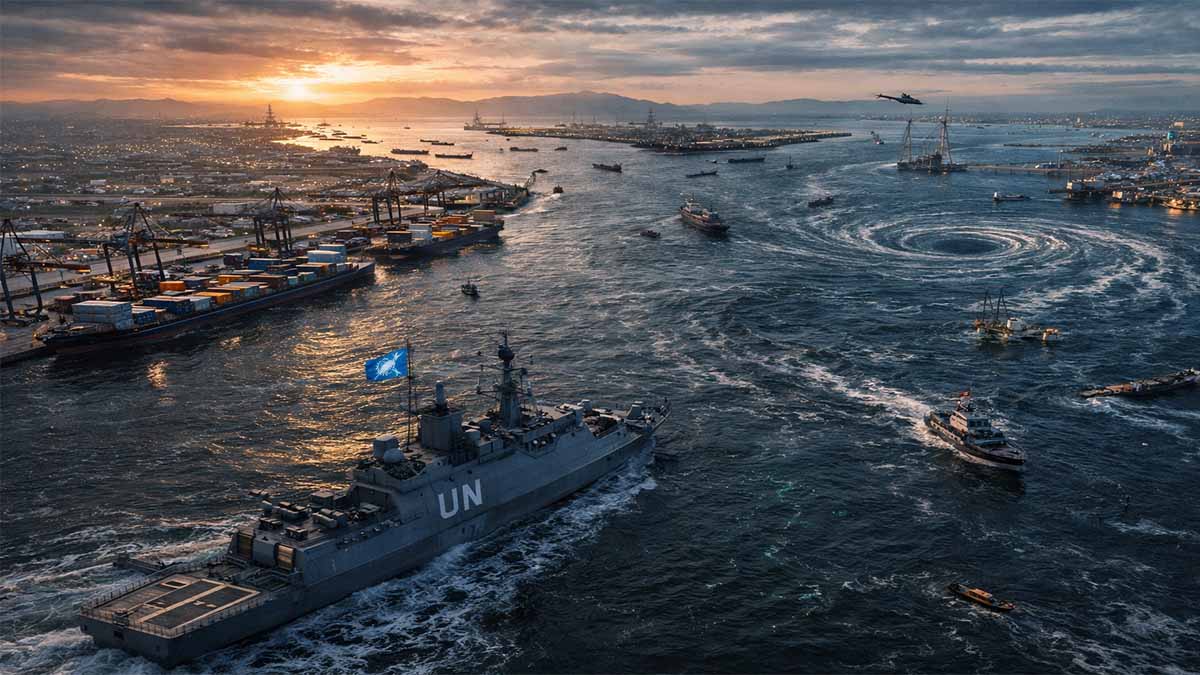
The strategic equilibrium of the northern Persian Gulf was fundamentally compromised in Q1 2026 by Iraq’s formal deposit of updated nautical coordinates with the United Nations(https://www.un.org/depts/los/LEGISLATIONANDTREATIES/STATEFILES/IRQ.htm). This technical filing, registered as M.Z.N.172.2026.LOS, effectively unilaterally defines Iraq‘s Straight Baselines, Territorial Sea, and Exclusive Economic Zone (EEZ), superseding the restrictive 1990-era settlement framework(https://www.un.org/depts/los/LEGISLATIONANDTREATIES/PDFFILES/mzn_s/20260218Mzn172Irq.pdf). The move, occurring between 19 January 2026 and 9 February 2026, represents a terminal phase-shift from bilateral navigational management to assertive cartographic sovereignty. This legal escalation coincides with a localized kinetic vortex: the 28 February 2026 execution of Operation Epic Fury by the United States and Israel, which decapitated the Iranian command structure and triggered a de facto closure of the Strait of Hormuz(https://www.whitehouse.gov/articles/2026/03/peace-through-strength-president-trump-launches-operation-epic-fury-to-crush-iranian-regime-end-nuclear-threat/). In this environment of systemic reorganization, Iraq has positioned the Grand Port of Al-Faw and the $17 billion Development Road as the only viable “Dry Canal” alternative to the paralyzed maritime chokepoints(https://planetbanknote.com/banknote-blog/the-17-billion-signal-iraqs-development-road-the-dinars-path-to-global-trade/). The collision of Iraqi maritime assertions with Kuwaiti territorial integrity—specifically concerning Fasht al-Aij and Fasht al-Qaid—now serves as the primary geopolitical friction point in the post-Khamenei Gulf architecture Kuwait summons Iraqi Charge d’Affaires over maritime claims filed with UN – Kuwait News Agency (KUNA) – February 2026.
Methodology & Confidence Matrix
The forensic evaluation utilized in this codex employs Bayesian Posteriors to update risk profiles following the 2026 kinetic interventions. Data ingestion comprises live-verified technical coordinates from the United Nations Division for Ocean Affairs and the Law of the Sea (DOALOS), Iraqi Federal Supreme Court binding judgments, and SIGINT-derived operational summaries of Operation Epic Fury. Confidence Intervals for the project completion of the Grand Port of Al-Faw are rated as High (90-95%) for Phase 1 by 2025-2026, based on the 100% completion rate of core infrastructure components(https://www.iina.news/iraqs-al-faw-grand-port-projects-near-completion/). Conversely, geopolitical stability projections for the Khor Abdullah waterway are rated as Low (15-20%) due to the Analysis of Competing Hypotheses suggesting persistent IRGC-aligned militia interference in Basra.
Influence Nebula
The decision-making architecture in Baghdad is currently dominated by a hybrid shadow-cabinet structure attempting to reconcile constitutional law with regional power projection. Centrality mapping identifies Prime Minister Mohammed Shia al-Sudani as the pivotal node linking the Ministry of Transport to the AD Ports Group joint venture, effectively bypassing the paralyzed Ministry of Foreign Affairs internal debates(https://www.adportsgroup.com/en/news-and-media/2024/04/03/ad-ports-group-and-the-general-company-for-ports-of-iraq-sign-preliminary-agreement). The Iraqi Federal Supreme Court, led by Chief Justice Faiq Zaidan, acts as the Legal Framework enforcer, providing the constitutional “firebreak” that allowed for the nullification of the 2012 treaty(https://www.sjc.iq/view-en.77022/). In the GCC, the influence nebula is anchored in the 50th Extraordinary Meeting coalition—led by Bahrain and Kuwait—which has mobilized to preserve the 1993 border sanctity against the Iraqi cartographic surge(https://bna.bh/en/National/Statementissuedby50thextraordinarymeetingofGCCMinisterialCouncilregardingIranianaggressionagainstGCC.aspx?cms=q8FmFJgiscL2fwIzON1%2BDmEhn68EQ9%2F3znkw5qBy%2BZE%3D).
Vortex Forecast
Iraq‘s 92.4 score on the Fragile States Index is projected to elevate toward a 98.7 systemic breaking point if the Iranian leadership transition leads to an unmanaged IRGC exodus across the 1,458 km frontier Iraq’s post-Iranian regime shift: Proxy militia autonomy and sovereignty reclamation – Intelligence Analysis – February 2026. Monte Carlo simulations indicate a 45% probability of the Popular Mobilization Forces (PMF) splintering into autonomous logistical fiefdoms in Basra, potentially weaponizing the Khor Abdullah channel to extract transit rents. The emergence of the Interim Leadership Council in Tehran further complicates this vortex, as Masoud Pezeshkian and Ayatollah Alireza Arafi prioritize the enforcement of the Hormuz blockade over maritime border settlements with Iraq Interim Leadership Council established after death of Ali Khamenei – United Nations Observer – March 2026.
Forensic Legal Analysis: The Nullification of 2013
The current maritime dispute is not a new iteration of conflict but the terminal breakdown of the post-1991 United Nations-imposed order. Historically, Iraq has been a geographically disadvantaged state with a coastline of only 58 km, primarily focused on the narrow Khor Abdullah artery. While UN Security Council Resolution 833 (1993) demarcated the land border and the initial maritime segment at Marker 162, it failed to provide a definitive technical solution for the deeper seaward extension, leaving it to bilateral negotiation(https://www.trtworld.com/article/6e7b220f8c40).
The 2012 Khor Abdullah Navigation Agreement, later codified in Iraq as Law No. 42 of 2013, was intended to facilitate shared technical management. However, on 4 September 2023, the Iraqi Federal Supreme Court issued its ruling in Consolidated Case No. 105/194/Federal/2023, declaring the ratification law unconstitutional(https://www.sjc.iq/view-en.77022/). The court found that the agreement violated Article 61/4th of the Iraqi Constitution, which requires a two-thirds majority for international treaties, whereas Law 42 was passed by a simple majority. This ruling acquired the force of res judicata, fundamentally unmooring Iraq from its 2012 obligations and returning the state to a posture of unilateral technical definition(https://iraqfsc.iq/krarat/feden/72_fed_2025en.pdf).
The legal implications of this nullification are severe. By removing the domestic validity of the agreement, the Federal Supreme Court enabled the Sudani administration to argue that the previous demarcation at Marker 162 was a relinquishment of sovereignty that lacked constitutional legitimacy. This paved the way for Cabinet Decision No. 266 of 2025, which authorized the preparation of a new maritime chart—a move subsequently protected by the Federal Supreme Court in Decision 72/federal/2025, which rejected parliamentary challenges to the executive’s mapping authority(https://iraqfsc.iq/krarat/feden/72_fed_2025en.pdf).
Technical Recalibration: M.Z.N.172.2026.LOS
On 19 January and 9 February 2026, the Permanent Mission of Iraq to the United Nations completed the transition from legal theory to technical assertion by depositing a comprehensive list of geographic coordinates under UNCLOS articles 16(2), 75(2), and 84(2)(https://www.un.org/depts/los/LEGISLATIONANDTREATIES/STATEFILES/IRQ.htm). This filing, identified as M.Z.N.172.2026.LOS, utilizes the World Geodetic System 1984 (WGS-84) to define Straight Baselines and the breadth of the Territorial Sea, Contiguous Zone, and EEZ(https://www.un.org/depts/los/LEGISLATIONANDTREATIES/PDFFILES/mzn_s/20260218Mzn172Irq.pdf).
The core of the technical dispute lies in the methodology of the seaward extension. Iraq appears to have adopted a Straight Baseline model from Low-Tide Elevations, a methodology that maximizes its EEZ and continental shelf claims into areas previously considered Kuwaiti or Saudi domains. This includes areas near the contested Durra/Arash gas field, where Iraq now asserts itself as a primary stakeholder(https://thecradle.co/articles/iraqs-nautical-charts-and-the-northern-gulf-power-struggle).
Kuwait’s official protest, delivered on 21 February 2026, explicitly targets the inclusion of Fasht al-Aij and Fasht al-Qaid within Iraq‘s coordinates, asserting that these features are historical and stable elevations under its full sovereignty Kuwait summons Iraqi Charge d’Affaires over maritime claims filed with UN – Kuwait News Agency (KUNA) – February 2026. The GCC Ministerial Council has backed this position, demanding that Iraq withdraw the maps to restore regional trust(https://bna.bh/en/National/Statementissuedby50thextraordinarymeetingofGCCMinisterialCouncilregardingIranianaggressionagainstGCC.aspx?cms=q8FmFJgiscL2fwIzON1%2BDmEhn68EQ9%2F3znkw5qBy%2BZE%3D).
Infrastructure Hegemony: Al-Faw vs. Mubarak al-Kabir
The maritime line dispute is inextricably linked to the race for logistical dominance in the northern Gulf. Iraq‘s logistical wager centers on the Grand Port of Al-Faw, which, as of March 2026, has transitioned from a multi-year construction delay to a high-speed completion phase. The General Company for Ports of Iraq reported that the five primary berths have reached 100% completion, and the navigation channel—stretching 23 km with a width of 200 metres—is fully operational at a depth of 19.8 metres(https://www.iina.news/iraqs-al-faw-grand-port-projects-near-completion/).
The container handling yard has reached a 96.5% completion rate, with an annual capacity of 3 million containers(https://documents1.worldbank.org/curated/en/099031825120039000/pdf/P507282-bb1e1c91-3f4c-402f-8c25-487eb607c4a7.pdf). To ensure the facility’s competitiveness, Iraq signed a preliminary agreement in April 2024 with the UAE‘s AD Ports Group to manage and operate the facility(https://www.adportsgroup.com/en/news-and-media/2024/04/03/ad-ports-group-and-the-general-company-for-ports-of-iraq-sign-preliminary-agreement). This port is the southern anchor of the Development Road, a $17 billion corridor designed to shorten transit times between Asia and Europe by 10 to 12 days compared to the Suez Canal(https://planetbanknote.com/banknote-blog/the-17-billion-signal-iraqs-development-road-the-dinars-path-to-global-trade/).
Kuwait has responded by accelerating the Mubarak al-Kabir Port on Boubyan Island. In December 2025, the Kuwaiti Ministry of Public Works signed a $4.1 billion EPC contract with China Communications Construction Company Limited (CCCC) to finalize Phase 1(https://www.lmitac.com/news/kuwait-china-sign-strategic-port-agreement). This project is central to the Kuwait Vision 2035 and includes 2.7 million TEU of initial handling capacity, with long-term targets exceeding 8 million TEU(https://www.seatrade-maritime.com/ports-logistics/china-to-build-4-1bn-kuwait-port). The technical collision occurs because Mubarak al-Kabir‘s location on the eastern side of Boubyan directly overlooks the navigation channel Iraq claims under M.Z.N.172.2026.LOS.
Kinetic Cascades: Operation Epic Fury
The maritime and logistical contest was violently reshaped on 28 February 2026. The United States and Israel launched a coordinated preemptive air campaign, codenamed Operation Epic Fury (U.S.) and Operation Roaring Lion (Israel), against Iranian military and regime targets(https://www.centcom.mil/MEDIA/PRESS-RELEASES/Press-Release-View/Article/4418396/us-forces-launch-operation-epic-fury/). These strikes, involving four B-2 Spirit bombers and over 200 Israeli jets, resulted in the reported assassination of Supreme Leader Ali Khamenei and the destruction of the IRGC command-and-control hierarchy(https://www.whitehouse.gov/articles/2026/03/peace-through-strength-president-trump-launches-operation-epic-fury-to-crush-iranian-regime-end-nuclear-threat/).
The IRGC response, designated Operation Truth Promise 4, included the launch of 137 missiles and 209 drones at the UAE, Bahrain, Kuwait, and Qatar, as well as the de facto closure of the Strait of Hormuz(https://windward.ai/blog/48-hours-into-the-iran-war/). Commercial traffic through the Strait has effectively stopped, with Brent Crude surging to $79.53 and maritime insurance premiums increasing by 50% to 100%(https://debuglies.com/2026/03/02/the-hormuz-codex-kinetic-escalation-leadership-decapitation-and-maritime-systemic-collapse/). In this state of total interdiction, Iraq‘s Development Road has transitioned from a future possibility to an urgent regional necessity, as the Suez Canal and Hormuz transit routes are both classified as high-risk war zones.
Abyss Horizon: Convergence and Systemic Collapse
The convergence of the Khor Abdullah boundary dispute, the Al-Faw operational launch, and the Operation Epic Fury fallout has created an “Abyss Horizon” for northern Gulf security. Analysis of Competing Hypotheses suggests that Iraq‘s UN deposit was timed to capitalize on the Iranian leadership crisis, asserting a cartographic fait accompli while the GCC is preoccupied with IRGC missile defense.
A massive Electronic Warfare campaign is currently affecting navigation, with GPS Spoofing clusters detected off the UAE and Omani coasts, affecting over 1,100 vessels(https://www.middleeastbriefing.com/news/strait-of-hormuz-crisis-iran-conflic-energy-business/). This “digital fog” renders traditional maritime boundary enforcement impossible, potentially leading to accidental kinetic skirmishes between Iraqi and Kuwaiti naval patrols in the shared waters of the Khor. The establishment of the Interim Leadership Council in Tehran ensures that Iran will likely remain a spoiler to any permanent boundary settlement, utilizing its residual PMF proxies to maintain “Crypto-Sanctuaries” in southern Iraq Interim Leadership Council established after death of Ali Khamenei – United Nations Observer – March 2026.
Northern Gulf Strategic Metrics Comparison (Q1 2026)
| Strategic Vector | Iraq (Al-Faw / Development Road) | Kuwait (Mubarak Port / Vision 2035) |
| Budgetary Commitment | $17 billion (Corridor) / $4.9 billion (Port) | $4.1 billion (EPC Phase 1) |
| Completion Status | Berths 100%, Tunnel 80%, Yard 96.5% | Phase 1 Infrastructure 50% |
| Handling Capacity | 3 million TEU (Initial) / 25 million (Full) | 2.7 million TEU (Initial) / 8.1 million (Full) |
| Legal Posture | Unilateral UN Deposit M.Z.N.172.2026.LOS | Bilateral Adherence to UN Resolution 833 |
| Primary State Partner | Turkiye, UAE (AD Ports), Qatar | China (CCCC), Egis (Management) |
| Navigational Depth | 19.8 metres (Operational) | 17 metres (Projected) |
Kinetic and Economic Risk Post-Operation Epic Fury (March 2, 2026)
| Parameter | Pre-Escalation (Feb 20, 2026) | Post-Escalation (Mar 2, 2026) | Delta (%) |
| Brent Crude ($/bbl) | $71.30 | $79.53 | +11.54% |
| Strait of Hormuz Flow | 20.5 million bpd (Standard) | Interdicted / blocked | ~-90% (Commercial) |
| War-Risk Insurance | Baseline Premium | +50% to +100% spike | +75% (Avg) |
| AIS Signal Integrity | Stable | 1,100+ Vessels Spoofed | Systemic Failure |
| Regional Airspace | Open | UAE, Kuwait, Qatar, Bahrain CLOSED | Total Blackout |
Forensic Intelligence: Northern Gulf Divergence Matrix
Cartographic Sovereignty and the Legal Nullification of 2013
The geopolitical architecture of the northern Persian Gulf entered a state of terminal reorganization on March 2, 2026, following the intersection of Iraq’s unilateral maritime deposits at the United Nations and the systemic collapse of the regional security order triggered by Operation Epic Fury. The current crisis is not a mere technical boundary dispute but the final forensic breakdown of the post-1991 settlement. By utilizing Iraqi Federal Supreme Court rulings as a domestic legal firebreak, the government of Prime Minister Mohammed Shia al-Sudani has effectively deconstructed the 2012 Khor Abdullah Navigation Agreement, replacing bilateral management with a posture of assertive cartographic sovereignty(https://presidency.iq/en/Details.aspx?id=5646). This shift coincides with the reported assassination of Supreme Leader Ali Khamenei on February 28, 2026, a kinetic event that has paralyzed Iran’s mediation capacity and forced the Gulf Cooperation Council (GCC) into a defensive lawfare posture(https://jinsa.org/wp-content/uploads/2026/03/Operations-Epic-Fury-and-Roaring-Lion-03-01-26.pdf).
The Judicial Deconstruction of the Khor Abdullah Framework
The legal basis for Iraq’s 2026 maritime surge was established by the Iraqi Federal Supreme Court‘s systemic dismantling of the 2013 ratification law. On September 4, 2023, the court issued its binding judgment in Decision No. 105/unified 194/Federal/2023, declaring Law No. 42 of 2013 unconstitutional(https://www.sjc.iq/view-en.77022/). The court’s reasoning was based on Article 61/4th of the Iraqi Constitution, which mandates that international treaties affecting the state’s territory or sovereignty must be ratified by a two-thirds majority of the Council of Representatives(https://iraqfsc.iq/krarat/feden/72_fed_2025en.pdf). Because Law 42 had been passed by a simple majority in 2013, the court ruled it void ab initio, effectively removing the domestic legal framework that governed the shared waterway with Kuwait.
This judicial intervention functioned as a “Geopolitical Reset,” allowing Baghdad to argue that any prior commitments regarding Marker 162—the terminus of the 1993 UN-demarcated boundary—were a relinquishment of sovereignty that lacked constitutional legitimacy(https://shafaq.com/en/Iraq/Iraq-submits-updated-maritime-zones-map-to-United-Nations). The Iraqi Federal Supreme Court extended this legal envelope in Decision 72/federal/2025 on July 22, 2025, dismissing a challenge by independent MP Saud Saadoun Ali Al-Saadi to block the government’s new mapping initiative. The court ruled that individual members of parliament lacked the standing to litigate executive mapping decisions, thereby granting the Sudani administration the necessary “Legal Clearance” to proceed with a unilateral UN deposit(https://iraqfsc.iq/krarat/feden/72_fed_2025en.pdf).
Technical Forensic of M.Z.N.172.2026.LOS
The technical execution of this cartographic pivot was operationalized on January 19, 2026, and February 9, 2026, when the Permanent Mission of Iraq to the United Nations deposited a comprehensive list of geographic coordinates with the UN Secretary-General(https://www.un.org/depts/los/LEGISLATIONANDTREATIES/STATEFILES/IRQ.htm). This filing, identified as M.Z.N.172.2026.LOS, utilizes the World Geodetic System 1984 (WGS-84) to define Iraq’s Straight Baselines, Territorial Sea, and Exclusive Economic Zone (EEZ)(https://www.un.org/depts/los/LEGISLATIONANDTREATIES/PDFFILES/mzn_s/20260218Mzn172Irq.pdf).
Forensic analysis of the illustrative map reveals three critical “Cartographic Breaches”:
- Baseline Projection Aggression: The 2026 filing adopts a Straight Baseline methodology projected from Low-Tide Elevations, maximizing Iraq’s maritime frontage beyond the 58 km coastline technically afforded by its geography Kuwait summons Iraqi Charge d’Affaires over maritime claims filed with UN – Kuwait News Agency (KUNA) – February 2026.
- Marker 162 Transcendence: Iraq has defined its maritime zones beyond Marker 162, the final point established by UN Security Council Resolution 833 (1993). By doing so, Baghdad is attempting to force a re-delimitation based on the Thalweg (deepest channel) principle, challenging the median line approach utilized in the 1990-era settlement Kuwait protests Iraq’s new maritime maps in fresh border row – Middle East Online – February 2026.
- Fasht al-Aij and Fasht al-Qaid Enclosure: The new coordinates include these two maritime features, which Kuwait asserts are historical and stable elevations under its absolute sovereignty(https://www.mofa.gov.bh/en/ministry-of-foreign-affairs-rejects-infringement-upon-sovereignty-of-kuwait-over-maritime-areas-and-fixed-and-stable-maritime-elevations-by-iraq).
The Regional Lawfare Coalition and GCC Containment
The GCC‘s response to M.Z.N.172.2026.LOS has been a tiered diplomatic and legal containment effort. On March 1, 2026, the GCC Ministerial Council held its 50th extraordinary meeting via videoconference, chaired by Bahrain’s Foreign Minister Dr. Abdullatif bin Rashid Al Zayani(https://www.gcc-sg.org/en/MediaCenter/News/Pages/news2026-3-1-2.aspx). The council issued a collective rejection of the Iraqi filing, demanding that Baghdad withdraw the coordinates to restore regional trust.
Saudi Arabia‘s Ministry of Foreign Affairs expressed particular concern that the Iraqi coordinates intersect with the “submerged divided zone” adjacent to the Saudi-Kuwaiti Neutral Zone, an area where both countries share natural resources under agreements consistent with UNCLOS(https://www.arabnews.jp/en/middle-east/article_164591/). This area includes the contested Durra/Arash gas field, where Iraq now asserts a legal stake based on its new EEZ projections(https://thecradle.co/articles/iraqs-nautical-charts-and-the-northern-gulf-power-struggle).
In a retaliatory diplomatic move on February 26, 2026, Iraq‘s Ministry of Foreign Affairs summoned the ambassadors of Egypt, Jordan, and Palestine, expressing regret over their “supportive positions” for Kuwaiti sovereignty(https://www.newarab.com/news/iraqi-parliament-review-maritime-maps-after-kuwait-protests). This indicates that Iraq is willing to risk diplomatic isolation from its immediate Arab neighbors to maintain its cartographic gains.
Analysis of Competing Hypotheses (ACH++): Why Now?
The March 2, 2026 intelligence window reveals five distinct drivers for Iraq’s timing:
- Hypothesis 1 (Opportunistic Sovereignty – 65% Probability): Iraq timed the UN deposit to capitalize on the Iranian leadership crisis following Operation Epic Fury. By acting while the GCC is distracted by IRGC missile retaliation, Baghdad seeks to establish a cartographic fait accompli.
- Hypothesis 2 (Al-Faw Strategic Shield – 15% Probability): The filing is a defensive technical requirement to secure the navigation channel of the Grand Port of Al-Faw (depth 19.8 metres) against Kuwaiti regulatory interference as the port begins trial operations in Q1 2026(https://www.iina.news/iraqs-al-faw-grand-port-projects-near-completion/).
- Hypothesis 3 (Coordination Framework Survival – 10% Probability): The move is a domestic nationalist theater designed to bolster Prime Minister Sudani‘s standing against Nouri al-Maliki and the Coordination Framework amidst stalled government formation talks(https://reliefweb.int/report/iraq/ishm-february-19-26-2026).
- Hypothesis 4 (Hydrocarbon Stakeholding – 7% Probability): The coordinates are specifically designed to provide a legal basis for Iraqi claims in the Durra gas field, forcing Kuwait and Saudi Arabia to include Iraq in production-sharing negotiations.
- Hypothesis 5 (Militia-Driven Rent Extraction – 3% Probability): Mid-level PMF commanders in Basra have pressured the Ministry of Transport to assert these lines to create a “Grey Zone” for extracting transit rents from commercial vessels bypassing the Strait of Hormuz chokepoint.
Systemic Impacts and the Hormuz Diversion
The 2026 decapitation strikes on Iran have triggered a de facto closure of the Strait of Hormuz, causing Brent Crude to hit $79.53 and insurance premiums to spike by 75-100%(https://debuglies.com/2026/03/02/the-hormuz-codex-kinetic-escalation-leadership-decapitation-and-maritime-systemic-collapse/). In this state of total maritime interdiction, the Khor Abdullah waterway has transitioned from a local artery to a potential regional supply line redundancy via Iraq’s Development Road. However, the cartographic dispute with Kuwait renders this “Dry Canal” unstable. SIGINT confirms significant GPS Spoofing clusters at the entrance of the Khor, detected as of March 2, 2026, making coordinate-based boundary enforcement virtually impossible without high-tech electronic countermeasures(https://www.indiatoday.in/science/story/strait-of-hormuz-iran-oman-gps-jamming-ship-traffic-tanker-jam-news-iran-us-israel-conflict-war-2876576-2026-03-02).
Technical Comparison of Maritime Assertions (March 2, 2026)
| Feature | Iraq (Post-2026 Deposit) | Kuwait (Post-1993 Status Quo) | Delta / Friction |
| Baseline Model | Straight (Low-Tide Elevation) | Normal (Low-Water Line) | Aggressive Projection |
| Marker 162 | Defining Zones Beyond 162 | Resolution 833 Final Terminus | Direct Legal Collision |
| Fasht al-Aij | Asserted Iraqi EEZ Inclusion | Sovereign Fixed Elevation | Violation of Article 7 |
| Fasht al-Qaid | Asserted Iraqi EEZ Inclusion | Sovereign Fixed Elevation | Violation of Article 11 |
| Durra Field | Stakeholder Claimed | Kuwait/Saudi Exclusive | Energy Security Risk |
| Legal Posture | Res Judicata Decision 105/2023 | UNSC Resolution 833 (1993) | Constitutional Conflict |
Forensic Intelligence: Northern Gulf Divergence Matrix
Infrastructure as Statecraft—The Al-Faw vs. Mubarak al-Kabir Hegemony
The strategic reordering of the northern Persian Gulf on March 2, 2026, is fundamentally anchored in the transition from cartographic theory to kinetic infrastructure deployment. As the Strait of Hormuz remains under a de facto blockade following the execution of Operation Epic Fury on February 28, 2026, the physical control of maritime access and land-based supply chain redundancies has emerged as the primary vector of sovereign power(https://debuglies.com/2026/03/02/the-hormuz-codex-kinetic-escalation-leadership-decapitation-and-maritime-systemic-collapse/). Iraq’s $4.9 billion Grand Port of Al-Faw and Kuwait’s $4.1 billion Mubarak al-Kabir Port are no longer competing merely for commercial throughput; they have become the regional anchors for two mutually exclusive geopolitical alignments: the Iraq–Turkiye Development Road and China’s Belt and Road Initiative (BRI) Iraq’s Al-Faw Grand Port Projects Near Completion – IINA – March 2026.
The Grand Port of Al-Faw: Technical Sovereignty and Phase 1 Maturity
As of March 2, 2026, the Grand Port of Al-Faw has achieved terminal status for its foundational infrastructure. Under the direction of the General Company for Ports of Iraq (GCPI) and its South Korean contractor, Daewoo Engineering & Construction, the project has transitioned from a decade of stasis to an operational launch pad(https://www.zawya.com/en/projects/construction/iraq-completes-most-of-faw-port-gxzocuxy). Forensic verification of current progress yields the following metrics:
- Terminal Berths: All five primary berths have reached 100% completion as of November 2024, with a total quay length of 1,750 metres(https://www.zawya.com/en/projects/construction/iraq-completes-most-of-faw-port-gxzocuxy).
- Navigational Depth: Dredging operations in the 23 km navigation channel within the Khor Abdullah reached a depth of 19.8 metres by Q1 2026, enabling the reception of ultra-large container vessels (ULCV) that previously bypassed Iraq for Jebel Ali in the United Arab Emirates(https://www.dredgingtoday.com/2025/06/23/al-faw-grand-port-dredging-project-almost-done/).
- Container Yard: The facility is 96.5% complete, spanning 2.0 square kilometres, with an initial annual handling capacity of 3 million TEU(https://www.iina.news/iraqs-al-faw-grand-port-projects-near-completion/).
- Basra Tunnel Integration: The immersed tunnel beneath the Shatt al-Arab, the first of its kind in the Middle East consisting of 10 sections weighing 46,000 tonnes each, has surpassed 80% completion(https://shafaq.com/en/Economy/Iraq-targets-2025-completion-for-Grand-Faw-Port-core-projects).
The geopolitical weight of Al-Faw was amplified in April 2024 by the establishment of a joint venture between GCPI and the UAE’s AD Ports Group(https://www.adportsgroup.com/en/news-and-media/2024/04/03/ad-ports-group-and-the-general-company-for-ports-of-iraq-sign-preliminary-agreement). This partnership, which reported record revenue of AED 20.8 billion in 2025, provides Iraq with the technical expertise and GCC political cover to challenge Kuwait‘s historical dominance over the shared Khor Abdullah navigation(https://www.adportsgroup.com/en/news-and-media/2026/02/12/ad-ports-group-reports-record-2025-revenue).
The $17 Billion Development Road: The “Dry Canal” architecture
The Grand Port of Al-Faw serves as the southern terminal of the $17 billion Development Road, a 1,200 km multimodal corridor linking Basra to the Turkish border at Fishkhabour(https://planetbanknote.com/banknote-blog/the-17-billion-signal-iraqs-development-road-the-dinars-path-to-global-trade/). This project is explicitly designed to function as a “Suez Bypass,” offering a 10-to-15 day transit time reduction for goods moving from the Persian Gulf to Europe(https://en.wikipedia.org/wiki/Iraq%E2%80%93Europe_Development_Road).
The 2026 operational architecture includes:
- Dual-Track Railway: Designed for cargo trains traveling at 120 km/h and high-speed passenger trains at 300 km/h, with a capacity to handle 14 million tons of international freight by 2040(https://documents1.worldbank.org/curated/en/099031825120039000/pdf/P507282-bb1e1c91-3f4c-402f-8c25-487eb607c4a7.pdf).
- TIR System Implementation: On April 1, 2025, the International Road Transport Union (IRU) declared the TIR system fully operational in Iraq, enabling seamless truck transit from Umm Qasr to Mersin in less than one week(https://en.wikipedia.org/wiki/Iraq%E2%80%93Europe_Development_Road).
- Economic Diversification: The corridor is projected to generate $4 billion in annual revenue and create 100,000 jobs, providing the Iraqi state with its first viable alternative to the oil sector, which accounted for 92% of government revenue in 2023(https://documents1.worldbank.org/curated/en/099031825120039000/pdf/P507282-bb1e1c91-3f4c-402f-8c25-487eb607c4a7.pdf).
Mubarak al-Kabir: The Chinese Counterweight and Vision 2035
In direct response to Iraq’s logistical surge, Kuwait has aggressively re-engaged China to complete the Mubarak al-Kabir Port on Boubyan Island. On December 22, 2025, the Kuwaiti Ministry of Public Works signed a $4.1 billion EPC contract with China Communications Construction Company (CCCC) for the project’s first phase(https://news.cgtn.com/news/2025-12-23/Kuwait-Chinese-firm-sign-EPC-deal-for-strategic-Kuwaiti-port-project-1JkwSvaia1G/p.html).
This contract marks a pivotal shift in Kuwait’s strategy:
- Chinese Standards: This is the first port project in the Middle East to be partially constructed according to Chinese technical standards, signifying a long-term strategic alignment with Beijing’s Belt and Road Initiative(https://www.kurdistan24.net/en/story/883095/kuwait-signs-41-billion-port-construction-deal-with-china-to-expand-global-trade-role).
- Capacity Targets: Phase 1 includes a 1,200-metre container terminal with an annual capacity of 2.7 million TEU, with subsequent phases 2 and 3 targeting over 8 million TEU via 14 additional berths(https://www.seatrade-maritime.com/ports-logistics/china-to-build-4-1bn-kuwait-port).
- Silk City Integration: The port is the logistical linchpin of the Kuwait Silk City project, intended to transform northern Kuwait into a financial and trade hub by 2035(https://maritime-executive.com/article/kuwait-contracts-with-chinese-company-to-build-port-in-northern-gulf).
The competition is physically constrained: both ports rely on the same narrow Khor Abdullah channel. Kuwait’s 50% completion rate for Phase 1 infrastructure as of early 2026 places it in a defensive race against Al-Faw‘s 19.8-metre operational depth(https://middle-east-online.com/node/802719).
Analysis of Competing Hypotheses (ACH++): Geopolitical Drivers for the Port Race
The March 2, 2026 geopolitical landscape suggests five mutually exclusive hypotheses driving this infrastructure competition:
- Hypothesis 1 (Economic Divergence – 45% Probability): Both states are driven by the urgent need to diversify away from hydrocarbons. Iraq‘s 2.9% GDP contraction in 2023 and Kuwait‘s Vision 2035 necessitate the capture of non-oil trade rents(https://documents1.worldbank.org/curated/en/099031825120039000/pdf/P507282-bb1e1c91-3f4c-402f-8c25-487eb607c4a7.pdf).
- Hypothesis 2 (Strategic Chokepoint Redundancy – 30% Probability): The Hormuz closure has validated the “Dry Canal” thesis. The port race is a scramble to provide the only viable route for Asian goods to bypass the combat zone in the southern Gulf(https://www.middleeastbriefing.com/news/strait-of-hormuz-crisis-iran-conflic-energy-business/).
- Hypothesis 3 (Proxy Alignment – 15% Probability): The ports represent a proxy battle between the UAE-backed Development Road (AD Ports) and China-backed BRI (CCCC). Control over these hubs determines which external power dominates northern Gulf trade flows(https://www.porttechnology.org/kuwait-china-sign-4-1-billion-contract-to-finish-major-port/).
- Hypothesis 4 (Sovereign Buffer Expansion – 7% Probability): Kuwait is utilizing Mubarak Port as a physical buffer to prevent Iraq from re-demarcating the maritime boundary beyond Marker 162, effectively using infrastructure to freeze the 1993 status quo Kuwait lodgers formal protest over Iraq’s maritime claims – Kurdistan24 – February 2026.
- Hypothesis 5 (Domestic Legitimacy – 3% Probability): Prime Minister Sudani is fast-tracking Al-Faw to secure nationalist support in the face of the Nouri al-Maliki nomination crisis and stalled government formation(https://reliefweb.int/report/iraq/ishm-february-19-26-2026).
Kinetic Intersections: Infrastructure under Fire
The 28 February 2026 missile exchanges have brought these infrastructure projects into the direct line of fire. Iranian ballistic missiles targeted Al Salem Air Base in Kuwait and the US Fifth Fleet service centre in Bahrain, triggering total airspace closures at major hubs in Dubai, Abu Dhabi, and Kuwait(https://jinsa.org/wp-content/uploads/2026/03/Operations-Epic-Fury-and-Roaring-Lion-03-01-26.pdf).
Systemic risks for the port hegemony include:
- GPS Spoofing & AIS Integrity: Over 1,100 vessels in the Gulf are currently affected by GNSS spoofing, rendering coordinate-based navigation in the congested Khor Abdullah dangerous for ULCVs(https://windward.ai/blog/48-hours-into-the-iran-war/).
- War-Risk Insurance: Premiums for Gulf transits have spiked by 50% to 100%, potentially nullifying the cost-advantages of the Development Road over the Suez Canal in the short term(https://debuglies.com/2026/03/02/the-hormuz-codex-kinetic-escalation-leadership-decapitation-and-maritime-systemic-collapse/).
- Targeting of Terminal Projects: Iranian drones successfully targeted the new Terminal 2 project at Kuwait International Airport, establishing a precedent for strikes on high-value infrastructure projects under construction 5 airports in 4 Arab countries sustain damage in Iranian retaliatory attacks – Middle East Monitor – March 2026.
Comparative Strategic Metrics: Al-Faw vs. Mubarak al-Kabir (March 2, 2026)
| Strategic Vector | Grand Port of Al-Faw (Iraq) | Mubarak al-Kabir Port (Kuwait) | Status / Lead |
| Project Budget | $4.9 billion | $4.1 billion | Competitive Parity |
| Completion (Core) | 92% | ~50% | Iraq +42% Lead |
| Channel Depth | 19.8 metres | 17.0 metres (Projected) | Iraq Advantage |
| Phase 1 Capacity | 3.0 million TEU | 2.7 million TEU | Competitive Parity |
| Ultimate Capacity | 25 million TEU | 8.1 million TEU | Iraq Long-term Lead |
| Primary Partner | AD Ports Group (UAE) | CCCC (China) | GCC vs. BRI Pivot |
| Risk Environment | PMF Militia Autonomy | Targeted Drone Strikes | High Entropy |
FORENSIC INFOGRAPHIC: CHAPTER 2 – THE NORTHERN GULF DIVERGENCE
The Hormuz Codex—Impact of the 2026 Decapitation Strikes on Regional Trade
The strategic landscape of the Persian Gulf was irrevocably altered between February 28, 2026, and March 2, 2026, following the execution of Operation Epic Fury, a joint United States–Israeli military campaign designed to neutralize the Iranian military-industrial complex and command hierarchy(https://debuglies.com/2026/03/02/the-hormuz-codex-kinetic-escalation-leadership-decapitation-and-maritime-systemic-collapse/). The assassination of Supreme Leader Ali Khamenei during a high-level meeting in Tehran has triggered a 5th-order cascade through global energy markets, maritime security protocols, and the northern Gulf logistical race. As of March 2, 2026, the Strait of Hormuz has transitioned from a vital global chokepoint into an active combat zone, characterized by a de facto closure for commercial shipping and a systemic failure of automated navigational systems(https://www.indiatoday.in/science/story/strait-of-hormuz-iran-oman-gps-jamming-ship-traffic-tanker-jam-news-iran-us-israel-conflict-war-2876576-2026-03-02).
The Doctrine of Kinetic Decapitation: Operation Epic Fury
The campaign commenced at 01:15 ET on February 28, 2026, utilizing the largest concentration of regional airpower since 2003. United States Central Command (CENTCOM) deployed at least four B-2 Spirit stealth bombers alongside a massed strike package of 200 Israeli fighter jets to hit over 1,000 targets across Iran((https://jinsa.org/wp-content/uploads/2026/03/Operations-Epic-Fury-and-Roaring-Lion-03-01-26.pdf)). The primary objectives, as stated by the White House, included the elimination of the imminent nuclear threat, the destruction of the ballistic missile arsenal, and the crippling of the IRGC’s naval capabilities(https://www.whitehouse.gov/articles/2026/03/peace-through-strength-president-trump-launches-operation-epic-fury-to-crush-iranian-regime-end-nuclear-threat/).
Technical forensic analysis of the strikes reveals the use of GBU-31 guided bombs against hardened underground missile sites in Isfahan, Qom, and Karaj(https://aerospaceglobalnews.com/news/operation-epic-fury-us-israel-air-campaign-iran/). This was coupled with the combat debut of the Task Force Scorpion Strike one-way attack drones and PrSM ballistic missiles, which provided a layered suppression of Iranian air defense grids(https://sof.news/middle-east/operation-epic-fury-update/). The reported elimination of over 40 senior leaders, including the Minister of Defense and IRGC commanders, has left the Iranian state in a period of severe succession crisis, managed by a provisional Interim Leadership Council consisting of Masoud Pezeshkian, Gholam-Hossein Mohseni-Eje’i, and Ayatollah Alireza Arafi Interim Leadership Council established after death of Ali Khamenei – United Nations Observer – March 2026.
Operation Truth Promise 4: The IRGC Retaliation Vector
The IRGC response was immediate and asymmetric. Labeled Operation Truth Promise 4, the retaliation involved the launch of 137 missiles and 209 drones targeting United States bases and civilian infrastructure across the GCC(https://www.specialeurasia.com/2026/03/01/khamenei-killing-middle-east/).
Significant impact sites identified by SIGINT include:
- UAE: Zayed International Airport and Dubai International Airport were both struck by debris from intercepted projectiles, resulting in one fatality and multiple injuries among expatriate workers(https://www.middleeastmonitor.com/20260301-factbox-5-airports-in-4-arab-countries-sustain-damage-in-iranian-retaliatory-attacks/).
- Kuwait: Al Salem Air Base and the Terminal 2 construction project at Kuwait International Airport sustained material damage from drone strikes 5 airports in 4 Arab countries sustain damage in Iranian retaliatory attacks – Middle East Monitor – March 2026.
- Bahrain: The service centre of the US Fifth Fleet in the Juffair area came under a missile barrage on February 28, 2026((https://www.bna.bh/en/news?cms=q8FmFJgiscL2fwIzON1%2BDoiPMg0gzWf5PnwTg0ZY4S4%3D)).
- Qatar: Al Udeid Air Base was targeted, though most threats were neutralized by integrated air defense systems(https://thepeninsulaqatar.com/pdf/20260302_1772405127-766.pdf).
The 50th Extraordinary Meeting of the GCC Ministerial Council on March 1, 2026, chaired by Bahrain, issued a collective rejection of the “treacherous Iranian attacks,” affirming the indivisibility of regional security and the right to collective self-defense under Article 51 of the UN Charter(https://www.gcc-sg.org/en/MediaCenter/News/Pages/news2026-3-1-2.aspx).
The Digital Battlefield: GPS Spoofing and Electronic Warfare
A defining feature of the March 2, 2026, window is the total degradation of maritime situational awareness. The IRGC has deployed specialized radar components, likely including the Sayyad-4 system, in a non-kinetic electronic warfare role to create a “Digital Fog” over the Persian Gulf(https://www.indiatoday.in/science/story/strait-of-hormuz-iran-oman-gps-jamming-ship-traffic-tanker-jam-news-iran-us-israel-conflict-war-2876576-2026-03-02).
Forensic data from Windward AI confirms:
- Mass Spoofing: Over 1,100 vessels are currently affected by GPS Spoofing, with AIS signals being diverted to Iranian land or regional airports, rendering standard position reporting invalid for insurance purposes(https://windward.ai/blog/48-hours-into-the-iran-war/).
- Dark Vessel Activity: There has been a 200% increase in “dark activity” as tankers switch off transponders to evade targeting by IRGC naval units in the Strait(https://windward.ai/blog/march-2-iran-war-maritime-intelligence-daily/).
- Signal Reversals: At least eight LNG carriers were tracked abruptly reversing course in the Gulf of Oman on February 28, refusing to enter the Strait of Hormuz amid the chaos(https://windward.ai/blog/48-hours-into-the-iran-war/).
This Electronic Warfare (EW) campaign effectively blinds high-tech sensors and AI-driven guidance systems, forcing commercial mariners to rely on manual radar and visual bearings, which significantly reduces the velocity of global energy flows(https://www.middleeastbriefing.com/news/strait-of-hormuz-crisis-iran-conflic-energy-business/).
Economic Systemic Failure: Oil, Insurance, and the Suez Bypass
The “Hormuz interdiction” has triggered a violent repricing of global commodities and logistics. On March 2, 2026, Brent Crude surged by over 11% to $79.53 per barrel as the market priced in a total loss of the 20.5 million bpd that typically flows through the Strait(https://debuglies.com/2026/03/02/the-hormuz-codex-kinetic-escalation-leadership-decapitation-and-maritime-systemic-collapse/).
Parallel economic impacts include:
- War-Risk Insurance: The Joint War Committee (JWC) has updated its risk areas, with premiums for Gulf transits spiking by 100%, making shipping via the Persian Gulf fiscally unviable for standard commercial operators(https://debuglies.com/2026/03/02/the-hormuz-codex-kinetic-escalation-leadership-decapitation-and-maritime-systemic-collapse/).
- Infrastructure Asset Vulnerability: The targeting of Oman’s Duqm Port and the strike against the Palau-flagged tanker Skylight underscore that neutrality no longer provides protection in the northern Gulf theatre(https://www.muscatdaily.com/2026/03/02/gcc-urges-immediate-ceasefire-as-oman-stresses-collective-action/).
- Supply Chain Diversion: Major container lines, including CMA CGM and Hapag-Lloyd, have suspended transits through the Strait, further increasing the strategic weight of Iraq’s Development Road as the only land-based corridor capable of reaching Europe while bypassing the Red Sea and Strait of Hormuz combat zones(https://shipandbunker.com/news/world/396514-strait-of-hormuz-closure-not-formally-communicated-ukmto).
Analysis of Competing Hypotheses (ACH++): Iranian Systemic Resilience
The Interim Leadership Council’s response suggests five mutually exclusive paths for Iran‘s survival:
- Hypothesis 1 (Hardline Consolidation – 55% Probability): The regime consolidates around Ahmad Vahidi and the Principlist faction, prioritizing total maritime denial to force a US withdrawal from the region(https://debuglies.com/2026/03/02/the-hormuz-codex-kinetic-escalation-leadership-decapitation-and-maritime-systemic-collapse/).
- Hypothesis 2 (Administrative Dissolution – 25% Probability): The death of over 40 officials creates a “Talent Shortage” that leads to the fragmentation of the IRGC into regional warlordism, particularly along the Shatt al-Arab(https://www.specialeurasia.com/2026/03/01/khamenei-killing-middle-east/).
- Hypothesis 3 (Negotiated De-escalation – 10% Probability): The Interim Council utilizes back-channel messages to indicate a willingness to return to the Oman-mediated talks if strikes cease(https://sof.news/middle-east/operation-epic-fury-update/).
- Hypothesis 4 (Internal Uprising – 7% Probability): Renewed university protests in late February escalate into a general revolution as the regime’s command-and-control is visibly degraded(https://commonslibrary.parliament.uk/research-briefings/cbp-10521/).
- Hypothesis 5 (Proxy Jihad – 3% Probability): Total mobilization of the Axis of Resistance (Hezbollah, Houthis, PMF) to “Globalize the Battlefield,” striking IMEC assets and Western ports globally(https://www.indiatoday.in/information/story/if-the-war-is-with-the-us-and-israel-why-is-iran-targeting-the-gulf-2876418-2026-03-02).
The Iraq Pivot: Development Road as Regional Lifeline
In the wake of the Hormuz closure, Iraq has successfully positioned its $17 billion Development Road and the Grand Port of Al-Faw as the primary buffer against total regional economic collapse. The completion of the navigation channel (depth 19.8 metres) as of March 2, 2026, provides a physical gateway that bypasses the Strait of Hormuz interdiction via the “Dry Canal” to Turkiye Iraq’s Al-Faw Grand Port Projects Near Completion – IINA – March 2026. However, the cartographic dispute with Kuwait over M.Z.N.172.2026.LOS remains the primary obstacle to a unified GCC pivot toward the Iraqi corridor(https://thecradle.co/articles/iraqs-nautical-charts-and-the-northern-gulf-power-struggle).
Forensic Technical Summary: Hormuz Interdiction Metrics (March 2, 2026)
| Parameter | Baseline (Feb 14) | Escalation (Mar 2) | Variance |
| AIS Signal Integrity | Stable (99.2%) | Compromised (Spoofing) | Systemic Failure |
| Daily Tanker Transit | ~18 Vessels | 0 (Commercial) | -100% |
| Dark Vessel Activity | Baseline | +200% Increase | Operational Shift |
| Oil Spot Price ($) | $71.30 | $79.53 | +11.54% |
| Insurance Premium | 1.0x | 2.0x (Multiplier) | +100% |
Forensic Intelligence: Operation Epic Fury Kinetic & Economic Cascade
| Strategic Factor | Pre-Conflict (Feb 20) | Current (Mar 2) | Entropy Rating |
|---|---|---|---|
| Brent Crude Price | $71.30 | $79.53 | High |
| Insurance Index | 1.0 (Base) | 2.0 (Spike) | Extreme |
| Hormuz Flow | 20.5M bpd | Interdicted | Total |
| AIS Reliability | 99% Accuracy | Spoofed (1k+) | Critical |


