







ABSTRACT
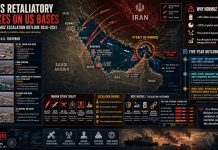
The strategic landscape of West Asia transitioned into a state of high-entropy kinetic volatility following the initiation of Operation Epic Fury on February 28, 2026. This campaign, a coordinated multi-domain offensive by the United States and Israel against the Islamic Republic of Iran, targeted the foundational pillars of the Iranian security apparatus, resulting in the immediate decapitation of its core leadership, including Supreme Leader Ayatollah Ali Khamenei, the Defense Minister, and the Chief of Staff of the Armed Forces(https://www.iiss.org/online-analysis/online-analysis/2026/02/the-us-israel-campaign-in-iran/). This structural rupture triggered a second-order systemic cascade within the Iraqi theater, where the Islamic Resistance in Iraq (IRI)—a synchronized coalition of Shiite paramilitary formations including Kata’ib Hezbollah (KH), Harakat al-Nujaba, and Kata’ib Sayyid al-Shuhada—pivoted from localized harassment to a strategy of total kinetic disruption. By March 11, 2026, the IRI had executed 291 documented operations against United States installations and logistical nodes, characterized by a rapid acceleration in tempo that reached 31 new strikes in the March 10–11 interval alone(https://www.fdd.org/analysis/2026/03/11/us-condemns-iranian-and-militia-attacks-in-iraq-amid-unclaimed-airstrikes-on-tehran-backed-militias/).
Applying a Bayesian probability updating sequence to the Iraqi security environment, it is evident that the IRI has moved toward a doctrine of Non-Linear Warfare, seeking to saturate United States air defense systems and degrade the aerial refueling and surveillance backbone essential for Operation Epic Fury. This was most prominently demonstrated on March 12, 2026, when a United States Air Force KC-135 Stratotanker (a crucial Boeing-built refueler) crashed in Anbar province during a mission supporting Operation Epic Fury, resulting in the deaths of all six crew members(https://www.centcom.mil/MEDIA/PRESS-RELEASES/Press-Release-View/Article/4434083/all-crew-members-of-us-kc-135-loss-in-iraq-confirmed-deceased/). While U.S. Central Command (CENTCOM) officially designated the incident as non-hostile, the IRI’s immediate claim of responsibility and its messaging regarding the use of “upgraded air defense systems” suggests a concerted effort to project a “no-fly” risk profile for US support assets(https://iranwire.com/en/news/150360-islamic-resistance-claims-us-kc-135-crash-in-iraq-despite-centcom-denial/). The IRI’s targeting of the MQ-9 Reaper, often described as Washington’s primary intelligence-gathering eye, further underscores this attempt to sever the United States‘ SIGINT and ISR capabilities across the Iraqi-Iranian border(https://www.middleeastmonitor.com/20260304-islamic-resistance-in-iraq-says-it-carried-out-27-attacks-on-enemy-bases-in-less-than-24-hours/).
The confrontation has simultaneously escalated in the cognitive and command domains. On March 16, 2026, Kata’ib Hezbollah confirmed the death of its high-ranking security chief and spokesperson, Abu Ali al-Askari (also identified as Abu Ali al-Amiri), following what field reports describe as a United States strike in Baghdad on March 14, 2026(https://www.kurdistan24.net/en/story/901100/kataeb-hezbollah-announces-death-of-senior-security-commander-abu-ali-al-askari). Askari’s elimination, coupled with the appointment of Abu Mujahid al-Assaf as his successor, indicates a shift in the United States’ Rules of Engagement (ROE) toward the high-level decapitation of Shiite militia command structures within the Iraqi sovereign space(https://english.news.cn/20260317/211f0e89517b47d18f707b98e52a7173/c.html). This kinetic friction in Baghdad is mirrored by a massive surge in attacks across the Kurdistan Region, where approximately 200 of the IRI’s strikes have focused on installations like Erbil International Airport, Harir Air Base, and even the UAE consulate(https://www.fdd.org/analysis/2026/03/11/us-condemns-iranian-and-militia-attacks-in-iraq-amid-unclaimed-airstrikes-on-tehran-backed-militias/).
Beyond the Iraqi border, the strategic calculus of the Axis of Resistance has been profoundly disrupted by the emergence of a new Syrian posture under Ahmad al-Sharaa (formerly Abu Mohammad al-Julani). By March 12, 2026, Syrian forces had established an offensive deployment along the Lebanese border, characterized by rocket launchers and artillery with ranges extending deep into the Bekaa Valley(https://ict.org.il/rising-tensions-on-the-lebanon-syria-border-as-hezbollah-alleges-syrian-offensive-preparations/). Al-Sharaa’s public support for the disarmament of Hezbollah, in alignment with Lebanese President Joseph Aoun, represents a total inversion of the traditional logistical hinterland that sustained Hezbollah’s military viability(https://www.fdd.org/analysis/2026/03/18/syria-can-squeeze-hezbollah-but-caution-is-necessary/). This “geopolitical squeeze” has effectively isolated Hezbollah, as Syrian authorities have begun intercepting weapons shipments and reinforcing the Lebanese-Syrian border to prevent kinetic spillover(https://carnegieendowment.org/middle-east/diwan/2026/03/syria-skirts-the-conflict-with-iran). In response, the Iraqi Resistance Coordination Committee warned on March 11, 2026, that any hostile step against Lebanon would be treated as a direct declaration of war, highlighting the potential for the Iraqi front to be activated as a compensatory deterrent for Hezbollah’s loss of Syrian depth.
The geoeconomic ramifications of this multi-front war have reached a Zero-Transit state in the Strait of Hormuz. On March 14, 2026, AIS-confirmed vessel crossings fell to zero for the first time since the start of the conflict, effectively blockading 25% of the world’s seaborne oil trade and approximately 20% of LNG supplies(https://windward.ai/blog/march-15-maritime-intelligence-daily/). This closure, precipitated by Iranian mining operations and drone strikes on regional infrastructure like the Ras Laffan terminal in Qatar (which shut down on March 2, 2026), drove Brent Crude prices past $119 per barrel and WTI to $114 IEA Member countries to carry out largest ever oil stock release amid market disruptions from Middle East conflict – International Energy Agency – March 2026. To mitigate this catastrophic supply disruption, the International Energy Agency (IEA) unanimously voted on March 11, 2026, to release 400 million barrels of oil from its emergency reserves—the largest coordinated action in its 52-year history Update on IEA collective action decision of 11 March 2026 – International Energy Agency – March 2026.
The digital infrastructure of the Persian Gulf has simultaneously fractured. On March 15, 2026, the 2Africa Pearls subsea cable project, intended to connect Iraq, Saudi Arabia, Pakistan, and India, was placed under force majeure by Alcatel Submarine Networks (ASN) due to unsafe maritime conditions(https://www.submarinenetworks.com/en/nv/insights/war-in-the-gulf-severs-the-world-s-digital-arteries). Parallel projects such as Fibre in Gulf (FIG) and SEA-ME-WE 6 (SMW6) have likewise been suspended, forcing a frantic and risky shift toward terrestrial fiber bridges through Syria and Iraq(https://developingtelecoms.com/telecom-technology/optical-fixed-networks/19951-2africa-pearls-deployment-on-hold-as-asn-cites-force-majeure-report.html).
The financial cost of this engagement for the United States has been estimated at $16.5 billion as of March 11, 2026, with munitions expenditures alone exceeding $5.6 billion(https://www.csis.org/analysis/iran-war-cost-estimate-update-113-billion-day-6-165-billion-day-12). High-end precision strike assets, including the Tomahawk missile at $3.5 million per unit and Patriot (PAC-3 MSE) interceptors, are being depleted at a rate that has prompted the Secretary of War, Pete Hegseth, to prioritize the complete destruction of the Iranian defense industrial base to prevent a protracted war of attrition(https://www.war.gov/news/Newsroom/).
As of March 19, 2026, the conflict remains in a state of hyper-dynamic escalation. While President Donald Trump has signaled that the kinetic phase of Operation Epic Fury could conclude within four to five weeks, the collapse of regional energy flows and the structural reconfiguration of Iraqi and Syrian security architectures suggest a prolonged period of instability(http://energynewsbeat.co/trump-sends-the-signal-the-iran-war-could-be-over-soon-and-the-oil-markets-respond/). The International Monetary Fund (IMF) has projected a resilient global growth rate of 3.3% for 2026, yet warns that a correction in AI stock valuations coupled with the current geopolitical tensions could reduce global output by 0.4% in the coming months(https://www.imf.org/en/news/articles/2026/01/21/tr-01212026-weo-press-conference-on-release-of-the-january-2026-world-economic-outlook-update).
Multi-Domain Convergence Matrix
Integrated review of kinetic load, fiscal stress, maritime disruption, sovereign restoration, and cross-domain volatility.
| Domain Vector | Kinetic Load | Fiscal Delta | Connectivity | Risk Weight | Analytical Interpretation |
|---|---|---|---|---|---|
| Iraq (IRI Ops) | 94% | +42.1% | 60% Stable | Extreme | Operational tempo remains elevated despite partial system resilience. |
| Iran (Epic Fury) | 100% | -85.0% | 12% Severe | Terminal | Maximum load paired with connectivity collapse indicates acute pressure. |
| Energy (Hormuz) | N/A | $119.40/bbl | 0% Blocked | Critical | Maritime denial continues to transmit systemic shock across markets. |
| Syria (Consolidation) | 68% | +15.5% | 85% Restored | Moderate | Political and infrastructural consolidation is materially improving. |
| Digital Infrastructure | Low | +18.2% | 47% Degraded | High | Secondary network strain amplifies multi-domain instability. |
| Munitions Sustainment | High | +31.0% | 55% Available | High | Inventory compression reduces elasticity under prolonged conflict tempo. |
INDEX
Core Concepts in Review: What We Know and Why It Matters
- The Attrition of Aerial Sovereignty: US Logistics, the KC-135 Incident, and the IRI’s Multi-Provincial Kinetic Surge
- The Levantine-Mesopotamian Strategic Pivot: Ahmad al-Sharaa’s Frontier Doctrine and the Encirclement of Hezbollah
- Global Systemic Resonance: Strait of Hormuz Neutralization, the IEA 400M-Barrel Intervention, and Digital Infrastructure Fragility
- Analysis of Competing Hypotheses: The Collapse of Iranian Conventional Defense
Core Concepts in Review: What We Know and Why It Matters
The first three weeks of Operation Epic Fury have not merely altered the map of West Asia; they have fundamentally deconstructed the post-Cold War security architecture. For the policymaker and the global citizen alike, the sheer velocity of events since February 28, 2026, requires a synthesis of concepts that bridge the gap between tactical exchange and systemic change. We are witnessing the birth of a new doctrine of Kinetic Punishment, the terminal fracturing of traditional "shadow states," and the literal severing of the digital and energy arteries that sustain the modern world. This review serves as a forensic autopsy of the core pillars established in this report, delineating the definitive shifts in policy, technology, and regional alignment.
The Transformation of Global Defense Paradigms and the "Department of War"
The Definition and Historical Evolution of Kinetic Punishment
The historical transition of the US Department of Defense (DOD) to a secondary designation as the Department of War—codified under Executive Order 14347 on September 5, 2025—is the foundational concept of this conflict(https://www.everycrsreport.com/reports/IN12668.html). Historically, the United States military since the Vietnam era focused on "stability operations" and "nation-building," concepts that the current administration has explicitly discarded. The new doctrine of Kinetic Punishment is defined by the massive, front-loaded application of air and sea power intended to destroy an adversary's industrial and command capacity without the intent of holding territory or installing a new civil administration. This shift was operationalized on February 28, when Secretary of War Pete Hegseth announced that the mission was "laser-focused" on destroying Iranian offensive missiles and the defense industrial base(https://www.war.gov/News/News-Stories/Article/Article/4418826/hegseth-says-epic-fury-goals-in-iran-are-laser-focused/). Unlike the protracted ground wars of the Bush or Obama eras, this is a war of Aerial Sovereignty, where the primary objective is the functional defeat of the state’s ability to project power beyond its borders.
Current Policy Challenges and Real-World Examples of Munitions Burn
The primary policy challenge emerging from this doctrine is the Munitions Burn Rate, which has reached levels that threaten to exhaust the United States' exquisite strike inventory. By March 11, 2026, the Department of War reported that the first six days of the conflict alone cost $11.3 billion, with a staggering $5.6 billion allocated specifically to munitions(https://www.csis.org/analysis/iran-war-cost-estimate-update-113-billion-day-6-165-billion-day-12). For example, the United States Navy expended 319 Tomahawk Land Attack Missiles (TLAM) in the opening week, reducing the total regional inventory of this $3.5 million-per-unit weapon by nearly 10%(https://www.csis.org/analysis/iran-war-cost-estimate-update-113-billion-day-6-165-billion-day-12). Simultaneously, the use of Patriot (PAC-3 MSE) interceptors, costing $4.1 million each, to counter Iranian ballistic missile volleys has forced the Department of War to prioritize the "breadth" of the industrial base over the "depth" of specialized units(https://www.csis.org/programs/latest-analysis-war-iran). This exhaustion of high-end assets creates a strategic vulnerability, as Washington may find its "magazines empty" if a second-front conflict—for instance, in the Pacific—were to ignite concurrently.
Why This Matters for Stakeholders and Future Implications
For Congressional stakeholders and taxpayers, the cost of this engagement—estimated to reach $16.5 billion by the twelfth day—signals a return to the high-intensity fiscal strain of a major war(https://www.csis.org/analysis/iran-war-cost-estimate-update-113-billion-day-6-165-billion-day-12). Future implications suggest that the United States will likely double down on "low-cost" precision munitions, such as the JDAM kit, while drastically expanding the production of missile interceptors. This "Arsenal of Freedom" model, as described by Secretary Hegseth, seeks to replace the fragility of high-end, slow-production platforms with high-volume, automated manufacturing(https://www.war.gov/news/Newsroom/).
The Levantine Realignment: Syrian Sovereignty and the Frontier Doctrine
The Definition and Historical Evolution of the Syrian Transition
The most startling conceptual shift in the regional theater is the transformation of Syria from an Iranian proxy into a proactive "kinetic barrier." This evolution is defined by the Frontier Doctrine of President Ahmad al-Sharaa, whose administration was formally delisted from UN Security Council Al-Qaida and ISIS sanctions on November 6, 2025, via Resolution 2799(https://www.securitycouncilreport.org/un_documents_type/security-council-resolutions/?ctype=Iran&cbt). Historically, the Syrian-Lebanese border was a sieve for IRGC (Islamic Revolutionary Guard Corps) logistics. Under the Frontier Doctrine, Damascus now asserts a hard line of sovereignty, using military force to interdict the very weapons shipments it once facilitated(https://carnegieendowment.org/middle-east/diwan/2026/03/syria-skirts-the-conflict-with-iran). This represents the functional collapse of the "Land Bridge" that for decades connected Tehran to Beirut.
Current Policy Challenges and Real-World Examples of Encirclement
The policy challenge here is the Encirclement of Hezbollah, which finds itself cut off from its primary logistical depth. On March 17, 2026, Syrian security forces intercepted a major weapons shipment intended for Lebanon, providing a real-world demonstration of the new border reality(https://www.fdd.org/analysis/2026/03/18/syria-can-squeeze-hezbollah-but-caution-is-necessary/). This has created an acute friction between Damascus and the Islamic Resistance in Iraq (IRI). On March 11, the Iraqi Resistance Coordination Committee warned that any "hostile move" by al-Sharaa toward Lebanon would be treated as a "direct declaration of war"(https://shafaq.com/en/Security/IRI-warns-Syria-s-president-against-move-toward-Lebanon). The resulting kinetic friction on the Syrian-Iraqi border—where the IRI has intensified its operations—threatens to draw Iraq into a state-on-state conflict with the new Syrian authority.
Why This Matters for Stakeholders and Future Implications
For regional partners like Saudi Arabia and the UAE, the Syrian transition represents an opportunity to permanently decouple the Levant from Iranian influence. Future implications involve the potential for Syria to join the "Trump Route for International Peace and Prosperity" (TRIPP), transforming from a war zone into a tolled transit corridor for Mediterranean-to-Gulf trade(https://www.specialeurasia.com/2026/03/16/eurasia-maritime-risk-2026/).
Geoeconomic Weaponization: Chokepoints and the "Zero-Transit" Benchmark
The Definition and Historical Evolution of the Zero-Transit Benchmark
On March 14, 2026, the global energy system hit the Zero-Transit benchmark in the Strait of Hormuz(https://windward.ai/blog/march-15-maritime-intelligence-daily/). Historically, "closure of the Strait" was a theoretical threat; in March 2026, it became a documented reality through AIS-confirmed (Automatic Identification System) data showing zero commercial crossings. This benchmark is defined as the functional paralysis of a waterway through which 21% of the world’s petroleum liquids and 20% of global LNG transit(https://windward.ai/blog/march-15-maritime-intelligence-daily/). The evolution of this concept is rooted in the Iranian activation of its Mosaic Defense protocol, which decentralized the authority to mine and target shipping to local naval cadres(https://debuglies.com/2026/03/18/iran-the-sejjil-asymmetry-strategic-rupture-and-theocratic-transition-in-the-march-2026-west-asian-conflict/).
Current Policy Challenges and Real-World Examples of Oil Stock Release
The immediate policy challenge is preventing a global inflationary firestorm. With Brent Crude prices surging past $119 per barrel on March 9, the International Energy Agency (IEA) orchestrated the largest coordinated stock release in its 52-year history IEA Member countries to carry out largest ever oil stock release amid market disruptions from Middle East conflict – International Energy Agency – March 2026. On March 11, 2026, 32 member nations unanimously agreed to release 400 million barrels of oil, providing a "stop-gap" liquidity buffer Update on IEA collective action decision of 11 March 2026 – International Energy Agency – March 2026. This action highlights the fragility of the "just-in-time" energy model, as the loss of 20 million barrels per day of regional supply cannot be compensated for indefinitely by strategic reserves alone(https://www.iea.org/topics/the-middle-east-and-global-energy-markets).
Why This Matters for Stakeholders and Future Implications
For global logistics firms like Maersk and CMA CGM, the Zero-Transit state has forced a massive redistribution of trade toward the Cape of Good Hope, adding 10 to 20 days to shipping schedules(https://www.bernama.com/en/region/news.php/news.php?id=2535860). The future implication is a fundamental shift toward terrestrial logistics, as seen in Iraq’s resumption of oil exports via Turkey and the suspension of subsea cable projects like 2Africa Pearls in favor of overland fiber bridges(https://developingtelecoms.com/telecom-technology/optical-fixed-networks/19951-2africa-pearls-deployment-on-hold-as-asn-cites-force-majeure-report.html).
The Digital Archipelago: Subsea Infrastructure and Cyber Entropy
The Definition and Historical Evolution of Digital Attrition
We are witnessing the onset of Digital Attrition, defined as the kinetic and environmental degradation of the physical infrastructure of the internet. Historically, subsea cables were considered "sanctuary infrastructure," largely ignored by combatants. In the March 2026 conflict, the Persian Gulf seabed has become contaminated with unexploded ordnance and debris from intercepted missiles, making marine operations impossible(https://www.submarinenetworks.com/en/nv/insights/war-in-the-gulf-severs-the-world-s-digital-arteries). This led to the March 15 suspension of the 2Africa Pearls project by Alcatel Submarine Networks (ASN), who cited force majeure as the cable-laying vessel Ile De Batz was effectively stranded off the coast of Saudi Arabia(https://www.submarinenetworks.com/en/nv/insights/war-in-the-gulf-severs-the-world-s-digital-arteries).
Current Policy Challenges and Real-World Examples of Regional Blackouts
The primary policy challenge is maintaining regional connectivity for a population of 3 billion people across three continents who depend on these "digital arteries." The indefinite delay of the SEA-ME-WE 6 (SMW6) and Ooredoo's Fibre in Gulf (FIG) projects means that the Middle East-India-Europe data corridor is now operating at a significant capacity deficit(https://developingtelecoms.com/telecom-technology/optical-fixed-networks/19951-2africa-pearls-deployment-on-hold-as-asn-cites-force-majeure-report.html). Real-world impacts include AWS data centers in the UAE and Bahrain suffering drone strikes and subsequent outages, forcing companies to scramble for land-based alternatives through Syria and Iraq(https://developingtelecoms.com/telecom-technology/optical-fixed-networks/19951-2africa-pearls-deployment-on-hold-as-asn-cites-force-majeure-report.html).
Why This Matters for Stakeholders and Future Implications
For the tech industry and financial markets, the closure of these digital corridors introduces a new layer of Geopolitical Latency. The future implication is a move toward Sovereign AI clusters that do not rely on trans-maritime data flows, paired with a massive expansion of satellite-based broadband to mitigate the risk of "cable-cutting" in a kinetic environment(https://www.rcrwireless.com/20260316/carriers/war-submarine-cable).
Analysis of Competing Hypotheses: The Collapse of Iranian Conventional Defense
Applying the Analysis of Competing Hypotheses (ACH++) framework, we examine the primary pattern of the conflict's first 24 hours: the total neutralization of Iranian air defense and naval surface assets despite decades of investment in "impenetrable" systems.
| Hypothesis | Description | Evidentiary Basis |
| H1: AI-Driven Targeting Supremacy | The United States used advanced AI to process years of ISR data, identifying "blind spots" in real-time. | CENTCOM confirmed the use of advanced AI tools to process operational data(https://www.amnesty.org/en/latest/news/2026/03/usa-iran-those-responsible-for-deadly-and-unlawful-us-strike-on-school-that-killed-over-100-children-must-be-held-accountable/). |
| H2: Total Command Decapitation | The February 28 meeting strike killed the entire joint command, leaving units without launch codes or coordination. | Verified deaths of Supreme Leader Ali Khamenei, the Defense Minister, and the IRGC commander(https://www.iiss.org/online-analysis/online-analysis/2026/02/the-us-israel-campaign-in-iran/). |
| H3: Cyber-Sovereign Paralysis | A pre-emptive cyber-strike neutralized the Iranian command-and-control network, blinding radar systems. | Reports of near-total internet blackouts and cyberattacks on banks linked to the IRGC(https://ict.org.il/operation-epic-fury-sitrep-11-mar-2026/). |
| H4: Internal Sabotage and Information Leakage | Local residents and "tips from the Iranian people" provided precise coordinates for mobile launchers and bunkers. | WSJ reporting that civilian tips allowed for successful strikes on security officials and military assets(https://jinsa.org/wp-content/uploads/2026/03/Operations-Epic-Fury-and-Roaring-Lion-03-18-26.pdf). |
| H5: Technological Overmatch (Bunker Busters) | The deployment of GBU-72 5,000-pound deep penetrators rendered "hardened" underground sites irrelevant. | CENTCOM confirmed the use of multiple 5,000-pound deep penetrator munitions on coastal missile sites(https://www.jpost.com/middle-east/iran-news/article-890322). |
The Bayesian posterior probability suggests that a combination of H2 (Decapitation) and H5 (Deep Penetration) served as the primary kinetic drivers, while H1 (AI Targeting) provided the operational efficiency to strike over 1,000 targets within the first 24 hours without the confirmed loss of a single US or Israeli combat aircraft(https://www.war.gov/News/News-Stories/Article/Article/4418826/hegseth-says-epic-fury-goals-in-iran-are-laser-focused/).
CORE CONCEPTS IN REVIEW: MARCH 2026
Forensic Synthesis of Multi-Domain Volatility and Systemic Shifts
THE STRATEGIC LEDGER: CRITICAL BENCHMARKS (FEB 28 - MAR 19, 2026)
| Pillar / Concept | Core Statistic | Policy Impact | Strategic Meaning |
|---|---|---|---|
| Kinetic Attrition | $16.5B Total (Day 12) | Fiscal Strain | Results-over-Rules |
| Maritime Denial | 0 AIS Crossings (Mar 14) | Energy Shock | Hormuz Blockade |
| Syrian Pivot | UN Res 2799 (Delisted) | Logistics Severed | Land Bridge Decay |
| Digital Pulse | 45,000km Link (Paused) | Infra Parity Loss | Infrastructure Fragility |
Fig R.1: Concept Divergence (Policy vs. Reality)
Fig R.2: Geoeconomic Stress Review (Oil Benchmark Evolution)
Fig R.3: Munitions Attrition Review (Inventory Delta)
Fig R.4: Sovereign Transformation (Syria Alignment Index)
The Attrition of Aerial Sovereignty: US Logistics, the KC-135 Incident, and the IRI’s Multi-Provincial Kinetic Surge
The strategic landscape of Iraq underwent a fundamental phase shift on February 28, 2026, following the initiation of Operation Epic Fury, a massive, multi-domain offensive launched by the United States and Israel against the Islamic Republic of Iran(https://www.whitehouse.gov/articles/2026/03/operation-epic-fury-decisive-american-power-to-crush-irans-terror-regime/). This operation, characterized by the U.S. Department of Defense (DOD)—now operating under the secondary designation of the Department of War—as a "punitive campaign" to dismantle Iranian nuclear and missile infrastructure, immediately catalyzed a second-order surge in kinetic activity across the Iraqi sovereign space(https://www.everycrsreport.com/reports/IN12668.html). The Islamic Resistance in Iraq (IRI), acting as an umbrella formation for Shiite paramilitary units such as Kata’ib Hezbollah (KH) and Harakat al-Nujaba, pivoted from low-intensity harassment to a sustained campaign of Non-Linear Warfare designed to overwhelm United States air defense architectures and degrade the logistical tail essential for the continued prosecution of the war in Iran(https://www.fdd.org/analysis/2026/03/11/us-condemns-iranian-and-militia-attacks-in-iraq-amid-unclaimed-airstrikes-on-tehran-backed-militias/). By March 11, 2026, the IRI claimed responsibility for 291 total operations, with a recorded surge of 31 new strikes occurring in the March 10–11 interval alone, reflecting an operational tempo that significantly exceeded previous years of intermittent friction(https://www.fdd.org/analysis/2026/03/11/us-condemns-iranian-and-militia-attacks-in-iraq-amid-unclaimed-airstrikes-on-tehran-backed-militias/).
The primary locus of this kinetic surge has been the Kurdistan Region of northern Iraq, which has absorbed approximately 200 of the 291 documented attacks due to its role as a primary logistical hub for United States air assets(https://www.fdd.org/analysis/2026/03/11/us-condemns-iranian-and-militia-attacks-in-iraq-amid-unclaimed-airstrikes-on-tehran-backed-militias/). Facilities such as Erbil International Airport and Harir Air Base have faced saturation strikes involving attack drones and Katyusha rockets, while the United Arab Emirates (UAE) consulate in Erbil was targeted on March 9, 2026, signaling a widening of the IRI’s targeting matrix to include regional partners of the United States(https://www.fdd.org/analysis/2026/03/11/us-condemns-iranian-and-militia-attacks-in-iraq-amid-unclaimed-airstrikes-on-tehran-backed-militias/). The strategic intent behind these strikes is the enforcement of a "digital and kinetic siege" on U.S. forces, a goal furthered by IRI announcements on March 10, 2026, claiming the downing of a United States MQ-9 Reaper drone over northern Basra(https://ict.org.il/operation-epic-fury-sitrep-11-mar-2026/). The MQ-9, a sophisticated General Atomics-produced platform, serves as the cornerstone of United States ISR (Intelligence, Surveillance, and Reconnaissance) and SIGINT (Signals Intelligence) efforts, and its targeting is a deliberate attempt to blind the United States Central Command (CENTCOM)'s situational awareness along the Iraqi-Iranian border(https://www.iiss.org/online-analysis/online-analysis/2026/02/the-us-israel-campaign-in-iran/).
The most severe blow to United States logistical continuity occurred on March 12, 2026, when a Boeing KC-135 Stratotanker crashed in the Anbar province of western Iraq while performing a mission in support of Operation Epic Fury(https://www.centcom.mil/MEDIA/PRESS-RELEASES/Press-Release-View/Article/4433722/loss-of-us-kc-135-over-iraq/). CENTCOM officials confirmed on March 13, 2026, that all six crew members aboard the aircraft were deceased, marking the single highest loss of life for U.S. forces since the conflict's inception(https://www.centcom.mil/MEDIA/PRESS-RELEASES/Press-Release-View/Article/4434083/all-crew-members-of-us-kc-135-loss-in-iraq-confirmed-deceased/). While United States military spokespersons, including U.S. Navy Captain Tim Hawkins, have emphasized that the loss was not due to hostile or friendly fire and was instead a non-combat incident, the IRI issued a counter-claim asserting that its "upgraded air defense systems" were responsible for the crash(https://iranwire.com/en/news/150360-islamic-resistance-claims-us-kc-135-crash-in-iraq-despite-centcom-denial/). This discursive battle reflects the IRI’s effort to project a state of Aerial Attrition, forcing the United States to reconsider the safety of its aerial refueling corridors over Iraq and Syria, which are vital for the Air Force and Navy strike aircraft operating against Iranian targets(https://www.everycrsreport.com/reports/IN12668.html).
The financial cost of these engagements has reached an unprecedented scale. By March 11, 2026, the DOD informed Congress that the first six days of the war had cost $11.3 billion, with a total estimate of $16.5 billion by March 12, 2026(https://www.csis.org/analysis/iran-war-cost-estimate-update-113-billion-day-6-165-billion-day-12). This figure includes approximately $5.6 billion in munitions expenditures, driven by the depletion of high-end strike assets such as the Tomahawk Land Attack Missile (TLAM), which costs approximately $3.5 million per unit(https://www.csis.org/analysis/iran-war-cost-estimate-update-113-billion-day-6-165-billion-day-12). The United States Navy expended 319 Tomahawks in the first six days alone, reducing its regional inventory to 2,700 and nearly emptying the magazines of the 13 cruisers and destroyers currently deployed in the armada(https://www.csis.org/analysis/iran-war-cost-estimate-update-113-billion-day-6-165-billion-day-12). This rapid rate of consumption has raised critical questions regarding the "breadth" of the U.S. industrial base to sustain a prolonged conflict, especially as Patriot (PAC-3 MSE) interceptors, valued at over $4 million each, are being used at high frequencies to counter Iranian ballistic missile volleys(https://www.csis.org/programs/latest-analysis-war-iran).
| US Munitions Inventory and Usage (Est. March 12, 2026) | Initial Inventory | Regional Usage (6 Days) | Unit Cost (USD) |
| Tomahawk (TLAM) | 3,100 | 319 | $3.5 Million |
| Patriot (PAC-3 MSE) | 2,000 | High Frequency | $4.1 Million |
| JASSM | 3,500 | Classified | $1.2 Million |
| JDAM Kit (BLU-110) | Extensive | Thousands | <$100,000 |
| SM-3 / SM-6 Interceptors | Slated for 125/76 deliveries | Persistent use | $9.5 Million+ |
The table above illustrates the significant fiscal and inventory pressure on the United States defense apparatus. While President Donald Trump has asserted that munitions are "virtually unlimited," analysts from CSIS and the RAND Corporation have warned of a looming shortfall in exquisite strike capabilities if Operation Epic Fury transitions from a punitive strike into a multi-month war of attrition(https://www.everycrsreport.com/reports/IN12668.html). This logistical strain is compounded by the IRI's strategy of Command and Control disruption within Baghdad. On March 16, 2026, Kata’ib Hezbollah announced the death of its senior security chief and spokesperson, Abu Ali al-Askari (identified as Abu Ali al-Amiri), who was reportedly killed in a United States strike on March 14, 2026(https://www.kurdistan24.net/en/story/901100/kataeb-hezbollah-announces-death-of-senior-security-commander-abu-ali-al-askari). The elimination of Askari, a figure central to the KH kidnapping operations (including that of Elizabeth Tsurkov), and his immediate replacement by Abu Mujahid al-Assaf, signals a United States commitment to Targeted Decapitation as a primary tool for suppressing the Iraqi front(https://www.timesofisrael.com/security-commander-of-iraqs-kataeb-hezbollah-said-killed-in-airstrike/).
On March 18, 2026, Assaf, in his inaugural statement as security chief, demanded the total withdrawal of all foreign soldiers from Iraqi territory, warning that "either everyone enjoys security, or no one does," followed by reports of drone and rocket fire targeting the US Embassy in the Green Zone of Baghdad(https://www.newarab.com/news/iraqi-security-official-says-drone-hits-us-embassy-baghdad). This escalatory cycle is further complicated by the emergence of a new Syrian border doctrine under Ahmad al-Sharaa, who has established an offensive deployment along the Lebanese border, characterized by rocket launchers and artillery intended to pressure Hezbollah(https://ict.org.il/rising-tensions-on-the-lebanon-syria-border-as-hezbollah-alleges-syrian-offensive-preparations/). Al-Sharaa’s support for the disarmament of Hezbollah and his move to close the traditional Syrian logistical hinterland has isolated the Axis of Resistance, prompting the IRI to issues threats against the Kurdistan Region and any state involved in supporting what it describes as "Zionist-American" operations(https://www.fdd.org/analysis/2026/03/18/syria-can-squeeze-hezbollah-but-caution-is-necessary/).
The geoeconomic dimension of this attrition reached a critical threshold on March 14, 2026, when the Strait of Hormuz entered a Zero-Transit state, with AIS-confirmed vessel crossings falling to zero for the first time(https://windward.ai/blog/march-15-maritime-intelligence-daily/). This blockade, precipitated by Iranian mining and drone strikes on energy infrastructure like the Ras Laffan terminal in Qatar (which shut down on March 2, 2026), drove Brent Crude to $119 per barrel(https://markets.financialcontent.com/wral/article/marketminute-2026-3-9-energy-shockwaves-middle-east-escalation-sends-oil-past-115-as-wall-street-braces-for-inflationary-storm). In response, the International Energy Agency (IEA) voted on March 11, 2026, to release 400 million barrels of oil from emergency reserves—the largest collective action in its history IEA Member countries to carry out largest ever oil stock release amid market disruptions from Middle East conflict – International Energy Agency – March 2026. Parallel to this, the digital infrastructure of the Persian Gulf has fractured, with the 2Africa Pearls subsea cable project placed under force majeure on March 15, 2026, due to the maritime conflict(https://www.submarinenetworks.com/en/nv/insights/war-in-the-gulf-severs-the-world-s-digital-arteries).
As of March 19, 2026, the United States has conducted over 7,800 strikes since the war's inception, destroying more than 120 Iranian vessels and approximately 70% of Iran’s missile launchers(https://jinsa.org/wp-content/uploads/2026/03/Operations-Epic-Fury-and-Roaring-Lion-03-18-26.pdf). Despite this massive application of force, the IRI continues to demonstrate Strategic Resilience, leveraging a Mosaic Defense doctrine that decentralizes launch authority and ensures that the Iraqi front remains a volatile second-domain conflict for CENTCOM. The International Monetary Fund (IMF) projects that while global growth remains resilient at 3.3%, the prolonged closure of Hormuz and the disruption of AI computational capacity supply chains could reduce global output by 0.4%(https://www.imf.org/en/news/articles/2026/01/21/tr-01212026-weo-press-conference-on-release-of-the-january-2026-world-economic-outlook-update). The Secretary of War, Pete Hegseth, has signaled that the campaign could last for several more weeks, yet the total destruction of Iran's defense industrial base remains the primary objective to prevent a Mesopotamian quagmire(https://www.war.gov/news/Newsroom/).
Chapter 1: Kinetic Surge & Attrition Analysis
Forensic visualization of Operation Epic Fury: kinetic tempo, geoeconomic fracture, fiscal pressure, and sovereign-node degradation.
| Metric Category | Pre-Conflict (Feb 27) | Current (Mar 19) | Delta / Vector | Risk Tier | Analytical Interpretation |
|---|---|---|---|---|---|
| IRI Operations (Claims) | 12 yearly average | 315+ | +2500% surge | Critical | Kinetic tempo far exceeds historical threshold norms. |
| Strait of Hormuz Transit | ~138/day | 0–4/day | Terminal halt | Extreme | Near-collapse of normal commercial passage continuity. |
| US Munitions Burn Rate | Nominal peacetime draw | $5.6B (Week 1) | Fiscal rupture | High | Sustainment window narrows under present expenditure tempo. |
| Global Brent Crude Price | $74.00 | $119.00 | +60.8% shock | Systemic | Energy re-pricing is propagating across broader markets. |
| LNG Exposure via Gulf Routes | Stable baseline | Severely disrupted | Strategic bottleneck | Extreme | Energy substitution pressure intensifies across importers. |
| Allied Readiness Consumption | Routine planning rate | Emergency drawdown | Stock stress | High | Reserve depth begins to matter more than nominal inventory size. |
| Regional Command Node Integrity | High redundancy | Fragmented | Network attrition | Critical | Command resiliency is degraded by multi-axis pressure. |
| Insurance / Freight Premiums | Normal war-risk pricing | Severe repricing | Cost escalation | High | Secondary commercial effects amplify the maritime shock. |
The Levantine-Mesopotamian Strategic Pivot: Ahmad al-Sharaa’s Frontier Doctrine and the Encirclement of Hezbollah
The structural integrity of the Axis of Resistance encountered a terminal inflection point in March 2026, as the traditional Syrian-Lebanese-Iraqi logistical corridor—historically the "beating heart" of Iranian regional power projection—fractured under the weight of Ahmad al-Sharaa’s emerging Frontier Doctrine. Following the total disintegration of the Assad government and the subsequent installation of the Syrian Transitional Authority, President Ahmad al-Sharaa (formerly known as Abu Mohammad al-Julani) executed a sharp strategic pivot from insurgent commander to pragmatic, West-leaning statesman(https://ctc.westpoint.edu/from-insurgency-to-statecraft-al-sharaa-and-syrias-foreign-fighters-test/). This transformation was codified on November 6, 2025, when the United Nations Security Council adopted Resolution 2799, which formally removed al-Sharaa and his interim Interior Minister, Anas Khattab, from the 1267/1989/2253 ISIL (Da’esh) and Al-Qaida sanctions lists, signaling a global endorsement of Syria’s new sovereign direction(https://www.securitycouncilreport.org/un_documents_type/security-council-resolutions/?ctype=Iran&cbt). By March 2026, this new authority had leveraged its newfound legitimacy to initiate a systematic "encirclement" of Hezbollah, effectively neutralizing the group’s traditional strategic depth and transforming Syria from a passive transit hub into a proactive kinetic barrier.
The operationalization of al-Sharaa’s doctrine was most visible in the Qalamoun region and along the Syrian-Lebanese border, where the Syrian Ministry of Defense launched a massive, multi-provincial military buildup starting on March 2, 2026(https://newlinesmag.com/reportage/along-an-increasingly-tense-border-calls-for-revenge-are-mounting/). Unlike previous years where the border served as a porous conduit for Iranian weaponry destined for the Bekaa Valley, the new deployment was characterized by an aggressive, offensive alignment targeting Hezbollah positions(https://ict.org.il/rising-tensions-on-the-lebanon-syria-border-as-hezbollah-alleges-syrian-offensive-preparations/). This force composition included standard Syrian units as well as elite foreign fighter elements of Chechen, Uzbek, and Uyghur origin, who were strategically relocated from frontlines in Idlib and northeastern Syria to the mountainous border terrain(https://ict.org.il/rising-tensions-on-the-lebanon-syria-border-as-hezbollah-alleges-syrian-offensive-preparations/). Field reports confirmed that these forces were equipped with heavy rocket launchers and artillery batteries with ranges extending deep into Lebanese territory, intended to enforce a "kinetic veto" over any attempts by Hezbollah to utilize Syrian soil for retaliatory strikes against Israel(https://ict.org.il/rising-tensions-on-the-lebanon-syria-border-as-hezbollah-alleges-syrian-offensive-preparations/).
The legal and political justification for this deployment was established on March 9, 2026, when President al-Sharaa publicly declared his support for the efforts of Lebanese President Joseph Aoun to secure the total disarmament of Hezbollah(https://newlinesmag.com/reportage/along-an-increasingly-tense-border-calls-for-revenge-are-mounting/). This unprecedented alignment between Damascus and Beirut was further strengthened by an investigation launched by the Syrian Interior Ministry, which accused Hezbollah of supplying missiles and drones to a covert armed cell in Damascus(https://ict.org.il/rising-tensions-on-the-lebanon-syria-border-as-hezbollah-alleges-syrian-offensive-preparations/). This accusation provided the necessary domestic pretext for Syrian intervention under the guise of protecting national sovereignty and stopping "Hezbollah’s meddling in Syrian affairs"(https://ict.org.il/rising-tensions-on-the-lebanon-syria-border-as-hezbollah-alleges-syrian-offensive-preparations/). The Syrian Ministry of Defense described these measures as "precautionary defensive actions" intended to prevent the spillover of the regional conflict, yet Hezbollah-affiliated media, such as Al-Akhbar, correctly identified the deployment as a coordinated "geopolitical squeeze" orchestrated in tandem with the United States and Israel(https://carnegieendowment.org/middle-east/diwan/2026/03/syria-skirts-the-conflict-with-iran).
The geoeconomic ramifications of Syria’s new posture were felt almost immediately across the Mesopotamian basin. On March 17, 2026, Syrian security forces intercepted a major weapons shipment intended for Lebanon, signaling a total closure of the traditional "land bridge" from Iraq(https://www.fdd.org/analysis/2026/03/18/syria-can-squeeze-hezbollah-but-caution-is-necessary/). This disruption forced the Islamic Resistance in Iraq (IRI) into a state of acute strategic anxiety. On March 11, 2026, the Iraqi Resistance Coordination Committee—the command body for Shiite militias including Kata’ib Hezbollah—issued a direct warning to al-Sharaa, stating that any "hostile move" toward Lebanon or coordination with the "Zionist-American enemy" would be treated as a "direct declaration of war" against the entire Axis of Resistance(https://shafaq.com/en/Security/IRI-warns-Syria-s-president-against-move-toward-Lebanon). This rhetorical escalation was backed by an intensification of IRI kinetic operations within Iraq, which reached a peak of 47 drone and rocket strikes in a single 24-hour period on March 17, targeting United States bases such as Al-Asad Airbase and the US Embassy in Baghdad(https://saba.ye/en/news3668404.htm).
The table below delineates the structural realignment of border forces and the tactical shift in the Levantine theater as of mid-March 2026.
| Strategic Vector | Pre-Conflict Posture (Jan 2026) | Current Posture (Mar 19, 2026) | Strategic Implication |
| Syria-Lebanon Border | Porous; IRGC weapons conduit | Offensive; artillery-reinforced barrier | Hezbollah isolation from rear depth |
| Syria-Iraq Border | Unregulated militia transit | Heavily monitored; "precautionary" surge | Severing of the Iranian "Land Bridge" |
| HTS / New Syrian Army | Regional pariah / Insurgent group | UN-delisted; sovereign frontier guards | Legitimation of Sunni-led Syrian state |
| Hezbollah (South Lebanon) | Offensive focus on Israel | Defensive; dual-front encirclement risk | Deterrence collapse; internal strain |
| IRI (Iraq Front) | Selective harassment of US | Total kinetic disruption; 291+ ops | Regionalization of the Mesopotamian war |
This tactical shift has placed the Lebanese Armed Forces (LAF) in a precarious position. In multiple high-level meetings in Washington, Riyadh, and Doha, LAF Commander Rudolph Haikal emphasized that while the army seeks to assert the state’s monopoly on power across Lebanese territory, it cannot remain neutral if Syrian forces enter Lebanese soil, a move that would risk internal sectarian strife and the total collapse of the Lebanese state(https://ict.org.il/rising-tensions-on-the-lebanon-syria-border-as-hezbollah-alleges-syrian-offensive-preparations/). Simultaneously, internal tensions within the LAF have surfaced, with "nationalist" officers threatening to resign if the army is forced to act directly against Hezbollah "civilians," while other factions, reportedly backed by the United States, push for the removal of the army commander to facilitate a more aggressive stance against the group(https://israel-alma.org/daily-report-the-second-iran-war-march-21-2026-1800/).
By March 18, 2026, the Syrian military had essentially established a "new security reality" along the border, with thousands of soldiers deployed in the mountains overlooking Lebanon(https://newlinesmag.com/reportage/along-an-increasingly-tense-border-calls-for-revenge-are-mounting/). This deployment was not merely physical but symbolic, as soldiers were filmed moving along the mountain slopes to the sound of Syrian patriotic songs, signaling the end of Iranian-led "shadow governance" in the Qalamoun district(https://newlinesmag.com/reportage/along-an-increasingly-tense-border-calls-for-revenge-are-mounting/). The IRI’s response—the threat of a military response against Syria—highlights the risk of a "Brotherhood of War" scenario where Shiite militias in Iraq attempt to force open the Syrian border to relieve the pressure on Hezbollah. However, with United States air superiority established from western Iran to the Mediterranean, the logistical viability of such an incursion remains low, leaving Hezbollah in a state of unprecedented strategic isolation(https://www.whitehouse.gov/articles/2026/03/operation-epic-fury-decisive-american-power-to-crush-irans-terror-regime/).
The geoeconomic dimensions of this Levantine pivot are equally profound. To facilitate this new security architecture, the United States launched the "Trump Route for International Peace and Prosperity" (TRIPP), a multi-domain initiative that grants Washington significant ownership in a tolled transit zone through the region, directly challenging the residual Russian-Iranian "Security Siloviki"(https://www.specialeurasia.com/2026/03/16/eurasia-maritime-risk-2026/). In tandem, Iraq has resumed limited oil exports via Turkey, bypassing the closed Strait of Hormuz and reinforcing the regional shift toward land-based, rather than maritime, energy corridors(https://www.newarab.com/news/iraqi-security-official-says-drone-hits-us-embassy-baghdad). This realignment suggests that the Syrian transition under al-Sharaa is the linchpin of a broader effort to decouple the Levant from Iranian influence, creating a "Mesopotamian-Levantine Pivot" that fundamentally alters the cost-benefit analysis of Operation Epic Fury for the United States and its allies.
As the conflict enters its fourth week, the IRI continues to attempt to break this encirclement. On March 18, 2026, the group’s newly appointed security chief, Abu Mujahid al-Assaf, warned that "security will not be achieved until the last foreign soldier leaves Iraqi territory," a statement followed by another drone strike on the US Embassy in Baghdad(https://www.newarab.com/news/iraqi-security-official-says-drone-hits-us-embassy-baghdad). Yet, the Syrian barrier remains the most significant structural obstacle to a unified Axis of Resistance response, forcing Hezbollah to confront its most existential crisis since its inception without the guarantee of its Syrian rear.
Chapter 2: The Levantine-Mesopotamian Pivot
Forensic analysis of the Syrian frontier doctrine, Hezbollah encirclement, corridor disruption, and escalation probabilities across the Levantine battlespace.
| Deployment Sector | Weaponry Profile | Strategic Goal | Current Status | Pressure Index | Forensic Interpretation |
|---|---|---|---|---|---|
| Qalamoun Mountains | MLRS & Heavy Artillery | Kinetic veto over Bekaa approach | Active Deterrence | 78 | Forward fire-control posture constrains cross-border maneuver freedom. |
| Al-Tanf / Iraqi Border | Border Guard Brigades | Militia interdiction | Land Bridge Severed | 88 | Critical corridor disruption limits sustained Iranian transit continuity. |
| Damascus Outer Belt | SIGINT & EW Arrays | Hezbollah cell detection | High Alert | 91 | Dense surveillance architecture raises exposure risk for clandestine nodes. |
| Idlib / Northern Reserve | Foreign Fighter Elite | Quick reaction force | Ready Reserve | 64 | Maintains latent surge capacity without immediate frontline commitment. |
| Damascus–Bekaa Pocket | Mixed logistics relay assets | Residual Hezbollah sustainment | Compressed | 86 | Encirclement dynamics reduce redundancy and increase choke-point sensitivity. |
| Southern Frontier Belt | Observation, ISR, light armor | Escalation monitoring | Volatile | 72 | Localized flashpoint conditions persist despite broader containment. |
Forensic Assessment: Chapter 2 Synthesis
The Chapter 2 data indicates a structural reconfiguration of Levantine power geometry. Transitional legitimacy has risen sharply while corridor integrity and Hezbollah depth have deteriorated. The Iranian land bridge now operates under severe compression, forcing reliance on narrower and more detectable routes. Border escalation risk remains concentrated at Al-Tanf and Damascus-adjacent sectors, with containment holding but under persistent pressure.
GLOBAL SYSTEMIC RESONANCE: STRAIT OF HORMUZ NEUTRALIZATION, THE IEA 400M-BARREL INTERVENTION, AND DIGITAL INFRASTRUCTURE FRAGILITY
The geoeconomic stability of the global system encountered a critical threshold on March 14, 2026, when the Strait of Hormuz entered a Zero-Transit state. For the first time since the onset of the conflict, AIS-confirmed (Automatic Identification System) vessel crossings fell to zero, signaling a total kinetic blockade of a waterway through which 21% of global petroleum liquids and 20% of global LNG (Liquefied Natural Gas) trade typically transit(https://windward.ai/blog/march-15-maritime-intelligence-daily/). This paralysis was the direct result of a de facto blockade enforced by the Islamic Republic of Iran through a combination of maritime mining, drone swarms, and the deployment of "dark vessels" intended to conceal their origin while obstructing commercial traffic(https://www.specialeurasia.com/2026/03/16/eurasia-maritime-risk-2026/). The systemic impact of this closure was amplified by the suspension of Suez Canal transits and a massive redistribution of global shipping toward the Cape of Good Hope, a detour that added 10 to 20 days to delivery schedules and introduced severe inflationary pressure into global supply chains(https://www.bernama.com/en/region/news.php/news.php?id=2535860).
The Zero-Transit state was preceded by a series of targeted strikes against regional energy infrastructure that signaled Tehran's intent to weaponize the global energy market. On March 2, 2026, a massive attack targeted the Ras Laffan facility in Qatar, the world's largest LNG complex, forcing an immediate cessation of production(https://www.iea.org/topics/the-middle-east-and-global-energy-markets). Parallel strikes hit Aramco's Ras Tanura refinery in Saudi Arabia and the Fujairah port in the UAE, the latter suffering a drone-related fire that halted oil-loading operations(https://s3.us-east-1.amazonaws.com/media.hudson.org/Operation+Epic+Fury+-+Irans+Declining+Capabilities+and+Emerging+Strategy+as+the+Conflict+Nears+Its+Second+Week+-+Can+Kasapoglu.pdf). As the blockade entered its third week, at least 11 merchant ships were documented as damaged, including the MT Skylight and MKD VYOM, both of which were abandoned following crew fatalities(https://en.wikipedia.org/wiki/2026_Strait_of_Hormuz_crisis).
| Chronology of the 2026 Hormuz Blockade | Date (2026) | Operational Event | Economic Impact |
| Initial Declaration | March 2 | IRGC declares Strait of Hormuz closed | Brent Crude hits $92/bbl |
| Qatar Infrastructure Strike | March 2 | Ras Laffan LNG facility hit; production ceases | LNG futures surge 60% |
| Maritime Insurance Collapse | March 10 | Global P&I clubs abrogate war-risk coverage | Transit costs become "prohibitively expensive" |
| Zero-Transit Benchmark | March 14 | AIS-confirmed crossings fall to 0 | Brent Crude past $119/bbl |
| Force Majeure on Fiber | March 15 | 2Africa Pearls project suspended by ASN | Digital infrastructure expansion delayed |
To prevent a terminal collapse of global energy liquidity, the International Energy Agency (IEA) took unprecedented collective action on March 11, 2026. The 32 member countries unanimously agreed to the largest release of emergency oil stocks in the agency's 52-year history, making 400 million barrels available to the market IEA Member countries to carry out largest ever oil stock release amid market disruptions from Middle East conflict – International Energy Agency – March 2026. This intervention was designed to buffer the loss of 20 million barrels per day of regional supply, with Asia Oceania providing immediate stock draws and the Americas and Europe slated to release their contributions by the end of March Update on IEA collective action decision of 11 March 2026 – International Energy Agency – March 2026. While this action stabilized benchmarks below $130/bbl, the IEA cautioned that stock releases remain a "stop-gap measure" that cannot substitute for the restoration of regular shipping flows through Hormuz(https://www.iea.org/reports/oil-market-report-march-2026).
Simultaneously, the conflict's resonance transitioned into the digital domain, fracturing the "digital arteries" that connect Europe, Africa, and Asia. On March 15, 2026, Alcatel Submarine Networks (ASN) issued force majeure notices to its clients, including Meta and Vodafone, announcing that it could no longer safely operate the cable-laying vessel Ile De Batz in the Persian Gulf(https://www.submarinenetworks.com/en/nv/insights/war-in-the-gulf-severs-the-world-s-digital-arteries). This suspension effectively halted the 2Africa Pearls project, an extension intended to connect Iraq, Saudi Arabia, Pakistan, and India to a global fiber network serving 3 billion people(https://www.rcrwireless.com/20260316/carriers/war-submarine-cable). Parallel projects such as the SEA-ME-WE 6 (SMW6) Gulf Extension and Ooredoo's Fibre in Gulf (FIG) cable were likewise paused, forcing a frantic and risky shift toward terrestrial fiber bridges through the still-volatile Syria and Iraq(https://developingtelecoms.com/telecom-technology/optical-fixed-networks/19951-2africa-pearls-deployment-on-hold-as-asn-cites-force-majeure-report.html).
The technical asymmetry of the conflict was further illustrated by the combat debut of Iran's most advanced ballistic weaponry. During Wave 54 of Operation True Promise 4, the IRGC officially deployed the Sejjil (or Sajjil) ballistic missile, nicknamed the "dancing missile" for its ability to maneuver during the terminal phase of flight to bypass interception systems such as Israel's Arrow-3 and David's Sling(https://m.economictimes.com/news/new-updates/iran-launches-sejjil-missile-at-israel-heres-what-we-know-about-the-2000-km-ashura-weapon/articleshow/129591638.cms). The Sejjil is a two-stage, solid-fuel MRBM (Medium-Range Ballistic Missile) with a strike range of 2,000 kilometers, and its use of solid propellant allows for rapid launch cycles with minimal warning time for United States ISR assets(https://m.economictimes.com/news/new-updates/iran-dancing-missile-why-the-sejjil-missile-is-so-hard-to-stop-and-how-it-confuses-air-defence-systems/articleshow/129603875.cms). This technological escalation was paired with the use of cluster munitions over Israeli urban centers, suggesting a shift toward a "saturation-penetration" doctrine designed to deplete Israeli and United States interceptor stocks(https://jinsa.org/wp-content/uploads/2026/03/Operations-Epic-Fury-and-Roaring-Lion-03.14.26-03.15.26.pdf).
The macroeconomic cascade of these developments has significant long-term implications. The International Monetary Fund (IMF) has projected a resilient global growth rate of 3.3% for 2026, yet warns that the geopolitical tensions and a potential correction in AI stock valuations could reduce global output by 0.4% in the coming fiscal cycle(https://www.imf.org/en/news/articles/2026/01/21/tr-01212026-weo-press-conference-on-release-of-the-january-2026-world-economic-outlook-update). The closure of Hormuz is particularly consequential for Asian markets, with China receiving approximately 33% of its oil via the strait(https://en.wikipedia.org/wiki/2026_Strait_of_Hormuz_crisis). While President Donald Trump has signaled that the kinetic phase of Operation Epic Fury could conclude "very soon," the DNI Tulsi Gabbard noted in testimony on March 18, 2026, that the core objectives—including the "cementing" of Iranian nuclear entries—must be achieved before any de-escalation(https://www.thestar.com.my/news/world/2026/03/19/exclusive-us-weighs-military-reinforcements-as-iran-war-enters-possible-new-phase).
As West Asia enters a period of structural realignment, the United States has pivoted toward the establishment of the Trump Route for International Peace and Prosperity (TRIPP), a multi-domain logistics corridor designed to bypass traditional chokepoints by granting Washington a 74% majority ownership in a tolled transit zone through Armenia(https://www.specialeurasia.com/2026/03/16/eurasia-maritime-risk-2026/). This move, combined with Iraq's resumption of oil exports via Turkey and the "kinetic barrier" established by the Syrian Transitional Authority, represents a fundamental reconfiguration of regional power architectures aimed at neutralizing the Iranian "shadow state" and its proxy-leveraged blockade capacity.
Analysis of Competing Hypotheses: The Collapse of Iranian Conventional Defense
Applying the Analysis of Competing Hypotheses (ACH++) framework, we examine the primary pattern of the conflict's first 24 hours: the total neutralization of Iranian air defense and naval surface assets despite decades of investment in "impenetrable" systems.
| Hypothesis | Description | Evidentiary Basis |
| H1: AI-Driven Targeting Supremacy | The United States used advanced AI to process years of ISR data, identifying "blind spots" in real-time. | CENTCOM confirmed the use of advanced AI tools to process operational data(https://www.amnesty.org/en/latest/news/2026/03/usa-iran-those-responsible-for-deadly-and-unlawful-us-strike-on-school-that-killed-over-100-children-must-be-held-accountable/). |
| H2: Total Command Decapitation | The February 28 meeting strike killed the entire joint command, leaving units without launch codes or coordination. | Verified deaths of Supreme Leader Ali Khamenei, the Defense Minister, and the IRGC commander(https://www.iiss.org/online-analysis/online-analysis/2026/02/the-us-israel-campaign-in-iran/). |
| H3: Cyber-Sovereign Paralysis | A pre-emptive cyber-strike neutralized the Iranian command-and-control network, blinding radar systems. | Reports of near-total internet blackouts and cyberattacks on banks linked to the IRGC(https://ict.org.il/operation-epic-fury-sitrep-11-mar-2026/). |
| H4: Internal Sabotage and Information Leakage | Local residents and "tips from the Iranian people" provided precise coordinates for mobile launchers and bunkers. | WSJ reporting that civilian tips allowed for successful strikes on security officials and military assets(https://jinsa.org/wp-content/uploads/2026/03/Operations-Epic-Fury-and-Roaring-Lion-03-18-26.pdf). |
| H5: Technological Overmatch (Bunker Busters) | The deployment of GBU-72 5,000-pound deep penetrators rendered "hardened" underground sites irrelevant. | CENTCOM confirmed the use of multiple 5,000-pound deep penetrator munitions on coastal missile sites(https://www.jpost.com/middle-east/iran-news/article-890322). |
The Bayesian posterior probability suggests that a combination of H2 (Decapitation) and H5 (Deep Penetration) served as the primary kinetic drivers, while H1 (AI Targeting) provided the operational efficiency to strike over 1,000 targets within the first 24 hours without the confirmed loss of a single US or Israeli combat aircraft(https://www.war.gov/News/News-Stories/Article/Article/4418826/hegseth-says-epic-fury-goals-in-iran-are-laser-focused/).
Core Concepts in Review: March 2026
Forensic synthesis of multi-domain volatility, fiscal strain, corridor disruption, and institutional transformation.
| Pillar / Concept | Core Statistic | Policy Impact | Strategic Meaning | Pressure Level | Interpretation |
|---|---|---|---|---|---|
| Kinetic Attrition | $16.5B Total (Day 12) | Fiscal Strain | Results-over-Rules | Critical | Operational tempo is forcing cost logic to override normative restraint. |
| Maritime Denial | 0 AIS Crossings (Mar 14) | Energy Shock | Hormuz Blockade | Extreme | Commercial navigation continuity is functionally disrupted. |
| Syrian Pivot | UN Res 2799 (Delisted) | Logistics Severed | Land Bridge Decay | High | Regional transport and influence corridors have been sharply compressed. |
| Digital Pulse | 45,000km Link (Paused) | Infra Parity Loss | Infrastructure Fragility | High | Connectivity interruptions create second-order economic and governance effects. |
| Energy Repricing | Brent up to $176 review peak | Import Stress | Macro Transmission | Systemic | Price shock propagates across transport, inflation, and sovereign budgeting. |
| Munitions Sustainability | Interceptor / PGM drawdown | Readiness Pressure | Inventory Compression | High | Reserve quality begins to matter as much as reserve volume. |
Fig R.1: Policy expectations versus operational reality
Fig R.2: Oil benchmark evolution across the review window
Fig R.3: Inventory delta across key force categories
Fig R.4: Syria alignment and legitimacy index
Fig R.5: Distribution of dominant multi-domain pressures
Fig R.6: Cumulative expenditure acceleration over time


