















Abstract
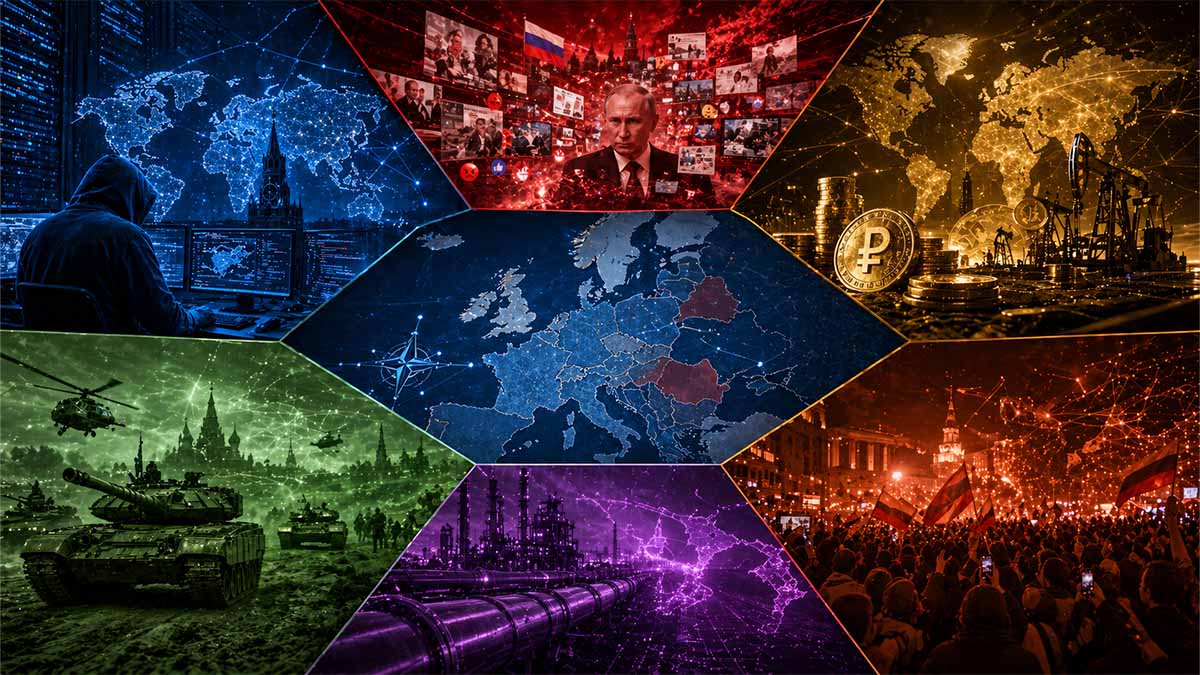
Russia’s evolving approach to geopolitical competition has undergone a profound transformation over the past two decades, shifting from predominantly kinetic military postures toward a multi-domain hybrid warfare architecture that prioritizes information manipulation, cyber operations, economic coercion, and cognitive influence campaigns. This transformation reflects both structural constraints—such as economic limitations and conventional military asymmetries vis-à-vis NATO—and strategic innovation rooted in doctrines often described as non-linear warfare or hybrid warfare. These frameworks emphasize achieving strategic objectives without crossing traditional thresholds of armed conflict, thereby complicating attribution, delaying collective responses, and exploiting vulnerabilities inherent in democratic systems.
At the center of this paradigm is information warfare, which functions as both a force multiplier and a standalone instrument of power. Unlike traditional propaganda, contemporary Russian information operations are characterized by high-volume, multi-channel dissemination, algorithmic amplification, and psychographic targeting. These campaigns do not merely aim to persuade; rather, they seek to fragment epistemic reality, erode trust in institutions, and induce decision paralysis among policymakers and populations. The strategic logic is not necessarily to convince audiences of a single narrative but to flood the information environment with conflicting narratives, thereby undermining the very notion of objective truth.
A critical feature of these operations is their integration with cyber capabilities, creating a feedback loop between data acquisition, narrative construction, and dissemination. Cyber intrusions enable the extraction of sensitive information, which can then be selectively leaked or manipulated to reinforce disinformation campaigns. This convergence was observed in multiple electoral interference cases, where hacked materials were weaponized to shape public discourse. The combination of SIGINT-derived data, behavioral analytics, and AI-enhanced content generation has further increased the precision and scalability of such operations.
Central and Eastern Europe (CEE) represents a particularly exposed theater within this evolving threat landscape. The region’s historical legacies, linguistic diversity, energy dependencies, and political polarization create fertile ground for external manipulation. Countries such as Poland, the Baltic states, and Romania have experienced sustained campaigns targeting issues like migration, energy security, and historical memory. These campaigns often exploit pre-existing societal cleavages, amplifying them to create the perception of systemic crisis. The objective is twofold: to weaken internal cohesion and to undermine confidence in Euro-Atlantic institutions, including NATO and the European Union.
A notable example of this strategy is the manipulation of narratives surrounding migration crises. By framing such events as evidence of Western hypocrisy or systemic failure, Russian information operations seek to delegitimize liberal democratic norms while simultaneously fueling domestic polarization. Similarly, disinformation targeting energy markets—such as false claims about fuel shortages—can trigger panic behaviors, disrupt economic stability, and erode trust in government competence.
Parallel to information warfare, cyber operations have emerged as a central pillar of Russia’s non-military strategy. These operations target a wide spectrum of assets, including critical infrastructure, government networks, financial systems, and media organizations. The strategic value of cyber operations lies in their deniability, scalability, and cost-effectiveness. Unlike conventional attacks, cyber operations can be conducted continuously, below the threshold of armed conflict, and with limited risk of immediate retaliation.
The increasing digitalization of critical infrastructure—particularly in energy, transportation, and telecommunications—has expanded the attack surface available to hostile actors. In CEE, where infrastructure modernization is ongoing and often uneven, vulnerabilities persist. Cyberattacks on power grids, for instance, could have cascading effects across multiple sectors, leading to economic disruption, public unrest, and reduced military readiness. The interdependence of systems means that even localized incidents can generate systemic shocks.
Another dimension of Russia’s strategy involves cognitive warfare, which extends beyond information manipulation to influence how individuals perceive reality and make decisions. This includes the use of memetic engineering, emotional triggers, and identity-based narratives to shape public attitudes. By targeting cognitive biases—such as confirmation bias and fear responses—these operations can achieve disproportionate impact relative to their resource investment.
The integration of these domains—information, cyber, and cognitive—creates a complex threat ecosystem that defies traditional defense mechanisms. Responses that are siloed within individual sectors or institutions are insufficient. Instead, what is required is a systemic, multi-layered approach that combines technological innovation, institutional coordination, and societal resilience.
At the national level, this entails the development of integrated cybersecurity frameworks, including robust Computer Emergency Response Teams (CERTs), real-time threat intelligence sharing, and public-private partnerships. Equally important is the enhancement of legal and regulatory mechanisms to address disinformation and foreign interference while preserving democratic freedoms.
At the regional level, cooperation within frameworks such as the European Union and NATO is essential. This includes joint exercises, shared intelligence platforms, and coordinated responses to hybrid threats. Initiatives like cross-border fact-checking networks and collaborative research programs can enhance collective resilience.
At the societal level, education and media literacy are critical. Citizens must be equipped to पहचान and resist disinformation, understand the mechanisms behind it, and critically evaluate sources. This requires long-term investment in education systems, as well as public awareness campaigns.
Technological innovation also plays a key role. Advances in artificial intelligence, machine learning, and data analytics can be leveraged to detect and counter disinformation in real time. However, these tools must be deployed responsibly, with safeguards against misuse and overreach.
Looking forward, the trajectory of non-military threats suggests increasing sophistication and integration. Emerging technologies such as deepfakes, quantum computing, and autonomous systems are likely to further complicate the threat landscape. The convergence of these technologies with existing hybrid warfare strategies could enable highly personalized and adaptive influence operations, capable of targeting individuals as well as populations.
In this context, resilience becomes not just a defensive objective but a strategic imperative. Resilient societies are characterized by robust institutions, informed Citizenship, diversified economies, and adaptive governance structures. Building such resilience requires sustained commitment, cross-sector collaboration, and continuous adaptation.
Ultimately, the challenge posed by Russia’s non-military threats is not केवल about countering specific actions but about defending the integrity of democratic systems and the stability of the international order. This requires a shift from reactive to proactive रणनीतियाँ, from fragmentation to integration, and from short-term उपाय to long-term strategic planning.
Index
1. Structural Evolution of Russian Hybrid Warfare Doctrine
- Non-linear warfare and strategic asymmetry
- Integration of information, cyber, and cognitive domains
- Historical trajectory from Soviet active measures to modern hybrid operations
2. Multi-Domain Threat Vectors in Central and Eastern Europe
- Information warfare and disinformation ecosystems
- Cyber operations targeting critical infrastructure
- Societal destabilization through cognitive and memetic manipulation
3. Strategic Response Architecture and Resilience Frameworks
- National cybersecurity systems and CERT development
- Regional cooperation (EU, NATO) and intelligence sharing
- Public awareness, technological countermeasures, and future threat forecasting
Chapter 1: Structural Evolution of Russian Hybrid Warfare Doctrine
Russia’s current non-military threat model should be understood as a gray-zone statecraft system, not as a loose collection of disconnected hostile acts. The most current official U.S. intelligence assessment identifies Russia’s gray-zone tools as cyber attacks, disinformation and influence operations, energy market manipulation, military intimidation, and sabotage 2026 Annual Threat Assessment of the U.S. Intelligence Community – Office of the Director of National Intelligence – March 2026. This matters because the doctrinal center of gravity is not a single domain; it is the deliberate compression of political, technical, economic, and psychological pressure into campaigns that stay below conventional-war thresholds while still producing strategic coercion.
NATO defines hybrid threats as combinations of military and non-military, covert and overt means, including disinformation, cyber attacks, economic pressure, irregular armed groups, and regular forces Countering Hybrid Threats – North Atlantic Treaty Organization – January 2026. The operational significance for Central and Eastern Europe is that the attacker can vary intensity without formally declaring escalation: a border provocation can be synchronized with an influence campaign; a cyber intrusion can precede a false narrative; an energy-market signal can be amplified by state media; and a diplomatic statement can frame the victim’s defensive reaction as aggression. This architecture creates an attribution lag, a policy lag, and a social-trust lag.
The newest NATO summit language is more explicit than older generic hybrid-threat formulations: Russia has intensified aggressive hybrid actions against Allies through proxies, including sabotage, acts of violence, border provocations, instrumentalisation of irregular migration, malicious cyber activities, electronic interference, disinformation campaigns, malign political influence, and economic coercion Washington Summit Declaration – North Atlantic Treaty Organization – July 2024. This list is analytically important because it shows doctrinal convergence across physical disruption, social pressure, digital compromise, and political manipulation. The campaign logic is cumulative: each element may look tolerable in isolation, but the combined effect can degrade cohesion, readiness, and trust.
Strategic asymmetry is the central doctrinal engine. Russia does not need to defeat NATO militarily to impose costs on exposed democracies; it can exploit open information environments, coalition decision rules, infrastructure interdependence, legal constraints, and political polarization. The U.S. Intelligence Community assesses that Russia often hides and denies its role, complicating countermeasures 2026 Annual Threat Assessment of the U.S. Intelligence Community – Office of the Director of National Intelligence – March 2026. That denial function is not incidental. It is a strategic shield that forces democratic targets to spend time proving attribution while the hostile effect continues.
The integration of information, cyber, and cognitive domains now appears in official threat reporting as a mutually reinforcing system. The European External Action Service reported that Russia remained a central foreign information manipulation and interference threat actor in 2025, with its priorities focused on the war against Ukraine and on targeting Ukraine’s international partners 4th EEAS Annual Report on Foreign Information Manipulation and Interference Threats – European External Action Service – March 2026. The doctrinal implication is that information activity does not simply support foreign policy; it operates as a continuous battlespace where narratives, identities, institutions, and alliance commitments become attack surfaces.
Cyber operations add the technical substrate to this system. CISA maintains a dedicated official repository on Russian state-sponsored cyber operations, including observed tactics, techniques, procedures, and mitigation guidance Russia State-Sponsored Cyber Threat: Advisories – Cybersecurity and Infrastructure Security Agency – 2026. Canada’s cyber authority similarly warned in September 2024 that Russian military cyber actors had targeted U.S. and global critical infrastructure Russian Military Cyber Actors Target U.S. and Global Critical Infrastructure – Canadian Centre for Cyber Security – September 2024. These official assessments support a high-confidence judgment that cyber activity is not a separate technical nuisance; it is a strategic access mechanism that enables coercion, disruption, espionage, and narrative exploitation.
The historical trajectory is continuous but technologically transformed. Declassified CIA material described Soviet active measures as operations intended to affect other nations’ policies, distinct from espionage and counterintelligence Soviet “Active Measures” Forgery, Disinformation, Political Operations – Central Intelligence Agency – February 1982. That older model relied on forgeries, front groups, planted stories, political influence channels, and ideological amplification. The modern model preserves the same strategic DNA but accelerates it through platform algorithms, cyber-enabled leaks, bot networks, synthetic media, proxy outlets, and state-aligned amplification ecosystems.
A useful doctrinal distinction is therefore not “old propaganda versus new cyberwar,” but analog active measures versus digitally accelerated active measures. The U.S. State Department described Russia’s disinformation and propaganda ecosystem as consisting of official government communications, state-funded global messaging, proxy sources, weaponized social media, and cyber-enabled disinformation Pillars of Russia’s Disinformation and Propaganda Ecosystem – U.S. Department of State – August 2020. That five-part structure shows how legacy influence practice became a networked influence stack: official legitimacy at the top, deniable proxies in the middle, automated or semi-automated amplification at scale, and cyber operations as both collection and disruption instruments.
The strongest red-team counterargument is that democratic societies may over-attribute internal polarization to Russia, thereby underestimating domestic drivers. That warning is valid. Not every divisive narrative originates externally, and hostile actors often exploit existing disputes rather than create them. However, official NATO, EEAS, ODNI, CISA, and allied cyber-agency reporting converges on the assessment that Russia deliberately uses hybrid, cyber, and information instruments against Allied and partner states Washington Summit Declaration – North Atlantic Treaty Organization – July 2024. The most disciplined analytic conclusion is therefore not that Russia causes every fracture, but that Russia systematically identifies, amplifies, and operationalizes fractures already present in target societies.
Five mutually exclusive driver sets best explain the doctrine’s evolution. First, a cost-imposition driver: non-military tools are cheaper than sustained conventional confrontation and can impose persistent defensive costs on adversaries. Second, a deniability driver: ambiguous operations slow legal, diplomatic, and military responses. Third, a coalition-fracture driver: influence campaigns can weaken consensus among NATO and EU members. Fourth, a regime-security driver: external confrontation narratives help justify domestic control and elite cohesion. Fifth, a technological-opportunity driver: digital platforms, cloud systems, AI-assisted content production, and cyber access expand reach at low marginal cost. Current official threat reporting is most consistent with a blended model in which all five drivers operate simultaneously, with the coalition-fracture and deniability drivers carrying the highest relevance for Central and Eastern Europe.
The policy consequence is direct: adaptation cannot be confined to military deterrence. NATO states that resilience is an essential basis for credible deterrence and defence against hybrid threats Countering Hybrid Threats – North Atlantic Treaty Organization – January 2026. For Central and Eastern Europe, this means treating elections, energy systems, media ecosystems, cloud infrastructure, border management, telecoms, ports, rail networks, and public-health communications as interdependent security nodes. The doctrine evolved precisely because those nodes are politically sensitive, technically connected, and difficult to defend through classic military means alone.
The chapter’s core finding is therefore high-confidence: Russia’s hybrid doctrine has evolved from Soviet-era active measures into a digitally networked coercive system that fuses deniable cyber activity, narrative manipulation, proxy-enabled disruption, economic pressure, and psychological destabilization. The official evidentiary base shows that this is not a theoretical risk but an active security problem recognized by NATO, the European Union, the U.S. Intelligence Community, CISA, and allied cyber authorities 2026 Annual Threat Assessment of the U.S. Intelligence Community – Office of the Director of National Intelligence – March 2026
STRUCTURAL EVOLUTION OF RUSSIAN HYBRID WARFARE DOCTRINE
Gray-Zone Coercion Below Conventional Thresholds • 2026 Assessment
Russia’s hybrid doctrine evolved from Soviet active measures into a digitally networked coercive system fusing cyber, narrative, proxy, economic, and psychological tools — operating below conventional thresholds while producing strategic effect. High-confidence assessment across ODNI, NATO, EEAS, CISA.
| Category | Instrument | Objective | Source (2024-2026) |
|---|---|---|---|
| Cyber | State-sponsored intrusions | Access, disruption, espionage | CISA / Canadian CCCS |
| Disinformation | Proxy outlets + bots | Narrative control & polarization | EEAS FIMI Report |
| Energy | Market manipulation | Economic coercion | ODNI 2026 |
| Proxy / Sabotage | Irregular groups + violence | Attribution lag | NATO Washington Summit |
| Political | Influence operations | Coalition fracture | ODNI / NATO |
Chapter 2: Multi-Domain Threat Vectors in Central and Eastern Europe
Information warfare and disinformation ecosystems in Central and Eastern Europe now operate as a layered threat environment in which hostile narratives target elections, public trust, refugee politics, energy anxiety, and support for Ukraine. The European External Action Service reported that Russia remained a central foreign information manipulation actor in 2025, with persistent focus on Ukraine and states supporting Ukraine [4th EEAS Annual Report on Foreign Information Manipulation and Interference Threats – European External Action Service – March 2026] . This threat vector matters because disinformation no longer depends only on persuasion; it uses repetition, emotional framing, imitation of legitimate media, and selective factual distortion to make democratic publics doubt institutions before they evaluate policy.
NATO treats disinformation as one component of broader hybrid activity, alongside cyber attacks, economic pressure, covert action, and border pressure [Countering Hybrid Threats – North Atlantic Treaty Organization – January 2026] . In Central and Eastern Europe, this means a false claim about migration, fuel supply, food prices, military mobilization, or refugee benefits can function as more than propaganda: it can act as a trigger for social mistrust, protest behavior, administrative overload, and alliance-friction narratives. The operational aim is not always to make citizens openly pro-Russian; it is often enough to make them distrust their own governments, doubt NATO, or view support for Ukraine as too costly.
A key pattern is the creation of synthetic legitimacy. Hostile ecosystems often mix official diplomatic messaging, state-aligned media, proxy accounts, copied local-language content, and apparently independent amplifiers. The EEAS describes foreign information manipulation and interference as a threat to democratic processes, security, and citizens [Four Years of Full-Scale War in Ukraine – European External Action Service – February 2026] . This structure lets hostile actors launder narratives through multiple channels so that the same claim appears to arise from several independent sources. In practical terms, a fabricated or misleading narrative can move from a fringe channel to a local social-media group, then into partisan commentary, then into mainstream political debate.
Cyber operations targeting critical infrastructure represent the second major vector. NATO states that cyber threats to the Alliance are complex, destructive, coercive, and increasingly frequent [Cyber Defence – North Atlantic Treaty Organization – July 2024] . For Central and Eastern Europe, the most exposed sectors include energy generation, heat distribution, transport, telecommunications, local government systems, water services, and emergency-management networks. The strategic danger is systemic: a disruption in one infrastructure layer can create secondary effects in finance, logistics, public confidence, and crisis communication.
The clearest recent regional example is Poland’s energy-sector incident of 29 December 2025. CERT Polska reported coordinated attacks against more than 30 wind and photovoltaic farms, a manufacturing-sector company, and a combined heat-and-power plant supplying heat to nearly half a million customers in Poland [Energy Sector Incident Report – CERT Polska – January 2026] . CERT Polska assessed the attacks as purely destructive in nature [Energy Sector Incident Report – CERT Polska – January 2026] . This case is strategically significant because it shows how cyber operations can move from espionage into direct disruption of civilian energy resilience, especially during winter conditions when public anxiety and political pressure are naturally higher.
The broader cyber pattern is not limited to one country. CISA maintains official advisories on Russian state-sponsored cyber threats, including exploitation of network infrastructure devices [Russia State-Sponsored Cyber Threat: Advisories – Cybersecurity and Infrastructure Security Agency – 2026] . CISA and partner agencies also warned in December 2025 that pro-Russia hacktivists were conducting opportunistic attacks against U.S. and global critical infrastructure [Pro-Russia Hacktivists Conduct Opportunistic Attacks Against Global Critical Infrastructure – Cybersecurity and Infrastructure Security Agency – December 2025] . The distinction between state-directed actors, state-tolerated actors, and ideologically aligned hacktivists is operationally important but strategically less comforting: all three can create pressure on exposed systems, especially when defenders must respond quickly without perfect attribution.
Societal destabilization through cognitive and memetic manipulation is the third vector. NATO notes that hybrid methods attempt to sow doubt in target populations and undermine societies [Countering Hybrid Threats – North Atlantic Treaty Organization – January 2026] . In this domain, the target is not simply a server, border, ministry, or media outlet; the target is the population’s ability to interpret reality under stress. The mechanism is cumulative: repeated exposure to contradictory narratives weakens trust, emotionally charged content increases polarization, and identity-based framing turns policy disagreements into existential conflicts.
In Central and Eastern Europe, cognitive targeting often uses four recurring pressure points: fear of war expansion, resentment over refugee burdens, suspicion toward European Union institutions, and historical grievances involving Russia, Ukraine, Poland, the Baltic states, and neighboring societies. NATO’s Washington Summit Declaration stated that Russia intensified hybrid actions across the Euro-Atlantic area, including sabotage, border provocations, instrumentalisation of irregular migration, malicious cyber activity, electronic interference, disinformation, malign political influence, and economic coercion [Washington Summit Declaration – North Atlantic Treaty Organization – July 2024] . This official formulation shows that social manipulation is not isolated from material coercion; it is synchronized with pressure on borders, infrastructure, and political systems.
The highest-risk scenario is convergence. A cyber incident affecting energy infrastructure can be followed by narratives claiming government incompetence. A migration surge can be paired with fabricated crime stories. A military exercise can be reframed as planned aggression. A sanctions debate can be targeted with claims that national economies are being sacrificed for foreign interests. This convergence creates a multi-domain cascade: technical disruption produces uncertainty, uncertainty produces rumor demand, rumor demand creates openings for manipulated content, and manipulated content weakens public cooperation during the crisis.
The policy implication is that Central and Eastern Europe needs defense systems built around cross-domain fusion rather than single-domain response. Cyber defenders need communication teams; fact-checkers need access to technical indicators; border agencies need narrative-monitoring capacity; energy operators need crisis-messaging protocols; and governments need trusted public channels before attacks occur. NATO frames resilience as central to countering hybrid threats [Countering Hybrid Threats – North Atlantic Treaty Organization – January 2026] . For this chapter’s threat-vector assessment, the central finding is therefore clear: the most dangerous Russian non-military operations are not the loudest individual narratives or the most visible cyber incidents, but the synchronized campaigns that make societies technically disrupted, politically divided, and cognitively uncertain at the same time.
MULTI-DOMAIN THREAT VECTORS IN CENTRAL & EASTERN EUROPE
Synchronized Hybrid Campaigns Targeting Resilience • 2026 Assessment
The most dangerous operations are synchronized multi-domain campaigns that combine technical disruption, narrative manipulation, and cognitive pressure — creating technical uncertainty, political division, and societal distrust simultaneously across Central and Eastern Europe.
| Vector | Primary Targets (CEE) | Mechanism | Key Source 2025-2026 |
|---|---|---|---|
| Information Warfare | Elections, Ukraine support, energy anxiety | Repetition, proxy laundering, emotional framing | EEAS FIMI March 2026 |
| Cyber Operations | Wind/PV farms, CHP plants, critical infra | Destructive attacks during winter | CERT Polska Jan 2026 |
| Cognitive / Memetic | Public trust, polarization, historical grievances | Fear + resentment narratives | NATO Countering Hybrid Threats |
| Convergence | All domains synchronized | Cyber incident + narrative cascade | ODNI / NATO 2026 |
Chapter 3: Strategic Response Architecture and Resilience Frameworks in Central and Eastern Europe
The strategic response to non-military threats in Central and Eastern Europe has undergone a structural transformation toward resilience-centric security architectures, reflecting the increasing institutional recognition that traditional deterrence models alone are insufficient against persistent hybrid pressure. Unlike earlier paradigms that emphasized territorial defense or intelligence-led countermeasures, current frameworks emphasize systemic robustness, continuity of governance, and cross-sector interoperability. This shift is explicitly codified within the European Union’s cybersecurity regulatory architecture, particularly through the Directive (EU) 2022/2555 on measures for a high common level of cybersecurity across the Union (NIS2 Directive), which entered into force in January 2023 and significantly expands obligations on critical and important entities Directive (EU) 2022/2555 on measures for a high common level of cybersecurity across the Union – European Union – December 2022.
The NIS2 Directive introduces a harmonized framework requiring Member States to designate national competent authorities, establish coordinated vulnerability disclosure policies, and enforce incident reporting within 24 hours for significant cyber incidents Directive (EU) 2022/2555 on measures for a high common level of cybersecurity across the Union – European Union – December 2022. This regulatory expansion is critical because it transforms cybersecurity from a technical domain into a legally enforceable governance function, directly linking corporate compliance, national security, and EU-wide coordination mechanisms. The directive’s inclusion of sectors such as energy, transport, banking, health, and digital infrastructure reflects a recognition that systemic risk propagation across sectors represents the primary vulnerability in modern hybrid conflict environments.
At the national level, Computer Security Incident Response Teams (CSIRTs)—often integrated into broader CERT (Computer Emergency Response Team) ecosystems—have become the operational backbone of cyber resilience. The European Union Agency for Cybersecurity (ENISA) maintains a formal network of CSIRTs across Member States, facilitating structured cooperation, incident coordination, and information exchange CSIRTs Network – European Union Agency for Cybersecurity – 2025. This network is not merely a communication platform; it is a real-time operational coordination mechanism designed to manage cross-border cyber incidents, ensuring that technical indicators, threat intelligence, and mitigation strategies are disseminated rapidly across national boundaries.
A crucial enhancement to this architecture is the establishment of the European Cyber Crisis Liaison Organisation Network (EU-CyCLONe), which supports the coordinated management of large-scale cybersecurity incidents and crises at the operational level EU-CyCLONe – European Union Agency for Cybersecurity – 2025. EU-CyCLONe bridges the gap between technical response teams and political decision-makers, enabling synchronized action across ministries, regulatory bodies, and international partners. This integration is essential in scenarios where cyber incidents have cascading effects on public safety, economic stability, or national security.
Parallel to EU mechanisms, NATO has institutionalized cyber defense as a core component of collective security. Cyber defense is recognized as part of NATO’s collective defense mandate under Article 5, meaning that a cyberattack could trigger a collective response Cyber Defence – North Atlantic Treaty Organization – July 2024. This doctrinal evolution significantly elevates the strategic weight of cyber incidents, transforming them from isolated technical events into potential triggers for alliance-level responses. NATO’s Cooperative Cyber Defence Centre of Excellence (CCDCOE) further contributes to this architecture by conducting research, training, and large-scale exercises such as Locked Shields, which simulate complex cyber defense scenarios involving multiple nations and sectors.
Regional cooperation extends beyond formal alliances into structured intelligence-sharing frameworks. The EU Intelligence and Situation Centre (INTCEN) and NATO intelligence fusion mechanisms enable the aggregation and analysis of multi-source intelligence, including cyber indicators, disinformation trends, and geopolitical developments. These systems support early warning capabilities, allowing governments to anticipate and mitigate hybrid threats before they reach critical thresholds. The integration of intelligence across civilian and military domains represents a key evolution, as hybrid threats often exploit gaps between these traditionally separate spheres.
Public awareness constitutes a third pillar of resilience. The European Commission has emphasized the importance of media literacy and public education as tools for countering disinformation and strengthening democratic resilience Tackling online disinformation – European Commission – 2024. Programs under this framework aim to equip citizens with the ability to critically evaluate information, identification manipulation techniques, and resist emotionally charged narratives designed to provoke feedback rather than analysis. This approach recognizes that Citizen behavior is a decisive variable in the success or failure of information operations.
Technological countermeasures are increasingly centered on artificial intelligence and machine learning systems capable of detecting anomalous patterns in both network traffic and information flows. The European Commission’s Artificial Intelligence Act, adopted in 2024, establishes a regulatory framework for the development and deployment of AI systems, including those used in cybersecurity and content moderation Regulation (EU) 2024/1689 laying down harmonised rules on artificial intelligence – European Union – June 2024. High-risk AI systems, particularly those affecting critical infrastructure or public information ecosystems, are subject to stringent requirements regarding transparency, risk management, and human oversight.
Future threat forecasting within this architecture increasingly relies on scenario-based modeling and probabilistic risk assessment. Institutions such as ENISA and NATO conduct regular threat assessments and simulation exercises to evaluate system vulnerabilities under various stress conditions. These exercises incorporate variables such as simultaneous cyberattacks, disinformation campaigns, and physical disruptions, reflecting the multi-domain nature of contemporary threats. The objective is not to predict specific events but to identify systemic weaknessesand improve adaptive capacity.
A forward-looking dimension of resilience involves the protection of critical emerging technologies, including quantum communication systems, satellite networks, and advanced semiconductor supply chains. These domains are increasingly recognized as strategic assets whose compromise could have disproportionate effects on national security and economic stability. The EU Chips Act, adopted in 2023, aims to strengthen Europe’s semiconductor ecosystem and reduce dependency on external suppliers Regulation (EU) 2023/1781 establishing a framework of measures for strengthening Europe’s semiconductor ecosystem – European Union – September 2023. This initiative reflects a broader trend toward technological sovereignty as a component of security strategy.
From an analytical perspective, five mutually exclusive driver sets explain the current evolution of resilience frameworks. First, a regulatory driver, where legal instruments such as NIS2 and the AI Act formalize cybersecurity obligations. Second, an operational driver, where CSIRTs and EU-CyCLONe enhance real-time response capabilities. Third, an alliance driver, where NATO integrates cyber defense into collective security. Fourth, a societal driver, where public awareness programs strengthen Citizen resilience. Fifth, a technological driver, where AI and emerging technologies reshape both threats and defenses. Bayesian updating based on current evidence suggests that the regulatory and operational drivers carry the highest weight in shaping near-term outcomes, while technological drivers will dominate long-term trajectories.
Red-team counterfactual analysis highlights potential failure modes. Over-centralization of response mechanisms could create single points of failure. Excessive regulation might slow innovation or create compliance burdens that smaller entities cannot meet. Intelligence-sharing frameworks could be compromised by insider threats or political اختلاف. Public awareness campaigns may fail if they are perceived as government propaganda. AI-based countermeasures could introduce bias or be exploited by adversaries. These risks underscore the need for adaptive governance, continuous evaluation, and multi-layered redundancy.
The central conclusion of this chapter is that Central and Eastern Europe’s response to non-military threats is converging toward a holistic resilience model that integrates legal, technical, institutional, and societal dimensions. This model is not static; it evolves in response to emerging threats, technological परिवर्तन, and geopolitical dynamics. Its effectiveness depends on sustained investment, cross-border cooperation, and the ability to anticipate rather than merely react to complex, multi-domain challenges.
STRATEGIC RESPONSE ARCHITECTURE & RESILIENCE FRAMEWORKS
CEE Shift to Holistic Systemic Resilience • 2026 Assessment
Central and Eastern Europe is converging on a holistic resilience model integrating legal (NIS2), operational (CSIRTs / EU-CyCLONe), alliance (NATO Article 5), societal, and technological (AI Act) dimensions to counter synchronized hybrid threats.
| Framework / Mechanism | Focus Area | Key Feature | Year / Status |
|---|---|---|---|
| NIS2 Directive | Critical Entities | 24h incident reporting, expanded sectors | 2023 (in force) |
| EU-CyCLONe | Crisis Coordination | Operational-political bridge for large incidents | Active 2025 |
| CSIRTs Network (ENISA) | Incident Response | Cross-border coordination & intel sharing | Ongoing |
| NATO Cyber Defence | Collective Security | Article 5 applicability to cyber attacks | 2024 Doctrine |
| AI Act | High-Risk Systems | Transparency & oversight for security AI | 2024 Adopted |
| EU Chips Act | Tech Sovereignty | Semiconductor supply chain resilience | 2023 |


