















The resurgence of warfare in Yemen is transforming a fragmented regional confrontation into a strategic challenge for international shipping, European industrial competitiveness, energy security, military commitments and the political architecture of the Middle East.
Executive Summary — Bottom Line Up Front
The renewed war in Yemen has moved beyond the conventional boundaries of an internal conflict. As of October 2026, the military struggle surrounding Taiz, Mocha and Bab al-Mandab is directly connected to Saudi Arabia’s territorial security, the political future of southern Yemen, Iran’s regional influence and Europe’s ability to preserve commercial access between the Mediterranean and the Indian Ocean.
The United Nations confirmed on 9 October that Yemen had returned to full-scale war, with fighting spreading across multiple fronts and strikes affecting civilian and energy infrastructure in Saudi Arabia.
The central strategic assessment is that the conflict now constitutes an interconnected land, maritime and economic security crisis, rather than an isolated military campaign. Control of Yemen’s coastline, the fragmentation of anti-Houthi armed formations, the vulnerability of Saudi infrastructure and the deployment of external military assistance create mutually reinforcing escalation risks.
For Europe, the consequences extend well beyond naval security. They encompass the Suez Canal commercial corridor, industrial supply chains, maritime insurance, container shipping, energy transportation, defence expenditure and relations with Gulf partners.
European exposure is particularly consequential for Italy, France, Germany and the United Kingdom, although their vulnerabilities and military responsibilities differ significantly.
The principal uncertainty is whether the conflict will consolidate into a prolonged struggle over Yemen’s political and maritime geography or whether military exhaustion, Saudi diplomatic recalibration and international pressure can restore negotiations before the deterioration becomes structurally irreversible.
Yemen, the Red Sea and Europe’s Economic Security: The Price of Defending Trade Without Ending the War
Europe is spending military resources to defend a maritime corridor whose security ultimately depends on a political settlement it cannot impose. The renewed war in Yemen has exposed this contradiction at a moment when European governments face rising energy costs, pressure on industrial competitiveness and competing defence commitments. On 9 October 2026, the United Nations confirmed Yemen’s return to full-scale warfare, while Germany subsequently renewed its participation in the EU’s Red Sea naval mission. Saudi Arabia is simultaneously expanding its regional defence arrangements as attacks threaten its economic infrastructure. The governing problem is that naval protection can reduce immediate losses, but cannot restore commercial confidence while Yemen’s fragmented political authority and capacity for cross-border coercion remain intact. The consequences are increasingly measurable in shipping routes, public expenditure, industrial logistics and the strategic choices confronting European governments.
The shipping figures expose the cost of military uncertainty
The most revealing measure of the Red Sea crisis is not the number of missiles launched or intercepted, but the redistribution of international maritime traffic. According to the US Energy Information Administration’s March 2026 assessment, oil and petroleum-product flows through Bab al-Mandab declined from 9.3 million barrels per day in 2023 to 4.2 million during the first half of 2025, a reduction of approximately 55%. Traffic through the Suez Canal and SUMED system fell from 8.8 million to 4.9 million barrels per day over the same reference periods. Meanwhile, petroleum movements around the Cape of Good Hope increased from 6.2 million to 9.1 million barrels per day.
These figures describe historical route adjustments rather than the final commercial effects of the October 2026 escalation. Their economic meaning is nevertheless considerable: maritime trade does not need to stop for insecurity to impose costs. It can continue through longer voyages, additional vessel employment, higher fuel consumption and less predictable delivery schedules. UN Trade and Development’s 2025 maritime review found that Suez Canal tonnage in May 2025 remained approximately 70% below its 2023 level, while global shipping ton-miles had increased by 5.9% during 2024, reflecting a disproportionate expansion of transportation distances relative to cargo volumes.
This creates a cost mechanism that conventional military indicators fail to capture. A naval force may successfully defend individual merchant ships while container carriers continue to avoid the corridor because voyage planning, insurance and crew protection depend on expectations of sustained security. The International Maritime Organization’s August 2026 warning, following a fatal attack near Al Mokha, demonstrated why commercial operators cannot treat the existence of naval protection as equivalent to the disappearance of operational risk.
Europe is financing protection without eliminating the threat
The European Union extended the mandate of EUNAVFOR ASPIDES on 23 February 2026 until 28 February 2027, allocating a financial reference amount of nearly €15 million for common costs over the twelve-month period beginning in March. The operation, established under Council Decision (CFSP) 2024/583, remains defensive: its responsibilities concern freedom of navigation, maritime awareness, accompaniment and protection of commercial shipping. That financial reference does not include the complete national costs of deploying, maintaining and operating participating naval assets. Council of the European Union, February 2026.
Germany’s parliamentary decision makes the fiscal and institutional constraints especially visible. On 15 October 2026, the Bundestag approved continued participation by 421 votes to 66, with 90 abstentions. The national mandate permits up to 350 Bundeswehr personnel until the end of October 2027, with approximately €18.9 million in additional deployment expenditure. The personnel figure represents an authorised ceiling, not permanently deployed strength; the expenditure is a national estimate, not the cost of the entire European mission. Deutscher Bundestag, October 2026.
The contradiction is operational as well as financial. Defensive warships can intercept weapons and accompany selected vessels, but they cannot guarantee security across every commercial route or eliminate mobile launch capabilities situated inside Yemen. Expanding the mission toward offensive operations would introduce new questions of international legal authority, target identification, civilian protection and retaliation. Maintaining its existing scope leaves Europe dependent on the eventual reduction of threats through developments it cannot determine militarily.
This explains the importance of the EU Council’s 30 March 2026 decision to expand coordination between ASPIDES, ATALANTA and regional maritime-capacity programmes. The additional emphasis on coast-guard cooperation, information exchange and suspicious activity involving submarine infrastructure recognises that protecting navigation requires more than permanently assigning expensive warships to threatened waters. Council of the European Union, March 2026.
Industrial competitiveness is being taxed through logistics
Europe’s economic exposure is more substantial than the immediate freight bill. In 2025, the European Union imported €559.4 billion of goods from China, including €164.9 billion in electrical machinery and equipment and €106.5 billion in machinery and mechanical appliances. These figures, published by Eurostat in April 2026, do not identify the maritime route used by every shipment. They do, however, establish the scale of industrial relationships potentially affected when a principal Asia–Europe shipping corridor becomes less reliable.
The transmission mechanism is especially damaging where low-value components support high-value production. A delayed electronic assembly, chemical intermediate or specialised machinery component can interrupt a manufacturing process whose economic value substantially exceeds the price of the missing item. Companies then face a choice between larger inventories, alternative suppliers, more expensive transportation or a higher probability of production interruptions. Each response reduces capital efficiency or increases operating expenditure.
Italy is particularly exposed to the commercial geography of the Mediterranean. On 20 September 2026, Foreign Minister Antonio Tajani stated that approximately 40% of Italy’s commercial maritime traffic and 60% of its goods exports to Asia passed through the Red Sea. These are ministerial estimates rather than independently harmonised route statistics, but they identify the government’s assessment of the national interest at stake. For Mediterranean ports such as Gioia Tauro, Genoa and Trieste, persistent rerouting may change carrier schedules, transshipment patterns and the competitiveness of inland logistics connections. Italian Ministry of Foreign Affairs, September 2026.
Germany faces a different transmission channel through automotive production, chemicals, machinery and imported industrial inputs. France combines commercial exposure with naval commitments across the Mediterranean and Indian Ocean. The United Kingdom’s interests include international maritime services and direct defence cooperation with Saudi Arabia. On 22 September 2026, the British Ministry of Defence announced an additional RAF Voyager refuelling aircraft to support Saudi defensive operations against missile and drone attacks, placing London in a different operational position from EU governments whose participation is centred on ASPIDES. UK Ministry of Defence, September 2026.
The consequence is that European states share an interest in restoring navigation but do not face identical economic costs or military obligations. The EU can coordinate defensive operations and industrial policy; it cannot automatically convert national naval capabilities, supply-chain decisions and bilateral Gulf relationships into a single command.
Saudi Arabia’s security strategy creates another fiscal constraint
The European dilemma is inseparable from Saudi Arabia’s changing security position. Riyadh must protect national infrastructure while supporting Yemeni formations whose political objectives and command structures remain fragmented. Reporting in February 2026 described Saudi plans to allocate nearly $3 billion to Yemeni military and civilian salaries, including approximately $1 billion for southern fighters previously financed by the United Arab Emirates. These were reported financial commitments, not audited evidence of complete disbursement. Reuters, February 2026.
The amounts matter because military financing can preserve allied formations without producing the political integration required for a stable national authority. Southern independence constituencies, government-aligned forces and other armed organisations do not necessarily share the same conception of Yemen’s future. Purchasing their continued participation cannot settle disputes over constitutional authority, security command or the distribution of revenues.
Saudi Arabia must also accommodate these commitments within its domestic economic priorities. In July 2026, the International Monetary Fund projected Saudi real GDP growth of 1.7% for 2026, a fiscal deficit of 3.7% of GDP and public debt equivalent to 32.1% of GDP. Those estimates preceded the October escalation and therefore do not measure its eventual fiscal consequences. They nonetheless reveal the constraints confronting a government attempting to finance economic diversification while increasing infrastructure protection and regional military expenditure. IMF Article IV Consultation, July 2026.
The establishment of a more formal defence framework among Saudi Arabia, Türkiye and Pakistan adds a further dimension. On 5 October 2026, the Makkah Alliance for Defense announced arrangements concerning collective defence commitments and the deployment of agreed capabilities within Saudi Arabia. The announcement established an institutional commitment; it did not independently demonstrate a completed multinational ground deployment inside Yemen. Republic of Türkiye Ministry of Foreign Affairs, October 2026.
The danger is that regional defence commitments become more extensive before the underlying Yemeni political dispute becomes more tractable. Stronger Saudi protection may reduce the effectiveness of cross-border coercion, but it does not automatically produce agreement among the forces competing for authority inside Yemen.
Humanitarian collapse is making any settlement more expensive
Europe’s fiscal exposure does not end with maritime protection or industrial disruption. The institutional deterioration inside Yemen is increasing the eventual cost of stabilisation. The United Nations’ March 2026 Humanitarian Needs and Response Plan estimated that more than 22 million people required assistance or protection, including 5.2 million internally displaced persons. Approximately 18.3 million people faced acute food insecurity, while more than 2.2 million children under five were acutely malnourished. Only 59.3% of health facilities were fully functional.
The UN requested $2.16 billion for the 2026 humanitarian response. That amount concerns specified assistance programmes, not the financing necessary to rebuild Yemen’s state institutions, recover lost production or establish sustainable public services. The fiscal distinction becomes critical when governments assume that funding emergency relief can substitute for financing institutional recovery.
Renewed hostilities accelerated the deterioration. On 16 September 2026, UNICEF reported more than 104,000 displacements in two weeks, interruptions affecting 26 supported health facilities and the closure or suspension of teaching at 243 schools, affecting more than 137,000 students. UNICEF, September 2026.
These losses carry economic consequences beyond the immediate emergency. A depleted health system, interrupted education and weakened public finances reduce the capacity of any future government to administer reconstruction, maintain infrastructure or restore lawful economic activity. The World Bank’s May 2026 estimate that government revenues amounted to only 5.6% of GDP in 2025 illustrates the narrow fiscal foundation available for recovery. World Bank Yemen Economic Monitor, May 2026.
The institutional problem is therefore cumulative: every additional period of conflict can increase future reconstruction requirements while diminishing the domestic capacity to finance them.
The next two years will determine who absorbs the losses
Between October 2026 and October 2028, Europe’s decisive choice will concern the relationship between continued maritime defence and investment in reducing the causes of persistent disruption. The EU’s ASPIDES mandate runs to February 2027, while Germany has authorised national participation through October 2027. Those deadlines will require governments to reconsider resources, operational outcomes and the balance between immediate protection and longer-term resilience.
The costs of continuing the present arrangement are distributed unevenly. Mediterranean ports and logistics operators face uncertainty over carrier networks. Manufacturers dependent on Asian inputs absorb longer delivery times, inventory expenses and financing requirements. Energy-intensive businesses remain exposed to the wider disruption of Gulf markets. European defence budgets must sustain naval deployments whose commercial benefits are difficult to isolate from changes in shipping and insurance behaviour.
The alternative is not an abrupt withdrawal from maritime protection. It is to connect the existing defensive commitment with measurable diplomatic and institutional objectives: monitored reductions in attacks, enforceable transport-access arrangements, transparent public financing and a political process involving the Yemeni authorities and southern constituencies whose competing claims have repeatedly obstructed settlement.
The UN Special Envoy’s 9 October 2026 assessment confirmed that Yemen had returned to full-scale war. That finding defines the limit of Europe’s current response: international naval forces can manage part of the commercial damage, but the fighting that regenerates the threat remains unresolved.
Over the next 12–24 months, failure to connect military protection with political stabilisation will leave the financial burden with European taxpayers, shipping operators, manufacturers and consumers, while Yemeni civilians continue bearing the more immediate costs of destroyed services and prolonged insecurity. The question for European governments is whether their next round of expenditure purchases measurable reductions in exposure or merely finances another year of adaptation to an unresolved war.
Navigational Index
PILLAR I — THE TRANSFORMATION OF YEMEN’S CONFLICT AND THE NEW ARABIAN SECURITY ORDER
- Chapter 1. Yemen’s Political Fragmentation, Historical Conflict Architecture and the Collapse of the Ceasefire Framework
- Chapter 2. Saudi Arabia’s Strategic Recalibration: Military Patronage, Religious Legitimacy and Domestic Security
- Chapter 3. Ansar Allah, Southern Armed Formations and the Changing Military Geography of Yemen
- Chapter 4. Iran, the United Arab Emirates, Pakistan, Türkiye and the Internationalisation of the Conflict
PILLAR II — THE RED SEA CRISIS AND EUROPE’S STRATEGIC EXPOSURE
- Chapter 5. Bab al-Mandab, the Suez Canal and the Emerging Vulnerability of Global Maritime Trade
- Chapter 6. Economic Transmission: Energy Security, Insurance, Shipping Costs, Supply Chains and European Industrial Competitiveness
- Chapter 7. Italy, France, Germany and the United Kingdom: Differentiated National Security and Economic Consequences
- Chapter 8. European Naval Operations, International Law, Military Escalation and the Limits of Maritime Protection
PILLAR III — SYSTEMIC RISKS, GEOPOLITICAL OUTLOOK AND EUROPEAN POLICY CHOICES
- Chapter 9. Armed Radicalisation, Proxy Networks, Humanitarian Fragmentation and Transnational Security
- Chapter 10. Strategic Scenarios for 2027–2031: Escalation, Fragmentation, Negotiated Stabilisation and Maritime Disruption
- Chapter 11. European Strategic Responses: Diplomacy, Naval Resilience, Industrial Adaptation and Gulf Security Cooperation
- Chapter 12. Final Net Assessment: The Future of Yemen, Arabian Peninsula Stability and Europe’s Southern Strategic Perimeter
Master Abstract
Yemen’s battlefield transformation and its geopolitical significance
The renewed military confrontation in Yemen is producing a transformation in the regional balance of power whose implications are not confined to the territorial ambitions of the principal Yemeni factions. The conflict involves a complex competition among an internationally recognised government, Ansar Allah, southern political and military movements, tribal constituencies and external governments pursuing objectives that are not necessarily compatible. Saudi Arabia seeks to prevent a hostile armed authority from threatening its southern frontier, civilian infrastructure and strategic economic assets, while preserving sufficient influence over Yemen’s future institutional settlement. Ansar Allah seeks to convert its military capabilities and territorial position into lasting political and strategic influence. Southern actors, meanwhile, confront an unresolved question of statehood, autonomy and their future relationship with institutions claiming authority over Yemen as a whole.
These competing objectives create the conditions for prolonged instability even if one side achieves significant battlefield gains. Tactical victories do not necessarily generate stable political authority, particularly where armed forces depend on different external sponsors, local patronage networks and incompatible constitutional visions. The central military problem is therefore inseparable from the institutional problem: Yemen cannot be stabilised through territorial redistribution alone without establishing an enforceable political framework capable of regulating armed authority, fiscal resources, regional autonomy and security guarantees.
The United Nations’ 9 October assessment illustrates the deterioration. Special Envoy Hans Grundberg described renewed hostilities along the western coast, around Taiz and Lahj, and across additional governorates, alongside the growing effects of aerial attacks and infrastructure damage.
The regionalisation of the conflict and Saudi Arabia’s strategic dilemma
The Saudi strategic dilemma is fundamentally different from the one Riyadh faced when it originally intervened in March 2015. After years of military expenditure, contested interventions, political negotiations and changes in coalition leadership, the kingdom must reconcile the requirement to defend its territory with its ambition to preserve economic credibility and international investment attractiveness.
This tension has become more acute as missile and unmanned aerial attacks demonstrate that Yemen’s armed conflict can impose costs well beyond Yemen’s borders. An adversary does not need to conquer Saudi territory to influence Saudi political calculations. It can instead threaten airports, industrial facilities, commercial shipping and investor confidence, thereby compelling Riyadh to allocate additional resources to defensive operations while potentially weakening its freedom to pursue other regional and domestic priorities.
The political fragmentation of the forces opposing Ansar Allah further complicates Saudi policy. Military organisations with divergent allegiances cannot automatically be converted into a coherent national force through external funding. Their ability to retain personnel, command discipline and territorial legitimacy depends on political incentives, local authority structures and prospects for post-conflict governance. Where ideological mobilisation is used to reinforce military cohesion, it may improve short-term recruitment within particular constituencies while simultaneously increasing sectarian antagonism and obstructing future reconciliation.
Religious rhetoric, therefore, must be examined as one instrument within a broader political economy of war, rather than treated as a sufficient explanation for the conflict. The public official record reviewed for this assessment establishes the renewed military confrontation and external security responses; it does not independently establish the full extent of alleged sectarian recruitment networks, clandestine financial transfers or foreign-fighter deployments. Those propositions require separate corroboration before they can support definitive institutional judgments.
Bab al-Mandab and the transformation of geographic control into international economic leverage
The geographical centre of gravity of the conflict is the maritime space connecting the Gulf of Aden with the southern Red Sea. Bab al-Mandab is not simply a military chokepoint adjacent to Yemeni territory. It forms part of the commercial system linking Asian production, Middle Eastern energy exports, East African markets, the Suez Canal and European maritime infrastructure.
The importance of this corridor derives from the concentration of commercial flows through a relatively constrained maritime passage. Armed movements operating near the coast can impose substantial economic disruption through missiles, drones, naval mines, surveillance and the credible threat of attack. Even where these capabilities do not produce a complete closure, uncertainty over vessel safety can alter commercial decisions concerning routing, insurance, vessel availability and contractual delivery schedules.
Germany’s Federal Foreign Office stated on 8 October 2026 that approximately 12% of global maritime trade normally passes through Bab al-Mandab, while warning that a simultaneous crisis affecting Bab al-Mandab and the Strait of Hormuz could endanger two critical routes of international commerce. This figure describes normal commercial exposure, not a measured share of traffic successfully transiting the strait during the current hostilities.
For Europe, this distinction is essential. The economic consequences of a prolonged maritime crisis can arise without a formal blockade. When shipowners choose longer routes around southern Africa, the resulting pressure on transport capacity, fuel consumption, freight expenditure and delivery reliability is transmitted across manufacturing and distribution networks.
UN Trade and Development documented precisely such effects during the earlier period of Red Sea disruption. Its 2025 Review of Maritime Transport reported that Suez Canal tonnage in May 2025 remained 70% below its 2023 level, while longer voyages contributed to a substantial increase in global transport distances. This is historical evidence of the corridor’s economic sensitivity, not a measurement of October 2026 traffic.
Europe’s exposure is structurally differentiated
European governments share an interest in maritime security, but the economic structure and national security implications of the Yemen crisis differ substantially.
Italy faces a particularly direct connection between Red Sea security and its Mediterranean logistics position. Disruption can affect the competitiveness of Italian ports, the economics of Asia–Europe container services and the reliability of manufacturing supply chains dependent on maritime transport. On 20 September 2026, Italian Foreign Minister Antonio Tajani stated that approximately 40% of Italy’s commercial maritime traffic and 60% of its goods exports to Asia pass through the Red Sea. These are ministerial estimates of national exposure rather than independently harmonised EU statistical measures.
France must evaluate the crisis through its responsibilities as a military power with maritime security interests extending across the Mediterranean, the Red Sea and the Indian Ocean. Its exposure encompasses defence deployments, commercial routes, regional diplomatic relations and the operational sustainability of naval commitments. Germany’s principal vulnerability arises from the intersection of export-oriented manufacturing, imported intermediate goods, energy costs and maritime supply-chain reliability. The United Kingdom faces the additional complication of an already explicit defensive military commitment to Saudi Arabia: on 22 September 2026, the British Ministry of Defence announced additional assistance involving an RAF Voyager air-to-air refuelling aircraft, alongside existing air-defence support.
These differences create a European coordination problem. A common naval presence can reduce certain immediate security risks, but it does not eliminate the commercial consequences of rerouting, guarantee the protection of every vessel or settle the political conflict that generates the threat.
The limits of naval deterrence and the requirement for political stabilisation
The European Union has established a formal military response through EUNAVFOR ASPIDES, whose mandate covers maritime security in the Red Sea, Bab al-Mandab, Gulf of Aden and other specified waters. The operation is principally defensive, focused on freedom of navigation, situational awareness, accompaniment and vessel protection within its authorised capabilities. The relevant Council decision, as amended in 2026, provides for the operation to continue until 28 February 2027.
The existence of this mission establishes an important European security capability, but also exposes the difference between protecting navigation and resolving the source of persistent maritime threats. Naval escorts and defensive interceptions can reduce vulnerability in particular encounters, while sustained disruption may continue if armed groups maintain the ability to launch attacks from inland positions, replenish equipment or exploit rapidly changing targeting opportunities.
Europe’s longer-term challenge is consequently political as much as military. A durable reduction in maritime threats would require arrangements that reduce incentives for armed confrontation, protect civilian populations, restore commercial confidence and establish credible mechanisms for compliance. Without such progress, European maritime forces may be compelled to maintain costly defensive activity against a threat that is repeatedly regenerated by events on land.
The resulting strategic question is whether European governments can develop a coordinated policy capable of connecting maritime defence, diplomacy, economic resilience, humanitarian access and relations with Saudi Arabia and other regional actors. Failure to integrate those components risks producing an expensive security response that mitigates individual incidents without changing the underlying trajectory of the conflict.
Key Evidence Table — Verified Strategic Baseline
The following indicators establish the principal military, humanitarian, commercial and institutional dimensions of the crisis. Different reference dates are retained to avoid presenting historical measurements as current conditions.
| Strategic indicator | Verified value or status | Reference date | Issuing institution |
|---|---|---|---|
| Yemen’s security situation | Return to full-scale war across multiple fronts | 9 Oct 2026 | UN Special Envoy for Yemen |
| Bab al-Mandab trade exposure | Approximately 12% of normal global maritime trade | 8 Oct 2026 statement | German Federal Foreign Office |
| Suez Canal tonnage | 70% below 2023 level | May 2025 | UNCTAD |
| Displacement from renewed hostilities | More than 104,000 people in two weeks | 16 Sep 2026 | UNICEF |
| Children affected by school disruption | More than 137,000 students | 16 Sep 2026 | UNICEF |
| Italian maritime trade exposure | Approximately 40% of commercial maritime traffic through the Red Sea, according to the foreign minister | 20 Sep 2026 | Italian Ministry of Foreign Affairs |
| British military assistance | Additional RAF Voyager support for Saudi defensive activity | 22 Sep 2026 | UK Ministry of Defence |
| European maritime operation | ASPIDES mandate extended to 28 February 2027 | 23 Feb 2026 decision | Council of the EU |
| International diplomatic position | G7 condemnation of attacks and support for a negotiated political settlement | 22 Sep 2026 | G7 Foreign Ministers |
The humanitarian dimension as a strategic destabiliser
The humanitarian emergency is not a secondary consequence of military developments. It is one of the mechanisms through which the conflict undermines Yemen’s prospects for political and economic recovery.
On 16 September 2026, UNICEF reported that more than 104,000 people, including over 57,000 children, had been displaced in just two weeks. It also recorded disruption to 26 supported health facilities and the closure or suspension of teaching at 243 schools. More than 2,000 people had crossed to Djibouti, demonstrating that the conflict’s humanitarian effects were already extending across Bab al-Mandab.
These developments affect the prospects for any post-conflict settlement. The destruction of local services, displacement of working-age populations, interruption of education and weakening of public institutions all increase the financial and administrative burden of reconstruction. Consequently, the longer the war continues, the greater the distance between a possible military ceasefire and the restoration of sustainable governance.
For Europe, this requires an assessment extending beyond emergency humanitarian allocations. Prolonged instability in Yemen can create additional demands on humanitarian logistics, international assistance, migration management and regional diplomatic engagement. The actual scale of any subsequent movement toward Europe cannot be inferred from current displacement figures and must be assessed separately from population movements within Yemen and across the Red Sea.
Competing Strategic Pathways
The evidence supports several distinct but potentially overlapping interpretations of the crisis. They are not mutually exclusive, and no defensible numerical probability can currently be assigned to them.
| Strategic pathway | Supporting considerations | Countervailing considerations | Indicators to monitor |
|---|---|---|---|
| Protracted military fragmentation | Multiple armed authorities, incompatible political objectives and contested territory | External financial pressure and battlefield exhaustion could encourage bargaining | Recruitment, territorial changes, salary payments and local ceasefires |
| Regionalised confrontation | Strikes against Saudi infrastructure and insecurity around strategic waterways | Regional governments have strong economic incentives to avoid uncontrolled escalation | Cross-border attacks, foreign military deployments and maritime incidents |
| Negotiated containment | UN diplomatic mechanisms and international support for a political settlement remain in place | No demonstrated enforceable settlement among principal armed actors | Verified ceasefire commitments, monitoring mechanisms and political negotiations |
| Prolonged maritime disruption without territorial resolution | Coastal threat capabilities can continue despite changing frontlines | Defensive naval activity and commercial adaptation can mitigate some losses | Attacks on merchant shipping, insurance conditions, vessel routing and naval deployments |
Assessment of the pathways
The most consequential characteristic of these pathways is their capacity to coexist. A conflict that becomes militarily fragmented may still produce sustained maritime disruption, while limited diplomatic agreements may reduce border violence without resolving Yemen’s competing claims to political authority.
The existence of negotiations is therefore not sufficient evidence that maritime security will improve. Conversely, even a successful military counteroffensive near Bab al-Mandab would not necessarily eliminate long-range attack capabilities or the incentives to use them.
A credible improvement in the strategic outlook would require sustained reductions in attacks, independently observable stabilisation of shipping routes, enforceable local security arrangements and measurable restoration of civilian economic activity.
Principal Gaps and Strategic Watch Indicators
The principal unresolved questions concern the durability of territorial control, the command relationships among anti-Houthi forces, the extent of external financing and recruitment, and the ability of maritime security operations to reduce actual commercial exposure.
Territorial and operational control
Monitor verified changes in control of Taiz, Mocha, Perim Island and the approaches to Bab al-Mandab. Distinguish temporary battlefield presence from sustained territorial administration and operational reach.
Armed-group financing and ideological mobilisation
Establish whether changes in financing, recruitment and command structures are documented by official financial records, sanctions investigations or independently corroborated evidence. Religious identity alone cannot establish an organisation’s participation in terrorist activity.
Maritime risk and commercial transmission
Track actual vessel transits, rerouting, war-risk premiums, freight rates and port performance. Distinguish increases caused by Yemen from those attributable to simultaneous disruptions elsewhere, particularly the Strait of Hormuz.
European military commitments
Monitor the future mandate of ASPIDES, European naval contributions, British defensive support arrangements and the sustainability of maritime protection operations.
Political and humanitarian stabilisation
Evaluate whether diplomatic commitments produce enforceable arrangements, improved humanitarian access, restored services and reduced displacement rather than temporary reductions in reported fighting.
Strategic Implications for European Decision-Makers
The near-term policy challenge is to prevent the defensive protection of commerce from evolving into an open-ended military commitment disconnected from realistic political objectives.
The European Union already possesses a legal and operational framework for maritime protection, but it must coordinate that framework with national defence resources, diplomatic initiatives, critical infrastructure security and commercial resilience measures. The amended ASPIDES mandate also permits additional information gathering and sharing concerning suspicious activity affecting critical submarine infrastructure, highlighting the breadth of European maritime security interests.
For Italy, the immediate priority is protecting the competitiveness and continuity of Mediterranean-connected trade while maintaining a defensible maritime mission. For France, the central requirement is preserving freedom of action and regional diplomatic credibility without permitting maritime obligations to crowd out other military responsibilities. Germany’s principal concern is limiting further instability in transport-dependent industrial supply chains while defining a sustainable contribution to collective protection. The United Kingdom must reconcile its closer defence engagement with Saudi Arabia with the need to preserve clear operational limits, legal accountability and diplomatic options.
At the political level, European governments face a necessary distinction between defending Saudi Arabia against attacks on civilians and infrastructure, which has been explicitly supported in European and G7 statements, and endorsing every military method employed by forces associated with regional partners. Support for regional security does not remove obligations under international humanitarian law or diminish the importance of civilian protection and accountability.
The longer-term European interest is not necessarily determined by which Yemeni faction gains additional territory. It is determined by whether a future political and security arrangement can sustain maritime freedom, reduce cross-border attacks, prevent the institutionalisation of armed extremism and permit economic recovery.
This makes Yemen an increasingly important test of Europe’s ability to integrate military protection, economic security and diplomatic statecraft within a single regional strategy.
Yemen’s Strategic Rupture
Military fragmentation, the Bab al-Mandab corridor and the differentiated consequences for European economic and defence security. A qualitative dependency model with separately dated, sourced quantitative indicators.
Assessment date: 18 October 2026 · Evidence vintages stated below3D strategic transmission chain
Conceptual cause-and-effect pathway: each connection represents a strategic risk mechanism, not a measured causal coefficient or probability.
The chain is directional for explanation only. Each stage has independent drivers and potential mitigating responses.
3D data bar · Normal trade corridor exposure
Denominator: total global maritime trade. This is a typical-route exposure figure, not current passage volume. German Foreign Office, 8 Oct 2026.
3D data bar · Suez tonnage decrease
The bar shows magnitude of the decrease, not retained tonnage. Historical observation from UNCTAD; it is not a current October 2026 estimate.
European national exposure · Select a country
Italy · Ports and industrial supply chains
Primary exposure: Mediterranean-linked container traffic, Asian import/export routes, logistics competitiveness and manufacturing lead times.
Policy lever: protective naval cooperation, ports resilience and a shared European diplomatic track.
Reported national indicator: the foreign minister estimated approximately 40% of Italy’s commercial maritime traffic passes through the Red Sea; this is an attributed statement, not a harmonised European dataset.
France · Expeditionary defence and maritime presence
Primary exposure: operational demands spanning Mediterranean, Red Sea and Indian Ocean naval interests, alongside commercial shipping and diplomatic relations.
Policy lever: sustainable naval protection, regional diplomacy and defined escalation limits.
Germany · Export industry and logistics
Primary exposure: manufacturing inputs, freight costs, industrial delivery reliability and maritime shipping connectivity.
Policy lever: supply chain resilience, EU maritime coordination and international diplomatic engagement.
United Kingdom · Gulf security commitments
Primary exposure: commercial navigation and direct military support to Saudi defensive operations.
Policy lever: maintain clear defensive operational limits and political dialogue. The Ministry of Defence announced additional RAF Voyager support in September 2026.
European Union · Collective maritime protection
Primary exposure: corridor security, trade fragmentation, the sustainability of naval commitments and collective crisis management.
Policy lever: EUNAVFOR ASPIDES and integrated economic-security diplomacy. The mission’s amended mandate runs to 28 February 2027.
Strategic pathways · Qualitative, not probabilistic
These outcomes can overlap. Visual block size is identical by design and conveys no relative likelihood.
Competing authorities sustain territorial and governance instability.
Cross-border attacks increase costs for Saudi Arabia and its partners.
Enforceable arrangements reduce attacks and open political space.
Threat capabilities continue even as frontlines shift.
Evidence and governance table
Dates, definitions and limitations are shown to prevent comparison of incompatible figures or treatment of past observations as live indicators.
| Indicator | Value / status | Reference date | Interpretation / limitations | Institution |
|---|---|---|---|---|
| Yemen conflict | Renewed full-scale fighting | 9 Oct 2026 | UN diplomatic assessment; not a quantified measure of territorial control | UN Special Envoy |
| Bab al-Mandab normal trade exposure | ≈12% | 8 Oct 2026 statement | Share of ordinary world maritime trade, not active October transits | German Federal Foreign Office |
| Suez Canal tonnage | 70% below 2023 level | May 2025 | Historical traffic comparison; not current canal throughput | UNCTAD |
| Displacement | More than 104,000 | 16 Sep 2026 | People displaced during preceding two weeks | UNICEF |
| Italy Red Sea maritime exposure | ≈40% | 20 Sep 2026 | Attributed foreign-minister estimate; not directly comparable to global share | Italian Foreign Ministry |
| UK defensive support | Additional RAF Voyager assistance | 22 Sep 2026 | Announced military assistance; not a measure of sortie volume | UK Ministry of Defence |
| EU maritime mission | ASPIDES mandate to 28 Feb 2027 | 23 Feb 2026 decision | Legal/operational mandate does not demonstrate continuous protection of all vessels | Council of the EU |
Decision-useful monitoring priorities
Security: independently documented coastal control, cross-border attacks and civilian infrastructure strikes. Commerce: transit counts, route diversions, insurance premiums and port performance. Diplomacy: verified ceasefire compliance, humanitarian access and political negotiations. Europe: ASPIDES mandate review, national force contributions, industrial lead times and humanitarian expenditure.
The dashboard does not assign numerical probabilities, risk scores, military outcomes or causal effect sizes where validated input series are unavailable.
PILLAR I — THE TRANSFORMATION OF YEMEN’S CONFLICT AND THE NEW ARABIAN SECURITY ORDER
Chapter 1. Yemen’s Political Fragmentation, Historical Conflict Architecture and the Collapse of the Ceasefire Framework
The structural origins of Yemen’s contemporary state crisis
The renewed war in Yemen cannot be adequately understood as the latest episode of a confrontation between the internationally recognised government and Ansar Allah, commonly identified as the Houthi movement. Its deeper significance lies in the accumulated breakdown of the political arrangements through which Yemen attempted to reconcile regional identities, competing centres of authority, tribal structures, military institutions and the distribution of national economic resources. By October 2026, these unresolved contradictions had interacted with external military intervention, the institutional separation of northern and southern administrative systems, and the development of increasingly sophisticated non-state military capabilities to produce a conflict whose internal territorial dynamics could directly affect the security architecture of the Arabian Peninsula.
Yemen’s contemporary crisis originated within a political system that had never completely resolved the tensions accompanying the unification of the Yemen Arab Republic and the People’s Democratic Republic of Yemen in May 1990. Unification established a single internationally recognised state but did not eliminate the institutional, economic and political differences between its constituent territories. The northern political system had developed around complex relationships among military elites, tribal networks, republican institutions and religious constituencies, while the southern state had inherited a different administrative structure, a distinctive political history and a tradition of centralised state authority.
The civil war of 1994 demonstrated that formal unification had not generated an accepted distribution of political power. The defeat of southern secessionist forces consolidated the authority of President Ali Abdullah Saleh but left grievances concerning political representation, military appointments, land ownership, public-sector employment and the allocation of national resources. Over time, these grievances became central to the emergence of the Southern Movement, commonly known as al-Hirak, which developed into an important political expression of southern dissatisfaction with the post-unification settlement.
In northern Yemen, a separate trajectory of political and religious mobilisation developed around the Zaydi revivalist movement from which Ansar Allah emerged. Zaydism is a branch of Shia Islam with deep historical roots in northern Yemen, although its doctrines and institutions cannot simply be equated with those of Iranian Twelver Shiism. The distinction matters because the contemporary relationship between Ansar Allah and Iran reflects political, military and strategic developments that cannot be explained solely through shared religious identity.
The movement’s confrontation with the Yemeni state intensified during the Saada wars between 2004 and 2010. These conflicts established patterns that would subsequently become central to Yemen’s wider civil war: contested state authority in peripheral territories, military campaigns accompanied by civilian displacement, the political mobilisation of religious identity and the difficulty of converting temporary military successes into durable institutional settlements.
The revolutionary crisis of 2011, occurring within the wider Arab uprisings, destabilised the political system constructed under Saleh. The Gulf Cooperation Council Initiative subsequently provided a framework for transferring presidential authority to Abdrabbuh Mansur Hadi, while the National Dialogue Conference attempted to construct a new constitutional and political settlement.
The National Dialogue process addressed federalism, regional representation, political inclusion and the relationship between central institutions and local constituencies. However, the political transition was unable to reconcile the competing demands of the northern armed movements, southern autonomists, established political parties and military networks. The institutional framework lacked the coercive and administrative capacity needed to implement decisions in a political environment where important actors retained independent armed organisations.
The United Nations Security Council repeatedly endorsed the Gulf Cooperation Council transition framework and the National Dialogue outcomes, including through Resolution 2216 of April 2015, which called for negotiations and a restoration of the political transition process. Security Council Resolution 2216 (2015) — United Nations, April 2015.
The contemporary conflict therefore developed from the interaction of three unresolved problems: the legitimacy of central political authority, the territorial distribution of state power and the ability of armed organisations to operate independently of national institutions. Foreign intervention subsequently amplified these contradictions, but it did not create all of them.
From the seizure of Sanaa to the internationalisation of the civil war
The capture of Sanaa by Ansar Allah and allied forces in September 2014 marked a decisive change in the political balance. The movement, which had initially established its territorial base in northern Yemen, acquired influence over national institutions and subsequently expanded its military confrontation with the government of President Hadi.
The deterioration of the transition accelerated during early 2015, culminating in the movement of Ansar Allah-aligned forces toward southern Yemen and the Saudi-led military intervention beginning in March 2015. Saudi Arabia and its coalition partners framed the intervention around restoring the internationally recognised government and countering the expansion of an armed movement they regarded as increasingly aligned with Iran.
For Riyadh, the intervention also reflected a longstanding strategic concern: Yemen’s political instability could produce a hostile military presence along the kingdom’s southern frontier, threaten border provinces and create opportunities for rival regional powers to exercise influence over the Arabian Peninsula.
Yet the military intervention progressively changed the character of the conflict. Yemen ceased to be exclusively a struggle over domestic political authority and became a contest over regional influence, military access, strategic ports, transnational armed networks and the security of international navigation.
The intervention also exposed the limits of treating anti-Houthi forces as a unified coalition. Different military formations participated for different reasons. Some sought restoration of the internationally recognised state, others sought southern autonomy or independence, while local tribal and political organisations pursued narrower territorial and economic objectives.
Saudi Arabia and the United Arab Emirates shared an interest in resisting Ansar Allah’s military expansion but did not consistently share the same vision for Yemen’s future political structure. Their differences became increasingly consequential as Emirati-supported southern formations established independent territorial and military influence.
The result was a conflict in which international recognition, administrative authority, military power and local political legitimacy were distributed among institutions and organisations that did not necessarily recognise one another’s claims.
This division became particularly evident in the relationship between the Presidential Leadership Council, established in April 2022, and the various military formations operating nominally within the anti-Houthi camp. The Council was designed to consolidate political leadership, but the existence of multiple command structures, patronage relationships and territorial constituencies restricted its capacity to act as the undisputed centre of military authority.
The institutional challenge was not merely organisational. Control over ports, customs revenues, government appointments, security services and commercial corridors provided material incentives for armed formations to maintain substantial autonomy. Any agreement requiring these organisations to surrender independent military authority would also have implications for their financial resources and political influence.
The failure to resolve this relationship between military power and institutional legitimacy explains why the Yemeni conflict continued to reproduce fragmentation even during periods of reduced conventional fighting.
The 2022 truce: successful de-escalation without a comprehensive political settlement
The United Nations-brokered truce that entered into force on 2 April 2022 represented the most significant interruption of large-scale offensive operations during the preceding years of conflict. Its importance lay not only in the reduction of fighting but also in the introduction of practical confidence-building measures intended to improve civilian conditions and create opportunities for further political negotiations.
Under the initial arrangement, the parties accepted a temporary cessation of offensive ground, aerial and maritime operations inside Yemen and across its borders. They also agreed to facilitate fuel imports through Hudaydah, resume specified commercial flights from Sanaa International Airport and initiate discussions on reopening roads in Taiz and other governorates.
The agreement was designed to remain in force for two months, with the possibility of renewal by mutual consent. The parties subsequently agreed to extensions, but the formal truce expired on 2 October 2022. The United Nations continued to pursue broader arrangements after that date. Press Statement on the Two-Month Truce — UN Special Envoy for Yemen, April 2022 and OSESGY Background — United Nations, December 2025.
The operational commitments of the 2022 truce
| Component | Original provision | Operational purpose | Structural limitation |
|---|---|---|---|
| Military cessation | Halt to offensive ground, aerial and maritime operations | Reduce direct combat and cross-border attacks | Did not establish a permanent integrated security command |
| Fuel imports | Facilitation of 18 fuel ships over the initial two-month period | Relieve energy and civilian supply constraints | Depended on continued coordination over port access |
| Civil aviation | Two commercial flights weekly from Sanaa to agreed destinations | Restore limited civilian mobility | Did not amount to unrestricted national aviation access |
| Taiz roads | Negotiations to open roads in Taiz and other governorates | Reduce isolation and improve civilian movement | Implementation required agreement on contested local security arrangements |
| Political transition | Continued negotiations toward a comprehensive settlement | Convert de-escalation into a lasting political process | Fundamental disputes over sovereignty and governance remained unresolved |
The truce’s principal limitation was that the reduction of military activity did not correspond to an equally substantial transformation of Yemen’s political architecture. The main parties continued to exercise authority over separate territories, armed formations retained distinct command structures and the country’s monetary and fiscal institutions remained divided.
The difference between a cessation of hostilities and a comprehensive peace agreement is particularly important in this case. A cessation can reduce immediate violence without determining which institution possesses legitimate command authority, how public revenues should be distributed or whether regional governments may maintain autonomous security forces.
The 2022 arrangement also demonstrated that humanitarian confidence-building measures could become entangled in wider struggles over sovereignty. Access to airports, the movement of fuel shipments and the reopening of roads were not merely technical arrangements. They affected the ability of rival authorities to administer populations, secure revenues and demonstrate political legitimacy.
Consequently, the truce created an important reduction in immediate military pressure but did not remove the institutional incentives that had sustained the conflict.
The unrealised political roadmap and the limits of regional diplomacy
The diplomatic initiatives of 2023 introduced the possibility that the truce could evolve into a structured national settlement. In December of that year, the United Nations reported commitments concerning a nationwide ceasefire, public-sector salary payments, the resumption of oil exports, the opening of roads and the further easing of restrictions on Sanaa Airport and Hudaydah Port.
The importance of these commitments lay in their recognition that military de-escalation required an accompanying economic and institutional framework. Yemen’s divided fiscal system, disrupted energy exports and unpaid public-sector salaries had become independent sources of political instability.
Nevertheless, the commitments had not produced a comprehensive, implemented peace settlement by the time renewed military operations spread across the country in 2026. The proposed roadmap continued to face difficulties arising from regional escalation, competing expectations over political sequencing and unresolved questions concerning the role of southern actors.
The institutional record of the UN mediation process demonstrates the persistence of this gap between political commitment and practical implementation. OSESGY Background and Mandate — United Nations, updated December 2025.
This diplomatic failure should not be understood solely as an absence of political will. The conflict had developed a political economy in which armed organisations and administrative authorities depended upon separate revenue sources, patronage networks and external relationships. A comprehensive settlement would therefore require negotiations over economic redistribution as well as over constitutional authority.
The resumption of oil exports, for example, would affect the resources available to the internationally recognised government, while the payment of public salaries across divided territories would raise questions over the recognition of administrative institutions operating under rival authorities.
Similarly, military integration would require decisions concerning officer appointments, operational command, weapons control and the status of formations whose local legitimacy depends partly on their autonomy from central institutions.
These are not marginal implementation details. They are fundamental components of the political settlement itself.
Economic fragmentation as an autonomous driver of instability
One of the most consequential features of Yemen’s conflict is the transformation of institutional fragmentation into a persistent macroeconomic crisis.
The division of monetary authorities between Sanaa and Aden, the coexistence of differing exchange-rate environments and the interruption of government oil exports have weakened the capacity to conduct coherent national fiscal and monetary policy.
The economic consequences have accumulated over more than a decade. In June 2025, the World Bank reported that Yemen’s real GDP per capita had fallen by approximately 58% since 2015, while inflation in territories administered by the internationally recognised government exceeded 30% during 2024. It also identified the emergence of two increasingly separate economic zones, with different monetary institutions and exchange rates. Economic Fragmentation and External Shocks Hamper Yemen’s Recovery Path — World Bank, June 2025.
The World Bank’s May 2026 Economic Monitor subsequently estimated that national real GDP had contracted by 1.5% during 2025 and projected a further decline of 0.5% in 2026. That forecast was published before the full consequences of the September–October military escalation could be assessed and should not be interpreted as an updated end-of-year estimate. Economic Strain Deepens in Yemen as Regional Risks Intensify — World Bank, May 2026.
Yemen’s economic deterioration: selected official indicators
| Indicator | Recorded value | Reference period | Economic interpretation |
|---|---|---|---|
| Real GDP per capita | Approximately −58% | Change since 2015, reported June 2025 | Severe cumulative decline in average economic output |
| Inflation in internationally recognised government areas | Above 30% | 2024 | Acute pressure on purchasing power |
| Real GDP growth | −1.5% | 2025 estimate | Continued national contraction |
| Real GDP growth | −0.5% | 2026 projection issued May 2026 | Baseline before later conflict escalation |
| Public revenues | 5.6% of GDP | 2025 | Extremely narrow national fiscal capacity |
| UN humanitarian response funding coverage | 56.5% | 2024 | Share of requirements funded |
| UN humanitarian response funding coverage | 28% | 2025 | Major deterioration in humanitarian financing |
Sources: World Bank Yemen Economic Monitor — June 2025 and World Bank Yemen Economic Monitor: Pushing Against the Tide — May 2026.
The reduction of public revenues to approximately 5.6% of GDP demonstrates the extraordinarily limited capacity of Yemeni institutions to sustain normal state functions without external assistance. It is also important to distinguish this revenue-to-GDP measure from the fiscal revenue ratios of other states because Yemen’s fragmented institutional environment and interrupted production fundamentally affect the meaning and reliability of national aggregation.
The relationship between economic fragmentation and military conflict is reciprocal. Military instability reduces commercial activity, interrupts exports and undermines tax collection, while the resulting revenue shortages weaken the government’s ability to pay personnel and maintain services. Armed organisations can then become alternative providers of employment, income and security, reinforcing the fragmentation that initially contributed to economic deterioration.
This mechanism helps explain why the provision of external financing, even at substantial levels, cannot automatically restore effective state authority. Financial assistance may sustain institutions in the short term without resolving the underlying division of political legitimacy and administrative control.
The return to full-scale warfare in 2026
The military escalation of September and October 2026 represented a fundamental deterioration in the security environment established after the 2022 truce.
In his briefing to the Security Council on 9 October, UN Special Envoy Hans Grundberg stated that Yemen had returned to full-scale war, with hostilities expanding along multiple fronts. He identified Ansar Allah’s earlier advances around Mocha and the Bab al-Mandab coast, continued intense fighting in the highlands west and south of Taiz, and the extension of military operations into Lahj. He also reported that government forces had launched a major counteroffensive and claimed to have recovered positions in the Bab al-Mandab area.
The significance of this statement is that it establishes both the seriousness of the renewed conflict and the limits of treating territorial claims as settled facts. At the time of the briefing, the military situation was changing and rival parties were making competing claims regarding control of strategically important territory. Yemen Has Returned to Full-Scale War, Special Envoy Warns — UN Department of Political and Peacebuilding Affairs, October 2026.
The renewed fighting had already generated severe humanitarian consequences. UNICEF reported on 16 September that more than 104,000 people, including more than 57,000 children, had been displaced over the preceding two weeks. Twenty-six UNICEF-supported health facilities had experienced interruptions, while 243 schools had closed or suspended teaching, affecting more than 137,000 students. Renewed Hostilities in Yemen Push Over 12 Million Children Deeper into Crisis — UNICEF, September 2026.
These figures are important not only because they measure immediate suffering but because they demonstrate how rapidly renewed military operations can destroy the limited institutional resilience accumulated during periods of reduced fighting.
The October escalation also transformed the territorial problem into a regional security emergency. As fighting intensified in Yemen, attacks against Saudi infrastructure increased, creating an additional dimension of military pressure that could not be contained through local battlefield operations alone.
The collapse of the de-escalation framework therefore resulted from the interaction of unresolved political claims, fragile territorial arrangements, weak economic institutions and the renewed employment of cross-border military capabilities.
Key judgments — Chapter 1
Yemen’s present conflict is the product of cumulative state fragmentation rather than a single uninterrupted military dispute. The 2022 truce reduced violence but did not resolve the institutional separation of rival authorities, the autonomous military structures of regional formations or the fiscal contradictions of a divided economy.
The renewed fighting of 2026 demonstrates that the absence of an enforceable political settlement allowed the underlying conflict to survive even when major offensive operations had diminished.
The principal institutional requirement for durable stabilisation remains the construction of a Yemeni-led political arrangement capable of reconciling territorial authority, security-sector governance and the distribution of public revenues. Any settlement that addresses only the military frontlines would leave substantial incentives for renewed conflict intact.
The assessment would change materially if negotiations produced independently monitored military arrangements accompanied by verified implementation of salary payments, fiscal coordination, transport access and an inclusive process addressing the southern political question.
Chapter 2. Saudi Arabia’s Strategic Recalibration: Military Patronage, Religious Legitimacy and Domestic Security
The transformation of Saudi Arabia’s strategic objectives
Saudi Arabia’s position in the Yemeni conflict has undergone a profound transformation since the military intervention launched in March 2015. Initially, Riyadh sought to reverse the expansion of Ansar Allah, restore the authority of the internationally recognised Yemeni government and prevent the establishment of a hostile political-military organisation along the kingdom’s southern frontier. By 2026, however, the kingdom faced a substantially more complex strategic environment in which its ability to influence Yemen’s internal balance depended not only on military operations but also on financial commitments, relations with competing Yemeni factions, defensive capabilities against long-range weapons and the credibility of its wider economic transformation programme.
The Saudi leadership’s principal dilemma is the growing contradiction between the international ambitions associated with Vision 2030 and the persistent security vulnerabilities created by the Yemeni conflict. Under Crown Prince Mohammed bin Salman, the kingdom has attempted to transform its economic model by expanding non-oil sectors, attracting international investment, modernising infrastructure and developing a more diversified international commercial position. These objectives require a degree of predictability in the security environment that prolonged cross-border confrontation makes increasingly expensive to sustain.
Saudi Arabia possesses substantial financial and military resources, but those resources do not eliminate the opportunity costs associated with an extended conflict. Every additional requirement for air defence, infrastructure protection, military compensation, intelligence capabilities and external coalition coordination competes with other fiscal and institutional priorities. The strategic burden is therefore measured not only by the direct financial cost of military operations but also by the potential disruption of investment decisions, international aviation, tourism, logistics and economic diversification.
The renewed Houthi attacks against Saudi infrastructure in October 2026 demonstrated this vulnerability. The international diplomatic response reflected the seriousness of the threat: Türkiye, Egypt, Pakistan and Saudi Arabia issued a joint declaration on 11 October condemning attacks on King Khalid International Airport and other civilian facilities, reaffirming Saudi territorial integrity and supporting lawful defensive measures. Joint Statement by the R4 Group — Republic of Türkiye Ministry of Foreign Affairs, October 2026.
The resulting shift in Saudi policy is best understood as an effort to restore strategic leverage under increasingly restrictive conditions. Riyadh must prevent its adversaries from converting military advances into regional political concessions, while avoiding a confrontation that would impose disproportionate costs on the Saudi economy and draw additional external actors into an increasingly internationalised war.
Military patronage and the attempted consolidation of southern Yemen
A particularly important development in Saudi Arabia’s Yemen policy occurred during late 2025 and early 2026, when relations between Riyadh and Abu Dhabi deteriorated sharply over the political and military future of southern Yemen. The dispute exposed a structural contradiction that had existed within the coalition since the earlier stages of intervention: although both governments opposed Ansar Allah’s expansion, their relationships with Yemeni armed organisations reflected different priorities concerning territorial authority, security institutions and the possible future of southern statehood.
The United Arab Emirates had invested heavily in the development of local military formations, particularly in southern Yemen and along parts of the western coast. These relationships gave Abu Dhabi influence through organisations that possessed their own command structures and local political constituencies, rather than depending exclusively on the internationally recognised government.
Saudi Arabia, by contrast, placed greater emphasis on preserving a political framework through which it could exercise influence over Yemen’s recognised national institutions while containing the security risks originating near its borders.
As the Saudi–Emirati confrontation intensified, Riyadh attempted to assume a more dominant role in the financing, coordination and political management of southern Yemeni forces. Reporting based on Yemeni and Western officials in February 2026 described a Saudi financial commitment approaching $3 billion during the year for salaries paid to Yemeni military personnel and civilian employees, including approximately $1 billion associated with southern fighters previously financed by the United Arab Emirates.
These figures are significant because they reveal the scale of the financial undertaking required to maintain a fragmented military coalition. They were reported allocations rather than independently audited expenditure, and they should not be treated as evidence that every planned payment was subsequently disbursed. Saudi Arabia Deploys Cash and Clout in Yemen After Ousting UAE — Reuters, February 2026.
The strategic implications of this financial commitment extend beyond the immediate military balance. When military organisations depend on external financing for salaries, maintenance and operational support, the external sponsor gains substantial influence over the organisations’ behaviour. However, such financial dependence does not necessarily create unified political loyalty, particularly where the recipients maintain alternative ideological affiliations, local power bases or expectations concerning future autonomy.
A military unit may accept Saudi financing while continuing to pursue political objectives that conflict with those of other Saudi-supported formations. The organisation’s commanding officers may also retain relationships with previous sponsors or local political authorities, limiting Riyadh’s ability to translate expenditure into effective operational control.
Military patronage therefore creates a paradox: the more Saudi Arabia depends on multiple locally rooted organisations to contain Ansar Allah, the greater the expenditure necessary to sustain those organisations and the more difficult it may become to impose an integrated national command structure.
The political economy of Saudi military patronage
| Instrument | Strategic objective | Mechanism of influence | Principal limitation |
|---|---|---|---|
| Military salary financing | Maintain force availability and loyalty | Regular compensation for armed personnel | Payment does not guarantee unified political objectives |
| Civil-service financing | Preserve administrative continuity | Support for recognised government institutions | Fragmented revenue collection and competing authorities |
| Security-sector reorganisation | Improve coalition coordination | Changes in command, deployment and institutional affiliation | Resistance from autonomous commanders |
| Political negotiations with southern leaders | Contain separatist confrontation | Conditional recognition, dialogue and political accommodation | Unresolved southern sovereignty claims |
| Infrastructure and development support | Increase local political legitimacy | Financing of services and reconstruction | Insecurity, weak institutions and corruption risks |
| Border and infrastructure defence | Reduce direct threats to Saudi territory | Air defence, intelligence and protective measures | Persistent threat from low-cost missiles and drones |
The central problem is the absence of a straightforward relationship between external financial support and political integration. A coherent military coalition requires common operational doctrine, functioning command arrangements, reliable logistics and agreement over political objectives. These conditions cannot be created solely by transferring financial resources.
The implications are particularly acute in southern Yemen, where the future constitutional status of the territory remains unresolved. Groups that favour independence or extensive regional autonomy may regard cooperation with Riyadh as a temporary arrangement rather than a permanent commitment to the political architecture preferred by Saudi Arabia.
This difference between temporary military alignment and durable political convergence represents one of the kingdom’s principal strategic vulnerabilities.
Fiscal resilience and the growing opportunity cost of regional confrontation
Saudi Arabia entered the renewed confrontation with substantial financial buffers, but the kingdom’s macroeconomic position in 2026 was not immune to the broader regional security crisis.
The International Monetary Fund’s July 2026 Article IV assessment described a resilient Saudi economy that had nevertheless experienced disruptions to oil exports, commercial activity and confidence because of the wider war in the Middle East. The Fund reported real GDP growth of 4.6% during 2025 and projected growth of 1.7% for 2026, with a recovery to 5.5% in 2027 under its baseline assumptions.
The same assessment projected a fiscal deficit of 3.7% of GDP in 2026, compared with 5.8% in 2025, and public debt equivalent to 32.1% of GDP in 2026. It also recognised that the kingdom’s diversified oil and logistics infrastructure had helped mitigate some external disruption, including through the rerouting of oil shipments using the East–West pipeline. These were July projections, preceding the later October escalation against Saudi civilian and economic infrastructure. IMF Executive Board Concludes 2026 Article IV Consultation with Saudi Arabia — International Monetary Fund, July 2026.
Saudi Arabia: official macroeconomic baseline and strategic fiscal exposure
| Indicator | 2025 | 2026 IMF projection | 2027 IMF projection |
|---|---|---|---|
| Real GDP growth | 4.6% | 1.7% | 5.5% |
| Non-oil GDP growth | 4.2% | 2.6% | 4.5% |
| Average consumer price inflation | 2.0% | 2.2% | 2.1% |
| Government revenue, % of GDP | 23.3% | 23.5% | 24.1% |
| Government expenditure, % of GDP | 29.1% | 27.2% | 27.1% |
| Overall fiscal balance, % of GDP | −5.8% | −3.7% | −3.1% |
| Public debt, % of GDP | 31.8% | 32.1% | 34.4% |
| Non-oil primary balance, % of non-oil GDP | −23.3% | −22.2% | −20.9% |
Source: Saudi Arabia: 2026 Article IV Consultation — International Monetary Fund, July 2026.
The fiscal implications of renewed warfare must be assessed against this baseline rather than through unsupported assumptions about the kingdom’s capacity to finance unlimited external commitments. Saudi Arabia has sufficient financial buffers to absorb significant shocks, but prolonged defence expenditure can alter the distribution of public investment and increase pressure to prioritise security spending over other initiatives.
The IMF’s assessment is also relevant because it identifies the importance of continued fiscal consolidation and greater selectivity in public investment, including a recalibration of the Public Investment Fund’s strategy. These priorities create an additional constraint on the willingness of the Saudi leadership to accept indefinite military obligations in Yemen.
An extended confrontation could also affect the fiscal balance through several channels simultaneously. Increased defensive expenditure would raise costs, while disruptions to commercial confidence or logistics could affect non-oil activity. Conversely, higher international oil prices might temporarily improve revenue, partially offsetting other costs. Consequently, the net fiscal effect cannot be determined by assuming that every regional security crisis necessarily reduces Saudi government revenue.
The principal economic risk is more complex: volatility in military expenditure and commercial activity may weaken the predictability required for long-term investment, particularly in projects whose returns depend on tourism, transport, foreign participation and the establishment of new industries.
Religious legitimacy and the changing relationship between the Saudi state and clerical authority
Saudi Arabia’s religious institutions occupy a distinctive position in the kingdom’s political history. The relationship between the ruling family and the religious establishment has long provided an important source of political legitimacy, although the balance of authority between these institutions has changed substantially during the period associated with Mohammed bin Salman’s consolidation of power.
The expansion of central political authority under the crown prince was accompanied by restrictions on the autonomy of clerical institutions, changes in religious policing and a broader redefinition of the social and economic role of religious conservatism within the kingdom.
It would nevertheless be misleading to interpret these reforms as the elimination of religious authority from Saudi political life. The monarchy continues to derive important aspects of its legitimacy from its relationship with Islam, its custodianship of the two holy mosques and its role within the wider Muslim world.
The renewed conflict in Yemen creates circumstances in which religious legitimacy can become politically useful without necessarily reversing the institutional reforms of the preceding decade.
Religious discourse can perform several different functions during a military confrontation. It can strengthen domestic solidarity, legitimise defensive measures, mobilise constituencies with established ideological commitments and reinforce political narratives concerning the protection of national territory and religious institutions.
However, there is an important distinction between official religious solidarity, sectarian polemics, ideological recruitment and direct organisational involvement in armed violence. These phenomena may overlap, but their existence and operational relationships must be established separately.
The political sensitivity of this issue increased as Saudi Arabia and its partners accused Ansar Allah of threatening the holy cities of Mecca and Medina. The 5 October 2026 declaration of the Makkah Alliance for Defense explicitly condemned attempted attacks against the two cities and linked collective security commitments to their protection. Joint Statement of the Strategic Political and Defense Committee of the Makkah Alliance — Republic of Türkiye Ministry of Foreign Affairs, October 2026.
The statement is an official record of the participating governments’ position. It does not, by itself, constitute an independent forensic determination concerning the origin, intended target or technical characteristics of every alleged attack.
The distinction is essential because the invocation of religious sanctities can have powerful political effects regardless of the extent to which particular allegations are independently established.
Sectarian mobilisation and the risk of radicalised military constituencies
The possible expansion of sectarian mobilisation within Yemen’s armed conflict raises a broader security concern concerning the relationship between religious identification and military recruitment.
Yemen’s religious landscape cannot be reduced to a simple opposition between Sunni and Shia populations. It includes different Zaydi traditions, Shafi’i Sunni communities, multiple Salafi currents, tribal religious authorities and political organisations whose alliances have changed repeatedly during the conflict.
Not all Salafi organisations share the same attitude toward political participation or armed conflict. Some have advocated political quietism, while others have participated in electoral politics, supported particular military formations or adopted more confrontational doctrinal positions.
Likewise, the political ideology of Ansar Allah cannot be treated as interchangeable with the beliefs or political preferences of Yemen’s wider Zaydi population.
These distinctions are necessary for assessing whether ideological mobilisation is producing a measurable change in recruitment or military behaviour. Statements issued by religious leaders may influence political narratives without establishing operational command over armed formations.
The strategic danger arises when religious hostility becomes a mechanism for defining entire communities as legitimate military targets, particularly if armed organisations begin to employ language that denies the religious identity or civilian protections of opposing populations.
Such discourse may contribute to an environment in which attacks against prisoners, civilians or religious institutions become easier to justify within particular armed constituencies. Yet direct organisational responsibility for abuses must still be established through evidence linking perpetrators, commanders and specific actions.
From an international security perspective, the central concern is therefore not the existence of conservative religious institutions but the possibility that armed organisations exploit doctrinal hostility to facilitate violence, evade accountability or obstruct local reconciliation.
An additional risk is that extremist organisations operating independently of recognised religious establishments could exploit the wider conflict to recruit, obtain weapons or expand territorial influence. Yemen has historically provided an operating environment for Al-Qaeda in the Arabian Peninsula, and Security Council Resolution 2216 explicitly recognised the danger that AQAP could benefit from political and security deterioration. Security Council Resolution 2216 — United Nations, April 2015.
This established risk does not justify treating every anti-Houthi Salafi formation as an extension of AQAP or ISIS. Doing so would obscure differences in organisational history, political objectives and command structures, undermining the precision required for credible security analysis.
For Saudi Arabia, the strategic calculation is correspondingly delicate. Reliance on ideologically motivated constituencies may increase military participation in certain sectors, but it can also strengthen organisations whose long-term political objectives are difficult to reconcile with an inclusive Yemeni settlement.
The resulting costs could emerge after the immediate conflict, when demobilisation, security-sector integration and local reconciliation become essential requirements for state reconstruction.
Domestic security and the vulnerability of Saudi economic transformation
The direct military threat posed by Ansar Allah has evolved considerably since the early stages of the Saudi intervention.
The movement’s ability to employ missiles and unmanned aerial systems means that Saudi Arabia must defend not only border positions but also strategic infrastructure located far from Yemen. Airports, energy facilities, logistics centres and major urban areas may become relevant targets within a wider campaign of coercion.
The renewed October attacks demonstrated the political and economic consequences of this capability. The strikes against Riyadh’s airport were sufficiently serious to produce a collective diplomatic response from Saudi Arabia, Türkiye, Pakistan and Egypt, with the governments emphasising civilian casualties, damage to infrastructure and the threat to national sovereignty. Joint Statement by the R4 Group — Republic of Türkiye Ministry of Foreign Affairs, October 2026.
The strategic consequences extend beyond physical damage. Even limited attacks can produce commercial disruption if airlines, investors, international companies or infrastructure operators conclude that the probability of repeated incidents has increased.
This creates a form of asymmetric economic pressure in which relatively inexpensive offensive systems can compel substantially more expensive defensive measures. Missile interception, persistent surveillance, hardened infrastructure and contingency planning all require continuing investment, particularly when an adversary can vary routes, targets and attack profiles.
The effectiveness of this pressure depends on several conditions, including the sustainability of Ansar Allah’s weapons production, the reliability of its targeting information, Saudi defensive performance and the willingness of commercial actors to continue operating despite elevated risks.
It would therefore be incorrect to assume that the mere possession of long-range weapons guarantees the ability to impose unlimited economic damage. Saudi defensive capabilities, redundant infrastructure, international assistance and commercial adaptation can mitigate substantial parts of the threat.
Nevertheless, the emergence of repeated attacks affecting major civilian and commercial infrastructure changes the strategic calculation. Riyadh must now consider not only the military feasibility of operations in Yemen but also the domestic exposure created by retaliation.
This dynamic may encourage more extensive defensive cooperation with regional partners while simultaneously increasing the political value of negotiations capable of reducing attacks.
The Saudi strategic dilemma: deterrence, escalation and political accommodation
Saudi Arabia’s immediate policy options are constrained by a fundamental trade-off between deterrence and escalation.
A more forceful military response may be intended to demonstrate resolve, weaken Ansar Allah’s offensive capabilities and reassure domestic and regional constituencies. However, it can also produce additional incentives for cross-border retaliation, especially if the movement calculates that attacks against Saudi infrastructure are more politically consequential than losses on individual Yemeni battlefields.
A strategy centred on financing and coordinating Yemeni formations offers a different mechanism for pressure. It reduces the requirement for extensive Saudi ground deployments but transfers operational responsibility to forces whose political objectives and institutional loyalties remain fragmented.
A diplomatic approach could reduce the immediate danger of cross-border escalation, but it would require negotiations over issues that the parties have repeatedly failed to resolve, including security guarantees, territorial authority, sanctions, revenues and the status of armed formations.
The optimal combination of these instruments cannot be determined from their military effectiveness alone. It must also take account of fiscal sustainability, domestic political legitimacy, the future of Saudi–Emirati relations and the risk of drawing additional regional governments into the conflict.
Saudi Arabia’s strategic policy trade-offs
| Policy orientation | Potential strategic benefit | Principal risk | Necessary condition for effectiveness |
|---|---|---|---|
| Expanded military operations | Increase pressure on Ansar Allah’s deployed forces | Retaliation and prolonged escalation | Sustainable logistics and achievable political objectives |
| Greater support for Yemeni formations | Preserve local military resistance | Fragmented command and financial dependence | Coherent coordination and political integration |
| Reinforced domestic defence | Reduce infrastructure vulnerability | Expensive and potentially indefinite commitment | Integrated warning, interception and resilience measures |
| Regional collective defence | Broaden burden-sharing and political support | Coalition coordination problems and escalation exposure | Defined mandates and agreed defensive responsibilities |
| Negotiated security arrangements | Reduce cross-border attacks and economic disruption | Insufficient enforcement and continued territorial competition | Credible guarantees and reciprocal implementation |
Saudi Arabia’s strategic challenge is ultimately to prevent short-term military decisions from creating a more expensive and less controllable political environment.
The kingdom’s economic transformation increases its incentive to contain regional confrontation, but it does not eliminate its perceived need to maintain deterrence against an armed movement capable of threatening national territory.
A durable Saudi policy must therefore reconcile territorial security with a credible political process inside Yemen. Without that connection, military patronage and defensive coalitions risk becoming permanent substitutes for a political settlement rather than instruments supporting one.
Key judgments — Chapter 2
Saudi Arabia’s renewed engagement in Yemen reflects an attempt to recover strategic initiative under conditions in which military fragmentation, cross-border attacks and economic transformation create competing political pressures.
The kingdom’s financial commitments can preserve allied formations and support recognised institutions, but they cannot independently overcome the political differences among southern military actors.
Religious legitimacy remains an instrument of Saudi statecraft, although the extent to which particular clerical networks participate directly in military recruitment requires evidence beyond public political statements.
The most consequential change in Saudi Arabia’s security environment is the increasing capacity of attacks originating from Yemen to affect the kingdom’s major civilian and economic centres. This development raises the potential cost of escalation and strengthens the strategic importance of defensive cooperation and enforceable diplomatic arrangements.
The assessment would change materially if Riyadh established a demonstrably unified Yemeni command structure, secured a sustained reduction in cross-border attacks or concluded an enforceable political-security agreement addressing the principal causes of renewed confrontation.
Chapter 3. Ansar Allah, Southern Armed Formations and the Changing Military Geography of Yemen
The changing relationship between territorial control and military power
Yemen’s military balance in October 2026 cannot be measured adequately through the number of districts claimed by either side, the nominal strength of recognised military units or the political affiliation of individual commanders. The conflict combines conventional ground operations, missile and unmanned aerial warfare, geographically dispersed armed formations and competition for access to cities, mountain passes, ports, supply routes and administrative institutions. These dimensions interact but are not interchangeable, meaning that the loss of a particular territory may be strategically decisive in one sector while relatively inconsequential elsewhere.
Ansar Allah has demonstrated an ability to combine territorial expansion with long-range coercive capabilities, allowing the movement to place pressure on both Yemeni opponents and foreign governments. By contrast, anti-Houthi forces possess substantial manpower and receive external support but face persistent difficulties integrating their military resources into a politically coherent command structure.
This asymmetry is central to understanding the renewed confrontation. The movement controlling the largest number of nominal military formations does not necessarily possess the greatest operational flexibility, while a force capable of coordinating intelligence, logistics, political mobilisation and offensive activity may achieve substantial effects with fewer deployed personnel.
The October 2026 offensive around Taiz demonstrated the significance of these differences. Ansar Allah’s advances along the western coast and into the highlands threatened to isolate government-held positions and complicate communications between the Red Sea coast, Taiz and southern Yemen. Government forces subsequently launched counteroperations, but the military situation remained contested.
In his 9 October Security Council briefing, UN Special Envoy Hans Grundberg confirmed the expansion of fighting from the coastal approaches to Bab al-Mandab into the highlands west and south of Taiz, with additional confrontations in Lahj and other governorates. The government reported recovering territory around Bab al-Mandab, illustrating the need to distinguish independently established developments from individual battlefield claims. Yemen Has Returned to Full-Scale War — United Nations Department of Political and Peacebuilding Affairs, October 2026.
The military significance of these developments derives from the relationship between geography and logistics. Control of a port does not automatically guarantee control of the inland roads serving it, while dominance of a mountain approach can disrupt supply lines without requiring the occupation of a large urban centre. Likewise, the capacity to threaten maritime navigation may survive even after an armed movement loses positions immediately adjacent to the coastline.
The operational analysis must therefore distinguish between territorial occupation, administrative consolidation, access denial and long-range military reach.
Ansar Allah’s military organisation and strategic evolution
Ansar Allah originated as a northern Yemeni political-religious movement but developed into an armed organisation exercising substantial territorial, administrative and military authority. Its expansion during the wars preceding 2015, followed by the capture of national military infrastructure and years of coalition warfare, contributed to the accumulation of military expertise and access to a wider range of weapons systems.
The movement’s military development can be understood through several overlapping processes. It integrated personnel and equipment from elements of the former Yemeni armed forces, developed command structures adapted to prolonged conflict and expanded its ability to employ missiles, unmanned aerial systems and other weapons capable of operating beyond immediate ground frontlines.
Its political and military institutions also developed mechanisms for mobilisation, internal security and territorial administration. These structures help explain how Ansar Allah has sustained military operations despite extensive external pressure.
Iranian assistance has been an important component of the movement’s military evolution, but Ansar Allah should not be treated as a force whose every battlefield decision is necessarily directed from Tehran. Its leadership possesses local political objectives, a distinct institutional history and incentives derived from Yemen’s internal conflict.
A comprehensive assessment must distinguish external provision of weapons, technology or training from direct operational control. The former can strengthen military capability without conclusively establishing the latter.
The UN Panel of Experts on Yemen reported in October 2025 that Ansar Allah had diversified its international and regional procurement arrangements, with weapons, military equipment and dual-use materials moving through multiple channels. The Panel identified continued external support and described the evolution of procurement networks capable of sustaining the movement’s combat capabilities. Final Report of the Panel of Experts on Yemen, S/2025/650 — United Nations, October 2025.
This procurement dimension has two strategic consequences. First, the movement’s ability to replenish weapons and components cannot be evaluated solely through the presence or absence of conventional arms deliveries. Second, the use of international commercial supply chains and dual-use components complicates efforts to distinguish legitimate trade from prohibited military procurement.
The movement’s accumulated experience also increases the importance of operational adaptation. Weapons systems that were initially employed sporadically may become more effective when integrated with reconnaissance, targeting procedures, concealment practices and the lessons of previous engagements.
These developments do not establish that Ansar Allah possesses unrestricted production capacity or that all its claimed weapons capabilities are operationally available. A reliable military assessment must distinguish declared capabilities, demonstrated employment and the ability to sustain operations over time.
Taiz as the decisive operational and political battleground
Taiz has become one of the most consequential centres of the renewed war because of its geographical position, population concentration, political history and connections to the main transport routes between northern and southern Yemen.
The governorate occupies a critical position between the western coastal plain, the central highlands and the approaches to southern Yemen. Its terrain produces operational conditions in which controlling roads, elevated positions and access points can be more important than occupying large expanses of territory.
The city of Taiz also carries considerable political importance. It has historically been associated with commercial activity, education, political mobilisation and opposition to concentrated authoritarian power. These characteristics contribute to its symbolic value for competing Yemeni constituencies.
For Ansar Allah, sustained military pressure around Taiz can serve several possible objectives. It can weaken anti-Houthi formations, restrict the movement of personnel and supplies, increase pressure on the internationally recognised government and create bargaining leverage over Yemen’s future territorial arrangements.
For the government and its allies, retaining access to Taiz is important not only for local defence but also for preserving political credibility among populations that oppose Ansar Allah’s rule.
The conflict’s effects on civilian movement are particularly severe because access to the city depends on transport routes vulnerable to interruption. The loss of road access can generate shortages of food, fuel and medical supplies even without the complete occupation of surrounding territory.
By mid-October, the operational situation around Taiz had deteriorated significantly, with the city’s principal approaches under increasing pressure. The UN’s October assessment had already identified major fighting in the surrounding highlands, and the broader humanitarian consequences were becoming increasingly evident. UN Special Envoy’s Security Council Briefing — United Nations, October 2026.
The strategic importance of Taiz, however, should not be confused with the assumption that its capture would automatically determine the outcome of the war. Even a major territorial change would leave unresolved the political status of southern Yemen, the security of Saudi territory, the organisation of rival military forces and the governance of areas under Ansar Allah’s administration.
The value of Taiz is therefore both operational and political: it is a potential means of altering the balance of negotiations, but not a substitute for a viable national settlement.
The western coastal corridor and the military significance of Bab al-Mandab
The western coast presents a different military environment from the mountainous interior. Its strategic significance derives from ports, coastal roads, maritime approaches and the relationship between shore-based weapons and international navigation.
The corridor extending southward toward Bab al-Mandab contains infrastructure and access routes that connect military operations on land to commercial activity in the Red Sea and Gulf of Aden.
Mocha occupies a particularly important position within this system because of its location along the coast and its relationship with the transport routes connecting the coastal plain to Taiz and the southern highlands.
Bab al-Mandab itself is a narrow international maritime passage separating the Arabian Peninsula from the Horn of Africa. Control of nearby territory can improve opportunities for coastal surveillance, weapons deployment and the disruption of maritime traffic, although the effectiveness of these activities depends on actual weapons capability, reconnaissance and command arrangements.
A force does not necessarily need to control both shores of a strait to create a significant threat to commercial navigation. Missiles, unmanned systems and other weapons can impose operational restrictions if shipping operators consider the possibility of attack sufficiently credible.
At the same time, geographic proximity should not be confused with guaranteed maritime interdiction capability. The ability to damage or threaten vessels depends on technical performance, targeting information, operational availability and the effectiveness of defensive measures.
This distinction is particularly important when assessing the relationship between reported changes in coastal control and the security of international shipping.
The October 2026 UN reporting confirmed that Ansar Allah had advanced around Mocha and the coast near Bab al-Mandab, while government forces subsequently reported recovering positions in the same general area. The public official record therefore supports the conclusion that the coastal corridor had become a major contested theatre, but not a stable, definitive allocation of control across every relevant military position. Yemen Has Returned to Full-Scale War — United Nations, October 2026.
The wider strategic consequence is that the contest for the western coast now directly affects calculations concerning international maritime security, even where precise changes in local territorial control remain difficult to establish.
Southern armed formations and the absence of unified command
The principal military weakness of the anti-Houthi camp is not necessarily an absolute shortage of personnel or equipment. It is the difficulty of combining formations with different institutional histories, political constituencies and external relationships into an effective command structure.
The Presidential Leadership Council provides a framework for the internationally recognised government, but important military forces have maintained identities shaped by their previous sponsors, local constituencies and operational histories.
Among these are formations historically associated with the Southern Transitional Council, the Giants Brigades, National Resistance forces and other government-aligned military organisations.
The Southern Transitional Council has represented a major current of southern political separatism, although southern political opinion is not uniform and the STC cannot be assumed to speak for every southern community.
The Giants Brigades developed as prominent anti-Houthi formations, particularly in southern and western Yemen, but their command relationships and political alignments have been affected by changes in external sponsorship and the wider Saudi–Emirati competition.
National Resistance forces associated with Tariq Saleh have operated in the western coastal theatre and possess their own organisational and political background.
The Islah party and organisations associated with it have also exercised influence within segments of the anti-Houthi political and military environment, although the relationship between party affiliation and individual military command cannot be treated as uniform.
These differences have concrete operational consequences. Military formations may possess incompatible communications procedures, different logistics systems, overlapping areas of responsibility and competing expectations regarding command authority.
The problem can become acute during rapidly changing operations, when the movement of one formation may expose the flank of another or create uncertainty concerning who is responsible for defending a particular road or settlement.
Political distrust can also discourage intelligence sharing and produce delays in coordinated military responses.
Military-political structure of the principal Yemeni armed actors
| Actor or formation | Principal political relationship | Historical external relationship | Operational significance | Main strategic constraint |
|---|---|---|---|---|
| Ansar Allah | Sanaa-based political and military authorities | Iranian military and technical support documented through international reporting | Territorial operations and long-range strike capabilities | Sustainability of war resources and political legitimacy |
| Presidential Leadership Council-aligned forces | Internationally recognised government | Saudi-led support | National political and military coordination | Fragmented practical command authority |
| Southern Transitional Council-associated formations | Southern autonomy and independence constituencies | Historically strong UAE relationship | Security and territorial influence in southern Yemen | Political divergence over Yemen’s constitutional future |
| Giants Brigades | Anti-Houthi military formations | Historically UAE-backed, with evolving Saudi relationships | Ground combat in southern and western theatres | Internal organisational and patronage divisions |
| National Resistance forces | Tariq Saleh-associated political-military organisation | Historically UAE-supported | Western coastal operations | Need for broader command integration |
| Islah-associated networks | Political and military constituencies linked to Islah | Complex relationships with recognised government and Saudi Arabia | Influence in parts of the anti-Houthi political-military environment | Distrust among competing coalition actors |
| Tribal armed organisations | Local authorities and territorial constituencies | Varying relationships | Local defence, access and territorial negotiations | Conditional and geographically specific loyalties |
This table describes established organisational relationships at the level of broad political-military structure, not a verified October 2026 order of battle. The precise current strengths, deployments and command assignments of individual formations require contemporary military documentation.
The operational challenge is consequently one of coalition management rather than simple force aggregation.
A military headquarters can issue orders only to the extent that subordinate commanders recognise its authority and possess the capacity and incentive to implement those orders. Where formations are sustained through external funding or local political commitments, formal incorporation into a national structure does not necessarily eliminate autonomous decision-making.
The operational significance of tribal networks
Tribal constituencies continue to influence Yemen’s military geography, particularly in areas where local authority is organised through negotiated relationships among communities, armed groups and political institutions.
Tribal alignment should not be interpreted as a permanent or uniform political identity. Local decisions may reflect security guarantees, commercial access, disputes over land, relationships with neighbouring communities, expectations of future political authority and the need to avoid destructive fighting.
In some circumstances, local agreements may reduce violence by establishing understandings concerning transit, security and the presence of armed formations. In other cases, negotiations may be used by competing military actors to isolate opponents, secure routes or avoid the costs of direct confrontation.
For the main parties, tribal engagement can therefore provide a mechanism for political influence that does not necessarily require the deployment of substantial conventional forces.
However, the effectiveness of such arrangements depends on the credibility of the commitments offered. A community that accepts a temporary security agreement may reverse its position if circumstances change, if another actor becomes more powerful or if agreed conditions are violated.
This creates a highly fluid operational environment in which the appearance of territorial stability can conceal continuing political competition.
The implication is particularly important around governorates containing mixed political constituencies and strategically relevant road networks. A rapid change in local alignment can alter the accessibility of a military position without an immediately corresponding conventional battle.
Military capability, command cohesion and operational effectiveness
The comparative strengths of Yemen’s principal armed formations should be analysed through specific operational characteristics rather than nominal manpower.
The capacity to sustain military operations depends on command cohesion, logistics, intelligence, equipment maintenance, training, available ammunition, personnel replacement and the political reliability of deployed units.
An organisation with access to external financing but weak command integration may experience substantial difficulties responding to coordinated offensives.
Conversely, an organisation with relatively limited resources may achieve military advantages through concentrated command, familiarity with the terrain and effective employment of asymmetric weapons.
Comparative operational assessment
| Military dimension | Ansar Allah | Anti-Houthi formations | Decisive analytical consideration |
|---|---|---|---|
| Central command | More concentrated political-military direction | Multiple commands and political affiliations | Ability to coordinate simultaneous operations |
| Territorial legitimacy | Stronger in some established northern areas, contested elsewhere | Varies substantially by region and political constituency | Local acceptance of military presence |
| External support | Iranian-linked procurement and technical assistance | Saudi financing and historical Emirati sponsorship | Sustainability and reliability of support |
| Long-range weapons | Demonstrated missile and drone employment | Greater dependence on external state capabilities for comparable effects | Ability to impose costs beyond the immediate battlefield |
| Ground operations | Established experience in mountainous and irregular warfare | Significant conventional and irregular ground-force experience | Terrain, logistics and command coordination |
| Political integration | Centralised movement institutions | Disputed relationship between local forces and national institutions | Durability of military gains |
| Post-conflict governance | Administrative capacity in controlled territories, with contested legitimacy | Multiple competing models of political authority | Capacity to establish an accepted settlement |
The comparative table does not imply that Ansar Allah enjoys superiority across every military domain. It identifies structural differences that may affect the employment of available resources.
For example, Saudi-supported formations may possess access to substantial air support, intelligence and modern equipment, while Ansar Allah may benefit from greater cohesion in particular operational circumstances.
The outcome of an individual engagement depends on actual force concentration, terrain, readiness and the effectiveness of combined operations rather than on general organisational characteristics alone.
War crimes, detention and the protection of civilians
The renewed conflict has increased the importance of accountability for the treatment of civilians, prisoners and humanitarian personnel.
International humanitarian law imposes obligations on all parties to the conflict regardless of their political objectives or the legitimacy claimed by their leadership.
Common Article 3 of the Geneva Conventions prohibits, among other acts, violence to life and person against individuals who are not actively participating in hostilities, including members of armed forces who have laid down their weapons or been placed hors de combat.
The deliberate killing of captured or incapacitated fighters is therefore prohibited, irrespective of the affiliation of the perpetrators or victims.
The attribution of responsibility for particular incidents requires a separate factual assessment establishing the identity of those involved, the circumstances of the violence and the relationship between the perpetrators and responsible command structures.
The same requirement applies to allegations concerning indiscriminate bombardment, attacks against civilian infrastructure, arbitrary detention and the obstruction of humanitarian relief.
The United Nations Security Council has repeatedly emphasised obligations relating to civilian protection and humanitarian access. Resolution 2216 expressly called on the parties to comply with international humanitarian law and ensure humanitarian personnel could reach populations requiring assistance. Security Council Resolution 2216, Operative Paragraphs 8–9 — United Nations, April 2015.
The deterioration of humanitarian access is also an operational concern because it can exacerbate instability in contested territories, increase civilian displacement and undermine the conditions required for local de-escalation.
The movement of displaced populations can place additional pressure on roads, medical facilities, water supplies and local administrations already operating under severe financial constraints.
A military assessment that ignores these effects risks underestimating the political and logistical consequences of sustained urban warfare.
Key judgments — Chapter 3
The renewed conflict is characterised by a mismatch between Ansar Allah’s relatively concentrated political-military organisation and the fragmented command structure of many opposing formations.
The battle for Taiz and the western coast is important because it combines operational access, political legitimacy and the possibility of influencing the security environment around Bab al-Mandab.
Territorial gains alone cannot establish enduring military superiority. The sustainability of control depends on logistics, local political relationships, command effectiveness and the ability to protect civilian populations.
The central vulnerability of the anti-Houthi camp remains the difficulty of converting military patronage and multiple armed organisations into coherent operational authority.
The assessment would change substantially if government-aligned forces demonstrated sustained joint operations under a verified integrated command, or if Ansar Allah’s logistics and weapons supply systems suffered a prolonged, independently observable reduction in effectiveness.
Chapter 4. Iran, the United Arab Emirates, Pakistan, Türkiye and the Internationalisation of the Conflict
The emergence of a wider regional security confrontation
The internationalisation of Yemen’s war has entered a new phase in which the conflict is no longer shaped principally by the bilateral rivalry between Saudi Arabia and Iran. The military deterioration of 2026 has encouraged the emergence of a wider network of diplomatic, financial and defence relationships involving the United Arab Emirates, Türkiye, Pakistan, Egypt and other regional actors, each responding to a different combination of national security requirements, political relationships and strategic opportunities.
The resulting regional architecture should not be confused with a unified coalition possessing common operational objectives. The participating governments differ in their willingness to deploy military forces, accept offensive combat responsibilities, finance Yemeni armed organisations or become involved in a prolonged territorial war. These distinctions are particularly important because declarations of political solidarity, collective defence commitments and practical military participation represent different levels of international engagement.
The most significant documented institutional development occurred on 5 October 2026, when Saudi Arabia, Türkiye and Pakistan convened an emergency meeting of the Strategic Political and Defense Committee of the Makkah Alliance for Defense in Riyadh. The governments appointed retired Pakistani Lieutenant General Nauman Mahmood as the alliance’s first Secretary-General for a three-year term and announced measures intended to implement collective defence commitments, including the provision and deployment of agreed military capabilities inside Saudi Arabia, subject to national legal arrangements.
The declaration is important because it demonstrates the transition from political consultation toward an institutional framework intended to support practical military cooperation. However, the announcement does not provide a publicly verifiable inventory of deployed units, operational readiness levels, rules of engagement or the specific military responsibilities of each participant. Joint Statement on the Emergency Meeting of the Strategic Political and Defense Committee of the Makkah Alliance for Defense — Republic of Türkiye Ministry of Foreign Affairs, October 2026.
The distinction between a declared defence commitment and an operational military capability is especially consequential in the Yemeni theatre. Defending Saudi airspace and infrastructure involves a different military requirement from participating in ground operations against Ansar Allah inside Yemen.
The first mission can be organised around defensive deployments, intelligence, air surveillance, logistical support and the protection of infrastructure. The second would expose foreign forces to complex terrain, prolonged counterinsurgency risks, political controversy and the operational difficulties that have characterised previous campaigns.
The broader regional confrontation is therefore evolving through overlapping forms of involvement rather than through a single multinational war plan.
Iran: strategic depth, asymmetric capabilities and the limits of proxy warfare
Iran’s relationship with Ansar Allah is a central component of the regional security environment, but its significance requires a distinction between strategic alignment, external military assistance and direct command authority.
Tehran has benefited strategically from the emergence of a Yemeni armed movement capable of imposing military costs on Saudi Arabia and threatening infrastructure and maritime routes. The relationship offers Iran an additional means of influence within the Arabian Peninsula without requiring the permanent deployment of large conventional military formations.
At the same time, Ansar Allah’s Yemeni political origins, internal command structures and independent territorial objectives mean that its conduct cannot automatically be interpreted as the mechanical implementation of decisions made by the Iranian government.
The relevant strategic relationship is therefore one of external enablement and overlapping interests, with the degree of operational direction requiring evidence relating to particular activities.
The United Nations Panel of Experts on Yemen documented the diversification of the movement’s weapons procurement networks, identifying continued international and regional supply arrangements involving military equipment and dual-use components. This evidence supports the conclusion that external supply networks have contributed to sustaining Ansar Allah’s combat capabilities. It does not, by itself, establish Iranian operational direction over every military engagement conducted by the movement. Final Report of the Panel of Experts on Yemen, S/2025/650 — United Nations, October 2025.
Iran’s strategic interests in the Yemeni theatre
Iran’s first interest concerns the military balance with Saudi Arabia. The ability of an aligned armed organisation to threaten Saudi territory can create pressure on Riyadh without requiring direct Iranian military engagement. This capacity becomes particularly valuable during broader regional confrontations, when Saudi defensive resources may be required across several geographical directions simultaneously.
A second interest concerns maritime geography. A military actor operating near the Red Sea can potentially influence navigation between the Indian Ocean and the Mediterranean, giving its external supporters additional political leverage during regional crises.
A third interest involves strategic deterrence. The ability to threaten an adversary’s economic infrastructure can alter calculations regarding military escalation, particularly where direct confrontation between states carries substantial risks.
However, these potential benefits are accompanied by important limitations.
An escalation originating from Yemen may expose Iran to diplomatic pressure, sanctions enforcement or military retaliation if external actors attribute particular attacks to Iranian assistance or involvement. Increased military activity may also generate political developments that Tehran cannot completely control, especially if Ansar Allah pursues objectives connected to Yemen’s internal territorial competition rather than Iran’s wider regional preferences.
The influence of external technical support is therefore substantial but not unlimited. A sponsor can contribute to the development of military capabilities while retaining incomplete control over how those capabilities are subsequently employed.
The weapons supply problem
The investigation of external military support requires attention to the distinction between complete weapons systems and the wider industrial supply chains through which military capabilities are produced.
Modern unmanned aerial systems and missiles may incorporate components used legitimately in civilian industries, including navigation equipment, electronic devices, communications systems and manufacturing materials.
The presence of a component produced in a particular country does not establish that the government of that country knowingly supplied it for military use. Procurement may occur through intermediaries, re-export arrangements, commercial diversion or illicit networks.
For this reason, sanctions enforcement and weapons attribution require a combination of physical examination, documentation, financial tracing and evidence concerning the relevant transactions.
The diversification of procurement routes reported by the UN Panel of Experts indicates the importance of examining networks rather than focusing exclusively on direct state-to-state transfers.
It also helps explain why military pressure against individual launch sites may not permanently eliminate an armed organisation’s long-range strike capability. The underlying industrial and logistical networks can continue operating unless the relevant procurement mechanisms are effectively disrupted.
The United Arab Emirates: from coalition partner to competing regional patron
The United Arab Emirates occupies a distinctive position in Yemen because its influence has been built through a combination of previous military intervention, security partnerships, support for local formations and relationships with southern political authorities.
Abu Dhabi’s strategic interests have included countering Ansar Allah, containing extremist organisations, securing regional maritime access and maintaining relationships with forces capable of influencing developments along Yemen’s southern and western coasts.
These interests overlapped with Saudi objectives but were never entirely identical.
The Emirati preference for supporting particular southern formations created a political-military architecture that did not always correspond to the Saudi objective of sustaining a national framework under the internationally recognised Yemeni government.
This divergence was particularly significant in relation to the Southern Transitional Council, whose political aspirations involved forms of southern autonomy or independence that could conflict with the territorial integrity formally supported by international institutions.
The competition between Saudi Arabia and the UAE intensified during late 2025 and early 2026, producing a reconfiguration of external influence over southern Yemen.
The February 2026 reporting on Saudi financial commitments documented Riyadh’s attempt to assume greater responsibility for previously Emirati-supported formations. The reported allocation of approximately $1 billion toward the salaries of southern fighters previously paid by Abu Dhabi illustrates the scale of the patronage transition. Saudi Arabia Deploys Cash and Clout in Yemen After Ousting UAE — Reuters, February 2026.
The strategic consequences of this transition are more complex than the simple replacement of one sponsor by another.
Military relationships developed over many years may persist through personal loyalties, institutional habits, intelligence connections and shared political objectives even after formal financing arrangements change.
Consequently, Saudi Arabia’s assumption of greater financial responsibility does not necessarily eliminate Emirati political influence or guarantee that southern commanders will abandon their previous relationships.
The UAE’s reduced direct military presence should therefore be distinguished from the possible continuation of political and security relationships with Yemeni constituencies.
The southern sovereignty question
The long-term importance of Saudi–Emirati differences lies in the future constitutional status of southern Yemen.
A comprehensive settlement could theoretically preserve a unified state while granting substantial regional autonomy, establish a federal arrangement or move toward some other negotiated constitutional structure.
However, these alternatives imply different distributions of political authority, military responsibility and economic resources.
The question becomes particularly difficult when armed formations already exercise effective control over specific territories. Negotiated autonomy would have to address the relationship between local security institutions and national command, while a centralised settlement would require the integration or demobilisation of forces that may resist losing independent authority.
For Saudi Arabia, maintaining a politically stable southern neighbour is particularly important because instability can create additional security pressures and complicate the management of its southern frontier.
For the UAE, relationships with southern actors have provided influence within a maritime region connecting the Arabian Peninsula, Gulf of Aden and wider Indian Ocean.
Neither government can assume that the political objectives of its Yemeni partners will remain subordinate to external strategic preferences.
The resulting uncertainty means that a reduction in direct Saudi–Emirati confrontation would not automatically resolve the southern political problem.
The underlying conflict could continue through competition among Yemeni organisations even if their external sponsors reached a broader political accommodation.
Pakistan and the emergence of a more formal Saudi defence framework
Pakistan’s relationship with Saudi Arabia has long included defence cooperation, military training, economic ties and political consultation. The creation of the Makkah Alliance for Defense adds a more formal regional security framework to that relationship and introduces an additional institutional participant, Türkiye.
Pakistan’s military significance derives from its conventional armed forces, experience in military training and its longstanding security relationship with Saudi Arabia.
Yet Islamabad’s potential involvement in the renewed Yemen conflict must be evaluated in terms of the distinction between defending Saudi territory and conducting military operations inside Yemen.
The 5 October 2026 alliance declaration explicitly referred to the provision and rapid deployment of agreed forces and capabilities in Saudi Arabia under the applicable national legislation. It did not publicly establish that Pakistani ground formations had entered Yemen or that Pakistan had accepted an unrestricted offensive role. Makkah Alliance for Defense: Emergency Committee Joint Statement — Republic of Türkiye Ministry of Foreign Affairs, October 2026.
This limitation is important for legal, operational and domestic political reasons.
A defensive deployment within Saudi Arabia may be justified politically as assistance to a partner facing attacks against civilian infrastructure. Participation in ground operations inside Yemen would raise a different set of questions concerning military authorisation, the scope of the operation and the potential consequences of involvement in a prolonged civil war.
It would also create additional operational burdens, including the movement and sustainment of troops, command integration, medical evacuation arrangements and responsibility for the conduct of military operations.
Pakistan’s contribution to regional security may therefore be substantial even without a major offensive ground deployment.
Defensive support can improve surveillance, military coordination, training and infrastructure protection, potentially allowing Saudi forces to concentrate resources on other priorities.
The actual effectiveness of such cooperation will depend on operational integration and available capabilities rather than on the existence of the alliance alone.
Türkiye: collective defence, regional diplomacy and strategic autonomy
Türkiye’s participation in the Makkah Alliance reflects its increasingly important role in regional security arrangements extending beyond its immediate neighbourhood.
Ankara has developed substantial experience in defence production, military training, unmanned systems and expeditionary security cooperation. These capabilities make Türkiye a potentially valuable partner for Saudi Arabia, particularly in areas such as defensive technology, operational coordination and the development of military interoperability.
Nevertheless, Türkiye must balance its relationship with Saudi Arabia against broader regional interests involving Iran, Syria, the Gulf states and international trade.
The distinction between political solidarity and participation in offensive operations is therefore especially important.
The October 2026 alliance declaration demonstrated Türkiye’s commitment to the collective defence framework, while leaving the precise scope and scale of its military contribution dependent on subsequent implementation. Joint Statement of the Makkah Alliance for Defense — Republic of Türkiye Ministry of Foreign Affairs, October 2026.
Türkiye’s position also reflects an important difference between regional defence cooperation and alliance obligations under NATO.
The existence of a Turkish defence commitment to Saudi Arabia does not automatically transform military developments in Yemen into a NATO operation or create an obligation for other NATO members to participate.
Any Turkish deployment would need to be assessed according to its own legal and political authorisation, mission objectives and operational arrangements.
From a strategic perspective, Ankara’s participation may strengthen Saudi defensive resilience while also increasing Türkiye’s diplomatic influence within the Arabian Peninsula.
However, a wider military role could expose Türkiye to retaliation, complicate relations with other regional actors and create additional resource demands.
The most consequential question is whether Türkiye’s participation remains primarily defensive and institutional or expands into operational roles that directly affect the military balance inside Yemen.
Egypt and the widening of regional collective-security diplomacy
Although the institutional core of the Makkah Alliance consists of Saudi Arabia, Türkiye and Pakistan, Egypt’s participation in the broader R4 diplomatic framework demonstrates that regional responses to the renewed conflict extend beyond the alliance’s formal membership.
The foreign ministers of Egypt, Pakistan, Saudi Arabia and Türkiye had already met in New York in September 2026, expressing support for diplomacy and Saudi security. Their subsequent declaration of 11 October condemned the attacks against Saudi civilian infrastructure and supported measures consistent with international law to prevent their recurrence. Joint Statement of the Foreign Ministers of Türkiye, Egypt, Pakistan and Saudi Arabia — Republic of Türkiye Ministry of Foreign Affairs, September 2026 and Joint Statement by the R4 Group — October 2026.
Egypt’s interest in the Yemen conflict is structurally different from that of Pakistan or Türkiye because it is directly connected to the security and economic importance of the Red Sea and Suez Canal.
The ability of hostile actors to disrupt navigation through Bab al-Mandab can affect commercial traffic using the Suez route, creating economic consequences for Egypt even in the absence of attacks against Egyptian territory.
Cairo consequently has strong incentives to support regional de-escalation and measures protecting international navigation.
The possibility of greater Egyptian military involvement raises separate political and operational questions, particularly concerning the relationship between defensive assistance, parliamentary authorisation and the risk of becoming involved in prolonged operations outside Egyptian territory.
Egypt’s strategic position therefore reinforces the wider regional significance of Yemen: the conflict’s consequences are no longer confined to states sharing a land frontier with Yemen or those already involved in the preceding coalition.
Syria and the limits of foreign-fighter mobilisation
The possible involvement of Syrian personnel introduces another dimension of internationalisation, but the evidentiary distinction between discussions, commitments and actual deployment is especially important in this case.
On 8 October 2026, reporting attributed to a United States official and a Syrian defence official indicated that Syria was considering the possibility of deploying troops to assist Saudi Arabia against Ansar Allah. The discussions occurred as Riyadh sought support from regional partners amid increasing attacks against its infrastructure.
The existence of such discussions does not establish that a deployment was completed, that specific Syrian formations entered Yemen or that a defined operational agreement had been implemented. Syria Considers Help in Yemen War After Saudi Airports Come Under Houthi Fire — Reuters, October 2026.
The potential strategic significance nevertheless warrants examination.
Foreign personnel possessing combat experience could theoretically increase the manpower available to anti-Houthi formations, particularly if they were integrated into existing command structures.
However, the transfer of experienced fighters does not automatically produce an effective military contribution. Personnel would need appropriate training for Yemeni terrain, compatible communications, reliable logistics and a clear relationship with local command authorities.
The political consequences could also be considerable if external combatants were perceived as participating in an ideologically motivated intervention.
The risks would increase further if recruitment involved individuals connected to organisations responsible for terrorist activities or serious violations of international humanitarian law.
Such allegations require examination of individual affiliations, recruitment documentation, command structures and the conduct of deployed personnel. Nationality, prior participation in another conflict or adherence to a particular religious doctrine does not independently establish terrorist membership.
An additional challenge involves post-conflict demobilisation. Foreign combatants recruited for temporary military service can become a persistent security problem if their legal status, remuneration, movements and eventual departure are not adequately regulated.
For these reasons, the potential deployment of Syrian personnel should be treated as an unresolved operational development whose consequences depend on evidence of actual implementation.
Comparative assessment of external actors
The regionalisation of the conflict is creating a network of relationships in which different governments possess different interests, instruments and operational constraints.
External strategic actors: objectives, instruments and limitations
| Actor | Principal interest | Established or publicly documented instruments | Main limitation | Strategic consequence |
|---|---|---|---|---|
| Saudi Arabia | Border security, domestic infrastructure protection and influence over Yemen’s political settlement | Financing of Yemeni institutions and forces; military operations; regional defence cooperation | Fiscal costs, retaliation and fragmented partners | Central sponsor and principal target of cross-border coercion |
| Iran | Regional strategic leverage and support for an aligned movement | Military-technical relationships and procurement networks identified in international investigations | Escalation exposure and incomplete control over Yemeni decision-making | Supports an asymmetric balance against Saudi Arabia |
| United Arab Emirates | Maritime access, regional influence and relationships with southern political-military actors | Historical military assistance and sponsorship of local formations | Deteriorated Saudi relations and uncertain future leverage | Influences the southern political question |
| Pakistan | Saudi security and broader regional defence cooperation | Participation in Makkah Alliance commitments | National authorisation and limits on offensive involvement | Potential enhancement of Saudi defensive capacity |
| Türkiye | Regional influence, defence cooperation and diplomatic positioning | Participation in Makkah Alliance and R4 diplomacy | Competing regional interests and escalation risks | Additional institutional and potentially operational support |
| Egypt | Red Sea navigation, Saudi security and regional stability | R4 diplomatic cooperation and expressed security support | Economic pressures and implications of military involvement | Connects Yemen’s conflict to Suez and wider Red Sea security |
| Syria | Relations with Saudi Arabia and possible regional military cooperation | Discussions concerning possible assistance, reported October 2026 | No verified comprehensive deployment arrangement | Potential, but not established, addition of foreign manpower |
The table is intended to distinguish actual institutional relationships from potential military roles. It does not imply that every state listed has deployed combat troops inside Yemen or that the participating governments operate under a unified command.
The consequences for regional balance and strategic deterrence
The widening of regional defence relationships changes the incentives facing the principal participants in Yemen’s war.
For Saudi Arabia, collective defence arrangements can improve deterrence by demonstrating that attacks against its territory may produce a response involving additional regional governments.
For Ansar Allah, however, the development of broader defence partnerships may create incentives to intensify military pressure before those partnerships become fully operational. Alternatively, the movement may seek to avoid attacks that could provoke more extensive international involvement.
Iran faces a related calculation. An expanded regional defence network could complicate the strategic value of Ansar Allah’s military capabilities, but it could also reinforce Tehran’s concern about the emergence of security arrangements designed to constrain its regional influence.
These competing calculations create a risk of escalation arising from mutual uncertainty rather than a deliberate decision by all parties to enter a wider war.
An official announcement concerning the deployment of military capabilities may be interpreted by one participant as a defensive precaution and by another as preparation for offensive action.
Similarly, a missile attack intended to demonstrate deterrence may be interpreted by the targeted government as evidence that a stronger military response is required.
The outcome depends on the credibility of communication channels, the clarity of declared military objectives and the degree to which participating governments can control the actions of allied forces.
The institutionalisation of the Makkah Alliance may help manage these risks if it produces transparent command relationships and clearly defined defensive missions. It may increase them if participating governments adopt ambiguous commitments that encourage adversaries to assume the most threatening interpretation.
International law and the distinction between collective defence and intervention
The emergence of new regional defence arrangements raises legal questions that must be separated from their political and military significance.
Under Article 51 of the United Nations Charter, states retain the inherent right of individual or collective self-defence if an armed attack occurs, subject to the conditions established by international law.
However, the existence of a defence agreement does not automatically establish that every military action undertaken by participating governments is lawful.
The application of collective self-defence depends on the nature of the armed attack, the relationship between the requesting and assisting states, and the requirements of necessity and proportionality.
The lawfulness of a particular operation also depends on the distinction between the use of force against an external attacker, intervention undertaken with valid consent and participation in an existing non-international armed conflict.
In Yemen, these questions can become particularly complex because the internationally recognised government’s legal position intersects with the actual territorial control exercised by Ansar Allah and other armed organisations.
The conduct of military operations remains subject to applicable international humanitarian law irrespective of the political justification advanced for intervention.
An important consequence is that the protection of Saudi civilian infrastructure does not create unrestricted authority to attack targets inside Yemen. Any military response must be assessed according to the relevant legal framework and the circumstances of the operation.
The Security Council’s established position concerning Yemen includes support for the country’s sovereignty, independence and territorial integrity, the requirement to protect civilians, and the importance of a negotiated political solution. Security Council Resolution 2216 — United Nations, April 2015.
The credibility of a regional defence arrangement will therefore depend partly on whether its members can articulate objectives and rules consistent with international law while avoiding an indefinite expansion of military responsibilities.
The emerging regional order and the limits of military alliances
The wider significance of the October 2026 developments lies in the transition from an externally supported Yemeni civil war to a confrontation increasingly connected to regional collective-security institutions.
Saudi Arabia is attempting to combine national defence, Yemeni military patronage and broader international partnerships in response to threats that cross conventional distinctions between internal and external security.
Iran continues to exercise influence through a relationship with Ansar Allah that combines strategic alignment and military-technical support, while the UAE retains important historical connections to Yemeni formations whose political objectives are not necessarily compatible with Riyadh’s preferred settlement.
Pakistan and Türkiye have entered a more formal defence framework, and Egypt has participated in collective diplomatic support for Saudi security.
These developments indicate a redistribution of regional security responsibilities, but not the emergence of a fully integrated alliance capable of imposing a comprehensive settlement on Yemen.
The principal limitation remains political. External military assistance can alter battlefield conditions, reinforce defensive capabilities and influence negotiations, but it cannot independently reconcile Yemen’s competing claims to national authority, regional autonomy and economic resources.
There is consequently a danger that a more extensive international military presence could preserve a temporary balance without resolving the institutional fragmentation that sustains the conflict.
The opposite possibility also exists. If regional defence cooperation is accompanied by credible diplomatic commitments, it could provide reassurance that allows participating governments to accept negotiated limitations on military operations.
Whether the new security architecture contributes to stabilisation or escalation will depend on the relationship between its defensive functions and the political objectives pursued in Yemen.
Key judgments — Chapter 4
The internationalisation of Yemen’s renewed war is producing a regional security structure more complex than the earlier Saudi–Iranian confrontation.
The establishment and activation of the Makkah Alliance for Defense is a consequential institutional development, but its military significance must be measured through actual deployments, command integration and operational responsibilities rather than declarations alone.
Iranian support remains an important element of Ansar Allah’s military capacity, although the extent of direct Iranian control over individual operations cannot be assumed.
The UAE’s historical relationships with southern armed formations continue to affect the political environment, particularly because changes in sponsorship do not automatically eliminate established local allegiances.
Pakistan and Türkiye can contribute to Saudi defensive resilience without necessarily assuming responsibility for offensive operations inside Yemen. Egypt’s participation in regional diplomacy further connects the conflict to the security of the Red Sea and Suez Canal.
The decisive question is whether these external relationships develop into a framework supporting an enforceable Yemeni settlement or instead create additional military commitments that prolong the conflict.
Final Net Assessment — Pillar I
The transformation of Yemen’s conflict demonstrates that territorial fragmentation, external military patronage and asymmetric strike capabilities are now interacting within a broader struggle over the Arabian Peninsula’s security architecture. The crisis is no longer adequately explained by the original objectives of the 2015 intervention, because the principal participants have acquired new military capabilities, developed different political dependencies and become exposed to a wider range of economic and security consequences.
Ansar Allah’s military position has been strengthened by its ability to combine territorial operations with long-range attacks, while the internationally recognised government’s military environment remains complicated by the divergent interests of southern formations and their external sponsors.
Saudi Arabia possesses substantial resources and has responded by increasing financial support, reorganising regional relationships and strengthening collective defence arrangements. These measures may improve immediate military resilience, but they cannot guarantee a durable political settlement in a country whose central institutions remain divided.
The most important strategic development is the widening gap between military deterrence and political stabilisation. A stronger regional defence architecture may reduce the vulnerability of Saudi infrastructure without resolving the sources of conflict inside Yemen. Conversely, a political agreement that lacks effective security guarantees may fail to prevent renewed coercion.
The result is a regional confrontation in which military and diplomatic measures must be assessed together, but their objectives and limitations should remain distinct.
For Europe, the implications of this transformation are substantial. Yemen’s internal conflict has become connected to the security of major maritime routes, the credibility of Gulf defence arrangements and the possibility of additional regional escalation. These developments create the strategic conditions examined in Pillar II, where the principal questions concern European economic exposure, maritime protection, energy security and the differentiated responsibilities of Italy, France, Germany and the United Kingdom.
PILLAR II — THE RED SEA CRISIS AND EUROPE’S STRATEGIC EXPOSURE
Chapter 5. Bab al-Mandab, the Suez Canal and the Emerging Vulnerability of Global Maritime Trade
The transformation of maritime geography into an instrument of strategic coercion
The principal significance of the Red Sea crisis lies in the progressive transformation of maritime geography from a relatively predictable component of international commercial infrastructure into an increasingly contested strategic environment in which military threats, political confrontation and private-sector risk decisions jointly determine the accessibility of major shipping corridors. The economic disruption is not dependent upon the permanent physical closure of a strait or the complete destruction of commercial vessels. It can emerge when a sufficient proportion of shipping operators, insurers, charterers and cargo owners conclude that the uncertainty associated with a particular passage exceeds the commercial cost of avoiding it.
This mechanism is especially consequential for the maritime system connecting the Indian Ocean, Bab al-Mandab, the Red Sea and the Suez Canal. The corridor forms a geographically concentrated connection between Asian manufacturing centres, Middle Eastern energy producers, the Mediterranean basin and European consumer and industrial markets. Its strategic importance derives not simply from the volume of merchandise transported through it, but from the dependence of modern maritime logistics upon reliable sailing schedules, standardised container movements, vessel rotation systems and predictable port access.
International shipping operates through interdependent networks in which disruption at one geographical point may affect commercial activity thousands of kilometres away. Container services linking Asian and European ports generally require the coordination of multiple vessels, terminal reservations, transshipment operations, inland transportation services and contractual delivery commitments. When a major corridor becomes less attractive because of military threats, the resulting adjustments propagate through the entire network, altering the availability of vessels, containers and terminal capacity.
The maritime crisis must therefore be understood as a systemic disturbance rather than merely a succession of attacks against individual ships.
The International Maritime Organization confirmed that renewed attacks in July and August 2026 had endangered seafarers and international commerce. On 12 August, the IMO reported fatalities following an attack against the cargo vessel TIHAMAH near Al Mokha, illustrating the direct human consequences of attacks on commercial navigation. The IMO’s institutional response emphasised the safety of merchant crews and the responsibility of ship operators to evaluate the risks of transit. Statement on the Deadly Ship Attack in the Red Sea — International Maritime Organization, August 2026.
For European governments, the resulting challenge is not restricted to protecting vessels flying national flags. Ships involved in European trade may be registered under foreign flags, owned through multinational corporate structures, operated by international shipping companies and insured through arrangements involving several jurisdictions. The economic nationality of a cargo, the legal nationality of a vessel and the state responsible for its immediate protection are frequently different.
This fragmentation of commercial and legal relationships complicates the allocation of protective responsibilities and means that maritime disruption can affect European economic interests even when no European-flagged vessel is directly attacked.
The physical architecture of the Red Sea–Mediterranean corridor
The maritime system linking Asia to Europe includes several geographically distinct components whose operational functions should be differentiated.
Bab al-Mandab provides the southern entrance to the Red Sea from the Gulf of Aden. The Suez Canal connects the Red Sea with the Mediterranean, while the Suez–Mediterranean crude oil pipeline, generally known as SUMED, provides an additional transportation mechanism for oil between Egypt’s Red Sea and Mediterranean coasts.
The Strait of Hormuz, although geographically separate from the Red Sea, is directly relevant to the supply of energy cargoes originating in the Persian Gulf.
These infrastructures are complementary but not interchangeable. A commercial vessel carrying manufactured goods cannot substitute a pipeline for passage through the Suez Canal. Conversely, some crude oil shipments can be redirected through pipeline infrastructure without following the same route as conventional tanker traffic.
The consequences of disruption therefore depend upon the commodity, vessel type, origin, destination and availability of alternative transportation capacity.
The United States Energy Information Administration’s March 2026 assessment provides a useful official baseline. During the first half of 2025, approximately 4.2 million barrels per day of crude oil and petroleum products passed through Bab al-Mandab, compared with 9.3 million barrels per day in 2023. The corresponding flow through the Suez Canal and SUMED pipeline declined from approximately 8.8 million barrels per day in 2023 to 4.9 million barrels per day in the first half of 2025. World Oil Transit Chokepoints — U.S. Energy Information Administration, March 2026.
These figures describe maritime and pipeline energy flows, not the total value or tonnage of containerised trade. Their significance lies in demonstrating the extent to which route selection had already adjusted to security threats before the renewed escalation of late 2026.
Historical oil-flow redistribution through strategic maritime corridors
Million barrels per day; first-half 2025 observations compared with annual 2023 and 2024 averages.
| Maritime corridor | 2023 | 2024 | First half 2025 | Change: 2023 to first half 2025 |
|---|---|---|---|---|
| Bab al-Mandab | 9.3 | 4.1 | 4.2 | −54.8% |
| Suez Canal and SUMED | 8.8 | 4.8 | 4.9 | −44.3% |
| Cape of Good Hope | 6.2 | 9.3 | 9.1 | +46.8% |
| Strait of Hormuz | 21.8 | 20.7 | 20.9 | −4.1% |
| Strait of Malacca | 24.0 | 22.5 | 23.2 | −3.3% |
Percentage changes calculated from the published values; historical comparisons, not October 2026 changes.
Source: World Oil Transit Chokepoints, Table 1 — U.S. Energy Information Administration, March 2026.
Reconfiguration of oil transit flows
Historical observations in million barrels per day, not a forecast.
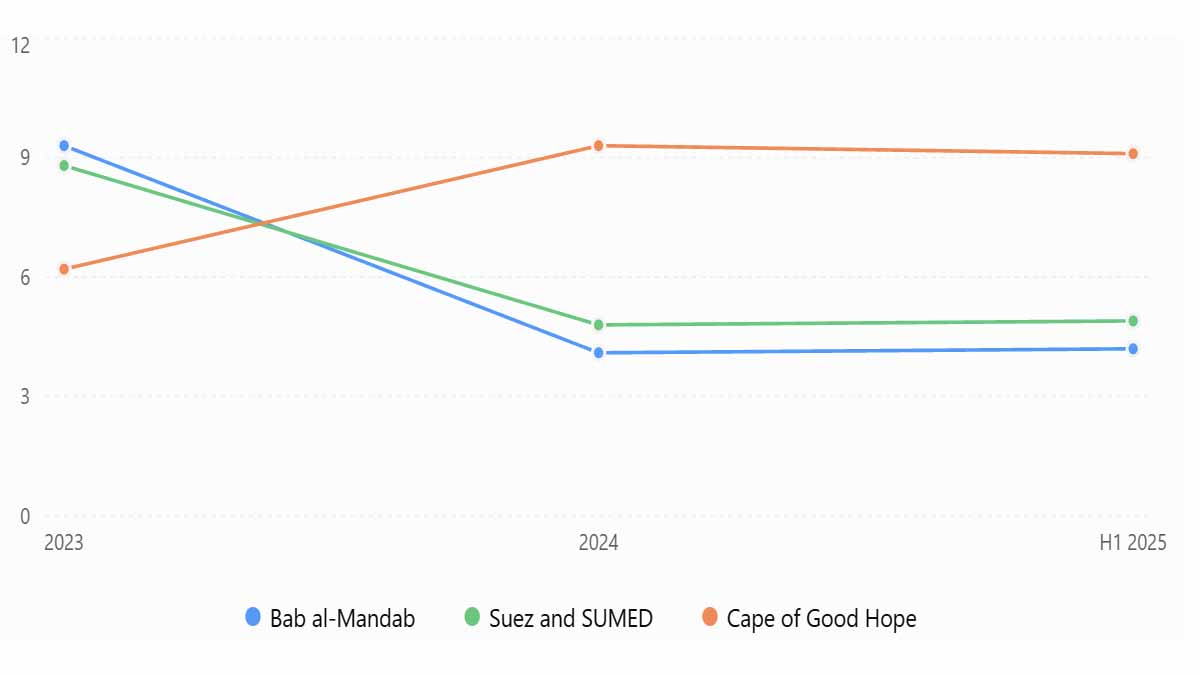
The direction of these changes is strategically revealing. As oil flows through Bab al-Mandab and Suez declined, volumes transported around southern Africa increased substantially. This demonstrates a commercial adaptation process in which shipping operators preserved international supply connections by accepting longer voyages.
However, the historical redistribution should not be interpreted as a complete substitution of one corridor for another. Changes in oil production, geographical trade patterns, sanctions, refinery demand and destination markets also influence vessel movements. Russian crude oil shipments to Asia, for example, have affected the geography of international tanker traffic independently of the immediate security conditions in Yemen.
The figures therefore establish an important change in route utilisation but do not permit every movement to be attributed exclusively to Houthi attacks.
The structural significance of the Suez Canal
The Suez Canal occupies a distinctive position in European economic geography because it allows commercial vessels to connect the Indian Ocean with the Mediterranean without circumnavigating Africa.
Its economic importance can be analysed through three principal functions: reducing maritime transportation distance, concentrating international liner services and supporting the logistical competitiveness of Mediterranean ports.
The first function concerns the direct relationship between sailing distance and operating expenditure. A shorter voyage generally requires less fuel, fewer days of vessel employment and a shorter interval between the departure and arrival of cargo.
The second function concerns the organisation of shipping networks. Regular services are designed around expected voyage durations, and significant deviations may require additional vessels to maintain the same frequency of departures.
The third function concerns the geography of maritime distribution. European Mediterranean ports benefit from their relative proximity to the Suez route because vessels arriving from Asia can reach Mediterranean terminals before continuing toward northern European destinations.
When shipping services avoid the Red Sea and travel around the Cape of Good Hope, some of these advantages are weakened.
This does not mean that every Mediterranean port necessarily loses traffic or that every northern European port benefits. Port outcomes depend on carrier networks, terminal capacity, inland connections and the distribution of final cargo destinations.
Nevertheless, changes in routing can alter the relative attractiveness of particular ports, especially where their commercial position depends on serving as a first point of entry for cargo arriving from Asia.
UN Trade and Development reported that by May 2025, Suez Canal tonnage remained approximately 70% below its 2023 level. The same review found that longer shipping routes had contributed to a 5.9% increase in global ton-miles during 2024, nearly three times the growth rate of the volume of goods transported. Review of Maritime Transport 2025 — UN Trade and Development, September 2025.
The divergence between transported volume and ton-miles is particularly important. Ton-miles measure the amount of cargo multiplied by the distance transported. When maritime trade volume grows slowly but ton-miles rise more rapidly, the shipping system is using additional transportation effort to move a similar or only moderately larger quantity of goods.
This increases demand for vessel capacity even without a corresponding expansion of the underlying volume of international trade.
The expansion of transport distance as a hidden economic shock
The economic significance of maritime rerouting is frequently underestimated because the effect is not immediately visible in the physical quantity of goods arriving at their destinations.
A shipment may eventually reach its destination without any reduction in cargo volume, yet still impose additional costs through longer transportation time, increased working capital requirements and greater uncertainty over delivery.
The financial mechanism is especially consequential for containerised trade because supply chains often operate with limited inventory buffers and carefully coordinated delivery schedules.
Manufacturers may depend on components arriving within a narrow time window, particularly in industries where production involves numerous specialised suppliers. When transportation becomes less predictable, firms must either accept a greater probability of production interruptions or increase inventories.
Both choices carry costs.
Higher inventories require storage capacity and additional financing, while lower inventories increase exposure to delayed shipments.
This creates a transmission channel through which maritime insecurity can weaken industrial efficiency without necessarily producing an immediate collapse in import volumes.
The same mechanism affects retailers whose commercial models depend on rapid inventory turnover. Longer shipping intervals may require earlier purchasing decisions, larger stocks or more expensive alternative transport.
UNCTAD’s evidence concerning rising ton-mile demand demonstrates the structural nature of the problem. The increase in transportation work reflects a change in the amount of maritime capacity required to support global commerce, even when the total volume of traded goods changes relatively little.
The resulting effects can persist after immediate security conditions improve because shipping companies must reorganise schedules, reposition vessels and renegotiate commercial arrangements before returning to previous operating patterns.
Maritime security as a commercial risk decision
The decision to transit Bab al-Mandab is not made exclusively by governments or naval commanders. It emerges from negotiations and assessments involving shipowners, charterers, cargo interests, insurers and professional maritime advisers.
A naval operation may reduce the probability of successful attack, but individual shipping companies must still determine whether the remaining risk is commercially acceptable.
The relevant considerations include the value of the vessel and cargo, contractual delivery requirements, the availability of escorts, the operational history of attacks, insurance terms and the possibility of crew injury or detention.
Importantly, the legal right to navigate through an international strait does not establish that the passage is commercially prudent under a particular threat environment.
This distinction explains why maritime traffic may remain depressed even after governments announce the deployment of additional defensive capabilities.
The International Maritime Organization has repeatedly emphasised that seafarer safety must remain central to commercial decisions. In August 2026, it specifically warned that continued attacks threatened supply chains and called upon operators to conduct careful risk assessments before entering affected waters. IMO Statement on Deadly Red Sea Shipping Attack — August 2026.
The IMO’s incident reporting also provides an important basis for distinguishing the Red Sea conflict from piracy and armed robbery in the wider Gulf of Aden. Its Red Sea monitoring page records 61 confirmed incidents notified to the organisation since 10 January 2024, of which 57 occurred by the end of 2025, alongside 17 earlier incidents between November 2023 and 9 January 2024. These totals reflect the organisation’s defined reporting periods and verification criteria, not every unconfirmed commercial security alert. Red Sea Area: Confirmed Incidents — International Maritime Organization, accessed October 2026.
In addition, the IMO reported a renewed piracy crisis in the Gulf of Aden and surrounding waters during 2026. In August it warned that more than 90 seafarers were being held captive following hijackings and armed robberies. These incidents represent a distinct maritime security problem from attacks attributed to Ansar Allah, although their combined effect can increase perceived regional risk. IMO Calls for Urgent Action as Piracy Resumes in the Gulf of Aden — August 2026.
Distinguishing the principal maritime threat categories
| Threat category | Typical mechanism | Principal commercial effect | Primary legal or operational response |
|---|---|---|---|
| Missile or drone attack against shipping | Stand-off weapons directed at vessels | Loss of life, vessel damage, diversion and insurance pressure | Air and missile defence, maritime protection and accountability |
| Naval mine or explosive hazard | Explosive devices affecting navigation | Area avoidance, survey requirements and prolonged clearance | Mine-countermeasure operations and navigational warnings |
| Piracy | Private acts of violence or detention for private ends, subject to the applicable legal definition | Hijacking, crew detention and ransom exposure | Naval counter-piracy, prosecution and industry security measures |
| Armed robbery against ships | Unlawful acts within waters subject to coastal-state jurisdiction | Crew harm, cargo loss and insecurity around port approaches | Coastal-state law enforcement and maritime cooperation |
| GPS interference or navigation disruption | Interference with positioning or navigation systems | Navigational uncertainty and collision risk | Technical redundancy, reporting and electronic protection |
| Infrastructure disruption | Damage to ports, cables, terminals or energy facilities | Network-wide logistics and communications losses | Infrastructure protection, repair and continuity planning |
The distinctions have practical significance for European policymakers. A missile-defence frigate may be capable of protecting ships against certain aerial threats but may not possess the assets required for mine clearance, piracy law enforcement or the repair of damaged submarine infrastructure.
Effective maritime security therefore requires capabilities matched to the actual threat rather than an assumption that all naval missions are operationally interchangeable.
The Strait of Hormuz and the danger of simultaneous maritime crises
The interaction between the Red Sea crisis and instability around the Strait of Hormuz creates a more serious geoeconomic problem than the sum of two isolated disruptions.
Hormuz is the principal maritime exit from the Persian Gulf for a substantial portion of internationally traded oil and liquefied natural gas. Bab al-Mandab, by contrast, provides access between the Indian Ocean and the Red Sea–Suez corridor.
When both passages become insecure, the capacity to redistribute shipping routes becomes more constrained.
A tanker unable to leave the Persian Gulf through Hormuz cannot simply solve the problem by travelling around the Cape of Good Hope. Alternative routes around Africa are relevant primarily once cargo has access to the Indian Ocean.
Similarly, the SUMED pipeline can facilitate the transport of some crude oil between the Red Sea and Mediterranean, but it cannot replace all forms of maritime trade or eliminate the requirement to move the oil to an accessible Red Sea terminal.
The EIA estimated that Hormuz carried approximately 20.9 million barrels per day of petroleum liquids during the first half of 2025, compared with 4.2 million barrels per day through Bab al-Mandab during the same period. These measurements should not be added to estimate unique global oil exposure because some cargoes can traverse both passages. World Oil Transit Chokepoints — U.S. Energy Information Administration, March 2026.
The simultaneous-crisis dimension became particularly important in 2026 as attacks and disruptions affected shipping in and around Hormuz. On 28 August, the IMO reported that up to 400 ships carrying approximately 6,000 seafarers had been unable to depart the Persian Gulf safely since the beginning of the wider regional conflict. Six Months of Uncertainty for Seafarers in the Strait of Hormuz — International Maritime Organization, August 2026.
The implication for Europe is that maritime security planning cannot treat the Red Sea and Persian Gulf as entirely separate operational environments. A crisis in either passage can affect the availability of tankers, insurance capacity, energy prices and naval resources required elsewhere.
The strategic consequences for Mediterranean port competition
European port systems are not equally positioned to absorb a long-term shift away from the Suez route.
Mediterranean ports such as Gioia Tauro, Trieste, Genoa, Marseille-Fos, Valencia, Piraeus and the major transshipment terminals serving the central Mediterranean possess different commercial functions. Some specialise in container transshipment, others in gateway cargo, liquid bulk, automotive logistics or connections to continental rail and road networks.
The effect of Red Sea disruption depends on how individual services are reorganised.
When a carrier sends vessels around Africa, it may alter the sequence in which European ports are served, change transshipment arrangements or concentrate cargo at terminals that allow more efficient subsequent distribution.
This can reduce the advantage associated with geographical proximity to Suez while increasing the relative importance of hinterland connectivity, terminal productivity and operational resilience.
However, port competition should not be assessed exclusively through distance from the maritime route. Rail capacity, customs efficiency, availability of logistics land, vessel handling capabilities and connections to industrial regions can be equally important.
The long-term danger for Mediterranean ports is therefore not necessarily the permanent disappearance of trade, but the possibility that shipping networks become reorganised in ways that reduce their role in higher-value logistics services.
Conversely, improved inland infrastructure and greater service diversification may allow some Mediterranean ports to recover or strengthen their positions even under conditions of prolonged route uncertainty.
A credible European maritime strategy must consequently connect external security policy with internal transport infrastructure investment.
Key judgments — Chapter 5
The Red Sea crisis has transformed the security of international navigation into a factor affecting the structure of global maritime networks. Its economic significance arises not only from attacks on vessels but also from commercial rerouting, increased transportation distance and the resulting demand for additional shipping capacity.
Historical EIA and UNCTAD data confirm substantial changes in route utilisation and ton-mile demand. They also demonstrate why the commercial consequences of maritime disruption cannot be measured solely through the number of ships attacked.
The simultaneous deterioration of security around Bab al-Mandab and Hormuz reduces the effectiveness of traditional rerouting options and increases the importance of energy infrastructure, strategic reserves and coordinated maritime protection.
The principal European challenge is to preserve access to international trade corridors while ensuring that the cost of defensive commitments remains proportionate to their practical effectiveness.
Chapter 6. Economic Transmission: Energy Security, Insurance, Shipping Costs, Supply Chains and European Industrial Competitiveness
The transmission of maritime insecurity into the European economy
The economic consequences of the Red Sea crisis are transmitted into European markets through a sequence of interconnected mechanisms that extend considerably beyond the direct expenditure associated with maritime transport. Shipping disruption affects freight rates, insurance premiums, vessel availability, inventory management, energy prices, industrial production schedules and ultimately the competitive position of companies operating within international supply chains. The relative importance of each mechanism varies according to the type of commodity transported, the geographical origin of imports and the ability of individual firms to substitute alternative suppliers or transportation routes.
The crisis is especially important because it affects an international trading system already characterised by substantial structural adjustments. Energy import patterns have changed following Russia’s invasion of Ukraine, manufacturing supply chains have been influenced by rising geopolitical competition, and European industrial companies have faced persistent concerns regarding electricity costs, technology dependence and international competitiveness.
Maritime disruption interacts with these existing vulnerabilities rather than creating an entirely separate economic shock.
UNCTAD’s September 2025 assessment estimated that international maritime trade growth would slow to approximately 0.5% during 2025, compared with 2.2% in 2024. It also identified increased freight-rate volatility and the tendency for maritime trade distances to expand as shipping operators adjusted their routes. These estimates provide a documented historical baseline for evaluating the economic effects of the subsequent escalation, not a measurement of the final outcome for 2026. Maritime Trade Under Pressure: Growth Set to Stall in 2025 — UN Trade and Development, September 2025.
The central analytical problem is that the relationship between freight costs and consumer prices is neither immediate nor uniform. A temporary increase in container freight rates may have a limited effect on the final price of a high-value electronic device while imposing a much larger proportional burden on low-value, bulky merchandise.
Similarly, energy-intensive industries can be affected by rising hydrocarbon and electricity prices even when their own products are not transported through the Red Sea.
A comprehensive assessment must therefore separate direct transport costs from indirect macroeconomic and industrial consequences.
The economics of maritime rerouting
Maritime transport costs depend on a combination of vessel operating expenses, voyage duration, charter arrangements, fuel consumption, port charges, insurance, financing and the commercial utilisation of the ship.
When a container vessel is diverted around southern Africa, the additional journey can affect several of these components simultaneously.
Fuel expenditure generally rises when the vessel must travel farther at a given speed, although the relationship depends on operating speed, weather conditions and engine characteristics. Crew and maintenance costs accrue over a longer period, and the vessel remains unavailable for another commercial voyage until the extended journey is completed.
For operators maintaining fixed schedules, this creates a further problem: additional vessels may be necessary to preserve the original frequency of service.
If a weekly service previously required ten ships and a longer route increases the round-trip cycle sufficiently to require twelve, maintaining the same departure frequency entails the use of two additional vessels. This is a mathematical illustration of the scheduling mechanism, not a measurement of a particular company’s operating requirements.
The requirement for additional capacity can increase charter demand even if total cargo volume remains unchanged.
At the same time, slower voyages may reduce fuel consumption per day but increase the total transportation time, creating a trade-off between direct operating expenses and delivery reliability.
The relevant economic outcome is therefore determined by the configuration of the shipping network rather than by the additional nautical distance alone.
Principal components of maritime cost escalation
| Cost component | Mechanism | Directly affected actor | Possible downstream consequence |
|---|---|---|---|
| Marine fuel | Longer voyages and changes in fuel prices | Shipowner or operator | Higher freight expenditure |
| Charter costs | More vessel-days required for the same cargo movement | Carrier and charterer | Increased capacity costs |
| War-risk insurance | Higher perceived probability of conflict-related loss | Insured vessel and cargo interests | Additional premium or restrictions |
| Cargo insurance | Increased exposure to delay, damage or loss | Cargo owner | Higher total landed cost |
| Working capital | Goods remain in transit longer | Importer and manufacturer | Greater financing requirement |
| Inventory | Additional safety stock to offset unreliable deliveries | Industrial and retail firms | Storage and financing costs |
| Port and terminal services | Changes in arrival patterns and transshipment flows | Ports and logistics operators | Congestion or loss of business |
| Contractual performance | Missed delivery windows and revised obligations | Shippers, suppliers and customers | Penalties, renegotiation or production interruption |
These transmission channels also interact. A longer shipping route may increase fuel expenditure and delay cargo arrival, causing the importer to hold additional inventory while simultaneously facing higher insurance and financing costs.
The resulting total economic burden cannot be established by measuring the freight-rate increase alone.
Maritime insurance and the pricing of geopolitical risk
Marine insurance plays a particularly important role because it translates expectations about military threats into commercial costs.
The relevant insurance arrangements may include hull and machinery cover, war-risk cover, protection and indemnity arrangements and cargo insurance. These products protect against different types of loss and are subject to differing contractual conditions.
A rise in regional security threats may produce additional war-risk premiums, changes in underwriting terms, higher deductibles or restrictions on cover. In more severe circumstances, insurers may decline to provide protection under commercially acceptable conditions.
The effect is not necessarily proportional to the observed frequency of attacks. Insurers must also consider the potential severity of losses, uncertainty concerning targeting behaviour, the concentration of vessels in vulnerable areas and the possibility that a single incident could generate substantial environmental or liability claims.
For a large container vessel, a severe attack could expose the insurer to damage to the ship, cargo losses, salvage expenditure, pollution-related liabilities and interruption of commercial operations.
This aggregation of potential losses makes the insurance market sensitive to tail risks, particularly when the expected consequences of an incident are difficult to estimate.
The commercial significance of insurance becomes even greater when the disruption affects energy cargoes.
At a meeting in Riyadh in October 2026, ministers associated with OPEC and non-OPEC producing states expressed concern that shipping and insurance costs for some energy flows had risen to more than one-third of the value of the underlying commodity. This was a ministerial warning concerning affected energy movements, not a uniform global insurance rate or a measure applicable to all cargoes. Shipping and Insurance Costs for Energy Flows Surge — Reuters, October 2026.
The distinction is essential. Shipping and insurance together may account for a very large proportion of delivered costs in particular disrupted trades, but this does not mean that insurance alone represents one-third of cargo value.
It also does not establish that the same cost relationship applies to containerised manufactured goods, crude oil and liquefied natural gas.
The strategic implication is that maritime security threats can produce substantial commercial disruption even without physically preventing vessels from sailing. If insurance becomes too expensive or commercially unavailable, the practical accessibility of a route can deteriorate independently of its legal navigability.
Energy security and the distinction between physical shortage and price exposure
Europe’s energy vulnerability must be assessed through two separate dimensions: the physical availability of energy supplies and exposure to changes in international energy prices.
A country may possess sufficient physical supply to meet domestic demand while still experiencing a significant economic shock because imported oil, natural gas or refined products become more expensive.
Conversely, a country may face a direct interruption of particular deliveries even when international benchmark prices remain relatively stable because cargoes are redirected or transportation infrastructure becomes inaccessible.
The Red Sea crisis affects these dimensions differently depending on the commodity and supply route.
Crude oil can sometimes be redirected to alternative maritime corridors or transported through pipelines. Petroleum products depend on refinery location, storage capacity and available tanker transportation.
Liquefied natural gas requires specialised vessels, liquefaction and regasification facilities, and commercial arrangements that may restrict the ability to change destinations quickly.
The importance of this distinction is visible in EIA data. During the first half of 2025, LNG flows through Bab al-Mandab were effectively zero, compared with approximately 4.2 billion cubic feet per day in 2023. LNG shipments through the Suez Canal fell from 4.1 billion cubic feet per day in 2023 to approximately 0.9 billion cubic feet per day in the first half of 2025. World Oil Transit Chokepoints, Table 4 — U.S. Energy Information Administration, March 2026.
LNG traffic through the Red Sea system
| Route | 2023 | 2024 | First half 2025 |
|---|---|---|---|
| Bab al-Mandab | 4.2 | 0.0 | 0.0 |
| Suez Canal | 4.1 | 0.5 | 0.9 |
Billion cubic feet per day, historical EIA estimates.
The reduction of LNG transit through Bab al-Mandab illustrates the ability of shipping markets to adapt to security conditions, but adaptation is not equivalent to the elimination of economic costs.
Longer LNG voyages reduce the number of annual trips that a vessel can complete, potentially increasing demand for specialised shipping capacity and affecting delivered fuel costs.
The consequences become particularly significant when several regions compete for flexible LNG cargoes.
European buyers may then face higher prices because of changes in global supply availability even if the specific molecules purchased do not transit the Red Sea.
The 2026 oil-price shock and Europe’s inflationary vulnerability
The wider Middle Eastern conflict has increased the importance of distinguishing the specific effects of Yemen-related maritime insecurity from those arising through the Strait of Hormuz and regional energy production.
In October 2026, international crude prices reached levels close to $120 per barrel amid the broader conflict and disruption affecting Gulf energy transportation. The European Commission was examining possible measures concerning exceptional energy-sector profits as member states confronted the consequences of elevated prices.
The discussion included the possibility of an EU-level windfall-profit mechanism, although the examination of such an instrument did not mean that legislation had already been adopted. EU Looking at Oil and Gas Windfall Profit Tax as Energy Prices Soar — Reuters, October 2026.
The effects of higher energy prices on European inflation operate through several channels.
Directly, households face higher expenditure on transportation fuels and, depending on national electricity and gas market arrangements, increased utility costs.
Indirectly, firms face higher production and distribution expenses, some of which may be passed on to customers.
Energy-intensive industries experience a particularly significant challenge because higher input costs can reduce international competitiveness, especially when foreign competitors have access to cheaper energy.
The inflationary outcome also depends on the duration of the shock, the responses of monetary authorities, the availability of inventories and the extent to which firms absorb higher costs through reduced margins.
A temporary increase in oil prices may affect headline inflation without necessarily producing an equally persistent increase in underlying inflation. A prolonged shock, however, can influence wage negotiations, business expectations and investment decisions.
The European policy problem is therefore not simply one of replacing unavailable supplies. It concerns the interaction between energy security, price stability and the competitive position of the industrial economy.
European industrial exposure: the role of imported intermediate goods
The European manufacturing system depends on international trade in intermediate goods, machinery, electronics, chemicals and specialised components.
China occupies a particularly important position in this system. Eurostat reported that the European Union imported €559.4 billion of goods from China in 2025, while exports to China amounted to €199.6 billion.
Electrical machinery and related equipment accounted for approximately €164.9 billion of EU imports from China, equivalent to 29.5% of the total, while machinery and mechanical appliances accounted for €106.5 billion, or 19.0%. Trade in Goods with China in 2025 — Eurostat, April 2026.
These figures do not establish that every shipment travelled through Suez. The reported trade values include goods transported through different maritime and non-maritime routes, and the statistics do not identify the actual transportation route for each product.
They nevertheless demonstrate the scale of commercial relationships that could be affected by disruption to major Asia–Europe shipping networks.
EU trade with China: principal categories of import exposure
| Category | EU imports from China, 2025 | Share of total EU imports from China |
|---|---|---|
| Electrical machinery and equipment | €164.9 billion | 29.5% |
| Machinery and mechanical appliances | €106.5 billion | 19.0% |
| Organic chemicals | €34.1 billion | 6.1% |
| Vehicles and related equipment | €29.9 billion | 5.4% |
| Furniture, lighting, bedding and prefabricated buildings | €21.3 billion | 3.8% |
| Total EU goods imports from China | €559.4 billion | 100% |
Source: Trade in Goods with China in 2025 — Eurostat, April 2026.
The economic vulnerability associated with these imports is not determined solely by their monetary value. Certain low-cost components can be operationally critical if they have few immediate substitutes and are required for the completion of high-value industrial products.
A disruption affecting a relatively inexpensive electronic controller, semiconductor component or specialised chemical input may interrupt production of a much more expensive finished good.
This creates an asymmetry between the commercial value of the delayed import and the economic value of the production process it supports.
European industrial resilience therefore depends partly on understanding supply-chain criticality rather than measuring imports only in aggregate monetary terms.
Automotive manufacturing and the vulnerability of production schedules
The automotive industry offers an especially clear example of how maritime disruption can affect industrial performance.
Vehicle production depends on the coordinated delivery of thousands of components, including electronic systems, mechanical assemblies, batteries, sensors, wiring, plastics and specialised materials.
A manufacturer can sometimes compensate for delayed deliveries by drawing upon inventories or obtaining components from alternative suppliers. However, these adjustments are less effective when a component is highly specialised, supplier qualification requires extensive testing or production is geographically concentrated.
The vulnerability becomes greater when multiple suppliers depend on the same upstream producer or transportation corridor.
Maritime disruption can therefore affect automotive manufacturing through three distinct mechanisms: direct delays in imported components, increases in delivered input costs and the need to restructure procurement arrangements.
The consequences are likely to differ across European countries because their automotive industries occupy different positions within global value chains.
German manufacturers possess extensive international production and supplier networks, including substantial commercial relationships with Asia. French and Italian manufacturers have different combinations of domestic production, European supply integration and overseas industrial relationships. British automotive production is particularly sensitive to the interaction between international logistics and customs arrangements affecting trade with the European Union.
The precise effects cannot be inferred solely from national production volumes. They require plant-level data concerning suppliers, inventory policies and the share of components moving through affected routes.
However, the economic mechanism is clear: when a highly integrated production system depends on predictable deliveries, additional transit time can create costs substantially larger than the freight charge associated with the delayed shipment.
Pharmaceuticals, medical technology and critical industrial inputs
The consequences of maritime insecurity also extend to industries where delivery reliability has implications for public health and critical services.
European pharmaceutical and medical technology production depends on international supply networks involving active pharmaceutical ingredients, chemical intermediates, packaging materials, electronic components and specialised manufacturing equipment.
A delayed shipment of non-critical consumer goods may primarily create a commercial inconvenience. Delayed delivery of essential pharmaceutical inputs can create production problems with more serious downstream consequences.
However, not all pharmaceutical products or inputs are equally exposed to Red Sea shipping routes, and the criticality of a supply chain cannot be inferred from the country of origin alone.
The relevant assessment must consider the number of qualified suppliers, available inventories, regulatory requirements for substituting products and the expected time necessary to restore supply.
The same principle applies to energy-transition technologies, including battery components, electrical equipment and industrial materials required for renewable-energy infrastructure.
Where projects depend on internationally sourced equipment, transportation uncertainty may delay construction schedules and increase financing costs.
Consequently, maritime disruption can affect the pace of industrial investment as well as current production.
The environmental and regulatory consequences of rerouting
Longer maritime routes can increase fuel consumption and greenhouse-gas emissions, although the precise effect depends on vessel speed, engine efficiency, fuel type and operational conditions.
UNCTAD’s 2025 maritime review explicitly identified additional emissions associated with rerouting around the Cape of Good Hope.
This creates an important regulatory tension for European policy.
The European Union has established mechanisms intended to reduce emissions from maritime transport, including the extension of its Emissions Trading System to shipping and the FuelEU Maritime framework.
Longer routes may increase operational emissions while the regulatory framework is simultaneously encouraging shipowners to reduce carbon intensity.
The resulting cost effects depend on how voyages fall within the geographical scope of the relevant legislation and on the applicable emissions-accounting rules.
The problem is not necessarily that security requirements and environmental objectives are incompatible. It is that a maritime crisis can change the physical conditions under which environmental compliance must be achieved.
A commercially viable response requires both security improvement and investment in more efficient vessels, alternative fuels and operational optimisation.
Economic exposure and the limits of quantitative prediction
The available official data demonstrate historical rerouting, substantial energy-flow adjustments and Europe’s exposure to imported intermediate goods. They do not establish a single reliable numerical estimate of the total GDP loss attributable to the renewed Yemen war in October 2026.
Producing such an estimate would require a consistent counterfactual incorporating transport prices, vessel routing, trade volumes, inventories, industrial output and energy prices, while separating Yemen-specific effects from those caused by the wider Iran-related conflict.
The absence of such a comprehensive estimate should not obscure the underlying risk, but it does limit the precision with which governments can attribute observed macroeconomic deterioration to one theatre.
Economic transmission and measurable indicators
| Transmission channel | Primary measurable indicator | Secondary indicator | Principal analytical limitation |
|---|---|---|---|
| Maritime rerouting | Vessel transits and ton-miles | Average voyage duration | Other changes in trade routes influence totals |
| Freight expenditure | Freight-rate indices | Charter rates and bunker prices | Rates vary by vessel and contract |
| Insurance | War-risk premiums and deductibles | Underwriting restrictions | Commercial terms are not always public |
| Energy security | Import volumes and inventories | Refinery throughput and LNG deliveries | Production disruptions may dominate route effects |
| Energy inflation | Wholesale oil, gas and electricity prices | Consumer energy-price indices | Taxes, contracts and subsidies influence pass-through |
| Manufacturing | Input inventories and production schedules | Supplier delivery times | Firm-specific exposure differs |
| Port competitiveness | Throughput and service frequency | Transshipment and hinterland volumes | Port trends also reflect wider commercial changes |
| Industrial investment | Project expenditure and completion schedules | Financing and procurement costs | Causal attribution requires project-level evidence |
The appropriate economic response is therefore to develop consistent monitoring across several variables rather than attempt to reduce the entire crisis to a single headline estimate.
Key judgments — Chapter 6
The economic impact of Red Sea insecurity is transmitted through multiple interacting channels, including freight expenditure, insurance, energy markets, industrial inventories and the availability of specialised shipping capacity.
European vulnerability is greatest where maritime disruption interacts with already concentrated supply chains, energy-intensive manufacturing and limited opportunities for rapid supplier substitution.
The 2026 wider regional energy crisis has increased the importance of separating physical supply disruptions from international price exposure.
A credible assessment of national economic losses requires counterfactual analysis and cannot be obtained by attributing every increase in energy prices or freight rates to the Yemen conflict alone.
The strategic policy requirement is the integration of maritime security, energy resilience and industrial supply-chain management rather than the treatment of transport disruption as an isolated commercial problem.
Chapter 7. Italy, France, Germany and the United Kingdom: Differentiated National Security and Economic Consequences
Europe’s strategic exposure is not evenly distributed
The European consequences of the Red Sea crisis cannot be evaluated through a single continental exposure ratio because the four principal European powers considered here possess different industrial structures, maritime geographies, defence commitments, energy systems and institutional constraints. These differences shape both the economic damage that prolonged disruption could generate and the practical military options available to each government.
Italy’s position is strongly influenced by the Mediterranean orientation of its ports and the integration of maritime logistics with manufacturing exports. France combines a major commercial maritime sector with wider military responsibilities extending into the Indian Ocean and the Middle East. Germany is exceptionally sensitive to the reliability of industrial supply chains and possesses a parliamentary framework governing overseas military deployments. The United Kingdom, while remaining outside the European Union, combines global shipping and financial services with direct defence relationships that have already expanded in response to the renewed attacks against Saudi Arabia.
These distinctions also affect the political sustainability of military operations. A naval deployment justified through the protection of commercial navigation may receive broader political support than participation in an offensive campaign on Yemeni territory. Yet governments can encounter increasing pressure to expand their missions if defensive operations appear insufficient to prevent repeated attacks.
The strategic problem is therefore to determine how each country’s specific national interests can contribute to a coordinated European response without obscuring the legal, operational and political differences among them.
Italy: the Mediterranean economy and the security of access to Asian markets
Italy faces a particularly consequential combination of maritime exposure, industrial dependence and regional security responsibilities. Its geographical location gives Italian ports access to commercial routes linking the Mediterranean with the Suez Canal, while its manufacturing economy depends on the movement of intermediate goods and finished products across international markets.
The Italian government’s assessment has explicitly recognised the strategic importance of the Red Sea. In a statement published by the Ministry of Foreign Affairs on 20 September 2026, Foreign Minister Antonio Tajani argued that the EU maritime operation ASPIDES remained defensive and was intended to protect merchant vessels transiting the Red Sea and Bab al-Mandab. He also stated that approximately 40% of Italy’s commercial maritime traffic and 60% of its goods exports to Asia passed through the Red Sea.
These figures are official ministerial statements of national exposure, but their precise statistical definitions are not sufficiently detailed in the statement to establish direct comparability with Eurostat or UNCTAD trade-route measurements. Tajani: We Are Not at War, but the Red Sea Is Strategic — Italian Ministry of Foreign Affairs, September 2026.
Italian port geography and the restructuring of commercial routes
The vulnerability of Italy’s maritime system derives partly from its geographical position within the Mediterranean.
Ports such as Gioia Tauro, Genoa, La Spezia, Trieste, Venice, Livorno and Naples serve different commercial functions, including container transshipment, industrial imports, automotive logistics, liquid bulk and access to continental transport networks.
The importance of these differences becomes evident when shipping companies alter their European port rotations.
A container service entering the Mediterranean from Suez may have commercial reasons to call at Italian terminals before continuing toward northern European ports. When the same service approaches Europe after circumnavigating Africa, the optimal rotation may change according to the distribution of cargo destinations and the carrier’s network.
The potential disadvantage for Italian ports is not limited to the loss of a particular vessel call. Reduced service frequency can affect shipping connectivity, the attractiveness of transshipment operations and the ability of logistics companies to offer predictable delivery arrangements.
However, the outcome depends on individual terminal capabilities and hinterland connections. Genoa and La Spezia serve industrial regions with extensive commercial activity, while Trieste possesses important connections toward central and eastern European markets. Gioia Tauro operates within a different commercial model, with a substantial emphasis on container transshipment.
A uniform assessment of Italian ports would therefore conceal important differences in their exposure and adjustment capacity.
Manufacturing and export vulnerability
Italy’s industrial structure includes machinery, automotive components, pharmaceuticals, chemicals, electrical equipment, luxury products and specialised intermediate goods.
Many of these sectors are internationally competitive but operate through relatively complex supply chains.
The Red Sea crisis can affect them through delayed imported components, increased shipping expenditure and the deterioration of delivery reliability for exports to Asian markets.
The implications are particularly important for medium-sized and specialised manufacturers whose competitiveness depends on engineering quality, customer relationships and timely fulfilment rather than large inventories.
An extended shipping delay may place pressure on working capital because a company must finance production and transportation for longer before receiving payment.
Smaller exporters may be less able than large multinational groups to absorb these financing and logistics costs.
The consequences can also extend to contractual performance when delivery commitments are linked to installation schedules, industrial maintenance or the completion of larger investment projects.
For the Italian economy, the relevant risk is therefore not limited to freight prices. It includes the possibility that reduced logistics reliability weakens the ability of specialised manufacturers to compete on delivery time and customer service.
Energy and industrial competitiveness
Italy’s energy exposure must be evaluated separately from its container-shipping dependence.
Natural gas, oil and electricity prices are influenced by multiple international markets, and the relationship between the Red Sea crisis and Italian energy costs depends upon the origin and transportation route of the relevant commodities.
The wider disruption around Hormuz can increase international energy prices even when Italy’s physical supplies continue to arrive through other corridors.
Energy-intensive industries, including ceramics, chemicals, glass, steel and certain manufacturing processes, are particularly sensitive to the interaction between energy expenditure and international competition.
A prolonged rise in energy prices can reduce margins, discourage investment and increase the pressure to relocate production or change sourcing arrangements.
The Italian policy challenge is therefore to maintain industrial access to energy at commercially sustainable prices while improving transport resilience and preserving the competitiveness of its Mediterranean logistics system.
Italy’s military and diplomatic position
Italy’s participation in the European maritime security framework reflects a specific political choice: supporting the protection of commercial navigation through a defensive EU operation rather than treating participation as an authorisation for unrestricted military intervention inside Yemen.
This distinction is important because the country must balance its economic interest in maritime security with its wider diplomatic relationships across the Mediterranean and Arabian Peninsula.
Italian maritime capabilities can contribute to escort operations, maritime awareness and coalition coordination, but these tasks require appropriate naval availability, maintenance and operational sustainability.
The resulting decisions must also take account of competing requirements in the Mediterranean, where the Italian Navy has responsibilities relating to national maritime security, NATO commitments, migration-related missions and the protection of strategic infrastructure.
The central Italian challenge is not the absence of a maritime interest. It is the need to define a financially and operationally sustainable contribution that addresses commercial risk without creating an open-ended military obligation.
France: strategic maritime autonomy and the Indian Ocean connection
France approaches the Red Sea crisis from a different strategic position because its security interests extend beyond the Mediterranean and include overseas territories, maritime zones and military relationships in the Indian Ocean region.
Its naval forces are expected to operate across several theatres, while French defence policy places considerable emphasis on maintaining national strategic autonomy and the ability to act independently when required.
The Red Sea therefore intersects with France’s wider responsibilities concerning the protection of maritime approaches, military mobility and regional partnerships.
France also has commercial exposure through major shipping and logistics companies, port infrastructure and international supply chains.
Marseille-Fos is a major Mediterranean industrial and logistics complex whose economic activities include containers, hydrocarbons, industrial cargo and connections to the Rhône corridor.
Le Havre and the broader northern French maritime system serve different geographical markets and shipping networks. Consequently, rerouting away from Suez can produce differentiated effects even within France.
Naval operational exposure
French naval participation in regional maritime security is significant because France possesses a blue-water navy capable of escort operations, air defence and sustained deployments outside European coastal waters.
However, naval capability is not equivalent to unlimited operational availability.
A warship committed to merchant-vessel protection cannot simultaneously be employed elsewhere without changes in deployment schedules or force allocation. Extended operations also increase maintenance requirements, personnel demands and the consumption of weapons and supplies.
The defence of commercial vessels against missiles and drones may require sophisticated surveillance and interception systems, potentially involving expensive defensive weapons against lower-cost offensive systems.
The resulting cost asymmetry is important for naval planning.
An adversary does not necessarily need to sink a protected vessel to impose costs on the defending force. Repeated threats can compel the deployment of ships, aircraft and defensive weapons whose replacement and maintenance require substantial resources.
France must therefore balance the immediate requirement to protect maritime navigation against the long-term preservation of naval readiness.
Diplomatic and regional considerations
France’s wider diplomatic position also requires attention to relations with Gulf states, Egypt and other regional partners.
Support for maritime security is compatible with efforts to reduce regional military escalation, but the balance can become difficult when attacks on shipping coincide with military operations affecting civilian populations.
A strategy relying exclusively on military interceptions may protect individual vessels without reducing the political incentives for further attacks.
France’s broader diplomatic capabilities are therefore relevant because maritime security cannot be separated from regional negotiations concerning Yemen, Iran and the security of Saudi Arabia.
The French interest is best understood as preserving freedom of navigation while avoiding a permanent expansion of military commitments that would reduce strategic flexibility elsewhere.
Germany: industrial supply-chain security and parliamentary control of military commitments
Germany’s exposure to the Red Sea crisis is particularly important because of the structure of its manufacturing economy and its dependence on international trade in industrial components, machinery, chemicals, vehicles and electrical equipment.
The German economy is highly integrated into European and global production networks, and many manufacturers depend on the predictable movement of goods between suppliers and industrial facilities.
Maritime disruption can affect these networks through delayed deliveries, increased inventory costs and changes in the availability of shipping capacity.
The effects are especially relevant for automotive manufacturing, industrial machinery, electronics and chemical production, where complex supplier relationships can make rapid substitution difficult.
Germany’s vulnerability is therefore predominantly industrial and logistical, although higher energy prices create an additional macroeconomic challenge.
German parliamentary authorisation and the 2026 mandate
Germany’s institutional response provides an unusually clear example of the relationship between national democratic oversight and European maritime security operations.
On 15 October 2026, the Bundestag approved the continuation of German participation in EUNAVFOR ASPIDES, with 421 members voting in favour, 66 against and 90 abstaining.
The renewed national mandate permits the participation of up to 350 Bundeswehr personnel and extends to the end of October 2027.
The German government estimated additional deployment-related expenditure of approximately €18.9 million for the period covered by the mandate. This amount should not be interpreted as the full cost of the multinational European operation or as the total value of German naval assets assigned to the mission. Bundeswehreinsatz im Roten Meer um ein Jahr verlängert — Deutscher Bundestag, October 2026.
Germany’s renewed maritime mission: parliamentary evidence
| Indicator | Documented value or status | Institutional meaning |
|---|---|---|
| Parliamentary approval | 15 October 2026 | Bundestag authorisation |
| Votes in favour | 421 | Majority support |
| Votes against | 66 | Recorded opposition |
| Abstentions | 90 | Recorded non-affirmative participation |
| Personnel ceiling | 350 | Maximum authorised deployment, not actual continuously deployed strength |
| Mandate duration | Until end of October 2027 | National military authorisation |
| Additional deployment expenditure | Approximately €18.9 million | Estimated mission-related additional costs |
| Operational framework | EUNAVFOR ASPIDES | EU-led defensive maritime mission |
| Additional mission function | Collection and sharing of information on suspicious activity involving submarine infrastructure | Expanded maritime situational awareness |
Source: German Bundestag: Extension of Bundeswehr Participation in EUNAVFOR ASPIDES — October 2026.
These details demonstrate the importance of distinguishing national ceilings from actual deployed strength.
The authorisation of up to 350 personnel does not establish that 350 German military personnel are continuously present in the Red Sea. Likewise, the estimated financial expenditure represents a specific budgetary measure rather than a comprehensive assessment of military replacement costs.
Germany’s contribution is therefore best understood within a legally constrained framework of participation in a multinational defensive mission.
Industrial resilience as an extension of national security
For Germany, the security of maritime supply chains has become increasingly relevant to economic and national security policy.
The interruption of imported intermediate goods can affect domestic production even without physical damage to German infrastructure.
Furthermore, the concentration of global shipping routes creates dependencies that individual companies cannot necessarily resolve through private procurement decisions alone.
The German government therefore faces a policy challenge involving commercial diversification, infrastructure capacity, maritime security contributions and the development of industrial supply-chain resilience.
These instruments operate over different time horizons.
Naval protection may mitigate immediate threats to vessels. Larger inventories can improve short-term production continuity, while supplier diversification and changes in industrial sourcing require longer periods and substantial investment.
The country must consequently integrate immediate maritime security policy with a broader industrial strategy capable of reducing dependence on individual geographical corridors.
The United Kingdom: global maritime interests and direct Saudi defence support
The United Kingdom occupies a distinctive position because its response to the renewed Yemen conflict includes both maritime security interests and explicit military assistance to Saudi Arabia.
The British economy depends on international shipping for a substantial part of its trade, while the country retains important positions in maritime insurance, finance, legal services and shipping-related commercial activity.
Disruption to international sea routes can therefore affect British interests even where the immediate physical movement of cargo takes place between non-British ports.
London’s maritime insurance and professional services sectors may face increased demand for risk management and contractual expertise, while British importers and consumers face potential increases in the cost of goods and energy.
This creates a complex distribution of economic effects in which some service providers may experience increased activity while the broader economy absorbs higher transportation costs.
British military assistance to Saudi Arabia
On 22 September 2026, the British Ministry of Defence announced that the United Kingdom would provide an additional RAF Voyager air-to-air refuelling aircraft to support Saudi defensive activity, following a request from Riyadh.
The announcement explicitly described the contribution as additional defensive military assistance and referred to existing British air-defence equipment and personnel helping Saudi Arabia protect itself against missile and drone attacks. UK Military Support to the Kingdom of Saudi Arabia — Ministry of Defence, September 2026.
This development is strategically important because an aerial-refuelling asset can support the operational endurance and flexibility of aircraft conducting defensive missions.
However, the provision of a refuelling aircraft does not itself establish that British personnel are undertaking offensive attacks inside Yemen.
The legal and political implications depend on the actual mission, command arrangements, rules of engagement and relationship between British support and operations conducted by Saudi forces.
The distinction matters because assistance to defend civilian infrastructure against missile and drone attacks is not operationally equivalent to direct participation in an offensive campaign against Yemeni territory.
The political sensitivity of British military involvement
British involvement in regional security has historically attracted parliamentary and public scrutiny concerning the relationship between arms exports, military assistance and compliance with international humanitarian law.
Renewed support for Saudi Arabia therefore raises questions concerning the scope of British operational participation, the assessment of risks associated with supported operations and the mechanisms through which the government maintains oversight.
The underlying legal and political challenge is to distinguish legitimate defensive cooperation from forms of assistance that could implicate the United Kingdom in unlawful military conduct.
Such assessments cannot be resolved by describing all cooperation as either inherently defensive or inherently unlawful.
They require examination of the actual conduct supported, the information available to British authorities and the applicable international and domestic legal frameworks.
For the United Kingdom, the strategic objective is to protect regional stability and commercial interests while preserving the ability to define clear limitations on military participation.
Comparative European exposure and response
The four national cases demonstrate why European coordination must be organised around complementary capabilities rather than identical contributions.
National security and geoeconomic comparison
| Dimension | Italy | France | Germany | United Kingdom |
|---|---|---|---|---|
| Primary economic exposure | Mediterranean logistics and manufacturing exports | Maritime logistics, energy and global commercial networks | Export manufacturing and imported industrial components | Global trade, energy and maritime services |
| Relevant maritime geography | Central Mediterranean and Suez access | Mediterranean, Red Sea and Indian Ocean | Asia–Europe routes and northern European port systems | Global maritime routes and international shipping services |
| Main industrial sensitivity | Machinery, components, chemicals and manufacturing | Industrial logistics, energy and international supply chains | Automotive, machinery, electronics and chemicals | Manufacturing inputs, energy and commercial services |
| Direct military policy emphasis | Defensive EU maritime operations | Naval protection and strategic maritime presence | EU mission under parliamentary mandate | Maritime security and direct defensive assistance to Saudi Arabia |
| Particularly relevant institution | Italian government and EU Council | French executive and EU security structures | Bundestag and Bundeswehr | UK government and Ministry of Defence |
| Principal operational constraint | Naval availability across Mediterranean responsibilities | Competing global maritime deployments | Parliamentary scope and force availability | Scope and accountability of Saudi support |
| Principal policy requirement | Protect Mediterranean connectivity | Preserve strategic flexibility | Integrate industrial resilience with maritime security | Maintain defensive clarity and legal accountability |
The table establishes qualitative differences, not a numerical ranking of national vulnerability.
A credible numerical comparison would require consistent datasets covering bilateral trade by route, shipping costs, energy import exposure, industrial inventories and actual defence expenditure.
The European Union as a coordination mechanism
The European Union provides an institutional framework through which member states can coordinate maritime protection, economic policy and diplomatic engagement.
However, EU competence varies across these domains.
Common commercial policy and aspects of economic regulation fall within established EU powers, while security and defence operations under the Common Security and Defence Policy depend upon the relevant Council decisions and national contributions.
This institutional distinction has practical consequences.
The European Commission may develop initiatives concerning industrial resilience, trade logistics and energy-market responses, but it does not independently command national naval forces.
Likewise, the existence of a European maritime mission does not eliminate the need for national governments to authorise personnel, allocate ships and sustain military deployments.
The current crisis therefore tests the extent to which European institutions can coordinate complementary instruments without assuming a degree of centralised authority that the treaties do not provide.
The European interest is substantial because the disruption affects the continent’s connections to Asian markets and the security of international energy transportation.
Yet the appropriate response must recognise that protection of navigation, management of supply-chain risks and resolution of Yemen’s political conflict are separate tasks requiring different institutions and instruments.
Key judgments — Chapter 7
Italy’s principal vulnerability arises from the interaction between Mediterranean shipping connectivity, specialised manufacturing exports and energy costs.
France’s response is shaped by wider maritime responsibilities and the requirement to preserve military flexibility across multiple theatres.
Germany combines substantial industrial supply-chain exposure with a clearly defined parliamentary framework governing participation in maritime security operations. The October 2026 Bundestag vote provides a documented example of continued national commitment within established legal limits.
The United Kingdom has a distinctive role because of its direct defensive assistance to Saudi Arabia, creating additional questions concerning mission definition and operational accountability.
European security policy will be more effective if national contributions are coordinated according to actual capabilities and vulnerabilities rather than through the assumption that all four countries should adopt identical military commitments.
Chapter 8. European Naval Operations, International Law, Military Escalation and the Limits of Maritime Protection
Europe’s maritime-security architecture faces an increasingly complex operational environment
The principal challenge facing European naval forces in the Red Sea is the growing discrepancy between the strategic importance of the commercial routes they are expected to protect and the resources required to provide sustained security across a geographically extensive, technologically contested maritime environment. The problem extends beyond the interception of missiles or unmanned aerial systems. It encompasses the ability to maintain continuous maritime awareness, distinguish credible threats from routine civilian activity, protect merchant shipping, coordinate with regional governments, respond to potential attacks against submarine infrastructure and preserve the readiness of national fleets for other military responsibilities.
The renewed escalation in Yemen has intensified these requirements at a time when European naval forces also face significant obligations in the Mediterranean, Atlantic, Baltic and other maritime theatres. The resulting operational challenge is one of simultaneous commitments rather than a single isolated deployment.
The European response has been institutionalised principally through EUNAVFOR ASPIDES, established in February 2024 as a Common Security and Defence Policy operation intended to protect freedom of navigation in relation to the Red Sea crisis.
The mission’s importance derives from the fact that it provides a common European framework for defensive maritime action while remaining legally and operationally distinct from offensive campaigns against targets on Yemeni territory.
The Council of the European Union extended the operation on 23 February 2026 until 28 February 2027 and established a financial reference amount of nearly €15 million for common costs over the twelve-month period beginning on 1 March 2026.
This amount is particularly important to interpret correctly: it is the EU common-cost financial reference, not the full economic cost of the mission, which also depends upon nationally provided personnel, warships, aircraft, maintenance and other resources. Red Sea: Council Extends the Mandate of Operation ASPIDES to Safeguard Freedom of Navigation — Council of the European Union, February 2026.
The distinction between common operational financing and the wider cost of national contributions demonstrates why the financial sustainability of maritime missions cannot be evaluated solely through the amounts published in EU Council decisions.
The legal foundation and operational limits of EUNAVFOR ASPIDES
The legal foundation of ASPIDES is Council Decision (CFSP) 2024/583, subsequently amended, which established the mission’s strategic objective, defensive character and political-control framework.
The decision provides for a European naval presence intended to safeguard freedom of navigation, accompany vessels, maintain maritime situational awareness and protect shipping against multidimensional attacks at sea.
Crucially, the operation is required to remain defensive in nature.
The authorising framework also provides that deployed forces must act in accordance with applicable international law, including the conditions governing self-defence, and must respect the United Nations Convention on the Law of the Sea.
Political control and strategic direction are exercised through the EU’s established Common Security and Defence Policy institutions, including the Political and Security Committee under the authority of the Council and the High Representative. Council Decision (CFSP) 2024/583 on EUNAVFOR ASPIDES — Official Journal of the European Union, February 2024, as amended.
This legal architecture matters because the protection of a merchant vessel against an imminent or ongoing attack is a fundamentally different activity from conducting a sustained campaign intended to destroy an armed organisation’s military capabilities on land.
Defensive action at sea may involve surveillance, manoeuvre, electronic countermeasures and the employment of weapons against an immediate threat. Offensive operations against inland facilities raise additional legal and strategic questions concerning the use of force, the applicable armed-conflict framework and the potential for escalation.
The distinction is not always technically simple. A missile launched from land may create an immediate danger to a ship at sea, and protective action must be evaluated according to the applicable rules and the actual circumstances.
Nevertheless, the existence of a defensive mandate cannot be interpreted as an unrestricted authorisation for military action throughout Yemen.
The operational planning documents and rules of engagement determine the detailed conditions under which force may be employed, subject to the governing legal instruments.
The geography of the European operation
The operational area associated with ASPIDES extends beyond the narrow waters immediately adjacent to Yemen.
According to the Council and the German parliamentary framework, the mission encompasses the principal sea lines of communication around Bab al-Mandab and relevant international waters in the Red Sea, Gulf of Aden, Arabian Sea, Gulf of Oman and Persian Gulf, with maritime awareness relating also to the Strait of Hormuz.
This geographical extent reflects the fact that threats to commercial navigation are not limited to a single fixed point.
A vessel travelling between the Indian Ocean and the Mediterranean may encounter different forms of security risk as it approaches the Gulf of Aden, transits Bab al-Mandab and continues northward through the Red Sea.
The resulting operational requirement is therefore a geographically distributed protective presence.
However, the existence of a broad mission area does not mean that European naval forces can provide continuous escort to every merchant vessel operating within it.
Warships are finite resources, and their operational availability depends upon maintenance, ammunition, fuel, crew readiness, replenishment and the requirements of other national missions.
The German Bundestag’s October 2026 authorisation explicitly identifies vessel protection, accompaniment, maritime situational awareness, cooperation with international partners and the collection and sharing of information concerning suspicious activity involving critical underwater infrastructure. Bundeswehreinsatz im Roten Meer um ein Jahr verlängert — Deutscher Bundestag, October 2026.
These tasks illustrate the expansion of contemporary maritime security from traditional surface protection toward an integrated requirement involving air, surface, electronic and infrastructure-related threats.
The operational economics of naval protection
The fundamental military-economic challenge is that defensive naval operations must protect valuable commercial assets against threats that may be substantially less expensive to generate than to intercept.
Modern naval air-defence systems can be highly effective against certain missile and unmanned aerial threats, but their use requires sophisticated sensors, trained personnel and limited stocks of defensive weapons.
The financial asymmetry becomes important when an attacker can repeatedly employ comparatively inexpensive systems in an attempt to compel a defender to use more costly interceptors.
This relationship should not be reduced to a simplistic comparison between the price of one drone and the price of one missile.
The relevant military calculation includes the value of the protected vessel, the consequences of a successful attack, the availability of alternative defensive measures and the broader effects on commercial confidence.
An interceptor that costs more than the attacking weapon may still be economically justified if it prevents the destruction of a valuable ship, saves lives or avoids a major environmental incident.
Nevertheless, prolonged operations can place pressure on ammunition stocks and maintenance cycles.
The operational sustainability of a naval mission consequently depends on more than the immediate ability to defeat individual attacks. It also requires reliable resupply, sufficient defensive systems and the capacity to rotate vessels without creating gaps in protection.
Principal capability requirements for sustained maritime protection
| Capability | Operational function | Principal constraint | Strategic consequence if insufficient |
|---|---|---|---|
| Maritime surveillance | Identify vessels and potential threats | Sensor coverage and information integration | Reduced warning and situational awareness |
| Air and missile defence | Protect ships against aerial threats | Interceptor stocks, engagement capacity and readiness | Increased vulnerability to repeated or complex attacks |
| Electronic warfare | Detect or mitigate certain electronic threats | Threat-specific effectiveness and technical adaptation | Greater dependence on kinetic defence |
| Escort vessels | Accompany merchant shipping | Number of available warships and transit distances | Limited ability to cover commercial traffic |
| Replenishment and logistics | Sustain ships deployed away from home ports | Support-vessel capacity and access arrangements | Reduced operational endurance |
| Intelligence cooperation | Integrate threat reporting and maritime information | Classification and interoperability restrictions | Delayed or incomplete operational picture |
| Medical and rescue capability | Respond to casualties and incidents | Distance from support facilities | Greater consequences for affected crews |
| Mine-countermeasure capacity | Detect and neutralise maritime explosive hazards | Specialist platforms and technical requirements | Extended restrictions on navigation |
| Undersea infrastructure awareness | Identify suspicious activity affecting cables and seabed assets | Large geographic area and attribution difficulties | Delayed detection of infrastructure threats |
This framework demonstrates why a maritime-security operation requires a balanced collection of capabilities rather than a narrow focus on the number of deployed frigates.
A force composed primarily of air-defence vessels may still require additional assets for reconnaissance, rescue, mine clearance and logistical support.
Conversely, extensive maritime surveillance has limited practical value if the information obtained cannot be translated into timely protective action.
Seafarer protection as a legal and operational priority
The human dimension of the maritime crisis is frequently obscured by discussion of shipping tonnage, oil prices and naval capabilities.
Commercial vessels operate with civilian crews whose members may have no political connection to the conflict and little ability to influence the route selected by a shipowner or charterer.
The International Maritime Organization has repeatedly emphasised that seafarers must not be targeted or exposed unnecessarily to armed conflict.
Its July 2026 statement condemned renewed Red Sea attacks and warned that they threatened not only maritime trade but also the marine environment and the lives of merchant crews. Statement on Recent Attacks on Ships in the Red Sea — International Maritime Organization, July 2026.
The problem is particularly serious because the crew’s interests may differ from the commercial incentives of the vessel operator.
A carrier may calculate that a shorter route provides substantial financial advantages, while the personnel aboard the ship bear the immediate physical risks associated with an attack.
This asymmetry reinforces the importance of professional risk assessment, crew protection procedures, maritime warnings and compliance with applicable international safety standards.
The direct financial value of cargo should not determine the degree of legal protection afforded to civilian seafarers.
Furthermore, attacks causing damage to oil or chemical cargoes can create severe environmental consequences, particularly in confined or ecologically sensitive waters.
A major spill could affect coastal communities, fisheries, desalination infrastructure and marine ecosystems across multiple jurisdictions.
This environmental dimension increases the strategic importance of prevention and emergency response capacity.
The relationship between UNCLOS, Security Council decisions and maritime self-defence
The legal framework governing the Red Sea crisis includes the law of the sea, international rules on the use of force, international humanitarian law and applicable Security Council decisions.
The United Nations Convention on the Law of the Sea establishes rules concerning navigation through straits used for international navigation, including transit passage where the relevant legal conditions apply.
These rules protect important navigational freedoms but do not eliminate the applicability of international law governing military operations.
The United Nations Security Council adopted Resolution 2722 in January 2024, demanding that the Houthis cease attacks against merchant and commercial vessels in the Red Sea. Subsequent resolutions continued international monitoring and reporting arrangements.
The IMO identifies Resolution 2812, adopted in January 2026, as one of the subsequent instruments governing the reporting of Houthi attacks against commercial shipping. Red Sea Area: International Maritime Security and Security Council Reporting — International Maritime Organization.
It is essential to distinguish the Security Council’s condemnation of attacks from an unlimited authorisation to conduct military operations.
A resolution demanding cessation of unlawful attacks does not automatically provide a general legal basis for any military response a state might consider politically desirable.
The legality of particular uses of force requires examination of the resolution’s operative language, the circumstances of the attack, the applicable principles of self-defence and the relevant armed-conflict law.
The EU’s ASPIDES mandate expressly preserves the operation’s defensive character, providing an important institutional limitation on the scope of military activity.
Legal regimes and their practical relevance
| Legal instrument or regime | Principal relevance | Important limitation |
|---|---|---|
| United Nations Charter, Article 2(4) | General prohibition on the threat or use of force between states | Subject to recognised Charter exceptions |
| United Nations Charter, Article 51 | Individual and collective self-defence | Requires satisfaction of applicable legal conditions |
| UNCLOS transit-passage framework | Navigation through international straits | Does not grant unrestricted military authority |
| Security Council Resolution 2722 (2024) | Demands cessation of Houthi attacks on commercial shipping | Must not be treated as a blanket authorisation for unrelated offensive action |
| Council Decision (CFSP) 2024/583 | Establishes ASPIDES and its defensive functions | Subject to approved mandate and rules of engagement |
| International humanitarian law | Protection of civilians and regulation of hostilities | Applies according to conflict classification and relevant obligations |
| National constitutional and parliamentary law | Authorisation of national military participation | Requirements differ among participating European states |
Sources: Council Decision (CFSP) 2024/583 — Official Journal of the European Union, Bundestag Authorisation for ASPIDES — October 2026 and IMO Red Sea Security Council Reporting Framework.
The interaction between these regimes becomes particularly important when defensive forces encounter threats originating outside the immediate maritime area.
An attack on a merchant vessel at sea may originate from land, but the possible legal bases for responding to that threat cannot be inferred solely from the geographical origin of the weapon.
The relevant questions include whether an attack is imminent or ongoing, which forces are responsible, what actions are necessary to protect those threatened and whether the contemplated response is proportionate under the applicable law.
These legal issues require case-specific assessment and should not be resolved through broad political descriptions of an entire conflict.
The risks associated with mission expansion
A sustained defensive mission can face political pressure to expand when the original measures fail to prevent recurring attacks.
The argument for expansion generally rests on the proposition that the most effective way to protect ships is to suppress the military capabilities from which attacks originate.
Yet an expanded mission would create additional operational and legal challenges.
Attacking weapons infrastructure on land requires reliable intelligence, target identification and assessments of the potential consequences for civilians.
It may also expose European forces to retaliation and increase the perception among local actors that European governments are participating directly in Yemen’s wider civil war.
This perception could undermine diplomatic channels and make commercial shipping associated with European states more politically salient as a target.
The operational challenge is equally significant. Mobile launch systems, concealed equipment and dispersed logistical networks may survive repeated military strikes, making complete suppression difficult without a prolonged campaign.
The resulting problem is one of strategic proportionality between the resources required, the political risks incurred and the probability of producing a lasting reduction in maritime attacks.
A defensive maritime mission can have limited objectives that are operationally coherent: protecting selected vessels, improving maritime awareness and reducing the likelihood of successful attacks.
A campaign intended to eliminate the threat at its source requires a broader political and military strategy, including a realistic assessment of the adversary’s capacity to regenerate its capabilities.
The two missions should not be conflated.
Maritime infrastructure and the expansion of the security perimeter
The inclusion of critical submarine infrastructure within the German mandate demonstrates the growing recognition that maritime security extends below the water’s surface.
Submarine communications cables, energy connections and seabed infrastructure support international economic activity and digital connectivity.
Damage to these systems can produce consequences extending beyond the immediate maritime area, particularly where communications or energy networks possess limited redundancy.
However, the protection of submarine infrastructure requires capabilities that differ from conventional merchant-vessel escort.
Monitoring large seabed areas, detecting suspicious activity and attributing deliberate interference present substantial technical and legal challenges.
A naval vessel capable of intercepting a missile may not possess the specialist equipment required to inspect an underwater cable or repair damaged infrastructure.
The collection and sharing of relevant information can improve awareness, but the effectiveness of protection depends on coordination with infrastructure operators, coastal authorities and specialised technical organisations.
The broader strategic implication is that European maritime operations are increasingly becoming part of a multidomain security architecture involving commercial navigation, energy systems and digital infrastructure.
This development increases the importance of clear mission priorities.
If every maritime vulnerability is incorporated into a single operational framework without corresponding increases in resources, the result may be an expansion of responsibilities that exceeds available capabilities.
Naval protection and commercial confidence
An important limitation of military maritime protection is that operational success and commercial confidence do not always move together.
A naval force may intercept several attacks without losses, yet shipowners may continue avoiding the affected corridor because they consider the residual risk unacceptable.
Conversely, some commercial operators may resume transit following a reduction in incidents even when the underlying military threat has not been eliminated.
The relationship between naval activity and shipping decisions is mediated by insurance, contractual obligations, crew safety assessments and the availability of alternative routes.
For this reason, the number of successful defensive engagements is an incomplete measure of strategic effectiveness.
A more comprehensive assessment would examine whether maritime protection has contributed to a sustained recovery in vessel movements, reduced exposure to attack and improved commercial confidence.
These outcomes must also be evaluated against wider market conditions. Shipping traffic can change because of fuel prices, seasonal trade patterns or the availability of vessels, independently of the local military situation.
The relevant analytical objective is therefore to distinguish direct operational results from broader commercial developments.
Measuring the effectiveness of European maritime protection
| Evaluation dimension | Appropriate indicator | What it establishes | What it does not establish |
|---|---|---|---|
| Tactical defence | Verified attacks defeated or intercepted | Effectiveness against specific threats | Elimination of future attack capability |
| Vessel protection | Protected voyages completed safely | Performance for selected escorted vessels | Security of all commercial traffic |
| Maritime awareness | Verified threat detection and information dissemination | Quality and reach of monitoring | Guaranteed capacity to respond |
| Commercial confidence | Changes in transit volumes and route selection | Market response to the operating environment | Exclusive causal effect of naval operations |
| Economic effectiveness | Mission expenditure relative to measured protective outcomes | Resource burden and selected benefits | A complete GDP-wide cost-benefit result without broader modelling |
| Legal compliance | Documented authorisations and review procedures | Institutional oversight | Automatic legality of every individual engagement |
| Strategic sustainability | Availability of ships, personnel, maintenance and ammunition | Ability to continue operations | Political resolution of Yemen’s conflict |
The table illustrates why European institutions need a multidimensional assessment of mission performance rather than relying solely on operational statistics.
European naval resources and the problem of competing theatres
The Red Sea crisis has developed during a period in which European naval forces face demands across several operational environments.
The security of the Baltic Sea, North Atlantic, Mediterranean and other maritime approaches requires surveillance, deterrence, infrastructure protection and, in some circumstances, the deployment of sophisticated naval assets.
Warships possess limited operational lifetimes between maintenance periods, and crews require training and recovery cycles.
Consequently, the prolonged commitment of high-value naval units to Red Sea operations can affect force generation elsewhere.
This does not necessarily mean that European governments should reduce their participation in maritime protection. Rather, it requires recognition of the resource implications associated with sustained deployments.
The relevant decisions include the allocation of air-defence-capable ships, the distribution of escort responsibilities, support arrangements and the development of more sustainable protection methods.
Coordination among European states can reduce duplication and improve coverage, but multinational operations also require compatible communications, agreed procedures and mechanisms for resolving differences in national rules of engagement.
These institutional requirements are essential to operational effectiveness.
A multinational naval force cannot rely solely on the technical capabilities of individual vessels. It must also ensure that commanders possess sufficiently clear authority and reliable information to act when an attack is detected.
Policy options for the European Union and participating governments
The European policy response should be evaluated against the distinction between immediate protection, medium-term maritime resilience and longer-term political stabilisation.
Immediate measures concern the capacity to protect vessels, share warnings and sustain naval operations. Medium-term measures concern the resilience of commercial logistics, insurance arrangements and critical infrastructure. Longer-term measures depend upon diplomatic progress capable of reducing the incentives for attacks.
European maritime-security options and implementation requirements
| Policy option | Competent authority | Expected effect | Implementation burden | Principal risk |
|---|---|---|---|---|
| Sustain ASPIDES within existing mandate | EU Council and contributing states | Continued defensive vessel protection | Naval assets, personnel, logistics and common costs | Resource strain without political resolution |
| Improve maritime information sharing | EU institutions, national navies and competent partners | Better warning and coordination | Secure systems and interoperability | Information gaps and legal restrictions |
| Coordinate commercial security guidance | Maritime authorities and industry organisations | More consistent operational decisions | Continuous updating and commercial participation | False confidence if threat conditions deteriorate |
| Strengthen critical infrastructure monitoring | Coastal states, naval authorities and infrastructure operators | Improved detection of suspicious activity | Specialist technical capabilities | High cost and attribution difficulty |
| Support logistics and inventory resilience | EU and national economic authorities, industry | Reduced vulnerability to transport interruption | Investment and supply-chain adjustment | Higher permanent operating costs |
| Pursue coordinated regional diplomacy | EU External Action Service and national governments | Potential reduction in military escalation | Sustained negotiations and regional engagement | Limited leverage over armed actors |
| Consider a broader military mandate | EU Council and national authorities | Potentially greater suppression of certain threats | New legal, political and military requirements | Escalation, civilian harm and mission expansion |
The available choices are not necessarily mutually exclusive.
Maintaining defensive naval protection while improving information sharing and supporting diplomacy can offer complementary benefits.
However, a broader military mandate would require a separate assessment rather than being treated as the automatic next stage of an existing operation.
The conditions for a sustainable European response
The central requirement for European policymakers is to maintain a clear relationship between declared strategic objectives, authorised military capabilities and measurable outcomes.
The protection of international navigation is a legitimate security objective, but it must be implemented through operations whose scope and resource requirements are understood.
A mission designed to accompany merchant ships and respond to immediate threats should not be judged against the objective of eliminating every armed capability in Yemen.
Likewise, a long-term diplomatic strategy should not be evaluated solely by the number of maritime attacks occurring during a short reporting period.
The instruments operate over different time horizons and should be assessed accordingly.
The European Union’s February 2026 extension of ASPIDES, combined with Germany’s October 2026 parliamentary authorisation, demonstrates an institutional commitment to sustained maritime protection. The distinction between the EU’s common-cost reference of nearly €15 million and Germany’s separate estimated additional deployment expenditure of €18.9 million also illustrates why the true financial burden of the mission is distributed across several accounting frameworks.
These figures cannot be added together to produce a complete operational cost because they represent different institutional definitions and do not comprehensively cover all contributing states’ assets and expenditures.
The principal challenge is therefore not merely to allocate sufficient resources for the next operational period, but to develop an assessment framework capable of establishing what those resources achieve and whether the results justify continued commitments.
Key judgments — Chapter 8
EUNAVFOR ASPIDES provides a legally defined European mechanism for defensive protection of commercial navigation, but its effectiveness is constrained by geography, naval availability, the diversity of threats and the capacity of adversaries to regenerate attack capabilities.
The EU’s maritime mission should be evaluated according to its authorised defensive objectives rather than through expectations of achieving a comprehensive military settlement in Yemen.
The rising importance of submarine infrastructure, electronic threats and simultaneous insecurity around Bab al-Mandab and Hormuz increases the demand for multidomain maritime capabilities.
Military effectiveness must also be distinguished from commercial confidence. Successful interceptions do not automatically restore normal shipping patterns, while reduced vessel traffic can persist because of insurance, contractual and operational considerations.
The principal strategic danger is mission expansion without a corresponding clarification of legal authority, political objectives and military resources.
Final Net Assessment — Pillar II
The Red Sea crisis has become an important test of Europe’s capacity to protect its economic interests under conditions of prolonged geopolitical confrontation. Its consequences are transmitted through the international maritime system, energy markets, insurance arrangements, industrial supply chains and the operational requirements imposed upon European naval forces.
The historical evidence establishes that maritime traffic can adjust substantially to military insecurity, but these adaptations carry costs through longer voyages, greater demand for shipping capacity and changes in the organisation of international trade. The simultaneous instability affecting Hormuz introduces an additional layer of vulnerability because some energy flows cannot be protected or redirected through the same mechanisms available to container shipping.
The European consequences are distributed unevenly. Italy faces particular exposure through Mediterranean logistics and manufacturing trade. France must reconcile commercial security with wider naval responsibilities. Germany’s industrial model makes supply-chain reliability a national economic concern, while its parliamentary authorisation framework defines the scope of military participation. The United Kingdom’s direct defensive assistance to Saudi Arabia creates a distinctive set of strategic, legal and operational responsibilities.
The central European challenge is to preserve maritime access without permitting the protection of commercial routes to develop into an indefinite military commitment disconnected from a viable political strategy.
The appropriate response requires a combination of defensive naval capabilities, credible maritime intelligence, energy resilience, industrial adaptation and sustained regional diplomacy. None of these instruments can independently resolve the wider crisis, but their coordinated employment can reduce Europe’s vulnerability and preserve strategic flexibility.
The long-term outcome will depend upon whether regional diplomatic arrangements and developments inside Yemen create conditions under which international navigation can become substantially less dependent upon permanent military protection.
PILLAR III — SYSTEMIC RISKS, GEOPOLITICAL OUTLOOK AND EUROPEAN POLICY CHOICES
Chapter 9. Armed Radicalisation, Proxy Networks, Humanitarian Fragmentation and Transnational Security
Yemen’s transformation into a multidimensional security ecosystem
The most consequential long-term danger arising from Yemen’s renewed conflict is not confined to the possibility of further territorial advances by competing military formations. It is the progressive transformation of prolonged warfare into a self-sustaining political, economic and security environment in which armed organisations, illicit commercial networks, ideological entrepreneurs, displaced populations and competing external patrons operate within overlapping systems of authority. In such an environment, the deterioration of civilian institutions becomes both a consequence of military confrontation and an enabling condition for further instability, creating feedback mechanisms that can survive temporary ceasefires and changes in battlefield control.
This systemic perspective is particularly important because the renewed fighting of 2026 has occurred against the background of more than a decade of institutional destruction, economic contraction, fiscal fragmentation and population displacement. The loss of administrative capacity does not simply reduce the government’s ability to deliver public services. It also changes the distribution of power between state institutions and organisations capable of providing employment, physical protection, access to commodities or financial assistance.
Armed actors operating within these conditions may acquire political influence through mechanisms that are not primarily military. Control of commercial routes, informal taxation, fuel distribution, local security arrangements and access to external funding can provide alternative sources of authority. Communities facing acute economic insecurity may become increasingly dependent on whichever organisation can secure the movement of essential goods or guarantee limited protection against violence.
The resulting relationships are neither uniformly ideological nor necessarily voluntary. They often reflect the absence of credible alternatives within an environment where civilians must negotiate with competing armed authorities to preserve their livelihoods.
The principal strategic danger is therefore the institutionalisation of coercive dependency. Once armed groups become embedded in local economic and security structures, the restoration of formal state authority requires more than the departure or defeat of their military units. It requires the replacement of the functions those organisations have assumed, including revenue collection, dispute settlement, employment, policing and access to resources.
This problem is directly relevant to Europe’s interests because persistent institutional fragmentation increases the risks associated with illicit finance, transnational trafficking, violent extremist organisations and humanitarian displacement. It also reduces the effectiveness of conventional diplomatic agreements that focus exclusively on national political leaders while leaving local systems of coercion largely unchanged.
The United Nations’ 2026 humanitarian planning documents demonstrate the scale of the underlying institutional challenge. The Office for the Coordination of Humanitarian Affairs estimated that more than 22 million people would require humanitarian assistance or protection during the year, including 5.2 million internally displaced persons, while essential services remained severely constrained. Yemen Humanitarian Needs and Response Plan 2026 — United Nations OCHA, March 2026.
These figures do not prove that all affected communities are exposed to armed recruitment or illicit activity. They establish the breadth of civilian vulnerability within which such risks must be assessed.
Violent extremism and the distinction between ideological identity and terrorist organisation
Yemen’s security environment contains several forms of armed mobilisation that must be distinguished analytically rather than grouped under an undifferentiated category of religious extremism.
The first consists of organisations formally associated with international terrorist networks, notably Al-Qaeda in the Arabian Peninsula, whose organisational history, external attack ambitions and relationships with the wider Al-Qaeda system have been documented through United Nations sanctions mechanisms.
The second comprises armed organisations whose political and military objectives are primarily connected to Yemen’s internal conflict, including movements with religiously defined identities that are not necessarily affiliated with internationally designated terrorist organisations.
The third consists of informal networks, local militant entrepreneurs and individuals whose participation in armed activity may depend on financial incentives, political loyalties, personal relationships or opportunities created by the collapse of local governance.
These categories can interact, but their relationships must be established through evidence of organisational cooperation, recruitment, financing, command authority or operational conduct.
The distinction is particularly important in Yemen because sectarian polemics can be used by opposing factions to delegitimise their adversaries. A religiously conservative identity, membership in a Salafi educational institution or adherence to a particular Sunni or Shia tradition is not sufficient evidence of terrorist activity. Nor does hostility toward Ansar Allah establish affiliation with Al-Qaeda or Islamic State.
For a professional security assessment, the relevant questions concern whether an organisation facilitates attacks against civilians, provides material assistance to a designated group, recruits personnel for internationally recognised terrorist structures or participates in other activities covered by applicable sanctions and criminal law.
The United Nations maintains Al-Qaeda in the Arabian Peninsula under permanent reference QDe.129 within the ISIL and Al-Qaeda sanctions framework. The Security Council’s narrative summary, updated on 18 August 2026, identifies the organisation’s established affiliation with Al-Qaeda and documents its history of attacks, recruitment and external terrorist activity. Al-Qaeda in the Arabian Peninsula, QDe.129 — United Nations Security Council Sanctions Committee, updated August 2026.
This official designation provides a legally grounded basis for assessing AQAP-related threats, unlike assertions that classify entire religious constituencies as terrorist organisations on the basis of sectarian identity.
Al-Qaeda in the Arabian Peninsula and the exploitation of state weakness
AQAP represents a distinct and persistent security challenge because its objectives extend beyond the Yemeni political settlement. Its historical activities include attacks against local security targets and civilians, as well as the development of capabilities intended to threaten interests outside Yemen.
The organisation’s ability to operate has varied over time in response to military pressure, leadership losses, changing local alliances and the availability of permissive territorial environments.
Its long-term resilience is partly attributable to its ability to adapt organisational structures and exploit areas where competing authorities possess limited capacity to maintain public security.
The United Nations Analytical Support and Sanctions Monitoring Team’s thirty-seventh report, issued in February 2026, described AQAP as increasingly assertive within the wider Al-Qaeda network. This assessment is significant because it indicates that the organisation remained relevant despite years of counterterrorism operations and the changing priorities of Yemen’s principal military factions. Thirty-Seventh Report of the Analytical Support and Sanctions Monitoring Team, S/2026/44 — United Nations Security Council, February 2026.
The Monitoring Team’s report is an authoritative institutional assessment of the terrorist threat, but it should not be used to infer that AQAP controls every area of Yemen in which government authority is weak or that every local armed confrontation involves its members.
The principal security mechanism is more specific. When the main military actors concentrate resources on conventional frontlines, policing and local counterterrorism capabilities may deteriorate elsewhere. Administrative disruption can reduce the capacity to investigate financing, control weapons transfers and monitor movements of individuals associated with designated organisations.
At the same time, the fragmentation of armed authority can create opportunities for terrorist groups to negotiate temporary local arrangements, conceal personnel or exploit commercial networks.
This does not mean that the principal parties intentionally support AQAP. It means that the conditions produced by their conflict may reduce the effectiveness of measures intended to contain it.
The resulting counterterrorism problem is structurally different from defeating an identifiable conventional military formation. It requires sustained local intelligence, legitimate security institutions, financial investigation, judicial procedures and cooperation with communities whose willingness to provide information depends on their confidence in the authorities.
Comparative taxonomy of armed security risks in Yemen
| Threat category | Basis for identification | Principal security concern | Appropriate response | Principal analytical error to avoid |
|---|---|---|---|---|
| AQAP | UN-listed terrorist organisation, QDe.129 | Terrorist recruitment, violence and external attack capability | Targeted counterterrorism, financial investigation and lawful prosecution | Treating all Yemeni armed actors as AQAP affiliates |
| Islamic State-associated networks | Verifiable organisational affiliation or conduct | Attacks against civilians and sectarian violence | Intelligence-led disruption and sanctions enforcement | Assuming operational strength without current evidence |
| Political-military factions | Command structures and political objectives | Armed coercion and territorial competition | Negotiation, security-sector reform and accountability | Conflating opposition to a political actor with terrorism |
| Ideological recruitment networks | Documented recruitment activity and financing | Potential mobilisation toward violence | Financial transparency, lawful investigation and community protection | Treating religious doctrine alone as criminal evidence |
| Local armed entrepreneurs | Demonstrated control of coercive or illicit activities | Extortion, weapons trafficking and coercive governance | Policing, financial investigation and legitimate alternatives | Assuming every local actor belongs to a national chain of command |
| Foreign combatants | Verified deployment, identity and organisational relationships | Cross-border movement of combat skills and possible extremist networks | Registration, screening, lawful prosecution and demobilisation | Equating nationality or former combat participation with terrorist membership |
This distinction is necessary not merely for legal accuracy but also for operational effectiveness. An indiscriminate approach to religious communities may discourage cooperation with authorities, reinforce perceptions of collective persecution and create grievances that extremist organisations can exploit.
Financial networks and the political economy of armed mobilisation
The financing of armed organisations in Yemen involves several mechanisms whose relative importance varies across territories and factions.
These include external state support, locally collected revenues, taxation of commercial activities, control over infrastructure, private contributions and potentially illicit financial transfers.
The relative significance of each mechanism cannot be established through a single national accounting framework because Yemen’s fiscal and banking systems remain fragmented.
External military financing presents a particular governance risk when funds are distributed through command structures that are not subject to transparent public accounting or independent audit.
Salary payments may support legitimate defence functions and prevent the collapse of recognised military institutions. However, where personnel registers are incomplete or commands operate autonomously, the system may become vulnerable to inflated payrolls, patronage, duplicated payments and the diversion of funds.
These risks are not proof that any particular military formation has engaged in misconduct. They are established governance vulnerabilities associated with fragmented security-sector financing.
From an institutional perspective, a sustainable system would require identifiable personnel, documented payment channels, internal controls, financial reporting and oversight mechanisms capable of tracing funds from the sponsoring authority to the intended recipients.
The same principles apply to international assistance supporting civilian administration.
The consequences of weak controls are particularly important because salary expenditure may represent a substantial proportion of the financial resources available to an externally supported administration.
A programme that preserves nominal military strength while permitting financial leakage can become increasingly expensive without producing corresponding improvements in security.
The 2026 World Bank assessment placed government revenues at only 5.6% of GDP in 2025, a measure of the extraordinary fiscal constraints affecting Yemeni institutions. Economic Strain Deepens in Yemen as Regional Risks Intensify — World Bank, May 2026.
The combination of limited domestic revenue and externally financed armed organisations creates a structural dependence on the political decisions of foreign sponsors.
The humanitarian emergency as a long-term security determinant
The humanitarian crisis has reached a scale at which the distinction between immediate relief and long-term stabilisation becomes increasingly difficult to maintain.
In its March 2026 planning document, OCHA estimated that 18.3 million people were experiencing acute food insecurity, while more than 2.2 million children under five were acutely malnourished, including approximately 516,000 suffering from severe acute malnutrition.
An additional 1.3 million pregnant and breastfeeding women were expected to experience malnutrition, and 14.4 million people required water, sanitation and hygiene assistance.
Only 59.3% of health facilities were fully functional, while complete vaccination coverage was reported at approximately 63%. Yemen Humanitarian Needs and Response Plan 2026 — United Nations OCHA, March 2026.
These indicators provide a particularly important measure of state fragility because they concern the basic institutional capacity required for population survival.
A society in which large numbers of children experience malnutrition, education is repeatedly interrupted and essential medical services are inaccessible faces consequences that can persist for decades.
Malnutrition during early childhood can impair physical and cognitive development, while prolonged educational interruption reduces future labour-market opportunities and the capacity of institutions to recruit qualified personnel.
The security implications are indirect but consequential. Reduced economic opportunity, administrative weakness and inadequate public services can intensify local grievances and make post-conflict reconstruction more difficult.
The existence of such conditions does not imply that affected children or communities are predisposed to radicalisation. The relevant mechanism is the increased vulnerability of populations to coercion, exploitation and dependency when protective institutions are absent.
Yemen’s humanitarian and institutional vulnerability: 2026 baseline
| Indicator | Official estimate | Reference period | Strategic implication |
|---|---|---|---|
| People requiring humanitarian assistance or protection | More than 22 million | 2026 planning baseline | Scale of civilian needs |
| Women and girls requiring assistance | 10.95 million | 2026 | Gender-specific protection and service requirements |
| Internally displaced persons | 5.2 million | 2026 planning baseline | Pressure on host communities and local services |
| Migrants in the humanitarian planning population | 329,000 | 2026 | Cross-border protection and mobility requirements |
| Refugees and asylum seekers | 63,000 | 2026 | Refugee protection obligations |
| People experiencing acute food insecurity | 18.3 million | 2026 | Food-access and livelihood vulnerability |
| Acutely malnourished children under five | More than 2.2 million | 2026 | Severe human-development consequences |
| Children with severe acute malnutrition | Approximately 516,000 | 2026 | Immediate life-threatening nutritional needs |
| Malnourished pregnant and breastfeeding women | 1.3 million | 2026 | Maternal and infant health vulnerability |
| People requiring water and sanitation assistance | 14.4 million | 2026 | Disease-prevention and public-health needs |
| Fully functional health facilities | 59.3% | 2026 baseline | Reduced healthcare capacity |
| Complete vaccination coverage | 63% | 2026 baseline | Increased exposure to preventable disease |
| Humanitarian funding requested | $2.16 billion | 2026 HNRP | Resources required under the response plan |
| Population targeted for assistance | 12 million | 2026 HNRP | Planned reach, not completed delivery |
Source: Yemen Humanitarian Needs and Response Plan 2026 — United Nations OCHA, March 2026.
The humanitarian funding request should not be interpreted as the total amount necessary to reconstruct Yemen’s economy or restore its institutions. It represents the cost of the specified humanitarian response, and even full financing would not independently resolve the country’s political, fiscal and security crises.
The September–October deterioration and the breakdown of humanitarian access
The escalation beginning in September 2026 transformed an already severe humanitarian environment into an acute emergency affecting displaced populations, hospitals, transport routes and humanitarian delivery systems.
UNICEF documented the displacement of more than 104,000 people during the first two weeks of renewed hostilities, including over 57,000 children. It also reported interruptions affecting 26 supported health facilities and the closure or suspension of teaching at 243 schools, affecting more than 137,000 students. Renewed Hostilities in Yemen Push Over 12 Million Children Deeper into Crisis — UNICEF, September 2026.
By 14 October, humanitarian organisations were reporting a substantially more serious situation, with more than 200,000 recent displacements and disruption affecting assistance intended for approximately 800,000 people. These later figures concern a different reporting date and should not be added to the earlier displacement count. Yemen Fighting Overwhelms Hospitals and Cuts Aid to 800,000 People — Reuters, October 2026.
The deterioration reveals an important causal mechanism: the interruption of humanitarian access can amplify civilian harm beyond the immediate casualties caused by fighting.
A hospital may remain physically intact yet become unable to provide treatment because supplies cannot reach it. Water infrastructure may continue to operate but become insufficient when displaced populations arrive in large numbers. Food may remain available in national markets while being inaccessible to households because roads are blocked or prices exceed their purchasing power.
These conditions create secondary mortality risks that are not captured by conventional battlefield casualty statistics.
They also generate additional pressures on neighbouring countries, particularly Djibouti and other states connected to Yemen through maritime routes.
The Horn of Africa and the transnational movement of vulnerable populations
The relationship between Yemen and the Horn of Africa is frequently interpreted through the movement of refugees away from conflict. In practice, the regional mobility system is more complex, involving migrants, refugees, asylum seekers and other populations travelling in both directions for different reasons.
The Eastern Route connecting Ethiopia, Somalia and Djibouti with Yemen and the Gulf states has long been a significant channel of mixed migration.
UNHCR’s July 2026 research described the route as one of the world’s most active and dangerous mixed-movement corridors, where individuals may remain in transit countries for prolonged periods, change destination or become exposed to exploitation and violence.
The study covering Djibouti examined more than 500 refugees and migrants, with approximately 21% of respondents reinterviewed after six months. This longitudinal component is relevant because it demonstrates the instability of migration intentions and the importance of protection conditions in determining subsequent movement. Djibouti: Refugee and Migrant Journeys to Yemen and the Gulf — UNHCR and Mixed Migration Centre, July 2026.
The renewed fighting also produced movement from Yemen toward Djibouti. UNICEF reported that more than 2,000 people had arrived in Djibouti following the September escalation, including children facing dehydration and other protection risks. Renewed Hostilities in Yemen — UNICEF, September 2026.
The existence of these movements does not establish that a large-scale migration flow toward Europe is inevitable.
The geography of migration is shaped by destination-country policies, available resources, family networks, employment opportunities and the security conditions along potential routes.
For European governments, the immediate policy relevance lies in supporting regional protection capacity, lawful migration management and humanitarian assistance rather than assuming that every displacement crisis will translate into proportional arrivals at European borders.
Child protection, recruitment vulnerability and the intergenerational consequences of war
The long-term consequences of Yemen’s conflict are particularly severe for children because the disruption affects several stages of human development simultaneously.
Malnutrition undermines physical health, interrupted schooling reduces educational attainment, and prolonged exposure to insecurity can damage psychological well-being.
Children separated from families may face additional risks of exploitation, trafficking, forced labour and recruitment by armed organisations.
The relevant prevention framework must therefore integrate education, nutrition, medical services, family reunification, documentation and community protection.
UNICEF’s child-protection programme in Yemen includes family tracing, psychosocial care, legal support, mine-risk education and assistance for children formerly associated with armed groups. Child Protection Programme — UNICEF Yemen.
The significance of these measures extends beyond humanitarian relief. They are essential components of future institutional reconstruction because they help preserve the human capital upon which functioning schools, public administration, healthcare systems and legitimate security institutions depend.
A post-conflict settlement that succeeds in reducing military violence but fails to restore education and basic services would leave Yemen vulnerable to renewed instability.
Principal security transmission mechanisms
| Structural weakness | Immediate consequence | Possible transnational effect | Priority response |
|---|---|---|---|
| Weak local law enforcement | Reduced control of armed activity | Terrorist and criminal mobility | Local security-sector reconstruction |
| Fragmented military financing | Weak financial accountability | Diversion and illicit transfer risks | Audited payment systems |
| Food insecurity | Household impoverishment | Increased exploitation and displacement | Food assistance and livelihood recovery |
| Disrupted healthcare | Preventable disease and mortality | Regional health and humanitarian burdens | Emergency medical supply continuity |
| Education interruption | Human-capital deterioration | Long-term economic and social instability | School restoration and child protection |
| Insecure maritime crossings | Exploitation of refugees and migrants | Pressure on regional protection systems | Search and rescue, registration and protection |
| Weak border administration | Poor monitoring of movement and trade | Smuggling and trafficking opportunities | Lawful customs and border-capacity support |
| Persistent armed competition | Fragmented political authority | External military intervention and regional destabilisation | Inclusive political settlement |
These mechanisms should not be treated as independent causal certainties. Their significance lies in the interaction between governance deterioration, economic insecurity and the availability of actors capable of exploiting institutional gaps.
Key judgments — Chapter 9
The security risks generated by Yemen’s renewed war are increasingly systemic, with humanitarian deterioration, administrative fragmentation, external financing and armed mobilisation reinforcing one another.
AQAP remains a documented international terrorist threat, but counterterrorism assessments must distinguish designated organisations from other religious or political-military actors.
Humanitarian vulnerability is not evidence of predisposition toward extremism. It becomes strategically relevant when institutional collapse exposes communities to coercion, exploitation and the erosion of legitimate economic opportunities.
The conflict’s long-term international consequences will depend substantially on whether humanitarian protection, public administration and lawful security institutions can be restored alongside military de-escalation.
The most important measurable indicators are changes in humanitarian access, health-service functionality, school attendance, documented terrorist activity, financial transparency and the capacity of local institutions to function without coercive armed patronage.
Chapter 10. Strategic Scenarios for 2027–2031: Escalation, Fragmentation, Negotiated Stabilisation and Maritime Disruption
The limits of conventional forecasting in a fragmented conflict system
Forecasting Yemen’s trajectory over the period 2027–2031 requires a distinction between developments that can be observed directly, structural conditions that influence future behaviour and political decisions whose timing and consequences remain inherently uncertain. The conflict involves numerous actors with unequal military capabilities, overlapping external relationships and objectives that are not necessarily mutually compatible. These conditions make a single linear projection particularly unreliable, because changes in the behaviour of one participant can alter the incentives of several others.
A five-year assessment must therefore examine alternative pathways rather than assume that the military conditions observed in October 2026 will continue unchanged. A temporary reduction in fighting may lead to a negotiated settlement, but it may also allow opposing forces to reorganise before another confrontation. A territorial victory may weaken an adversary without resolving the political grievances sustaining its recruitment. A strengthening of Saudi defensive capabilities may deter attacks, but it may also encourage Ansar Allah to adopt different methods of coercion.
The relevant forecasting question is not simply whether the war will continue. It is whether Yemen’s political institutions, armed organisations and external relationships will evolve toward a sustainable distribution of authority or reproduce the conditions that have repeatedly prevented lasting stabilisation.
The October 2026 baseline points to several powerful constraints. The United Nations has confirmed a return to full-scale warfare, the humanitarian system is operating under severe pressure, and the conflict has demonstrated an ability to affect civilian and strategic infrastructure outside Yemen. At the same time, international mediation mechanisms remain in existence, and external governments possess significant incentives to contain the economic consequences of prolonged regional confrontation. Special Envoy for Yemen’s Remarks to the Security Council — United Nations, October 2026.
These conditions create several plausible pathways, none of which can be reduced to a reliable numerical probability using the presently available evidence.
The following assessment therefore uses qualitative judgments and identifies the observations necessary to distinguish among competing developments. The pathways are not fully mutually exclusive: military fragmentation may coexist with reduced maritime attacks, while a partial political agreement may occur without comprehensive national reconciliation.
Scenario A — Prolonged fragmentation and intermittent military confrontation
The first pathway involves the persistence of multiple political-military authorities, with alternating periods of intensive fighting and limited local de-escalation.
Under this scenario, no actor achieves a sufficiently decisive victory to impose a stable national political framework, while the principal parties continue to preserve their territorial influence, military structures and external relationships.
The internationally recognised government could retain authority over selected administrative centres and territories while remaining dependent upon external financial and military support. Ansar Allah could consolidate its position in areas under its administration while maintaining the capacity to threaten rival forces and regional infrastructure. Southern organisations could continue pursuing competing visions of autonomy or statehood without reaching agreement on a common political settlement.
This pathway does not require continuous large-scale warfare. Indeed, its defining characteristic may be the coexistence of prolonged periods of relative military inactivity with sudden, geographically concentrated escalations.
Such a pattern would permit armed groups to maintain their institutions while placing the economic and social costs of continuing fragmentation upon civilian populations.
The political economy of this scenario is particularly important. External financial transfers, customs revenues and local taxation could preserve the immediate functioning of some institutions while discouraging difficult negotiations over unified fiscal administration.
A recognised government that depends on external assistance may lack sufficient domestic revenue to deliver services independently. Conversely, an armed authority that controls local revenue sources may resist integration into national fiscal institutions if doing so would reduce its autonomy.
The result could be a durable division of economic administration without formal international recognition of partition.
Implications for Europe
For European governments, prolonged fragmentation would require the maintenance of humanitarian assistance, diplomatic engagement and maritime-security contingency planning without a clearly defined endpoint.
Commercial operators might adapt to persistent risk through longer transportation routes, revised insurance arrangements and changes in logistics networks.
Such adaptation could reduce the immediate volatility associated with individual attacks while creating permanent additional costs.
The strategic danger would be normalisation: instability could become an accepted feature of the commercial environment, producing reduced political urgency even as economic and humanitarian costs accumulate.
The most important indicators would include the failure of national political negotiations, continuing separation of monetary and fiscal institutions, recurring local offensives and the absence of credible security-sector integration.
Scenario B — Escalation into a broader Arabian Peninsula confrontation
The second pathway involves an intensification of cross-border attacks and the expansion of regional military commitments.
This scenario could emerge if Ansar Allah increased the frequency or destructive impact of attacks against Saudi infrastructure, if Saudi-led operations generated substantial retaliation or if external actors became more directly involved in offensive military activity.
The escalation mechanism would be particularly dangerous if attacks affected installations whose economic importance extends beyond Saudi Arabia, including major energy facilities, international airports or maritime infrastructure.
Such incidents could create political pressure for military retaliation, leading to a sequence of reciprocal actions in which each participant interprets its own conduct as defensive while perceiving the adversary’s response as evidence of a widening threat.
The involvement of additional regional partners could strengthen deterrence, but it could also complicate escalation management if governments disagreed over the appropriate response.
The October 2026 activation of the Makkah Alliance provides an institutional framework for defensive cooperation, but the ultimate stabilising or destabilising effect will depend on the specific missions assigned to participating forces, their legal authorisations and the degree of operational integration achieved.
A broader confrontation could also involve simultaneous instability around Hormuz, increasing the economic consequences for energy-importing states.
Escalation pathways and potential consequences
| Trigger | Immediate military implication | Regional political implication | European consequence |
|---|---|---|---|
| Major attack on Saudi energy infrastructure | Expanded air-defence and retaliatory operations | Pressure for collective defence measures | Energy-price and market volatility |
| Significant civilian casualties in Saudi Arabia | Greater domestic pressure for military action | Reduced diplomatic flexibility | Increased demands for European political positioning |
| Foreign ground-force deployment inside Yemen | More complex coalition command arrangements | Wider internationalisation of the conflict | Additional diplomatic and legal complications |
| Major attack on commercial shipping | Heightened maritime defensive requirements | Pressure for international response | Freight disruption and naval-resource demands |
| Simultaneous escalation around Hormuz | Multiple threatened maritime corridors | Wider regional security confrontation | Greater energy and shipping vulnerability |
| Large-scale offensive toward a major population centre | Increased civilian casualties and displacement | Greater pressure on humanitarian institutions | Emergency assistance requirements and regional instability |
These are conditional mechanisms, not predictions that the listed events will occur.
The principal early-warning signals would include confirmed major infrastructure attacks, activation of additional foreign military deployments, significant changes in rules of engagement and a sustained increase in the geographical scope of hostilities.
Scenario C — Negotiated containment without full political reunification
The third pathway involves a partial settlement designed to reduce military confrontation without resolving every constitutional or territorial dispute.
This scenario may be more politically feasible than immediate comprehensive reunification because it allows the parties to defer highly contentious questions while pursuing concrete security and economic arrangements.
Potential components could include a monitored ceasefire, the reopening of transport routes, arrangements concerning civilian salaries, mechanisms for restoring certain public services and mutual commitments to reduce cross-border attacks.
The central advantage of such an approach is that it can produce practical improvements without requiring all participants to agree immediately on Yemen’s final constitutional structure.
However, the durability of containment would depend on enforceable commitments and institutions capable of resolving disputes.
The experience of previous truce arrangements demonstrates that reductions in violence can be achieved without resolving fundamental political disagreements. The challenge is to prevent these unresolved issues from becoming triggers for renewed escalation.
A negotiated containment arrangement would therefore require a stronger relationship between military de-escalation and the administration of public finances.
For example, salary-payment mechanisms would need adequate verification to ensure that resources reached intended recipients without automatically legitimising contested claims to state authority.
Transport-access agreements would require monitoring and dispute-resolution procedures, particularly where the opening of roads could alter the military vulnerability of particular positions.
Conditions supporting this pathway
Negotiated containment would become more credible if the parties demonstrated a sustained reduction in attacks, accepted independent monitoring and implemented practical confidence-building measures over several consecutive reporting periods.
It would also require regional sponsors to coordinate sufficiently to avoid financing actions that undermine the political arrangement.
The involvement of southern political constituencies would be especially important because an agreement reached exclusively between Saudi Arabia and Ansar Allah would not necessarily resolve the aspirations and security concerns of southern actors.
The European policy advantage would be the creation of conditions under which maritime risks could decline and humanitarian access improve without requiring immediate agreement on every aspect of Yemen’s political future.
Scenario D — Political fragmentation combined with sustained maritime coercion
The fourth pathway involves the persistence of military threats against commercial navigation even if major land offensives diminish.
This possibility deserves separate treatment because Yemen’s maritime threat capabilities are not necessarily dependent upon continuous control of every coastal district.
Long-range weapons, distributed launch systems and external procurement networks may permit attacks against shipping from positions not immediately adjacent to the main maritime corridor.
Consequently, a reduction in conventional fighting could coexist with continuing maritime insecurity.
This scenario would be especially damaging to European commercial interests because it would preserve uncertainty in shipping markets while providing limited prospects for a comprehensive political settlement.
The affected maritime environment could also become more complicated if piracy and armed robbery increased independently of attacks associated with Yemen’s principal factions.
The International Maritime Organization documented a renewed piracy problem during 2026, reporting 24 attempted or actual incidents of piracy and armed robbery during the three months preceding July and calling for the release of 44 seafarers then held captive. IMO Secretary-General Calls for Urgent Release of 44 Seafarers Held by Pirates — International Maritime Organization, July 2026.
The coexistence of different maritime threat categories could complicate the interpretation of security incidents and increase the resources required for protection.
The resulting European risk would be a long-term requirement for defensive naval presence without a corresponding decline in the commercial incentives to reroute vessels.
Scenario E — Progressive political stabilisation and institutional reconstruction
A more favourable pathway would involve sustained de-escalation followed by a negotiated political process capable of creating a workable distribution of authority and supporting the gradual restoration of economic institutions.
This scenario would require more than an agreement among the principal military leaders.
It would depend upon an inclusive political process addressing regional representation, the position of southern constituencies, security-sector governance and the distribution of public revenues.
The economic dimension would be particularly important. Restoration of public services requires predictable financing, administrative controls and mechanisms for coordinating institutions presently operating under different authorities.
A credible settlement would also need to create conditions for private investment and commercial activity, rather than relying indefinitely on external humanitarian assistance.
The World Bank’s May 2026 assessment highlighted the continuing contraction of Yemen’s economy and the severe constraints imposed by disrupted oil exports, weak demand and declining public revenues. This institutional baseline indicates the scale of the reconstruction challenge even under substantially improved security conditions. Economic Strain Deepens in Yemen as Regional Risks Intensify — World Bank, May 2026.
A stabilisation process would therefore require a multiyear sequence linking security arrangements, public finance, reconstruction and political legitimacy.
The principal risk would be premature declarations of success before the underlying institutions had acquired sufficient capacity to operate independently.
Comparative assessment of the 2027–2031 pathways
| Scenario | Defining characteristic | Conditions supporting emergence | Evidence that would weaken it | Principal European exposure |
|---|---|---|---|---|
| A. Prolonged fragmentation | Multiple armed authorities remain in place | Failed negotiations and continued external patronage | Verified national security and fiscal integration | Persistent commercial and humanitarian costs |
| B. Regional escalation | Expanded cross-border and foreign military activity | Major attacks and retaliatory mobilisation | Sustained reciprocal restraint | Energy, naval and diplomatic crisis |
| C. Negotiated containment | Reduced fighting without final constitutional settlement | Monitored commitments and limited economic agreements | Repeated ceasefire violations | Lower immediate risk but continuing uncertainty |
| D. Maritime coercion | Shipping threats persist despite reduced land warfare | Continued launch capability and route insecurity | Sustained decline in attacks and recovery in transit confidence | Long-term logistics and defence costs |
| E. Progressive stabilisation | Political and institutional reconstruction | Inclusive agreements and restored public administration | Breakdown of fiscal or security commitments | Reduced medium-term vulnerability, reconstruction commitments |
The scenarios should be treated as analytical pathways rather than mutually exclusive forecast outcomes. No numerical probabilities are assigned because the public record does not provide a sufficiently reliable empirical base rate or reproducible forecasting model for their specific definitions.
Decision indicators and thresholds
An effective strategic monitoring system must distinguish information that describes the general conflict from observations that are sufficiently diagnostic to change policy.
A single military incident may demonstrate continued risk but provide little evidence concerning the long-term political trajectory. By contrast, a sequence of independently verified commitments involving military restraint, public finance and humanitarian access may constitute stronger evidence of a transition toward stabilisation.
Strategic early-warning and decision indicators
| Indicator | Observation required | Interpretation | Potential policy consequence |
|---|---|---|---|
| Cross-border attacks | Sustained changes in frequency, target category and verified damage | Saudi security and escalation environment | Review defensive commitments and diplomatic engagement |
| Foreign deployment | Official orders and independently established movement of forces | Degree of regional internationalisation | Reassess legal and military exposure |
| Maritime incidents | Verified attacks, locations and outcomes | Threat to commercial navigation | Adjust protection posture and industry guidance |
| Commercial rerouting | Vessel transits, shipping schedules and insurance terms | Commercial confidence and corridor accessibility | Reassess logistics resilience measures |
| Ceasefire implementation | Independently monitored compliance over consecutive periods | Credibility of containment | Support phased economic and humanitarian measures |
| Public finance integration | Audited payment arrangements and functioning institutions | Progress toward institutional stabilisation | Consider longer-term reconstruction support |
| Humanitarian access | Delivery volumes, access permissions and functioning services | Civilian protection conditions | Adjust relief financing and access diplomacy |
| Terrorist activity | Confirmed incidents and organisational evidence | Transnational security exposure | Prioritise targeted cooperation and sanctions enforcement |
The analytical significance of these indicators depends on comparison over time and corroboration through competent institutions.
A change in reported incidents may reflect improved security, but it may also result from reduced commercial activity or incomplete reporting. Similarly, an increase in humanitarian deliveries may reflect improved access without necessarily indicating durable political stabilisation.
Outlook through 2031
The central structural judgment is that a durable settlement will remain difficult while Yemen’s armed organisations retain incompatible political objectives and substantial independent sources of authority.
Nevertheless, the incentives for de-escalation are considerable. Saudi Arabia has strong reasons to limit threats against its economic infrastructure, international shipping companies have incentives to restore reliable routes and regional governments face increasing costs from a wider confrontation.
These incentives may support partial agreements even where comprehensive political reconciliation remains unattainable.
Over the 2027–2031 period, the most important determinant of Yemen’s stability will be whether military de-escalation produces institutional change.
If armed formations remain financially and politically autonomous, the underlying system may reproduce conflict even after a temporary reduction in violence.
If negotiations create verifiable arrangements concerning public finances, territorial administration and military command, the prospects for progressive stabilisation would improve.
For Europe, the strategic objective should be to support the latter transition while preserving sufficient resilience to withstand the former.
Key judgments — Chapter 10
Yemen’s future cannot be credibly represented by a single numerical forecast. The available evidence supports several overlapping pathways involving fragmentation, escalation, negotiated containment, maritime disruption and progressive stabilisation.
The most decisive distinction is between temporary military de-escalation and lasting institutional transformation.
European policy should therefore use observable indicators to adjust commitments rather than depend upon predictions that cannot be reliably quantified.
The central long-term risk is the emergence of a political and security environment in which maritime instability and external military patronage become permanent features of the Arabian Peninsula.
Chapter 11. European Strategic Responses: Diplomacy, Naval Resilience, Industrial Adaptation and Gulf Security Cooperation
The requirement for an integrated European policy architecture
Europe’s response to the Yemeni conflict must be organised around a broader strategic objective than the immediate protection of merchant shipping. The deterioration of security in the Arabian Peninsula exposes a structural weakness in European policymaking: maritime defence, external diplomacy, industrial competitiveness, energy security, humanitarian assistance and relations with Gulf partners are frequently administered through separate institutional processes, even when developments in one domain directly affect the effectiveness of decisions taken in another.
A naval operation may reduce the danger facing a particular merchant vessel, but it cannot independently restore political stability in Yemen. Industrial supply-chain diversification may reduce exposure to a particular shipping corridor, but it cannot protect civilian crews or prevent escalation against Saudi infrastructure. Humanitarian assistance may preserve essential services, but it cannot substitute for an enforceable political settlement capable of regulating armed authority.
The appropriate European response must therefore combine these instruments while preserving their distinct legal mandates, operational objectives and measures of success.
The European Union possesses important capabilities across several of the relevant domains, but those capabilities are distributed among institutions and member states rather than concentrated within a single strategic authority. The Council and the High Representative play central roles in foreign and security policy, the Commission exercises important economic and regulatory powers, and individual member states retain substantial responsibilities concerning military deployments, intelligence and national security.
The United Kingdom, although outside the EU institutional framework, remains relevant through bilateral defence cooperation, maritime security capabilities, financial services and diplomatic relationships in the region.
An effective European strategy must accordingly establish mechanisms for coordination without assuming the existence of unified political authority where none exists.
Diplomatic engagement and the restoration of credible political incentives
The diplomatic component should begin with recognition that Yemen’s conflict involves multiple political constituencies whose objectives cannot be reduced to negotiations between two national governments.
A process addressing only the international security concerns of Saudi Arabia and the military position of Ansar Allah could reduce cross-border attacks while leaving unresolved the political future of southern Yemen, the distribution of national revenues and the governance of disputed territories.
European diplomacy should consequently support an inclusive Yemeni-led process under United Nations auspices, with the participation of constituencies necessary for implementation.
The Office of the UN Special Envoy is mandated to facilitate a peaceful and inclusive Yemeni-led political transition, drawing upon the established international framework and the results of earlier national dialogue efforts. Office of the Special Envoy of the Secretary-General for Yemen — United Nations.
This mandate provides the institutional foundation for coordinated international diplomacy.
The European contribution should focus on supporting mechanisms that make commitments verifiable and economically meaningful.
A ceasefire agreement is more credible when accompanied by arrangements for monitoring, civilian access, public salary payments and dispute resolution. Political declarations unsupported by such mechanisms are vulnerable to collapse because each party may interpret implementation differently.
The central diplomatic principle should therefore be conditional institutional progress: practical measures should be linked to observable implementation, while avoiding demands for an immediate comprehensive settlement that the parties may be unable to deliver.
A phased diplomatic framework
| Phase | Principal objective | Required agreement | Verification mechanism | European contribution |
|---|---|---|---|---|
| Initial de-escalation | Reduce immediate civilian and cross-border harm | Restraint commitments and humanitarian access | UN reporting and incident verification | Coordinated diplomatic pressure |
| Local security stabilisation | Limit renewed fighting in sensitive areas | Local monitoring and access arrangements | Agreed verification mechanisms | Technical and diplomatic assistance |
| Economic confidence-building | Restore essential civilian functions | Salary, transport and revenue arrangements | Financial audit and implementation reporting | Conditional economic support |
| Political negotiations | Address representation and territorial governance | Inclusive negotiations under UN auspices | Negotiated procedural guarantees | Diplomatic facilitation and institutional expertise |
| Security-sector transformation | Reduce autonomous armed authority | Integration, demobilisation and command arrangements | Personnel verification and oversight | Targeted technical assistance |
| Reconstruction | Restore sustainable economic activity | Public investment and governance framework | Procurement oversight and programme evaluation | Development finance and private-sector engagement |
The framework is a proposed sequencing model rather than an existing negotiated agreement. Its feasibility depends on the willingness of the parties to accept reciprocal commitments and external verification.
European relations with Saudi Arabia: security partnership and policy conditionality
Saudi Arabia is an indispensable participant in any regional stabilisation effort because of its geographical position, security interests, financial resources and influence over Yemeni institutions and armed formations.
European governments therefore have substantial reasons to maintain dialogue and cooperation with Riyadh.
However, cooperation must be structured around clear distinctions between defending Saudi civilian infrastructure, supporting regional diplomacy, supplying military equipment and becoming operationally involved in Yemen’s internal conflict.
These categories raise different legal and political considerations.
Defensive cooperation may improve Saudi resilience against missile and drone attacks and reduce incentives for retaliatory escalation. At the same time, the provision of military assistance must remain subject to the applicable national and international legal requirements, including controls concerning the transfer and use of military equipment.
A sustainable partnership should therefore combine security cooperation with transparency regarding operational objectives and compliance obligations.
The strategic purpose should be to reduce the incentives for escalation rather than create an open-ended commitment to one side’s preferred military outcome inside Yemen.
Europe’s position would be strengthened by maintaining a consistent distinction between support for the territorial security of regional partners and endorsement of particular methods of warfare.
This distinction also has diplomatic value because European credibility in future negotiations depends partly on the perception that humanitarian law and civilian protection standards are applied consistently.
Naval resilience: from temporary deployment to sustainable capability
The long-term effectiveness of European maritime operations depends upon the ability to maintain protective capabilities without placing disproportionate strain on national naval fleets.
This requires greater attention to operational readiness, maintenance, ammunition stocks, intelligence interoperability and logistical support.
The European Union’s decision of 30 March 2026 to update the mandates of ASPIDES and ATALANTA provides an important basis for broadening practical cooperation while retaining their separate operational functions.
The Council authorised additional cooperation with the Yemeni Coast Guard, training-related engagement with Djiboutian maritime forces and stronger links with existing European maritime capacity-building initiatives, including CRIMARIO. It also expanded information-sharing functions concerning suspicious activity affecting critical submarine infrastructure. Maritime Security: Council Updates Mandates of EU Naval Operations ASPIDES and ATALANTA — Council of the European Union, March 2026.
The significance of these changes lies in their recognition that maritime protection depends on more than deploying armed vessels.
Regional partners require capacities to maintain maritime awareness, investigate illicit activities, respond to emergencies and support the enforcement of applicable maritime law.
European cooperation can improve these functions through training, information exchange and support for institutional development.
However, the effectiveness of such programmes depends on the legitimacy and capacity of the recipient institutions.
Assistance to a coast guard operating within a politically fragmented state requires particular attention to command authority, accountability and the risk that equipment or training could be diverted toward internal political objectives.
This challenge is particularly acute in Yemen, where the designation of an organisation as a national institution does not necessarily establish its practical control over every relevant territory.
European defence industry and the economics of sustained maritime operations
Sustained naval protection creates requirements for air-defence weapons, surveillance technologies, electronic warfare, ship maintenance and logistical support.
These requirements have implications for European defence-industrial planning because high-intensity maritime operations can consume equipment faster than peacetime procurement systems are designed to replace it.
The issue is not merely the number of missiles available in national inventories. It is the industrial capacity to manufacture replacement systems, obtain critical components, perform maintenance and deliver equipment within operationally relevant periods.
Defence procurement decisions must consequently evaluate production capacity and supply-chain resilience alongside nominal acquisition costs.
The problem becomes particularly important when several maritime theatres require advanced naval capabilities simultaneously.
European governments may face competing demands for air-defence systems, naval sensors and specialist maintenance facilities.
A coordinated industrial response could improve efficiency through common procurement specifications, framework contracts, joint maintenance arrangements and more predictable production orders.
However, such cooperation must account for differences in national equipment, security requirements and procurement law.
European maritime defence-industrial priorities
| Capability area | Immediate requirement | Medium-term industrial response | Principal implementation constraint |
|---|---|---|---|
| Naval air defence | Maintain available interceptors and defensive readiness | Expand sustainable procurement and replenishment | Manufacturing capacity and component supply |
| Maritime surveillance | Improve threat detection and information sharing | Integrate sensors and interoperable systems | Technical and security compatibility |
| Electronic protection | Adapt to evolving unmanned and navigation threats | Investment in modular defensive technologies | Rapid technological change |
| Naval maintenance | Sustain operational vessel availability | Shared support capacity and predictable maintenance planning | National fleet commitments |
| Logistical replenishment | Support prolonged operations | Improve allied support arrangements | Availability of replenishment platforms |
| Maritime infrastructure monitoring | Detect suspicious activity affecting seabed assets | Develop specialist sensors and partnerships | Geographic scale and attribution challenges |
| Crew readiness | Preserve operational effectiveness | Training and rotation arrangements | Personnel availability |
| Regional partner capacity | Improve local maritime enforcement | Long-term training and governance assistance | Institutional fragmentation and accountability |
The value of these measures should be assessed through improvements in operational availability, not merely through budgetary commitments or announcements of future procurement.
A contract to acquire additional equipment does not establish that the capability is already available for deployment.
Industrial adaptation and European strategic autonomy
The commercial consequences of maritime insecurity create a broader requirement for industrial resilience.
European companies cannot eliminate exposure to every international disruption, but they can reduce vulnerability where supply chains depend excessively on a single route, supplier or logistical arrangement.
The most appropriate measures depend on the economic characteristics of each sector.
For some industries, maintaining larger inventories of critical components may be comparatively inexpensive. For others, especially where components are costly or technologically specialised, additional inventory may create significant financing and obsolescence risks.
Supplier diversification can improve resilience, but alternative producers may not exist at commercially acceptable prices or may require extensive qualification before their products can be used.
Regionalisation of production may reduce transportation distances but cannot automatically reproduce the efficiency or technological capabilities of established international supply chains.
The strategic objective should therefore be selective resilience rather than indiscriminate attempts to eliminate international dependencies.
Industrial resilience options
| Measure | Potential benefit | Cost or limitation | Appropriate application |
|---|---|---|---|
| Critical-component inventories | Reduce short-term disruption | Working capital and storage costs | Components with high production-criticality |
| Alternative supplier qualification | Reduce single-source dependence | Testing, certification and transition expense | Concentrated industrial inputs |
| Route diversification | Preserve access during corridor disruption | Longer voyages and uncertain cost | High-value or time-sensitive cargo |
| Nearshoring or regional production | Reduce certain external transport dependencies | Capital expenditure and supplier availability | Selected strategic manufacturing activities |
| Digital supply-chain visibility | Identify disruption earlier | Data integration and commercial confidentiality | Multinational supplier networks |
| Strategic logistics infrastructure | Improve inland and port connectivity | Long investment horizons | Major industrial and transport corridors |
| Commercial contingency contracts | Preserve access to alternative capacity | Reservation and flexibility costs | Critical imported materials |
| Coordinated industrial monitoring | Improve common situational awareness | Data definitions and participation | EU-level vulnerability assessment |
The implementation of these measures should be based on documented vulnerabilities.
A blanket requirement to reshore all strategically significant production would risk imposing substantial costs without necessarily increasing resilience, particularly where production depends on scarce materials, specialist technology or globally concentrated expertise.
A more effective approach would identify the combination of components, suppliers and routes whose disruption would produce disproportionate industrial consequences.
Humanitarian finance as a component of strategic stabilisation
Humanitarian assistance should not be subordinated to military objectives, but it remains an essential component of the wider stability environment.
The scale of Yemen’s needs means that short-term emergency funding is necessary to prevent further deterioration in health, nutrition and protection conditions.
However, humanitarian assistance cannot substitute for the restoration of basic public administration.
The 2026 OCHA plan requested $2.16 billion to support humanitarian operations, including approximately $1.6 billion directed toward prioritised life-saving interventions.
The proposed response aimed to reach 12 million people, with 9.4 million prioritised for more focused assistance based on severity. Yemen Humanitarian Needs and Response Plan 2026 — United Nations OCHA, March 2026.
The relationship between humanitarian financing and reconstruction policy requires careful sequencing.
Emergency programmes are designed to address immediate needs, whereas reconstruction projects depend on more predictable security conditions, functioning local institutions and the capacity to maintain infrastructure after completion.
A hospital rebuilt without reliable electricity, medical personnel or supply chains may provide only limited lasting benefit.
Likewise, investment in water infrastructure will not necessarily produce sustainable improvements unless local authorities can finance maintenance and protect the relevant facilities.
European financing should therefore distinguish emergency response, early recovery and long-term development according to their different requirements.
Sanctions, financial transparency and the protection of legitimate commerce
European governments and international institutions possess financial tools capable of targeting individuals and organisations involved in prohibited activity, but the effectiveness of sanctions depends on accurate designation, enforceable controls and mechanisms that protect legitimate humanitarian and commercial transactions.
The United Nations ISIL and Al-Qaeda sanctions regime provides an established basis for measures against designated terrorist organisations and associated persons.
The Security Council’s sanctions list, updated in September 2026, operates through targeted restrictions including asset freezes, travel bans and arms embargoes applicable to designated entities and individuals. ISIL and Al-Qaeda Sanctions List — United Nations Security Council, updated September 2026.
The application of these measures must be distinguished from broader restrictions affecting trade with Yemen or the conduct of humanitarian operations.
Financial institutions may become excessively cautious when facing unclear compliance requirements, potentially restricting legitimate payments even where transactions are legally permitted.
Such unintended consequences can worsen humanitarian conditions and weaken commercial recovery.
A credible sanctions policy therefore requires clear guidance, reliable designation procedures, appropriate humanitarian safeguards and financial monitoring that distinguishes prohibited activity from legitimate economic transactions.
The strategic objective should be to restrict the resources available for unlawful activities without unnecessarily weakening civilian markets or the functioning of essential services.
European coordination with the Horn of Africa
The European response should also recognise that the security of the Red Sea depends partly on governance and maritime capacity on its African coast.
Djibouti occupies an important geographical position at the southern entrance to the Red Sea and provides infrastructure relevant to international trade and military logistics.
Somalia and neighbouring maritime areas face distinct security challenges involving piracy, trafficking and limited coastal enforcement capabilities.
The EU’s updated mandates for ASPIDES and ATALANTA demonstrate an effort to connect protective naval operations with regional capacity-building and information sharing.
This approach can improve long-term effectiveness if maritime institutions acquire the ability to monitor, investigate and respond to threats within their lawful responsibilities.
However, capacity-building programmes require sustained political commitment and the development of institutions capable of using external assistance responsibly.
The objective should not be the indefinite substitution of European naval forces for regional maritime authorities.
It should be the gradual improvement of regional capabilities alongside the continued protection of international navigation.
Implementation responsibilities and strategic sequencing
A coherent European response requires a practical allocation of responsibilities among institutions.
The Council and participating states determine the mandates and contributions of Common Security and Defence Policy operations.
The European External Action Service can coordinate diplomatic engagement and elements of external security policy.
The European Commission exercises important responsibilities in trade, industrial regulation, transport, energy and humanitarian financing.
National governments retain competence over many aspects of military deployment, intelligence and public expenditure.
The United Kingdom participates through separate national and cooperative frameworks.
Institutional responsibility matrix
| Policy domain | Principal European authority | Operational partners | Measurable objective |
|---|---|---|---|
| Diplomatic mediation | EEAS and member-state foreign ministries | UN Special Envoy and regional governments | Implementation of verifiable political commitments |
| Defensive maritime security | EU Council and contributing states | Naval commands and maritime partners | Safer accompanied voyages and sustained mission readiness |
| Commercial maritime resilience | European Commission and national transport authorities | Shipping companies and port operators | Reduced vulnerability to route disruption |
| Industrial supply-chain policy | Commission, member states and industry | Manufacturers and logistics providers | Improved continuity of critical production |
| Energy preparedness | EU and national energy authorities | Infrastructure operators and suppliers | Secure supply and effective emergency response |
| Humanitarian assistance | EU humanitarian institutions and national donors | UN agencies and humanitarian organisations | Delivered assistance and restored access |
| Targeted financial enforcement | EU and national competent authorities | UN sanctions bodies and financial institutions | Lawful disruption of prohibited financing |
| Regional capacity-building | EU security institutions and member states | Djibouti, Yemeni and other competent maritime authorities | Sustainable local maritime capability |
The effectiveness of this framework depends on coordination and timely information rather than the creation of a single institution responsible for every dimension of the crisis.
Key judgments — Chapter 11
Europe possesses relevant diplomatic, economic and military instruments, but their effectiveness is reduced when they are employed through disconnected policy processes.
The most promising strategic approach is a coordinated framework combining defensive maritime operations, support for UN-led diplomacy, targeted industrial resilience and humanitarian protection.
Security cooperation with Saudi Arabia should remain clearly distinguished from participation in offensive operations inside Yemen.
Naval sustainability requires greater attention to maintenance, replenishment, industrial capacity and the responsibilities of regional maritime authorities.
Economic resilience should prioritise documented critical dependencies rather than indiscriminate attempts to relocate international production.
The principal measure of success is not the volume of public expenditure or the number of political declarations, but observable improvements in civilian protection, commercial reliability, military restraint and institutional stability.
Chapter 12. Final Net Assessment: The Future of Yemen, Arabian Peninsula Stability and Europe’s Southern Strategic Perimeter
Yemen as a structural test of the emerging regional order
The transformation of the Yemeni conflict into a wider strategic crisis exposes a fundamental characteristic of the contemporary international security environment: states and armed movements can impose substantial economic and political costs without achieving conventional military superiority, particularly when their capabilities intersect with geographically concentrated infrastructure, international commercial dependencies and politically fragmented regions. Yemen demonstrates this relationship with unusual clarity because its internal struggle over political authority has become connected to the security of Saudi economic infrastructure, international maritime navigation, regional defence commitments and the economic resilience of Europe.
The strategic importance of the conflict therefore exceeds the conventional measures used to evaluate military campaigns. Territorial control, numbers of personnel and battlefield casualties remain relevant, but they do not fully explain the ability of an armed movement to influence shipping routes, international insurance conditions or the diplomatic calculations of governments located far beyond Yemen’s borders.
The renewed confrontation has also demonstrated the limits of external military patronage as a substitute for political legitimacy. Financial resources can support military organisations and preserve administrative structures, but they do not automatically reconcile competing territorial identities, integrate command systems or produce an accepted constitutional framework.
The same problem applies to regional defence arrangements. Collective security cooperation can strengthen the protection of national infrastructure and improve military coordination, but it cannot independently resolve the political disputes that sustain Yemen’s internal conflict.
The decisive long-term issue is therefore whether military and diplomatic initiatives can generate institutional change rather than merely redistribute the costs of continuing confrontation.
The central strategic finding: three interacting systems of instability
The future security environment can be understood through three interdependent systems whose interaction determines the broader consequences of Yemen’s conflict.
The first is Yemen’s internal political and military system, characterised by competing authorities, autonomous armed organisations, fragmented public finances and unresolved disputes concerning territorial governance.
The second is the Arabian regional security system, involving Saudi Arabia’s defensive requirements, Iranian strategic relationships, Emirati influence, emerging regional defence partnerships and the possibility of cross-border escalation.
The third is the international maritime and economic system, through which developments in Yemen affect commercial navigation, transport costs, energy markets and the deployment of foreign naval forces.
The importance of this structure lies in the fact that instability can move between the systems in both directions.
A military offensive inside Yemen can provoke a response against Saudi infrastructure. An attack against Saudi territory can generate external military involvement. An increase in maritime attacks can produce international defensive operations whose political consequences affect calculations inside Yemen.
Similarly, economic disruption can influence the willingness of governments to continue military operations or enter negotiations.
This means that the conflict cannot be stabilised sustainably through policies directed at only one of these systems.
A ceasefire inside Yemen may reduce immediate civilian harm but leave maritime attacks unresolved. A stronger maritime defence operation may reduce the danger to shipping without changing the political incentives of the organisations launching attacks. Expanded Saudi defensive cooperation may improve infrastructure protection while leaving the conflict’s underlying constitutional and fiscal disputes unchanged.
The strategic requirement is consequently one of alignment: military restraint, political negotiation, fiscal arrangements and maritime security must develop in mutually reinforcing directions.
The limits of deterrence in an asymmetric maritime environment
The crisis demonstrates why deterrence against dispersed armed organisations is more complex than traditional military comparisons between states.
Conventional deterrence often depends on the ability to impose costs that an adversary considers unacceptable. In an asymmetric maritime environment, however, an armed organisation may calculate that even unsuccessful attacks are politically useful if they compel foreign governments to maintain expensive defensive deployments or commercial operators to avoid particular routes.
The relevant measure of strategic success is therefore not limited to the number of weapons intercepted or the amount of territory controlled.
An armed group may fail to destroy a commercial vessel yet still contribute to a perception of persistent danger that changes the behaviour of shipping companies.
Conversely, a naval operation may achieve substantial tactical success without restoring normal traffic because insurers and operators remain uncertain about the future threat.
The International Maritime Organization’s 2026 reporting illustrates the continuing seriousness of maritime attacks, including fatalities among civilian seafarers and warnings concerning the consequences for international supply chains. Statement on Deadly Ship Attack in the Red Sea — International Maritime Organization, August 2026.
The principal deterrence challenge is thus to reduce both the adversary’s capacity to inflict harm and its expectation that the threat of harm will produce meaningful political or economic leverage.
The first objective requires effective defensive and security capabilities. The second requires a wider strategy capable of reducing the political value of coercion.
Neither can be achieved sustainably through military action alone.
The future of Saudi Arabia’s regional security model
The Yemeni conflict is testing Saudi Arabia’s attempt to reconcile economic modernisation with an increasingly demanding external security environment.
The kingdom’s economic transformation depends on investor confidence, functioning infrastructure, access to international markets and the credibility of long-term development programmes.
Repeated attacks against civilian and economic facilities threaten those objectives even when physical damage remains limited.
Saudi Arabia therefore has strong incentives to strengthen its defensive partnerships, improve resilience and reduce the frequency of attacks originating from Yemen.
However, a strategy based exclusively on the financing of allied military formations and the expansion of external defence arrangements risks creating continuing fiscal and political obligations.
The kingdom’s long-term position would be strengthened by a Yemeni political settlement capable of reducing border threats while permitting the development of institutions that do not require indefinite external financial support.
The difficulty is that the parties may not share a common understanding of what such a settlement should contain.
For Saudi Arabia, the ideal outcome may involve a stable neighbouring state that does not threaten its territory. For Ansar Allah, security arrangements may be inseparable from recognition of its political authority and the preservation of military capabilities. Southern actors may require guarantees concerning autonomy, representation and local security institutions.
These objectives are not necessarily irreconcilable, but the negotiations required to reconcile them are considerably more complex than a bilateral ceasefire.
The future of the European southern strategic perimeter
The Red Sea crisis requires Europe to reconsider the geographical assumptions underlying its security planning.
European security is often analysed principally through the continental military balance and the direct protection of EU and allied territory. Yet the economic functioning of Europe also depends upon maritime corridors, energy infrastructure and commercial networks located beyond its immediate geographical borders.
The southern strategic perimeter therefore extends through the Mediterranean, Suez, the Red Sea and the wider Indian Ocean system.
This does not mean that Europe should seek military control over these regions.
It means that European economic security requires sustained diplomatic relationships, sufficient defensive capabilities and the capacity to adapt when international transport routes become unstable.
The emerging danger is the possibility of simultaneous security pressures across several maritime theatres.
When commercial navigation is threatened in the Red Sea, energy transport is disrupted near Hormuz and naval resources are required elsewhere, European governments face difficult choices concerning the allocation of limited military and economic resources.
These pressures can also expose differences among European states.
Countries with substantial Mediterranean port interests may prioritise the restoration of the Suez corridor, while states possessing wider naval responsibilities may place greater emphasis on operational flexibility and force sustainability.
Manufacturing economies may focus on supply-chain reliability, while maritime financial centres may be particularly sensitive to insurance and commercial risk.
A credible European strategy must reconcile these interests without assuming that they are identical.
Reconstruction as the decisive measure of long-term stabilisation
The ultimate measure of a successful settlement will not be the temporary absence of major military operations. It will be the restoration of institutions capable of providing security, essential services and predictable economic administration without continual dependence upon coercive armed structures.
This requires progress in several areas.
Public finance must become sufficiently coherent to support salaries, infrastructure maintenance and essential services.
Security institutions must operate under legitimate and accountable command structures.
Commercial activity must recover enough to support employment and domestic revenue.
Civilian populations must have reliable access to education, healthcare, water and food.
The judiciary and administrative institutions must possess sufficient authority to address disputes without systematic recourse to armed organisations.
These requirements are interdependent.
A functioning school system cannot be sustained without public finance and physical security. Effective economic recovery is difficult without reliable transport and banking services. Security-sector reform is unlikely to succeed if armed personnel have no credible alternative source of income.
The World Bank’s 2026 economic assessment demonstrates the depth of the challenge. The projected contraction of real GDP, continuing interruption of oil exports and severe fiscal constraints indicate that institutional reconstruction would require sustained economic support even after a political settlement. Yemen Economic Monitor: Pushing Against the Tide — World Bank, May 2026.
The humanitarian baseline reinforces this conclusion. Millions of people require assistance, substantial proportions of the health system are not fully functional, and childhood malnutrition threatens the country’s future productive capacity.
The strategic consequence is that reconstruction must be treated as a long-term economic and institutional programme rather than an extension of emergency relief.
Final strategic assessment by policy domain
| Domain | Principal established condition | Strategic risk | Required direction of policy |
|---|---|---|---|
| Yemeni political authority | Multiple competing centres of power | Renewed conflict despite temporary ceasefires | Inclusive political and constitutional negotiations |
| Security-sector governance | Fragmented command structures | Autonomous military action and weak accountability | Verifiable integration and oversight |
| Saudi territorial security | Documented cross-border attacks | Escalation and economic infrastructure disruption | Defensive resilience and enforceable restraint |
| Regional defence partnerships | Expanded formal cooperation | Mission expansion and coalition coordination risks | Defined mandates and legal clarity |
| Terrorist and criminal networks | AQAP remains an internationally designated threat | Exploitation of weak institutions | Targeted lawful counterterrorism and financial controls |
| Humanitarian conditions | Extensive food insecurity and service deterioration | Long-term human-capital and governance damage | Emergency assistance linked to recovery |
| Maritime navigation | Documented attacks and commercial disruption | Persistent rerouting and economic costs | Sustainable defensive protection and regional cooperation |
| European industrial security | Exposure to complex international supply chains | Supply delays and higher working-capital requirements | Selective industrial resilience |
| European naval capability | Sustained external operational demands | Resource strain and diminished readiness elsewhere | Coordinated procurement, maintenance and deployment |
| Diplomatic stabilisation | UN mediation framework remains available | Failure to convert commitments into implementation | Monitored, phased and inclusive agreements |
Decision priorities for 2027–2031
The next five years will be decisive not because a final political settlement is guaranteed to emerge, but because the choices made during this period may determine whether Yemen’s fragmentation becomes a durable regional security condition.
For the Yemeni parties, the central requirement is movement toward enforceable political and institutional arrangements.
For Saudi Arabia, the priority is to ensure that defensive commitments and financial patronage contribute to a reduction in long-term insecurity rather than maintaining a permanently expensive military balance.
For Iran and other external actors, the decisive issue is whether regional relationships are used to sustain coercive leverage or to support a framework of reciprocal security restraint.
For European governments, the principal task is to protect commercial access and civilian interests while avoiding military commitments whose objectives expand beyond the available resources and legal authorities.
The sequencing of these priorities is important.
Immediate civilian protection and maritime security cannot be postponed until a comprehensive settlement is achieved.
At the same time, defensive measures should not become substitutes for the political and institutional changes required to reduce the underlying threat.
European policy should therefore be evaluated according to whether it preserves the ability to respond to immediate danger while supporting conditions for eventual military and economic disengagement from emergency arrangements.
Conditions that would change the final assessment
The present judgment would become materially more favourable if several observable developments occurred together.
A sustained reduction in cross-border attacks would reduce the immediate danger of regional escalation.
Verified compliance with local security arrangements would demonstrate that the parties possess sufficient control over their forces to implement commitments.
Progress toward fiscal coordination and public salary payments would indicate that political negotiations were producing institutional consequences.
Improved humanitarian access, school attendance and health-service functionality would provide evidence that civilian conditions were beginning to recover.
A sustained return of commercial vessels to the Red Sea corridor, accompanied by improved insurance conditions and fewer verified attacks, would indicate that maritime confidence was being restored.
Conversely, the assessment would deteriorate if foreign military involvement expanded into prolonged offensive operations, if attacks against major Saudi infrastructure continued, if maritime incidents increased or if the humanitarian system experienced further restrictions on access and financing.
The coexistence of several negative developments would be particularly significant because it could indicate that the crisis was moving toward a more deeply regionalised and self-sustaining confrontation.
Final Net Assessment — The Arabian Peninsula, Yemen and European Strategic Security
The Yemeni conflict has become a test of whether regional and international security institutions can manage a confrontation in which political fragmentation, military patronage, asymmetric weapons and economic interdependence operate simultaneously.
The principal finding is that the strategic consequences of the war cannot be reduced to the territorial balance among Yemeni factions. The conflict now affects the security calculations of Saudi Arabia, the regional relationships of Iran and other external actors, the safety of international shipping and the economic resilience of European states.
For the Arabian Peninsula, the principal danger is the normalisation of a security environment in which cross-border military threats and externally financed armed organisations become persistent instruments of political competition.
For Yemen, the greater long-term danger is the continued erosion of public institutions, economic opportunity and the human capital required for reconstruction.
For Europe, the crisis demonstrates that the security of international trade routes must be considered part of strategic economic policy, rather than treated exclusively as an external naval responsibility.
The European response should therefore combine realistic military protection, active diplomatic engagement, targeted industrial resilience and sustained humanitarian support, while maintaining the legal and political distinctions among these instruments.
The decisive strategic objective is not the indefinite military management of Yemen’s instability, but the creation of conditions under which regional security, civilian economic recovery and international maritime navigation can be sustained without permanent crisis intervention.
Achieving that objective will require agreements that extend beyond battlefield control and address the institutions, resources and political relationships through which armed authority is exercised.
The experience of the preceding decade demonstrates the costs of pursuing military outcomes without an adequate political settlement. The renewed confrontation of 2026 now adds a wider international economic and security dimension to those costs.
By 2031, the most consequential measure of success will be whether Yemen has moved toward a functioning political order and whether Europe and the Arabian Peninsula have reduced their dependence on emergency military measures to preserve the security of essential commercial infrastructure.
Until those conditions emerge, Yemen will remain not merely a conflict within the southern Arabian Peninsula, but a significant source of strategic uncertainty for the surrounding region and for the wider international system.


