










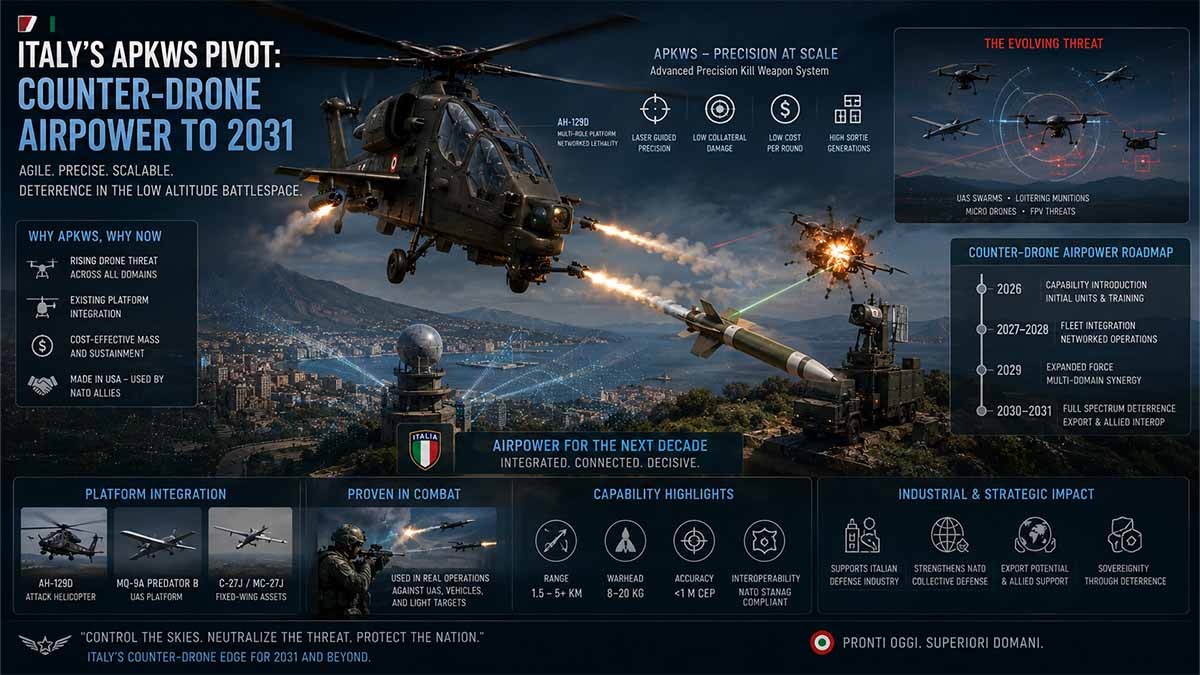
Executive Summary
- BLUF: The United States has authorised a possible Italian Foreign Military Sale covering 5,031 WGU-59B/B air-to-air APKWS II guidance sections, associated rocket components, launchers, proximity fuzes and support, with a ceiling value of USD 364 million.
- The notification is neither a signed contract nor proof of appropriation, final quantities, delivery dates or operational acceptance.
- The official notification does not publicly identify the Italian launch platform; the F-2000 Eurofighter is a strong analytical inference, not yet a verified Italian programme declaration.
- The United Kingdom’s 2026 operational integration of APKWS on RAF Typhoons materially reduces Italy’s technical and schedule risk.
- APKWS would add an economical short-range layer against comparatively slow drones; it would not replace Meteor, AMRAAM, IRIS-T, guns, electronic warfare or ground-based air defence.
- The principal vulnerability is the semi-active laser engagement chain: detection, classification, laser designation and uninterrupted tracking must remain coherent until intercept.
- Baseline assessment: 58% probability of an operational Italian air-launched capability by 2030; 17% probability of broader platform expansion by 2031; 9% probability that no FMS case is implemented.
- The decisive strategic question is whether Rome treats APKWS as an urgent imported munition or as the first component of a sovereign, networked Italian–European counter-UAS architecture.
Italy’s Anti-Drone Turn: The New Economics of Air Power
Italy’s prospective purchase of the Advanced Precision Kill Weapon System II is more than a weapons transaction. It signals a structural change in European air defence: the search for an interceptor sufficiently accurate to destroy drones, sufficiently inexpensive to preserve scarce high-end missiles, and sufficiently mature to enter service before the threat changes again. The operation is not yet a contract, and the weapon alone cannot defeat saturation attacks. Yet the decision opens a strategically important path for the Italian Eurofighter F-2000 fleet. It also exposes Europe’s deeper dilemma: whether to answer an age of mass-produced aerial threats through isolated foreign acquisitions or convert urgent purchases into an integrated, sustainable and increasingly sovereign defensive architecture.
The Italian Request
On 21 August 2026, the United States Department of State approved a possible Foreign Military Sale to Italy involving 5,031 WGU-59B/B air-to-air APKWS II guidance sections and related equipment, with a maximum estimated value of USD 364 million. The wording matters. Washington has authorized the transaction and notified the required institutional process; Rome has not thereby signed a procurement contract, accepted the maximum configuration or committed itself to the full financial ceiling.
The notification nevertheless identifies the operational direction with unusual clarity: the proposed sale is intended to strengthen Italy’s capacity against current and future threats, including airborne targets, and places the Eurofighter at the centre of the prospective capability. The quantity is large enough to suggest an intended operational stock rather than a limited experimental purchase, but its final scale, delivery profile and cost will depend on the agreement eventually negotiated.
APKWS II does not constitute a complete missile in isolation. The U.S. Naval Air Systems Command describes it as a laser-guidance section inserted between the warhead and motor of a legacy 2.75-inch rocket. The conversion gives an unguided rocket precision capability without reproducing the cost or complexity of a sophisticated air-to-air missile. This modularity is its economic strength—and the first warning against simplistic comparisons. The guidance kit still requires compatible launchers, rocket motors, warheads, fuzes, aircraft software, testing, logistics and qualified target-designation procedures.
The Cost of the Drone War
The rationale is rooted in an increasingly unfavorable exchange ratio. Modern combat aircraft can destroy drones with advanced missiles, but every such engagement consumes a weapon designed for faster, more manoeuvrable and more consequential targets. A defender that repeatedly uses its most sophisticated interceptors against comparatively inexpensive unmanned aircraft may win each encounter while progressively weakening its ability to confront the next, more dangerous wave.
The British experience has transformed this argument from theory into an allied operational precedent. On 17 May 2026, the United Kingdom Ministry of Defence announced the operational deployment of APKWS on Royal Air Force Typhoons in the Middle East. A ground-target firing had been completed in March 2026, followed by an air-to-air firing conducted by 41 Test and Evaluation Squadron in April 2026. Aircraft of No. 9 Squadron subsequently flew operational sorties with the weapon. British Minister for Defence Readiness and Industry Luke Pollard described the system as a means of engaging more drones at substantially lower cost.
The British programme is important for Italy because it reduces technological uncertainty around the Typhoon-aircraft combination. It does not eliminate Italy’s certification burden. National software baselines, weapon-clearance evidence, launcher configurations, training standards, safety rules and command arrangements must still be validated. The decisive advantage is not automatic interoperability, but the existence of a recent allied pathway that Rome can study, accelerate and adapt.
Latvia’s Warning
Italy has already confronted the operational problem directly. On 14 August 2026, two Italian Eurofighter F-2000s assigned to Task Force Air “Baltic Thunder III” were scrambled after a drone violated Latvian airspace. According to the Italian Ministry of Defence, the aircraft intercepted and destroyed it under NATO procedures. The official account did not identify the weapon used; any claim that the engagement involved a particular missile would therefore be unsupported.
The episode nevertheless clarifies the strategic geography of the prospective acquisition. Italy is not purchasing exclusively for the defence of national territory. Its combat aircraft contribute to NATO air policing, reinforce the eastern flank and may be called upon to address unmanned incursions far from Italian bases. A lower-cost guided rocket would give deployed commanders an additional option between cannon fire and advanced missiles.
That option has limits. Fighters are expensive systems to keep airborne merely to intercept low-speed threats. Their availability is constrained by crews, maintenance, runway security, tanker support and competing missions. APKWS may improve the cost of the munition fired, but it does not remove the cost of generating the sortie. Italy will gain strategic value only if fighters are cued by a wider surveillance network and launched or redirected against targets whose position, identity and trajectory have already been established with sufficient confidence.
The Targeting Chain
APKWS uses semi-active laser guidance. The target must be illuminated through the terminal phase by the launching platform or another qualified designator. This creates precision, but also binds the weapon to geometry, visibility, line of sight, atmospheric conditions and continuous target tracking. A rocket cannot compensate for a weak surveillance picture, an ambiguous identification or a delayed engagement decision.
This is why counter-drone defence is becoming a command-and-control problem before it becomes a missile problem. Radars must detect targets with small signatures; electro-optical and passive radio-frequency systems must refine classification; command networks must correlate tracks; and engagement authorities must distinguish hostile aircraft from civilian, friendly or merely unidentified objects. Electronic attack can disrupt radio-controlled or satellite-dependent drones, but autonomous navigation and non-radio control methods reduce its universality. Cannon fire remains economical, yet short engagement distances, difficult tracking and the consequences of missed rounds restrict its use around populated areas and allied aircraft.
On 18 May 2026, NATO Allied Command Transformation defined precisely this requirement through its Layered Counter-UAS Initiative, or LCI-X: affordable sensors, effectors and decision tools connected in an interoperable architecture. During the first Crucible event at Romania’s Capu Midia range, NATO brought together approximately 500 personnel, about 215 technical systems and representation from 21 Allied nations. The exercise did not seek a single technological winner. It tested whether radar, electronic warfare, command systems and interceptors could operate as one defensive organism.
Saturation Changes Everything
The most demanding threat through 2031 will not be the isolated drone intercepted over an empty sea or controlled range. It will be a heterogeneous raid in which reconnaissance aircraft, decoys and one-way attack vehicles approach from several directions, at different altitudes and with different communications profiles. The attacker’s objective will be to overload detection, exhaust operators, create false priorities and compel the premature expenditure of interceptors.
Under those conditions, the number of rockets available matters less than the rate at which the defensive system can process simultaneous tracks and assign the correct response. Electronic warfare should be used where the target remains vulnerable to it; guns and short-range systems should protect terminal zones; APKWS-class weapons should address confirmed targets that require precision but not an advanced missile; high-end interceptors should remain reserved for fast, manoeuvring or strategically critical threats. No layer is sufficient alone, and every layer has a different failure mode.
NATO formally acknowledged the scale of the transformation on 7 July 2026, when Allies launched NATO’s Drone Edge at the Ankara Summit Defence Industry Forum. The Alliance announced investment exceeding USD 40 billion in counter-drone capabilities over the following five years and committed to training five times as many military drone operators by the end of 2027. NATO also announced a counter-drone marketplace intended to make tested and compatible systems more rapidly available. The initiative places Italy’s potential acquisition inside a much larger contest over industrial scale, interoperability and procurement speed.
Europe’s Industrial Dilemma
The Italian decision arrives as Europe attempts to reconcile urgency with strategic autonomy. On 19 November 2024, European Union defence ministers approved the 2024 Coordinated Annual Review on Defence. The European Defence Agency reported that at least 18 Member States intended to address urgent gaps through counter-UAS systems, ground-based air defence and ammunition. At least 14 Member States expressed willingness to cooperate on electronic warfare, including shared procurement, data platforms, doctrine, training, jamming and counter-jamming.
The same review estimated EU defence expenditure at EUR 326 billion, equal to 1.9 per cent of EU GDP, for 2024, with more than EUR 100 billion allocated to investment. Yet the Agency warned that national programmes remained insufficiently coordinated and that urgent purchases from non-European suppliers could perpetuate fragmentation. Italy’s APKWS choice embodies this tension. A U.S.-managed Foreign Military Sale may deliver a mature capability faster than a new European programme. It may also reinforce external dependence for authorization, components, replenishment and future modifications.
Italy does possess relevant industrial foundations. Leonardo operates in radar, electronics, aircraft integration and defensive systems; MBDA’s European structure supplies advanced missiles; and the national defence sector has experience in guided ammunition and naval point defence. None of this proves that an immediately available Italian alternative to APKWS exists. It does mean that Rome should negotiate more than delivery: integration knowledge, maintenance capacity, test access, supply assurance and the ability to connect the weapon to Italian and European sensors should form part of the strategic return.
The Decision Beyond the Missile
By 2031, the success of the programme should not be judged by whether Italy has received thousands of guidance sections. It should be judged by whether the Armed Forces can defeat repeated drone attacks without exhausting advanced missiles, overusing combat aircraft or losing the targeting chain under electronic pressure.
Three decisions will determine the outcome. The first concerns integration: whether APKWS becomes an isolated Typhoon weapon or an effector embedded in national and NATO command networks. The second concerns industrial endurance: whether Italy secures predictable replenishment, maintenance and configuration control rather than depending on occasional emergency orders. The third concerns force design: whether airborne interception is combined with ground-based systems, electronic warfare, passive sensors, naval defences and automated—but human-supervised—weapon assignment.
The prospective purchase is therefore neither a minor technical adjustment nor a complete answer to the drone threat. It is an opportunity to correct the economics of a specific class of engagement. If Rome treats it as part of a layered European architecture, APKWS can preserve scarce high-end weapons and increase the operational flexibility of the F-2000 fleet. If it remains a stand-alone acquisition, Italy may obtain a cheaper projectile without solving the expensive system surrounding every launch.
Navigational Index
- Acquisition and Operational Reality — FMS status, Typhoon integration, certification, targeting chain and force-employment limits.
- Five-Year Threat and Capability Evolution — saturation warfare, electronic attack, layered interception and competing programme outcomes through 2031.
- Industrial Sovereignty and Alliance Effects — US dependence, Italian technology, European procurement, production resilience and NATO interoperability.
Master Abstract
The Italian APKWS proposition must first be stripped of three analytical distortions: an export authorisation is not a procurement contract; an aggregate package ceiling is not a unit price; and an air-to-air designation does not, by itself, prove that a particular Italian aircraft has completed integration. On 21 August 2026, the U.S. Department of State approved a possible Foreign Military Sale requested by Italy for 5,031 Guidance Sections Single Variant Air-to-Air APKWS II WGU-59B/B, accompanied by LAU-131 A/A launchers, Mk-152 high-explosive warheads, Mk 66 rocket motors, proximity fuzes, training warheads, inert motors, documentation, transportation and government and contractor support. The notified ceiling is USD 364 million, equivalent to approximately USD 72,351 per guidance section only if the entire package ceiling is mechanically divided by the requested quantity; that quotient must not be represented as the procurement price of an individual complete rocket because it embeds launchers, ammunition components, integration services, logistics and programme risk. The principal contractor identified by Washington is BAE Systems in Nashua, New Hampshire, while any offset structure remains subject to later negotiation. Italy – Guidance Section Single Variant Air-to-Air Advanced Precision Kill Weapon System-II – U.S. Department of State – August 2026 — Official FMS notification. Under the American FMS system, the legally operative government-to-government instrument is the signed and implemented Letter of Offer and Acceptance, while congressional notification precedes the offer of qualifying cases; consequently, quantities, configuration, value and schedule can still change. Foreign Military Sales Planning and Case Development, Chapter 5 – Defense Security Cooperation Agency – August 2026 — Official FMS process. This distinction changes the intelligence baseline: Italy has crossed a significant political and export-control threshold, but it has not publicly crossed the contractual, budgetary, certification or initial-operational-capability thresholds.
Operationally, APKWS II is best understood as a new rung in the engagement ladder rather than a substitute for conventional air-to-air missiles. The system inserts a semi-active laser guidance section between a 70-millimetre rocket motor and warhead, steering toward reflected laser energy generated by an airborne or ground designator; the designation chain must therefore survive target manoeuvre, cloud, haze, obscurants, platform geometry, sensor handover and electromagnetic disruption until the intercept. The U.S. Navy describes APKWS II as a conversion of the Hydra-class unguided rocket into a precision weapon and confirms that the fixed-wing design uses reflected laser energy supplied by airborne or ground-based designators. APKWS – Naval Air Systems Command – August 2026 — Official programme description. Navy Deploys New APKWS Design for Fixed-Wing Aircraft – Naval Air Systems Command – March 2016 — Official fixed-wing integration record. Its counter-UAS credibility is not merely conceptual: NAVAIR delivered vehicle-mounted APKWS systems to Ukraine and identified the radio-frequency proximity fuze as the enabling component for engagements against Group 2 and Group 3 UAVs. Navy to Complete Rapid Delivery of New Counter-UAS System to Ukraine – Naval Air Systems Command – December 2023 — Official counter-UAS deployment record. Most importantly for Italy, the Royal Air Force moved APKWS from testing to operational Typhoon deployment in less than two months during 2026, including successful air-to-air firings by 41 Test and Evaluation Squadron and operational carriage by 9 Squadron. UK Deploys New Low-Cost Anti-Drone System in the Middle East – UK Ministry of Defence – May 2026 — Official Typhoon deployment record. That British precedent substantially raises the probability of an Italian F-2000 pathway because the airframe, launcher integration logic, targeting architecture and safety evidence are no longer entirely novel. It does not, however, establish Italian certification, funding or platform assignment. No primary Italian or U.S. document verified in this session confirms integration on AW249 Fenice, M-346FA or an Italian uncrewed aircraft; those possibilities must remain outside the factual baseline.
The five-year outlook is therefore governed less by the aerodynamic performance of one rocket than by the architecture surrounding it. Between 2026 and 2031, Italy will confront a threat spectrum extending from accidental airspace incursions and reconnaissance platforms to coordinated salvos, low-observable one-way attack systems, decoys and electronically displaced drones. Chinese official military analysis describes saturation by intelligent swarms as a structural evolution of warfare, while Chinese government defence research separates counter-UAS architecture into detection—radar, radio-frequency, electro-optical and acoustic sensing—and defeat through kinetic destruction, electronic interruption or control capture. These sources are not neutral performance audits, but they provide primary evidence of how a major military competitor conceptualises the problem. Military Intelligentisation Is Profoundly Affecting Future Operations – Ministry of National Defense of the People’s Republic of China – September 2019 — Official Chinese assessment. Analysis of Counter-Unmanned-Aircraft Equipment Technologies – Hunan Provincial National Defense Mobilization Office – July 2024 — Official Chinese technical assessment. Russian military material similarly records the increasing role of inexpensive UAVs and layered local air observation and interception, supporting the assessment that volume, distributed sensing and inexpensive effectors will remain central variables rather than temporary features. Features of Air-Defence Organisation Against Unmanned Aerial Vehicles – Russian Ministry of Defence – June 2023 — Official Russian military analysis. Europe’s institutional response already points in the same direction: at least 18 EU Member States declared an intention to address urgent gaps through joint procurement of C-UAS, ground-based air defence and ammunition, followed by medium-term technology for defeating swarms and a long-term integrated air-and-missile-defence architecture. 2024 Defence Review Paves Way for Joint Military Projects – European Defence Agency – November 2024 — Official CARD assessment. APKWS can contribute a magazine-depth and cost-exchange improvement, but only inside a layered system combining identification, rules of engagement, electronic warfare, guns, ground effectors and high-performance missiles. The shadow dimensions reinforce this conclusion: proxy or irregular forces can accelerate drone diffusion, but no verified evidence currently connects mercenary structures to the Italian APKWS case; cyber and electronic-warfare pressure can attack the sensor-to-designator chain even though the rocket itself does not depend on satellite navigation; and liquidity flows will follow FMS deposits, production allocation, support contracts and any negotiated industrial return. These variables are tracked as indicators, not presented as established programme facts.
Acquisition and Operational Reality: Italy’s APKWS II Path to 2031
The legal threshold, not the contract
The Italian programme currently exists at the intersection of a validated operational requirement and an authorised American export pathway, but it has not yet reached the publicly demonstrated status of a binding acquisition. On 21 August 2026, the U.S. Department of State approved a possible Foreign Military Sale to Italy with a notified ceiling of USD 364 million, centred on 5,031 WGU-59B/B Guidance Sections Single Variant Air-to-Air APKWS II. The proposed package also encompasses LAU-131 A/A launchers, Mk-152 high-explosive warheads, Mk 66 rocket motors, proximity fuzes, WTU-1/B practice warheads, inert motors, technical publications, transportation, support equipment and American governmental and contractor services. The named principal contractor is BAE Systems, Nashua, New Hampshire; any offset arrangement remains subject to negotiation rather than constituting an established part of the notification. Italy – Guidance Section Single Variant Air-to-Air Advanced Precision Kill Weapon System-II – U.S. Department of State – August 2026 — Official FMS notification. These facts establish that Italy submitted a formal request and that Washington completed the political and export-control determination needed to make the capability available. They do not establish a signed Letter of Offer and Acceptance, Italian parliamentary appropriation, final negotiated price, contractual quantity, production slot, delivery calendar, platform certification or operational declaration. Under the U.S. security-cooperation framework, congressional notification precedes the offer of qualifying cases, while the implemented LOA is the government-to-government instrument that defines the articles and services ultimately purchased. Foreign Military Sales Planning and Case Development, Chapter 5 – Defense Security Cooperation Agency – August 2026 — Official FMS process. The correct intelligence judgment is consequently neither “Italy has bought APKWS” nor “the transaction is merely speculative”: Rome has passed a high-significance policy gate, but several financial, engineering and acceptance gates remain unresolved.
| Programme gate | Publicly verified status, August 2026 | What remains unverified |
|---|---|---|
| Italian Letter of Request | Completed | Exact operational requirement and internal funding profile |
| U.S. export determination | Completed | None within the notified ceiling |
| Congressional notification | Publicly announced | Completion of all subsequent case actions |
| Implemented LOA | Not publicly confirmed | Signature, deposit, payment schedule and final configuration |
| U.S. procurement contract | Not publicly confirmed for Italy | Lot placement, quantities and delivery priorities |
| Italian platform designation | Not stated in the public notification | F-2000 configuration, fleet subset and responsible unit |
| Airworthiness approval | Not publicly confirmed | Certification basis, limitations and release-to-service |
| Initial operational capability | Not achieved publicly | Trained crews, weapons stocks, doctrine and deployability |
The price problem and the meaning of 5,031 kits
The USD 364 million ceiling cannot legitimately be divided by 5,031 and presented as the market price of one APKWS round. Such a calculation produces approximately USD 72,351 per requested guidance section, but this is only a ceiling-equivalent allocation across a total-package case containing launchers, motors, warheads, proximity fuzes, inert and training articles, documentation, integration, transport, engineering and logistics. The eventual LOA may be lower than the notification ceiling; quantities can also change before or during execution. The more strategically relevant number is therefore not an unverified unit price but the requested inventory depth. If fully contracted and delivered, 5,031 guidance sections would create an ammunition population large enough to support operational stocks, training consumption, technical reserves and multi-year replenishment rather than a token evaluation programme. Yet even that conclusion requires qualification: a guidance section is not automatically a complete, certified air-to-air round, and deployable inventory depends on the synchronized availability of motors, proximity-fuzed warheads, compatible launchers, approved software, storage infrastructure and trained personnel. The British government describes APKWS on Typhoon as permitting drone engagements “at a fraction” of the cost of conventional air-to-air missiles, but it does not publish a transferable Italian all-up-round price. UK Deploys New Low-Cost Anti-Drone System in the Middle East – UK Ministry of Defence – May 2026 — Official deployment statement. The acquisition logic should consequently be evaluated through cost per defended hour, cost per successful engagement, magazine depth per sortie and preservation of scarce high-performance missiles, not through a simplistic munition-versus-drone price comparison. APKWS can improve the economic exchange ratio only when the target is detected, classified, designated and engaged within its practical envelope. Scrambling a twin-engine fighter, sustaining tanker and command-and-control support, and maintaining high readiness impose costs that remain substantial even when the expended interceptor is cheaper.
Typhoon: probable destination, unconfirmed Italian baseline
The F-2000A Eurofighter is the analytically strongest candidate for Italy’s air-to-air APKWS capability, but the distinction between probability and documentation is essential. The public American notification describes an air-to-air variant yet does not identify an Italian service, airframe, squadron or integration schedule. The Aeronautica Militare’s official aircraft description identifies the F-2000 as the principal national air-defence fighter operating in the twenty-four-hour Quick Reaction Alert system and lists its publicly declared armament as the 27-millimetre Mauser cannon, AIM-9L, AIM-120 AMRAAM, IRIS-T, Meteor, guided bombs and laser-targeting pods; APKWS is not yet listed. Eurofighter Typhoon – Aeronautica Militare – June 2024 — Official F-2000 capability record. The operational requirement is no longer theoretical. On 14 August 2026, two Italian F-2000s assigned to Task Force Air “Baltic Thunder III” scrambled after a drone violated Latvian airspace, intercepted it and destroyed it under NATO procedures. The Ministry of Defence did not disclose the weapon used, so no inference concerning an AMRAAM, IRIS-T or cannon can be treated as verified. Scramble in Latvia: Italian Eurofighters Shoot Down an Unmanned Aircraft – Italian Ministry of Defence – August 2026 — Official operational statement. The event nevertheless demonstrates the mission demand: Italy’s fighters must be able to identify and neutralise unmanned aircraft during real NATO air-policing sorties, including incidents whose origin, intent and navigation history may initially be uncertain. APKWS would not replace the existing fighter armament; it would add a shorter-range, higher-capacity effector appropriate only after the target has been reduced from an ambiguous air track to a positively classified, legally engageable object.
The British precedent and the transferability gap
The British programme sharply improves the feasibility assessment because it proves that an operational Eurofighter Typhoon–APKWS configuration is achievable without a decade-long integration cycle. The UK Ministry of Defence reported a ground-target trial in March 2026, successful air-to-air firings by 41 Test and Evaluation Squadron in April, and deployment with 9 Squadron in May, stating that the transition from testing to operations occurred in less than two months. UK Deploys New Low-Cost Anti-Drone System in the Middle East – UK Ministry of Defence – May 2026 — Official Typhoon integration account. BAE Systems’ 2026 investor report independently records a successful APKWS firing from Eurofighter, operational deployment in under two months and new investment in Austin and Hudson intended to increase precision-guided-munition production capacity. Half-yearly Report 2026 – BAE Systems plc – July 2026 — Official investor report. This precedent reduces uncertainty in launcher carriage, aircraft–store compatibility, laser designation and employment software, but it does not automatically confer Italian clearance. Typhoon is a multinational platform whose national fleets differ in software standards, defensive-aids configurations, targeting pods, weapon-clearance documentation, mission-data sets and release authorities. Italy would still require access to the relevant British evidence, configuration comparison, national safety assessment and acceptance by the competent military airworthiness authority. If the Italian aircraft standard and pod configuration are sufficiently close to the British test configuration, Rome could reuse evidence and compress the schedule. If they diverge materially, additional ground trials, captive carriage, safe-separation analysis, telemetry firings and software validation would be necessary. The British two-month emergency pathway therefore represents an optimistic technical benchmark, not a guaranteed Italian calendar.
Certification is the programme’s hidden centre of gravity
Weapon integration is not accomplished by attaching a seven-tube launcher to an available hardpoint; it is accomplished when the aircraft, store, launcher, software, fuze, sensor and operating procedures have been demonstrated as a controlled configuration across the authorised flight and employment envelope. European military airworthiness requirements place responsibility for integrating weapons and other systems on the aircraft’s military type-certificate holder and require the retention of design information, drawings, tests, operating limitations and continuing-airworthiness instructions. EMAR 21: Certification of Military Aircraft and Related Products, Parts and Appliances, and Design and Production Organisations – European Defence Agency – September 2014 — Official military-airworthiness requirements. For an Italian APKWS configuration, the certification workload would normally encompass structural loads, launcher attachment, aerodynamic interference, flutter and vibration, electromagnetic compatibility, rocket-motor plume effects, safe separation, jettison behaviour where applicable, proximity-fuze safety, laser-code management, store-management software, cockpit indications, targeting-pod interfaces, mission-planning data, ground handling, explosive safety, maintenance publications and emergency procedures. Certification must also distinguish carriage from employment: an aircraft can be cleared to transport a store before it is authorised to launch it, and a launch clearance may initially contain restrictions on altitude, speed, manoeuvre, weather, target aspect or adjacent-store combinations. The British evidence could eliminate duplicated testing only where Italy’s authority accepts the provenance, methods and configuration equivalence. The decisive programme actors are therefore broader than the U.S. supplier and the Aeronautica Militare: they include the Typhoon design authority, Italian military airworthiness authority, weapons-test organisations, software and mission-data entities, range authorities, launcher and pod suppliers, and NATO interoperability stakeholders. Delay at any interface could produce an inventory that has been delivered financially but remains operationally constrained.
Italian APKWS Capability Chain: Eurofighter Typhoon Integration
Comprehensive end-to-end foreign military sales (FMS), hardware manufacturing, software modification, and operational kill-chain lifecycle.
1. Italian Requirement & Capability Gap Analysis
Requirement PhaseItalian Defense Staff formalization of precision strike requirements against asymmetrical, light-armored, and urban threats using low-collateral guidance kits.
2. U.S. Export Approval & Congressional Process
Regulatory ClearanceNavigation of International Traffic in Arms Regulations (ITAR) and Foreign Military Sales (FMS) oversight mechanisms.
3. Negotiated LOA, Funding & Payment Milestones
Financial StructuringFinalization of the Letter of Offer and Acceptance (LOA) between the U.S. Government and Italian Secretariat General of Defense.
4. U.S. Production Order & Munitions Assembly
Industrial FabricationActivation of BAE Systems manufacturing lines for WPU-4/B semi-active laser guidance sections, MK66 rocket motors, warheads, and fuzes.
5. Eurofighter Typhoon Design Change & Integration
Platform AdaptationModifications executed by Leonardo and Eurofighter consortium partners to equip the Typhoon fleet for APKWS employment.
6. Ground & Flight Testing Phase
Test & EvaluationRigorous testing campaigns conducted at Italian Air Force test ranges (e.g., Salto di Quirra) and allied proving grounds.
7. Airworthiness Approval & Certification
Certification GateIssuance of formal military airworthiness certification by the Italian Directorate of Air Armaments and Airworthiness (ARMAEREO).
8. Release to Service & Doctrine Integration
Operational FieldingTransition of weapon systems to operational wings, flight crews, and NATO joint command structures.
9. Operational Capability & Kill-Chain Execution
Full Operational CapabilityExecution of active combat missions leveraging real-time sensor-to-shooter loops.
The targeting chain defines the real envelope
APKWS II converts an unguided 70-millimetre rocket into a precision munition by inserting a semi-active laser guidance section between the rocket motor and warhead. The seeker follows laser energy reflected from the designated target; illumination can originate from the launch aircraft or another compatible designator. Navy Deploys New APKWS Design for Fixed-Wing Aircraft – Naval Air Systems Command – March 2016 — Official fixed-wing technical description. The consequence is operationally decisive: APKWS does not possess the autonomous beyond-visual-range search and terminal discrimination associated with a modern radar-guided air-to-air missile, and it should not be analysed as a reduced-price Meteor or AMRAAM. Its effectiveness depends on a complete sensor-to-effector chain. Surveillance systems must first detect a low-signature track amid ground clutter; command authorities must establish identity and intent; the fighter must acquire and maintain a geometrically suitable intercept; a laser designator must hold energy on the target; the seeker must capture the reflected signal; and the proximity fuze must generate lethal effect despite a small miss distance. NAVAIR’s Ukrainian VAMPIRE programme explicitly identifies the radio-frequency proximity fuze as enabling APKWS engagements against Group 2 and Group 3 UAVs. Navy to Complete Rapid Delivery of New Counter-UAS System to Ukraine – Naval Air Systems Command – December 2023 — Official counter-UAS fielding record. Clouds, haze, smoke, precipitation, poor contrast, low-altitude clutter, crossing geometry, masking terrain, target manoeuvre and designation interruption can degrade the chain. The rocket is therefore most credible against relatively slow, non-manoeuvring or predictably moving drones after positive identification; it is progressively less suitable as target speed, evasiveness, altitude, electronic complexity and engagement distance increase.
| Engagement variable | APKWS implication | Force-employment consequence |
|---|---|---|
| Target identity | Human and command validation remain essential | Poor choice for ambiguous tracks in dense civilian airspace |
| Target speed and manoeuvre | Limited energy and control authority relative to purpose-built missiles | Best matched to slower, predictable UAVs |
| Weather and obscurants | Laser propagation and target visibility may degrade | Conventional missiles or guns may remain necessary |
| Designation continuity | Illumination must be maintained through intercept | Fighter geometry and crew workload become critical |
| Proximity fuze | Increases effectiveness against small aerial targets | Correct fuze configuration is indispensable |
| Range | Platform, altitude, geometry and target motion alter practical reach | Published maximum figures cannot define all engagements |
| Salvo size | Rocket pods increase shots carried per station | Useful against repeated threats, not a solution to unrestricted swarms |
| Rules of engagement | Debris trajectory and target attribution remain relevant | Political control may dominate purely technical feasibility |
Force-employment limits and NATO reality
For the Aeronautica Militare, the greatest doctrinal error would be to interpret APKWS as a universal answer to the drone problem. Fighter-launched rockets address only one segment of a layered defence architecture. They are valuable when airborne combat patrols or QRA aircraft are already available, when the target is outside the efficient reach of local ground systems, when electronic defeat is unavailable or inappropriate, and when commanders wish to conserve longer-range missiles. They are less efficient when every engagement requires a costly scramble from a distant base, persistent tanker support or extended loiter by high-performance fighters. They cannot repair deficiencies in low-altitude radar coverage, passive radio-frequency detection, optical classification, civil–military air-traffic coordination or command latency. They also cannot neutralise simultaneously every member of a large swarm when target designation and engagement remain substantially sequential. NATO’s air-policing system provides continuous command and control for interception, but it was historically designed around aircraft violating or approaching Allied airspace, not massed populations of inexpensive, low-signature objects. Italy’s 2024–2025 Baltic deployment illustrates the scale of conventional readiness: the Aeronautica Militare reported 55 Alpha Scrambles, 82 intercepted aircraft, more than 1,500 flight hours and 400 sorties over eight months. NATO Baltic Air Policing Lithuania: Baltic Thunder II Mission Concludes – Aeronautica Militare – April 2025 — Official mission record. Adding APKWS changes the weapons menu available to such deployments, but sustainable counter-UAS defence still requires ground-based systems, electronic warfare, guns, passive sensors and distributed command nodes. The European Defence Agency accordingly treats C-UAS, ground-based air defence and ammunition as mutually reinforcing elements of integrated air and missile defence rather than interchangeable acquisitions.
Competing hypotheses and Bayesian update
The forecast uses five mutually exclusive programme outcomes: H₁, full Typhoon-focused fielding before the end of 2030; H₂, a reduced or phased purchase producing a limited operational capability; H₃, contractual or certification delay pushing meaningful fielding beyond 2031; H₄, an expanded programme in which Typhoon becomes the first node of a broader Italian or multinational counter-UAS architecture; and H₅, failure to implement the FMS case or substitution by another solution. Judgmental priors were established before incorporating the August notification and British operational evidence: H₁ at 28%, H₂ at 22%, H₃ at 20%, H₄ at 12% and H₅ at 18%. The U.S. authorisation strongly decreases H₅ because it proves both an Italian request and American releasability; the RAF Typhoon precedent increases H₁ and H₄ by reducing platform-integration uncertainty; the absence of a public Italian LOA, budget line, platform declaration and certification plan preserves meaningful weight for H₂ and H₃. The resulting posterior distribution is H₁ at 41%, H₂ at 19%, H₃ at 14%, H₄ at 17% and H₅ at 9%. These are analytical probabilities, not official estimates, and they must be updated when discriminating evidence appears. The most valuable indicators are an implemented LOA, an Italian procurement appropriation, identification of the implementing service, a formal Typhoon design-change notice, launcher or targeting-pod integration activity, Italian live-fire testing, airworthiness documentation, training releases, delivery announcements and evidence of industrial participation. A signed LOA without platform activity would favour H₂ or H₃; Italian Typhoon firing trials would sharply favour H₁; a joint procurement or adaptation to additional launch domains would favour H₄; disappearance of funding from successive planning documents would revive H₅.
| Hypothesis | Prior | Posterior | Principal confirming indicator | Principal disconfirming indicator |
|---|---|---|---|---|
| H₁ Full Typhoon-focused fielding | 28% | 41% | Italian flight test and release-to-service | No integration activity by 2028 |
| H₂ Reduced or phased acquisition | 22% | 19% | LOA with reduced quantity or staged deliveries | Full 5,031-unit production placement |
| H₃ Operational delay beyond 2031 | 20% | 14% | Certification or software divergence | Rapid evidence reuse from RAF programme |
| H₄ Broader multi-platform architecture | 12% | 17% | Official additional-platform or ground-launch programme | Explicit Typhoon-only sustainment plan |
| H₅ No implemented case or substitution | 18% | 9% | Funding withdrawal or alternative selection | Signed LOA and first production order |
Monte Carlo outlook, 2027–2031
The Monte Carlo model runs 50,000 synthetic programme paths using distributions for LOA timing, budget continuity, production allocation, certification duration, configuration commonality with the RAF, successful flight testing and threat-driven acceleration. It does not simulate classified aerodynamic performance or infer undisclosed Italian decisions. The baseline assumes that a signed LOA becomes more likely than not during 2027, that British Typhoon evidence provides partial rather than automatic certification credit, that production capacity remains contested among U.S. and allied requirements, and that persistent drone incursions preserve political urgency. The model assigns a 64% probability that Italy has at least a limited certified air-launched capability by the end of 2030, but only a 46% probability that a substantial majority of the originally requested guidance sections has been delivered by then. The distinction matters: software, launchers, training rounds and an initial combat stock can support operational declaration well before all 5,031 kits arrive. Conversely, delivered material can remain unavailable for combat if flight clearance, proximity-fuze configuration or crew qualification lags. The fifth-year model also gives a 24% probability that Italy has formally extended the capability beyond a single Typhoon configuration by 2031. That figure includes an additional airborne or surface-launch programme but does not assert that AW249, M-346FA or an Italian UAV has been selected. The 90% uncertainty interval around initial operational capability spans late 2027 to beyond 2031, demonstrating that the dominant uncertainty is institutional execution rather than weapon existence.
| Year-end milestone | 2027 | 2028 | 2029 | 2030 | 2031 |
|---|---|---|---|---|---|
| Implemented LOA | 61% | 76% | 81% | 83% | 84% |
| Italian Typhoon flight-test activity | 27% | 51% | 65% | 71% | 73% |
| Limited operational capability | 12% | 31% | 49% | 64% | 72% |
| More than 3,000 kits delivered | 4% | 15% | 29% | 46% | 59% |
| Additional launch-domain programme | 3% | 8% | 14% | 19% | 24% |
Shadow dimensions: industry, cyber norms and liquidity
The programme’s shadow architecture deserves the same attention as its visible hardware. The first dimension is industrial dependence. Guidance production and critical components remain anchored in the United States, while aircraft integration is embedded in a multinational European design ecosystem. BAE Systems reported additional investment in its Austin and Hudson sites to increase precision-guided-munition capacity, but greater capacity does not guarantee Italian delivery priority because production allocation will reflect U.S. requirements, existing allied orders and contract timing. Half-yearly Report 2026 – BAE Systems plc – July 2026 — Official investor report. The second dimension is liquidity: congressional authorisation establishes a ceiling, but programme velocity depends on Italian deposits, milestone payments, U.S. contracting authority and sustained appropriations for integration, training and replenishment. The third is contractor power. Engineering data, launcher interfaces, seeker support and software evidence can create continuing foreign dependence even when Italy holds physical stocks. The fourth is cyber and electromagnetic exposure. APKWS guidance itself avoids reliance on satellite navigation, but the broader kill chain depends on radar networks, tactical data, mission planning, identification systems, targeting pods and command links; adversarial manipulation of tracks or timing can therefore compromise engagement before rocket launch. The fifth is proxy diffusion. No verified source connects mercenary organisations to the Italian transaction, so that variable receives low present weight; nevertheless, irregular and state-supported actors increasingly exploit inexpensive UAVs, forcing national air forces to defend against threats whose financial and political sponsors may remain deniable. These dimensions transform an apparently simple munition purchase into a question of sovereign access, information assurance and long-duration financing.
Russian, Chinese and European cross-check
Russian and Chinese primary materials must be treated as interested official narratives rather than neutral performance evaluations, but they reveal convergent operational principles relevant to Italy’s five-year planning. Russian Ministry of Defence reporting from 2026 describes networks of air-observation posts and mobile fire groups used to detect and destroy UAVs, demonstrating an emphasis on distributed detection and inexpensive local engagement rather than exclusive reliance on sophisticated long-range interceptors. Air-Observation Posts of the 51st Combined Arms Army Detect and Destroy UAVs – Russian Ministry of Defence – May 2026 — Official Russian operational report. Chinese governmental defence analysis divides counter-UAS systems into detection functions—radar, radio-frequency, electro-optical and acoustic—and defeat functions comprising kinetic destruction, technical disruption and control capture; it identifies low signature, ground clutter, target discrimination, friendly interference and swarm scale as persistent problems. Analysis of Counter-Unmanned-Aircraft Equipment Technologies – Hunan Provincial National Defense Mobilization Office – July 2024 — Official Chinese technical assessment. The European response is institutionally aligned with this layered logic. At least 18 EU Member States declared their intention to pursue C-UAS, ground-based air defence and ammunition collaboratively, with swarm-defeat technologies as a medium-term objective and robust IAMD as the long-term destination. 2024 Defence Review Paves Way for Joint Military Projects – European Defence Agency – November 2024 — Official CARD assessment. The Commission’s Defence Readiness Roadmap places air and missile defence, drones, counter-drones, missiles, ammunition, cyber and electronic warfare among the linked capability priorities for 2030. Preserving Peace – Defence Readiness Roadmap 2030 – European Commission and High Representative – October 2025 — Official EU roadmap. APKWS is therefore strategically coherent only if Italy uses it as a component of this wider architecture, not as a substitute for it.
Five-year judgment
The most probable 2031 end state is an Italian counter-UAS force in which the F-2000 carries APKWS for selected short-range engagements while retaining Meteor, AMRAAM, IRIS-T and the cannon for targets demanding greater reach, autonomy, energy or manoeuvrability. Ground-based effectors, electronic warfare and distributed sensors will absorb threats that do not justify fighter employment; NATO command-and-control will coordinate cross-border tracks; and national rules of engagement will remain the decisive constraint in ambiguous peacetime incursions. The acquisition’s success should not be measured by whether Italy receives exactly 5,031 guidance sections. It should be measured by whether the country establishes a repeatable chain from detection through legal identification to affordable defeat, whether combat stocks can be replenished faster than they are consumed, whether airworthiness evidence can be reused across the Typhoon partnership, and whether Italian industry gains meaningful access to integration, maintenance, test and future seeker development. The most serious downside case is not outright cancellation but partial implementation: guidance kits acquired, launcher availability limited, aircraft clearance narrow, training consumption constrained and operational employment dependent on a small number of specially configured aircraft or external technical support. The most strategically valuable upside case is a common European Typhoon counter-UAS configuration with shared test evidence, pooled procurement, harmonised training and distributed stocks, followed by complementary Italian development of ground and maritime effectors. Between these poles, the next eighteen months will be more informative than the notification itself. An implemented LOA, identified platform authority and Italian flight-test programme would move the forecast decisively toward operational fielding; absent those signals, the USD 364 million announcement will remain an authorised capability envelope rather than a fielded Italian weapon system.
Five-Year Threat and Capability Evolution: Italy’s Counter-UAS Contest Through 2031
The strategic problem: adaptation speed, not weapon availability
Between 2027 and 2031, Italy will confront a counter-unmanned-aircraft problem governed less by whether APKWS II works against an individual drone than by whether the entire defensive enterprise can adapt faster than adversaries can alter signatures, routes, communications and attack density. APKWS can improve the exchange ratio against targets that do not justify an AIM-9X, Meteor or comparable high-value interceptor, but it cannot independently solve detection, classification, target allocation, laser designation, airspace deconfliction, battle-damage assessment or magazine-depth constraints. The decisive unit of analysis is consequently the engagement chain: heterogeneous sensors must discover a target early enough; command systems must separate hostile vehicles from civil, friendly and ambiguous tracks; an engagement authority must select an effector; and a weapon platform must obtain a geometrically valid firing solution before the target reaches its objective. The United States describes inexpensive unmanned systems as an urgent and enduring challenge rather than a temporary feature of one theatre, while NATO experimentation is increasingly organized around interoperable combinations of sensors, decision aids and effectors rather than isolated weapons. DoD Announces Strategy for Countering Unmanned Systems – U.S. Department of Defense – December 2024 — Official strategy announcement. Layered Counter-UAS Initiative Is Building NATO’s Approach to a Fast-Moving Threat – NATO Allied Command Transformation – May 2026 — Official NATO ACT assessment. The central five-year judgment is therefore conditional: Italian acquisition of several thousand guidance sections could create a useful middle interception layer, particularly from F-2000 Typhoon, but only distributed sensing, resilient communications, diversified effectors and recurring software-driven certification can convert those inventories into sustained protection. Absent those complements, the acquisition would produce a technically credible but episodic capability optimized for selected targets, permissive weather and manageable raid sizes rather than persistent defence against adaptive saturation.
Saturation warfare and the changing unit of attack
Saturation through 2031 will probably evolve from the simple proposition “more drones launched simultaneously” into coordinated packages designed to consume different defensive resources at different times. A representative raid may combine low-signature reconnaissance aircraft, inexpensive decoys, one-way attack vehicles, higher-altitude relay nodes, emitters intended to trigger passive sensors, and weapons programmed to arrive from separated bearings within a compressed interval. Route diversity will force radars to divide attention across terrain-masked, sea-skimming and higher-altitude tracks; signature diversity will complicate classification; and timing diversity will encourage defenders to expend scarce interceptors on early targets before the principal strike arrives. NATO’s Ukraine lessons process reports drone employment on a scale of thousands across the operational environment, while the U.S. Joint Interagency Task Force describes the diffusion of small systems among both state and non-state actors as requiring continuously evolving defences. Drones – Lessons from Ukraine – North Atlantic Treaty Organization – October 2025 — Official NATO operational-learning material. Small Drones, Big Problems: A First Principles Approach to Countering-UAS – U.S. Department of Defense – July 2026 — Official Department of Defense study. Chinese official technical analysis similarly identifies weak radar signatures, clutter discrimination, swarming and the need to combine detection, disruption, control capture and kinetic defeat; this material is useful as evidence of the problem set discussed within China, not as proof of any particular Chinese operational capability. 探析反无人机装备技术 – Hunan Provincial National Defense Mobilization Office – July 2024 — Official Chinese government analysis. For Italy, the operational implication is that the relevant metric will not be the number of APKWS rounds purchased but the number of concurrent tracks that the national and NATO system can detect, classify, assign and engage per minute while preserving lower-cost options for subsequent waves. A stockpile of 5,031 guidance sections could appear substantial under single-target assumptions yet contract rapidly when measured against repeated multi-axis raids, training consumption, maintenance reserves, dispersed bases and the probability of multiple shots per uncertain kill.
| Saturation dimension | Likely development through 2031 | Pressure on Italy and NATO | Required countermeasure |
|---|---|---|---|
| Raid density | Larger simultaneous and near-simultaneous packages | Track overload, compressed authorization time, launcher depletion | Automated correlation, engagement-quality track sharing, pre-authorized doctrine |
| Target heterogeneity | Decoys, reconnaissance UAVs, one-way weapons and relay aircraft mixed together | Misallocation of expensive interceptors | Multispectral classification and value-based weapon assignment |
| Spatial dispersion | Low-altitude, maritime and terrain-masked ingress from multiple bearings | Radar gaps and fragmented local pictures | Distributed passive and active sensors connected to resilient command nodes |
| Temporal sequencing | Probe, suppression and strike waves separated by minutes or hours | Premature magazine expenditure and crew fatigue | Campaign-level inventory control, crew rotation and reserve thresholds |
| Signature adaptation | Reduced emissions, composite structures and irregular flight profiles | Later detection and weaker identification confidence | Sensor fusion across radar, electro-optical, acoustic and passive radio-frequency channels |
| Economic coercion | Cheap attackers repeatedly trigger costly launches and sorties | Adverse exchange ratios and reduced readiness for higher-end threats | Guns, electronic attack, reusable interceptors and APKWS-class intermediate effectors |
| Learning speed | Rapid firmware, navigation and tactics changes | Certification cycles become obsolete before deployment | Modular software baselines and recurring operational experimentation |
Electronic attack against the complete targeting chain
Electronic attack will increasingly target the defender’s information architecture rather than merely jam the drone’s control signal. The attack surface includes surveillance radar, passive radio-frequency receivers, electro-optical cueing, navigation timing, tactical data links, weapon-platform mission computers, laser-designation coordination and the databases used for classification. An adversary may combine broad-spectrum noise with deceptive emitters, GNSS interference, false track generation, malware introduced through maintenance chains, and physical attacks against exposed relay nodes. Conversely, autonomous navigation, terrain matching, image-based terminal guidance and fibre-optic control can reduce the attacker’s dependence on conventional radio links. NATO’s 2025 innovation challenge explicitly treated fibre-optic-controlled first-person-view aircraft as systems capable of bypassing conventional radio-frequency jamming, illustrating why electronic warfare cannot remain the sole inexpensive countermeasure. Innovation Challenge Counters Fibre-Optic-Controlled FPV Drones – NATO Allied Command Transformation – June 2025 — Official NATO ACT notice. APKWS semi-active laser homing provides a partial hedge because terminal guidance does not require continuous satellite navigation or a radio command link to the rocket. It does not, however, make the engagement chain electronically independent: the launching aircraft still needs a trusted track, target correlation, rules-of-engagement authorization, appropriate geometry and either organic or cooperative laser illumination until impact. Italy’s own modernization documentation identifies cyber hardening of the SIRIUS air-command system, modernization of Link 16 cryptography and throughput, and optimization of KRONOS Land for counter-UAS and counter-rocket, artillery and mortar missions. SIRIUS and KRONOS Land Modernization Programme – Italian Ministry of Defence – 2021 — Official Italian programme document. Through 2031, resilience will therefore depend on degraded-mode operations: local sensors must retain engagement authority when wide-area networks fail; identification confidence must be quantified rather than assumed; mission data must be cryptographically authenticated; and operators must train against delayed, contradictory or intentionally manipulated tracks. Electronic protection becomes a prerequisite for the economic advantage promised by APKWS because a low-cost round fired on a false, duplicated or stale track is still a wasted round and may create severe collateral or fratricide risk.
Adversary Attack Package vs. Defensive Engagement Chain
Interactive dual-stream kinetic analysis mapping penetration vectors against multi-layered air defense architecture.
Radar cross-section (RCS) reduction combined with low-altitude contour hugging to suppress line-of-sight detection.
Integrated telemetry via Active/Passive Radar, EO/IR tracking, acoustic sensors, and passive RF receivers.
Electronic warfare chaff, spoofed transponder signals, and neural network input injection to saturate sensor data.
SIRIUS combat management, NATO C2 node synchronization, and local tactical battle manager data filtering.
Broadband signal jamming and spoofing targeting network synchronization and inertial navigation systems.
Automated threat valuation scoring, tracking confidence evaluation, and collateral risk mitigation logic.
Saturated swarm vectors routed through heavy commercial traffic corridors to degrade identification windows.
Tiered weapon allocation: Electronic Warfare (EW) → Autocannon / CIWS → Interceptor UAV → APKWS → Heavy Missile.
Aerosol screening, high-g terminal weaving, and thermal flare deployment to break lock-on.
Laser designation, missile launch, kinetic intercept, and real-time Battle Damage Assessment (BDA).
Layered interception and the proper place of APKWS
A defensible 2031 architecture must treat every effector as a constrained resource assigned according to target class, confidence, range, raid phase and consequences of leakage. Passive detection and electronic surveillance can provide early warning without revealing every defensive position. Electronic attack is attractive where a target remains dependent on controllable radio-frequency or satellite-navigation links, but it may fail against autonomous, hardened or fibre-controlled systems. Guns and programmable ammunition offer low marginal cost but impose short engagement windows, difficult lead calculations and potential danger from misses or falling projectiles. Interceptor drones can extend reach and conserve munitions, although their launch time, weather sensitivity, recovery rate and own susceptibility to electronic attack remain important. Directed-energy systems may eventually supply deep magazines at defended fixed sites, but atmospheric attenuation, dwell time, power generation, thermal management and line-of-sight limitations prevent treating them as universal solutions. APKWS occupies the intermediate kinetic layer: more precise and generally longer-reaching than direct-fire cannon, materially less capable than an advanced air-to-air missile, and potentially deployable from multiple airborne or surface platforms. U.S. Army demonstrations have integrated radar, electro-optical sensing, Link 16, missiles, laser-guided rockets and cannon; one reported trial credited APKWS with three successful engagements from four attempts, a useful result that also cautions against assuming one-shot certainty. Army Demonstrates Apache Counter-UAS Capabilities – U.S. Army – September 2025 — Official U.S. Army demonstration report. A subsequent demonstration emphasized mobile air defence and cooperative detection across the Apache sensor and weapons suite. Apache Helicopter Proves Advanced Counter-UAS Capabilities in Live Demonstration – U.S. Army – November 2025 — Official U.S. Army report. NATO’s 2026 Romanian experimentation likewise focused on layered systems and integration under Eastern Sentry. NATO Allies Test Layered Counter-Drone Defences in Romania in Support of Eastern Sentry – Supreme Headquarters Allied Powers Europe – May 2026 — Official SHAPE report. The sound Italian employment concept is consequently not “APKWS instead of other interceptors,” but “APKWS assigned automatically when track quality, target value, firing geometry and residual inventory make it the least-cost reliable kinetic option.”
| Defensive layer | Principal advantage | Critical limitation | Optimal 2031 employment |
|---|---|---|---|
| Passive detection | Low signature and persistent surveillance | Identification may remain ambiguous | Early warning, emitter characterization and cueing |
| Electronic attack | Low marginal shot cost and scalable coverage | Ineffective against some autonomous or non-RF control modes | First response where legal authority and target dependence permit |
| Cannon and programmable ammunition | Immediate response and large carried quantity | Short range, geometry and collateral hazards | Terminal defence of military sites and platforms |
| Interceptor UAV | Reusable or low-cost extended reach | Launch delay, weather and counter-EW vulnerability | Outer local layer against slower targets |
| APKWS II | Precision and intermediate cost/capability | Requires designation, line of sight and finite magazines | Mobile middle layer against confirmed low-to-medium-value air targets |
| Advanced air-to-air missile | High kinematic reach and probability against demanding targets | High cost and scarce inventory | Fast, manoeuvring or high-consequence leakers |
| Directed energy | Potentially deep magazine | Power, atmosphere, dwell and fielding maturity | Fixed-site augmentation where conditions are favorable |
Italy’s operational geometry and NATO dependence
Italy’s distinctive contribution through 2031 is likely to be a mobile airborne interception layer able to reinforce national territory, maritime approaches, expeditionary bases and NATO’s eastern flank, rather than a permanently economical point-defence solution. F-2000 Typhoon offers speed, altitude, radar coverage, tactical-data-link connectivity and rapid geographic redistribution; the Italian Air Force’s August 2026 destruction of an unmanned aircraft over Latvia demonstrates the operational relevance of this mission, although the official statement does not identify the weapon employed and therefore cannot substantiate claims that APKWS or any particular missile was used. Scramble in Latvia: Italian Eurofighters Shoot Down an Unmanned Aircraft – Italian Ministry of Defence – August 2026 — Official Italian account. The United Kingdom’s rapid Typhoon APKWS fielding offers a relevant allied precedent because it moved from ground testing to air-to-air activity and operational deployment within a compressed period, but national certification, software, carriage, training and weapons-release evidence cannot simply be assumed transferable to Italy. UK Deploys New Low-Cost Anti-Drone System in the Middle East – United Kingdom Ministry of Defence – May 2026 — Official UK government announcement. Fighter-based counter-UAS also carries structural opportunity costs: flying-hour consumption, tanker demand, runway vulnerability, crew endurance and diversion from air-policing or conventional air-superiority missions. A Typhoon that intercepts a low-cost drone may achieve the immediate tactical objective while still imposing a strategically unfavorable resource exchange if persistent combat air patrols are required. Italy should therefore connect APKWS-capable aircraft to distributed ground and maritime sensors, allowing fighters to remain on strip alert or optimized patrol patterns until external tracks achieve sufficient quality. The programme’s success must be measured by reduced time from detection to weapon assignment, increased raids defeated without advanced-missile expenditure, and the proportion of engagements completed through cooperative targeting—not by the raw number of guidance kits delivered.
Analysis of competing programme outcomes
The Analysis of Competing Hypotheses produces five materially different programme outcomes. The posterior estimates below are structured judgments, not frequencies extracted from an official dataset. Initial priors were assigned from current programme maturity, NATO experimentation, European procurement direction and the demonstrated speed of UK integration; they were then updated against four diagnostic evidence classes: availability of Typhoon precedent, Italian command-and-control modernization, increasing NATO emphasis on open layered architectures, and evidence that autonomous or fibre-controlled threats can erode electronic-warfare advantages. H₁, national layered convergence, receives the largest posterior because Italy already possesses relevant fighter, radar, naval and command-system components, while European policy is directing investment toward air defence, counter-drone, cyber, artificial intelligence and electronic warfare. Preserving Peace – Defence Readiness Roadmap 2030 – European Commission – October 2025 — Official European Commission roadmap. H₂, a Typhoon-centric but operationally narrow capability, remains substantial because rapid integration is easier than building national sensor and effector coherence. H₃, NATO mosaic advantage, reflects the possibility that recurring alliance experimentation and cross-national data exchange become more important than any national architecture. The Layered Counter-UAS Initiative explicitly employs recurring cycles and connected counter-UAS cells to test interoperability. Layered Counter-UAS Initiative – NATO Allied Command Transformation – 2026 — Official NATO ACT programme description. H₄ captures adversary overmatch through raid density, electronic attack and faster tactical adaptation, while H₅ represents fragmentation caused by delayed contracts, certification bottlenecks, insufficient training or incompatible national programmes. European Defence Agency reporting that numerous member states identify counter-UAS, ground-based air defence and electronic warfare as collaboration priorities supports convergence but also implies that capability gaps remain unresolved. 2024 Defence Review Paves Way for Joint Military Projects – European Defence Agency – November 2024 — Official EDA assessment.
| Hypothesis | 2031 outcome | Prior | Posterior | Most diagnostic indicators |
|---|---|---|---|---|
| H₁ | Italian layered convergence: Typhoon, ground, maritime and command layers operate coherently | 23% | 31% | Shared track standards; joint exercises; automatic effector assignment; recurring software releases |
| H₂ | Typhoon-centric capability works, but remains episodic and geographically selective | 28% | 24% | APKWS qualification progresses faster than ground-layer procurement and C2 integration |
| H₃ | NATO mosaic becomes the principal source of resilience and scale | 15% | 21% | Federated sensors, common engagement messages and multinational ammunition pooling |
| H₄ | Saturation and electronic attack outpace defensive adaptation | 20% | 16% | Rising leakage in exercises; expanding false-track rates; poor performance against autonomous systems |
| H₅ | Fragmented programmes and delayed certification prevent operational scale | 14% | 8% | Contract slippage, low annual firing rates, incompatible data standards and weak stockpile replenishment |
Monte Carlo outlook through 2031
An illustrative 100,000-run Monte Carlo model was constructed to expose uncertainty rather than manufacture precision. The 2026 threat-pressure baseline was fixed at 100, while defensive capability began at 95 to represent the current asymmetry between rapidly proliferating unmanned threats and still-developing layered responses. Each run selected one of H₁–H₅ according to the posterior weights above. Annual threat growth was sampled from triangular distributions whose ranges varied by hypothesis: the lowest-growth conditions assumed roughly 10–22 percent annual expansion in effective raid pressure, whereas adversary-overmatch conditions allowed 16–31 percent. Defensive growth ranged from 4–11 percent under programme fragmentation to 15–27 percent under layered convergence, with intermediate distributions for the Typhoon-centric and NATO-mosaic cases. “Threat pressure” aggregates raid density, signature diversity, electronic-attack intensity and attacker replacement capacity; “defensive capability” aggregates sensor coverage, track quality, command resilience, suitable-effector capacity and trained-force availability. These are analytical indices, not forecasts of aircraft numbers or interceptor inventories. The simulation’s median threat index reaches 222.5 in 2031, compared with 214.2 for defensive capability. The probability that the defensive index equals or exceeds the threat index rises from 13.2% in 2027 to 49.3% in 2031 because successful layered programmes compound over time, but the wide 2031 intervals—202.6–276.8 for threat and 151.7–248.2 for defence—show that programme execution dominates any deterministic forecast. NATO’s announced intention to channel more than USD 40 billion into counter-drone capabilities and training over five years creates favorable capacity conditions, but expenditure does not by itself guarantee integration, trained operators or sustainable magazines. Allies Invest 40 Billion Dollars in Counter-Drone Capabilities and Drone Training – North Atlantic Treaty Organization – July 2026 — Official NATO investment announcement.
| Year | Threat index P₁₀ | Threat median | Threat P₉₀ | Defence index P₁₀ | Defence median | Defence P₉₀ | Probability defence keeps pace |
|---|---|---|---|---|---|---|---|
| 2027 | 113.8 | 117.6 | 123.0 | 103.5 | 110.2 | 116.2 | 13.2% |
| 2028 | 131.2 | 138.0 | 150.4 | 113.5 | 129.6 | 140.6 | 31.9% |
| 2029 | 151.6 | 161.9 | 184.1 | 124.9 | 153.1 | 170.0 | 41.8% |
| 2030 | 175.2 | 189.8 | 225.6 | 137.6 | 181.1 | 205.4 | 46.8% |
| 2031 | 202.6 | 222.5 | 276.8 | 151.7 | 214.2 | 248.2 | 49.3% |
Shadow dimensions: proxies, cyber norms, liquidity and industrial depth
The most consequential variables may remain outside formal acquisition reporting. First, proxy and irregular-force dynamics will widen the threat population because commercially available airframes, modular payloads and transferable software allow non-state organizations, private military structures and criminal networks to acquire capabilities previously associated with national militaries. Official Russian military communications emphasizing observation-post networks, rapid reporting and mobile fire groups should be treated as evidence of Russian institutional attention to distributed counter-UAS practice, not as independently verified evidence of battlefield performance. Расчеты пунктов воздушного наблюдения 51-й ОА обеспечивают безопасность воздушного пространства – Ministry of Defence of the Russian Federation – May 2026 — Official Russian Ministry of Defence publication. Second, cyber norms remain underdeveloped where military counter-UAS systems interact with civil telecommunications, navigation and air-traffic infrastructure. Expanding passive radio-frequency surveillance or active jamming may protect military sites while creating privacy, spectrum-management and civil-safety conflicts; the U.S. counter-UAS privacy guide’s emphasis on layered sensing and distinctions between signal characterization and communications-content interception illustrates that technical optimization cannot be separated from legal authority. Counter-UAS Operations: Safeguarding Freedoms and Preserving Privacy – U.S. Department of Defense – March 2026 — Official Department of Defense guide. Third, liquidity flows determine whether announcements become replenishable combat power. Advance payments, multi-year orders, supplier financing, energetics capacity, optical-component availability and test-range throughput will shape production more than headline authorization values. BAE Systems’ investor reporting confirms investment in precision-guided-weapons production capacity and records rapid Typhoon APKWS operational deployment, but corporate statements do not establish Italy’s delivery schedule or configuration. Half-Yearly Report 2026 – BAE Systems plc – July 2026 — Audited corporate investor report. The practical leading indicators are therefore supplier lead times, annual live-fire allocations, designator availability, software-release cadence, qualified-maintainer numbers and the percentage of exercises conducted under electronic degradation.
Competing programme trajectories, 2027–2031
The five-year sequence will probably unfold through decision gates rather than a smooth rise in capability. In 2027, the decisive questions will be whether Italy converts export authorization into a binding contract, specifies the complete Typhoon configuration and establishes a certification plan covering separation, aerodynamics, fire control, laser coordination and operational software. By 2028, attention should shift from isolated firings to the targeting chain: external cueing, identification thresholds, engagement authority and interoperability with SIRIUS, NATO air command and maritime sensors. By 2029, programme credibility will depend on operational-scale trials involving simultaneous targets, electronic interference, civil-airspace constraints, night and adverse-weather conditions, and deliberate degradation of tactical links. The 2030 decision point concerns force multiplication: whether APKWS remains a Typhoon-specific weapon or becomes part of a broader family of surface, rotary-wing or unmanned launch options. Any extension to AW249 Fenice, M-346FA, armed unmanned aircraft or ground launchers should remain classified analytically as a possibility until supported by official contracting and certification evidence. By 2031, the meaningful outcome measure will be sustained raid defeat across multiple defended assets rather than a successful demonstration. NATO’s Latvia innovation range is already testing high-speed and high-altitude interceptors together with electronic-warfare technologies in realistic conditions, indicating the alliance’s movement toward iterative field experimentation. New NATO Innovation Range Starts Counter-Drone Testing in Latvia – North Atlantic Treaty Organization – March 2026 — Official NATO test-range announcement. Italy should align national gates with that cycle, accepting modular certification evidence where safety permits while retaining sovereign validation for flight clearance, weapons release and rules of engagement. The unfavorable trajectory is not necessarily programme cancellation; it is a system that reaches formal operational capability while remaining too centralized, too weather-sensitive, too manpower-intensive or too poorly stocked to survive repeated saturation.
| Period | Required Italian milestone | Adversary adaptation to test | Failure warning |
|---|---|---|---|
| 2027 | Contract definition, platform baseline and certification authority established | Small low-signature targets and irregular flight profiles | Export approval remains unconverted or configuration remains ambiguous |
| 2028 | Cooperative targeting through Italian and NATO command networks | GNSS disruption, deceptive emissions and communications latency | Weapon works only with organic sensor and benign data links |
| 2029 | Multi-target operational evaluation under electronic attack | Decoys, autonomous navigation and multi-axis arrival | Single-target demonstrations substitute for raid-level trials |
| 2030 | Distributed launch and replenishment architecture | Repeated waves designed to exhaust airborne patrols and stocks | Typhoon flying hours become the dominant cost of low-end defence |
| 2031 | Sustained layered readiness across national and deployed forces | Heterogeneous swarms combining reconnaissance, attack and suppression | Capability exists technically but cannot maintain coverage or inventory depth |
Net assessment and decision thresholds
The highest-probability 2031 condition is bounded parity rather than decisive defensive dominance. Italy and NATO are likely to field more capable sensors, interoperable command tools, lower-cost kinetic interceptors and better-trained operators; adversaries are simultaneously likely to increase attack density, autonomy, electronic protection, route diversity and production depth. APKWS should improve Italy’s tactical exchange ratio, but its strategic contribution will be greatest when it prevents unnecessary use of advanced air-to-air missiles without imposing permanent fighter patrols against every low-cost threat. The strongest positive indicators are a signed and funded procurement; a published or officially acknowledged Italian Typhoon certification pathway; successful cooperative engagements using non-organic tracks; exercises involving more simultaneous targets than launch platforms; reliable operation under degraded Link 16 and GNSS conditions; and procurement of complementary passive sensors, guns, electronic-warfare systems and battle-management software. The strongest negative indicators are reliance on a single sensor mode, low annual live-fire volumes, persistent dependence on foreign test capacity, inability to classify targets near civil traffic, and absence of a replenishment plan linking guidance kits to motors, warheads, fuzes and launchers. The Bayesian estimate should move H₁ above 45% only after raid-scale trials demonstrate resilient targeting and sustainable weapon assignment; it should move H₄ above 30% if exercises repeatedly show track saturation, false-target susceptibility or inability to engage autonomous RF-silent aircraft. The central policy choice is consequently architectural: Italy can purchase APKWS as another weapon within the Typhoon inventory, or it can use the acquisition to impose common interfaces, joint targeting doctrine, electronic-protection standards and measurable magazine-management rules across the national force. Only the second approach changes the five-year balance. The relevant success criterion is not possession of a cheaper interceptor but the ability to defeat the maximum number of consequential targets per unit of time, expenditure and scarce platform availability while retaining advanced missiles for threats that genuinely require them.
Figure 1: Threat–Capability Balance, 2027–2031
Illustrative Monte Carlo index, 2026 threat baseline = 100; bands show the 10th–90th percentile range.