








Scope: This assessment examines whether developments from the 2024 cessation-of-hostilities architecture through 25 September 2026 support the proposition that Lebanon is moving toward a de facto partition produced not by a negotiated territorial settlement but by differentiated security regimes, reconstruction timetables, state capacity, external patronage and post-UNIFIL arrangements, with particular attention to southern Lebanon, Beirut, northern Lebanon, Türkiye, Israel, Cyprus, France, Italy, Germany, the United Kingdom and the European Union.
Executive Summary / BLUF
The public record supports a serious risk of functional territorial divergence inside Lebanon, but it does not yet establish an organised project to partition the country, because the strongest evidence instead reveals several mutually interacting processes—Israeli retention of a military “security zone” in the south, conditional and incomplete transfers of territory to the Lebanese Armed Forces, delayed reconstruction, the planned termination of UNIFIL operations, and simultaneous foreign investment in Lebanese state institutions—which can create partition-like outcomes without any actor formally adopting partition as policy. IDF
The most consequential mechanism is sequencing: Lebanon has formally committed itself to extending exclusive state authority, restricting weapons to legitimate institutions and deploying the Lebanese Armed Forces, while the Lebanese framework simultaneously requires Israeli withdrawal, civilian return and reconstruction; Israeli official records, meanwhile, continue to describe IDF operations inside a southern Lebanese “security zone” and condition territorial transfers on agreed security arrangements, thereby making the transition dependent upon reciprocal actions that neither side controls unilaterally. Presidency of the Lebanese Republic
The Israeli position should therefore be described more precisely than as a strategy that simply “requires a weak Lebanon”: Israel publicly supports Hezbollah’s disarmament and a Lebanese state capable of exercising authority, but its operational doctrine simultaneously preserves direct Israeli freedom of action where Israeli authorities judge Lebanese control insufficient, creating a structural tension between Lebanese sovereignty as the declared destination and Israeli security control as the interim instrument. Presidenza del Governo
Türkiye’s documented approach is materially different because Ankara openly emphasises Lebanon’s institutional capacity, bilateral state relations and a successor international arrangement after UNIFIL, while Turkish development activity at Tripoli port and Ankara’s July and September high-level diplomacy demonstrate that its principal publicly verifiable instruments operate through recognised Lebanese institutions rather than through a territorial authority outside the state. İletişim Başkanlığı
The UN timetable materially increases the pressure because Security Council Resolution 2790 provides for UNIFIL to cease operations on 31 December 2026 and conduct its orderly drawdown thereafter, potentially through 2027, while the European Union, Türkiye, France, Italy and other partners are already discussing or preparing successor mechanisms centred on Lebanese security forces. Sistema ufficiale di documenti – ONU
The evidence therefore supports the narrower judgment that Lebanon risks becoming divided by governance density and time rather than by internationally recognised borders: parts of the south remain subject to military-security conditionality and delayed normalisation, Beirut remains dependent upon externally financed institutional reform, while northern economic and logistical connectivity can deepen through separate Mediterranean and Turkish channels without itself constituting an autonomous political entity.
Lebanon Is Being Partitioned by Time, Not by Treaty
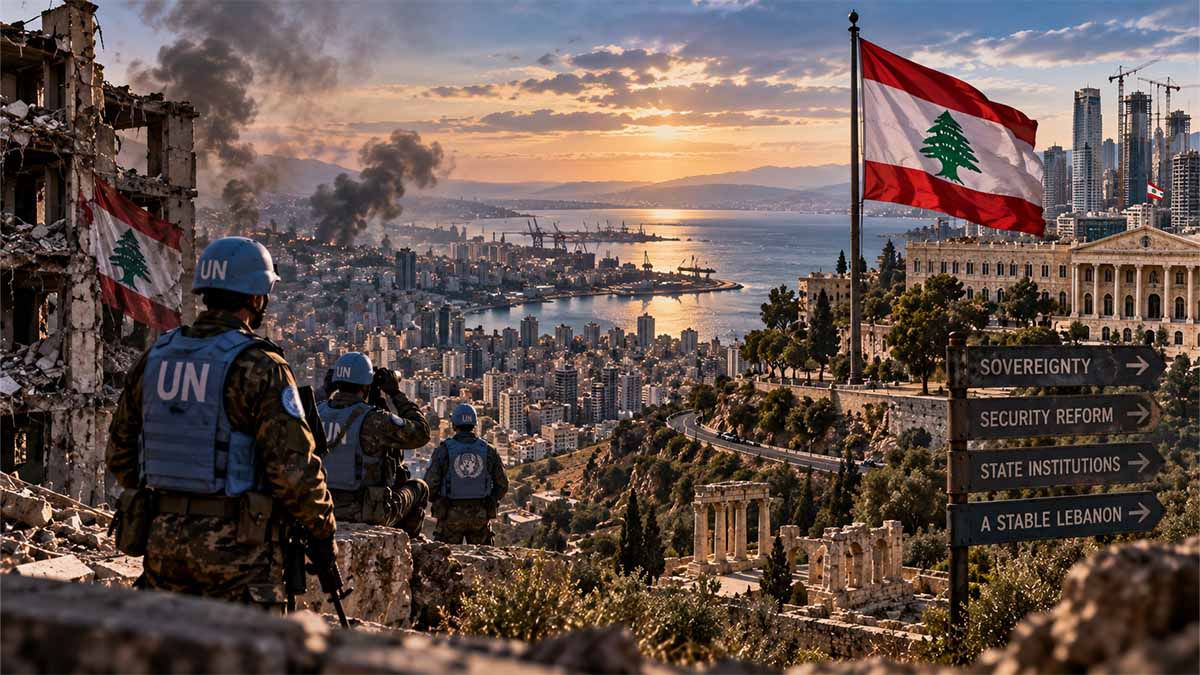
Lebanon’s most consequential territorial change is occurring without a border commission, a peace conference or a declaration of partition. Since the 26 June US–Israel–Lebanon trilateral framework, sovereignty has been turned into a sequence of conditions: Beirut must extend state authority and disarm Hezbollah, Israel withdraws progressively, reconstruction follows verification, and foreign money arrives only as institutions demonstrate credibility. The mechanism looks transitional; the risk is that transition becomes the political order. Southern Lebanon remains tied to military verification, the north is deepening its economic relationship with Türkiye, Beirut depends on Gulf and European confidence, and UNIFIL’s mandate expires on 31 December 2026 even as its withdrawal is expected to continue through September 2027. Lebanon is therefore not being divided by a treaty. It is being divided by clocks that increasingly run at different speeds.
The 26 June framework made sovereignty conditional on sequence
The 26 June US–Israel–Lebanon trilateral framework was designed around a reciprocal bargain: the Lebanese army restores “effective sovereign authority over all Lebanese territory” while Israel withdraws progressively. The problem lies in the sequencing. Withdrawal is tied to verified disarmament, yet the Lebanese army cannot forcibly dismantle Hezbollah without risking internal confrontation, while Israeli troops remain inside Lebanese territory and continue operating around the areas Beirut is supposed to normalise. The framework therefore allows both sides to point to the other’s incomplete implementation, turning Lebanon’s institutional weakness from a temporary obstacle into a mechanism capable of extending the transition indefinitely.
The first pilot area at Zawtar al-Gharbiyah exposed the vulnerability. The sequence was supposed to move from clearance to third-party verification, maintenance and reconstruction before expanding toward Srifa and Froun. After the Rome negotiations in early August, however, Israel demanded verification in the initial areas before the process widened. On 14 September, Israeli Channel 14 accused the Lebanese army of coordinating with Hezbollah inside the zones; two days later, Israeli Chief of Staff Eyal Zamir linked Hezbollah’s removal from south of the Litani to a dramatic improvement in Lebanese army performance. Whatever the merits of each claim, the operational consequence is clear: every additional verification threshold delays the moment when security transition becomes ordinary civilian administration.
The diplomatic calendar compounds the problem. The next formal Rome round was delayed until October, while the Lebanese and Israeli ambassadors’ meeting in Washington on 15 September kept negotiations alive without producing an announced breakthrough. A framework can therefore remain administratively active while the political bargain beneath it is effectively frozen. That is precisely how temporary arrangements acquire durability: nobody formally abandons them, yet nobody completes them either.
Reconstruction is becoming the material border
Southern Lebanon is not separated from the rest of the country by a recognised line, but reconstruction policy can produce effects that resemble one. The dossier records that reconstruction in the south remains tied to verified disarmament after a war that destroyed scores of villages and made displacement increasingly persistent. The sequencing matters because delay compounds: homes remain unusable, residents postpone return, businesses do not reopen, agricultural land loses productive value and municipalities lose the population and revenue required to restore ordinary government.
Prime Minister Nawaf Salam captured the financial chain in parliament on 15 September: “There can be no sustainable reconstruction without funding, no funding without trust, and no trust without a capable state.” The statement is more than a reform slogan. It defines the political economy of the post-war order. Beirut must demonstrate institutional capacity before Gulf and European capital moves at scale; yet the state’s credibility is hardest to establish precisely in territories where security conditions restrict reconstruction. A geographical funding gap can therefore become a political gap even without anyone deciding to create one.
The danger is that reconstruction ceases to restore the pre-war economy and instead adapts to the new geography. If capital, skilled labour and logistics relocate while the south waits for verification, the country can reach a point where security conditions no longer need to prevent return because the economics of return already do so. Partition then moves from the military map into household balance sheets and commercial decisions.
Ankara needs the Lebanese state — but paralysis may redirect its gains northward
Türkiye’s position illustrates the paradox. Ankara’s influence is strongest when Lebanon remains a functioning sovereign state, because only Beirut can sign maritime agreements, license major infrastructure, regulate ports and airports, and provide the international legal personality required for durable bilateral arrangements. The dossiers’ northern connections — Tripoli Port, the Mersin shipping route and Qlayaat’s planned aviation links — therefore do not by themselves amount to a separatist project. They are more useful to Türkiye when they operate inside a recognised Lebanese state.
The danger emerges if Beirut remains too weak to absorb those relationships nationally. A northern economic network can begin as connectivity and end as institutional differentiation. If investment, shipping, aviation and political relationships become concentrated around Tripoli and the north while the south remains reconstruction-deferred, Türkiye does not need to create an enclave for one to begin acquiring a distinct economic logic. The central state can remain sovereign in law while different regions become progressively dependent on different external systems.
That is why paralysis can damage Ankara’s own strategy. A fragmented Lebanon would deprive Türkiye of the sovereign counterpart it needs for Mediterranean agreements, yet prolonged dysfunction could still push Turkish-linked networks toward greater local autonomy by default. The result would be an outcome Ankara may not seek: influence that becomes geographically concentrated because the state through which it was supposed to operate never became strong enough to nationalise it.
Athens and Cyprus turn Lebanese sovereignty into an Eastern Mediterranean question
The Lebanese problem now sits inside a larger Mediterranean competition. On 31 August, Greek Prime Minister Kyriakos Mitsotakis received Lebanese President Joseph Aoun in Athens and described a strong state as the condition for a strong Lebanon; on the same day, Greece and Israel signed a €3 billion, approximately $3.4 billion, agreement for the Achilles Shield air-defence system. Greece also plans to place an EU–Lebanon partnership on the agenda during its EU presidency in the second half of 2027, precisely when UNIFIL’s withdrawal will be approaching its final stage.
Cyprus adds the legal dimension. Lebanon and Cyprus signed an exclusive economic zone agreement on 26 November 2025, a decision immediately rejected by Ankara and Northern Cyprus because the agreement treated the Republic of Cyprus as the island’s sole representative. Lebanese ratification remained politically contested. That means a Lebanese maritime agreement that appears bilateral is already entangled with the unresolved Cyprus question and with Türkiye’s wider objection to an Eastern Mediterranean order constructed without Turkish participation.
UN Secretary-General Antonio Guterres said in July that another Cyprus 5+1 meeting required more preparation, and by late September no date had been set. If a future Cyprus settlement were to give Turkish Cypriots an effective role in exclusive-economic-zone decisions, the political basis of the Lebanese agreement could become contested again. Beirut’s maritime position is therefore increasingly shaped by events beyond Lebanon, while the country’s own sovereignty becomes an input into the Greece–Cyprus–Israel–Türkiye balance.
Europe is financing a state whose security transition remains unresolved
France and Jordan exposed the contradiction at the Paris Aqaba Process meeting, convened ahead of an international conference intended to support the Lebanese army and security forces. Paris tied substantial assistance to a credible deployment plan, while Lebanese commanders warned that deployment could not be allowed to provoke internal confrontation and that outside support remained hostage to unresolved political conditions. The money is intended to strengthen the state, but the state is being asked to assume responsibilities that remain politically and territorially contested.
Saudi Arabia has adopted a similar state-first approach since President Joseph Aoun’s election, tying financial support to reform and the restriction of arms to state authority. The Mecca Joint Defense Agreement linking Saudi Arabia, Türkiye and Pakistan has also reduced the old assumption that Riyadh and Ankara must compete mechanically for the same Sunni space inside Lebanon. Paris, Riyadh and Ankara can disagree on regional strategy while still converging on one requirement: Lebanon must retain institutions strong enough to sign, deploy, regulate and receive assistance.
Israel is the outlier not because it publicly rejects Lebanese state capacity, but because it possesses an alternative instrument when that capacity fails: direct military control. Prime Minister Benjamin Netanyahu’s 29 March description of “three security zones deep in enemy territory” in Lebanon, Gaza and Syria gives the Israeli approach a territorial logic unavailable to Paris, Riyadh or Ankara. Those capitals need Beirut to work; Israel can respond to Beirut’s failure by continuing to operate around it. That asymmetry is what makes prolonged Lebanese weakness strategically consequential.
UNIFIL’s deadline can turn an interim order into a durable one
The institutional deadline is now fixed. UNIFIL’s mandate expires on 31 December 2026, but its withdrawal is expected to continue until September 2027. President Joseph Aoun has identified prevention of a security vacuum as the priority and has argued that any replacement force should remain only until the Lebanese army can deploy fully. Lebanese military officials, however, reject the idea of a monitoring mission empowered to dictate army operations, while Israeli elections complicate agreement on a successor arrangement in the near term.
The Cyprus precedent explains why timing matters. The United Nations force sent to Cyprus as a temporary measure in 1964 remains on the island more than six decades later. Lebanon is not Cyprus, but the institutional lesson is relevant: arrangements created because a final political settlement is unavailable can acquire budgets, personnel, procedures and vested interests of their own. The longer the interim lasts, the less interim it becomes.
The five tests identified in the dossier are therefore unusually precise: the October Rome talks, the money committed at the international conference for the Lebanese army, the composition of any post-UNIFIL presence, Türkiye’s place inside or outside that mechanism, and the emergence of any northern authority capable of deciding who may operate there. Each measures whether temporary differentiation is contracting or becoming institutional.
The next 12–24 months will decide who pays for a Lebanon running on different clocks
Between October 2026 and September 2027, Lebanon will either begin synchronising its security, reconstruction and institutional timetables or allow them to diverge further. If the Rome process produces verifiable reciprocal steps, if army financing arrives, if reconstruction follows rather than waits indefinitely, and if the post-UNIFIL mechanism transfers functions instead of preserving exceptions, territorial differentiation can still remain transitional.
If those conditions fail, the cost will not fall evenly. Southern households will pay through delayed return, damaged property and foregone economic activity; the Lebanese army will inherit responsibilities without the uncontested authority required to perform them; Beirut will pay through weaker credibility with Gulf and European funders; and Turkish investment in the north will become more geographically concentrated precisely because the national state failed to absorb it. Greece and Cyprus will gain greater leverage over Lebanon’s Mediterranean orientation, while Israel will retain the strongest argument for maintaining direct security arrangements.
No treaty is required for that outcome. No government needs to declare partition. If reconstruction, security and investment continue operating on different calendars for another 12–24 months, the most expensive border in Lebanon may be the one nobody ever draws.
Navigational Index
Pillar I — Sovereignty under conditionality: the interaction between Lebanese disarmament commitments, Israeli withdrawal, military control, reconstruction and the approaching end of UNIFIL.
Pillar II — Competing models of regional influence: Türkiye’s institution-dependent strategy, Israel’s security-first architecture, Cyprus and maritime delimitation, and the emerging European investment in Lebanese state capacity.
Pillar III — Partition by timetable rather than treaty: the circumstances under which temporary security, reconstruction and economic arrangements could harden into geographically differentiated systems of authority.
Master Abstract
Lebanon is not being formally partitioned, but different parts of the country are increasingly governed by different clocks
The central proposition becomes more defensible when “partition” is defined not as the imminent creation of recognised territorial entities but as the progressive differentiation of authority, security, reconstruction and external connectivity across Lebanese territory, because the official record does not show a publicly documented Turkish, Israeli, European, American or Lebanese plan for a territorial division of Lebanon, whereas it does show increasingly different institutional conditions governing the south, Beirut and the northern Mediterranean corridor.
The most important legal and institutional baseline remains the Lebanese state’s own commitment to restoring sovereignty over its entire territory, placing decisions of war and peace in constitutional institutions and restricting possession of weapons to state authority, commitments reiterated by the Lebanese cabinet in its response to the American framework and subsequently incorporated into the Lebanese Armed Forces plan considered by the Council of Ministers. The same Lebanese framework, however, also specifies withdrawal of Israel from the five positions, resolution of border and prisoner questions, the return of civilians to border communities and reconstruction, which means that Beirut has not accepted a model in which disarmament can be analytically detached from withdrawal, civilian normalisation and territorial sovereignty. Presidency of the Lebanese Republic
This distinction is decisive because the Israeli and Lebanese concepts of implementation overlap at the level of ultimate objectives but diverge over sequencing and acceptable interim control. Israel’s public diplomatic position supports Hezbollah’s disarmament and presents the June framework as a possible foundation for peace, while the IDF’s own September reporting continues to describe Israeli forces as operating inside a “security zone in southern Lebanon”, where forces have conducted searches, seized weapons and destroyed infrastructure attributed to Hezbollah. On 21 July, an Israeli government statement recorded an incident in which Lebanese Armed Forces personnel entered what Israel described as its security zone and were warned away because the location was outside the designated pilot area, an unusually clear documentary indication that parts of Lebanese sovereign territory were at that point governed operationally by an Israeli-defined access regime. Ministero degli Affari Esteri
That condition does not prove that Israel seeks permanent territorial partition, because Israeli authorities publicly describe the security arrangement as a mechanism for preventing Hezbollah’s restoration and insist that a stronger Lebanese state capable of disarming Hezbollah forms part of an eventual settlement, yet it establishes a mechanism capable of generating de facto spatial separation even in the absence of formal annexation or a declared partition strategy. The risk increases whenever transfer of control becomes contingent upon verification thresholds that can be changed, contested or interpreted differently by the parties, because civilian return and reconstruction then depend upon security decisions made outside the ordinary Lebanese administrative chain.
UNIFIL’s termination turns an old security problem into an institutional succession problem
The approaching end of UNIFIL fundamentally alters the strategic geometry because Security Council Resolution 2790 extended the mission for the final time until 31 December 2026, directed it to cease operations on that date and authorised an orderly drawdown and withdrawal thereafter, with the stated objective of making the Lebanese government the sole provider of security in southern Lebanon. The operative UN text also reiterates the objective that there should be no weapons or authority in Lebanon other than those of the Lebanese government, thereby making Lebanese sovereign capacity—not an international protectorate—the formal destination of the transition. Sistema ufficiale di documenti – ONU
The important analytical question is therefore no longer simply whether UNIFIL remains, but what authority performs each of its functions as it disappears, because monitoring, liaison, civilian protection, situational awareness and support to Lebanese Armed Forces deployment cannot vanish simultaneously without creating operational gaps. France and Jordan used the Aqaba Process meeting in Paris on 17 September to organise support for the Lebanese Armed Forces and prepare a subsequent conference, while the official French account described the work as operational planning for LAF deployment rather than as an abstract diplomatic consultation. elysee.fr
Türkiye has moved into the same institutional question from another direction. In his 22 September meeting with Prime Minister Nawaf Salam in New York, President Recep Tayyip Erdoğan explicitly stated that an international initiative would be needed to supersede UNIFIL, following his 30 July meeting with President Joseph Aoun in Ankara, where the Turkish government publicly emphasised strengthening Lebanon’s institutional capacity. These are stronger documentary foundations for Turkish post-UNIFIL ambitions than broader claims that Türkiye is attempting to construct a northern Lebanese protectorate, for which the official record currently provides much weaker evidence. İletişim Başkanlığı
The European Union has meanwhile converted state-building rhetoric into significant financial commitments. On 4 June 2026 the Council approved an additional €100 million under the European Peace Facility for the Lebanese Armed Forces, bringing cumulative EPF assistance to €182 million, specifically covering territorial control, multi-domain awareness, maritime security, protection of military sites and healthcare; on 23 September the European Commission announced a further €505 million package for 2026–2027 supporting reforms, recovery, security, border management and essential services, while confirming that work was under way on a possible EU mission to advise and train Lebanese forces. Consiglio dell’Unione Europea
This creates an important counterweight to the partition thesis because the largest documented European programmes are attempting to increase the density of national Lebanese institutions, not finance geographically autonomous governing structures. Nevertheless, precisely because foreign assistance is increasingly tied to institutional performance, reform and security implementation, uneven Lebanese capacity could still translate into geographically uneven access to reconstruction, investment and international protection.
Türkiye needs a Lebanese state more than the available evidence suggests it needs a Lebanese enclave
Türkiye’s documented northern Lebanese footprint deserves close examination because Tripoli, Akkar and the north possess obvious strategic significance for Turkish Mediterranean policy, commercial access and regional influence, yet the available first-order evidence supports an institution-centric interpretation more strongly than an enclave-building one. The Turkish Cooperation and Coordination Agency’s Tripoli Port infrastructure project, inaugurated in March 2025 with Lebanese officials present, explicitly describes Tripoli as a major northern trade hub and an important point for commercial relations with Türkiye, illustrating how Ankara can deepen connectivity while operating through recognised Lebanese administrative structures. tika.gov.tr
The July 2026 Erdoğan–Aoun meeting reinforces that pattern, because Erdoğan publicly promised continued support for Lebanese institutional capacity and humanitarian and technical assistance, rather than announcing a subnational northern arrangement, while the September Erdoğan–Salam meeting again treated the Lebanese prime minister and the Lebanese state as the interlocutor for the post-UNIFIL security problem. The proposition that Türkiye’s strategy therefore requires a functioning sovereign counterpart is analytically strong where maritime agreements, military cooperation, aviation permissions, port management and international security participation are concerned, because all of those instruments receive materially greater legitimacy and durability when exercised through Beirut. İletişim Başkanlığı
The stronger version of the argument—that Ankara is deliberately preparing a Sunni or Turkmen cadre capable of becoming an alternative government in northern Lebanon—cannot currently be established from the first-order evidence reviewed for this assessment. Turkish cultural, development and political influence in northern Lebanon is real and measurable, but the transformation of such influence into a territorially coherent governing authority would require additional evidence concerning command relationships, financing, administrative delegation, coercive capability and the displacement or capture of Lebanese state institutions.
That distinction matters because social penetration and territorial state formation are not the same phenomenon, and collapsing them would convert a plausible warning indicator into an asserted fact. The appropriate intelligence question is therefore not whether a Turkish-backed northern administration already exists, but whether economic dependence, patronage, municipal influence and security provision begin to converge under a common authority capable of determining access, licensing activity, allocating public goods or excluding competing institutions.
Israel’s model is better understood as sovereignty conditioned by security performance
Israeli official statements do not support the simple proposition that Israel requires Lebanon to remain weak, because President Isaac Herzog has publicly endorsed the June understandings as a possible foundation for peace and explicitly linked a different future for Lebanon to Hezbollah’s removal from the security equation. Israeli Foreign Ministry material similarly presents the framework as strengthening both Israel and Lebanon while weakening Hezbollah and Iran. Presidenza del Governo
The operational record, however, reveals the critical qualification: Israeli forces retain direct control and freedom of action inside what the IDF itself calls a security zone, and the transition to Lebanese Armed Forces authority occurs through specified areas, understandings and verification mechanisms rather than through unconditional restoration of Lebanese administrative jurisdiction. The July incident involving Lebanese soldiers and the September IDF reporting on continuing searches and demolitions show that this is not merely diplomatic terminology but an active territorial-security arrangement. Governo israeliano
The resulting Israeli logic can therefore be stated more defensibly as follows: Lebanese sovereignty is an accepted end-state only insofar as the Lebanese state can produce security outcomes Israel regards as adequate, while Israeli military control remains an interim mechanism wherever that condition is judged unmet. This architecture can unintentionally become self-reinforcing, because the longer Lebanese authorities lack unrestricted access, reconstruction resources and normal civil administration in southern communities, the more difficult it becomes for the state to demonstrate precisely the institutional reach on which withdrawal is conditioned.
The Lebanese government makes the reciprocal argument from the opposite direction, maintaining that implementation must include Israeli withdrawal, cessation of violations, return of displaced civilians and sovereign state control rather than only Lebanese disarmament obligations. The divergence is therefore less a dispute over whether a Lebanese state should exist than over which party bears the risk during the transition and which benchmark must be satisfied first. Presidency of the Lebanese Republic
Cyprus introduces a second sovereignty problem at sea
The Lebanese–Cypriot maritime agreement signed in Beirut on 26 November 2025 adds a strategically distinct dimension because Cyprus and Lebanon formally delimited their exclusive economic zones through a state-to-state instrument, while the Lebanese text specifically recognises that the relevant endpoint may require future revision in light of delimitation with another neighbouring state. Governo Cipro
For Lebanon, maritime delimitation is important precisely because it demonstrates the value of intact international legal personality: recognised governments can conclude boundary agreements, structure energy development and negotiate cross-border infrastructure in ways that a subnational enclave cannot readily reproduce. The Cypriot Presidency additionally stated that the two states were exploring an electricity interconnection and described the agreement as a foundation for wider regional cooperation. Governo Cipro
This makes the eastern Mediterranean dimension materially relevant to Türkiye, but the available official record reviewed here does not establish that the Lebanese–Cypriot agreement by itself creates a formal anti-Turkish security coalition. The more defensible assessment is that any strengthening of Cyprus–Lebanon maritime and energy integration affects a strategic environment in which Ankara places considerable importance on eastern Mediterranean jurisdiction, meaning that Türkiye has an incentive to preserve influence over Lebanese maritime policy while simultaneously benefiting from dealing with a sovereign Lebanese government capable of concluding internationally recognised agreements.
The north–south divergence is therefore real as a risk pathway, not yet as a territorial settlement
The analytical power of the partition-by-time proposition lies in the possibility that temporary asymmetry becomes institutional permanence. Southern Lebanon can remain subject to military access restrictions, weapons-clearance requirements, verification and reconstruction delays; Beirut can remain the formal centre for international aid, reform programmes and diplomatic agreements; and northern Lebanon can deepen commercial connectivity with Türkiye without any formal constitutional change.
If those trajectories persist for a sufficiently long period, Lebanon would increasingly cease to experience sovereignty uniformly even though every international actor continued verbally to recognise the same national borders. A villager returning to a southern community, a commercial operator using Tripoli, a ministry negotiating donor support in Beirut and a Lebanese soldier seeking access to an agreed pilot zone could all encounter materially different governing authorities and external constraints inside the same recognised state.
This is the central mechanism by which a country can be partitioned functionally without being partitioned juridically.
Key Evidence Table
| Indicator | Value/status | Reference date | Definition/scope | Issuer | Exact source |
|---|---|---|---|---|---|
| UNIFIL operational mandate | Ends 31 Dec 2026, followed by orderly drawdown and withdrawal | 2025 resolution governing 2026–27 transition | UN mission in southern Lebanon | UN Security Council | Security Council Resolution 2790 (2025) |
| Lebanese state monopoly of arms | Formally adopted government objective | 2026 | Entire Lebanese territory, including non-state armed actors | Lebanese Presidency / Council of Ministers | Lebanese Council of Ministers decision on the American framework |
| Lebanese Armed Forces implementation plan | Cabinet welcomed phased plan and required monthly reporting | 2026 | Extension of state authority and monopoly of legitimate arms | Lebanese Presidency / Council of Ministers | Council of Ministers statement on the LAF plan |
| Israeli territorial security presence | IDF officially reports operations in a “security zone in southern Lebanon” | 1 and 15 Sep 2026 | Israeli forces operating north of internationally recognised Israeli territory | Israel Defense Forces | IDF activity in southern Lebanon, 1 September 2026 |
| Turkish post-UNIFIL position | Erdoğan calls for an international initiative to supersede UNIFIL | 22 Sep 2026 | Türkiye–Lebanon bilateral and regional security | Presidency of Türkiye | President Erdoğan meets Prime Minister Salam of Lebanon |
| EU military-support measure | €100m new EPF package; €182m cumulative EPF support | 4 Jun 2026 | Non-lethal LAF capacity building | Council of the EU | European Peace Facility assistance to the Lebanese Armed Forces |
| EU economic/institutional package | €505m for 2026–27 | 23 Sep 2026 | Reform, recovery, security, borders and basic services | European Commission | EU adopts €505 million package for Lebanon |
| UK security programme | Up to £16.3m over 31 months | 17 Aug 2026 | Lebanese Army and Internal Security Forces | UK Government | UK and Lebanon sign MOU to strengthen security co-operation |
| Cyprus–Lebanon EEZ | Formal agreement signed | 26 Nov 2025 | Bilateral EEZ delimitation | Cyprus Presidency / Lebanese Presidency | Cyprus Presidency statement on Lebanon EEZ agreement |
Competing Explanations and Pathways
| Hypothesis | Diagnostic support | Disconfirming evidence | Indicators | Current standing |
|---|---|---|---|---|
| National state consolidation succeeds | Lebanese monopoly-of-arms policy, LAF implementation plan, substantial EU and bilateral capacity building, French-led operational planning and Turkish support for institutional capacity | Continuing Israeli security-zone operations, incomplete sovereign access, political and military constraints on coercive disarmament | LAF assumes uncontested access to successive southern areas; reconstruction begins; external military presence contracts | Substantively supported but implementation remains incomplete, because the institutional architecture exists while territorial execution remains contested |
| Managed fragmentation hardens into de facto partition | Israeli security-zone regime, conditional territorial transfers, geographically differentiated reconstruction and foreign economic linkages | No official partition policy; all principal external actors publicly endorse Lebanese sovereignty and state institutions | Persistent restricted zones after UNIFIL; reconstruction remains geographically unequal; subnational authorities begin licensing or excluding activity | Credible risk pathway rather than established outcome, because the mechanisms exist but autonomous territorial governance has not been demonstrated |
| A new international security architecture bridges the transition | French/Jordanian Aqaba planning, Turkish call for a successor initiative, EU willingness to contribute post-UNIFIL, Italian and British capacity building | No final mandate, force composition, rules of engagement or Israeli–Lebanese consensus has yet been established publicly | Formal mandate, financing, host-state consent, contribution commitments and liaison arrangements emerge before UNIFIL ceases operations | Institutionally plausible but unresolved, because several states support succession planning while the governing instrument remains open |
Italy, France, Germany and the United Kingdom
Italy is positioned to preserve continuity between UNIFIL and Lebanese sovereign capacity
Italy has one of the deepest institutional stakes in avoiding an abrupt security vacuum because its 2026 authorisation permits a national UNIFIL contingent of up to 1,256 personnel, while Rome simultaneously operates the bilateral MIBIL training mission and leads the Military Technical Committee for Lebanon. Italian defence authorities state that approximately 1,300 Lebanese personnel were trained during 2025 and approximately 8,500 since MIBIL began in 2015, illustrating that Italy’s post-UNIFIL leverage rests substantially on institutional continuity with the Lebanese Armed Forces rather than merely on peacekeeping deployment. Difesa
Foreign Minister Antonio Tajani’s April 2026 visit added a political layer by explicitly supporting Lebanese structural reform, strengthened governance, the rule of law and the disarmament of Lebanese factions while affirming Italian willingness to continue training Lebanese armed and security forces beyond UNIFIL’s mandate. Rome consequently occupies a strategically useful position between the traditional UN peacekeeping architecture and a possible future model centred on bilateral training, multinational technical coordination and strengthened Lebanese national forces. Ministero degli Affari Esteri
For Italy, therefore, a durable informal partition would create direct policy costs because it would undermine both the premise of MIBIL—building a national Lebanese military institution—and the viability of any successor mechanism requiring a sovereign Lebanese counterpart.
France is constructing the political and military bridge to the next architecture
France is operating at both the diplomatic and operational levels, because the 17 September Aqaba Process meeting in Paris focused explicitly on a support plan for Lebanese Armed Forces deployment and preparation of a broader international support conference, while French forces continue direct training of Lebanese personnel in precision shooting, drone operation, armoured vehicle employment and urban combat. Francia Diplomazia
The French concept therefore appears to rest on replacing international territorial substitution with progressively stronger Lebanese security capacity, although Paris continues to recognise that deployment cannot be divorced from political conditions. This makes France particularly important to the partition-by-time thesis: successful French-led mobilisation could compress the difference between the security timetable of the south and the institutional timetable of Beirut, whereas failure to produce resources, political guarantees and an agreed succession mechanism would widen it.
Germany is withdrawing its UNIFIL operational component but not necessarily disengaging from the security problem
Germany decided in May 2026 that Bundeswehr participation in UNIFIL would conclude with the end of the mission’s operational mandate on 31 December 2026, while retaining support for the withdrawal process through 30 June 2027. The German decision is particularly relevant because Germany has contributed maritime capabilities to UNIFIL, meaning that the transition also raises questions concerning coastal surveillance, maritime interdiction and the institutional transfer of functions to Lebanese forces. Bundesregierung
The German case demonstrates that “post-UNIFIL” does not necessarily mean the immediate disappearance of external involvement, because military withdrawal, logistical drawdown, Lebanese capacity building and political support proceed on different schedules; nevertheless, every national contingent that terminates an operational function without a fully prepared Lebanese or successor capability increases the importance of sequencing.
The United Kingdom is shifting resources directly into Lebanese state security institutions
The United Kingdom signed a new memorandum of understanding with the Lebanese ministries of defence and interior on 17 August 2026, establishing a 31-month programme worth up to £16.3 million for the Lebanese Armed Forces and Internal Security Forces, while the British government states that it has committed more than £180 million to Lebanese internal and border security since 2009, including more than £120 million for the LAF. GOV.UK
The British model therefore reinforces the same institutional trend visible in France, Italy and the EU: international actors are increasingly attempting to transfer security responsibility into Lebanese national institutions rather than create permanent foreign territorial administrations, but the success of that approach depends upon whether those institutions can actually exercise authority in precisely the spaces where sovereignty remains most contested.
European Net Assessment
Europe is not acting as a single military actor, yet the combined French, Italian, German, British and EU measures reveal substantial convergence around one strategic proposition: the post-UNIFIL order should increase rather than reduce the Lebanese state’s security capacity. The European Council has explicitly supported Lebanon’s sovereignty and territorial integrity, the state monopoly of weapons and continued support for the Lebanese Armed Forces, while also indicating readiness to contribute to a continued UN presence in a post-UNIFIL context during 2027. Consiglio dell’Unione Europea
The contradiction is that European state-building policy operates inside an environment in which Lebanese territorial authority remains incomplete, Israeli security requirements remain operationally enforceable and Hezbollah disarmament remains politically and militarily difficult. Money and training can increase institutional capability, but they cannot alone resolve the sequencing dispute governing Israeli withdrawal, Lebanese disarmament, civilian return and reconstruction.
Europe’s decisive contribution is therefore not simply financial; it is whether European states can help construct an international arrangement in which security verification no longer requires indefinite territorial substitution for Lebanese sovereignty.
Principal Gaps and Watch Indicators
The first decisive gap is the absence of a fully public, authoritative implementation matrix for the June Israel–Lebanon framework specifying the exact relationship among Hezbollah disarmament, LAF deployment, Israeli redeployment, verification, civilian return and reconstruction, because without that document it remains impossible to determine whether current friction represents non-compliance with agreed sequencing or disagreement over provisions that remain politically or operationally ambiguous.
The second gap concerns the post-UNIFIL architecture, because France, Türkiye, the European Union and Italy have all signalled continued involvement or successor planning, yet no publicly established instrument currently defines command authority, geographical scope, force composition, monitoring authority, rules of engagement, Israeli acceptance or the precise relationship between any successor presence and the Lebanese Armed Forces.
The third concerns northern Lebanon, where commercial, cultural and institutional Turkish influence is documented but the stronger proposition that a politically coherent Ankara-backed administrative cadre is preparing to assume territorial authority remains unproven and would require evidence of integrated financing, personnel networks, command relationships, control of service delivery and the ability to regulate entry or economic activity independently of Beirut.
The fourth concerns reconstruction geography, because the partition-by-time thesis becomes substantially stronger if verified expenditure data show that southern reconstruction remains systematically delayed while infrastructure and economic integration elsewhere accelerate; aggregate aid announcements are insufficient, and disbursements must therefore be tracked by location, implementing authority and completion status.
The fifth concerns Israeli operational permanence, because continued IDF use of the expression “security zone” after Lebanese forces have demonstrated verified control in designated pilot areas would materially strengthen the argument that the security regime is evolving from a transitional instrument into a durable territorial architecture.
Watch Indicators
The October negotiating round, including any revised implementation timetable, will be the first major test of whether the withdrawal–disarmament sequence can move from reciprocal conditionality toward measurable parallel implementation.
The international support conference for the Lebanese Armed Forces will reveal whether pledges are converted into deployable mobility, surveillance, engineering, border-control and sustainment capabilities rather than remaining politically significant but operationally insufficient financial commitments.
The legal form, mandate and membership of any post-UNIFIL mechanism will determine whether 2027 marks a genuine transfer of territorial responsibility to Lebanon or merely the replacement of one externally mediated security order with another.
Reconstruction disbursement by district will show whether southern Lebanon is re-entering the national economic system at a pace comparable with the rest of the country or remaining trapped in an exceptional security economy.
Northern Lebanon should be monitored not for Turkish cultural activity by itself, which is insufficient evidence of political capture, but for any organisation that acquires the practical authority to license activity, control strategic infrastructure, allocate essential services, collect compulsory payments or exclude Lebanese state institutions.
Decision-Relevant Net Assessment
The proposition that Lebanon is being partitioned should therefore be retained as an analytical warning rather than asserted as an established territorial fact, because no verified official record demonstrates an agreed plan to divide the country, while substantial evidence shows that the dominant regional and European state actors continue publicly to support Lebanese sovereignty and national institutions.
The more important finding is nevertheless consequential: Lebanon already contains the ingredients from which a partition-like order can emerge without proclamation, because security authority, access, reconstruction, economic connectivity and international supervision are increasingly operating on different geographic and institutional timetables.
Israel’s continuing security-zone operations provide the strongest territorial component of that divergence; Lebanon’s incomplete monopoly of arms provides the principal internal constraint; UNIFIL’s approaching termination creates the institutional deadline; European and Turkish investments in the Lebanese state provide the strongest countervailing force; and the future distribution of reconstruction money will determine whether exceptional security geography becomes exceptional political economy.
The decisive question over the coming year is consequently not whether anyone formally draws a new border, but whether temporary differences in who secures, rebuilds, finances and connects different Lebanese territories become durable enough that the national border remains intact while the national state ceases to operate everywhere on the same terms.
That is the point at which partition by timetable would cease to be a metaphor and become an institutional condition.
The protocol governing this assessment requires exactly this separation between established fact, attributed institutional position and analytical judgment, together with claim-level sourcing and explicit treatment of conflicting accounts. Testo incollato The supplied substantive continuation itself frames the central hypothesis as a geographically differentiated timetable rather than a declared territorial settlement, while identifying southern reconstruction, northern Turkish connectivity and post-UNIFIL succession as the decisive mechanisms requiring verification.
Lebanon’s Partition by Time
The emerging strategic danger is not a formally negotiated division of Lebanon, but a progressive differentiation of sovereignty in which security authority, reconstruction, economic connectivity and international supervision begin operating according to different geographic and institutional timetables.
The verified record supports a credible risk of functional territorial divergence, but not an established or coordinated project to partition Lebanon. The mechanism is increasingly temporal and institutional: Israeli military-security conditionality remains concentrated in the south, international assistance is attempting to strengthen national institutions through Beirut, northern Lebanon is acquiring stronger Turkish commercial and diplomatic connectivity, and the disappearance of UNIFIL creates a deadline for deciding whether these different systems converge again under Lebanese sovereignty or harden into separate realities.
The strategic structure
Sovereignty under conditionality
Lebanese state authority, Hezbollah disarmament, Israeli withdrawal, civilian return and southern reconstruction are linked through a sequencing problem in which progress by one actor remains dependent upon actions and verification controlled partly by another.
Competing models of influence
Türkiye’s publicly documented instruments depend predominantly upon Lebanese institutions capable of signing agreements and administering infrastructure, whereas Israel retains direct operational freedom inside portions of southern Lebanon where it judges Lebanese security control insufficient.
Partition by timetable
A formal territorial settlement is unnecessary if different regions acquire durable security rules, reconstruction schedules, external economic relationships and degrees of access to national state authority that cease to converge over time.
The mechanism: how temporary arrangements can become structural
Security conditionality
Territorial transfer and normalisation remain tied to disarmament, verification and security benchmarks.
Uneven reconstruction
Civilian return and rebuilding proceed at different speeds according to territorial access and political conditions.
Differentiated connectivity
Beirut, the south and the northern Mediterranean corridor acquire distinct external financial, security and commercial relationships.
Functional territorial divergence
Lebanon remains legally unified while sovereignty is experienced differently according to geography.
Two strategic logics require different forms of Lebanese state capacity
- Port infrastructure, aviation, maritime agreements and formal security cooperation obtain their durability through recognised Lebanese institutions.
- Ankara has publicly supported strengthening Lebanese institutional capacity and has called for an international initiative capable of succeeding UNIFIL.
- Tripoli and northern Lebanon provide economic and Mediterranean connectivity, but the reviewed official record does not establish an autonomous Turkish-backed governing enclave.
- A fragmented Lebanon would weaken the internationally recognised state counterpart required for maritime delimitation and other sovereign agreements.
- Israeli public positions support Hezbollah’s disarmament and the restoration of effective Lebanese state authority as an eventual outcome.
- Israeli forces nevertheless continue to operate inside what official IDF reporting describes as a security zone in southern Lebanon.
- Transfer of territorial responsibility is therefore linked to Israeli assessments of Lebanese security performance and implementation.
- The unresolved strategic question is whether this interim security architecture contracts as Lebanese capacity increases or becomes a durable territorial condition.
The post-UNIFIL countdown
France and Jordan convene the Aqaba Process meeting in Paris to advance operational planning for Lebanese Armed Forces deployment and prepare wider international support.
President Recep Tayyip Erdoğan meets Prime Minister Nawaf Salam in New York and publicly states that an international initiative will be required to supersede UNIFIL.
The European Commission announces a €505 million Lebanon package for 2026–2027 covering reforms, recovery, security, border management and essential services.
Under United Nations Security Council Resolution 2790, UNIFIL is scheduled to cease operational activity and begin its orderly drawdown and withdrawal.
The strategic question becomes whether Lebanese Armed Forces capacity and an agreed international successor mechanism can replace external territorial security functions without creating a vacuum or perpetuating exceptional zones.
European roles in the transition
Italy
Continuity and training. Italy combines a major UNIFIL role with the bilateral MIBIL mission and leadership of the Military Technical Committee for Lebanon, positioning Rome to preserve institutional continuity after peacekeeping operations terminate.
France
Political-military bridge. Paris is coordinating international support for Lebanese Armed Forces deployment while maintaining direct military training, making France central to the construction of any transition architecture.
Germany
Managed operational withdrawal. Germany plans to conclude Bundeswehr operational participation with the end of UNIFIL while continuing support during the subsequent withdrawal phase, highlighting the importance of transferring maritime and security functions without interruption.
United Kingdom
Direct state-capacity investment. Britain’s new 31-month security programme shifts resources toward the Lebanese Armed Forces and Internal Security Forces, reinforcing the broader European strategy of transferring responsibility into national institutions.
Three pathways from the verified record
National consolidation
Lebanese Armed Forces deployment expands, Israeli territorial presence contracts, reconstruction accelerates and external assistance strengthens nationally integrated institutions rather than geographically differentiated systems.
Supported pathway · implementation incompleteManaged fragmentation
Exceptional security arrangements persist in the south, reconstruction remains geographically uneven and northern economic connectivity deepens sufficiently that temporary differences in governance begin acquiring structural permanence.
Credible risk · not established outcomeInternational bridge architecture
A successor international arrangement assists Lebanese forces with monitoring, training, coordination and verification while progressively reducing direct foreign territorial substitution.
Institutionally plausible · mandate unresolvedFive indicators that determine whether “partition by time” hardens
Whether future negotiations establish parallel and measurable sequencing between Lebanese disarmament measures and Israeli territorial withdrawal.
Whether international commitments generate deployable Lebanese Armed Forces mobility, surveillance, engineering and sustainment capability.
Whether the post-UNIFIL mechanism receives a defined mandate, host-state consent, financing, contributors and accepted monitoring authorities.
Whether reconstruction expenditure reaches southern districts at a pace compatible with civilian return and restoration of ordinary Lebanese administration.
Whether any northern actor begins exercising regulatory, licensing, security or service-allocation authority independently of recognised Lebanese state institutions.
The decision-relevant threshold
The decisive issue is not whether a new border appears on a map. Lebanon reaches the partition-by-time threshold when temporary differences in who secures territory, controls access, finances reconstruction, administers infrastructure and connects individual regions to external powers become sufficiently durable that the internationally recognised state remains legally intact while sovereignty is no longer exercised throughout the country according to the same institutional rules.
Pillar I — Sovereignty Under Conditionality
The decisive contest is over the sequence by which sovereignty is restored
Lebanon’s southern problem is no longer adequately described as a conventional confrontation between a state and a foreign army, nor as a simple contest between Israel and Hezbollah, because the post-2024 architecture has created a much more complicated mechanism in which the restoration of Lebanese sovereignty has itself become conditional upon a sequence of interdependent military, political and territorial actions. The Lebanese state has formally undertaken to extend exclusive state authority across the national territory, terminate the armed presence of non-state organisations, strengthen the Lebanese Armed Forces, and re-establish the constitutional monopoly over decisions of war and peace; simultaneously, however, Beirut has defined Israeli withdrawal, cessation of violations, return of prisoners, restoration of border authority, reconstruction and economic recovery as integral components of the same settlement rather than as benefits to be considered only after Lebanese implementation has been completed. The Lebanese Council of Ministers’ own formulation is unusually explicit: implementation includes the extension of state sovereignty, exclusive state possession of arms, the gradual termination of the armed presence of all non-state actors including Hezbollah throughout Lebanon, deployment of the Lebanese Armed Forces, and Israeli withdrawal from the five retained positions. Lebanese Presidency — Council of Ministers framework decision
That architecture creates a sequencing problem rather than merely an enforcement problem, because each major obligation affects the state’s ability to perform the others. The Lebanese authorities cannot convincingly establish exclusive security authority in territory to which their forces have incomplete or negotiated access; population return cannot normalise areas where military access remains contested, unexploded ordnance persists or infrastructure is unusable; reconstruction cannot restore state legitimacy where physical access remains conditional; and Israel, conversely, argues that territorial withdrawal without sufficiently reliable Lebanese security control could permit Hezbollah to restore military infrastructure close to the border. The resulting system therefore contains a built-in circularity: stronger Lebanese sovereignty is treated as a condition for reducing Israeli security intervention, while the persistence of that intervention can itself restrict the territorial, political and economic conditions necessary for the Lebanese state to demonstrate stronger sovereignty.
This is the central structural problem of Pillar I. It is not simply that implementation is slow. It is that security, territorial authority and reconstruction are linked through reciprocal conditions whose failure can reproduce the conditions that caused them to fail.
Beirut has formally moved farther on the monopoly-of-arms question than the pre-war Lebanese system
The internal Lebanese position has undergone an important institutional change that should not be understated. On 5 August 2025 the Council of Ministers adopted the objective of extending sovereign state authority throughout the country and restricting arms to the legitimate state institutions, after which the Lebanese Armed Forces developed what it calls the Nation Shield plan for implementation. By January 2026 the Army publicly stated that the first phase had reached an advanced level in the South Litani Sector and that its operational presence had expanded across territory brought under its authority, although it expressly excluded locations remaining under Israeli occupation. The Army also reported that its operations included securing vital areas, addressing tunnels and unexploded ordnance, responding to Requests for Action and preventing armed organisations from rebuilding capabilities. Lebanese Armed Forces — Achieving the Objectives of the First Phase of the Army’s Disarmament Plan
This is significant because the official Lebanese formulation no longer treats the South Litani question solely as implementation of Resolution 1701 while leaving the wider national weapons question conceptually separate. The Council of Ministers framework refers explicitly to the gradual termination of the armed presence of all non-state parties, including Hezbollah, throughout Lebanese territory, both south and north of the Litani, while linking implementation to support for the Army and Internal Security Forces. That is a materially broader state commitment than a geographically confined buffer arrangement and represents an attempt to transform a post-conflict security mechanism into a national doctrine of state monopoly over organised force.
The Army’s own reporting nevertheless demonstrates why political decisions and operational capacity must not be treated as equivalent. During a November 2025 field presentation, the LAF stated that it had dealt with tunnels, closed crossings, seized weapons and ammunition and reinforced deployments, but it simultaneously identified continuing Israeli violations and occupied Lebanese locations as constraints on implementation. The January 2026 Army assessment was even more explicit, stating that Israeli attacks, continued occupation of sites and buffer zones restricting access were negatively affecting completion of its tasks and hindering the extension of state authority and exclusive control of weapons.
The distinction is fundamental for assessing sovereignty. Political monopoly has been declared; operational monopoly remains geographically incomplete.
Lebanese state commitments and their operational dependencies
| State objective | Formal Lebanese position | Operational requirement | Present constraint | Strategic consequence |
|---|---|---|---|---|
| Exclusive state possession of weapons | Applies across Lebanese territory and includes Hezbollah | LAF access, intelligence, storage control, inspection and ability to prevent regeneration | Access remains incomplete in some southern areas and enforcement carries domestic political risks | Political commitment can exceed immediately enforceable capability |
| Exclusive constitutional authority over war and peace | Reaffirmed in the state framework | Armed organisations must lose independent capacity to initiate hostilities | Residual military structures and external confrontation continue to affect the security environment | Formal constitutional authority does not automatically equal operational exclusivity |
| LAF deployment to borders and key internal positions | Explicit government objective | Personnel, mobility, engineering, surveillance, logistics and protected access | Infrastructure destruction, contested zones and limited resources | Foreign assistance becomes part of sovereignty-building rather than ordinary defence cooperation |
| Israeli withdrawal | Explicit Lebanese objective covering the retained positions | Agreed sequencing, verification and security assurances | Israel conditions territorial arrangements on security implementation | Withdrawal and disarmament risk becoming mutually dependent |
| Civilian return | Integral to restoration of ordinary sovereign administration | Security, roads, housing, utilities, mine and UXO clearance | Destruction, insecurity and unexploded ordnance | Population geography becomes a measure of actual sovereignty |
| Reconstruction | Explicit component of Lebanese political framework | Funding, territorial access, functioning municipal and central institutions | Massive financing requirement and uncertain security conditions | Reconstruction becomes part of the political-security settlement |
Sources: Lebanese Presidency and Lebanese Armed Forces.
The territorial transition is taking place town by town rather than through one comprehensive transfer
The most revealing development in 2026 is the emergence of a micro-geography of sovereignty, because control is not being transferred through a single nationwide or even southern-wide mechanism; instead, individual localities are moving through different stages of withdrawal, access, deployment, clearance and civilian return. On 20 July, for example, the Lebanese Army reported continuing operations in Froun and Srifa while coordinating through the Military Coordination Group for Lebanon, MCG4L, for deployment into Zawtar al-Gharbiyeh following Israeli withdrawal. Lebanese Armed Forces — Missions in Froun, Srifa and preparation for Zawtar al-Gharbiyeh deployment
On 21 July, the Lebanese Army announced that its units had begun deployment in Zawtar al-Gharbiyeh and instructed civilians not to enter until conditions stabilised. On precisely the same date, however, the Israeli government published an IDF account stating that Lebanese Armed Forces personnel had entered approximately 150 metres into what Israel defined as its “Security Zone” near Zawtar al-Sharqiyah, outside the designated pilot area, where Israeli soldiers fired warning shots and the Lebanese personnel withdrew. Israel’s statement explicitly called upon the LAF to operate only within agreed areas and warned that movement outside them without coordination could endanger Lebanese soldiers. Israeli Government — Lebanese Armed Forces personnel enter the Security Zone in southern Lebanon, 21 July 2026
These two official records, published by the opposing military systems within twenty-four hours of the same territorial transition, expose the mechanism with unusual clarity. Lebanon is deploying national forces into sovereign Lebanese territory, but the geography of that deployment remains mediated by agreed areas, pilot zones and military coordination. Israel, meanwhile, continues to exercise the practical ability to determine that Lebanese soldiers have entered a zone in which they are not yet authorised to operate under the current understandings.
The significance extends beyond the immediate tactical incident because a state cannot exercise territorially uniform sovereignty if its national army requires differentiated access arrangements for different parts of its internationally recognised territory. That condition can be justified as transitional without being insignificant. Its political importance depends overwhelmingly on duration.
The emerging territorial-transfer sequence
| Stage | Territorial condition | Principal actor | Required action | Failure mode |
|---|---|---|---|---|
| Security preparation | Area remains militarily contested or inaccessible | Israel / coordination mechanism | Define conditions permitting transfer | Temporary restrictions become indefinite |
| Withdrawal or repositioning | Israeli force leaves or changes posture | Israel | Vacate designated locality or operational space | Territorial handover stalls |
| LAF entry | Lebanese Army enters locality | Lebanese Armed Forces | Establish security presence and restrict access | Deployment exists without complete control |
| Clearance | Weapons, tunnels, UXO and damaged infrastructure addressed | LAF / specialists | Inspect, clear and secure area | Civilians cannot safely return despite formal transfer |
| Verification | Compliance assessed | MCG4L / relevant mechanism | Confirm agreed security conditions | Verification becomes recurring veto point |
| Civilian return | Residents regain access | Lebanese state and municipalities | Restore roads, services and physical safety | Territory remains legally Lebanese but socially emptied |
| Reconstruction | Buildings and infrastructure restored | Lebanese state / donors / private sector | Finance and execute rebuilding | Temporary security geography becomes economic geography |
| Normalisation | Ordinary civil administration resumes | Lebanese institutions | Replace exceptional security regime with ordinary governance | Exceptional regime becomes permanent |
The purpose of this table is not to imply that every locality follows an identical formal protocol; rather, it reconstructs from documented cases the functional sequence through which territorial sovereignty becomes practically usable again.
Deir Mimas demonstrates that even Lebanese civilian access has become a sovereignty variable
The 18 September incident at Deir Mimas–Marjaayoun provides an even more important test because the Lebanese Army states that it established a temporary observation position on 10 September, in coordination with MCG4L, specifically to accompany local inhabitants inspecting their agricultural land. According to the Army, an Israeli force approached the post on 18 September within what Beirut described as the “so-called security zone,” deployed stun grenades around the area, and triggered a heightened alert before withdrawing following communications through MCG4L. Lebanese Armed Forces — Deir Mimas observation-post incident, 18 September 2026
The importance of this episode lies less in the military exchange than in its civilian purpose. The LAF observation post was reportedly established to enable Lebanese citizens to inspect agricultural lands inside Lebanese territory, which means that the boundary between normal civil life and the exceptional security system has penetrated private economic activity and access to land. Sovereignty here is therefore measurable not merely by which flag or military unit is present, but by whether farmers can reach fields, municipal services can operate, engineers can survey infrastructure, utility workers can repair networks, and displaced residents can return without requiring military deconfliction.
This introduces a concept that is often missing from strategic descriptions of southern Lebanon: effective sovereignty has a civilian utilisation dimension. Territory that is internationally recognised as Lebanese but cannot be safely farmed, rebuilt, supplied or inhabited without security coordination remains only partially normalised even after large-scale combat subsides.
The Israeli “security zone” is no longer merely analytical terminology
Israel’s official use of the expression “Security Zone in southern Lebanon” must be treated carefully because terminology itself does not determine international legal status, but it is operationally significant. An 8 September IDF account states that Hezbollah continued to attack Israeli troops “operating in the Security Zone in southern Lebanon,” while an 11 September IDF report described the dismantling of underground infrastructure at the Ali al-Taher Ridge, also specifically located within that security zone. IDF — Defense Meets Offense: The IDF’s Response to Hezbollah in Southern Lebanon
The Ali al-Taher operation demonstrates the security rationale Israel invokes for maintaining direct action because the IDF reported dismantling an underground network extending for more than two kilometres, containing rockets, missiles, UAVs, machine guns, anti-tank missiles, mines and explosive devices, together with a command complex attributed to Hezbollah’s Badr Unit. Those are Israeli military claims concerning what its forces discovered and should therefore be treated as attributed operational reporting rather than independently established inventories, but if accurate they illustrate the security concern underlying Israel’s insistence that territorial transfer cannot be reduced to symbolic withdrawal. IDF — What Happened in the Ali al-Taher Ridge?, 11 September 2026
The analytical issue is nevertheless different from whether the reported weapons existed. The decisive question is who possesses authority to determine that a Lebanese area remains insecure, who verifies remediation, who decides when the Lebanese Army can assume unrestricted control, and whether those powers terminate automatically when specified conditions are met. Without clear answers, a security arrangement designed as a temporary response to military infrastructure can acquire characteristics of territorial governance.
Resolution 2790 sets a stronger legal endpoint than the current territorial reality
United Nations Security Council Resolution 2790 (2025) creates a particularly important benchmark because the Council did not endorse indefinite buffer zones or permanent Israeli security control inside Lebanese territory. Adopted unanimously on 28 August 2025, the resolution extends UNIFIL for the final time until 31 December 2026, reiterates support for Lebanon’s territorial integrity and sovereignty within its internationally recognised borders, demands implementation of Resolution 1701 and explicitly calls upon Israel to withdraw its forces north of the Blue Line, including from the five positions held in Lebanese territory, while calling upon Lebanese authorities to deploy to those positions and extend government control over the entire country. United Nations — Security Council Resolution 2790 (2025)
The resolution also states the intended institutional end-state with unusual precision: Lebanon is to become the sole provider of security in southern Lebanon, and the objective remains that there be no weapons other than those of the Lebanese government and no authority other than that government. This means that the international framework does not conceptually divide the security equation into one permanent Israeli-controlled zone and another Lebanese-controlled zone. Its endpoint is unitary Lebanese sovereign responsibility.
The distance between that legal-political endpoint and the current operational reality creates the transition risk. By September 2026, both Israeli and Lebanese official sources were still describing incidents inside an Israeli-defined security zone, while the Security Council’s timetable leaves only months before UNIFIL stops normal operations.
Security Council endpoint versus September 2026 operating reality
| Dimension | Resolution 2790 end-state | Documented 2026 condition | Remaining transition requirement |
|---|---|---|---|
| Israeli forces | Withdrawal north of Blue Line, including five positions | Israeli forces continue operating in a southern “Security Zone” | Agreed and implemented territorial withdrawal |
| Lebanese government authority | Control extended over all Lebanese territory | LAF control expanded, but access remains incomplete in specified areas | Full unrestricted state access |
| Weapons | No weapons other than those of Government of Lebanon | LAF reports weapons seizures and continuing clearance; Israel reports remaining Hezbollah infrastructure | Completion and sustainable verification of weapons-control regime |
| Security provider | Lebanese government becomes sole provider in south | LAF, Israel, UNIFIL and coordination mechanisms retain distinct security functions | Transfer without operational vacuum |
| UNIFIL | Operations cease 31 Dec 2026 | Mission still performs security and coordination functions | Replacement, transfer or termination of individual functions |
| Civilian normalisation | Implicit in sovereign territorial restoration | Return remains affected by insecurity, destroyed infrastructure and UXO | Safe return plus service restoration and reconstruction |
Source: United Nations Security Council Resolution 2790 (2025) and Lebanese/Israeli official operational reporting.
UNIFIL is ending in stages, which creates a transition window rather than a single withdrawal date
The phrase “UNIFIL ends in December 2026” can obscure an important institutional distinction. Resolution 2790 requires UNIFIL to cease operations on 31 December 2026, but it authorises an orderly and safe drawdown and withdrawal beginning on that date and lasting up to one year. During that phase the mission retains specified functions related to protecting UN personnel, facilities and equipment and facilitating the withdrawal process.
The practical consequence is that 2027 will not necessarily begin with an empty institutional landscape, but neither will it preserve UNIFIL in its existing operational form. Lebanon therefore faces a functional decomposition problem: every activity currently performed by the mission must either terminate, migrate to the Lebanese Armed Forces, migrate to another UN or international mechanism, or remain temporarily attached to the drawdown operation.
This issue becomes particularly important for liaison, deconfliction, maritime awareness, civilian access and incident management. The Deir Mimas episode demonstrates that MCG4L communications can already be used to defuse a local confrontation, while the Zawtar cases demonstrate that territorial deployment remains coordination-intensive. A reduction in UNIFIL activity before Lebanese institutions or a successor architecture are capable of performing these functions would not simply remove peacekeepers; it could remove part of the connective tissue that currently prevents geographically local disputes from escalating.
Germany’s transition planning gives a concrete illustration of how participating states interpret the timetable. The German government decided that the Bundeswehr’s operational participation would conclude on 31 December 2026, while its mandate would also support the withdrawal phase through 30 June 2027, including assistance to the UN and other member states. German Federal Government — Bundeswehr mission for UNIFIL concludes
The distinction between ending operations and completing withdrawal is therefore real and already embedded in national military planning.
The European Union is financing sovereignty as a capability problem
The EU’s 4 June 2026 European Peace Facility decision provides one of the clearest external assessments of the problem because the Council explicitly connects military capacity with state monopoly over weapons. The fourth bilateral EPF assistance measure provides €100 million, bringing cumulative EPF support for the Lebanese Armed Forces to €182 million, and targets five areas: territorial control, multi-domain awareness, maritime security, protection of critical military sites and healthcare. Council of the European Union — €100 million assistance measure for the Lebanese Armed Forces
Those categories reveal the actual material requirements of sovereign substitution. Territorial control requires personnel, vehicles, protected mobility and persistent presence; multi-domain awareness requires surveillance and command systems capable of understanding activity across land, air and maritime environments; maritime security matters because Resolution 1701 implementation cannot be reduced to the land frontier; protection of critical military sites affects the resilience of the force assuming responsibility; and healthcare affects deployability and force endurance.
The EU therefore is not merely giving Lebanon generic defence assistance. Its assistance architecture increasingly corresponds to the particular state functions that become necessary as UNIFIL’s role contracts.
The Foreign Affairs Council went further on 15 June, discussing enhanced EU engagement in Lebanon, including the possibility of a dedicated Common Security and Defence Policy mission, while an EU statement of 6 June maintained that a continued UN presence in Lebanon after UNIFIL remains important for implementing Resolution 1701. This indicates that European planning itself has not yet converged on a single post-UNIFIL model: one track strengthens the LAF directly, another considers a CSDP role, while a third supports a continued UN presence of some form.
The post-UNIFIL functional transfer problem
| Function | Current or recent provider | Potential post-UNIFIL destination | Consequence if inadequately transferred |
|---|---|---|---|
| Territorial presence | LAF + UNIFIL, with Israeli forces in contested/security-zone areas | LAF | Security vacuum or continued foreign territorial presence |
| Liaison and deconfliction | UNIFIL / MCG4L / bilateral mechanisms | LAF + successor international mechanism | Local incidents become harder to contain |
| Monitoring | UNIFIL and national actors | LAF, UN mechanism or CSDP-type structure | Competing factual narratives become harder to arbitrate |
| Maritime awareness | UNIFIL Maritime Task Force + LAF | Lebanese Navy with external support | Reduced ability to police maritime approaches |
| UXO and route clearance | LAF, UN actors and specialised partners | LAF + technical assistance | Civilian return and reconstruction delayed |
| Civilian-access facilitation | LAF / UNIFIL / humanitarian actors | Lebanese authorities | Areas remain effectively inaccessible after hostilities |
| Security verification | Existing coordination mechanisms | Negotiated successor mechanism | Withdrawal becomes hostage to unilateral assessments |
| Force capacity development | International donors | Bilateral/EU programmes | State cannot absorb transferred responsibilities |
The implication is straightforward: ending an international mission does not eliminate the functions that made the mission necessary.
Reconstruction is not downstream from sovereignty; it is one of the instruments through which sovereignty becomes real
The reconstruction dimension is considerably larger than the infrastructure projects visible at village level. The World Bank’s Lebanon Rapid Damage and Needs Assessment estimated US$7.2 billion in direct damage, approximately US$14 billion in total economic cost, and US$11 billion in recovery and reconstruction needs, of which an estimated US$3–5 billion would require public financing and US$6–8 billion private financing. Housing alone accounted for an estimated US$4.6 billion in damage, while the World Bank identified Nabatiyeh and the South as the most heavily affected governorates. World Bank — Lebanon’s Recovery and Reconstruction Needs Estimated at US$11 Billion
These figures predate subsequent rounds of conflict and therefore should not be treated as a complete September 2026 damage estimate. They are nevertheless essential because they establish the scale of the reconstruction burden against which later damage must be understood.
The World Bank subsequently approved US$250 million for the Lebanon Emergency Assistance Project, LEAP, targeting critical public infrastructure, essential services and rubble management in conflict-affected areas. The programme is implemented through Lebanon’s Council for Development and Reconstruction, under the strategic guidance of the Prime Minister’s Office and in coordination with the relevant ministries, which means that the reconstruction architecture itself is deliberately state-centred rather than administered through a foreign territorial authority. World Bank — Lebanon Emergency Assistance Project
This institutional design matters because reconstruction does more than replace buildings. It restores the state’s ability to provide roads, water, power, schools, hospitals, municipal services and administrative presence; it permits population return; it recreates taxable and productive economic activity; and it alters whether communities look primarily to national institutions, local networks or external patrons for recovery.
Reconstruction as a sovereignty system
| Reconstruction variable | Verified baseline | Sovereignty relevance |
|---|---|---|
| Estimated total economic cost of 2023–24 conflict | US$14bn | Scale exceeds ordinary municipal or local recovery capacity |
| Direct physical damage | US$7.2bn | Requires coordinated public/private reconstruction architecture |
| Recovery and reconstruction need | US$11bn | Creates long-term dependence on financing and institutional implementation |
| Public financing requirement | US$3–5bn | Puts central-state credibility and donor confidence at the centre of territorial recovery |
| Private financing requirement | US$6–8bn | Security and property certainty become prerequisites for capital return |
| Housing damage | US$4.6bn | Population return depends directly on physical reconstruction |
| Initial LEAP financing | US$250m | Meaningful launch funding but small relative to the total assessed requirement |
| Most affected governorates | Nabatiyeh and South | Reconstruction imbalance risks becoming territorial political imbalance |
Source: World Bank Rapid Damage and Needs Assessment and LEAP documentation.
The arithmetic of reconstruction reveals the size of the state-capacity gap
Comparing the initial US$250 million LEAP financing with the US$11 billion reconstruction and recovery requirement estimated by the World Bank produces a useful, though necessarily simplified, measure of scale: the initial project corresponds to roughly 2.3 per cent of the assessed requirement. This calculation does not imply that LEAP was designed to finance the entire national reconstruction bill; the World Bank explicitly structured it as an initial platform capable of absorbing further financing. It does demonstrate, however, why the recovery cannot be treated as a single-project problem.
Similarly, the estimated US$3–5 billion public-financing requirement means that even complete mobilisation of the initial World Bank project would cover only a fraction of the public burden, while private financing of US$6–8 billion depends strongly on investor expectations regarding security, property rights, infrastructure reliability and political stability.
The resulting sequence can therefore become economically self-reinforcing:
security uncertainty → delayed private capital → incomplete reconstruction → slower civilian return → weaker local economic base → reduced visible state presence → continued justification for exceptional security arrangements.
The opposite sequence is equally possible:
credible security transfer → infrastructure restoration → civilian return → renewed municipal activity → private investment → stronger national administrative presence → reduced need for exceptional territorial arrangements.
The strategic struggle over sovereignty is therefore also a struggle over which of these two economic feedback loops prevails.
Population return is one of the strongest empirical indicators of whether sovereignty is normalising
Civilian return provides a more meaningful indicator than formal declarations because populations reveal through movement whether territory has become genuinely usable again. On 17 April 2026 the Lebanese Armed Forces reported reinforcing deployment south of the Litani, establishing temporary checkpoints, reopening roads, clearing obstacles and detonating unexploded ordnance while accompanying residents returning to southern villages. The Army simultaneously warned civilians against roads leading to villages where Israeli forces were still present. Lebanese Armed Forces — Army accompanies residents returning to southern villages
The UN reported in early July that more than 500,000 displaced people had begun returning, but tens of thousands remained displaced and many families could not or would not return because of damaged homes, insecurity, unexploded ordnance and missing basic services; approximately 308,000 children remained displaced according to UNICEF data cited by the Secretary-General’s spokesperson.
Two days later, the UN reported more than 33,000 people still living in 325 collective shelters, while communities in Nabatiyeh continued to face shortages of water, electricity and fuel. The revised humanitarian appeal sought US$640 million to assist 1.4 million people through August 2026 and at that point was 42.2 per cent funded. United Nations — Noon briefing, 9 July 2026
These data demonstrate that territorial normalisation contains at least four separate thresholds:
- military access — national forces can physically enter;
- security access — civilians can enter without unacceptable danger;
- service access — water, power, roads, healthcare and communications function;
- economic access — households and businesses can resume sustainable activity.
A locality has not returned fully to normal sovereign administration merely because the first threshold has been crossed.
The most dangerous condition is a mismatch between military withdrawal and civilian normalisation
The South could therefore enter a situation in which formal territorial handovers advance faster than economic and civilian restoration, producing areas nominally under Lebanese state control but unable to sustain normal population density or economic life. Such a condition would not be occupation in the conventional administrative sense, but neither would it represent complete sovereign recovery.
This is where reconstruction conditionality becomes strategically important. President Joseph Aoun’s official presentation of the Lebanese framework emphasised that state authority, exclusive possession of weapons, protection of international borders, reconstruction and economic revival must proceed “simultaneously and in parallel.” Lebanese Presidency — Comprehensive memorandum on implementing Lebanon’s commitments
Aoun later described the negotiating principle as “step for step”, explaining that the Lebanese roadmap linked Israeli withdrawal, prisoners, border stabilisation and cessation of attacks to economic revival, reconstruction and broader implementation. Lebanese Presidency — President Aoun interview on the implementation roadmap
That formula is strategically significant because it attempts to prevent a one-directional implementation mechanism in which Lebanon irreversibly changes its internal security architecture while withdrawal, reconstruction or economic recovery remain discretionary or indefinitely delayed.
It also explains why sequencing has become the central political variable.
“Step for step” is both a safeguard and a potential deadlock mechanism
Reciprocal implementation protects Lebanon against asymmetric sequencing, but reciprocity can also immobilise the process if neither party accepts the other’s verification threshold. A security arrangement based on simultaneous obligations therefore requires more than agreement on objectives: it requires an accepted method for establishing when a step has occurred and what reciprocal action automatically follows.
For each stage, four elements must be defined:
| Sequencing requirement | Essential question |
|---|---|
| Trigger | What specific observable action begins the reciprocal obligation? |
| Verification | Who determines that the action has actually occurred? |
| Deadline | How rapidly must the counterpart perform the corresponding step? |
| Remedy | What happens if the parties disagree over implementation? |
If any one of these elements remains ambiguous, reciprocal conditionality can become indefinite conditionality.
For example, a Lebanese deployment does not resolve the issue if Israel concludes that the deployment has not eliminated Hezbollah infrastructure; a weapons seizure does not resolve it if the quantity or geographic scope required for verification is undefined; an Israeli withdrawal from one locality does not necessarily normalise the area if civilians cannot safely return; and reconstruction financing does not restore sovereignty if projects cannot reach their sites.
The architecture therefore needs not merely benchmarks but closure conditions—criteria under which a completed obligation cannot later be reopened by adding a new requirement without formal renegotiation.
The Lebanese Army is becoming the pivotal institution on which every external strategy depends
This produces an unusual convergence among actors who disagree profoundly over Lebanon’s regional orientation. Beirut requires the LAF to establish state monopoly over force; Israel requires an effective LAF if it is eventually to relinquish direct security intervention; the EU is financing the LAF precisely to increase territorial control and disarm non-state actors; UN Resolution 2790 identifies the Lebanese government as the future sole security provider in the south; and European states are structuring assistance around the force that must inherit functions currently performed by UNIFIL.
The LAF consequently occupies the narrow institutional space where otherwise incompatible regional strategies overlap.
That does not mean that all actors want the same Lebanese political order. It means that almost every viable non-partition outcome requires a stronger Lebanese military institution.
The danger lies in imposing responsibilities faster than capacity can be generated. A national army asked simultaneously to police the southern security transition, implement a politically sensitive national weapons monopoly, clear unexploded ordnance, protect returning civilians, monitor borders, prevent renewed armed infrastructure, absorb post-UNIFIL functions and maintain internal stability requires considerably more than additional infantry.
The capability package necessarily includes engineering, intelligence, surveillance, reconnaissance, protected mobility, explosive-ordnance disposal, command-and-control, communications, logistics, healthcare, maritime surveillance, infrastructure protection, training and sustainable salaries. The EU’s own assistance categories confirm that this is increasingly understood as a multidomain institutional problem rather than simply a manpower problem.
An operational contradiction is emerging between state monopoly and state exposure
The Lebanese Army’s growing presence also increases its exposure to direct confrontation. The July Zawtar incident involved Israeli warning shots intended to remove Lebanese Army personnel from an area Israel considered outside the agreed pilot zone. The September Deir Mimas episode generated an armed alert after an Israeli force approached a Lebanese Army observation point and deployed stun grenades, according to the Lebanese Army account.
The paradox is evident: the more the LAF performs the sovereign functions demanded of it, the more frequently it can come into physical contact with Israeli forces wherever territorial jurisdiction remains unresolved.
A functioning coordination architecture therefore performs more than diplomatic housekeeping. It prevents the very institution intended to replace non-state armed authority from being pulled into confrontations that could undermine its national role.
This also places a premium on restraint by all sides. If the Lebanese Army becomes perceived domestically as unable to protect sovereign territory, the political legitimacy of weapons monopolisation can weaken; if Israel perceives the LAF as incapable of preventing Hezbollah regeneration, Israeli incentives to retain unilateral freedom of action increase. Both dynamics reinforce the very dual-security system that the settlement is intended to dismantle.
The security transition has five distinct veto points
The evidence supports identification of five points at which the movement toward unitary Lebanese sovereignty can stall.
The access veto
Lebanese forces cannot implement weapons control, clearance or normal policing in locations they cannot physically reach without prior coordination.
The verification veto
Even where the LAF deploys, withdrawal can remain delayed if another actor concludes that Hezbollah infrastructure or personnel remain present.
The reconstruction veto
Even after military transfer, civilian normalisation can fail if homes, roads, water networks, electricity and public facilities remain destroyed.
The financing veto
Reconstruction cannot proceed at the required scale without billions of dollars of public and private capital, while capital deployment itself depends on confidence that security arrangements will remain stable.
The political-legitimacy veto
National implementation can slow if the monopoly-of-arms programme becomes perceived within Lebanon as detached from reciprocal Israeli withdrawal and restoration of territorial sovereignty.
These vetoes are interdependent, meaning that resolving any single one is insufficient.
Sovereignty therefore has to be measured as a chain, not as a binary condition
For analytical purposes, southern Lebanese sovereignty should be tracked across a sequence of observable functions rather than described simply as present or absent.
| Sovereign function | Operational test | Evidence of consolidation | Evidence of deterioration |
|---|---|---|---|
| Territorial access | Can LAF enter without foreign permission or deconfliction? | Routine unrestricted national deployment | New exclusion areas or warning incidents |
| Coercive monopoly | Can the state locate, seize and prevent regeneration of non-state weapons? | Verified decline in illicit military infrastructure | Repeated discovery or regeneration of armed networks |
| Border control | Can the state monitor and secure land and maritime approaches? | Persistent surveillance and interdiction capacity | Dependence on external forces for essential monitoring |
| Civil administration | Do municipalities and ministries operate normally? | Services restored and local administration functioning | Military-security mechanisms substitute for civil government |
| Population return | Can residents live and work safely? | Sustained return and declining displacement | Repeated evacuation, inaccessible land and persistent shelters |
| Economic activity | Can farms, firms and infrastructure operate? | Investment and commercial reopening | Capital flight, agricultural exclusion and destroyed networks |
| Reconstruction | Is rebuilding geographically accessible and funded? | Continuous project execution | Security delays or persistent funding gaps |
| International substitution | Are foreign security functions declining as Lebanese capacity rises? | Measurable transfer of functions | Foreign territorial role persists despite LAF deployment |
This framework is more analytically useful than asking whether Lebanon is “sovereign” in an abstract sense, because the risk of partition by time arises precisely when these functions recover at radically different speeds in different locations.
The window between September 2026 and the end of 2027 is therefore structurally decisive
Resolution 2790 creates two clocks. The first expires on 31 December 2026, when UNIFIL ceases normal operations. The second runs for up to another year during the withdrawal phase. The strategic danger lies in treating the second clock merely as logistical time rather than as the final period available to establish which institutions will assume the disappearing functions.
Three different outcomes can arise during that window.
The first is sovereign absorption, in which the LAF expands territorial control faster than UNIFIL contracts, Israeli forces progressively withdraw, reconstruction follows and international assistance shifts from territorial security provision to conventional capacity support.
The second is international substitution, in which another UN, multinational or European mechanism inherits monitoring and liaison functions because Lebanese capacities remain insufficient, preserving external involvement but potentially preventing a security vacuum.
The third is fragmented substitution, in which no single successor architecture emerges, Israeli security control persists in some areas, Lebanese forces control others, separate coordination arrangements govern contact lines and reconstruction remains geographically uneven.
Only the third pathway directly pushes Lebanon toward the partition-by-time condition examined in this dossier, but the difference between the pathways will be determined by operational implementation rather than declarations of political intent.
Key evidence matrix: what the verified record actually establishes
| Proposition | Documentary status | Evidence |
|---|---|---|
| Lebanon has formally adopted exclusive state control over weapons | Established | Lebanese Council of Ministers framework and LAF implementation reporting. |
| The policy extends beyond the area south of the Litani | Established | Government framework explicitly includes armed non-state actors south and north of the Litani. |
| LAF has undertaken material disarmament/clearance activity | Established as Lebanese official reporting | Army reports tunnels addressed, crossings closed, weapons seized and deployment expanded. |
| Israeli forces continue to exercise control inside Lebanese territory | Established at least for documented security-zone incidents and retained positions | Israeli and Lebanese official sources both describe Israeli activity inside the security zone. |
| Israel formally seeks the permanent partition of Lebanon | Not established by reviewed first-order record | Current evidence supports security conditionality and retained operational control, not a verified formal partition policy |
| Lebanese access to some territory remains coordination-dependent | Established | Zawtar and Deir Mimas incidents document agreed areas and coordination requirements. |
| UNIFIL operational activity ends on 31 December 2026 | Established | UNSCR 2790. |
| UNIFIL disappears completely on that date | Incorrect | Resolution authorises drawdown and withdrawal for up to one year thereafter. |
| Reconstruction requirements exceed current initial international project financing by an order of magnitude | Established | World Bank estimates US$11bn needs versus initial US$250m LEAP financing. |
| Reconstruction is geographically concentrated in the south | Strongly supported | World Bank identifies Nabatiyeh and South as most affected governorates. |
| A permanent territorial partition has already been created | Not established | Functional differentiation exists, but internationally recognised territorial division and autonomous governing structures are not demonstrated |
What changes the assessment
The assessment that sovereignty remains conditionally and unevenly restored would strengthen materially if Israeli forces continue exercising exclusion authority inside Lebanese territory after the LAF has completed agreed security tasks in the relevant localities; if agreed pilot areas cease expanding despite verified Lebanese deployments; if reconstruction financing systematically bypasses or remains unable to reach southern districts; if residents remain unable to return after nominal territorial transfers; or if the post-UNIFIL period begins without either sufficient LAF absorption capacity or an agreed international mechanism capable of preserving monitoring and deconfliction.
The assessment would weaken if LAF deployment becomes geographically continuous, Israeli forces withdraw from successive positions according to stable predetermined criteria, verification disputes decline, civilians return in sustained numbers, reconstruction advances through Lebanese public institutions and UNIFIL functions are transferred without producing new territorial restrictions.
The most important indicator is therefore not the number of communiqués announcing implementation but the declining number of locations in which extraordinary coordination is required for the Lebanese state, Lebanese soldiers or Lebanese civilians to operate on Lebanese territory.
Open official record
The public record still lacks a fully accessible authoritative implementation matrix specifying, locality by locality, the precise trigger, verification authority, reciprocal obligation and deadline connecting Lebanese weapons-control measures with Israeli withdrawal. Without such a document, it remains difficult to determine when disagreement reflects non-compliance and when it reflects genuinely different interpretations of the sequence.
The complete operational criteria governing MCG4L verification and the designation, modification or termination of pilot areas are likewise not publicly established in sufficient detail to audit every territorial transfer.
A definitive post-UNIFIL mandate also remains unresolved in the public record. The European Union has discussed a possible dedicated CSDP mission and supports a continuing UN presence, while individual states are planning national transitions and the Security Council has established the drawdown schedule, but there is not yet a single publicly established successor architecture defining mandate, geographical reach, command relationships and verification powers.
Finally, a current comprehensive damage assessment incorporating the additional destruction of 2026 is required before the reconstruction burden can be quantified at September 2026 levels. The World Bank’s US$11 billion estimate remains the most rigorous baseline identified here, but it was derived from the conflict period ending in December 2024 and must not be presented as a complete valuation of subsequent damage.
Key judgments
The first judgment is that Lebanon has crossed an important political threshold by formally embracing the nationwide principle of exclusive state control over weapons, while the Lebanese Armed Forces has moved from doctrine into measurable implementation through deployment, weapons seizures, tunnel and crossing remediation, clearance and territorial-control activity.
The second is that territorial sovereignty remains operationally conditional, because documented episodes in Zawtar and Deir Mimas show that Lebanese military and civilian access to parts of Lebanese territory can still depend upon negotiated areas, coordination procedures and Israeli-defined security restrictions.
The third is that Resolution 2790 creates a clear internationally endorsed endpoint—Israeli withdrawal, Lebanese government control, state monopoly over weapons and Lebanon as the sole security provider in the south—but the time available to move from the present hybrid security system toward that endpoint is narrowing as UNIFIL approaches the end of operational activity on 31 December 2026.
The fourth is that reconstruction must be treated as part of the sovereignty mechanism rather than as a humanitarian appendix, because the World Bank’s documented US$11 billion recovery requirement, severe housing damage and concentration of destruction in Nabatiyeh and the South mean that military handover without physical and economic restoration would leave large areas only partially normalised.
The fifth and controlling judgment is that the principal threat is not simply failure to disarm Hezbollah or failure to secure Israeli withdrawal in isolation, but failure to synchronize both processes with civilian return, reconstruction and institutional replacement of UNIFIL. If those clocks separate, the exceptional arrangements governing individual towns can outlive the emergency that created them, leaving Lebanon formally unified but territorially differentiated by who can enter, who can police, who can rebuild and who decides when normal sovereignty resumes.
Pillar II — Competing Models of Regional Influence
Lebanon is becoming the point at which four different concepts of regional order intersect
The contest over Lebanon is increasingly less about which external power can acquire the largest number of local clients than about which model of statehood becomes embedded in the post-war order, because Türkiye, Israel, Cyprus and the European states are not applying the same instruments, seeking the same operational relationships or even defining Lebanese sovereignty in the same way. Ankara’s publicly documented approach requires Lebanese ministries, ports, military institutions and internationally recognised authorities capable of concluding agreements and administering infrastructure; Israel accepts the principle of strengthened Lebanese state authority but simultaneously reserves direct military freedom of action where it considers Lebanese security performance insufficient; Cyprus is converting bilateral political relations into legally defined maritime space and prospective infrastructure connectivity; and the European Union is investing simultaneously in the Lebanese Armed Forces, border management, administrative reform, economic recovery and public services in an attempt to make sovereignty institutionally executable rather than merely constitutional. Türkiye’s Presidency — Erdoğan–Aoun meeting, 30 July 2026 Council of the EU — €100 million assistance measure for the Lebanese Armed Forces
These models overlap but are not interchangeable. Türkiye benefits from a Lebanese state strong enough to license, sign, administer and protect cross-border projects; Israel requires a Lebanese state strong enough to suppress hostile military infrastructure but does not currently rely exclusively upon that state for Israeli security; Cyprus benefits from Lebanon functioning as a recognised coastal sovereign capable of delimiting maritime jurisdiction; Europe seeks to reduce the gap between Lebanon’s nominal sovereignty and its actual capacity by financing precisely those institutions through which territorial authority, borders, policing and reconstruction become enforceable.
This chapter therefore does not ask simply which actor has “more influence” in Lebanon, because influence cannot be reduced to diplomatic access, aid totals or military presence. The relevant question is what kind of Lebanon each external strategy requires in order to work.
That distinction reveals a much deeper competition.
The four principal external models
| Actor/system | Principal instrument | Lebanese institution required | Territorial logic | Main strategic dependency | Principal vulnerability |
|---|---|---|---|---|---|
| Türkiye | Diplomacy, infrastructure, trade connectivity, development assistance, potential post-UNIFIL participation | Presidency, cabinet, ministries, ports, LAF, recognised sovereign authorities | Strengthen usable Lebanese sovereignty because agreements require a recognised counterpart | Functioning Lebanese state capable of authorisation and implementation | State paralysis prevents Ankara from converting influence into durable agreements |
| Israel | Military deterrence, direct operational action, security verification, negotiated withdrawal | LAF and government as eventual security provider | Sovereignty accepted conditionally where security performance meets Israeli requirements | Effective prevention of Hezbollah regeneration | Security conditionality can perpetuate the weak sovereignty that Israel says it wants replaced |
| Cyprus | Maritime delimitation, diplomacy, energy and electricity connectivity | Recognised Lebanese government with treaty-making authority | Translate sovereignty into legally delimited maritime space | Stable bilateral legal relationship | Wider Eastern Mediterranean disputes can politicise technical maritime cooperation |
| European Union | LAF capacity, governance reform, border management, economic recovery, essential services | Central state institutions and national security agencies | Increase density of Lebanese state authority across territory | Institutional reform plus security implementation | Funding cannot substitute indefinitely for political settlement or territorial access |
The strategic competition is therefore not symmetrical. Israel possesses by far the greatest capacity to affect Lebanese territory directly through military force, whereas Türkiye, Cyprus and the European Union exert influence primarily through recognised Lebanese institutions. That difference is central because it means the external contest is not merely between states; it is between different mechanisms for producing order.
Türkiye’s model depends on sovereign utility rather than territorial substitution
Türkiye’s relationship with Lebanon has long contained political, cultural, commercial and security dimensions, but the most important feature of its current strategy is institutional dependence. Ankara’s own Ministry of Foreign Affairs describes its Lebanon policy in terms of sovereignty, stability and bilateral cooperation, while historically situating Turkish engagement inside formal agreements, diplomatic exchange and participation in UNIFIL rather than recognising any alternative Lebanese authority. Republic of Türkiye Ministry of Foreign Affairs — Relations between Türkiye and Lebanon
The July 2026 Erdoğan–Aoun summit sharpened that orientation. President Erdoğan stated that Türkiye would continue supporting Lebanon’s institutional capacity, alongside humanitarian and technical assistance, while explicitly treating Joseph Aoun’s election and state leadership as central to Lebanese security and stability. Türkiye Directorate of Communications — Erdoğan and Aoun joint press conference, 30 July 2026
The significance becomes clearer when this diplomatic language is compared with Türkiye’s development activity in northern Lebanon. The Turkish Cooperation and Coordination Agency’s infrastructure project at Tripoli Port, inaugurated in March 2025, was presented by TİKA as an improvement to one of northern Lebanon’s principal commercial hubs and an important node in trade relations with Türkiye. The project improved passenger and driver service infrastructure and was opened in cooperation with Lebanese administrative and judicial officials rather than through a parallel authority. TİKA — Tripoli Port Service Infrastructure Strengthened with TİKA’s Support
That detail is strategically more important than its financial scale, because it illustrates Türkiye’s preferred mechanism: connectivity becomes influence through state-recognised infrastructure.
Ankara gains leverage if Tripoli functions more effectively, if Lebanese authorities facilitate maritime and commercial traffic, if transport and aviation links increase and if Turkish institutions become embedded in technical cooperation. It does not need formal territorial control over Tripoli to benefit from such integration; indeed, formal fragmentation would make many of Türkiye’s most useful instruments more difficult to institutionalise.
Tripoli is valuable to Ankara because it is Lebanese, not because it is separate from Lebanon
This distinction should be made explicit because a superficial reading of Turkish activity in northern Lebanon can produce the opposite conclusion. The concentration of Turkish cultural, developmental and commercial engagement around Tripoli and northern communities can look like preparation for an alternative sphere of authority, particularly when viewed against Ankara’s wider Eastern Mediterranean strategy. Yet the first-order evidence reviewed here shows Turkish projects operating through Lebanese institutions rather than replacing them.
The port illustrates the underlying logic. A functioning Tripoli Port can support trade, Turkish shipping relationships and access to northern Lebanese markets, but its value is magnified because it remains embedded in an internationally recognised state with customs authority, commercial law, ministries and treaty capacity. A port outside effective national authority would require parallel guarantees for insurance, customs, security, contract enforcement and international shipping relations, substantially increasing political and commercial risk.
The same principle applies to aviation, maritime delimitation and security cooperation: these instruments acquire strategic durability precisely because Beirut remains capable of authorising them.
Türkiye’s older regional institutionalism also provides a useful historical indicator. The Turkish Foreign Ministry’s documentation of the Quadripartite High Level Cooperation Council involving Türkiye, Syria, Jordan and Lebanon explicitly framed integration in terms of free movement, economic cooperation, bilateral agreements and negotiations for a Türkiye–Lebanon free trade agreement. That initiative belonged to a different regional environment, but its institutional logic remains relevant: Ankara has traditionally attempted to expand influence by increasing the number of formal political and economic channels linking Lebanon to Turkish-centred regional networks. Republic of Türkiye Ministry of Foreign Affairs — Joint Political Declaration on the High Level Cooperation Council
Türkiye’s influence architecture
| Instrument | Verified form | Institution required in Lebanon | Strategic effect |
|---|---|---|---|
| Presidential diplomacy | Erdoğan–Aoun and Erdoğan–Salam meetings | Presidency and premiership | Places Türkiye inside state-level decision architecture |
| Development assistance | TİKA infrastructure and technical projects | Ministries, municipalities, port authorities | Builds institutional and local relationships without assuming governance |
| Port connectivity | Tripoli infrastructure and commercial links | Lebanese transport and maritime authorities | Strengthens north–Türkiye economic orientation |
| International security role | Turkish participation in UNIFIL and proposal for post-UNIFIL initiative | Lebanese consent plus international mandate | Converts bilateral influence into legitimate security participation |
| Trade institutionalisation | Long-standing pursuit of bilateral/regional frameworks | Recognised Lebanese government | Requires sovereign contracting authority |
| Humanitarian support | State-to-state and agency channels | Government and humanitarian institutions | Generates political access while reinforcing formal authority |
This does not prove that Türkiye lacks relationships with subnational actors, religious constituencies or local communities, nor does it exclude a future Turkish attempt to exploit Lebanese fragmentation if state authority collapses. It does establish, however, that the strongest documented instruments available to Ankara work better through sovereignty than through fragmentation.
Erdoğan’s September intervention places Türkiye directly inside the post-UNIFIL succession question
Türkiye’s 22 September 2026 meeting with Prime Minister Nawaf Salam represents an important escalation in institutional ambition because Erdoğan explicitly stated the need for an international initiative to supersede UNIFIL, while reaffirming Turkish support for Lebanon’s stability and assistance to the Lebanese population. Türkiye Directorate of Communications — President Erdoğan meets Prime Minister Salam, 22 September 2026
The wording matters. Ankara did not simply call for extending Turkish bilateral military cooperation or for placing Turkish forces unilaterally inside Lebanon; it advocated an international initiative, implicitly recognising that a legitimate successor architecture requires multilateral acceptance and Lebanese sovereign consent.
This places Türkiye in potential competition with several alternative models already under discussion: a continued UN presence after UNIFIL, an EU advisory or training mission, expanded bilateral military assistance to the Lebanese Armed Forces, or some hybrid security mechanism combining monitoring, coordination and national capacity-building.
Türkiye’s objective within such an architecture is not publicly defined in sufficient detail to establish what troop presence, mandate or command relationship Ankara would seek. However, participation would offer three strategically valuable forms of influence.
First, it would give Türkiye institutional access to the security transformation of southern Lebanon rather than leaving that process dominated by the United States, France, Israel and European actors.
Second, it would connect Turkish influence in the north with a national Lebanese security role, reducing the risk that Ankara is perceived solely as a patron of a particular geographic or communal constituency.
Third, it would give Türkiye a position inside the regional system emerging as UNIFIL disappears, an issue with direct relevance to Turkish concerns about Cyprus, maritime security and Eastern Mediterranean strategic exclusion.
Israel’s model is structurally different because it can substitute its own force for Lebanese capacity
Israel’s approach begins from a different strategic premise: Israeli security does not depend entirely on Lebanese institutions performing effectively because Israel maintains the ability and declared intention to act directly when it considers threats unresolved.
The distinction is visible in official Israeli military terminology. On 1 September, the IDF reported that units of Division 91 were continuing operations in what it explicitly called the “security zone in southern Lebanon”, where forces said they had located anti-tank missiles, launchers, grenades, explosives, rifles and other military equipment while dismantling Hezbollah infrastructure. Israel Defense Forces — Division 91 activity in the security zone, 1 September 2026
On 8 September, the IDF again stated that Hezbollah had attacked Israeli forces operating inside that security zone and described Israeli action as necessary to prevent the organisation from rebuilding military capabilities. IDF — Defense Meets Offense: The IDF’s Response to Hezbollah in Southern Lebanon
On 15 September, IDF Brigade 55 reported discovering launch infrastructure that included 32 rockets, alongside other military facilities, again inside the area Israeli authorities define as the southern Lebanese security zone. These remain Israeli military claims concerning equipment found during operations and should be treated as attributed operational reporting, but they establish beyond ambiguity that direct Israeli military control and threat-removal activity continue to form part of Israel’s preferred interim security model. IDF — Brigade 55 activity in southern Lebanon, 15 September 2026
The consequence is a fundamentally different relationship to Lebanese weakness. Türkiye loses strategic utility when Lebanese institutions cannot authorise and secure Turkish economic or political initiatives; Israel can compensate for Lebanese weakness by maintaining or reintroducing direct military action.
That difference is one of the defining asymmetries of the Lebanese regional contest.
Israel does not publicly reject a strong Lebanese state; it defines strength through security performance
It would nevertheless be analytically incorrect to infer from continued Israeli military control that Israel’s declared objective is simply a permanently weak Lebanon. Israeli President Isaac Herzog publicly argued in June that Hezbollah’s disarmament must be integral to any Lebanese settlement and presented a Lebanon freed from externally directed armed power as a possible basis for a different bilateral future. Office of the President of Israel — President Herzog on Lebanon and Hezbollah, 22 June 2026
The EU’s official account of the June framework similarly records an agreement in which Hezbollah disarmament is linked to the progressive redeployment of Israeli forces out of Lebanese territory, indicating that the diplomatic architecture does contain a recognised transition toward Lebanese sovereignty rather than an explicitly permanent Israeli territorial regime. European Union — Statement on the Israel–Lebanon framework agreement, 2 July 2026
The strategic tension lies elsewhere.
Israel defines Lebanese state effectiveness principally through the state’s ability to produce a security outcome: preventing Hezbollah from retaining, rebuilding or using military capabilities that can threaten Israel. Lebanese institutions are therefore valuable to Israel to the degree that they perform that function reliably.
Türkiye and the EU place greater weight on the broader institutional utility of the Lebanese state—its ability to govern, administer ports and borders, deliver public services, regulate territory and conclude agreements.
These definitions overlap but are not identical.
Comparative definition of a “strong Lebanese state”
| Actor | Core indicator of Lebanese state strength | Secondary requirements | What the actor can do if state capacity remains weak |
|---|---|---|---|
| Israel | Prevent hostile military infrastructure and enforce weapons monopoly | Border control, verification, stable government | Retain or use unilateral military capability |
| Türkiye | Provide recognised sovereign authority for agreements, infrastructure and regional cooperation | Security, political stability, trade functionality | Influence degrades because formal instruments become harder to implement |
| Cyprus | Exercise treaty-making authority and maintain stable maritime commitments | Diplomatic continuity, maritime administration | Cooperation stalls or becomes legally uncertain |
| EU | Govern territory through accountable institutions, security forces, borders and administrative reform | Economic recovery, public services, rule of law | Expand assistance, training or international presence, but cannot unilaterally impose territorial control |
This explains why apparently similar calls for “a strong Lebanese state” can conceal substantially different strategic expectations.
Israel’s security-first architecture contains a structural paradox
The Israeli model faces a problem that cannot be resolved simply by increasing military pressure. If Israel retains direct territorial security control because the Lebanese state is judged incapable of suppressing Hezbollah, then continued Israeli control can restrict the same Lebanese forces whose performance is supposed to justify withdrawal.
This paradox becomes particularly significant when sovereignty is measured through institutional credibility. The Lebanese Armed Forces must convince Lebanese society that the state can replace non-state military protection; yet its credibility can be damaged if it is seen as implementing disarmament while unable to secure Israeli withdrawal. Israel, conversely, requires evidence that Hezbollah cannot exploit withdrawal to rebuild armed positions.
The strategic equilibrium can therefore become self-locking.
Israeli concern regarding insufficient Lebanese control → retained Israeli military freedom → reduced visibility of exclusive Lebanese sovereignty → weaker political legitimacy for Lebanese disarmament → slower internal implementation → renewed Israeli concern regarding insufficient Lebanese control.
No single actor needs to desire permanent fragmentation for this cycle to reproduce it.
Cyprus converts Lebanese sovereignty into maritime geometry
The Cyprus dimension differs from both Turkish and Israeli strategy because it operates primarily through law, delimitation and infrastructure rather than military deployment.
On 26 November 2025, President Nikos Christodoulides met President Joseph Aoun in Beirut, after which Cyprus and Lebanon signed the Agreement on the Delimitation of the Exclusive Economic Zone. The Cypriot Presidency characterised the agreement as an important bilateral milestone and linked it to broader energy and infrastructure cooperation, including examination of a possible electricity interconnection between the two countries. Presidency of the Republic of Cyprus — Cyprus–Lebanon EEZ agreement, 26 November 2025
The importance of the agreement for this assessment does not depend on whether near-term hydrocarbon development follows. Its strategic value lies in demonstrating that Lebanese sovereignty generates maritime consequences beyond Lebanon itself.
A recognised Lebanese government can delimit an exclusive economic zone, negotiate infrastructure corridors, regulate offshore activity and participate in Eastern Mediterranean legal arrangements. A fragmented territorial order would make each of these functions more difficult because maritime jurisdiction belongs to the internationally recognised state rather than to a northern or southern subnational authority.
For Türkiye, therefore, Lebanon’s legal capacity is simultaneously useful and strategically consequential: useful because Ankara can negotiate with a recognised sovereign authority, but consequential because that same authority can conclude agreements with Cyprus that Ankara may regard as inconsistent with its Eastern Mediterranean interests.
Cyprus is not merely a neighbouring island; it is a legal gateway into the Eastern Mediterranean order
The November 2025 agreement places Lebanon inside a wider geometry involving Cyprus, Türkiye, Israel and energy/connectivity projects across the Eastern Mediterranean. The Cypriot government explicitly linked the agreement not only to maritime delimitation but also to energy cooperation and possible electrical interconnection. Cyprus Presidency — EEZ delimitation and electricity-interconnection statement
This matters because infrastructure connectivity can become strategic architecture.
An electricity interconnection would create a physical network dependency; maritime delimitation creates a legal framework; bilateral political coordination creates diplomatic habit; and future energy or transport projects could layer economic interests onto those foundations.
None of this establishes an anti-Turkish alliance by itself. Treating every Cyprus–Lebanon agreement as part of a coherent anti-Ankara bloc would exceed the evidence. But it does mean that Lebanon’s maritime orientation can no longer be treated as separate from the broader Eastern Mediterranean balance.
The strategic variable is whether bilateral technical cooperation becomes embedded inside a larger Cyprus–Greece–Israel–EU security and infrastructure system or remains primarily bilateral and economically pragmatic.
Maritime agreements reveal why territorial fragmentation would reduce Lebanon’s strategic value
The Cyprus agreement also exposes a broader principle that applies to Türkiye, Europe and potentially Israel: Lebanon’s international value depends disproportionately on preserving a single recognised sovereign authority.
A fragmented Lebanon would create immediate uncertainty over:
| Sovereign function | Consequence of fragmentation |
|---|---|
| EEZ delimitation | Only the internationally recognised state can reliably enter durable boundary arrangements |
| Offshore licensing | Contract validity becomes vulnerable to competing claims of authority |
| Port regulation | Customs, sanctions compliance and commercial insurance become harder to guarantee |
| Electricity interconnection | Cross-border infrastructure requires stable regulatory counterparties |
| Maritime surveillance | Multiple security jurisdictions increase operational ambiguity |
| Search and rescue coordination | International responsibilities become harder to execute coherently |
| Energy transit | Investors face greater sovereign and legal risk |
| External borrowing | State fragmentation raises questions over liability and repayment authority |
This is one reason why external actors that disagree over almost everything else can still share an interest in preventing outright Lebanese state collapse.
Europe is attempting something more ambitious than traditional aid: it is financing sovereign substitution
European engagement has moved beyond conventional development support into a model in which international money is explicitly intended to enable Lebanese institutions to assume functions that external forces or non-state actors currently perform.
The most direct example is the Council of the European Union’s 4 June 2026 decision to provide an additional €100 million under the European Peace Facility to the Lebanese Armed Forces, bringing total bilateral EPF support to €182 million. The package targets five areas: territorial control, multi-domain awareness, maritime security, protection of critical military sites and healthcare. The Council explicitly stated that the objective is to help the Lebanese state monitor and secure its territory, uphold the state’s monopoly over arms and strengthen sovereignty. Council of the European Union — European Peace Facility assistance for the LAF
The institutional logic is unusually explicit: the EU is not merely supporting Lebanon’s army as a defence partner; it is attempting to make the Lebanese state sufficiently capable that security functions presently exercised by Hezbollah, Israel or international actors can progressively return to national institutions.
That is a form of sovereign substitution, but in the opposite direction from occupation or protectorate politics: external resources are being used so that external or non-state security providers become less necessary.
The €505 million September package expands state-building beyond the military sphere
The European Commission’s 23 September 2026 announcement significantly enlarges this model. The Commission allocated a further €505 million for 2026–2027, representing the second half of the €1 billion package announced in 2024, with funding allocated across basic services, institutional reform, economic recovery, security, border management and support to vulnerable populations. The Commission also stated that a new EU mission was being developed to advise and train the Lebanese Armed Forces to provide security across Lebanese territory. European Commission — EU adopts €505 million package to support Lebanon’s stability, recovery and reforms
The numbers reveal the scale of the European approach.
Principal European financial commitments relevant to Lebanese state capacity
| Instrument | Amount | Date/status | Main function | Strategic meaning |
|---|---|---|---|---|
| EU 2024–2027 Lebanon package | €1bn | Announced 2024 | Socio-economic stability, reforms, recovery, services, border management | Multi-year state-stabilisation framework |
| First tranche | €500m | Adopted 2024 for 2024–25 | Initial implementation | Sustains institutions and basic services |
| Second tranche | €505m | Announced 23 Sep 2026 for 2026–27 | Recovery, reforms, security, border management, services | Extends state-capacity investment into post-UNIFIL period |
| EPF fourth LAF measure | €100m | 4 Jun 2026 | LAF equipment and training | Territorial control and state weapons monopoly |
| Total EPF bilateral support to LAF | €182m | Through Jun 2026 | Defence-capacity building | Increasing military institutionalisation |
| EU humanitarian aid in Lebanon in 2026 | €100m | By Sep 2026 | Emergency healthcare, shelter, protection, education | Prevents state fragility from becoming humanitarian-system collapse |
| EU assistance to Lebanon since 2011 | >€3.5bn | Cumulative | Lebanese population and refugees from Syria | Demonstrates depth of institutional and social engagement |
Sources: European Commission — €505 million package, 23 September 2026 and Council of the EU — EPF support to the Lebanese Armed Forces
The significance of the €505 million package is not simply its size. Its structure indicates that Brussels understands sovereignty as a system of interdependent civilian and military institutions: security services cannot function without public administration, border control cannot function without regulatory capacity, economic recovery cannot proceed indefinitely without judicial and financial reform, and public legitimacy deteriorates if health, education, water and social protection collapse.
European strategy therefore differs from a narrow counter-Hezbollah model. It seeks to increase the overall capacity of the Lebanese state so that security monopolisation becomes politically and institutionally sustainable.
The EU is deliberately building a bridge between the end of UNIFIL and a new security role
European policy has also moved beyond financing toward possible direct institutional participation. The EU’s 2 July statement on the Israel–Lebanon framework declared readiness to strengthen support for the Lebanese Armed Forces and Internal Security Forces including through a possible EU mission, while simultaneously arguing that a continued United Nations presence in Lebanon after UNIFIL would remain important and that the EU was prepared to contribute during 2027. European Union — Statement on the framework agreement between Israel and Lebanon
The 6 June EU statement had already described LAF support as a decisive instrument for ensuring state monopoly over arms while calling for continued UN presence in the post-UNIFIL environment. European Union — Statement on Israel and Lebanon, 6 June 2026
This creates a layered European architecture rather than a single replacement force:
national capacity-building + possible EU advisory/training mission + continued UN presence + bilateral European military cooperation + reconstruction and governance assistance.
Such an arrangement would differ markedly from both the existing UNIFIL model and Israel’s direct security-zone model because its objective would be to increase Lebanese capability without assuming permanent territorial command.
France is trying to organise the political-security coalition around the Lebanese Armed Forces
France is the European actor most clearly attempting to convert these separate assistance channels into an international strategic framework. On 17 September 2026, President Emmanuel Macron and King Abdullah II of Jordan opened an Aqaba Process meeting alongside Lebanese President Joseph Aoun specifically to mobilise support for the Lebanese Armed Forces, identify their needs and coordinate the states already assisting them. The French–Jordanian statement explicitly connected that support to expanding Lebanese sovereignty throughout national territory, establishing the state’s monopoly over weapons and implementing Resolution 1701. Élysée — Franco-Jordanian Joint Declaration, 17 September 2026
France therefore occupies a role that goes beyond bilateral training: it is attempting to coordinate the coalition that must make Lebanese sovereign substitution operational.
This role is reinforced by French coordination with Saudi Arabia. In their 25 August 2026 joint declaration, Paris and Riyadh called for reinforcement of Lebanese state institutions, support to the LAF and security forces, implementation of Resolution 1701, disarmament of non-state armed groups and Israeli withdrawal from all Lebanese territory. Élysée — France–Saudi Arabia Joint Declaration, 25 August 2026
The policy is significant because it places state monopoly and Israeli withdrawal inside the same diplomatic formula, reducing the likelihood that French support is interpreted solely as pressure on Beirut to disarm Hezbollah without reciprocal territorial restoration.
Italy is building institutional continuity rather than designing a new political order
Italy’s comparative advantage is different from France’s. Rome possesses deep operational experience through UNIFIL, MIBIL and the Military Technical Committee for Lebanon, making Italian policy particularly relevant to the practical transfer of security functions.
During Foreign Minister Antonio Tajani’s 13 April 2026 visit to Beirut, Italy reaffirmed support for Lebanese structural reforms, governance, rule of law and the disarmament of Lebanese factions beginning with Hezbollah, while stating readiness to continue training Lebanese armed and security forces beyond the present UNIFIL mandate. Italian Ministry of Foreign Affairs — Tajani mission to Beirut, 13 April 2026
The same visit highlighted Italy’s involvement in MIBIL, the Military Technical Committee for Lebanon and UNIFIL, demonstrating that Rome already operates across the three layers likely to matter after 2026: bilateral capacity building, multinational military coordination and UN peacekeeping transition.
Italy therefore does not need to design a rival geopolitical sphere inside Lebanon to maintain influence. Its leverage arises from becoming indispensable to the institutions that survive the transition.
Germany provides the clearest example of function transfer from international force to Lebanese institution
Germany’s maritime role is particularly instructive because Berlin has explicitly linked the termination of its UNIFIL deployment to Lebanese naval capacity.
The German government confirmed that the Bundeswehr’s operational UNIFIL mission will end on 31 December 2026, with up to 300 German personnel authorised during the remaining operational phase and up to 80 personnel from 1 January 2027 for the withdrawal period through 30 June 2027. German contributions include a frigate in the UNIFIL Maritime Task Force, headquarters personnel and training personnel supporting development of the Lebanese Navy. German Federal Government — Bundeswehr mission for UNIFIL concludes
More important than the personnel figures is Berlin’s assessment that the Lebanese Navy has made significant progress and is, in principle, capable of independently performing technical procedures from querying vessels through inspecting suspicious ships. German Federal Government — UNIFIL and Lebanese Navy capability
This is precisely what successful sovereign substitution should look like: an international function does not disappear into a vacuum; national capacity is deliberately built until the host state can inherit it.
Germany has additionally stated that it is participating constructively in discussions concerning international and EU support after UNIFIL, including possible European mechanisms. German Federal Government — Press conference, 24 June 2026
The United Kingdom is investing in internal institutional resilience rather than territorial presence
The British model is again different but compatible with the broader European architecture. On 17 August 2026, the United Kingdom signed a memorandum of understanding with Lebanon’s defence and interior ministries establishing a 31-month Internal Security Assistance Programme worth up to £16.3 million for the Lebanese Armed Forces and Internal Security Forces. The UK government explicitly defined the objective as strengthening security, stability, state authority and institutional resilience, including responses to terrorism and criminal violence. UK Government — UK and Lebanon sign MOU to strengthen security cooperation
This differs from a post-UNIFIL military presence because Britain is primarily investing in the durability and professionalisation of Lebanese security institutions themselves.
That matters because state monopoly cannot be implemented only by the army. A durable order also requires policing, internal security, criminal investigation, border enforcement, judicial processes and accountable administration. Otherwise, the LAF risks becoming responsible for functions that should ultimately belong to civilian security institutions.
The emerging European model is therefore distributed rather than centralised
Taken together, France, Italy, Germany, the United Kingdom and the EU are not constructing a single European command system in Lebanon. They are creating interlocking layers of state capacity.
| Actor | Principal contribution | Post-UNIFIL relevance |
|---|---|---|
| France | Coalition-building, LAF support coordination, diplomacy with Jordan and Saudi Arabia | Political architecture and international mobilisation |
| Italy | MIBIL, MTC4L, UNIFIL experience, training | Operational continuity and force development |
| Germany | Maritime Task Force, Lebanese Navy training, transition support | Transfer of maritime-security functions |
| United Kingdom | LAF/ISF institutional and internal-security assistance | State resilience below the military level |
| European Union | EPF funding, €505m package, possible CSDP mission | Financial and institutional integration across military and civilian state functions |
This distributed model contains redundancy, which can increase resilience, but it also contains coordination risk. If each actor finances a separate training doctrine, procurement channel, command relationship or monitoring system without integration, Lebanese institutions could become externally dependent in fragmented ways even while formal state capacity increases.
The success metric is therefore not how many assistance programmes exist, but whether they converge into Lebanese-owned systems.
Türkiye and Europe are competitors in influence but potential partners in state preservation
Türkiye’s post-UNIFIL ambitions could generate friction with European states, particularly France, Greece and Cyprus, because Ankara will resist an Eastern Mediterranean architecture that it perceives as systematically excluding Turkish participation. Yet Türkiye and the European actors share a significant structural interest: both require the survival of a functioning Lebanese state.
This convergence creates room for cooperation despite broader regional rivalry.
Türkiye needs a recognised Beirut capable of approving security participation, maritime arrangements and infrastructure projects. Europe needs Lebanese institutions capable of absorbing UNIFIL functions and reducing non-state military authority. Neither benefits strategically from an outright collapse into autonomous territorial administrations.
The potential dispute is therefore not over whether Lebanon should possess state institutions, but over which external networks those institutions become connected to.
A Lebanese port integrated more deeply with Türkiye changes commercial geography.
A Lebanese electricity network tied to Cyprus changes infrastructure geography.
A Lebanese army trained and equipped through European mechanisms changes security geography.
A Lebanese maritime regime aligned with EU and Cypriot legal structures changes regulatory geography.
These are not territorial annexations, but they can produce strategic orientation without altering borders.
Cyprus is the point where Turkish and European models are most likely to collide
Cyprus introduces the greatest structural tension because it sits simultaneously inside the EU, inside the Eastern Mediterranean maritime dispute and inside Türkiye’s deepest unresolved regional sovereignty question.
A Cyprus–Lebanon EEZ agreement therefore cannot be understood only as a bilateral technical act from Ankara’s perspective, even if Beirut and Nicosia present it that way. Maritime boundaries influence future hydrocarbon licensing, submarine cables, electricity infrastructure, security cooperation and the jurisdictional map within which commercial activity takes place.
At the same time, Lebanon has a strong interest in treating maritime delimitation as ordinary sovereign administration rather than as alignment in the Greek–Turkish dispute.
This creates a difficult balancing problem.
If Beirut moves too far into a Cyprus–Greece–Israel infrastructure architecture, Ankara can interpret the result as strategic exclusion.
If Beirut refrains from exercising normal maritime sovereign rights because of Turkish objections, Lebanese autonomy becomes constrained.
If Lebanon can maintain working relationships with both Türkiye and Cyprus while separating technical delimitation from bloc politics, its own strategic value increases.
The most successful Lebanese policy would therefore maximise multiple connectivity without exclusive dependency.
Israel’s relationship with the same European project is simultaneously cooperative and contradictory
Israel benefits from European investment in Lebanese state capacity because stronger Lebanese armed and security forces increase the possibility that Hezbollah’s independent military infrastructure can be constrained without indefinite Israeli deployment.
Yet European policy also explicitly links state monopoly of arms with Lebanese sovereignty and Israeli withdrawal.
The EU’s June and July statements make both elements inseparable: Hezbollah and other non-state armed groups are to be disarmed, but Israel is also expected to respect Lebanese territorial integrity and the post-conflict framework is intended to restore Lebanese sovereignty. European Union — Statement on Israel and Lebanon, 6 June 2026 European Union — Statement on the framework agreement, 2 July 2026
The stronger the Lebanese state becomes, therefore, the weaker the justification becomes for parallel foreign territorial security systems.
That creates a built-in test for Israeli policy.
If Israeli military presence contracts as Lebanese capability improves, the security-first architecture functions as a transitional mechanism.
If Israeli presence persists despite verifiable Lebanese capacity, the analytical interpretation changes because the mechanism begins to resemble territorial strategy rather than conditional security substitution.
Four external strategies therefore generate four different dependency chains
Türkiye
Lebanese institutional capacity → legal authorisation → infrastructure and connectivity → economic and diplomatic influence → deeper Turkish strategic access
Türkiye’s influence grows when Lebanese sovereignty becomes more usable.
Israel
Threat assessment → security verification → direct or indirect military control → conditional withdrawal → Lebanese security substitution
Israel’s territorial role contracts only if the security function is successfully transferred.
Cyprus
Lebanese legal personality → bilateral delimitation → maritime certainty → infrastructure and energy cooperation → Eastern Mediterranean integration
Cyprus gains when Lebanese sovereignty is legally stable and predictable.
Europe
External finance and training → institutional capacity → territorial and administrative control → reduced need for non-state and foreign substitution → stronger sovereign state
European strategy succeeds only if assistance ultimately becomes less necessary because Lebanese institutions become self-sustaining.
These causal chains explain why Lebanon is not merely being fought over by rival patrons. It is being inserted into different regional architectures whose compatibility has not yet been tested.
The post-UNIFIL system will reveal which architecture becomes dominant
The end of UNIFIL creates the first moment at which these models will have to interact operationally rather than coexist diplomatically.
Türkiye has called for an international initiative to supersede UNIFIL. Türkiye Directorate of Communications — Erdoğan–Salam meeting
The EU supports a continuing UN role while developing a possible EU mission. European Commission — €505 million package
France is coordinating international support for the Lebanese Armed Forces. Élysée — Aqaba Process meeting, 17 September 2026
Italy intends to continue training Lebanese forces beyond UNIFIL. Italian Ministry of Foreign Affairs — Beirut mission, 13 April 2026
Germany is winding down its operational UNIFIL role while explicitly supporting continued international engagement and Lebanese maritime capacity. German Federal Government — UNIFIL transition
Israel continues direct security operations inside southern Lebanon. IDF — southern Lebanon security-zone operations
The eventual architecture will therefore answer five strategic questions:
| Question | Why it matters |
|---|---|
| Who verifies disarmament and security compliance after UNIFIL? | Determines whether Israel retains unilateral verification authority |
| Who provides monitoring and liaison? | Determines whether local incidents become internationalised or bilateral |
| Who controls maritime surveillance? | Determines whether Lebanese Navy capacity genuinely replaces the Maritime Task Force |
| Which external actors are permitted into the successor mechanism? | Determines whether Türkiye is incorporated or strategically excluded |
| Who finances Lebanese capability over the long term? | Determines whether state sovereignty becomes self-sustaining or donor-dependent |
The greatest strategic risk is not simply foreign rivalry but institutional segmentation
Foreign competition becomes dangerous when different Lebanese institutions become attached to different external ecosystems without sufficient central integration.
A hypothetical but analytically plausible segmentation would look like this:
| Lebanese domain | Dominant external connection | Potential institutional effect |
|---|---|---|
| Northern commercial infrastructure | Türkiye | Strong north–Anatolia connectivity |
| Maritime legal framework | Cyprus / EU | Integration into Eastern Mediterranean regulatory order |
| LAF training and equipment | EU member states / United States / partners | Western-oriented defence-capacity architecture |
| Southern security verification | Israel / trilateral coordination mechanism | Exceptional territorial security regime |
| Reconstruction finance | EU, Gulf, World Bank and others | Donor-conditioned rebuilding |
| Internal security | UK/EU/bilateral partners | Institutional professionalisation but external programme dependence |
None of these relationships is inherently incompatible with national sovereignty.
The risk appears if they cease being coordinated through Beirut.
That is the point at which external influence ceases to strengthen a common Lebanese state and begins to produce functionally separate geopolitical interfaces inside the same country.
A stronger state can therefore reduce foreign control while increasing foreign connectivity
This distinction is essential because sovereignty should not be confused with isolation.
Lebanon can deepen trade with Türkiye, sign maritime agreements with Cyprus, receive European military assistance, cooperate with France, Germany, Italy and the United Kingdom, and negotiate security understandings affecting Israel without becoming less sovereign—provided that these relationships are mediated through accountable national institutions.
Indeed, the opposite may be true.
A capable state can sustain more external relationships precisely because none of them needs to substitute for missing domestic authority.
The strategic objective for Lebanon is therefore not to eliminate external influence, which is unrealistic for a small Eastern Mediterranean state situated among stronger powers, but to convert external influence into nationally governed interdependence.
That is the critical difference between connectivity and dependency.
Comparative strategic balance
| Variable | Türkiye | Israel | Cyprus | European Union |
|---|---|---|---|---|
| Needs internationally recognised Lebanese government | High | Medium–High for durable settlement | Very high | Very high |
| Can operate despite weak Lebanese institutions | Partially | Yes, militarily | Limited | Partially through external programmes |
| Benefits from stronger LAF | Yes | Yes, if it suppresses hostile infrastructure | Indirectly | Central objective |
| Benefits from complete Lebanese fragmentation | No demonstrated evidence | No verified official policy establishing this objective | No | No |
| Direct military territorial capability inside Lebanon | No verified current equivalent to Israel’s | Yes | No | No collective territorial combat role currently established |
| Main post-UNIFIL interest | Participation in successor international arrangement | Reliable security mechanism and prevention of Hezbollah regeneration | Stability and maritime cooperation | Transfer of security capacity to Lebanese institutions with continued international support |
| Maritime interest | Strong and strategic | Strong and strategic | Existentially significant to foreign policy | Regulatory, energy and regional-stability interest |
| Primary influence channel | State-linked connectivity | Security power | International law and connectivity | Institutional capacity and finance |
The table demonstrates that the contest is not a simple binary Türkiye–Israel rivalry. Cyprus and Europe change the structure because they create additional pathways through which Lebanon can strengthen sovereignty while simultaneously becoming more deeply integrated into external systems.
Key judgments
The first judgment is that Türkiye’s strongest documented strategy in Lebanon remains institution-dependent, because its most durable instruments—diplomacy, port development, prospective international security participation, commercial connectivity and formal cooperation—require functioning Lebanese sovereign authorities. The evidence therefore supports treating Ankara as an actor seeking influence through the Lebanese state more strongly than as an actor currently constructing an autonomous northern governing entity. Türkiye Directorate of Communications — Erdoğan–Aoun meeting TİKA — Tripoli Port project
The second judgment is that Israel operates according to a security-first model in which Lebanese sovereignty is acceptable as an end-state but does not presently eliminate Israeli unilateral military action, because official Israeli records continue to describe direct operations inside a “security zone in southern Lebanon” while the diplomatic framework links withdrawal to Lebanese security performance. IDF — southern Lebanon security-zone operations European Union — Israel–Lebanon framework statement
The third judgment is that Cyprus has become strategically important because maritime delimitation converts Lebanese sovereignty into legally defined Eastern Mediterranean space, while prospective electricity and energy cooperation can transform a legal boundary relationship into physical infrastructure integration. Presidency of Cyprus — Lebanon–Cyprus EEZ agreement
The fourth judgment is that Europe is building the most comprehensive state-capacity architecture currently visible in the public record, because EU assistance now links territorial control, maritime security, border management, economic recovery, institutional reform and essential services, while France, Italy, Germany and the United Kingdom are providing complementary national capabilities. European Commission — €505 million Lebanon package Council of the EU — €100 million EPF assistance
The fifth judgment is that the strategic competition will be decided less by diplomatic declarations than by which external relationships become embedded in Lebanese institutions after UNIFIL, because security monitoring, maritime control, reconstruction, border management, port connectivity and military training will collectively determine the state’s operating architecture for the next phase.
The controlling judgment is therefore that Lebanon is not simply being divided among patrons. It is being offered different models of sovereignty.
Türkiye’s model requires a state capable of connecting.
Israel’s model requires a state capable of securing.
Cyprus’s model requires a state capable of contracting and delimiting.
Europe’s model requires a state capable of governing.
Those models are not automatically incompatible, but they become dangerous when individual external actors acquire enough control over separate Lebanese functions that Beirut ceases to integrate them into a single national system. The decisive measure of Lebanese sovereignty after UNIFIL will therefore not be the absence of foreign influence, but whether foreign influence continues to pass through one Lebanese state rather than creating several different Lebanese realities.
What would change the assessment
The assessment of Türkiye as primarily institution-dependent would require revision if credible official evidence emerged showing Turkish financing, command relationships, security structures or administrative mechanisms deliberately designed to exercise governing authority outside Lebanese central institutions; cultural influence, citizenship relationships, municipal cooperation and infrastructure assistance alone would not satisfy that threshold.
The interpretation of Israel’s architecture as conditional rather than openly permanent would change materially if Israeli authorities retained security-zone control after verifiable completion of mutually agreed Lebanese security benchmarks without presenting a new legally or diplomatically recognised basis for doing so.
The Cyprus assessment would become more strategically consequential if the EEZ agreement were followed by binding energy, electricity, defence or maritime-security instruments integrating Lebanon into a broader Cyprus–Greece–Israel architecture, particularly if those instruments produced an explicit Turkish diplomatic or security response.
The European assessment would weaken if the large financial commitments remained fragmented among donor programmes without creating sustainable Lebanese capabilities, or if a proposed EU mission effectively substituted indefinitely for national institutions rather than transferring knowledge and functions to them.
Most importantly, the entire Pillar II assessment would change if Lebanon ceased to act as the central contracting and coordinating authority for these relationships, because the transition from multiple foreign partnerships to multiple externalised governance systems would mark the point at which regional influence begins to produce institutional partition.
Open official record
The exact composition, mandate, command structure and geographical scope of the post-UNIFIL international arrangement remain unresolved publicly, despite Türkiye’s call for an international successor initiative, European discussion of a possible EU mission and continued UN presence, and French efforts to coordinate international support for the Lebanese Armed Forces. Türkiye Directorate of Communications — Erdoğan–Salam meeting European Union — post-UNIFIL position
The reviewed official record also does not yet establish the exact military, financial or political role Türkiye would seek inside such a mechanism, and no assumption should be made that Ankara necessarily seeks a Turkish troop deployment comparable in scale or function to existing UNIFIL contingents.
The implementation status and wider international legal consequences of the November 2025 Cyprus–Lebanon EEZ agreement require continued monitoring, particularly as additional energy, electrical or maritime infrastructure projects move from political discussion toward legally binding implementation.
The precise distribution of the EU’s €505 million 2026–2027 package across individual security, governance, economic and service programmes has not yet been publicly detailed enough to determine the eventual institutional weight of each component, although the Commission has established the principal categories and explicitly linked the package to stronger Lebanese institutions and territorial state control. European Commission — €505 million package
Finally, no verified first-order evidence reviewed for this chapter establishes a coordinated foreign plan to divide Lebanon into Turkish, Israeli, European or other zones of control. What the evidence establishes instead is a much more subtle and potentially durable process: different external powers are building relationships with different functions of the Lebanese state, and the survival of a unitary Lebanon increasingly depends upon whether those functions remain integrated under one sovereign authority.
Pillar III — Partition by Timetable Rather Than Treaty
Partition becomes possible when temporary exceptions acquire their own institutions, economies and populations
The most consequential form of territorial fragmentation facing Lebanon does not require a constitutional amendment, an internationally negotiated boundary, a declaration of secession or even an external power willing to administer a new territory, because a state can become functionally divided when different parts of its territory remain subject for sufficiently long periods to different rules governing security, movement, reconstruction, investment, public administration and access to economic life. The distinction is critical. Formal partition establishes a new border first and subsequently constructs institutions around it; partition by timetable operates in the opposite direction, because exceptional arrangements accumulate around particular territories until the institutional difference eventually matters more than the absence of a formally recognised boundary.
Lebanon already possesses several of the necessary mechanisms without yet having crossed that threshold. Parts of the south remain affected by Israeli military activity, negotiated access, unexploded ordnance, damaged infrastructure and coordination mechanisms that do not operate in ordinary Lebanese territory; reconstruction and return are progressing unevenly; the termination of normal UNIFIL operations on 31 December 2026 will alter the institutional architecture of the south; more than one million people have been internally displaced since the March 2026 escalation, according to the European Commission; the United Nations’ September response plan requires an additional US$385.88 million merely to assist 732,125 people between September and December 2026; and the World Bank now projects the Lebanese economy to contract by 6.4 per cent in 2026, after the conflict reversed the 4.2 per cent rebound recorded in 2025. European Commission — EU adopts €505 million package for Lebanon, 23 September 2026 United Nations in Lebanon — Lebanon Response Plan 2026 Addendum, 18 September 2026 World Bank — Renewed Conflict Derails Lebanon’s Fragile Economic Recovery, 21 August 2026
None of those facts proves that Lebanon has been partitioned. Together, however, they define the environment in which temporary geography can begin producing permanent institutions.
The decisive analytical question is therefore not whether Lebanon currently contains three or four separate political entities, because it does not. The correct question is whether exceptional arrangements are beginning to reproduce themselves: whether security restrictions delay reconstruction, whether reconstruction delays population return, whether delayed return moves economic activity elsewhere, whether economic displacement alters investment geography, whether new infrastructure follows that altered geography, and whether state and foreign institutions then adapt their presence to the new distribution of people and capital.
Once that cycle becomes self-sustaining, political borders become less necessary.
Time is not simply a duration variable; it changes the structure of power
A temporary checkpoint and a permanent frontier can look physically similar while performing completely different political functions. What changes the meaning of the checkpoint is not necessarily its design but how long economic, administrative and social behaviour has to adapt around it.
For this reason, the passage of time affects territorial politics through several cumulative mechanisms.
In the first months, restrictions are interpreted as emergency measures.
After longer periods, households change residence, businesses relocate inventories, insurers reprice risk, agricultural land goes uncultivated, schools and health services lose users, transport routes shift and municipal revenue declines.
When those effects persist longer still, public and private investment begins following the population and economic activity that actually remain rather than the territorial distribution that existed before the conflict.
Eventually, administrative structures adapt to the new reality: temporary aid offices become permanent service nodes, alternative transport corridors become normal trade routes, security coordination becomes routine procedure, donor programmes acquire geographically specific operating structures and communities learn to seek services from whichever institution can actually provide them.
The crucial transition is therefore:
temporary security exception → behavioural adaptation → capital reallocation → infrastructure adaptation → institutional adaptation → durable territorial differentiation.
That sequence is the operational meaning of partition by timetable.
The hardening cycle
| Phase | Temporary condition | Adaptation generated by time | Potential structural outcome |
|---|---|---|---|
| Security exception | Restricted access, military control, deconfliction | Residents avoid specific territory | Civilian geography changes |
| Displacement | Families leave temporarily | Schooling, housing and employment shift elsewhere | Temporary residence becomes semi-permanent |
| Reconstruction delay | Homes and services remain damaged | Capital flows toward safer districts | Investment geography diverges |
| Livelihood interruption | Farming, commerce and tourism disrupted | Firms change suppliers and markets | Economic corridors reroute |
| Infrastructure adaptation | Emergency routes and external connections expand | New patterns become cheaper or more reliable than old ones | Alternative connectivity becomes structural |
| Administrative adaptation | Special security or humanitarian mechanisms manage affected areas | Institutions acquire routines, staffing and budgets | Exceptional governance becomes normal governance |
| Political adaptation | Communities depend on different security or economic providers | Interests increasingly diverge geographically | National political integration weakens |
| Intergenerational adaptation | Displacement persists for years | Children, property and employment become rooted elsewhere | Return becomes economically irrational even when physically possible |
The threshold separating temporary disruption from structural fragmentation cannot be expressed through one universal number of months or years because different systems harden at different speeds. Transport can reroute within weeks, investment within quarters, housing patterns over several years, and political identity over much longer periods. What matters is whether the cost of reversing the new arrangement eventually becomes greater than the cost of preserving it.
Lebanon is already experiencing the economic conditions that accelerate territorial hardening
The August 2026 World Bank assessment provides the most important macroeconomic warning because the conflict has not merely damaged localities along a military front; it has interrupted the country’s nascent national economic recovery. Lebanon’s real GDP, after expanding an estimated 4.2 per cent in 2025, is now projected to contract 6.4 per cent in 2026, while inflation is projected to reach 17.5 per cent. The World Bank calculates that growth in 2026 will be approximately 10.4 percentage points lower than a non-conflict counterfactual, driven particularly by lost tourism receipts and weaker private consumption. World Bank — Lebanon Economic Monitor, August 2026
These are national aggregates, but their territorial implications are substantial because conflict costs are not geographically uniform. Areas exposed to recurrent violence, damaged housing, unexploded ordnance and uncertain property use face a higher investment threshold than areas in which physical access and commercial continuity can be assumed.
This creates the possibility of capital partition before political partition.
Businesses need not make geopolitical decisions to produce territorial divergence. They respond to operating cost, insurance availability, logistics reliability, labour mobility and expected demand. If one region faces repeated interruption while another offers functioning transport links, predictable access and expanding external connectivity, capital will begin reallocating even without any political instruction.
The resulting geography can become difficult to reverse because investment is path dependent: a warehouse built in one district, a shipping contract reorganised through one port, a workforce relocated to one city and a supply chain rebuilt around a different route create sunk costs that favour continuation.
The economic hardening mechanism
| Shock | Immediate economic effect | Medium-term adaptation | Potential territorial consequence |
|---|---|---|---|
| Repeated hostilities | Production interruption | Businesses move inventories and staff | Commercial centres shift |
| Housing destruction | Population displacement | Rental demand rises elsewhere | Household geography changes |
| Agricultural access restrictions | Lost harvest and land use | Farmers seek other income or relocate | Productive countryside empties |
| Tourism collapse | Revenue loss | Investment migrates to less exposed markets | Regional service economies diverge |
| Road/infrastructure damage | Higher transport cost | Supply chains adopt alternative routes | New logistics corridors become permanent |
| Insurance uncertainty | Higher premiums or unavailable cover | Capital avoids exposed districts | Investment concentration increases elsewhere |
| Public reconstruction delay | Infrastructure remains impaired | Private investment waits | State presence becomes visibly unequal |
| External infrastructure investment elsewhere | Lower transaction costs outside affected zone | Firms reorganise around new nodes | Alternative economic poles strengthen |
The importance of the World Bank’s 2026 assessment lies precisely here: prolonged displacement and destruction do not disappear from economic output once hostilities decline. The Bank explicitly warns that destruction of physical capital, disruption to education and health, prolonged displacement and the potential departure of skilled workers can produce lasting effects on Lebanon’s productive capacity and medium-term growth. World Bank — Renewed Conflict Derails Lebanon’s Fragile Economic Recovery
That is the economic equivalent of territorial hardening.
Displacement becomes political geography when return is no longer the dominant household strategy
Population movement is the most direct mechanism through which temporary military geography can become durable social geography.
The scale of the 2026 crisis is substantial. The European Commission reported on 23 September 2026 that the year’s escalation had generated more than one million internally displaced persons since March, while the United Nations’ 18 September Lebanon Response Plan Addendum describes multiple and prolonged displacement, returns, infrastructure damage, lost livelihoods and increased pressure on communities and national systems as defining features of the current emergency. European Commission — €505 million support package United Nations — Lebanon Response Plan 2026 Addendum
The UN’s response architecture is itself evidence that the crisis is no longer understood as a short evacuation problem. The September–December addendum seeks US$385.88 million for 732,125 targeted beneficiaries and integrates humanitarian relief with restoration of basic services, minor shelter rehabilitation, rental assistance and support to national and local service systems. United Nations — Lebanon Response Plan 2026 Addendum
This matters because displacement progresses through several distinct stages.
The displacement-to-fragmentation sequence
| Stage | Household behaviour | Territorial implication |
|---|---|---|
| Emergency evacuation | Residents expect rapid return | Original territorial pattern largely preserved |
| Short displacement | Temporary housing and assistance used | Minimal structural change if return is rapid |
| Prolonged displacement | Children change schools, adults change jobs, leases extend | Economic and social ties begin relocating |
| Semi-permanent relocation | Household assets and savings move | Return becomes more expensive |
| Property decapitalisation | Damaged homes are not repaired, agricultural land unused | Original locality loses productive base |
| Generational settlement | New employment, education and marriage patterns form elsewhere | Return becomes socially as well as economically difficult |
| Political reorientation | Voting, municipal interests and patronage shift toward new residence | Demographic change acquires institutional consequences |
The transition from temporary displacement to territorial restructuring therefore occurs long before refugees or internally displaced persons formally renounce a home.
It occurs when return ceases to be the economically rational default.
Return statistics must therefore be separated from durable return
Large return numbers can create a misleading impression of normalisation because returning physically to inspect a home is different from resuming sustainable residence.
UNIFIL reported on 16 July 2026 that the reduction in violence had allowed peacekeepers to increase support for returning families, humanitarian access and restoration of critical infrastructure in southern Lebanon. UN Peacekeeping — Peacekeepers step up support as families return to south Lebanon
Yet security conditions remained sufficiently unstable that the Lebanese Armed Forces had warned residents on 15 June 2026 to delay returning to southern border villages and to remain alert to Israeli attacks and unexploded ordnance. Lebanese Armed Forces — Guidance on return to southern border villages, 15 June 2026
Even in September, the Army’s newly established observation post at Deir Mimas–Marjaayoun had the specific purpose of accompanying inhabitants while they inspected agricultural lands, demonstrating that civilian utilisation of some territory still required a security framework. On 18 September, according to the LAF, Israeli forces approached that position inside what Lebanon described as the “so-called security zone,” producing an alert that was subsequently de-escalated through MCG4L communications. Lebanese Armed Forces — Deir Mimas observation-post incident, 18 September 2026
The distinction between physical return and durable return is consequently essential.
A durable return requires at minimum:
| Requirement | Physical-return threshold | Durable-return threshold |
|---|---|---|
| Security | Person can enter | Person can remain without recurrent evacuation |
| Housing | Home exists or can be visited | Home is habitable and repair financing exists |
| Utilities | Emergency provision available | Water, electricity, sanitation and communications are regular |
| Education | Child can temporarily attend elsewhere | Local schooling is dependable |
| Health | Emergency treatment accessible | Routine primary and specialist care available |
| Employment | Household receives assistance | Sustainable income can be generated locally |
| Agriculture | Land can be inspected | Land can be cultivated, harvested and marketed safely |
| Transport | Route opens intermittently | Predictable daily mobility exists |
| Governance | Army or aid agency provides access | Municipal and civilian institutions operate normally |
Only the second column of conditions reverses territorial hardening.
Reconstruction can unintentionally become a mechanism for territorial differentiation
Reconstruction is usually treated as the opposite of fragmentation, but its geographic distribution is as important as its aggregate scale. A state can receive substantial reconstruction funding while territorial inequality deepens if funds reach some areas rapidly and others only after security, political or verification conditions are satisfied.
The September UN response confirms that the recovery problem is now explicitly geographic. Its addendum refers to infrastructure damage, livelihood losses, prolonged displacement and the need to restore essential services in conflict-affected areas, while aligning humanitarian interventions with the Government of Lebanon’s Return, Early Recovery and Restoration of Basic Services Plan. United Nations in Lebanon — Lebanon Response Plan 2026 Addendum
The European Commission’s €505 million 2026–2027 package follows a similar logic, combining essential services with economic recovery in conflict-affected areas, border management, institutional reform and security-sector support. European Commission — EU adopts €505 million package
The strategic problem therefore is not absence of international money alone. It is whether reconstruction money can move geographically at approximately the same speed as political and military normalisation.
If it cannot, several feedback effects follow.
Reconstruction asymmetry and territorial hardening
| Condition | Immediate result | Longer-term consequence |
|---|---|---|
| Security approval precedes rebuilding | Projects wait for territorial clearance | Reconstruction timetable becomes externally conditioned |
| Housing repaired slowly | Families remain elsewhere | Displacement becomes semi-permanent |
| Roads repaired before local economy | Physical access improves but jobs do not return | Commuter or dependency economy replaces local economy |
| Public facilities rebuilt without population return | Infrastructure underutilised | Investment efficiency falls and further funding becomes harder |
| Commercial centres elsewhere recover faster | Firms relocate permanently | Economic hierarchy changes |
| Donor projects concentrate where implementation is easier | Safer districts absorb more investment | Geographic inequality becomes self-reinforcing |
| Municipal tax base collapses in damaged areas | Local government capacity weakens | Central or external actors replace local service delivery |
| Private capital waits for full security certainty | Public reconstruction carries disproportionate burden | Recovery slows despite formal territorial transfer |
The analytical threshold is reached when reconstruction no longer restores the pre-conflict geography but instead begins adapting to a newly unequal one.
The most dangerous territorial division is between areas receiving normal investment and areas receiving only humanitarian maintenance
This distinction is more important than headline aid totals.
Humanitarian assistance preserves life and minimum services during instability. Productive investment creates employment, tax revenue, property value and long-term expectations.
An area sustained principally through emergency cash support, shelter repair and aid distribution can remain populated without becoming economically normalised. If another region simultaneously receives port infrastructure, private investment, logistics improvements, service-sector growth and external commercial connectivity, the two territories begin accumulating fundamentally different economic futures even though both remain within the same state.
The distinction can be represented as follows:
humanitarian maintenance
→ prevents collapse
→ preserves minimum population
→ does not necessarily create productive capital
→ can become recurrent if underlying security remains unresolved
productive reconstruction
→ restores fixed capital
→ supports employment
→ increases municipal and national revenue
→ attracts private investment
→ creates incentives for permanent return.
Partition by timetable becomes increasingly plausible when one territory remains caught in the first circuit while another enters the second.
The difference between the south and the rest of Lebanon can therefore become financial before it becomes administrative
Credit decisions are particularly important because they embody expectations about the future.
Lebanon’s banking system remains deeply impaired, and the World Bank notes that banking-sector weakness persists despite limited restructuring progress, while public debt remains unsustainable and formal debt restructuring negotiations have not yet begun. World Bank — Renewed Conflict Derails Lebanon’s Fragile Economic Recovery
In such an environment, geographically differentiated risk becomes more consequential because domestic financial capacity cannot easily absorb reconstruction losses.
A bank, investor or insurer deciding whether to support a warehouse, hotel, farm, housing project or manufacturing facility must incorporate:
probability of renewed hostilities + access reliability + property destruction risk + insurance availability + infrastructure quality + customer return + legal enforceability + expected reconstruction timetable.
If those variables remain substantially worse in one region for several years, private financial institutions will effectively draw their own economic boundary even though no government does.
That boundary will appear in interest rates, collateral values, insurance exclusions, loan approvals and investment decisions rather than on a political map.
Agriculture is a particularly sensitive indicator because land cannot relocate
Manufacturing equipment, inventories and service companies can move. Agricultural land cannot.
The Deir Mimas episode is therefore strategically informative beyond the immediate security incident because the Lebanese Army established a temporary observation post specifically to accompany residents while inspecting their agricultural land. Lebanese Armed Forces — Deir Mimas, 18 September 2026
If farmers can inspect but cannot reliably cultivate, harvest, transport and sell, the productive value of land deteriorates even without formal expropriation.
Over time this can generate:
- abandonment of high-risk parcels;
- loss of seasonal crops;
- deterioration of orchards and irrigation;
- labour migration;
- reduced local processing and transport demand;
- declining agricultural property values;
- lower municipal economic activity;
- increased dependence on external assistance.
The strategic importance is considerable because agricultural inactivity can depopulate frontier territory more effectively than a formal administrative measure.
A security zone can therefore acquire demographic permanence without officially prohibiting settlement if the cost of living productively inside it becomes too high.
Infrastructure has its own geopolitical memory
Infrastructure decisions taken during crises frequently outlive the crisis because networks create increasing returns.
A temporary shipping route that proves reliable attracts logistics companies.
A port handling increased traffic receives additional investment.
A road carrying displaced commercial flows develops warehouses and service businesses.
An electricity connection creates long-term regulatory and maintenance relationships.
A telecommunications route attracts data infrastructure.
An airport opening to new destinations changes travel behaviour and business geography.
This mechanism is particularly relevant to the northern Lebanese corridor discussed in Pillar II. The analytical concern is not that Turkish-linked connectivity automatically creates political separatism; it does not. The concern is that if northern infrastructure continues improving while southern economic infrastructure remains constrained by war damage and security conditions, connectivity itself begins producing asymmetric territorial development.
That outcome can occur even if Ankara, Beirut and local authorities all explicitly support Lebanese territorial unity.
Infrastructure as a persistence mechanism
| Infrastructure type | Initial purpose | Potential long-term territorial effect |
|---|---|---|
| Port expansion | Increase trade capacity | Concentrates logistics and investment |
| Maritime route | Temporary/expanded commercial connection | Creates recurring commercial dependence |
| Airport connectivity | Improve passenger and cargo access | Reorients business and labour mobility |
| Electricity interconnection | Improve power security | Embeds external regulatory and technical relationships |
| Border-security infrastructure | Control movement | Can institutionalise exceptional territorial regimes |
| Military observation posts | Temporary security support | Can become persistent if underlying dispute remains unresolved |
| Humanitarian logistics hubs | Emergency distribution | Can become permanent service nodes during prolonged displacement |
| Reconstruction offices | Coordinate recovery | Can evolve into geographically specialised governance structures |
The central lesson is that temporary infrastructure is rarely politically neutral once surrounding economies reorganise around it.
Municipal capacity is the missing middle layer between central sovereignty and local fragmentation
National assessments often focus on presidents, cabinets, armies and international organisations, but durable territorial authority is experienced locally through municipalities.
Municipalities manage roads, sanitation, permits, public spaces, local records, utilities coordination and parts of emergency response. When their population and revenue base collapse, central sovereignty can remain constitutionally intact while everyday governance becomes hollow.
The September UN response explicitly emphasises support to national and local systems, recognising that large-scale displacement and damaged services have increased pressure not only on central government but also on receiving communities and local authorities. United Nations — Lebanon Response Plan 2026 Addendum
This produces two opposing pressures.
Conflict-affected municipalities lose population, revenue and infrastructure.
Receiving municipalities acquire additional population, service burdens and potentially greater external funding.
If prolonged, the second group becomes administratively stronger while the first becomes increasingly dependent.
Political geography then begins following administrative capability rather than constitutional design.
Northern Lebanon currently provides evidence of continued central-state reach, not an alternative administration
It is important to preserve the distinction between risk pathway and established fact.
Recent Lebanese Army activity in northern Lebanon demonstrates that central security institutions continue exercising authority there. On 18 September 2026, the Army announced operations in Tripoli, Akkar, Jabal Mohsen and the Madfoun checkpoint area that resulted in the arrest of 20 people, including individuals accused of armed robbery, weapons possession, drug possession and unlawful presence, with detainees and seized materials transferred through the competent judicial process. Lebanese Armed Forces — Security operations in northern Lebanon, 18 September 2026
This does not establish perfect state control, but it directly contradicts any claim that northern Lebanon is already operating as a separate security administration.
The relevant warning threshold would be crossed only if one or more local structures began performing functions that the state could no longer routinely exercise, particularly:
- coercive security;
- compulsory taxation;
- licensing;
- judicial dispute resolution;
- customs control;
- regulation of strategic infrastructure;
- systematic exclusion of national authorities;
- independent external agreements.
No verified official evidence reviewed here establishes such a structure in northern Lebanon as of 25 September 2026.
The south is different because exceptional authority is already geographically explicit
By contrast, southern Lebanon contains documented territorial exceptions.
The Lebanese Army’s Deir Mimas statement acknowledges activity inside what it calls the “so-called security zone”, while the incident required MCG4L communications before the Israeli force withdrew. Lebanese Armed Forces — Deir Mimas observation post
This distinction is crucial.
In the north, the analytical concern is whether external economic influence might eventually acquire governance characteristics.
In the south, the relevant issue is whether an already existing exceptional security geography becomes sufficiently durable that economic and civilian life reorganises around it.
These are different pathways toward territorial differentiation and should not be collapsed into one narrative.
Two distinct hardening mechanisms
| North | South |
|---|---|
| Primary current concern: economic and external connectivity | Primary current concern: exceptional security geography |
| Lebanese security institutions remain visibly active | Lebanese security activity can require coordination in specific areas |
| Risk emerges if external economic networks acquire governing functions | Risk emerges if security restrictions outlive the transitional rationale |
| Fragmentation would develop through institutional capture or dependency | Fragmentation would develop through normalisation of territorial exception |
| Evidence of separate authority remains insufficient | Evidence of differentiated security conditions is established |
| Principal watch variable: who regulates strategic infrastructure | Principal watch variable: who controls access and decides normalisation |
Partition by timetable therefore does not require identical processes on both sides of an internal divide.
Different mechanisms can eventually produce the same structural outcome.
Beirut represents a third timetable: conditional institutional recovery
Lebanon’s centre is governed neither by the southern security timetable nor by the northern connectivity timetable.
Beirut’s trajectory depends heavily on financial, regulatory and institutional reform.
The European Commission’s September package explicitly links financial assistance to justice reform, oversight institutions, Parliament, human rights, economic resilience, security, border management and the progressive assumption of essential-service responsibilities by Lebanese authorities. European Commission — EU adopts €505 million package
Meanwhile, the World Bank’s August assessment identifies banking restructuring and fiscal management as necessary to restore confidence and mobilise reconstruction financing, while noting that public debt remains unsustainable. World Bank — Lebanon Economic Monitor
Beirut is therefore operating on a reform clock.
Southern Lebanon is operating on a security and reconstruction clock.
Northern economic development increasingly operates on a connectivity clock.
UNIFIL operates on an international mandate clock that ends operationally on 31 December 2026.
The danger arises when these clocks cease to converge.
The end of UNIFIL creates the most important institutional deadline in the entire process
Security Council Resolution 2790 (2025) requires UNIFIL to cease operations on 31 December 2026 and then begin an orderly withdrawal lasting up to one year, with the objective of making the Lebanese government the sole provider of security in southern Lebanon. United Nations Peacekeeping — Security Council Resolution 2790
The operational transition is more complex than a simple closing date because UN planning documentation confirms that until the end of 2026 UNIFIL continues to provide liaison, coordination, tension mitigation, humanitarian-access facilitation, monitoring and verification support, including assistance with the return of displaced people and efforts to resolve contentious issues through bilateral and tripartite mechanisms. United Nations — UNIFIL implementation planning under Resolution 2790
These functions are invisible when they work.
Their importance becomes visible when they disappear.
If a shooting incident can currently be contained because a liaison architecture exists, removing that architecture without replacement increases escalation risk.
If humanitarian access depends on deconfliction channels, removing them affects reconstruction.
If displaced people require coordination to return, security architecture affects demographics.
If monitoring provides a common evidentiary reference, its disappearance increases the space for competing narratives.
UNIFIL’s departure can therefore accelerate territorial differentiation even if it creates no new territory.
The real question is not who replaces UNIFIL but which functions become geographically uneven
The transition should therefore be disaggregated function by function.
Functions at risk of geographic fragmentation after UNIFIL
| Function | Current transitional support | If successfully nationalised | If not successfully nationalised |
|---|---|---|---|
| Liaison | UNIFIL/MCG4L and diplomatic mechanisms | LAF and national authorities manage routine incidents | Local security depends on foreign bilateral channels |
| Monitoring | UNIFIL and coordination structures | Lebanese institutions produce credible situational awareness | Competing actors maintain separate factual systems |
| Humanitarian access | UN/deconfliction channels | Civil authorities regulate normal movement | Aid access remains exceptional |
| Civilian return | UN/LAF assistance | Municipal and national authorities manage return | Return remains security-mediated |
| Maritime surveillance | UNIFIL Maritime Task Force + LAF | Lebanese Navy assumes responsibility | External naval dependence persists |
| Weapons-control verification | International/national mechanisms | State monopoly becomes nationally administered | Foreign verification remains prerequisite for sovereignty |
| Blue Line incident management | International liaison | Stable state-to-state channels emerge | Tactical incidents acquire escalation potential |
| Reconstruction access | Security coordination + civilian agencies | Contractors operate normally | Economic activity remains politically conditioned |
The partition risk does not require failure in every row.
A durable difference in only a few critical functions—especially security access, civilian return and reconstruction—could be sufficient to generate a distinct southern territorial regime.
Temporary institutions harden when they acquire budgets, personnel and procedural memory
A key indicator of permanence is bureaucratic reproduction.
Temporary mechanisms become durable when they begin producing the organisational features of permanent institutions:
- dedicated personnel;
- recurring budgets;
- permanent offices;
- standard operating procedures;
- reporting chains;
- databases;
- maps;
- access permits;
- recurring coordination meetings;
- legal mandates;
- procurement systems;
- training pipelines.
Once those assets exist, organisations develop institutional interests in continuity.
This does not imply malign intent. Bureaucracies frequently persist because they solve real problems and because dismantling them creates risk.
The relevant analytical question for MCG4L, any successor international presence, reconstruction authorities and donor coordination systems is therefore not merely whether they are formally temporary, but whether their functions are designed with explicit transfer and termination criteria.
Without such criteria, temporary governance can persist because no actor is willing to assume the risk of ending it.
Cyprus provides the regional historical warning, but the analogy must remain disciplined
The comparison with Cyprus is valuable only at the level of institutional persistence and should not be overstated as a direct historical equivalence.
Cyprus and Lebanon differ profoundly in constitutional structure, military history, international guarantees, territorial control and the nature of external intervention.
The relevant lesson is narrower: an arrangement originally justified as temporary can become structurally durable when political settlement remains unresolved while institutions adapt around the unresolved condition.
The United Nations force in Cyprus demonstrates how an international security mechanism can outlast the circumstances under which policymakers originally expected it to operate. Lebanon need not reproduce Cyprus’s territorial division to reproduce the temporal problem.
The Lebanese danger is therefore not “becoming Cyprus” in a literal sense.
It is allowing the words temporary, interim, pilot, security, withdrawal phase and reconstruction condition to lose operational deadlines.
The language of temporariness must therefore be audited against observable exit conditions
Every exceptional Lebanese arrangement should be tested against five questions:
| Test | Required answer if the arrangement is genuinely temporary |
|---|---|
| Purpose | What specific problem does the arrangement solve? |
| Metric | What observable condition demonstrates that the problem has been resolved? |
| Authority | Who determines that the condition has been met? |
| Deadline | By what date must the determination be made or reviewed? |
| Exit mechanism | What institution assumes the function when the arrangement terminates? |
An arrangement without one or more of these elements may still be legally temporary, but its political duration becomes open-ended.
The most dangerous formulation is not explicit permanence.
It is temporary until conditions permit when no authority, metric or deadline conclusively defines those conditions.
Reconstruction geography should therefore become one of the principal intelligence indicators
Aggregate reconstruction commitments cannot reveal whether territorial divergence is hardening.
Monitoring requires subnational data.
A serious assessment should track at minimum:
| Indicator | Geographic unit | Why it matters |
|---|---|---|
| Housing units destroyed/repaired | Municipality/district | Measures capacity for permanent return |
| Population returned | Municipality | Tests real demographic normalisation |
| Population remaining displaced | Origin municipality | Identifies persistent territorial emptying |
| Electricity restoration | Locality | Tests basic economic viability |
| Water restoration | Locality | Tests residential viability |
| Schools reopened | Municipality | Indicates family-level return |
| Healthcare capacity | District | Indicates normal service restoration |
| Agricultural hectares accessible | Municipality | Measures productive territorial use |
| Business registrations | District | Tracks private-sector confidence |
| Commercial bank lending | Region | Measures financial normalisation |
| Insurance availability/cost | Region | Reveals private risk pricing |
| Public reconstruction expenditure | District | Measures state investment distribution |
| Donor disbursement | District | Identifies external geographic prioritisation |
| Road freight volumes | Corridor | Detects changing economic geography |
| Port throughput | Port | Detects trade rerouting |
| Property transactions | District | Reveals expectations regarding permanence |
Without such geographically disaggregated data, policymakers can mistake national recovery for territorial reintegration.
The first hardening threshold is reached when residents need exceptional permission to use ordinary property
The Deir Mimas incident illustrates this threshold particularly clearly.
The Lebanese Army’s temporary observation post existed so residents could inspect agricultural land. Lebanese Armed Forces — Deir Mimas observation post
Where citizens require military accompaniment to access ordinary productive property, exceptional security geography has penetrated civil life.
That condition can be understandable during a transitional security emergency.
It becomes structurally significant if it persists across agricultural cycles.
One missed harvest is damage.
Several missed harvests change investment.
Repeatedly inaccessible land changes property value.
Declining property value changes ownership incentives.
Changing ownership and residence patterns alter demography.
The transition from military restriction to territorial transformation can therefore occur through cumulative economic decisions that no political actor explicitly orders.
The second threshold is reached when aid substitutes for the local economy rather than bridging it
Emergency assistance is intended to keep households functioning until normal economic systems resume.
If normal activity does not resume, assistance becomes part of the territorial economy.
The UN’s September addendum demonstrates the scale of current stabilisation needs: US$385.88 million is sought for the final four months of 2026 alone, targeting 732,125 people, while the programme includes rental assistance, shelter rehabilitation, restoration of basic services and support to local and national delivery systems. United Nations — Lebanon Response Plan 2026 Addendum
The programme is necessary under current conditions, but from an analytical perspective its future trajectory matters.
A region supported mainly through salaries, commerce, agriculture, tourism and private investment participates in an ordinary national economy.
A region supported for years through humanitarian transfers, public repair programmes and externally financed services participates in a different economic system.
If the latter system persists, territorial differentiation acquires fiscal characteristics.
The third threshold is reached when exceptional security coordination becomes more reliable than normal state procedure
Temporary coordination mechanisms frequently become permanent because they work.
If a local dispute is consistently resolved faster through MCG4L or an international liaison channel than through ordinary Lebanese administrative structures, actors have practical incentives to continue using the exceptional mechanism.
This can create a paradox in which successful crisis management delays normalisation.
The goal is therefore not merely to make coordination mechanisms effective.
It is to make them transferable.
Their procedures, information systems, communication channels and conflict-management practices must eventually migrate into sustainable state-to-state or Lebanese institutional structures.
Otherwise, Lebanon remains dependent on a permanently exceptional operating system.
The fourth threshold is reached when private capital prices the exception as permanent
Governments frequently announce reconstruction before investors believe reconstruction is secure.
The private sector therefore provides an independent measure of territorial expectation.
Indicators would include:
- insurance exclusions that persist after formal cessation of hostilities;
- mortgages unavailable in particular districts;
- commercial leases moving permanently elsewhere;
- businesses refusing to reopen;
- lower land prices relative to comparable regions;
- abnormal capitalisation rates;
- logistics contracts rewritten around alternative corridors;
- construction permits remaining depressed despite public reconstruction spending.
If those patterns persist, capital markets are effectively forecasting that exceptional geography will continue.
That can make the forecast self-fulfilling.
The fifth threshold is reached when children experience the partition as normal
The deepest measure of territorial hardening is generational.
Adults displaced by conflict retain a memory of prior normality.
Children who spend formative years attending school elsewhere, building friendships elsewhere and expecting employment elsewhere may not.
The World Bank explicitly identifies disrupted education, prolonged displacement and potential skilled-worker departure as sources of lasting economic damage. World Bank — Lebanon Economic Monitor, August 2026
For this reason, the educational system is not peripheral to territorial sovereignty.
School reopening in conflict-affected villages is an indicator of whether families intend to reconstruct life there.
A school that remains closed for one semester is an emergency.
A school that loses multiple cohorts of students can become a demographic signal.
A differentiated Lebanon could therefore emerge through three simultaneous temporal regimes
The most important synthesis of the evidence is that Lebanon does not face one post-war timetable.
It faces at least three.
Southern security-reconstruction regime
Primary clock: military normalisation.
Critical variables: Israeli withdrawal, LAF access, deconfliction, UXO clearance, population return, housing reconstruction.
Failure mode: exceptional security geography becomes a durable economic and demographic boundary.
Beirut institutional-reform regime
Primary clock: fiscal, administrative and banking recovery.
Critical variables: public institutions, banking restructuring, donor confidence, fiscal sustainability, governance reform.
Failure mode: central government retains formal sovereignty but lacks resources to reintegrate damaged territories.
Northern connectivity-development regime
Primary clock: commercial adaptation and infrastructure growth.
Critical variables: port activity, transport links, external investment, municipal capacity, state regulation.
Failure mode: economically stronger external networks begin functioning independently of national integration.
None is currently a separate state.
But if they evolve at radically different speeds, Lebanon can become a country in which geography determines not merely economic opportunity but the type of authority governing daily life.
Partition by timetable should therefore be defined through functional divergence, not cartographic change
A rigorous definition for this dossier is possible.
Partition by timetable exists when geographically distinct parts of a formally unified state become durably governed by different combinations of security authority, administrative access, reconstruction status, economic connectivity and external institutional dependence, and when those differences become self-reproducing rather than transitional.
This definition deliberately excludes temporary wartime disruption.
To qualify as structural, four conditions should be visible simultaneously:
- geographic persistence — the difference applies repeatedly to identifiable territory;
- institutional persistence — specialised mechanisms manage that territory over time;
- economic adaptation — households and businesses reorganise around the difference;
- reversal cost — returning to uniform national administration becomes increasingly expensive.
Lebanon currently clearly exhibits elements of the first three in specific contexts.
The fourth remains unresolved.
That is why the correct assessment remains risk of functional partition, not completed partition.
A threshold matrix can distinguish disruption from structural partition
| Dimension | Temporary disruption | Transitional differentiation | Structural hardening | Functional partition |
|---|---|---|---|---|
| Security | Emergency deployment | Negotiated special access | Persistent separate security rules | Different territorial security authorities |
| Population | Short evacuation | Prolonged displacement | Semi-permanent relocation | Stable altered settlement pattern |
| Reconstruction | Damage awaiting repair | Uneven project start | Repeated geographic delay | Separate reconstruction economies |
| Economy | Temporary business closure | Rerouted activity | Capital permanently reallocates | Distinct economic corridors |
| Administration | Emergency coordination | Special procedures | Dedicated permanent institutions | Different systems of effective governance |
| Foreign role | Crisis support | Transition assistance | Long-term geographical specialisation | External actors become embedded in separate territorial functions |
| Law | Emergency measures | Temporary agreements | Repeated extensions | Exceptional regime becomes ordinary |
| Political identity | National crisis response | Regional grievances | Different material interests | Geography increasingly defines political preference |
As of 25 September 2026, Lebanon fits principally within transitional differentiation, with selected indicators moving toward structural hardening but insufficient evidence to conclude that functional partition is complete.
The next fifteen months contain several points at which temporary arrangements can either converge or harden
The transition from September 2026 through the end of 2027 is unusually important because several processes overlap.
September–December 2026
Humanitarian response remains extraordinarily large, UNIFIL continues its full operational functions, reconstruction must compete with renewed conflict damage, and the Lebanese economy remains under contraction. The UN’s additional US$385.88 million September–December requirement demonstrates that emergency stabilisation remains active even before the international security architecture begins formally changing. United Nations — Lebanon Response Plan 2026 Addendum
31 December 2026
UNIFIL ceases normal operations under Resolution 2790. United Nations Peacekeeping — Resolution 2790
2027 drawdown period
UNIFIL can continue withdrawal functions for up to one year, meaning that external infrastructure will contract progressively rather than disappear simultaneously. United Nations Peacekeeping — Resolution 2790
Concurrent 2027 institutional transition
The EU’s €505 million programme covers 2026–2027 and specifically includes recovery, security, border management and Lebanese assumption of essential-service responsibilities, while a prospective EU security mission remains under development. European Commission — €505 million package
The danger lies in asynchronous transition: humanitarian systems, UN security systems, Lebanese state institutions and reconstruction financing may all contract or expand at different speeds.
Six signposts would indicate that temporary differentiation is hardening
Security zones stop shrinking
The strongest indicator would be the continued existence of territorially explicit security restrictions after agreed Lebanese security benchmarks have been completed. Duration matters more than rhetoric.
Reconstruction increasingly follows security geography
If villages outside exceptional zones reconstruct significantly faster than those inside or adjacent to them, security geography will begin reproducing itself economically.
Return rates decouple from cessation of major fighting
If violence declines but households still do not return because property, services, employment or confidence remain absent, the displacement has entered a structural phase.
External infrastructure corridors outperform domestic reintegration
If northern or maritime external links deepen faster than national north–south economic connectivity recovers, external geography will increasingly shape domestic economic geography.
Temporary coordination bodies acquire permanent mandates
Repeated extensions, standing headquarters, permanent staffing or new legal competencies would indicate institutional hardening.
Municipal capacity diverges sharply
If receiving municipalities accumulate population, investment and administrative strength while affected municipalities lose all three, territorial inequality will begin acquiring political permanence.
Six signposts would indicate reintegration instead
The opposite pattern is equally measurable.
A decline in the number of locations requiring exceptional security coordination would demonstrate restoration of ordinary sovereignty.
A sustained increase in households permanently returning to southern municipalities would demonstrate demographic reintegration.
Reopening schools, health facilities, farms and businesses would demonstrate movement from physical access to normal civil life.
Private investment in previously affected districts without exceptional guarantees would demonstrate restored confidence.
Transfer of UNIFIL functions to Lebanese institutions on schedule would demonstrate institutional normalisation.
Finally, reconstruction spending distributed according to verified damage rather than political or security accessibility would reduce the danger that temporal inequality becomes territorial inequality.
The most dangerous scenario does not require anyone to choose partition
This is the fundamental conclusion of Pillar III.
A durable fragmented order can emerge from individually rational decisions made by actors pursuing entirely different objectives.
Israel can retain security measures because it fears renewed Hezbollah infrastructure.
Lebanese authorities can delay civilian access because they fear casualties.
International organisations can maintain exceptional procedures because they prevent escalation.
Donors can invest where implementation is easiest because they need accountable results.
Businesses can move because they need predictable operating conditions.
Families can remain displaced because their children’s schools and parents’ jobs are elsewhere.
Türkiye can deepen northern trade because commercial demand exists.
Cyprus can deepen maritime cooperation because legal agreements permit it.
Europe can finance the Lebanese state because it wants to prevent collapse.
No actor in that sequence needs to support partition.
Yet the combined result can still produce one.
That is precisely why the phenomenon is analytically important.
The core mechanism is cumulative path dependence
The risk can be expressed through one integrated chain:
military exception
→ restricted civilian use
→ prolonged displacement
→ delayed reconstruction
→ business relocation
→ alternative infrastructure growth
→ fiscal and municipal divergence
→ institutional adaptation
→ external relationships become geographically specialised
→ reversal costs increase
→ temporary geography becomes structural geography.
Breaking the chain early is relatively inexpensive.
Breaking it after capital, institutions and populations have adapted becomes progressively harder.
Policy architecture therefore needs convergence deadlines, not only sectoral targets
A reconstruction target by itself does not guarantee reintegration.
A weapons-control target by itself does not guarantee return.
A security withdrawal target by itself does not restore economic life.
A development programme elsewhere can unintentionally deepen territorial divergence even while benefiting Lebanon nationally.
The critical requirement is therefore temporal convergence.
Security transfer, population return, infrastructure restoration, municipal recovery, private investment and withdrawal of exceptional foreign or international mechanisms need not occur on the same day, but they must move within a sufficiently coordinated window that one territory does not permanently fall onto a different institutional trajectory.
A useful government monitoring matrix would therefore compare progress across all six dimensions simultaneously.
Territorial convergence dashboard
| Dimension | Desired trajectory | Warning condition | Critical hardening condition |
|---|---|---|---|
| Security | Exceptional zones contract | No change across repeated review periods | Special security geography persists after underlying benchmarks are met |
| Population | Durable returns rise | Return slows despite lower violence | Displacement becomes predominantly long-term |
| Reconstruction | Spending follows verified damage | Large geographic implementation gaps | Entire areas remain reconstruction-deferred |
| Economy | Firms reopen and investment returns | Business relocation remains high | Alternative commercial geography becomes permanent |
| Administration | Municipal services normalize | Emergency actors remain primary providers | Special external structures replace ordinary governance |
| Connectivity | National and external links grow together | External corridors outpace national reintegration | Regional economies orient outward more strongly than toward national system |
Such monitoring would identify structural fragmentation earlier than conventional political reporting because it would measure the material conditions from which later political fragmentation develops.
Key evidence table
| Indicator | Verified condition | Date/reference | Structural significance |
|---|---|---|---|
| Internally displaced since March escalation | More than 1 million | 23 Sep 2026 | Scale sufficient to alter housing, labour and municipal geography if prolonged |
| UN Sep–Dec response requirement | US$385.88m | 18 Sep 2026 | Emergency system remains large despite movement toward recovery |
| People targeted by UN addendum | 732,125 | Sep–Dec 2026 | Large population continues requiring humanitarian/stabilisation support |
| 2026 GDP forecast | −6.4% | World Bank, 21 Aug 2026 | Conflict has reversed national recovery |
| 2025 GDP growth | +4.2% | World Bank estimate | Demonstrates magnitude of reversal |
| Conflict effect versus non-conflict 2026 growth counterfactual | −10.4 percentage points | World Bank | Quantifies macroeconomic damage from renewed conflict |
| 2026 inflation forecast | 17.5% | World Bank | Erodes household capacity to finance return and rebuilding |
| UNIFIL normal operations cease | 31 Dec 2026 | UNSCR 2790 | Creates institutional succession deadline |
| UNIFIL withdrawal period | Up to one year thereafter | UNSCR 2790 | Produces transitional window through 2027 |
| EU 2026–27 package | €505m | 23 Sep 2026 | Links reconstruction, reform, security and essential services |
| Deir Mimas agricultural access | LAF temporary observation point established to accompany residents | Sep 2026 | Demonstrates persistence of security-mediated civilian land use |
Sources: European Commission ; United Nations in Lebanon ; World Bank ; United Nations Peacekeeping ; Lebanese Armed Forces .
Key judgments
The first judgment is that Lebanon has not reached functional partition, because national military, political and administrative institutions continue operating across the country, northern Lebanon has not developed a verified alternative sovereign authority, international programmes remain formally oriented toward strengthening Beirut rather than replacing it, and the post-UNIFIL architecture is still being designed around the objective that the Lebanese government become the sole security provider in the south. United Nations Peacekeeping — Resolution 2790
The second judgment is that the necessary mechanisms for territorial hardening are nevertheless present, because prolonged displacement, recurrent southern access restrictions, exceptional security coordination, large reconstruction requirements, severe economic contraction and geographically differentiated external connectivity can reinforce one another even without an explicit partition strategy.
The third judgment is that population geography is now as important as military geography. More than one million internally displaced people since March 2026 represent not simply a humanitarian challenge but a potential redistribution of labour, schooling, housing demand, municipal service burden and private investment if substantial numbers remain away from their original communities. European Commission — Lebanon package and displacement data
The fourth judgment is that reconstruction geography will determine whether temporary security geography survives economically. If access restrictions contract but capital, services and population fail to return, formal sovereignty can be restored without restoring territorial integration.
The fifth judgment is that the post-UNIFIL transition is the most important institutional test, because Lebanon must absorb or replace monitoring, liaison, humanitarian-access and other functions while the current security system is still contested. Resolution 2790 deliberately aims to make the Lebanese government the sole security provider, but the difference between that legal objective and operational reality will be determined during 2027 rather than by the text of the resolution alone. United Nations Peacekeeping — Security Council Resolution 2790
The sixth judgment is that economic partition can precede administrative partition. The 2026 contraction, persistent banking weakness, reconstruction burden and uncertainty surrounding exposed territories create conditions in which investors, insurers, families and businesses can relocate long before any political authority redraws jurisdiction. World Bank — Renewed Conflict Derails Lebanon’s Fragile Economic Recovery
The seventh judgment is that the northern and southern pathways must remain analytically separate. The south already displays documented exceptional security geography; the north displays increasing external connectivity but continued Lebanese state security activity and no verified autonomous governing authority. Treating both as already partitioned would overstate the evidence.
The controlling judgment is therefore that the durability of Lebanon’s territorial unity will depend increasingly on whether the country’s different clocks can be brought back into alignment before populations, capital and institutions adapt permanently to their divergence.
The danger is not that a conference will announce a new border.
It is that no conference will ever need to.
A southern village can remain Lebanese in law while residents cannot farm normally, reconstruction waits for security approval, capital refuses to return and exceptional coordination decides access.
A northern city can remain Lebanese in law while trade, transport and investment become progressively oriented toward a different external economic geography.
Beirut can remain the national capital while fiscal weakness prevents it from closing the material gap between those territories.
If these conditions persist long enough, Lebanon will still possess one flag, one constitution, one internationally recognised government and one map, while the practical meaning of belonging to the state increasingly depends on where inside that map a citizen lives.
That is the threshold at which partition by timetable stops being a warning about the future and becomes a description of the system.
What would change the assessment
The assessment would strengthen materially if southern security zones or access restrictions remain geographically stable despite verified implementation of agreed Lebanese security obligations; if displacement persists after major hostilities decline; if reconstruction spending remains systematically lower in the south than verified damage would justify; if agricultural and commercial land remains unusable across repeated production cycles; if private investment shifts structurally toward alternative Lebanese regions; if temporary coordination mechanisms receive recurrent mandate extensions without explicit transfer criteria; or if northern commercial structures begin exercising regulatory functions that properly belong to the Lebanese central state.
It would weaken materially if the number and area of exceptional security zones declines steadily; displaced households return durably rather than symbolically; southern schools, farms, businesses and municipal services reopen; private credit and insurance become available on terms approaching those elsewhere in Lebanon; UNIFIL functions transfer successfully to national institutions or a narrowly defined temporary successor mechanism; and national infrastructure development closes rather than widens regional connectivity gaps.
The strongest single disconfirming indicator would be convergence across security, population, reconstruction and private investment at the same time, because a region can recover in one dimension while remaining structurally separated in another.
Open official record
The principal evidentiary gap remains a geographically disaggregated national reconstruction dataset capable of comparing verified damage, committed financing, actual disbursement and completed projects by municipality or district. Without such a dataset, territorial reconstruction asymmetry can be identified qualitatively but not measured with the precision required to determine whether it has become structural.
A second gap concerns durable-return data. Headline numbers of displaced persons and returns do not establish how many households have resumed permanent residence, how many homes remain uninhabitable, how many children have returned to local schools or how many workers continue commuting from displacement locations. The United Nations’ September response architecture confirms that prolonged displacement remains material, but a municipality-level longitudinal dataset would be required to measure demographic hardening accurately. United Nations — Lebanon Response Plan 2026 Addendum
A third gap concerns private-sector geography. Reliable district-level data on new company registrations, investment, bank lending, insurance premiums, property transactions, agricultural output and freight patterns would materially improve the ability to detect capital reallocation before it becomes politically visible.
A fourth gap concerns the post-UNIFIL institutional design. Resolution 2790 establishes the termination and withdrawal timetable, and UN planning establishes the functions that remain active through December 2026, but the final allocation of monitoring, liaison, verification and humanitarian-access responsibilities after normal UNIFIL operations cease remains unresolved publicly. United Nations — UNIFIL implementation planning
A fifth gap concerns the termination criteria for territorial security exceptions. The persistence of areas requiring exceptional access or coordination is documented, but the public record does not yet provide a comprehensive locality-by-locality matrix establishing the precise conditions under which each exception automatically terminates.
Those missing records are not peripheral. They determine whether Lebanon’s current differentiated geography remains a transitional consequence of war or develops into a durable political economy of territorial separation.