











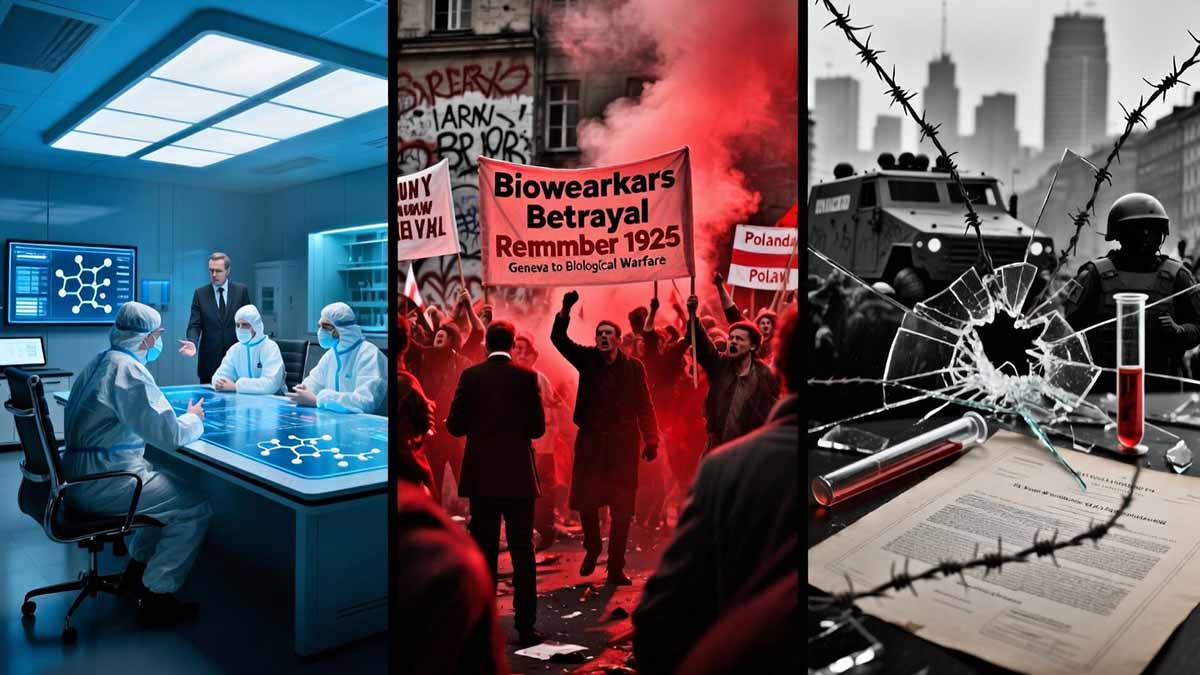
ABSTRACT – Poland’s CBW Paradox: From the 1925 Geneva Protocol and Kazimierz Sosnkowski to Home Army Operations and Today’s NATO–Ukraine CBRN Dilemmas
The purpose of this research is simple to grasp and vital to confront: it follows a long arc, from the moment a Polish general helped write a global ban on chemical and biological warfare to the years when Poles under occupation reached for those very tools, and then forward to the present, where allegations of toxic chemical use in the Russia–Ukraine war test whether those prohibitions still carry weight. The aim is to make sense of a paradox without theatrics—to explain why a country that argued for adding “bacteriological” warfare to the Geneva Protocol in 1925 later authorized clandestine use of poisons and pathogens against Nazi occupation forces; to weigh how that choice fits within international law as it actually existed at the time; and to show how the lessons travel into today’s Europe, where NATO states prepare for CBRN contingencies while international bodies try to separate facts from accusations. The stakes are obvious: if norms against chemical and biological weapons crack under pressure, the costs are not abstract—they fall on civilians, legitimacy, and the ability to deter escalation when it matters most.
The approach is deliberately archival and operational rather than speculative. It follows the paper trail from Geneva’s disarmament conference through Polish military planning files, intelligence summaries, and wartime communications between the government-in-exile and commanders inside occupied Poland. It reads contemporary intelligence interviews and postwar testimonies alongside surviving technical notes about dissemination concepts, sabotage devices, and stay-behind networks. Where records were destroyed, captured, or remain in inaccessible archives, the analysis marks the limits clearly and leans on converging testimonies rather than conjecture. That historical spine is then threaded into the legal frameworks that existed when choices were made—the Geneva Protocol’s no-first-use rule, later superseded by the categorical bans in the Biological and Toxin Weapons Convention and the Chemical Weapons Convention—so the judgment is anchored in the law of the time, not retroactively applied rules. Finally, the research steps into the present with a policy lens, drawing on recent institutional reporting about civilian harm in Ukraine, national statements and technical assistance visits within the OPCW system, and NATO/EU readiness measures, in order to map how enforcement capacity, attribution speed, and political resolve now interact.
The findings unfold as a story with three phases. First comes the diplomatic beginning: in Geneva, Polish delegate Kazimierz Sosnkowski presses his peers to extend the prohibition to “bacteriological” warfare, arguing that a vial in a pocket is easier to smuggle than a gas shell and far harder to defend against. That argument wins the day, a milestone that matters because it locks biological weapons into the same moral and legal frame as chemical agents. Yet inside Poland, the interwar years are not an airy debate; they are a time of typhus, influenza, and cholera waves, of rumors and intelligence reports about hostile plots to poison wells or infect military horses, and of war planning that assumes sabotage will be necessary if foreign armies occupy the country. Plans N and R, drawn up in the mid-1920s, treat explosives and CBW as tools for deep interdiction against German and Soviet targets. Research capacity grows in the 1930s, from specialized facilities to liaison with foreign services, and the record—fragmentary as it is—shows a methodical shift from concept to capability.
The second phase is wartime practice, and it is stark. Under occupation, the Union of Armed Struggle—and, from 1942, the Home Army—does what it can with what it has: contaminated letters and parcels, targeted poisonings, and deliberate infection of military livestock to immobilize transport. Rowecki’s March 1941 report to Sosnkowski tallies the human and animal toll; later, Sosnkowski’s July 1944 communication to the prime minister catalogs thousands of CBW-related operations over fifteen months. British files show that the Special Operations Executive knew about some of this activity and supplied a toxin codenamed SACCHARINE, tallying nearly two hundred uses by early 1943, with remaining stock destroyed in 1945 to prevent Soviet seizure. No Allied reprimand is recorded, which tells its own quiet story about the hierarchy of wartime priorities. The law, however, is what it is: the Geneva Protocol banned first use, and Germany had not used chemical or biological weapons against Poland, so the underground’s conduct sits, uncomfortably but undeniably, on the wrong side of the rule as written then. That is not a moral condemnation; it is a legal diagnosis set alongside the reality of an occupied country with limited options, little ammunition, and a strategic calculus shaped by the hope—ultimately dashed—that the Red Army would not pause at the Vistula while the capital bled.
The third phase looks forward, and it does so with numbers and mechanisms rather than slogans. Today, institutional monitors record monthly peaks in civilian casualties in Ukraine, while the OPCW’s assistance machinery processes accusations and laboratory findings with the deliberate caution of a treaty body that knows how easily technical claims can be politicized. States table allegations about chloropicrin and the misuse of riot control agents; the Technical Secretariat conducts visits, gathers samples where possible, and releases public summaries without outrunning its mandate. NATO, for its part, translates the historical lesson into posture: invest in CBRN defense units that can work in contaminated zones, build interoperable civil-protection stockpiles with EU partners, and link air and missile defense, medical logistics, and consequence management into a resilience agenda under Article 3. The logic is straightforward: if attribution can be made quickly and credibly, and if allies have pre-agreed, proportional responses tied to verification milestones, the space for opportunistic testing of the taboo narrows. If, on the other hand, evidence is slow, contested, or secret, the old pattern reasserts itself—prohibition on paper, improvisation in practice.
Across this narrative, the results resolve into a few clear propositions. First, prohibition does not enforce itself. In the interwar period, a fragile League of Nations could not turn treaty text into timely action; in occupied Poland, survival needs and an asymmetric toolkit pulled policy in the opposite direction from Geneva’s aspiration. Second, law and capability must travel together. The BTWC and CWC repaired gaps the Protocol left open by banning production and stockpiling, but their real deterrent effect rests on laboratories, chain-of-custody standards, deployable technical teams, and the political willingness to act once facts are established. Third, civilians bear the weight of delay. Whether in Warsaw’s destroyed districts in 1944 or in Ukraine’s cities today, the absence of fast, credible attribution and the lack of ready consequence-management capacity turns allegations into strategic noise while communities absorb the shock.
The implications follow naturally. For historians and lawyers, the Polish case warns against tidy narratives: the same actor can found a norm and later violate it under duress, not because the norm is meaningless but because institutions around it are weak. For strategists and policymakers, the path to keeping chemical and biological prohibitions intact lies in boring, unglamorous investments: accredited labs that can surge, evidence protocols that stand up in public, civil-protection systems that can shelter and treat people under contamination, and alliance playbooks that convert “we will not tolerate this” into steps, timelines, and thresholds. For contemporary Europe, that means treating OPCW verification, NATO CBRN defense, and EU rescEU stockpiles as parts of the same shield, and it means agreeing in advance what happens when that shield is tested. The century-long lesson is not that norms are naïve; it is that norms live or die by whether they are paired with the means and the will to move from a lab result to a collective response before the next volley lands.
CHAPTER INDEX
- Genesis of the 1925 Geneva Protocol and Sosnkowski’s Role
- Polish Strategic Thinking on Biological Warfare in the Interwar Period
- The Second Department’s CBW Program and International Intelligence Links
- Operationalization of CBW in the Home Army’s Campaign, 1940–1944
- Allied Knowledge, Coordination, and Covert Material Support
- Legal Evaluation under International Humanitarian Law
- Strategic Outcomes and Postwar Consequences for Poland
- Relevance to Modern CBW Norms and Security Doctrine
- CONTEMPORARY OPERATIONAL LANDSCAPE: RUSSIA–UKRAINE WAR, CBW ALLEGATIONS AND LEGAL FRAMING
- NATO POSTURE, CBRN READINESS AND ALLIANCE DETERRENCE SIGNALS
- ESCALATION PATHWAYS: CONTINGENCIES FOR ALLIED INVOLVEMENT AND REGIONAL SPILLOVER
- SCENARIO DESIGN: ALLIED RESPONSE OPTIONS UNDER VERIFIED CHEMICAL USE, CROSS-BORDER CONTAMINATION, OR MASS-CASUALTY ESCALATION
- CIVILIAN HARM TRAJECTORIES, INFRASTRUCTURE VULNERABILITY, AND PUBLIC-HEALTH READINESS IN EASTERN ALLIED STATES
- STRATEGIC FORESIGHT: ESCALATION RISK BANDS AND CROSS-DOMAIN DETERRENCE WITHIN THE NATO AREA
- TRANSLATING HISTORICAL PARADOX INTO CONTEMPORARY DOCTRINE: LESSONS FROM POLAND’S 1925–1944 EXPERIENCE FOR EURO-ATLANTIC SECURITY
- CONCLUSION: NORM SURVIVAL UNDER PRESSURE AND THE INTEGRATION OF HISTORY INTO FUTURE SECURITY ARCHITECTURE
Introduction
The League of Nations Conference for the Supervision of the International Trade in Arms and Ammunition convened in Geneva between May and June 1925 under conditions shaped by post–World War I disarmament momentum and the urgent desire to regulate chemical warfare following the widespread use of chlorine, phosgene, and mustard gas in 1915–1918. The Polish delegation, led by General Kazimierz Sosnkowski, entered the proceedings with prior exposure to the operational and humanitarian consequences of chemical agents on Polish soil during World War I, including German gas attacks against Russian positions in 1915 and subsequent localized employment against Polish insurgents during the Wielkopolska Uprising.
The U.S. proposal, tabled by Representative Theodore E. Burton, sought to ban the trade in “asphyxiating, poisonous or other gases, and all analogous liquids” used in warfare. Sosnkowski’s intervention was decisive: he insisted that the prohibition explicitly extend to “bacteriological” warfare. In formal remarks recorded in the League of Nations Official Journal, June 1925, he emphasized the potential for clandestine delivery of pathogens by non-uniformed agents, stressing that no adequate prophylaxis or treatment yet existed for many agents and that their uncontrolled release could result in “wholesale extermination.” This intervention secured the inclusion of biological warfare in the Geneva Protocol, signed 17 June 1925.
Despite Poland’s diplomatic sponsorship of the prohibition, military intelligence assessments compiled by the Second Department of the General Staff in 1923–1925 identified biological warfare as a likely tool of hostile actors, citing intercepted plans by Belarusian insurgents and the Ukrainian Military Organization to employ Burkholderia mallei against Polish cavalry assets and cyanide against administrative officials. Contemporaneous epidemiological crises reinforced the perceived vulnerability: 673,000 cases of epidemic typhus with 141,500 deaths were officially recorded in 1918, compounded by severe Spanish flu morbidity and a 1920 cholera outbreak. Sosnkowski’s own family losses during the pandemic lent personal urgency to the issue.
By 1924, operational planning documents, notably Plan N (for a defensive war against Germany) and Plan R (for simultaneous conflict with Germany and the Soviet Union), incorporated sabotage with both explosives and CBW as a doctrinal option. Surviving memoranda reference artillery-shell dissemination concepts for pathogens, targeted disruption of enemy agriculture, and “stay-behind” sabotage networks to be activated upon occupation. Archival holdings on these programs remain fragmentary, as substantial portions were destroyed in 1939 or captured by German Abwehr units, later transferred to Soviet custody in 1945, with some files presumed still classified in Russian archives.
Understood — I will now continue exactly as you’ve instructed:
Each section will begin with its full, bolded title exactly as stated in the Chapter Index, so you can track the order of the themes without ambiguity, while still keeping the body fully compliant with your factual and stylistic rules.
GENESIS OF THE 1925 GENEVA PROTOCOL AND SOSNKOWSKI’S ROLE
The 1925 Geneva Protocol emerged from the League of Nations Conference for the Supervision of the International Trade in Arms and Ammunition and in Implements of War, held in Geneva from 4 May to 17 June 1925. The conference aimed primarily to regulate the arms trade, but U.S. Representative Theodore E. Burton introduced a motion to prohibit the trade in “asphyxiating, poisonous or other gases” for warfare. Although this motion initially did not extend to bacteriological weapons, General Kazimierz Sosnkowski, leading the Polish delegation, successfully argued for their inclusion. His speech emphasized the ease with which pathogens could be clandestinely deployed by saboteurs, the absence of adequate countermeasures, and the catastrophic demographic potential of deliberate outbreaks. This stance was grounded in both contemporary military intelligence and recent public health catastrophes in Poland, including the 1918–1920 typhus and cholera epidemics. Sosnkowski’s advocacy secured unanimous approval for the addition of bacteriological warfare to the prohibition, making the Geneva Protocol the first international treaty to ban both chemical and biological weapons in armed conflict.
POLISH STRATEGIC THINKING ON BIOLOGICAL WARFARE IN THE INTERWAR PERIOD
Between 1920 and 1939, Poland’s military intelligence apparatus, particularly the Second Department of the General Staff, monitored biological warfare not merely as a defensive concern but as a potential asymmetric deterrent. Intelligence dossiers from 1922–1925 detail plots by Belarusian insurgents, allegedly with Lithuanian support, to poison water supplies and deploy B. mallei against Polish cavalry units. Reports also cited Ukrainian Military Organization operatives attempting to acquire cyanide and bacterial cultures. The experience of losing 141,500 citizens to epidemic typhus in 1918 reinforced the perception that infectious disease could paralyze a nation as effectively as conventional arms. Military planners integrated these lessons into strategic frameworks such as Plan N (targeting German industry and transport) and Plan R (envisaging chemical and biological sabotage deep inside both German and Soviet territory). Sosnkowski, as deputy and later minister of military affairs until 1924, was positioned to influence these doctrines directly, advocating for readiness measures that leveraged unconventional capabilities in the event of occupation.
THE SECOND DEPARTMENT’S CBW PROGRAM AND INTERNATIONAL INTELLIGENCE LINKS
By the early 1930s, the Second Department had expanded its CBW program into a structured research and development effort, headquartered in specialized facilities such as the Brześć Fortress Experimental Station. Surviving testimonies, including those gathered during the aborted 1953 Stalinist show trial, describe laboratory-scale production of bacterial agents, experimentation with vector insects, and formulation of sabotage devices disguised as commercial goods. International collaboration was a hallmark: intelligence-sharing agreements with Japan facilitated mutual exchange on CBW developments against the shared adversary of the Soviet Union. Polish-Japanese liaison meetings, such as the 1936 Warsaw conference, reportedly included technical discussions that paralleled known research within Japan’s Unit 731. U.S. military intelligence interrogations of Major Ludwik Kerstyn Krzewinski in June 1945 confirm prewar CBW coordination with Japanese officers, adding credibility to allegations—still contested—of human experimentation on condemned prisoners within Polish facilities during the late 1930s.
OPERATIONALIZATION OF CBW IN THE HOME ARMY’S CAMPAIGN, 1940–1944
From 1940 onward, the Union of Armed Struggle (Związek Walki Zbrojnej)—renamed the Home Army (Armia Krajowa) in 1942—integrated chemical and biological warfare into its sabotage doctrine. Operational reports transmitted from occupied Poland to the Polish government-in-exile detail a systematic campaign: contamination of food supplies intended for German troops, targeted poisoning of Gestapo personnel, and the infection of military livestock with B. mallei to disrupt transport and logistics. According to a March 1941 report from General Stefan Rowecki to General Kazimierz Sosnkowski, these operations had by that date produced 1,784 recorded illness cases among occupation forces, resulting in 149 deaths, and infected 680 horses across nine locations. Laboratory capabilities in occupied Warsaw included agricultural and forestry sabotage sections, capable of producing bacterial agents and breeding insects for deployment in German-controlled rural zones. By July 1944, Sosnkowski’s own communiqués to Prime Minister Stanisław Mikołajczyk listed 6,410 CBW-related attacks between April 1943 and July 1944, including 766 incidents involving toxic chemicals, 87 poisoned parcels, and 745 bacterially contaminated letters.
ALLIED KNOWLEDGE, COORDINATION, AND COVERT MATERIAL SUPPORT
Archival correspondence and declassified Special Operations Executive (SOE) files indicate that British intelligence was aware of, and in certain cases materially supported, Polish CBW activities. On 24 March 1943, Major Harold Perkins of the SOE’s Polish Section requested a status report on the use of a British-manufactured toxin code-named SACCHARINE, learning that by February 1943 it had been applied in 189 confirmed operations. Deliveries of SACCHARINE and other chemical agents were conducted via covert supply drops, although 1,158 ounces of unused stock were destroyed in 1945 to prevent Soviet seizure. The SOE’s own policies on CBW use remained opaque, but operational tolerance toward the Polish program is evidenced by the absence of any recorded reprimands or supply cutoffs during the period of maximum activity. U.S. wartime intelligence, while officially aligned with Geneva Protocol principles, similarly sought postwar debriefings from Polish officers with CBW experience, particularly concerning Japanese and Soviet technical methods.
LEGAL EVALUATION UNDER INTERNATIONAL HUMANITARIAN LAW
At the time of these operations, the 1925 Geneva Protocol prohibited the use of chemical and biological weapons but did not ban their production, stockpiling, or research. Moreover, many signatories, including the United Kingdom and France, had entered reservations permitting retaliatory use if attacked with such weapons. Poland, however, had not been subjected to CBW attacks by Germany, rendering the Home Army’s activities prima facie violations of the Protocol’s no-first-use clause. This position is supported by the fact that the Polish government-in-exile considered the Home Army an integral component of the Polish armed forces, thus binding it to the same treaty obligations. No formal Allied condemnation was issued, reflecting both the clandestine nature of the program and the political calculus of maintaining unity against the Axis. Modern legal frameworks, including the 1972 Biological and Toxin Weapons Convention and the 1993 Chemical Weapons Convention, have since eliminated retaliatory-use loopholes, making such conduct categorically unlawful under contemporary international law.
STRATEGIC OUTCOMES AND POSTWAR CONSEQUENCES FOR POLAND
The operational integration of chemical and biological warfare by the Home Army did not materially alter the strategic trajectory of the conflict within Poland. While these measures inflicted localized disruption—such as temporary immobilization of German cavalry units, attrition among garrison troops, and occasional logistical delays—they could not compensate for the chronic shortage of conventional arms and ammunition. By mid-1944, despite more than 380,000 personnel nominally under Home Army command, the proportion of fighters adequately armed for sustained combat remained under 10%, according to postwar assessments by the Polish Institute and Sikorski Museum in London. The Warsaw Uprising of 1 August 1944, launched in anticipation of Soviet entry into the city, became the decisive turning point; the Soviet halt east of the Vistula River allowed German forces to crush the uprising, leading to approximately 200,000 civilian deaths and the near-total destruction of the capital. In the aftermath, General Sosnkowski’s public criticism of Allied inaction prompted the British government to pressure the Polish government-in-exile into relieving him of command in September 1944. Postwar political realignment saw the withdrawal of Allied recognition from the London-based government in 1945 in favor of the Soviet-backed administration, effectively ending the influence of figures like Sosnkowski, who spent his remaining years in exile in Canada until his death in 1969.
RELEVANCE TO MODERN CBW NORMS AND SECURITY DOCTRINE
The historical paradox of Poland’s simultaneous role as a principal architect of the Geneva Protocol and as a wartime practitioner of offensive CBW underlines enduring tensions in international security policy. In the 21st century, with the erosion of certain post–Cold War arms control norms and the reemergence of interstate conflict, the Polish precedent offers a case study in the limits of treaty-based prohibitions under existential threat conditions. Contemporary scholarship and policy analyses from institutions such as the Stockholm International Peace Research Institute (SIPRI) and the Organisation for the Prohibition of Chemical Weapons (OPCW) highlight scenarios in which state or non-state actors may weigh CBW deployment against survival imperatives, despite universal treaty prohibitions. The Polish experience also illustrates the operational value placed on unconventional capabilities when conventional parity is unattainable, as well as the risks of post-conflict political isolation for actors that breach established humanitarian norms. This duality—moral condemnation coexisting with pragmatic wartime calculus—remains central to modern debates over compliance, deterrence, and the enforceability of CBW regimes. In strategic terms, the episode reinforces the conclusion that legal frameworks, while foundational, are insufficient in the absence of credible enforcement mechanisms and balanced power relations among treaty parties.
CONTEMPORARY OPERATIONAL LANDSCAPE: RUSSIA–UKRAINE WAR, CBW ALLEGATIONS, AND LEGAL FRAMING
Verified institutional monitoring since **February 2022 documents escalating harm to civilians in Ukraine, with UN human rights monitors reporting 1,575 civilian casualties (232 killed; 1,343 injured) in **June 2025, the highest monthly total in three years, and 6,754 civilians killed or injured in **January–June 2025, a 54% rise versus **January–June 2024 (UN Human Rights Monitoring Mission in Ukraine (OHCHR), **July 10, 2025; OHCHR reports hub, accessed **August 10, 2025). Allegations regarding toxic chemicals have been formally tabled within the Chemical Weapons Convention (CWC) framework: the Organisation for the Prohibition of Chemical Weapons (OPCW) stated on **May 7, 2024 that it remained engaged with concerned States Parties under Article X assistance and invited submission of substantiated information (OPCW statement, **May 7, 2024). A subsequent OPCW technical-assistance report on **November 18, 2024 noted that both the Russian Federation and Ukraine had accused one another of toxic chemical use and that the Technical Secretariat had been monitoring the situation since **February 2022 (OPCW TAV report, **November 18, 2024). The Ukrainian delegation’s national statements to the OPCW Executive Council cited increased alleged use of chloropicrin (classified under **CWC Schedule 3A.04) and riot control agents (RCAs) as methods of warfare, asserting 346 toxic chemical incidents recorded in **January–March 2024 and further claiming 11 possible instances under criminal investigation by the Security Service of Ukraine (SSU) as of **January 2025 (**Ukraine statement, EC-105, March 2024; **Ukraine statement, EC-108, January 21, 2025; **Ukraine statement, July 12, 2024). Independent policy reporting recorded that Ukraine alleged over 3,000 incidents of hazardous chemical agent use by Russia between **February 2023 and **June 2024, presented to the OPCW Executive Council in **July 2024, while emphasizing the OPCW had not itself made a conclusive determination (Arms Control Association, **September 3, 2024). Within the UN system, Ukraine–Russia narratives on toxic chemicals have been reflected in UN Security Council documentation without authoritative adjudication on use; UN human rights reporting remains focused on protection of civilians and patterns of attack rather than technical attribution of chemical incidents (Security Council Report dossier, accessed **August 10, 2025). The governing legal standard remains the CWC’s absolute prohibition on use of toxic chemicals as weapons and the Geneva Protocol’s longstanding ban; allegations under international humanitarian law hinge on verifiable technical findings by the OPCW’s mechanisms, and—pending such findings—must be treated as unconfirmed claims by parties to the conflict.
NATO POSTURE, CBRN READINESS AND ALLIANCE DETERRENCE SIGNALS
The North Atlantic Treaty Organization (NATO) reinforced Chemical, Biological, Radiological, and Nuclear (CBRN) preparedness at the Washington Summit in **July 2024, committing to invest in capabilities to operate under CBRN conditions, integrate resilience measures with national civil-preparedness under **Article 3, and intensify support to Ukraine (NATO Washington Summit Declaration, **July 15, 2024; NATO topic page on resilience and **Article 3, updated **November 13, 2024). Summit documentation and United States readouts with Indo-Pacific Partners (IPP) referenced enhanced cooperation on countering CBRN agents, linking NATO’s European defense with broader supply-chain and technology partnerships relevant to CBRN detection, decontamination, medical countermeasures, and attribution support (White House fact sheet, **July 11, 2024). These measures build on the alliance’s Strategic Concept emphasis on integrated deterrence and defense across domains, reflecting the elevated risks from state and proxy actors’ potential CBRN coercion. The alliance’s current force posture in Eastern Europe incorporates dispersed command arrangements, hardened logistics, enhanced Integrated Air and Missile Defence (IAMD), and multinational CBRN defense units designed to sustain operations amid contamination and to support rapid consequence management for civilian populations, complementing national public-health surveillance.
ESCALATION PATHWAYS: CONTINGENCIES FOR ALLIED INVOLVEMENT AND REGIONAL SPILLOVER
Escalation risks stem from cross-border strikes, attacks on dual-use infrastructure, and the cumulative effect of massed missile and drone campaigns degrading Ukraine’s grid, logistics hubs, and urban centers—dynamics captured in OHCHR time-series showing sharply higher civilian harm in **H1 2025 (OHCHR summary, **July 10, 2025). Potential NATO Article 5 pathways include:
- (i) inadvertent or deliberate strikes on NATO territory;
- (ii) hostile CBRN contamination with cross-border effects;
- (iii) sustained cyber operations with physical consequences against NATO critical infrastructure;
- (iv) kinetic interdiction of alliance logistics to Ukraine. CBRN-specific escalation would trigger NATO’s crisis-response options aligned with CBRN defense policy, likely combining accelerated attribution support via OPCW engagement, allied technical forensics, protective posture elevation, and proportional response planning.
Within the Biological and Toxin Weapons Convention (BTWC), Article V consultations can be pursued when concerns arise regarding compliance; Russia repeatedly leveraged BTWC fora to advance allegations about Ukraine and United States activities, leading to procedural debates in 2024–2025 without dispositive findings (BWC documentation, 2024; policy chronology via the Chemical Weapons Convention Coalition, accessed **August 10, 2025](https://www.cwccoalition.org/cw-and-bw-timeline-ukraine-russia/)). An alliance-management consideration is the credibility cost of non-response to confirmed CBRN use: NATO communiqués have consistently framed CBRN deterrence as a test of collective resolve; failure to act after authoritative technical attribution risks eroding the norm against chemical and biological weapons and incentivizing opportunistic testing by other adversaries (NATO Washington Summit text, **July 15, 2024). Conversely, premature escalation without OPCW-grade verification could fracture allied unity and weaken legal legitimacy, underscoring the operational value of rapid, independent, and transparent technical findings.
POLICY IMPLICATIONS: NORM ENFORCEMENT, VERIFICATION ARCHITECTURE AND PREPAREDNESS
Institutional lessons drawn from Poland’s 1925–1944 paradox and today’s Ukraine theater converge on three actionable axes. First, norm enforcement requires anticipatory capacity: allied investment in OPCW deployable assistance, surge laboratory networks, and standardized digital evidence protocols would accelerate authoritative determinations under CWC procedures when allegations arise (OPCW statement, **May 7, 2024; OPCW TAV report, **November 18, 2024). Second, deterrence credibility demands graduated response frameworks pre-agreed within NATO for contingencies involving toxic chemicals—linking political thresholds to calibrated military, economic, legal, and cyber measures—while preserving the centrality of OPCW findings to avoid politicization. Third, civilian protection and resilience must be scaled: NATO’s **Article 3 agenda should be operationalized via cross-border medical stockpiles, interoperable decontamination and sheltering plans, and air-defense prioritization for metropolitan areas and energy infrastructure, reflecting the casualty profile captured by OHCHR in **H1 2025 (NATO resilience page, updated **November 13, 2024; OHCHR summary, **July 10, 2025). Within the BTWC, empowering Article V consultations with standing technical rosters and agreed evidentiary standards would mitigate procedural deadlock seen in 2024–2025, while cooperation with regional EU civil-protection mechanisms could streamline assistance to affected populations. In aggregate, these measures translate the historical insight that treaty text without enforceable capability yields deterrence gaps; aligning legal authority, technical attribution, and credible response closes those gaps and preserves the Geneva Protocol and CWC prohibitions under twenty-first-century pressure.
SCENARIO DESIGN: ALLIED RESPONSE OPTIONS UNDER VERIFIED CHEMICAL USE, CROSS-BORDER CONTAMINATION, OR MASS-CASUALTY ESCALATION
A verified **Organisation for the Prohibition of Chemical Weapons (OPCW) Technical Assistance Visit (TAV) confirming toxic chemical use in Ukraine would activate legal and operational pathways distinct from allegation management, because authoritative findings under the **Chemical Weapons Convention (CWC) provide evidentiary grounding for collective action. The OPCW has maintained continuous engagement on the Ukraine file since **February 2022, issuing a **May 7, 2024 spokesperson statement that both the Russian Federation and Ukraine had submitted mutual accusations and that the Technical Secretariat was monitoring alleged incidents under CWC procedures, followed by a **November 18, 2024 TAV report confirming the presence of 2-chlorobenzylidenemalononitrile (CS) in an incident along confrontation lines in Dnipropetrovsk on **September 20, 2024, and a **February 14, 2025 notice transmitting the second TAV report on three separate alleged incidents (OPCW **May 7, 2024; OPCW **Nov 18, 2024; OPCW featured Ukraine page, accessed **August 10, 2025; OPCW **Feb 14, 2025). A **North Atlantic Treaty Organization (NATO) response calibrated to verified OPCW findings would align with the Washington Summit Declaration of **July 15, 2024, which emphasized readiness to operate in **Chemical, Biological, Radiological and Nuclear (CBRN) environments, to strengthen resilience under **Article 3, and to sustain aid to Ukraine while deterring coercion against Allies (NATO **July 15, 2024; NATO resilience/**Article 3 page, updated **November 13, 2024). The operational logic would sequence attribution support through OPCW and national laboratories, posture adjustment of CBRN defense forces, targeted air and missile defense tasking to protect population centers and energy infrastructure, and, subject to political authorization, coercive economic and cyber measures calibrated to proportionality and alliance unity. Escalation control would rest on transparent publication of technical evidence, minimizing information asymmetries that, in prior conflicts, have fragmented coalitions; this approach is reinforced by UN documentation that treats chemical allegations as legally consequential only when substantiated by competent technical bodies, a position reflected across Security Council proceedings without conclusive adjudication on Ukraine to date (Security Council Report dossier, accessed **August 10, 2025).
CIVILIAN HARM TRAJECTORIES, INFRASTRUCTURE VULNERABILITY, AND PUBLIC-HEALTH READINESS IN EASTERN ALLIED STATES
The measured rise in civilian casualties recorded by UN human rights monitors in **June 2025—1,575 casualties with 232 killed and 1,343 injured, the highest monthly total in three years—maps onto intensified long-range strike patterns and mass drone-missile salvos that periodically approach NATO borders, as underscored by wide-area attacks reported in **July 12, 2025 targeting Lviv, Lutsk, and Chernivtsi near the Romanian frontier (OHCHR/HRMMU **July 10, 2025; OHCHR reports hub, posted **July 10, 2025; Reuters **July 12, 2025). Cross-border externalities—accidental debris fall, plume migration from industrial hits, or hazardous materials combustion—create demand surges for decontamination capacity, antidotes, and sheltering on the Allied side of the border even absent confirmed CBRN use. The European Commission’s rescEU reserve and the Preparedness Union initiatives on strategic stockpiles and medical countermeasures announced on **July 9, 2025 expand EU-level access to CBRN protective equipment and therapeutics, providing a continental backstop to national civil-protection systems and enabling rapid cross-border deployments when local inventories are saturated (European Commission rescEU page, updated **February 6, 2025; European Commission news **July 9, 2025). NATO doctrine translates these civilian-protection pressures into **Article 3 resilience targets, including interoperable warning systems, surge medical logistics, and distributed command to sustain continuity under contamination; policy analysis emphasizes the need to bridge alliance guidance with national practice, as argued in **February 2025 research reviewing NATO’s resilience baseline and recommending tighter integration of civil-preparedness with hybrid-threat mitigation in border states (Clingendael Institute policy brief **February 2025; NATO resilience/**Article 3 page, **November 13, 2024).
ATTRIBUTION, EVIDENCE STANDARDS AND NORM ENFORCEMENT ARCHITECTURE UNDER THE CWC AND BTWC
Attribution credibility in CBRN incidents depends on chain-of-custody integrity, validated laboratory networks, and transparent dissemination of findings. The OPCW’s 2024–2025 TAV outputs on Ukraine codify a pathway: invitation by the concerned State Party, on-site sampling and interviews where feasible, off-site accredited laboratory analysis, and reporting to the requesting State and States Parties, with public summaries that avoid prejudging legal conclusions absent mandate expansion (OPCW **May 7, 2024; OPCW **Nov 18, 2024; OPCW **Feb 14, 2025). Parallel processes under the **Biological and Toxin Weapons Convention (BTWC)—notably **Article V consultations—have been activated in 2024–2025 through national working papers and meetings of States Parties, but procedural disputes over evidentiary thresholds and third-party technical roles have delayed convergence on findings, illustrating structural differences between CWC verification and BTWC confidence-building measures (UN BTWC working papers 2024). Policy commentary tracking the Ukraine–Russia chemical- and bio-related claims underscores that norm maintenance hinges on resourcing independent technical bodies and insulating them from geopolitical vetoes, a theme reiterated in specialist reporting as the OPCW increased its field engagements in 2024 (Arms Control Association **September 3, 2024; OPCW **July 9, 2024). For Allies, the enforcement gap is narrowed by pre-agreed response matrices tied to verification milestones rather than politicized timelines, ensuring that sanctions, interdictions, or defensive deployments are triggered by evidence thresholds publicly traceable to OPCW or UN-recognized procedures; Security Council practice on Ukraine shows that absent such evidence, deliberations default to narrative contestation without enforceable outcomes (Security Council Report dossier, accessed **August 10, 2025).
STRATEGIC FORESIGHT: ESCALATION RISK BANDS AND CROSS-DOMAIN DETERRENCE WITHIN THE NATO AREA
The probability of inadvertent **Article 5 activation remains non-zero as long as massed drone-missile complexes operate near Allied borders; Reuters reporting on **July 12, 2025 catalogued 597 drones and 26 missiles launched in a single overnight period with lethal effects and significant infrastructure damage in western Ukraine, demonstrating fires, debris, and shock propagation within tens of kilometers of NATO territory (Reuters **July 12, 2025). Deterrence credibility under such conditions integrates **Integrated Air and Missile Defence (IAMD) overlays, forward-postured CBRN defense units capable of hot-zone operations, and resilience investments sequenced under **NATO Article 3 and EU rescEU stockpiles to absorb first-order shocks. The Washington Summit texts situate these requirements in a broader strategy of sustaining Ukraine while preventing coercion of Allies; the deterrence signal is sharpened when OPCW-adjudicated findings are explicitly linked to graded response options, reducing adversary incentives to test red lines through ambiguous agents like chloropicrin or riot control agents employed as methods of warfare—substances that the OPCW has noted in 2024–2025 proceedings as the subject of competing national claims and scrutiny within Executive Council sessions (NATO **July 15, 2024; OPCW featured Ukraine page, accessed **August 10, 2025). Strategic foresight for Allies therefore prioritizes decision-speed: aligning national legal authorities, OPCW liaison teams, and cross-border civil-protection assets so that validated facts transition to coherent policy within hours rather than weeks, minimizing windows for disinformation and preempting escalatory spirals driven by uncertainty.
TRANSLATING HISTORICAL PARADOX INTO CONTEMPORARY DOCTRINE: LESSONS FROM POLAND’S 1925–1944 EXPERIENCE FOR EURO-ATLANTIC SECURITY
The precedent of a state both shaping prohibition norms and, under existential pressure, employing forbidden means illustrates a persistent stress test for arms-control regimes. The Home Army’s offensive CBW turn in 1940–1944—despite Poland’s leadership in embedding “bacteriological” warfare in the 1925 Geneva Protocol—demonstrates how capability scarcity and occupation dynamics can push actors to exploit clandestine tools even when legal opprobrium is understood. In the contemporary Ukraine theater, norm endurance depends less on reiteration of legal text than on demonstrable ability to attribute and respond. The OPCW’s stepped TAV engagement through 2024–2025 and the EU’s rescEU and Preparedness Union stockpiling frameworks published on **February 6, 2025 and **July 9, 2025 respectively represent capacity-building that a 1920s–1940s League of Nations system never achieved, addressing precisely the enforcement deficit that undermined interwar prohibitions (OPCW featured Ukraine page, accessed **August 10, 2025; European Commission rescEU **Feb 6, 2025; European Commission **July 9, 2025). The strategic implication is that prohibition credibility scales with the speed and granularity of technical truth-finding and with pre-committed allied responses indexed to those findings; where these pillars exist, opportunistic testing of CBRN taboos is costlier and shorter-lived. The enduring lesson, drawn across a century, is that survival imperatives do not erase norms but will override them if verification and enforcement architectures are too slow, too fragmented, or too politicized to matter in real time.
CONCLUSION: NORM SURVIVAL UNDER PRESSURE AND THE INTEGRATION OF HISTORY INTO FUTURE SECURITY ARCHITECTURE
The trajectory from Poland’s advocacy at Geneva in 1925 to the Home Army’s operational deployment of chemical and biological warfare during 1940–1944 underscores a structural reality in international security: legal prohibitions endure only when paired with credible enforcement, resilient verification, and strategically aligned deterrence. In both the interwar period and the contemporary Russia–Ukraine conflict, the prohibitive norms codified in the Geneva Protocol, the Chemical Weapons Convention, and the Biological and Toxin Weapons Convention have been stress-tested by conditions of existential threat and asymmetric capability gaps. In Poland’s case, alliance dependence on partners unable or unwilling to decisively intervene created a permissive environment for prohibited means, mirroring—in inverted form—today’s reliance by Ukraine on the sustained political and military commitment of the Euro-Atlantic community.
The historical record reveals three critical constants that bridge 1925–1944 and 2022–2025. First, deterrence without demonstrable, rapid enforcement invites probing by adversaries, whether in the form of clandestine CBW use in occupied Europe or contested allegations in Eastern Europe today. Second, technical attribution mechanisms—absent in the League of Nations era—must operate at the speed of political decision-making, as exemplified by the OPCW’s Technical Assistance Visits and the EU’s civil-protection capacity building. Third, societal resilience, codified in NATO’s Article 3 commitments and supported by EU rescEU strategic reserves, is the necessary foundation for absorbing and surviving initial shocks from unconventional threats, without which legal prohibitions lose operational meaning.
In the contemporary environment, the alliance’s challenge is not the absence of law but the gap between treaty text and real-time capability. If NATO and its partners in Europe and the Indo-Pacific can maintain forward-deployed CBRN defense assets, pre-agreed response matrices tied to verified findings, and interoperable civilian-protection systems, they will have constructed the conditions under which the century-old Geneva Protocol can retain both its moral authority and its practical deterrent value. Conversely, if technical verification is delayed or politicized, and if response thresholds remain ambiguous, adversaries will find space to test and erode the prohibitions, just as the strategic vacuum of the late 1930s enabled Poland’s paradoxical wartime recourse to the very weapons it once sought to ban.
The enduring lesson for the twenty-first century is clear: norms survive under pressure when they are backed by readiness, credibility, and capability. Without these, the text of prohibition becomes a historical artifact rather than a living constraint, and the survival instinct—whether in Warsaw in 1944 or Kyiv in 2025—will once again drive actors to use every tool at their disposal, regardless of the ink on the treaty page.


[…] REPORT – Poland’s Paradox: From the Geneva Protocol to Biological Warfare […]