


















As of: 2026-11-22 | Geographic focus: Central Asia, with Uzbekistan as the principal case | Strategic horizons: 2025–2030, 2035 and 2050
Strategic Intelligence Dossier | Water Security, Food Systems, Transboundary Infrastructure and Regional Stability
Scope. This assessment examines water availability, allocation, governance and infrastructure across Uzbekistan, Kazakhstan, Kyrgyzstan, Tajikistan, Turkmenistan and Afghanistan, distinguishing near-term risks through 2030 from longer-term climate, economic and security pressures through 2050.
Executive Summary — Bottom Line Up Front
Central Asia faces a structural water-security challenge in which rising demand, inefficient irrigation, changing hydrology and unequal control of transboundary infrastructure reinforce one another. Uzbekistan is particularly exposed because approximately 80% of its water resources originate outside its territory, while agriculture accounts for approximately 90% of water use. O‘zbekiston Respublikasi Hukumat portali+1
Uzbekistan’s National Committee on Ecology and Climate Change reported on 10 November 2026 that the country’s annual water deficit could reach 7 billion cubic metres (bcm) by 2030 and 15 bcm by 2050, compared with nearly 3 bcm in 2015. These are projections, not observed future shortages. O‘zbekiston Respublikasi Hukumat portali
Afghanistan’s Qosh Tepa Canal introduces a consequential new source of uncertainty into the Amu Darya basin. The World Bank Inspection Panel identified planned construction through 2029 and noted that potential withdrawals could substantially exceed the 2.1 bcm/year nominal Afghan allowance assumed in an earlier regional allocation protocol; actual future offtake remains insufficiently verified. World Bank
The central strategic judgment is that persistent agricultural and economic stress is more supportable than a forecast of interstate armed conflict. Nevertheless, uncoordinated water withdrawals, drought, reservoir operations and disputed infrastructure rights could produce localized incidents, particularly when declining flows coincide with politically sensitive border areas.
The region already has cooperative precedents. Uzbekistan and Kyrgyzstan ratified a joint water-management arrangement for the Kempir-Abad/Andijan reservoir in 2022, while Kyrgyzstan, Kazakhstan and Uzbekistan are jointly developing the Kambar-Ata-1 hydropower project. These establish practical pathways toward more predictable allocation, but neither constitutes a comprehensive settlement of Amu Darya basin competition. president.uz+1
The principal policy requirement for 2027–2030 is therefore not simply to build more water infrastructure. It is to combine independently auditable flow measurements, enforceable seasonal operating arrangements, investment in irrigation efficiency and diplomatic mechanisms capable of incorporating Afghanistan’s increasing water use.
Key Judgments
Confidence expresses the strength of the available evidence and analytical assessment, not a numerical probability.
- High confidence: Uzbekistan faces systemic water-security exposure because external inflows supply most of its water while irrigation accounts for approximately nine-tenths of national consumption.
- High confidence: Demographic growth, inefficient distribution systems and climate-related changes in runoff will continue to increase pressure on water availability through 2030.
- Moderate confidence: Under the published national projection, Uzbekistan’s annual water deficit could increase to 7 bcm by 2030 and 15 bcm by 2050, although alternative official estimates and different modelling assumptions require reconciliation.
- High confidence: Qosh Tepa represents a material prospective change in Amu Darya water demand, but its eventual annual withdrawal cannot be established from construction capacity or canal length alone.
- High confidence: Domestic irrigation inefficiency is a major, partly manageable source of scarcity, although gross conveyance losses must not automatically be classified as permanently unrecoverable basin losses.
- Moderate confidence: Water stress is more likely to intensify agricultural, fiscal and social vulnerability than to produce sustained interstate military confrontation by 2035.
- Moderate confidence: Bilateral water agreements and trilateral hydropower development demonstrate meaningful cooperation, but existing arrangements remain insufficiently integrated for comprehensive basin-wide management.
- High confidence: Transparent measurements, seasonal release protocols and irrigation modernization offer more immediate opportunities to reduce risk than infrastructure expansion without agreed operating rules.
Central Asia’s Water Crisis: How Uzbekistan’s Economic Security Is Becoming a Test of Regional Power
From Afghanistan’s Qosh Tepa Canal to Tajikistan’s Rogun Dam, control over water flows is exposing the limits of Central Asia’s infrastructure, economic policies and cross-border agreements.
Uzbekistan’s water crisis is becoming a test of economic sovereignty because the country must finance an increasingly expensive irrigation system while relying on neighboring states for approximately 80% of its water resources. Agriculture consumes roughly 90% of national water supplies, yet the government projects an annual deficit of 7 billion cubic metres by 2030 and 15 billion by 2050. Afghanistan’s Qosh Tepa Canal could increase upstream withdrawals from the Amu Darya, while Tajikistan’s Rogun project and Kyrgyzstan’s hydropower developments complicate the seasonal allocation of river flows. The central vulnerability is not simply declining water availability: it is the absence of a sufficiently comprehensive, verifiable system governing how water is measured, stored, diverted and delivered. Without such a system, hydrological uncertainty becomes an agricultural cost, a fiscal liability and, potentially, a source of regional insecurity.
1. Annual Water Figures Conceal a More Dangerous Seasonal Imbalance
Uzbekistan’s National Committee on Ecology and Climate Change reported on 10 November 2026 that the country’s annual water deficit could rise from nearly 3 billion cubic metres in 2015 to 7 billion by 2030 and 15 billion by 2050. Its longer-term assessment anticipates a possible 30–40% reduction in water availability and a 25% increase in irrigation demand by mid-century. An earlier government briefing, however, warned of a 15-billion-cubic-metre shortage as early as 2030. The discrepancy is consequential: the two projections cannot support the same investment timetable without reconciling their baselines, assumptions and definitions.
The immediate hydrological evidence also resists a simple narrative of continuous decline. According to the Interstate Commission for Water Coordination’s 2025 water-management yearbook, combined natural unregulated runoff in the larger Amu Darya and Syr Darya basins was 108.31 cubic kilometres in 2025, compared with 108.24 in 2024. Yet Syr Darya basin runoff fell from 41.99 to 33.25 cubic kilometres, while Amu Darya flow at the Nominal Kerki control section increased from 56.40 to 64.42 cubic kilometres. The figures describe different hydrological boundaries and cannot be added indiscriminately. Their significance is the divergence between regional aggregates and individual river systems.
For Uzbekistan, the sharper warning lies in actual deliveries. In 2025, the country withdrew 19.78 cubic kilometres from the smaller Amu Darya basin against an annual limit of 23.69 cubic kilometres. Nevertheless, its growing-season shortage in the Darganata–Samanbay reach reached 23%, while Turkmenistan recorded 25% in the same downstream reach. A country can remain below its annual abstraction ceiling and still experience serious agricultural shortages because water arrives in the wrong place or season. Annual allocation compliance is therefore an inadequate measure of economic water security.
2. Qosh Tepa Is Changing the Amu Darya’s Allocation Problem
Afghanistan’s Qosh Tepa Canal introduces an additional irrigation demand into a river system already supporting extensive agriculture in Uzbekistan and Turkmenistan. The World Bank Inspection Panel’s June 2025 report described a planned canal of 285 kilometres, construction beginning in 2022 and completion of the remaining works anticipated by 2029. Earlier World Bank documentation identified plans to develop approximately 550,000 hectares of agricultural land.
The Panel recorded concerns that future Afghan withdrawals could substantially exceed the nominal 2.1 billion cubic metres annually assumed for Afghanistan in an earlier regional allocation protocol. That historical figure is not proof of a contemporary entitlement accepted by Kabul, just as canal design capacity is not proof of actual annual consumption. The decisive missing information concerns measured intake, irrigated area brought into production, seasonal requirements and return flows.
The institutional consequence is more significant than the headline capacity. Afghanistan is not incorporated into the established Central Asian allocation arrangements on the same basis as the five participating republics. Without independently reconcilable measurements, downstream governments may struggle to separate the effects of Afghan withdrawals from drought, reservoir operations and domestic irrigation losses. Qosh Tepa could therefore increase both physical scarcity and uncertainty over responsibility, even without provoking formal confrontation.
This creates a specific diplomatic requirement: a basin-wide technical mechanism capable of incorporating Afghanistan’s actual water use. The United Nations Regional Centre for Preventive Diplomacy for Central Asia reported discussions in May 2026 on broader transboundary cooperation and Afghanistan’s inclusion. The initiative demonstrates diplomatic recognition of the problem, but not the existence of a binding allocation settlement.
3. Hydropower Can Stabilize Water Supply—or Transfer the Risk Downstream
Tajikistan’s Rogun Hydropower Project and Kyrgyzstan’s Kambar-Ata-1 illustrate a separate infrastructure tension. Unlike irrigation diversions, hydroelectric generation does not necessarily consume the water passing through turbines. Its economic and geopolitical effects depend on reservoir filling, seasonal releases, evaporation and the alignment of electricity generation with downstream agricultural demand.
On 30 June 2026, the World Bank announced a further financing phase for Rogun, whose projected annual electricity generation is approximately 14,400 gigawatt-hours. The World Bank Inspection Panel had previously recorded downstream concerns regarding seasonal discharge, cumulative impacts and dam safety. Those concerns warrant examination but are not established evidence that the project has already caused the projected damage.
Kambar-Ata-1 offers a different institutional model. Kyrgyzstan, Kazakhstan and Uzbekistan agreed in June 2024 to cooperate on its development. The World Bank’s project documentation identifies 1,860 megawatts of planned capacity, a 261-metre dam, a 5.2-cubic-kilometre reservoir and expected annual generation of approximately 6,000 gigawatt-hours. The proposed ownership distribution assigns 34% to Kyrgyzstan and 33% each to Kazakhstan and Uzbekistan.
Joint ownership could align upstream electricity interests with downstream irrigation requirements. But equity participation is not equivalent to an enforceable seasonal release schedule. Nor does a 5.2-cubic-kilometre reservoir create an equivalent quantity of additional annual runoff. The strategic value of shared infrastructure depends on binding operating arrangements, verified measurements and procedures for drought years—not on installed capacity alone.
4. Irrigation Inefficiency Is Becoming an Energy and Fiscal Liability
Uzbekistan’s domestic infrastructure presents a vulnerability that cannot be attributed to upstream governments. The World Bank’s May 2025 irrigation assessment reported that 2.4 million hectares—56% of irrigated agricultural land—depend on pumping. Approximately 1,700 pumping stations consume 7.2 billion kilowatt-hours of electricity annually, equivalent to roughly 16% of national electricity consumption in the assessment.
Water scarcity is therefore transmitted into electricity demand, operating expenditure and agricultural production costs. Aging canals and inefficient pumping systems can make each delivered cubic metre more expensive, while energy disruptions can interrupt irrigation even when river water remains physically available. Agriculture contributes approximately one-quarter of national GDP and employment, making these operating failures economically consequential beyond the water sector.
The World Bank approved a US$200 million concessional credit in May 2025, supplemented by US$23.2 million in Uzbek co-financing, to modernize irrigation infrastructure. The programme covers 259 kilometres of major canals, approximately 470 hydraulic structures and improved services across 232,000 hectares. Expected annual benefits include a reduction of approximately 540 million cubic metres in water losses and more than 165 million kilowatt-hours in electricity consumption.
These are investment targets, not verified savings. Moreover, eliminating canal seepage does not always produce an equal increase in basin-wide water availability: some losses recharge groundwater or return to rivers. The economically relevant gains may instead involve delivery reliability, lower pumping costs, reduced waterlogging and greater agricultural productivity. Investment appraisal must distinguish these benefits rather than presenting every reported conveyance loss as fully recoverable water.
The World Bank’s 2023 climate-development assessment warned that Uzbekistan’s economy could be approximately 10% smaller by 2050 under an insufficiently adapted climate-development pathway. That figure covers broader climate effects, not water scarcity alone. It nevertheless identifies the economic cost of allowing infrastructure and adaptation weaknesses to accumulate.
5. Regional Agreements Exist, but Their Effectiveness Depends on Actual Compliance
The November 2022 Uzbekistan–Kyrgyzstan agreement on joint management of the Andijan, or Kempir-Abad, reservoir demonstrates that practical arrangements can address politically sensitive infrastructure. Its provisions establish a joint commission and responsibilities concerning reservoir operations, access, safety and emergency notifications, including a normal maximum water level of 900 metres subject to specified exceptions.
The agreement’s importance lies in its operational specificity. It links territorial arrangements to the management of a shared hydraulic asset. Yet the existence of an agreed regime does not establish uninterrupted compliance or eliminate future disagreements over drought-year operations. The FAOLEX record of the agreement provides a legal basis for assessing implementation rather than relying solely on diplomatic declarations.
The wider security record also contains evidence against inevitable escalation. Kyrgyzstan and Tajikistan signed a state-border treaty on 13 March 2025, welcomed by the United Nations. On 31 March 2025, Kyrgyzstan, Tajikistan and Uzbekistan concluded an agreement concerning their common border junction in Khujand. These decisions reduce important sources of territorial uncertainty, although they do not independently resolve every dispute concerning water access and infrastructure.
The problem is thus not an absence of diplomatic architecture. It is whether existing mechanisms can reconcile the actual flow measurements, seasonal schedules and emergency procedures required by increasingly demanding river systems. The ICWC’s 2025 institutional record documents continued coordination while identifying the need for improved joint gauging between Kazakhstan and Uzbekistan. Regional cooperation is functioning, but its technical coverage remains incomplete.
6. The Aral Sea Shows the Cost of Treating Ecology as Residual Water Demand
The contraction of the Aral Sea demonstrates what happens when cumulative irrigation diversions are considered without sufficient regard for downstream ecological requirements. The consequences have extended to fisheries, soil conditions, dust exposure, public health and economic activity in affected communities. For Uzbekistan, particularly Karakalpakstan, environmental degradation forms part of the country’s long-term resilience problem rather than a separate conservation issue.
The contemporary evidence also demonstrates that ecological outcomes can respond to targeted intervention. According to the Government of Kazakhstan’s October 2026 assessment, Northern Aral Sea water volume increased from 18.9 cubic kilometres in 2022 to 23.4 by the end of 2025, an increase of approximately 23.8%. The same government reported expansion in surface area and reductions in salinity over the longer restoration period.
The southern system remains more constrained. SIC ICWC recorded total inflow of 2.29 cubic kilometres into the southern Aral region in 2025, including river water and drainage-related sources. Research cited in its yearbook identifies requirements of at least 3.5 cubic kilometres in dry years and 8 cubic kilometres in wet years. These are research benchmarks, not legally binding allocations. The gap between the 2025 total and the dry-year benchmark was 1.21 cubic kilometres.
The economic lesson is not that the Aral Sea can be fully restored through identical interventions across its northern and southern regions. It is that ecological water requirements must enter the same allocation decisions as agricultural and energy demand. Otherwise, governments defer environmental costs that eventually reappear through lower productivity, rehabilitation expenditure and declining local resilience.
7. The Next Two Years Will Determine Who Bears the Cost of Weak Governance
Between late 2026 and the end of 2028, Uzbekistan’s exposure will depend on decisions that can be measured: progress toward independently verified Qosh Tepa withdrawals, implementation of ICWC seasonal schedules, agreements governing upstream reservoirs and actual performance under irrigation modernization programmes. None requires waiting until 2050 to determine whether the underlying governance system is improving.
The fiscal constraint is immediate. Uzbekistan must finance capital-intensive irrigation rehabilitation while continuing to operate electricity-dependent delivery systems and manage agricultural vulnerability. The diplomatic constraint is equally concrete: Tashkent cannot unilaterally determine Afghan withdrawals or the seasonal operating decisions of neighboring hydropower systems. Domestic investment and regional coordination are therefore complementary, not interchangeable.
The security assessment remains conditional. Unverified abstractions, infrastructure access disputes and failed operating arrangements could generate localized incidents, but the 2022 Kempir-Abad agreement and March 2025 border settlements demonstrate that negotiated outcomes remain available. A shortage does not become an interstate confrontation without additional political and institutional failures.
The cost of inaction will fall first on irrigation-dependent farmers, rural workers and businesses facing unreliable deliveries and higher operating costs. It will then reach electricity systems, public budgets and downstream communities exposed to ecological deterioration. For Uzbekistan, the decisive measure of water sovereignty over the next 12–24 months will not be the number of new infrastructure announcements, but the measurable improvement in supply reliability, water productivity and enforceable cross-border operations.
Navigational Index — Three Strategic Pillars
The following architecture preserves all ten mandatory report sections. Each numbered section will be developed as a dedicated chapter, with supporting evidence, analytical findings, tables and policy implications.
Pillar I — Hydrological Balance and Structural Scarcity
Purpose: Establish the physical water balance, cross-border exposure and drivers of supply–demand deterioration.
- Chapter 1 — Water Balance and Trends : Historical supply decline, per-capita availability, Amu Darya and Syr Darya hydrology, 2025–2030 outlook and 2050 deficits.
- Chapter 2 — Upstream–Downstream Dynamics : Qosh Tepa, Afghanistan’s prospective withdrawals, Tajikistan’s Rogun project, Kyrgyz infrastructure, flow measurement and regional allocation arrangements.
- Chapter 3 — Drivers of Scarcity : Population, irrigation efficiency, climate change, glacier dynamics, competing national demand and uncertainty in resource projections.
Pillar II — Economic Exposure and Cooperative Governance
Purpose: Evaluate how water constraints affect national resilience and the capacity of existing institutions to manage scarcity.
- Chapter 4 — Food Security, Economic and Resilience Impacts : Agricultural production, employment, energy costs, regional disparities, public expenditure and socioeconomic stability.
- Chapter 5 — Governance and Cooperative Options : Kempir-Abad, Kambar-Ata-1, the Interstate Commission for Water Coordination, the International Fund for Saving the Aral Sea, seasonal allocations and irrigation investment.
- Chapter 6 — The Aral Sea Precedent and Long-Term Ecological Security : Historical river diversions, environmental consequences, salinization, land degradation and lessons for future resource governance.
Pillar III — Strategic Forecasting, Security and Decision Architecture
Purpose: Test competing pathways, identify escalation conditions and develop actionable warning and mitigation frameworks.
- Chapter 7 — Analysis of Competing Hypotheses (ACH) : Four specified hypotheses, evidence for and against, diagnostic indicators and comparative assessments.
- Chapter 8 — Strategic and Security Implications : Infrastructure friction, border incidents, interstate incentives, Afghanistan’s position, external actors and regional stability through 2035.
- Chapter 9 — Indicators, Warnings and Mitigation Pathways : Operational indicators, monitoring thresholds, contingency options and 2030–2050 scenarios.
- Chapter 10 — Gaps, Collection Recommendations and Final Net Assessment : Data deficiencies, priority official records, collection requirements, remaining uncertainty and cross-pillar strategic conclusions.
Master Abstract
A structural imbalance rather than a single emerging crisis
Uzbekistan’s vulnerability results from the interaction of limited domestic water formation, external dependency, agricultural specialization and an expanding population. A published Uzbek water-management source reports that per-capita water availability fell from approximately 3,048 m³ to 1,589 m³ over the preceding 25–30 years. This is a broader water-availability measure than the World Bank’s internal renewable freshwater resources per capita indicator, which records approximately 468 m³ for Uzbekistan in 2022; the two series must not be treated as interchangeable. api-portal.gov.uz+1
The projected deterioration is substantial, but analytical precision is essential. Uzbekistan’s November 2026 government assessment places prospective annual shortages at 7 bcm in 2030 and 15 bcm in 2050. A November 2023 presidential briefing instead warned of a possible 15 bcm shortage by 2030. The figures should not be merged into a single forecast because their baseline assumptions and modelling scope have not been reconciled in the records examined. O‘zbekiston Respublikasi Hukumat portali+1
The resulting challenge is not adequately described as a uniform decline in water supply. Temperature increases can alter evapotranspiration, glacier-fed flows and seasonal water demand, while reservoir management redistributes water between seasons and irrigation withdrawals change the quantity reaching downstream users. The World Bank warns that Uzbekistan’s irrigation requirements could rise by at least 5% by 2030 and 7–10% by 2050 owing to rising heat and evaporation. World Bank Blogs
The Amu Darya is becoming a more complex allocation system
The Amu Darya’s strategic importance lies in its dependence on decisions taken across multiple jurisdictions. Afghanistan’s Qosh Tepa Canal adds a potentially substantial consumptive use to a basin already serving irrigated agriculture and hydropower generation. The World Bank Inspection Panel’s June 2025 assessment identified construction beginning in 2022, a planned total length of 285 km and anticipated completion of remaining works by 2029. The Panel also documented concerns that Afghanistan is outside the region’s existing water-sharing arrangements. World Bank
Tajikistan’s Rogun development introduces a different problem: the timing of releases, reservoir filling and downstream assurances. Unlike irrigation diversion, hydropower operation does not necessarily consume the water passing through turbines. Its regional consequences depend on seasonal storage, evaporation, filling schedules and coordinated reservoir management.
This distinction is critical when assessing Uzbekistan and Turkmenistan’s exposure. A cubic metre diverted for irrigation, a cubic metre temporarily stored for electricity generation and a cubic metre lost to evaporation are not equivalent elements in the basin’s accounting system. Political assessments that combine them indiscriminately risk overstating some threats while overlooking others.
Economic resilience depends on the quality of governance
The World Bank estimated in May 2025 that agriculture contributes approximately one-quarter of Uzbekistan’s GDP and employment, with approximately 90% of national water consumption attributable to the sector. It also reported that 2.4 million hectares of irrigated agricultural land depend on pumping and that irrigation pumping consumes roughly 7.2 billion kWh of electricity annually. worldbank.org
Consequently, water shortages can propagate beyond reduced crop yields. They can increase agricultural costs, worsen regional inequalities, weaken household incomes, raise pressure on electricity systems and increase demands for public support. These transmission mechanisms become more consequential during concurrent drought, energy-price pressure or disruptions to international river flows.
The region’s historical experience reinforces the stakes. Diversion of the Amu Darya and Syr Darya toward irrigated agriculture contributed to the severe contraction of the Aral Sea, demonstrating that water-allocation choices can produce enduring ecological and economic damage even without interstate war.
The appropriate strategic outlook therefore separates three outcomes: recurring and increasingly costly water stress, localized tensions over infrastructure and allocation, and major interstate armed confrontation. The first has a strong evidentiary foundation; the second is a credible conditional risk; the third cannot presently be treated as an established trajectory.
Key Evidence Table — Verified Institutional Baseline
The following indicators establish the initial quantitative and institutional reference points for the dossier. They are not a complete, reconciled annual water balance.
| Indicator | Value / status | Reference period | Issuing institution / exact source |
|---|---|---|---|
| Uzbekistan water resources originating abroad | Approximately 80% | Reported 2023 | Government of Uzbekistan |
| Agricultural share of national water consumption | Approximately 90% | 2025 | World Bank |
| Per-capita water availability | 3,048 → 1,589 m³/person | Approximately preceding 25–30 years, reported 2025 | Uzbek water-management publication |
| Annual national water deficit | Nearly 3 bcm | 2015 reference | Uzbek National Committee on Ecology |
| Projected national water deficit | 7 bcm/year | 2030 | Same government projection |
| Projected national water deficit | 15 bcm/year | 2050 | Same government projection |
| Irrigation conveyance losses | 14 bcm/year; 36% in systems described in the government briefing | 2023 estimate | Uzbek government briefing |
| Irrigation pumping electricity consumption | Approximately 7.2 billion kWh/year | Reported 2025 | World Bank |
| Qosh Tepa Canal | 285 km planned; remaining construction projected through 2029 | Inspection Panel assessment, June 2025 | World Bank Inspection Panel, paragraph 66 |
| Kempir-Abad joint management | Bilateral agreement ratified, joint commission established | November 2022 | President of Uzbekistan |
| Kambar-Ata-1 | 1,860 MW design capacity on Naryn River | World Bank project specification | World Bank project FAQ |
| Uzbekistan irrigation modernization | US$200 million concessional credit; US$23.2 million national co-financing | Approved May 2025 | World Bank |
Quantitative convention: 1 bcm = 1 billion cubic metres = 1 km³. Reservoir capacity, annual withdrawals, river discharge, irrigation losses and projected deficits represent different measures and must not be added without an explicit water-accounting model.
Projected annual water deficit in Uzbekistan
Projected annual water deficit in Uzbekistan
Nearly 3 bcm in 2015 (historical reference), 7 bcm projected for 2030 and 15 bcm for 2050; figures from an Uzbek government statement dated November 10, 2026.
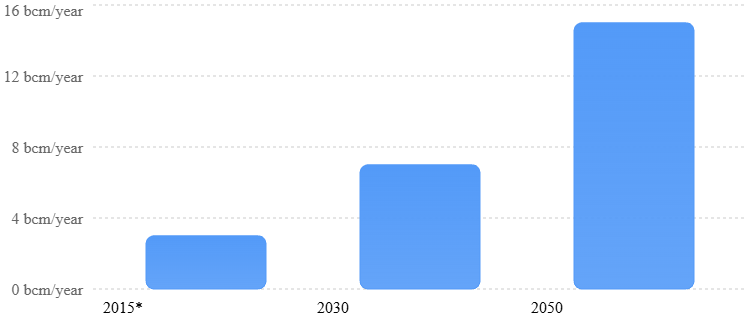
*2015 is shown as 3 bcm for visualization; the source describes the value as nearly 3 bcm. The 2030 and 2050 figures are projections rather than observed results. Source: National Committee on Ecology and Climate Change, 10 November 2026.
The apparent growth in deficits should not be interpreted as a mechanically determined reduction in river discharge. A deficit measures the imbalance between water requirements and water considered available under particular assumptions. It can change through both supply-side pressures and demand-management policy.
Competing Hypotheses — Preliminary ACH Assessment
The four required hypotheses are retained as potentially overlapping pathways, rather than artificially mutually exclusive predictions. Their current standing reflects the strength and diagnostic value of the available evidence, not numerical probabilities.
| Hypothesis | Supporting evidence | Counterevidence or limitations | Current standing |
|---|---|---|---|
| H1 — Effective data-driven cooperation prevents major shortages | Existing water commissions, bilateral agreements, joint Kambar-Ata-1 development and modernization financing | Fragmented regional mechanisms, incomplete cross-border data transparency and persistent demand pressures | Plausible but not established |
| H2 — Qosh Tepa creates persistent downstream deficits and tension without formal conflict | Prospective Afghan irrigation expansion, uncertain negotiated allocations and existing Amu Darya stress | Realized withdrawal remains uncertain; local efficiencies and negotiated arrangements could moderate effects | Credible risk; moderate confidence |
| H3 — Internal irrigation inefficiency remains the dominant scarcity driver | Approximately 90% agricultural use; substantial reported conveyance losses; outdated networks | External withdrawals, reduced runoff and demand growth could become decisive in particular years and regions | Strongly supported as a major driver; dominance unproven |
| H4 — Water stress produces localized or interstate incidents by 2035 | Strategic infrastructure, politically sensitive borders and potential seasonal allocation disputes | Existing cooperation, shared economic incentives and the absence of evidence establishing a trajectory toward armed confrontation | Conditional risk; lower confidence in occurrence |
The current evidence does not justify declaring any one hypothesis the exclusive outcome. H2 and H3, for example, could both materialize: Afghan withdrawals could reduce downstream flows while Uzbekistan’s irrigation system continues to lose substantial quantities of water. H1 could also mitigate either mechanism without fully eliminating scarcity.
H4 requires a separate evidentiary threshold. Physical water stress, political disagreement, localized confrontation and military escalation are analytically distinct outcomes. A warning framework must identify the specific institutional and operational failures through which one develops into another.
Principal Gaps and Watch Indicators
Qosh Tepa — actual diversion and construction status
The decisive gap is a current, independently verifiable record of canal withdrawals, hydraulic operating conditions, irrigated area brought into service and downstream effects. The World Bank’s 2025 description establishes project ambition but does not establish realized 2026 annual withdrawals.
Warning indicators: increasing measured abstraction, completion of additional canal sections, sustained dry-season discharge reductions and unsuccessful technical negotiations.
A reconciled Amu Darya–Syr Darya water balance
Basin-wide figures require consistently dated natural inflows, reservoir storage changes, sectoral abstractions, return flows, evaporation, groundwater interactions and environmental-flow requirements.
Warning indicators: unexplained discrepancies between national reporting, persistent monitoring gaps and increasingly divergent seasonal allocation claims.
Forecast reconciliation and climate sensitivity
Different published figures for 2030 water shortages require scrutiny of baseline year, geographic scope, irrigation-demand assumptions and whether projected conservation measures have been incorporated.
Warning indicators: repeated upward revisions, poor irrigation savings performance and consecutive years of low seasonal runoff.
Institutional authority and compliance
Existing agreements establish cooperation, but the existence of a commission or operating schedule does not by itself establish timely data access, independently verified compliance or effective dispute resolution.
Warning indicators: unilateral reservoir releases, unannounced operating changes, suspended consultations, contested border access and failure to implement seasonal schedules.
Socioeconomic stress and infrastructure security
The most decision-relevant vulnerabilities may emerge first in the form of crop shortfalls, higher pumping costs, water-service interruptions and localized grievances rather than interstate confrontation.
Warning indicators: repeated irrigation rationing, emergency agricultural subsidies, rising water-delivery costs and security incidents involving hydraulic infrastructure.
Initial Strategic Assessment
The governing strategic question is whether Central Asian governments can improve water productivity and establish credible cross-border operating arrangements quickly enough to prevent projected scarcity from becoming a persistent source of economic and political insecurity.
The evidence supports a differentiated answer. Uzbekistan possesses meaningful opportunities to reduce water losses and improve allocation within its territory, while existing bilateral agreements and joint infrastructure projects demonstrate that regional cooperation is operationally possible. However, these improvements cannot independently guarantee water security if upstream withdrawals, climate-driven hydrological changes and competing seasonal demands develop faster than institutional coordination.
A decisive distinction must therefore be maintained between water scarcity as a structural condition and water conflict as a conditional political outcome. The former is already documented and expected to intensify; the latter depends on decisions governing allocations, infrastructure operation, crisis communication and dispute resolution.
The principal monitoring horizon is 2027–2030, when progress on Qosh Tepa, irrigation reforms and regional operating agreements will provide stronger evidence about the direction of the system. The longer horizon to 2050 will depend increasingly on climate adaptation, water-use productivity, demographic change and the capacity of institutions to accommodate expanding national demands.
The dossier’s subsequent chapters will test these mechanisms against basin-specific evidence, the implementation record of existing agreements and the available official projections, with particular attention to preventing incompatible measures and uncertain infrastructure forecasts from being converted into misleading quantitative conclusions.
Central Asia’s Water Crisis: Scarcity, Power and Security
Uzbekistan faces a structural water challenge combining transboundary dependence, intensive agricultural demand, irrigation losses and competing upstream developments. Explore the evidence, projections and alternative strategic pathways.
01 / Water balance and structural pressure
Historical reference and government projections; different years are not independent observations of a measured time series.
Annual water deficit
Billion cubic metres per year. Select a bar to inspect its status.
Government projection
Structural dependency explorer
Select a measure. The remainder is the arithmetic complement of an approximate reported share.
Approximate share of water consumed nationally. Other uses represent the approximate remainder.
02 / Transboundary infrastructure
Conceptual basin relationship diagram, not a geographic map, hydraulic model or quantified river-flow measurement.
03 / Evidence register
Filter verified institutional indicators by category. Historical references, reported estimates and projections are separated.
| Indicator | Value / status | Reference period | Classification | Institution |
|---|
04 / Analysis of competing hypotheses
Four overlapping strategic pathways. Select a hypothesis to examine supporting and disconfirming evidence. No invented probabilities.
Diagnostic support
Counterevidence / limitations
05 / Strategic security pathways
Escalation is conditional, not inevitable. These categories are analytical pathways, not numerical risk scores.
Chronic resource pressure
Water deficits, rising agricultural demand and irrigation inefficiency create persistent economic and ecological vulnerability.
Local infrastructure friction
Disputed access, seasonal shortages and uncoordinated reservoir operations could trigger localized political incidents.
Interstate escalation
Major confrontation would require additional political and security failures beyond the existence of water scarcity.
OPEN-SOURCE ANALYTICAL ASSESSMENT | 22 NOVEMBER 2026
Pillar I — Hydrological Balance and Structural Scarcity
Geographic scope: Uzbekistan, Afghanistan, Tajikistan, Kyrgyzstan, Turkmenistan and Kazakhstan, with emphasis on the Amu Darya and Syr Darya basins.
Analytical horizon: Observed conditions in 2024–2025, developments through November 2026, projections for 2030 and structural risks through 2050.
Principal assessment: Uzbekistan’s water-security challenge is not simply a shortage of natural resources. It is a compound imbalance involving transboundary dependence, the seasonal distribution of river discharge, the timing of reservoir operations, agricultural water demand, hydraulic infrastructure efficiency and the capacity of institutions to measure and allocate water across national borders. The distinction matters because a basin can experience localized irrigation shortages even when annual withdrawals remain below aggregate permitted limits. Conversely, greater annual river runoff does not automatically mean that water is available in the correct location or season. The available institutional data support an assessment of significant structural vulnerability, but they do not support treating every reported reduction in water availability, every prospective canal withdrawal and every irrigation conveyance loss as an additive, independently verified reduction in the same water balance.
Chapter 1 — Water Balance and Trends
The distinction between physical water availability and operational water security
The most important hydrological distinction in Central Asia is between natural runoff, regulated river flow, permitted withdrawals, actual withdrawals, consumptive use and water reaching its intended destination. These quantities describe different stages of the water system. Natural runoff measures the flow generated by the basin’s hydrological processes before the effects of some regulation and abstraction adjustments. Reservoir operations redistribute water across time. Irrigation withdrawals measure the amount diverted into distribution infrastructure, but they do not necessarily equal the quantity permanently consumed because part of the water may infiltrate, return to rivers, recharge groundwater or reach drainage systems. An allocation limit represents an administrative entitlement or operational ceiling, not a guarantee that water will physically arrive when required.
This distinction is particularly important for Uzbekistan because its national water accounts cannot be reconstructed simply by adding the water abstracted from the Amu Darya to the water abstracted from the Syr Darya. National supplies also include other rivers, reservoirs, groundwater and return-flow components, while river-basin accounting covers withdrawals by several countries. The same water may be measured at successive control points; adding those measurements would risk double counting. A reliable national assessment requires a reconciled accounting framework separating river-basin generation, cross-border inflows, reservoir storage movements, sectoral deliveries, consumptive use, return flows and environmental allocations.
The 2024–2025 hydrological baseline
The most useful recent operational evidence is the annual reporting produced by the Scientific Information Center of the Interstate Commission for Water Coordination (SIC ICWC), drawing on information supplied by the basin water organizations and regional hydrometeorological institutions. Its 2024 and 2025 yearbooks offer a substantially more detailed picture than generic claims that Central Asia’s water supply is continuously declining.
According to the SIC ICWC — Water Management Situation in the Aral Sea Basin, 2025, total natural unregulated runoff across the larger Amu Darya and Syr Darya basins was 108.31 km³ in 2025, compared with 108.24 km³ in 2024, as reported in the 2024 yearbook. The regional annual aggregate was therefore almost unchanged, increasing by approximately 0.07 km³, or 0.06%. That apparent stability conceals a major redistribution between the two river systems: the larger Amu Darya basin produced 75.06 km³ in 2025, while the Syr Darya basin produced 33.25 km³. The preceding year, the Syr Darya figure had been 41.99 km³. A particularly important technical qualification is that the 2024 yearbook uses a smaller Amu Darya basin boundary for one of its reported figures, while the 2025 yearbook explicitly reports the larger basin. The figures cannot be compared without respecting their geographical coverage.
Within the Amu Darya system, the 2025 natural unregulated flow at the Nominal Kerki control section amounted to 64.42 km³, compared with 56.40 km³ in 2024. The increase was approximately 8.02 km³, equivalent to 14.2% of the previous year’s value. By contrast, Syr Darya basin runoff declined from 41.99 km³ to 33.25 km³, a reduction of 8.74 km³, or approximately 20.8%. These calculations illustrate why a regional aggregate can conceal materially different hydrological conditions in its constituent basins. They also show why neither year should be extrapolated directly into a long-term trend: interannual fluctuations, snowpack, glacier melt, precipitation, storage operations and seasonal distribution all need to be evaluated over longer observation periods.
The implications for Uzbekistan are substantial. An increase in upstream Amu Darya runoff can improve the physical resource available to the basin while leaving particular irrigation districts exposed to shortages arising from delivery constraints, reservoir operations, allocation rules or geographical position. The SIC ICWC reported that Uzbekistan’s actual withdrawal in the smaller Amu Darya basin was 19.78 km³ in 2025 against an annual limit of 23.69 km³. This difference of 3.91 km³ is not evidence of 3.91 km³ of unused water available for immediate economic exploitation. It reflects the difference between an annual quota and recorded annual abstraction, without establishing whether the unused allocation could physically have reached every intended user at the necessary time.
The same problem is evident in the reported seasonal shortages. During the 2025 growing season, SIC ICWC recorded a 10% shortfall for Uzbekistan in the Nurek-to-Darganata/Tuyamuyun operational reach and a 23% shortfall farther downstream in the Darganata-to-Samanbay reach, relative to relevant requirements or limits. The corresponding figures for Turkmenistan in those reaches were 1% and 25%. These are geographically specific operational measurements, not percentages of the entire national annual water deficit. They demonstrate that the location and timing of delivery can be as strategically important as the total volume generated by the basin.
Structural reduction in Uzbekistan’s water supply
Uzbekistan’s longer-term concern is nevertheless well documented. Its domestic resource base is limited relative to the scale of irrigated agriculture, and the country’s water system was developed around extensive river diversions under an earlier demographic, agricultural and institutional configuration. Roughly 80% external dependence means that national planning remains materially affected by conditions and decisions beyond Uzbekistan’s direct jurisdiction. The 2025 World Bank assessment identifies agriculture as accounting for approximately 90% of water consumption, creating a highly concentrated demand structure in which supply changes are transmitted disproportionately through farming and irrigation-dependent regional economies.
In November 2026, Uzbekistan’s National Committee on Ecology and Climate Change stated that climate-related changes could reduce water availability by 30–40% by 2050 while raising irrigation-water demand by 25%. It also reported that the national annual water deficit, estimated at nearly 3 km³ in 2015, could reach 7 km³ by 2030 and 15 km³ by 2050. The projected increase from approximately 3 to 7 km³ would correspond to a deficit more than twice the 2015 reference level; the 2050 figure would be approximately five times that reference. These are scenario comparisons, not a measured annual progression from 2015 to the present. In particular, the public summary does not fully disclose the water-accounting assumptions behind the deficit estimates, including whether planned irrigation investments, future Afghan withdrawals, crop substitution, groundwater constraints or specific climate pathways are incorporated.
The World Bank has separately described expected declines in water availability of 30–40% and irrigation-demand increases of approximately 25%. However, a November 2025 World Bank analysis gave a more specific estimate for the impact of rising temperature and evaporation on irrigation requirements: at least 5% by 2030 and 7–10% by 2050. These projections should not be averaged or presented as mutually confirming numerical forecasts. Their differences may arise from scenario assumptions, the distinction between crop water requirements and total irrigation demand, and the inclusion or exclusion of changes in cultivated area and agricultural practices. A defensible 2030–2050 forecast must make those distinctions explicit.
Sources: World Bank — Uzbekistan to Modernize Its Irrigation Infrastructure with World Bank Support, 21 May 2025; World Bank — Shared Water Infrastructure, Shared Prosperity: Investing in Central Asia’s Future, 25 November 2025.
Per-capita water availability and demographic pressure
Water availability per inhabitant is a relevant indicator of structural scarcity, but it requires careful definition. A country may report the amount of water available through its national distribution and resource-allocation system, the renewable resources originating within its territory or its share of transboundary surface water. These are not interchangeable series. For Uzbekistan, this distinction is particularly consequential because externally generated resources constitute such a large part of national water availability. The World Bank’s internal-renewable-resource indicator cannot be directly substituted for a broader estimate of total available water per inhabitant.
The mechanical demographic relationship is straightforward: even if the quantity of water available to Uzbekistan remained unchanged, population growth would reduce the average quantity available per inhabitant. If physical supply simultaneously declined, the per-capita reduction would be greater. Yet this arithmetic does not mean that every additional resident generates an equal increase in national water demand. Urban household consumption, industrial requirements, dietary change and agricultural production for domestic or export markets have distinct effects. Because irrigation accounts for the overwhelming majority of water consumption, changes in cropping patterns and irrigation productivity may outweigh household consumption increases in determining the national water balance. The United Nations World Population Prospects 2024 provides the appropriate demographic projection framework, but its population series must be matched to a specified water-resource definition and reporting year before publishing precise 2030 or 2050 per-capita forecasts.
Implications for the 2030 and 2050 water balance
The 2030 horizon is primarily an operational and institutional test. Uzbekistan’s water-security outcome will depend on whether existing allocations can be delivered more reliably, irrigation losses can be reduced, reservoir operations can better match seasonal demand and new upstream consumption can be incorporated into regional planning. The 2050 horizon is structurally different: it incorporates longer-term shifts in temperature, crop-water demand, glacial and snow-fed hydrology, urbanization and the location of economic activity. It would be analytically misleading to treat the 2050 deficit of 15 km³ as an inevitable physical shortfall unaffected by policy, infrastructure investment or future changes in demand. Equally, it would be misleading to assume that present modernization projects can entirely offset a projected long-term imbalance without an explicit basin-wide calculation.
The principal conclusion of Chapter 1 is that the 2025 operational evidence demonstrates substantial variability between basins and within individual river reaches, while the national forecasts point toward worsening structural demand pressure over the coming decades. These two findings are compatible. Annual runoff can increase temporarily while long-term water security deteriorates through higher demand, changing seasonal distribution and uneven access.
Chapter 2 — Upstream–Downstream Dynamics
The Amu Darya: a shared river without a fully integrated allocation regime
The Amu Darya is not governed by a single authority capable of independently determining the volume, timing and priority of every withdrawal throughout its basin. Its hydrological formation is concentrated in mountainous upstream catchments, while major irrigation demands are distributed across downstream agricultural systems. This produces a structural divergence between the places where water is generated, the jurisdictions where storage and diversions are controlled, and the locations where reliable summer deliveries are most economically important. Uzbekistan’s vulnerability arises not only from its geographical position but also from the need to coordinate the decisions of upstream and neighboring states under an institutional architecture that does not encompass all relevant participants equally.
The existing Central Asian allocation system operates through the Interstate Commission for Water Coordination, its scientific and information structures and the Amu Darya and Syr Darya basin water organizations. The ICWC coordinates limits and operational schedules among participating Central Asian republics, but the arrangements are not equivalent to a comprehensive modern basin treaty accepted by every state capable of altering the river’s water balance. Afghanistan’s increasing use of the Amu Darya exposes this institutional boundary particularly clearly. The June 2025 World Bank Inspection Panel report records stakeholder concerns about the applicability and enforceability of regional water-sharing arrangements, and distinguishes those concerns from the World Bank management’s assessment of the Rogun hydropower project.
The relevant institutional question is therefore not merely how much water each state is nominally entitled to receive. It is which authorities control particular diversions, who measures the volume actually abstracted, whether independent cross-border measurements are available, how reservoir releases are scheduled during drought and which procedures operate when observed deliveries differ from agreed plans. In a basin with substantial agricultural consumption and increasingly complex infrastructure, administrative coordination without transparent operational measurement can leave the underlying allocation problem unresolved.
Afghanistan’s Qosh Tepa Canal: a new demand center in the basin
Afghanistan’s Qosh Tepa Canal is the most consequential prospective addition to the Amu Darya’s large-scale irrigation demand examined in this pillar. The project is intended to divert river water into northern Afghanistan to expand irrigated agricultural production. Its strategic significance does not depend solely on the physical dimensions of the canal: it derives from the introduction of a potentially substantial, additional irrigation abstraction in a transboundary system where downstream economies already depend on large seasonal deliveries.
The World Bank Inspection Panel reported in June 2025 that Afghanistan began constructing the canal in 2022, that its planned total length was approximately 285 kilometres, that the first 100 kilometres had already been constructed and that the remaining works were expected to be completed by 2029. The Panel cited concern that the canal might divert significantly more than the nominal 2.1 km³ per year allowance for Afghanistan assumed in Protocol 566. That nominal historical allowance should not be mistaken for a demonstrated contemporary bilateral entitlement accepted by Afghanistan, nor does the Panel’s reference establish the canal’s current annual abstraction.
An earlier World Bank project document described plans to bring approximately 550,000 hectares into agricultural use through the canal. This figure refers to the proposed irrigation development, not a verified area already under full production. Neither the canal length nor the prospective irrigated area is sufficient to establish realized annual consumption. Actual withdrawals will depend on the intake’s operation, canal conveyance efficiency, crop mix, seasonal water requirements, cultivated area brought into service and the volume of water returning to the hydrological system. A headline maximum-capacity estimate, even if technically plausible, should not be incorporated into Uzbekistan’s projected deficit as though it were an observed annual loss.
Sources: World Bank — Rogun Project Environmental and Social Scoping Documentation, December 2023, Qosh Tepa entry; World Bank Inspection Panel — Rogun Hydropower Project, 26 June 2025, paragraph 66.
Three distinct outcomes must be considered. Under a coordinated development pathway, Afghanistan’s irrigation expansion would be accompanied by measured abstraction, improved conveyance efficiency, seasonal disclosure and technical engagement with downstream states, allowing the effects to be incorporated into basin operating schedules. Under an uncoordinated but relatively stable pathway, additional withdrawals could reduce available downstream water and increase agricultural stress without producing formal political confrontation. Under a more adverse pathway, canal expansion would coincide with drought, low seasonal reservoir storage or simultaneous changes in upstream hydropower operations, creating a cumulative shortage that would be considerably harder to attribute to any single state or project. None of these pathways can be assigned a reliable numerical probability using the presently established public evidence.
The additional institutional danger is attribution failure. If downstream deliveries fall below requirements, participating states may be unable to distinguish the effects of Afghan irrigation withdrawals from reduced precipitation, glacier-related runoff changes, reservoir filling, existing abstractions or domestic conveyance losses. Without reliable intake measurements and independently accessible cross-border hydrological observations, competing national interpretations can become entrenched even where the physical system could be jointly analyzed. For this reason, Qosh Tepa should be understood as both a prospective hydraulic pressure and a test of whether Central Asian water governance can accommodate a changing distribution of agricultural demand.
Rogun and the strategic importance of reservoir operations
Tajikistan’s Rogun Hydropower Project creates a different type of upstream influence. Whereas Qosh Tepa is principally associated with diversion for irrigation, Rogun is a storage and electricity-generation project on the Vakhsh River, a major tributary of the Amu Darya. The hydraulic difference is critical: water passing through hydropower turbines can continue downstream, meaning electricity generation does not automatically constitute a permanent consumptive withdrawal. Nevertheless, reservoir filling, operational storage, evaporation and changes in seasonal release schedules can materially affect downstream water availability.
On 30 June 2026, the World Bank announced approval of a second financing phase for Rogun and described the project’s expected annual electricity generation as approximately 14,400 GWh. This is a design or projected output, not evidence of that production having already been achieved. The World Bank’s inspection process has also documented concerns raised by downstream stakeholders in Uzbekistan and Turkmenistan about annual discharge, seasonal flows, cumulative impacts, dam safety and the adequacy of consultation. These concerns were presented as claims requiring assessment, not as established proof that Rogun would cause the forecast harm.
The critical operating variable is the relationship between annual releases and their distribution across seasons. Hydropower systems may favor releases during periods of high electricity demand, while irrigated agriculture requires reliable deliveries during the growing season. A reservoir may preserve broadly similar annual downstream discharge yet still alter the timing of that discharge in ways that affect agricultural production. Conversely, coordinated reservoir operations can potentially improve the reliability of irrigation deliveries and provide additional flood and drought-management flexibility. The strategic assessment depends on the actual filling schedule, release obligations, jointly verified flows, dam-safety arrangements and the cumulative effects of other projects within the basin.
The World Bank Inspection Panel concluded in June 2025 that the competing claims about downstream effects and the adequacy of project assessments warranted further investigation. That conclusion is materially different from a finding that downstream damage had already been demonstrated. The appropriate reporting standard is to distinguish project financing and announced operational intentions from measured effects, completed infrastructure and enforceable performance obligations.
Sources: World Bank — Advancing Energy Security and Jobs Through the Transformative Rogun Hydropower Project, 30 June 2026; World Bank Inspection Panel — Rogun Hydropower Project, June 2025, paragraphs 86–96.
Kyrgyz infrastructure, Kempir-Abad and Kambar-Ata-1
The Syr Darya system presents its own upstream–downstream dependencies. Kyrgyzstan controls important water-storage and hydropower infrastructure in the upper basin, while Uzbekistan and Kazakhstan rely on substantial seasonal supplies for irrigation and other uses. This creates a recurring challenge of reconciling winter electricity generation with downstream summer water requirements. Infrastructure governance becomes more complicated when reservoirs serve users in multiple countries, particularly where hydraulic facilities, access arrangements and border jurisdiction do not align neatly.
The Kempir-Abad, also known as Andijan, reservoir provides an example of bilateral institutional development. On 30 November 2022, Uzbekistan’s president signed legislation ratifying agreements with Kyrgyzstan concerning sections of the state border and joint management of the reservoir’s water resources. The agreements had been signed on 3 November 2022. Their significance lies in establishing an agreed bilateral framework for an infrastructure asset that previously formed part of a sensitive territorial and resource-management relationship. However, ratification alone cannot establish that all future release, access or operating disputes have been permanently resolved; implementation remains a separate question.
Kambar-Ata-1 represents a more ambitious form of cooperative infrastructure development. The World Bank describes the project on Kyrgyzstan’s Naryn River as having a planned installed capacity of 1,860 MW, a dam height of approximately 261 metres, a proposed reservoir volume of 5.2 km³ and expected annual generation of approximately 6,000 GWh. In June 2024, Kyrgyzstan, Kazakhstan and Uzbekistan signed a ministerial agreement to pursue the project jointly. The planned ownership arrangement, as described in the World Bank’s project information, allocates 34% to Kyrgyzstan and 33% each to Kazakhstan and Uzbekistan, although the final institutional and financial implementation depends on subsequent agreements and project development.
This is an important precedent because it places downstream states inside the prospective ownership and governance structure of a major upstream hydropower asset. The potential benefits extend beyond financial participation: joint development can create incentives for sharing operating information, coordinating electricity and irrigation requirements, and reducing the perception that an upstream state exercises unilateral control. However, the proposed 5.2 km³ reservoir volume must not be interpreted as 5.2 km³ of additional annual water supply. Storage capacity is a stock, electricity generation is an energy output, and releases represent flows over time. A reservoir can improve the timing of supply while leaving the total amount of natural runoff unchanged.
Source: World Bank — Kambarata-1 Hydropower Plant Project, Frequently Asked Questions.
The combined evidence demonstrates that upstream infrastructure cannot be evaluated as uniformly threatening or uniformly beneficial. Qosh Tepa primarily raises questions about prospective consumptive irrigation demand and the inclusion of Afghanistan in allocation arrangements. Rogun raises questions about filling schedules, seasonal water regulation, hydropower output and downstream assurances. Kempir-Abad illustrates the interaction of territorial agreements and joint water-resource management. Kambar-Ata-1 offers a possible institutional mechanism through which energy and agricultural interests can be incorporated into a shared project structure. The security implications depend less on the abstract presence of dams and canals than on who controls operations, who verifies performance, how scarcity is allocated and which procedures apply when expectations are not met.
Chapter 3 — Drivers of Scarcity
Population growth and the changing structure of demand
Population growth is a persistent source of pressure on Uzbekistan’s water system, but its effect operates through several distinct channels. Rising urban populations increase demand for reliable household water, sanitation and municipal infrastructure, while economic development can create greater industrial and commercial requirements. Agricultural production may also expand or intensify in response to domestic food demand, changing diets and export opportunities. These pressures are not necessarily proportional to population growth, and they do not all translate into equivalent consumptive use. The distribution of demand among households, industry, agriculture and ecological requirements is therefore as important as the growth of the population itself.
The World Bank’s Uzbekistan Country Climate and Development Report identifies rapid demographic and economic growth as factors placing increasing pressure on the country’s natural resources. Yet the effects of demand growth cannot be properly evaluated without considering water productivity. An agricultural system capable of producing a greater quantity or value of output per cubic metre of consumed water may accommodate some economic expansion without a corresponding increase in gross abstraction. Conversely, the expansion of highly water-demanding crops or irrigated areas can eliminate the gains produced by improved infrastructure. This means that demographic forecasts cannot be converted directly into water-deficit projections without assumptions about agricultural structure, economic development and the effectiveness of demand-management policies.
Source: World Bank — Uzbekistan Country Climate and Development Report.
Irrigation inefficiency and the difference between losses and recoverable water
Irrigation efficiency is one of Uzbekistan’s most important policy-controlled variables. The World Bank’s May 2025 project documentation states that much of the country’s irrigation infrastructure is outdated, leading to significant water losses and uneven distribution across regions. Approximately 2.4 million hectares, equivalent to 56% of irrigated agricultural land, depend on pumping stations. The World Bank reports that approximately 1,700 pumping stations consume around 7.2 billion kWh of electricity annually, equivalent to 16% of national electricity consumption in the reference assessment. These figures establish an important connection between water security and energy security: unreliable or inefficient irrigation increases not only water pressure but also electricity requirements, operational costs and vulnerability to energy-system disruptions.
The World Bank-approved modernization programme provides a concrete intervention rather than a purely aspirational reform. In May 2025, it approved a US$200 million concessional credit, with US$23.2 million in national co-financing, for infrastructure modernization across Karakalpakstan, Bukhara, Kashkadarya, Namangan and Surkhandarya. The planned measures include modernizing 259 km of major irrigation canals, constructing approximately 470 hydraulic structures, installing flowmeters and supervisory control systems, and improving irrigation delivery across 232,000 hectares. The expected annual reduction in water losses is approximately 540 million m³, alongside electricity savings exceeding 165 million kWh. These outcomes are project targets, not independently verified savings already achieved.
The economic interpretation of water savings requires care. A reduction in seepage from an unlined canal can improve the amount delivered to farms, but seepage may also recharge groundwater or return to the river system elsewhere. In that case, eliminating it does not necessarily increase basin-wide renewable supply by the same amount. The relevant benefit may instead be improved timing, lower pumping costs, reduced waterlogging or more reliable delivery. Conversely, seepage into saline groundwater or areas where evaporation is high may represent a genuine loss of economically usable water. Distinguishing these mechanisms is necessary to calculate the net benefit of infrastructure investments. A policy appraisal that classifies every cubic metre of conveyance loss as permanently recoverable could overstate the improvement in basin-wide water security.
Climate change, glaciers and seasonal water distribution
Climate change introduces uncertainty into both the supply and demand sides of the water balance. Rising temperatures increase evaporative demand and may intensify crop-water requirements, particularly during hot growing seasons. Changes in precipitation can alter snow accumulation, rainfall distribution and drought frequency, while glacier retreat can affect the timing and magnitude of runoff generated in mountain catchments. These effects are neither spatially uniform nor necessarily linear. Increased glacier melt can temporarily contribute additional runoff before longer-term ice loss reduces the buffering capacity of glacier-fed systems. Seasonal changes may matter even when annual averages remain comparatively stable.
For Uzbekistan, the strategic concern is the degree to which future flow regimes remain compatible with an irrigation system designed around particular seasonal patterns. A shift toward earlier spring runoff can increase the importance of storage and coordinated release schedules. More variable rainfall can increase reliance on reservoir reserves and groundwater during dry periods. Higher summer temperatures can increase crop-water demand precisely when downstream users need reliable deliveries. Reservoir infrastructure can partly compensate for this changing timing, but it cannot create additional natural runoff or eliminate the effects of sustained drought.
The World Bank’s November 2025 assessment projected that heat and evaporation could increase irrigation requirements in Uzbekistan by at least 5% by 2030 and 7–10% by 2050, with a larger increase possible in the longer term. Uzbekistan’s November 2026 government statement, meanwhile, described the possibility of a 30–40% reduction in water availability by 2050 and a 25% increase in irrigation-water demand. These are not necessarily contradictory because they may measure different outcomes under different scenarios, but they must not be combined mechanically. In particular, it would be invalid to subtract 40% from a national water-supply estimate and then add 25% to existing irrigation withdrawals without establishing the baseline, scenario definitions and accounting coverage used by both sources.
Sources: World Bank — Shared Water Infrastructure, Shared Prosperity, 25 November 2025; National Committee on Ecology and Climate Change — Uzbekistan’s First Artificial Glacier, 10 November 2026.
Competing national demand and the limits of allocation systems
Scarcity becomes more difficult to manage when several countries face simultaneous pressures to increase their use of the same river system. Afghanistan’s prospective irrigation expansion, Tajikistan’s hydropower development, Kyrgyzstan’s electricity needs and Uzbekistan’s and Turkmenistan’s dependence on irrigation create different incentives concerning the timing, storage and consumption of water. Kazakhstan adds further demand in the Syr Darya basin, where downstream availability is influenced by reservoir operations and irrigation abstractions across national borders.
These interests are not inherently incompatible. Hydropower cooperation can generate electricity revenues while enabling seasonal water regulation, and improved irrigation systems can reduce abstraction requirements for a given level of agricultural production. Yet the benefits depend on agreements that address both the physical and institutional characteristics of the river systems. Annual allocation limits alone cannot resolve disputes about the timing of releases, emergency drought restrictions, environmental requirements or the right to inspect infrastructure and measurements. Moreover, investments that increase the efficiency of agricultural water delivery can unintentionally encourage the expansion of irrigated production, potentially offsetting some of the intended reductions in aggregate abstraction.
The World Bank has emphasized that much of Central Asia’s shared hydraulic infrastructure is aging and that inadequate investment and data sharing remain obstacles to effective regional management. It also identified the risk that inefficient water management could contribute to regional economic losses reaching up to 6% of GDP by 2050 under the scenarios discussed in its analysis. That figure is a conditional regional economic estimate, not a direct forecast of Uzbekistan’s GDP loss from water shortages alone. It should therefore remain analytically separate from the World Bank’s country-level climate assessment, which indicates that insufficient climate adaptation could leave Uzbekistan’s economy approximately 10% smaller by 2050 than under an adapted development pathway.
Sources: World Bank — Shared Water Infrastructure, Shared Prosperity, November 2025; World Bank — Uzbekistan Country Climate and Development Report.
The Aral Sea as evidence of cumulative ecological consequences
The historical contraction of the Aral Sea demonstrates how sustained diversion decisions can create ecological and economic consequences that extend far beyond their immediate agricultural objectives. The United Nations Environment Programme attributes the sea’s dramatic decline primarily to river diversion for large-scale irrigation beginning in the 1960s. By the late 1980s, the sea’s surface area had approximately halved and its volume had decreased by about 75%; the ensuing ecological transformation affected fisheries, livelihoods, public health, salinization and the frequency of harmful dust storms.
The Aral Sea is an important historical precedent, but not a predictive model showing that every future development will reproduce the same outcome. The principal lesson is institutional: when consumptive withdrawals are assessed separately by individual projects or jurisdictions without adequate accounting for their combined environmental consequences, the cumulative damage may remain politically and economically underestimated until remediation becomes costly and difficult. The experience of the Northern Aral Sea, where targeted hydraulic interventions have supported partial recovery, also demonstrates that environmental outcomes can respond to coordinated infrastructure and management decisions under appropriate conditions.
Source: United Nations Environment Programme — The Changing Aral Sea, Foresight Brief, 2017.
Pillar I integrated assessment
The combined hydrological, infrastructural and socioeconomic evidence supports a conclusion of high confidence that Uzbekistan’s water security will remain under structural pressure through 2030, with significant additional uncertainties through 2050. Its exposure derives from the interaction of geographically concentrated water formation, externally controlled infrastructure, extensive agricultural use and a limited ability to guarantee that water will be available at the moment of peak demand. The 2024–2025 records demonstrate that annual basin-wide runoff may remain relatively stable while individual river systems and downstream operational reaches experience materially different conditions. Prospective Afghan irrigation development, the filling and operation of large upstream reservoirs, and the long-term influence of climate change could intensify these differences, but their quantitative contributions cannot currently be separated with sufficient precision to produce a fully reconciled national water balance.
The most consequential policy distinction is between changes Uzbekistan can directly influence and changes requiring external coordination. Irrigation delivery, monitoring systems, crop-water productivity and aspects of domestic demand management are principally domestic policy questions. Cross-border river flows, large upstream reservoirs and Afghanistan’s expanding withdrawals require credible international measurement and cooperative operating arrangements. The latter cannot substitute for domestic efficiency, just as domestic efficiency cannot guarantee protection against unrestricted external abstraction. The evidence therefore supports a combined approach in which water productivity, verified hydrological information and cooperative allocation institutions are treated as mutually reinforcing elements of national resilience rather than competing policy priorities.
Pillar I Hydrological Intelligence Matrix
Hydrological Intelligence Matrix
Basin measurements, allocation performance and structural constraints
Natural runoff, 2024 versus 2025
Annual unregulated runoff in km³; the overall total should not conceal differences between basins.
Amu Darya withdrawals, 2025
Actual annual abstraction and established limits, in km³, for three countries in the smaller basin.
Operational evidence table
Basin boundaries, indicators, years and seasons must be compared consistently. Select an evidence category.
| Indicator | 2024 | 2025 | Scope / interpretation |
|---|
From basin runoff to downstream water security
Conceptual water-accounting chain. These are distinct quantities and cannot be combined as identical flows.
Water generated by precipitation, snow and glacier-fed catchments.
Reservoir filling, electricity generation and seasonal releases alter timing.
Irrigation canals, pumping, return flows and losses determine deliveries.
Farms, households, industry and ecosystems compete for usable water.
Accounting rule: storage capacity is not annual runoff; withdrawal is not necessarily consumptive use; conveyance loss is not always a net basin loss; and permitted allocation is not a guaranteed delivery.
Infrastructure exposure and verification priorities
Source basis: SIC ICWC annual water-management yearbooks for 2024 and 2025, World Bank project documents and institutional water-management records. Natural runoff is not identical to regulated downstream discharge. Values are rounded to two decimals. This component does not retrieve live data or modify WordPress settings.
Data integrity notes for the component
The figures in the embedded charts come from the SIC ICWC 2024 water-management yearbook and 2025 water-management yearbook. The chart comparing annual natural runoff uses the reported two-basin regional total, Syr Darya basin runoff and Amu Darya flow at the Nominal Kerki gauging section. These three measures do not share identical geographical coverage; they are displayed as separate series for inspection, not as additive components of one total. The second chart compares the three countries’ 2025 actual abstractions with their reported annual limits within the smaller Amu Darya basin. Values in both charts are presented in km³, where one km³ equals one billion cubic metres.
The HTML component contains its own text translations and data; therefore, selecting another language changes the interface without contacting a translation service. It also includes keyboard-operable chart selections, an animation control and a reduced-motion preference. It does not load external JavaScript, external stylesheets or fonts, and does not modify global WordPress configuration. Compatibility still depends on WordPress allowing inline scripts and preserving the Custom HTML block unchanged.
Pillar I conclusion: The strongest evidence establishes a combination of domestic efficiency problems, seasonal operational shortages and unresolved upstream allocation exposure. The 2025 figures reveal significant differences between the Amu Darya and Syr Darya even when the overall regional annual runoff appears almost unchanged. For Uzbekistan, the central vulnerability is the inability to guarantee sufficiently reliable, geographically accessible and seasonally appropriate water deliveries under conditions of growing demand and changing upstream water use.
Pillar II — Economic Exposure and Cooperative Governance
Purpose: Evaluate how water constraints affect food security, employment, economic resilience, public expenditure and the capacity of national and regional institutions to manage competing demands, including the ecological consequences illustrated by the Aral Sea.
Coverage: Chapter 4 — Food Security, Economic and Resilience Impacts; Chapter 5 — Governance and Cooperative Options; Chapter 6 — The Aral Sea Precedent and Long-Term Ecological Security.
Chapter 4 — Food Security, Economic and Resilience Impacts
Water security is a macroeconomic and fiscal exposure, not merely an agricultural constraint
Uzbekistan’s exposure to water scarcity is unusually consequential because water availability influences the productive capacity of agriculture, the reliability of electricity-dependent irrigation, regional employment, food prices, household welfare and the government’s ability to sustain public investment. The World Bank’s May 2025 irrigation assessment placed agriculture at approximately one-quarter of national GDP and total employment, with the sector accounting for about 90% of water consumption. This establishes an important concentration of economic exposure: the principal consumer of the country’s water resources is simultaneously a major source of employment, output and rural livelihoods. However, the agricultural share of GDP is not a measure of the proportion of GDP automatically lost during a drought. The economic outcome depends on the location, duration and severity of shortages, the crops affected, the availability of groundwater and stored water, opportunities for substitution and the capacity of producers to absorb additional costs.
The critical transmission mechanism begins with the reliability of delivery. A reduction in water supplied during a crop’s sensitive growing period can generate disproportionate production losses even when the annual shortfall appears modest. Conversely, an identical volume reduction outside that period may produce less immediate damage. This makes seasonal river management economically important. A farmer’s exposure depends not only on whether the irrigation system has enough annual water on paper but also on whether the necessary quantity arrives when cultivation requires it, whether electricity is available for pumping and whether drainage conditions permit effective application. The implications extend to agricultural processors, transport operators and businesses serving rural communities, which may face diminished throughput, lower incomes or delayed payments when agricultural production is disrupted.
The World Bank’s 2023 Country Climate and Development Report assessed that, without adaptation, Uzbekistan’s economy could be approximately 10% smaller by 2050 than under the relevant climate-resilient counterfactual. This estimate concerns the combined economic effects of climate change, not water scarcity alone. The same assessment identified at least 8 million people potentially living in very high climate-risk areas by 2030, emphasizing the geographical concentration of vulnerability. These figures should not be represented as 8 million people forecast to experience drinking-water shortages, or as a 10% GDP loss caused exclusively by the Amu Darya and Syr Darya. They describe broader climate exposure, within which irrigation shortages, extreme heat and ecological degradation form interacting channels.
Source: World Bank — Climate Action Could Accelerate Growth and Improve Living Standards in Uzbekistan, 21 November 2023. worldbank.org
Irrigation reliability, pumping dependence and the economic cost of delivery
The electricity requirements of Uzbekistan’s irrigation system create a particularly important water–energy dependency. The World Bank reported in May 2025 that approximately 2.4 million hectares, or 56% of the country’s irrigated agricultural land, depend on pumping stations. Approximately 1,700 stations use an estimated 7.2 billion kWh of electricity annually, accounting for roughly 16% of national electricity consumption in the assessment. These figures demonstrate that irrigation is not simply a demand for river water: it also requires an extensive and energy-intensive hydraulic distribution system. The ability to supply farms can therefore deteriorate because of electricity constraints or operational failures even when river water remains physically available.
The consequences are economic as well as technical. Electricity-consuming pumping creates operating expenditures that must be borne by public authorities, water-service operators or agricultural producers, depending on the relevant financing arrangements. Older pumping infrastructure can increase the cost of delivering each cubic metre, while unreliable electricity service can produce interruptions at agriculturally sensitive moments. Where pumping costs increase, authorities face choices involving irrigation charges, subsidies, equipment investment and public-budget allocations. Each choice affects incentives and resilience differently. Subsidies can preserve agricultural affordability in the short term but may weaken incentives for efficient water and energy consumption if not designed carefully. Higher tariffs may improve cost recovery but expose financially constrained farmers to additional pressure unless metering, service quality and targeted support improve simultaneously.
The 2025 World Bank-supported modernization project provides a concrete measure of the potential benefits. Its planned annual savings exceed 165 million kWh, while projected reductions in water losses are approximately 540 million m³ across the project intervention area. The project also aims to improve irrigation services over 232,000 hectares, directly benefiting approximately 180,000 water users, including 80,000 women. These are expected results by the project’s completion horizon rather than verified outcomes already achieved. The planned electricity reduction represents approximately 2.3% of the country’s reported 7.2 billion kWh annual irrigation-pumping consumption, if the two values are compared on the stated baseline and no offsetting changes occur. The planned reduction in water losses is equivalent to 0.54 km³ annually, but it should not be interpreted as an equal amount of newly created basin-wide renewable water.
Source: World Bank — Uzbekistan to Modernize Its Irrigation Infrastructure with World Bank Support, 21 May 2025. worldbank.org
The project also illustrates why water infrastructure should be evaluated through a broader financial framework. Its financing combines a US$200 million World Bank concessional credit with US$23.2 million in national co-financing. The benefits are expected to accrue through improved water delivery, reduced electricity use, greater reliability and agricultural productivity. However, the financial appraisal must distinguish initial capital investment, implementation risk, ongoing maintenance, actual electricity cost savings and the public cost of operating the upgraded system. The nominal amount of a credit is not an annual budget expenditure, and projected physical savings cannot automatically be translated into equivalent fiscal savings without electricity prices, cost recovery arrangements and realized performance data.
Food security and the distribution of agricultural risk
Water scarcity threatens food security through three connected but distinct pathways: reduced domestic production, deterioration in household purchasing power and disruption of the institutions and infrastructure that support food distribution. These mechanisms should not be conflated. Reduced irrigation water can affect crop output and raise production costs, but the magnitude of national food-price effects depends on imports, inventories, trade policy, competition and international market conditions. Similarly, a region experiencing a significant decline in farm income may experience deteriorating food affordability even when national aggregate food availability remains adequate.
For Uzbekistan, the concentration of rural livelihoods in irrigation-dependent activities makes income transmission particularly important. Agricultural shocks can affect seasonal workers, farming households, local service businesses and food-processing operators. The severity of the impact depends on crop choices, irrigation access, farm size, financing conditions and opportunities to diversify income. Water stress may also encourage unsustainable coping mechanisms, including increased groundwater abstraction, deferred maintenance and cultivation strategies that preserve short-term output at the expense of soil or water quality. These responses can transfer the economic burden into future years, reducing resilience rather than resolving the underlying scarcity.
The resilience question is therefore not simply whether Uzbekistan can maintain national agricultural production during a single drought year. It is whether farms and connected industries can withstand repeated seasonal interruptions without persistent capital erosion, deteriorating soil conditions or growing dependence on emergency assistance. The relevant indicators include irrigation delivery reliability, crop yields by district, actual pumping costs, water-service arrears, groundwater depth, soil salinity, agricultural household income and the value of emergency government interventions. These indicators require geographical disaggregation because national averages can conceal severe pressure in particular downstream districts.
Water scarcity as a constraint on national resilience
National resilience is determined by the capacity of institutions and economic systems to absorb resource shocks while preserving essential services and productive activity. In Uzbekistan, that capacity depends on the interaction of water governance, electricity reliability, infrastructure maintenance, agricultural policy and public finance. A year of below-average water availability may be manageable when storage is adequate, pumping systems function and farmers receive predictable allocation information. The same physical shortfall can become more disruptive if electricity shortages, infrastructure failures, delayed releases or weak communication occur simultaneously.
The relevant policy challenge is thus a compound-risk problem. Water shortages can increase pumping requirements; energy constraints can then undermine irrigation deliveries; reduced agricultural output can weaken household incomes and expand demand for public support; repeated distress can reduce farmers’ ability to invest in water-efficient technology. The reverse process is also possible: modernization can reduce pumping requirements, improve delivery predictability, lower operating costs and make producers more resilient to fluctuations in upstream supply. These interactions mean that water and energy investment priorities should be evaluated jointly rather than through separate sectoral budgets.
The World Bank’s wider climate-development analysis recommends stronger water accounting, flexible allocation mechanisms, water-saving technologies, improved agricultural incentives and modernization of irrigation infrastructure. Such measures address the underlying transmission channels rather than merely expanding the nominal quantity of stored water. They also require implementation discipline. An approved project, installed meter or announced policy is not sufficient evidence of improved water productivity unless actual deliveries, costs and consumptive use can be measured against a defensible baseline.
Source: World Bank — Uzbekistan Country Climate and Development Report, 2023. worldbank.org
Chapter 5 — Governance and Cooperative Options
The institutional test is whether cooperation can control actual operations
Central Asian water diplomacy is sometimes characterized as a choice between cooperation and confrontation. The operational evidence suggests a more useful distinction: whether cooperative arrangements are sufficiently specific, measurable and enforceable to influence infrastructure behavior during periods of scarcity. High-level agreements may establish important political principles, but their resilience depends on how they distribute operating responsibilities, define access and release obligations, share measurements, allocate maintenance costs and manage emergencies. A functioning regional framework must allow governments to distinguish a genuine failure to comply with an allocation schedule from low natural runoff, technical disruption or an unexpected increase in legitimate demand.
The existing regional institutions provide a foundation but not a comprehensive solution. The ICWC framework coordinates water allocations and operating schedules among participating Central Asian states, while its basin organizations provide important information on actual withdrawals and river conditions. The 2025 operational yearbook demonstrates the value of this system because it reports both planned limits and realized withdrawals, including geographically specific seasonal shortages. Yet national allocation figures alone cannot resolve disputes involving participants outside the current framework or compensate for gaps in measurement, return-flow accounting and cross-border verification. The institutional objective should be to strengthen the operational quality of cooperation rather than to assume that creating a new organization would automatically produce better outcomes.
Kempir-Abad: a bilateral agreement with concrete operating obligations
The 3 November 2022 agreement between Uzbekistan and Kyrgyzstan on the joint management of the Andijan, or Kempir-Abad, reservoir is significant because its provisions address specific hydraulic and access-related responsibilities rather than simply expressing a general commitment to good relations. The agreement establishes a Joint Commission responsible for management of the reservoir’s water resources and allocates important operating duties between the parties. Under the agreement, the Uzbek side operates and maintains the reservoir, ensures its safety and releases water within limits agreed with Kyrgyzstan. The agreement also contains provisions concerning the maximum normal water level, public access, protective zones, emergency notification and coordinated actions in the event of dangerous conditions.
The FAOLEX record of the agreement specifies a normal maximum water level of 900 metres, subject to exceptions for emergencies and force majeure, including flooding and certain technical or natural events. The Uzbek side undertakes to preserve access for Kyrgyz citizens to reservoir water for agreed uses, including livestock watering, irrigation and fishing. The Kyrgyz side undertakes to establish water-protection zones and ensure compliance with the applicable regime. Both parties are to provide timely notification of emergencies and cooperate in mitigating their effects. These provisions are analytically important because they reduce ambiguity over day-to-day management and define responsibilities that can be monitored in practice.
Source: FAOLEX — Agreement between Uzbekistan and Kyrgyzstan on Joint Management of the Andijan (Kempir-Abad) Reservoir, 3 November 2022. FAO Legal Database (FAOLEX)
The agreement’s implementation record provides additional evidence of institutional activity. SIC ICWC reporting for 2023 recorded meetings of the bilateral water commission during which the parties addressed water-withdrawal schedules through interstate canals, maintenance and automation of the Kasan-Sai/Orto-Tokoy reservoir, and principles for joint management of Kempir-Abad. This demonstrates that the relationship was not limited to the original signature or ratification stage. Nevertheless, meeting records and agreed schedules must be distinguished from proof of complete operational compliance during every subsequent season. Assessing the effectiveness of the arrangement requires agreed release records, reservoir-level measurements, incident notifications, maintenance documentation and evidence concerning access rights.
Source: SIC ICWC — Cooperation between the Countries of Central Asia, Water Yearbook 2023, Section 4. cawater-info.net
The broader significance of Kempir-Abad lies in the combination of jurisdictional clarification and operational management. Border arrangements can reduce uncertainty over infrastructure access, but they do not independently resolve future water-allocation pressures. Conversely, technical water-sharing agreements may become difficult to implement when access rights or the authority to operate infrastructure remain contested. Kempir-Abad demonstrates that these issues can be addressed jointly, although its provisions cannot automatically be transferred to larger international river systems with different participants, geography and institutional obligations.
Kambar-Ata-1: shared ownership as a mechanism for aligning incentives
Kambar-Ata-1 represents an alternative governance model in which downstream countries participate in the planned development of a major upstream hydropower facility. The World Bank describes the project as a trilateral undertaking by Kyrgyzstan, Kazakhstan and Uzbekistan, following their June 2024 cooperation agreement. Its planned technical configuration includes 1,860 MW of generating capacity, a 261-metre dam and a 5.2 km³ reservoir, with anticipated annual electricity generation of approximately 6,000 GWh. The proposed joint venture ownership distribution is 34% for Kyrgyzstan and 33% each for Kazakhstan and Uzbekistan, reflecting anticipated financial contributions. These figures describe the proposed project and ownership design rather than an already operating power plant with demonstrated electricity production and finalized operational rules.
The strategic value of joint ownership lies in the possibility of aligning energy revenues, financing obligations and downstream water-management interests. Kyrgyzstan has an incentive to develop reliable hydropower supply, while Uzbekistan and Kazakhstan have interests in predictable irrigation flows and electricity exchange. A genuinely integrated operating regime can potentially permit seasonal scheduling that balances these needs more effectively than unilateral management. Yet shareholding percentages do not automatically determine the rules for reservoir filling, minimum summer releases, emergency restrictions or drought-year priorities. Those matters depend on detailed operating agreements and associated institutional arrangements.
The World Bank states that an intergovernmental agreement is being prepared to establish principles covering joint development, financing, ownership and operation. Its available project information also identifies a donor coordination mechanism and technical attention to dam safety, environmental assessment and stakeholder consultation. These preparatory arrangements are important, but the project’s ultimate contribution to water security will depend on whether financing is secured, the relevant agreements enter into force, construction proceeds as intended and seasonal operating obligations become practical and enforceable.
Source: World Bank — Kambarata-1 Hydropower Plant Project, Frequently Asked Questions. worldbank.org
Seasonal allocation regimes and integrated water–energy agreements
The operational logic of a seasonal allocation regime is to coordinate river flows with the changing requirements of irrigation, electricity generation, reservoir safety and environmental protection. Annual allocation limits are insufficient where water demand peaks during distinct periods. In practice, a regional regime could establish seasonal volume ranges, reservoir-level reporting, agreed schedules for planned releases, drought-adjustment rules and technical procedures for resolving disagreements over observed flows. Such arrangements would not eliminate scarcity but could reduce uncertainty and improve the capacity of governments and farmers to plan their activities.
A more sophisticated regime would distinguish between ordinary operations and exceptional conditions. During normal hydrological years, countries might operate according to published seasonal schedules and agreed delivery targets. During moderate drought, a prearranged adjustment mechanism could modify releases or withdrawals according to measurable indicators. During severe drought or infrastructure emergencies, additional consultation and emergency-notification procedures would become necessary. The principal advantage of this approach is predictability: participating governments would understand in advance how hydrological deterioration affects their obligations and expected deliveries. Its principal challenge is political and technical credibility, because a regime cannot function effectively when the underlying measurements are disputed or when governments are unwilling to disclose the operational decisions affecting shared flows.
The same logic applies to water–energy coordination. Upstream hydropower operators and downstream irrigation users may place different seasonal values on water releases. Agreements involving electricity exchange or financial compensation can, in principle, support mutually advantageous operating schedules. However, compensation arrangements are vulnerable to energy-price changes, fiscal pressures, domestic electricity shortages and uncertainty over the quantity of water actually delivered. Effective arrangements require transparent measurement, workable settlement procedures, enforceable obligations and contingency provisions for extreme hydrological conditions.
Irrigation modernization and institutional accountability
Infrastructure modernization should be accompanied by reforms in water accounting and operational accountability. The installation of flowmeters, supervisory systems and remotely monitored gates can improve the visibility of water deliveries, but measurement technology is effective only when information is reliable, maintained and used for decisions. A meter does not itself prevent excessive abstraction; it creates information that may support better allocation and enforcement. Similarly, lining a canal or introducing gravity-fed delivery does not necessarily improve basin-wide water productivity unless the resulting operational changes are sustained and the effects on return flows and consumptive use are understood.
The World Bank’s 2025 irrigation modernization project provides a specific implementation framework: 259 km of major canals are to be upgraded, approximately 470 hydraulic structures constructed and flow-measurement and control technologies introduced. The investment focuses on five administrative regions and aims to improve services across 232,000 hectares by 2031. Its policy relevance is the combination of physical rehabilitation, measurement and energy efficiency. Nevertheless, projected savings must be evaluated against observed outcomes. Independent verification should compare actual abstraction, farm deliveries, electricity use, crop output and operating costs before and after intervention, with appropriate adjustments for weather and crop composition.
Source: World Bank — Uzbekistan to Modernize Its Irrigation Infrastructure with World Bank Support, May 2025. worldbank.org
The most credible governance pathway combines national modernization with regional operating rules. Domestic water-saving measures can reduce the economic effects of unreliable supply, while cross-border measurement and seasonal allocation can improve the predictability of water deliveries. Either approach pursued in isolation would remain vulnerable to the weaknesses of the other. The institutional challenge through 2030 is therefore to move from agreements and project specifications toward independently observable performance.
Chapter 6 — The Aral Sea Precedent and Long-Term Ecological Security
The cumulative consequences of water allocation decisions
The Aral Sea represents a historical example of how water-management choices can generate cumulative environmental consequences that extend far beyond the original economic objectives of irrigation development. The expansion of agricultural diversions from the Amu Darya and Syr Darya progressively reduced the volume of water reaching the terminal lake, contributing to the fragmentation and contraction of the sea and major changes in surrounding ecosystems and communities. Its relevance to current Central Asian policy is not that every new canal or reservoir will recreate the same environmental outcome, but that individually rational withdrawals can become collectively unsustainable when basin-wide environmental requirements are excluded from allocation decisions.
The ecological consequences of the Aral Sea’s decline have included increasing salinity, the collapse or transformation of aquatic ecosystems, the loss of fisheries, the exposure of former seabed and the mobilization of saline and contaminated dust. These effects create additional economic and public-health vulnerabilities that can persist long after the original diversion decisions have been made. For Uzbekistan, especially Karakalpakstan and adjacent downstream areas, the historical degradation of the Aral Sea environment reinforces the importance of treating ecological conditions as part of national resilience rather than as a secondary environmental concern.
The World Bank’s 2023 climate-development assessment explicitly identifies the Aral Sea disaster as a central element of Uzbekistan’s environmental and development challenges, alongside water scarcity, extreme heat, drought, dust storms and rainfall volatility. This provides a basis for integrating the historical precedent into contemporary economic planning, while avoiding unsupported attempts to isolate one environmental mechanism as the sole cause of current health or economic outcomes.
Source: World Bank — Climate Action Could Accelerate Growth and Improve Living Standards in Uzbekistan, 21 November 2023. worldbank.org
The Northern Aral Sea: evidence that targeted restoration can produce results
The Northern Aral Sea is an important counterexample to the proposition that the consequences of large-scale hydrological degradation are necessarily irreversible. Kazakhstan has pursued a long-term restoration strategy involving hydraulic infrastructure and management of Syr Darya inflows, allowing partial recovery of water volume and ecological conditions in the northern basin. The Kazakh government’s October 2026 account reported that Northern Aral Sea volume had increased from 18.9 km³ in 2022 to 21 km³ in 2023, 22 km³ in 2024 and 23.4 km³ by the end of 2025. Those figures represent a progressive increase of 4.5 km³ between 2022 and the end of 2025, approximately 23.8% of the 2022 reference value.
The same government assessment stated that the Northern Aral Sea’s surface area had expanded by 36% over the longer restoration period, its water volume had almost doubled and salinity had declined by approximately half. These are government-reported achievements, not measurements independently established by the present assessment. The source further described efforts to ensure annual inflows of at least 2 km³ and plans for an additional restoration phase developed with the World Bank. The apparent improvement demonstrates that environmental allocations and hydraulic interventions can produce measurable benefits when pursued over sustained periods, although it does not establish that the much larger southern basin could be restored through identical methods or at comparable cost.
Source: Government of Kazakhstan — Implementation of Presidential Directives: Government Intensifies Efforts to Restore the Aral Sea and Preserve the Caspian Sea, October 2026. primeminister.kz
Southern Aral conditions and the environmental cost of downstream scarcity
The southern Aral region illustrates the severity of the remaining ecological challenge. SIC ICWC’s 2025 water-management yearbook reported that 0.977 km³ of Amu Darya river water was delivered to the southern Aral region at the Samanbay gauging station, while total inflow from river water, collector-drainage water and canal discharges amounted to 2.29 km³. The same yearbook cited research indicating a requirement of at least 3.5 km³ in dry years and 8 km³ in wet years for the southern Aral region. These benchmarks refer to the total regional supply requirements identified in the cited research; they should not be interpreted as a legally binding environmental allocation or an independently validated modern restoration target.
The arithmetic difference between the 2025 reported total inflow and the cited dry-year benchmark is 1.21 km³. Relative to the wet-year benchmark, the difference is 5.71 km³. Such comparisons are useful as indicators of the scale of ecological water requirements, but they are not evidence that the full shortfall could be delivered without changing agricultural allocations or other basin operations. Nor do they establish that additional water of the same nominal volume would produce identical environmental benefits regardless of quality, location and timing. Drainage water, for example, may differ materially from river water in salinity and other characteristics.
Source: SIC ICWC — Water Management Situation in the Aral Sea Basin, Yearbook 2025, Section 2.1.4. cawater-info.net
Environmental resilience therefore depends on the interaction of water quantity, quality and geographical delivery. A river system may achieve a nominal annual environmental allocation while failing to maintain the wetland conditions or ecological functions for which the water is required. Conversely, carefully timed flows and improved habitat management may produce benefits that cannot be inferred from annual volumes alone. This argues for environmental targets expressed through measurable hydrological and ecological outcomes rather than a single annual allocation figure.
Long-term consequences for Uzbekistan and the regional policy framework
The Aral Sea experience strengthens the case for including ecological requirements within regional water-governance arrangements. Environmental water should not be treated exclusively as the residual quantity left after agricultural and energy requirements have been met, because ecological degradation can generate future economic costs through soil salinization, dust exposure, deteriorating public health and reduced productive capacity. These costs may fall disproportionately on communities that do not control upstream abstractions, creating a distributional problem that cannot be resolved through national water-accounting measures alone.
At the same time, the institutional lessons of the Northern and Southern Aral regions must remain distinct. Kazakhstan’s northern restoration strategy demonstrates that targeted hydraulic management and sustained environmental allocations can support partial ecological recovery. The southern region presents a more complex challenge involving substantial historical degradation, major irrigation dependence and the cumulative effects of withdrawals across several jurisdictions. Policies aimed at stabilization, wetland protection, afforestation of exposed seabed and water-delivery improvements may be valuable, but they address different mechanisms and should be assessed against separate performance indicators. Afforestation may reduce some forms of dust mobilization and improve local conditions, yet it is not equivalent to replenishing the former sea.
The relevant long-term governance objective is therefore not simply to reverse the historical development of irrigated agriculture. It is to prevent additional ecological damage, improve the productivity of existing water use, sustain viable downstream ecosystems where feasible and establish transparent trade-offs between agricultural production, hydropower, human consumption and environmental requirements. This requires institutional mechanisms capable of considering the cumulative consequences of projects and allocation decisions rather than evaluating each investment in isolation.
Pillar II integrated assessment
The economic and institutional evidence supports three linked conclusions. First, Uzbekistan’s water vulnerability is transmitted through an energy-intensive agricultural economy in which irrigation reliability affects employment, production costs, household incomes and public finance. Second, Central Asian states have demonstrated meaningful capacity for cooperation, as shown by the Kempir-Abad agreement, the preparation of Kambar-Ata-1 and existing allocation institutions, but the effectiveness of these arrangements depends on operational measurement, transparent procedures and the implementation of agreed obligations. Third, the Aral Sea provides a historical warning concerning cumulative resource allocation, while partial recovery in the Northern Aral Sea demonstrates that targeted ecological management can achieve positive results under appropriate conditions.
The strongest policy approach is one that joins domestic modernization, regional operating arrangements and environmental accounting. The available evidence does not support a simple conclusion that new infrastructure is inherently destabilizing or that formal cooperation will necessarily prevent scarcity. Infrastructure can improve resilience when its operating arrangements are credible and can intensify vulnerability when withdrawals, reservoir filling or releases are uncoordinated. In the period through 2030, the primary test will be whether governments can convert financing, technical agreements and announced reforms into measurable improvements in water reliability and productivity. By 2050, the consequences of failure would extend beyond agricultural output to the broader resilience of downstream communities, economic systems and ecosystems.
Economic exposure, cooperative governance and Aral Sea recovery
Economic and Governance Intelligence
Interactive institutional evidence, infrastructure commitments and environmental recovery indicators.
Economic exposure and investment targets
National agricultural exposure and World Bank irrigation project targets. Figures are different types of measures.
| Measure | Figure | Interpretation |
|---|
Irrigation electricity exposure
Projected savings compared with reported national pumping use.
Northern Aral Sea recovery
Government-reported water volume, billion cubic metres.
Cooperative governance evidence
| Instrument / project | Parties | Mechanism | Evidence qualification |
|---|
Southern Aral environmental allocation comparison
Comparison of reported 2025 total inflow with cited research benchmarks; the benchmarks are not legally binding allocations.
| Metric | Figure | Evidence qualification |
|---|
Integrated resilience and governance mechanism
Conceptual relationship: infrastructure, management and economic outcomes require measurable operating performance.
River inflows, reservoir storage, irrigation networks, pumping stations and environmental water requirements.
Seasonal allocations, joint commissions, release schedules, investments, measurements and emergency coordination.
Crop reliability, employment, energy expenditure, household resilience and ecological stability.
Institutional source basis: World Bank, FAOLEX, SIC ICWC and Government of Kazakhstan. Projected savings are not observed outcomes. The component uses no external runtime data and does not change WordPress settings.
Data qualifications: In the electricity chart, the project target is represented by 165 GWh as a conservative displayed reference because the World Bank describes savings as more than 165 GWh. The Northern Aral Sea chart uses the Kazakh government’s reported 2022–2025 figures; its 2025 figure is an end-of-year water-volume estimate, not an annual inflow. The Southern Aral comparison contains benchmarks and measured inflows of differing evidentiary status, rather than treating all rows as equivalent observations.
OPEN-SOURCE ANALYTICAL ASSESSMENT | 22 NOVEMBER 2026
Pillar III — Strategic Forecasting, Security and Decision Architecture
Geographic scope: Uzbekistan, Afghanistan, Tajikistan, Kyrgyzstan, Turkmenistan and Kazakhstan, with the Amu Darya and Syr Darya as the principal transboundary systems.
Assessment horizons: 2027–2030 for operational warnings and institutional decisions; 2035 for security escalation; 2050 for long-term strategic resilience.
Purpose: Determine whether increasing water scarcity is more likely to produce institutional cooperation, persistent economic competition, localized security incidents or broader interstate confrontation, and identify the evidence and decisions that could alter these outcomes.
Chapter 7 — Analysis of Competing Hypotheses (ACH)
Principal judgment: persistent water stress is established, but its political outcome remains conditional
The central question is no longer whether Central Asia will experience significant pressure on its water resources. That condition is already reflected in the combination of agricultural dependence, regional water-allocation difficulties, infrastructure constraints and long-term climate projections. The unresolved strategic question is how states will respond when new withdrawals, changing seasonal flows and expanding economic requirements place additional demands on systems that already experience geographically uneven shortages.
The most defensible assessment is that persistent economic and operational water stress is substantially better supported than an expectation of major interstate armed conflict. This conclusion should not be interpreted as a prediction that conflict is impossible or that formal cooperation will necessarily succeed. It reflects the distinction between observable resource constraints and the additional political, institutional and security conditions required for violent escalation.
The strongest operational evidence comes from the Interstate Commission for Water Coordination’s 2025 records. In the smaller Amu Darya basin, total actual withdrawals amounted to 48.62 km³, against approved annual limits of 55.74 km³. Yet growing-season shortages remained significant in particular downstream reaches. Uzbekistan experienced a reported 23% shortfall against the relevant requirement in the Darganata–Samanbay reach, while Turkmenistan experienced a 25% shortfall. The corresponding Syr Darya operational reporting also identified shortages during the growing season, including 20% for Uzbekistan and 29% for Kazakhstan in the Toktogul–Shardara reach. These figures demonstrate that unused portions of an annual allocation do not necessarily eliminate local or seasonal shortages. cawater-info.net
The institutional evidence points in a more cooperative direction. During 2025, ICWC reviewed seasonal withdrawal limits and reservoir-operation schedules through its regular meetings, while its basin organizations continued monitoring water allocations and coordinating operational activities. The 2025 yearbook also records a specific need for joint Kazakhstan–Uzbekistan gauging at the border and improved coordination between national hydrometeorological services. These are meaningful institutional activities, but they also reveal that more complete and reliable measurement remains a practical requirement. cawater-info.net
Relevant official records: SIC ICWC — Water Management Situation in the Aral Sea Basin, 2025; SIC ICWC — IFAS and Other Regional Organizations in Central Asia, 2025.
The four hypotheses and the analytical requirement for differentiation
The four required hypotheses describe different mechanisms and outcomes, but they are not entirely mutually exclusive. Cooperation may improve during a period of increasing scarcity. Irrigation inefficiency may remain a major source of vulnerability while Afghan withdrawals add a separate external constraint. Localized security incidents could arise without ending diplomatic cooperation or developing into sustained interstate confrontation.
The purpose of ACH is therefore not to force a single explanation onto a complex system. It is to identify the evidence that most clearly supports or undermines each proposition, distinguish shared background conditions from genuinely diagnostic observations and specify what new evidence would change the assessment.
H1 — Central Asian states establish effective, data-driven sharing mechanisms that prevent major shortages. This hypothesis predicts substantial improvement in the credibility, coverage and practical enforcement of regional water governance. Agreements would become operationally meaningful through verified flow measurements, agreed seasonal release schedules, consistent measurement of actual withdrawals and procedures for adjusting allocations during drought. Its defining proposition is stronger than the existence of institutional cooperation: it requires that cooperation materially prevent major shortages attributable to avoidable coordination failures.
H2 — Upstream development, particularly Qosh Tepa, produces persistent downstream deficits and rising tension without formal interstate conflict. This hypothesis predicts a deterioration in water availability for downstream users as Afghanistan’s irrigation infrastructure becomes increasingly operational, while governments continue managing disputes primarily through diplomatic and administrative channels. Its distinctive feature is the attribution of additional scarcity to external upstream abstraction rather than principally domestic inefficiency.
H3 — Internal inefficiencies remain the dominant source of scarcity even if external withdrawals are managed. This hypothesis predicts that Uzbekistan’s distribution systems, irrigation practices, cropping decisions and water-governance incentives remain the principal constraints on usable water. It is supported by the large agricultural consumption share and the documented need for modernization, but dominance requires comparison against the independently measured effects of upstream withdrawals and climate-related supply changes.
H4 — Water stress escalates into localized or interstate incidents involving infrastructure or borders by 2035. This hypothesis predicts a specific security outcome, not merely increasingly severe water scarcity. It requires evidence of a pathway connecting contested allocations or infrastructure decisions to coercion, physical obstruction, border confrontation or armed incidents. The existence of dams, canals and disputed claims is insufficient to establish that such events will occur.
Testing H1: cooperation must be distinguished from compliance
The evidence supporting H1 is more substantial than a purely theoretical commitment to regional diplomacy. The ICWC system already provides an institutional mechanism for approving water-withdrawal limits and reviewing reservoir operations. The June 2024 agreement to develop Kambar-Ata-1 jointly provides an additional example of governments attempting to align hydropower and downstream water interests through shared project governance. The March 2025 progress on Central Asian border arrangements also demonstrates that states can reach negotiated settlements on politically sensitive territorial issues.
The World Bank describes Kambar-Ata-1 as a cooperative undertaking by Kyrgyzstan, Kazakhstan and Uzbekistan that could contribute to more reliable electricity and water management. Its proposed institutional structure includes joint development, financing and eventual operation. The arrangement is relevant because it may give downstream governments greater visibility into the decisions of an upstream hydropower operator. However, the World Bank’s project documentation distinguishes the proposed joint venture and intergovernmental operating framework from completed implementation. Ownership proposals and ministerial agreements do not independently establish binding drought-year release obligations. worldbank.org
The principal difficulty for H1 is that the existence of cooperation is not equivalent to the demonstrated prevention of shortages. A commission may meet regularly while members experience serious seasonal shortfalls. A bilateral agreement may establish jurisdiction without resolving the allocation of water under extreme drought conditions. A project may promise benefits without having reached operational readiness.
H1 would be strengthened by independently reconciled water balances, functioning joint gauging stations, published and consistently implemented seasonal release schedules, lower unexplained differences between national measurements, and demonstrable improvements in delivery reliability across consecutive growing seasons. It would be weakened by repeated failures to meet agreed schedules, opaque infrastructure operations, continued exclusion of significant water users from technical discussions or persistent shortages that cannot be resolved through the existing institutional framework.
The current standing is plausible but not established, with moderate confidence that cooperation will continue in some form and lower confidence that it will prevent major shortages across the region.
Testing H2: Qosh Tepa presents a credible external risk, but actual withdrawals remain decisive
The strongest evidence supporting H2 is the existence of major Afghan irrigation development in a basin where downstream demand is already extensive and where Afghanistan is not integrated into the existing Central Asian allocation mechanisms on the same basis as the participating republics.
The World Bank Inspection Panel’s June 2025 report recorded plans for a 285 km canal, substantial works already undertaken, and concerns that prospective abstraction could exceed the nominal 2.1 km³ annual Afghan allowance assumed under the earlier Protocol 566 allocation framework. The report did not establish the canal’s future actual annual consumption or conclude that particular downstream losses had already occurred because of the project. The difference between the project design and measurable operating performance is essential to assessing H2. World Bank
The hypothesis becomes substantially stronger if verified canal withdrawals increase while downstream seasonal shortages worsen in a pattern consistent with river mass-balance accounting, after controlling for natural runoff, reservoir storage, other abstractions and return flows. It becomes weaker if realized consumption remains significantly below prospective design levels, if additional Afghan irrigation is accompanied by high conveyance efficiency, or if negotiated arrangements and compensating measures materially reduce downstream effects.
A critical uncertainty is the degree to which observed downstream changes can be attributed to Qosh Tepa rather than to simultaneous hydrological and operational factors. This cannot be resolved through imagery documenting canal excavation alone. Satellite observations may reveal construction progress and cultivated area, but direct or independently corroborated flow measurement is needed to quantify abstraction with sufficient confidence.
The current standing is a credible external-risk pathway, with moderate confidence in the possibility of persistent additional pressure and lower confidence in the eventual magnitude of attributable downstream deficits.
Testing H3: major domestic inefficiency is established; exclusive dominance is not
H3 has strong supporting evidence because Uzbekistan’s irrigation system is both extensive and infrastructure-intensive. The World Bank documents significant water losses, uneven distribution, outdated canals and high electricity requirements. Its 2025 modernization programme anticipates material gains from upgrading hydraulic structures and installing improved monitoring systems. These commitments indicate that domestic infrastructure efficiency is a significant area in which additional water-delivery reliability and lower operating costs are achievable. worldbank.org
However, the hypothesis asserts more than the existence of inefficiency. It asserts that domestic inefficiencies will remain the dominant cause of scarcity, even if external withdrawals are successfully managed. This requires a common analytical measure against which internal and external pressures can be compared. Gross conveyance losses, changes in natural runoff, net consumptive use and shortages in delivered water are not equivalent quantities. Some seepage may recharge groundwater or return to the river; some external abstractions may have greater effects during particular growing-season periods than their annual volume implies.
H3 would be strengthened by evidence that irrigation rehabilitation and changes in demand management substantially improve farm-level reliability even when cross-border inflows remain unchanged. It would also gain support if unexplained domestic delivery losses remained large after upstream effects were measured and accounted for. The hypothesis would weaken if efficient districts nevertheless experienced persistent shortages directly attributable to lower measured upstream flows or if basin-wide shortages intensified despite substantial verified reductions in inefficient water use.
The current standing is strongly supported as a major driver but unproven as the dominant driver. Confidence is high that domestic inefficiency materially affects Uzbekistan’s water security and moderate-to-low in an exclusive ranking of its importance relative to upstream development and climate change.
Testing H4: physical scarcity does not establish a security escalation trajectory
H4 is a distinct forecast about political and security behavior. Resource scarcity creates grievances and incentives for competition, but major confrontation requires additional mechanisms through which disputes become coercive. Those mechanisms might include disagreement over infrastructure jurisdiction, inability to verify the cause of shortages, unilateral changes to reservoir operations, politically sensitive border access or failure of normal diplomatic and technical dispute-resolution procedures.
The regional historical context makes this hypothesis necessary to examine. Nevertheless, developments in 2025 provide meaningful counterevidence against treating confrontation as inevitable. On 13 March 2025, Kyrgyzstan and Tajikistan signed a state-border treaty after prolonged negotiations. The United Nations Secretary-General publicly welcomed the agreement. On 31 March 2025, the presidents of Kyrgyzstan, Tajikistan and Uzbekistan met in Khujand and signed an agreement concerning the junction of their three national borders, alongside a joint declaration. These are significant diplomatic achievements that can reduce certain forms of jurisdictional uncertainty, although they do not eliminate every potential future dispute over hydraulic infrastructure or local water access. United Nations in Kyrgyz Republic+1
Official sources: United Nations — Secretary-General’s Statement on the Kyrgyz–Tajik State Border Treaty, 13 March 2025; President of Uzbekistan — Trilateral Meeting of the Heads of State, Khujand, 31 March 2025.
H4 would be materially strengthened by verified infrastructure-related incidents, repeated physical interference with water facilities, the deployment of security forces in connection with specific allocation disputes, the breakdown of bilateral communications or evidence that governments were deliberately using water-delivery decisions as instruments of coercion. It would be weakened by prompt resolution of operational disagreements, sustained cross-border access arrangements, transparent emergency communications and the successful use of existing diplomatic mechanisms during severe hydrological stress.
The current standing is a conditional security risk rather than the leading forecast, with low confidence that an incident will necessarily occur by 2035.
Comparative ACH result and confidence
The four hypotheses should be ranked by evidentiary support rather than by invented probability percentages. At present, the most defensible combination is that domestic inefficiency and external allocation uncertainty will continue to create material pressure, while some regional cooperation will persist. Whether cooperative arrangements become effective enough to prevent major shortages remains unproven. Localized incidents remain possible, but the evidence does not support a conclusion that significant interstate confrontation is the expected outcome.
The principal analytical conclusion is therefore conditional: the risk of geopolitical confrontation increases when physical scarcity coincides with unverified withdrawals, disputed authority and failed consultation mechanisms. It does not increase mechanically in proportion to every cubic metre of projected deficit.
Chapter 8 — Strategic and Security Implications
Strategic assessment: infrastructure becomes a security concern when operational control and political authority diverge
The growing strategic significance of Central Asia’s hydraulic infrastructure lies in the concentration of economic dependency within a limited number of interconnected river systems. Major reservoirs, canal intakes, diversion structures, pumping stations and border gauging facilities can affect communities and agricultural districts beyond the jurisdiction in which those facilities are situated. That interdependence creates an environment in which an operational disagreement can acquire political significance, particularly if governments lack access to the measurements needed to establish responsibility.
This does not justify treating every dam, canal or border crossing as an imminent conflict zone. Rather, it means that major infrastructure constitutes a potential point of friction when three conditions coincide: a material dependence on its operation, disagreement over the authority or rules governing that operation, and insufficient institutional capacity to resolve the resulting dispute. Where these conditions are absent, the same infrastructure can facilitate cooperation and increase the economic benefits shared among neighboring states.
The World Bank has identified more than 50,000 hydraulic structures across Central Asia, many of which were constructed more than four decades ago. The number illustrates the scale of the regional maintenance and investment challenge, but it does not imply that all facilities have equal strategic significance or security exposure. An upstream reservoir controlling seasonal releases into a major international river presents a different risk profile from a small local irrigation structure. Similarly, a border-crossing canal can become politically sensitive because of access and jurisdictional questions even when its hydraulic capacity is relatively modest.
Source: World Bank — Shared Water Infrastructure, Shared Prosperity: Investing in Central Asia’s Future, 25 November 2025. World Bank Blogs
Four mechanisms through which hydraulic infrastructure could become a source of insecurity
The first mechanism is operational asymmetry. A government controlling reservoir filling or releases can affect downstream water availability before downstream institutions are able to adapt. This asymmetry does not establish hostile intent. Reservoir operators may be responding to electricity demand, dam safety, drought or technical requirements. Nevertheless, when downstream users lack advance notice or independent data, operational decisions can be interpreted as unilateral appropriation of a shared resource. The strategic problem is therefore partly informational: the less transparent the operating regime, the more difficult it becomes to distinguish legitimate management from politically motivated restriction.
The second mechanism is jurisdictional ambiguity. Border-adjacent reservoirs and canals may require employees, maintenance teams and local users to cross or access sensitive areas. Where responsibilities over land, infrastructure, water use and security are divided among different authorities, ordinary operational activities can create disputes. The Kempir-Abad arrangements illustrate why negotiated operating and access provisions are important. The Kyrgyz–Tajik border treaty of March 2025 and the subsequent trilateral agreement on the border junction demonstrate a broader regional effort to reduce jurisdictional uncertainty. However, the existence of treaties does not by itself prove that every local access, maintenance or irrigation issue has been settled operationally.
The third mechanism is attribution failure during scarcity. Downstream shortages can result from multiple simultaneous processes, including low natural runoff, withdrawals by several countries, reservoir operations, evaporation, distribution-system inefficiency and changes in agricultural demand. Governments may face strong domestic pressure to explain the shortage, while available measurements may be inadequate to identify its precise cause. Under these conditions, competing national explanations can reinforce political mistrust. Reliable, jointly accessible gauging and transparent reservoir accounting therefore serve a security function in addition to their technical purpose.
The fourth mechanism is cumulative dependence on aging infrastructure. Hydraulic assets that support agriculture and electricity systems may become increasingly important as climate variability rises. Maintenance failures or infrastructure emergencies could interrupt supplies independently of any interstate dispute. If emergency information is delayed or responsibility for repairs is contested, an engineering failure can become a diplomatic crisis. This creates a rationale for joint safety assessments, emergency-notification procedures and agreed access protocols, particularly where facilities affect more than one country.
Afghanistan: a changing stakeholder structure in the Amu Darya basin
Afghanistan occupies a distinctive position because its prospective irrigation expansion changes the distribution of demand in the Amu Darya basin without operating within the same established allocation framework as the five Central Asian republics. The strategic question is not whether Afghanistan has an economic interest in developing agriculture; that interest is evident from the nature of the Qosh Tepa project. The question is whether regional arrangements can accommodate increased Afghan water use while protecting the predictability of downstream supply and avoiding a cycle of unilateral decisions.
An exclusionary approach risks leaving a major source of future abstraction outside the system of measurement and negotiation. A more inclusive approach would require sustained technical dialogue addressing actual water withdrawal, canal operation, seasonal demand, hydrological monitoring and the implications for downstream users. Such engagement need not imply immediate agreement on all legal allocation questions. Technical exchanges, measurement cooperation and coordinated forecasting can provide useful interim mechanisms even where broader political recognition or treaty negotiations remain difficult.
The United Nations Regional Centre for Preventive Diplomacy for Central Asia reported that a May 2026 forum in Dushanbe included a panel organized with the Swiss Agency for Development and Cooperation and the United Nations Assistance Mission in Afghanistan, focused on basin-wide cooperation and Afghanistan’s integration. UNRCCA’s representative proposed considering a high-level regional dialogue platform that could include Afghanistan. This constitutes evidence of diplomatic exploration, not proof that a comprehensive Afghanistan-inclusive water-sharing agreement has entered into force.
The security implication is that Afghanistan’s inclusion in practical hydrological cooperation could improve the quality of basin-wide information even before governments resolve more difficult legal and political questions. Conversely, continued uncertainty about actual withdrawals may increase mistrust during severe drought, especially if downstream governments have limited independent access to operational information.
Uzbekistan and Turkmenistan: shared downstream exposure with differing national priorities
Uzbekistan and Turkmenistan face related but not identical strategic pressures within the Amu Darya basin. Both depend heavily on irrigation deliveries, but their respective water-management systems, agricultural structures, infrastructure positions and policy priorities differ. They may share an interest in reliable information about upstream abstraction and reservoir releases while continuing to negotiate their own allocation requirements.
The 2025 SIC ICWC figures illustrate why aggregate regional assessments can be misleading. Although both countries’ annual withdrawals remained below their respective reported limits, shortages in particular downstream reaches were significant. This demonstrates that downstream cooperation must address actual delivery conditions and not merely annual allocation volumes. A joint interest in data transparency does not automatically translate into identical preferences over reservoir operations, irrigation priorities or the distribution of drought-related reductions.
The policy opportunity is to strengthen compatible monitoring and technical representations of river conditions, especially where multiple downstream states are affected by the same changes in flow. Shared hydrological information may make it easier to identify the relationship between natural variability and upstream operational decisions. It may also reduce the potential for contradictory interpretations to become diplomatic disputes.
Kyrgyzstan, Tajikistan and the regional water–energy relationship
Kyrgyzstan and Tajikistan have important hydropower development interests, while downstream countries have substantial requirements for irrigation water during the growing season. These interests can generate seasonal disagreements, but they also create opportunities for negotiated exchange. A storage and hydropower project may support more predictable irrigation deliveries if its release schedules are coordinated with downstream demand. Electricity trade and financing arrangements can provide incentives for cooperation, although their effectiveness depends on implementation and the credibility of operating commitments.
Kambar-Ata-1 is especially relevant because its proposed joint ownership gives downstream participants a stake in the development of an upstream asset. Rogun presents a different institutional configuration, with downstream concerns reflected in the World Bank Inspection Panel process. The Panel’s June 2025 report recorded stakeholder claims about the adequacy of downstream impact assessments and water-management arrangements, without converting those claims into established findings of project-caused harm. The distinction between grievances, assessed impacts and independently measured effects is essential to avoiding exaggerated security judgments.
Sources: World Bank — Kambarata-1 Hydropower Plant Project; World Bank Inspection Panel — Rogun Hydropower Project, 26 June 2025.
External actors: finance, diplomacy and strategic influence
External actors influence Central Asian water governance principally through development finance, technical assistance, infrastructure investment, diplomatic engagement and support for institutional capacity. The World Bank’s financing and advisory activities can affect project design, environmental assessment, procurement, dam safety and economic appraisal. United Nations bodies can facilitate dialogue on cross-border risks. Other international partners may contribute expertise in monitoring, irrigation modernization, climate adaptation and infrastructure financing.
These forms of involvement should not automatically be interpreted as geopolitical competition over control of water resources. The financial participation of an international institution does not ordinarily confer sovereign authority over water allocation, while technical support may strengthen national and regional decision-making rather than replace it. The strategic implications depend on the conditions attached to financing, the governance of shared projects, procurement choices, access to operational data and the durability of international support.
The European Union has an interest in regional stability, climate resilience and connectivity, but this does not establish a unified European operational role in Central Asian water allocation. European institutions and individual European governments may pursue different technical or financing priorities. Similarly, neighboring powers with interests in regional infrastructure, energy and trade can influence investment conditions without acquiring formal rights over river flows. A defensible security assessment should therefore distinguish documented financial participation from diplomatic influence, and both from any claim of operational control.
Conditions for escalation through 2035
A localized incident becomes more plausible where water shortages directly affect communities near sensitive infrastructure or borders and where normal channels for resolving disputes fail. A broader interstate confrontation would require additional escalation mechanisms, such as sustained coercive action, repeated violations of agreed access arrangements, politically authorized security involvement or the collapse of diplomatic communication. It cannot be inferred merely from the presence of increasingly severe scarcity.
The 2025 border agreements provide a countervailing institutional development. Their practical value lies in reducing legal uncertainty and supporting cooperation across formerly contentious areas. Whether that progress proves durable under severe water stress remains an empirical question. The most important early warnings are therefore not political rhetoric alone but changes in actual operating behavior, access, emergency communications and compliance with established procedures.
The principal security judgment is that water infrastructure should be treated as strategically consequential civilian infrastructure, not automatically as an instrument of hostile state action. This framing supports risk reduction through monitoring, safety, governance and crisis communication while avoiding premature assumptions of military escalation.
Chapter 9 — Indicators, Warnings and Mitigation Pathways
The purpose of an early-warning system is to identify actionable changes before scarcity becomes a crisis
A useful regional water-security warning system must distinguish hydrological deterioration from institutional failure. Low river flow is a physical condition; an unauthorized withdrawal is an operational or legal question; a breakdown in consultation is a governance failure; and coercive interference with infrastructure is a security event. These developments may be connected, but they require different evidence and different responses. A monitoring system that collapses them into a single risk score would obscure the actual mechanism driving the problem and could encourage inappropriate decisions.
For Uzbekistan, an effective system should operate at three levels. At the basin level, it must monitor natural runoff, reservoir storage, regulated releases and cross-border abstractions. At the delivery-system level, it must measure the reliability of supply to irrigation districts, including actual deliveries relative to seasonal requirements. At the institutional level, it must record whether states publish operational information, follow agreed schedules and resolve disputes through established procedures.
The 2025 SIC ICWC record demonstrates why this separation matters. In the Amu Darya basin, the annual volume withdrawn was below the approved aggregate limit, yet specific downstream growing-season shortages were substantial. A national indicator focused exclusively on annual allocation compliance would therefore fail to identify some of the economically significant pressure experienced by downstream users. cawater-info.net
Source: SIC ICWC — Water Management Situation in the Aral Sea Basin, 2025.
Warning indicators and defensible thresholds
The most useful indicators should be based on observable values, not political impressions. A reduction in measured discharge relative to an agreed reference period should prompt investigation, but it should not automatically be interpreted as hostile upstream action. Similarly, a canal expansion visible from satellite imagery may justify updated water-demand projections without establishing the volume actually diverted.
Thresholds should therefore be divided into documented operational limits, proposed management triggers and confirmed security events. Documented limits are those contained in applicable agreements or approved operating schedules. Proposed management triggers can be established through a transparent decision framework, but they are not legally binding until adopted by the competent authorities. Security events require independent corroboration and should not be inferred from hydrological anomalies alone.
For example, a technical early-warning protocol could require review when a measured release differs from an agreed operating schedule by more than a predefined tolerance over a specified number of days. The tolerance cannot responsibly be selected as a universal numerical percentage without considering measurement uncertainty, reservoir type, seasonal operating rules and local safety conditions. Similarly, a drought-response protocol might use reservoir storage relative to a seasonally defined operating envelope, rather than treating all reservoirs as equally vulnerable whenever storage declines by a given fraction.
A more useful approach is to establish the trigger methodology now and calibrate its numerical thresholds against actual historical records, applicable agreements and technical operating requirements. This avoids introducing arbitrary percentages into a report that otherwise demands numerical verification.
The 2027–2030 monitoring priorities
The first priority is to improve visibility into Afghanistan’s Qosh Tepa Canal. Monitoring should distinguish construction progress, physical diversion capacity, actual abstraction, the development of irrigated land and downstream hydrological changes. The most consequential missing observation is not the canal’s length but its measured seasonal consumptive effect, after accounting for return flows and other withdrawals.
The second priority is to observe whether joint water governance develops into reproducible operational performance. Relevant indicators include publication of seasonal allocation schedules, independent reconciliation of reservoir releases, timely sharing of gauging information and the operation of agreed procedures during drought. The fact that ICWC identified a need for improved joint measurement between Kazakhstan and Uzbekistan in its 2025 records demonstrates that monitoring arrangements remain an operational policy issue rather than a purely theoretical requirement. cawater-info.net
The third priority is to assess domestic modernization performance. Uzbekistan’s irrigation investments should be evaluated against actual reductions in pumping energy, improved delivery reliability, changes in consumptive use and the resulting economic benefits. The World Bank’s reported project targets provide an initial performance framework, but their implementation must be measured before conclusions about achieved savings can be drawn. Source: World Bank — Uzbekistan Irrigation Modernization Project, May 2025.
The fourth priority is to monitor the relationship between water stress and socioeconomic resilience. Relevant indicators include crop yields, agricultural producer income, irrigation service interruptions, electricity costs, groundwater levels and emergency government expenditure. Security monitoring should focus on verified incidents involving infrastructure access, physical obstruction, coercive demands or failed emergency communication rather than treating ordinary political disagreement as evidence of imminent conflict.
Mitigation pathway A: integrated monitoring and transparent allocation
This pathway would strengthen existing technical organizations and bilateral arrangements by introducing more consistent joint measurement, publishing seasonal operating information and establishing agreed procedures for investigating unexplained discrepancies. Its expected benefits include better attribution of shortages, improved planning and reduced opportunity for competing claims to become entrenched.
The principal implementation burden lies in equipment, data standards, maintenance, operational access and political agreement over information disclosure. Some improvements can occur within existing national institutions; others require cross-border cooperation. The approach is comparatively reversible from a technical perspective, but its value depends on continuity and institutional credibility. Its principal weakness is that better information does not itself create additional water or guarantee that states will accept the necessary allocation adjustments.
Mitigation pathway B: irrigation productivity and energy efficiency
This pathway would prioritize reliable water delivery and economic output per unit of water consumed. It includes modernization of distribution systems, better measurement, improved pumping efficiency, drainage management and agricultural practices adapted to local water conditions. Its potential advantages include lower operating costs and greater resilience to variations in external supply.
Implementation requires capital investment, maintenance capacity, agricultural incentives and credible verification. The effects may be geographically uneven, and improvements to conveyance efficiency must be assessed against their impact on groundwater recharge and return flows. A central risk is that additional effective supply could encourage expansion of irrigated cultivation, reducing the expected net water savings unless policy addresses total consumption.
Mitigation pathway C: cooperative infrastructure governance
This pathway would strengthen joint arrangements for reservoirs and other facilities affecting multiple states. It could involve more detailed operating schedules, shared safety information, coordinated maintenance, emergency notification and mechanisms for addressing changes in hydrological conditions. Kambar-Ata-1 provides one potential model in which downstream states participate in the governance of a prospective upstream asset.
The principal advantage is alignment of incentives and improved predictability. The principal disadvantage is complexity: successful implementation depends on compatible national priorities, sustained financing, legally effective agreements and technically credible monitoring. It may take years for major infrastructure projects to produce the intended benefits, making such investments complementary to rather than substitutes for shorter-term operational reforms.
Mitigation pathway D: preventive water diplomacy involving Afghanistan
This pathway would seek technical engagement with Afghanistan on measured Amu Darya abstraction and the consequences of new irrigation development. It could begin with practical information exchange before more ambitious discussions on basin-wide allocation principles. Its potential benefit is the inclusion of a major emerging water user in technical assessments that currently remain incomplete.
The principal political obstacle is the absence of a comprehensive accepted framework governing Afghanistan’s relationship with downstream allocation institutions. Technical cooperation may nevertheless provide incremental benefits even without immediate resolution of broader legal questions. The relevant objective is not to predetermine Afghanistan’s permissible development but to reduce uncertainty and improve the capacity of all affected states to understand and manage cumulative demand.
Strategic scenarios through 2030, 2035 and 2050
Three broad pathways are useful for strategic planning, although none supports a defensible numerical probability.
In a coordinated-adaptation pathway, governments strengthen measurement, modernize irrigation, implement operating agreements and engage constructively over additional upstream demand. Water scarcity remains a significant constraint, but economically damaging shortages become more predictable and manageable. This pathway depends on actual implementation and cannot be inferred from the signature of agreements alone.
In a fragmented-adjustment pathway, cooperation continues selectively while domestic inefficiencies and changing upstream withdrawals produce recurrent shortages. Governments manage most disputes diplomatically but fail to develop a fully reconciled basin-wide allocation system. Agricultural and economic losses remain concentrated in vulnerable locations, with repeated demands for emergency intervention. This pathway is consistent with the coexistence of current cooperation and documented operational shortcomings.
In an adverse-compound-shock pathway, severe hydrological conditions coincide with larger upstream withdrawals, infrastructure or energy-system disruption, and weak institutional coordination. Economic pressure intensifies and localized disputes become more plausible. Escalation beyond local incidents would still require additional political or security failures. The scenario describes a combination of adverse conditions, not an inevitable consequence of climate change.
For 2050, all three pathways must be assessed against changing climate, demographic and economic conditions. Even successful cooperation cannot eliminate the physical consequences of long-term hydrological change, while ineffective governance can amplify the damage produced by a given supply reduction.
Chapter 10 — Gaps, Collection Recommendations and Final Net Assessment
The decisive analytical gap is the absence of a fully reconciled, independently verifiable basin-wide water account
The most important limitation in the public evidence is not an absence of individual figures. Official institutions publish substantial information on runoff, allocations, project specifications and reservoir operations. The problem is that these figures often represent different boundaries, periods and stages of the water system. A national annual deficit, a seasonal downstream delivery shortfall, the volume of a reservoir and a prospective canal abstraction cannot be incorporated into one numerical model without explicit reconciliation.
For decision-makers, this distinction is consequential. A model that overstates recoverable irrigation losses could encourage investment priorities based on unrealistic water savings. A model that treats Qosh Tepa’s proposed capacity as actual consumption could exaggerate the immediate external threat. A model that excludes return flows or changes in groundwater storage could misstate the net effect of withdrawals. A model that relies on annual averages could overlook severe growing-season shortages. Each error can distort the allocation of public resources and complicate international negotiations.
A decision-grade water-security system therefore requires consistent definitions for natural flow, regulated flow, storage, withdrawal, delivery, consumptive use, return flow and environmental requirements. It also requires transparent geographic boundaries and sufficiently frequent measurements to capture seasonal operating conditions.
Priority collection requirement: Qosh Tepa’s realized hydrological effect
The first collection priority is a verified account of water entering the Qosh Tepa Canal, its distribution over the year, the area brought under effective irrigation and the quantity of water returning to the basin. Public construction information establishes that Afghanistan is expanding hydraulic infrastructure, but it does not fully establish the actual net consumptive effect.
A useful collection programme would integrate authenticated intake measurements, official operating records where available, independent observations of cultivated area and river measurements upstream and downstream of the abstraction. Satellite imagery can support estimates of cultivated area and water extent, but it should not be treated as an exact substitute for discharge measurement. The confidence assigned to estimated abstraction should depend on the consistency of several independent observations and an explicit accounting of measurement uncertainty.
The institutions best positioned to improve this evidence include the relevant Afghan water authorities, national hydrometeorological agencies, basin water-management organizations and competent international technical partners. The required output is not a single headline estimate of maximum canal capacity but a seasonally disaggregated account of actual consumptive use and uncertainty.
Priority collection requirement: reservoir operations and enforceable release commitments
The second priority concerns operating information for major reservoirs, particularly where projects affect more than one country. Relevant records include storage levels, inflows, releases, filling schedules, operational restrictions, dam-safety requirements and emergency communications. The information should distinguish existing operating practice from planned future arrangements, and government statements from enforceable commitments.
The strategic value of this collection is twofold. It permits more accurate assessments of seasonal downstream availability and reduces the risk that legitimate operational decisions are interpreted as unilateral restriction. It also allows governments to identify whether projected benefits from new reservoirs are being achieved in practice.
Particular attention should be paid to the final operating arrangements for Kambar-Ata-1 and the evolution of downstream consultation, assessment and operating arrangements related to Rogun. Both projects have important regional implications, but their institutional characteristics and implementation stages are not identical.
Priority collection requirement: independently verified irrigation savings
The third priority is a consistent evaluation of Uzbekistan’s irrigation modernization programmes. Project descriptions and approved financing establish planned interventions, while verified reductions in water use and electricity consumption require observed performance.
The relevant measurements should include canal intake, delivery at farm-level distribution points, pump energy consumption, water quality, groundwater response, cropping patterns and crop productivity. These should be compared across appropriate baseline and post-intervention periods, with explicit adjustment for rainfall, seasonal demand and crop composition.
The principal analytical problem is distinguishing improved conveyance efficiency from genuine reductions in basin-wide consumptive use. Water delivered more efficiently can improve agricultural output and lower pumping costs even without producing a proportional increase in downstream river flow. Evaluation frameworks should preserve those different benefits rather than compressing them into one water-savings total.
Priority collection requirement: socioeconomic consequences and local stability
The fourth priority concerns the economic and social effects of shortages at the subnational level. National figures on agricultural production and employment may conceal significant variation between districts. A more useful evidence system would connect irrigation-service interruptions with crop yields, farm income, electricity costs, household welfare, groundwater depletion and emergency public expenditure.
Security-related collection should remain evidence-based and proportionate. Relevant information includes formally recorded disputes concerning water access, documented infrastructure interruptions, verified incidents involving physical obstruction and the use or failure of established bilateral consultation mechanisms. Political rhetoric alone is insufficient to establish an imminent risk of violence, and unrelated border incidents should not be attributed to water scarcity without evidence of the causal relationship.
The purpose of this collection is to distinguish ordinary distributional conflict, manageable diplomatic disagreements and genuinely escalating security situations. Doing so helps prevent unnecessary securitization of routine infrastructure problems while ensuring that consequential warning signs are not overlooked.
Net strategic assessment: the greatest threat is cumulative institutional underperformance
The final assessment is that Uzbekistan and the wider Central Asian region face a genuine and substantial long-term water-security challenge, but the most consequential uncertainty is not the existence of scarcity. It is the degree to which governments can adapt the governance of shared rivers and domestic water-use systems before changing demand and climate conditions produce more persistent economic damage.
The strongest physical evidence establishes extensive irrigation dependence, geographically uneven seasonal shortages and a continuing need for infrastructure modernization. The strongest institutional evidence establishes that regional cooperation is already taking place, through ICWC coordination, bilateral agreements and joint project development, but that important gaps remain in data transparency and the inclusion of emerging water users. The strongest security evidence supports a conditional pathway from resource pressure to localized disputes, rather than a forecast of inevitable interstate confrontation.
The distinction between a structural water crisis and an acute security crisis is fundamental. Uzbekistan can experience mounting agricultural costs, reduced delivery reliability and difficult fiscal trade-offs without a breakdown in relations with neighboring states. Conversely, a relatively localized shortage can become politically sensitive when infrastructure rights are disputed, monitoring is inadequate or consultation fails. The severity of the political outcome cannot be derived directly from the size of a national water deficit.
The most defensible policy priority for 2027–2030 is therefore a combined programme of transparent hydrological measurement, operationally credible regional agreements, verified domestic irrigation improvements and practical engagement with Afghanistan over the Amu Darya. These measures address different causes of insecurity and should be evaluated through separate performance indicators.
The longer-term outlook to 2050 depends on more profound adjustment. Economic growth, demographic change, climate variability and the evolving distribution of agricultural demand will alter the value and availability of water throughout the region. Infrastructure investment can support adaptation, but it cannot substitute for basin-wide accounting and enforceable operating arrangements. Cooperative agreements can improve predictability, but they cannot eliminate the consequences of inefficient consumption or long-term hydrological change.
The Aral Sea provides the historical warning against allowing cumulative abstraction to exceed the ecological capacity of a shared system, while more recent infrastructure agreements demonstrate that institutional choices can change the trajectory of regional resource management.
Final strategic judgment: Central Asia’s water scarcity is likely to remain a major economic and governance challenge through 2050. The most serious security risk arises when scarcity is compounded by opaque infrastructure operations, contested authority and ineffective dispute resolution. The most credible mitigation pathway is not a single new dam, canal or treaty, but an integrated system in which actual flows are measured, allocation decisions are transparent, infrastructure performance is independently assessed and the legitimate interests of upstream and downstream populations are incorporated into durable operating arrangements.
Interactive ACH evidence matrix
All five languages are included in the component itself. Its source basis is the SIC ICWC 2025 Yearbook, the World Bank Inspection Panel report on Rogun and Qosh Tepa, the World Bank Kambar-Ata-1 programme and the United Nations record of the 2025 Kyrgyz–Tajik border treaty.
Competing Hypotheses: Evidence and Uncertainty
Select an hypothesis to inspect its diagnostic evidence.
H1
| Supporting evidence | Disconfirming evidence or uncertainty | Decisive next observation |
|---|
Evidence-to-judgment architecture
Measurements, agreements and documented operations.
Distinguish external withdrawals, internal inefficiency and political decisions.
Update the assessment only when diagnostic evidence changes.
Qualitative assessment; hypotheses overlap and probabilities are not assigned. Source-linked explanations appear in Chapter 7.
Strategic warning matrix and collection priorities
Water Security: Indicators and Decisions
Observable warnings, collection priorities and the conditions required for security escalation.
Operational warning indicators
| Indicator | Observable signal | Analytical meaning | Recommended response |
|---|
Priority evidence collection
| Priority | Required record | Relevant authority or source | Decision supported |
|---|
Conditional escalation pathway
A shortage becomes a security incident only when additional political and institutional conditions materialize.
Lower seasonal availability or higher withdrawals constrain deliveries.
Governments cannot reconcile measurements or agree on responsibility.
Consultations and established operating procedures fail to resolve the dispute.
Verified coercive action or physical interference occurs; this outcome is not inevitable.
Conceptual analytical framework; not a statistical prediction of conflict. Thresholds must be calibrated using competent operating authorities and validated measurements.
Final source and implementation note
The analytical conclusions and proposed monitoring architecture draw on the 2025 ICWC water-management and institutional records, the World Bank’s assessment of shared water infrastructure, the World Bank Inspection Panel’s 2025 Rogun assessment and the United Nations documentation of preventive diplomacy and regional border agreements.


